
Ad Guides · Gyms & Fitness Studios × Instagram
Instagram ads for gyms and fitness studios
The feed is full of the one ad you are not allowed to run. Here is what a gym or studio can sell instead — and the rule that decides which rulebook your ad set is under.
Every guide to gym advertising on Instagram is built on a creative format that a paid slot mostly cannot carry. The split image with a date stamp, the number on a scale, the caption about who somebody used to be — that is what the category posts for free, and it is what Meta's Health and Wellness standards spend most of their length restricting once money changes hands. A creator posting a transformation is under none of those rules. A gym paying to put the identical image in the same feed is under all of them. So the first thing to know is that you are competing against content you are not allowed to copy, and the second is that this is closer to an instruction than a handicap.
This page is the playbook for what to do instead: which of the six objectives to buy for a class pack and which for a membership, the offers an access gym has and the different ones a boutique studio has, what the standards actually say — read on the date at the bottom, and narrower than our own examples page first reported — which targeting levers you keep (all of them), whether the click should land on a form, a DM or a page, and the budget arithmetic for a trade whose whole year arrives in January. Every platform claim is footnoted.
The structural fact that drives everything below is that a gym's content rule is conditional. Fitness is not a special ad category, so the ad set keeps age, a radius down to a kilometre, lookalikes and exclusions. The Health and Wellness standards then require ads marketing weight-loss services to be targeted to adults 18 and over — and exempt ‘products and services marketed for general wellbeing, such as fitness services and equipments, health clubs’. Read those two sentences together and you have the whole trade: the same membership is exempt when the ad sells training and restricted when the ad sells weight loss. The creative decides which rulebook the ad set is under. No other industry on this site works that way.
Two businesses share this page, on purpose. ‘Gym’ is what people search for, and it covers a 24/7 access gym selling membership on price, convenience and cancel-anytime, and a boutique studio selling class packs on a coach, a schedule and a room capped at twelve. They are the same trade with opposite offers, and every section below says which of the two it is talking to rather than blending them into a fitness business that fits neither.
The ads are real output, not mock-ups. Six come from the ten on the gym and studio Instagram examples page, published exactly as generated for gyms that do not exist, and two of those ten must not be run as they stand: one carries an invented coach and an invented client's numbers, and one — the brief that came closest to training outcomes — came back with ‘Same body’ burned into the image, which is precisely the statement about appearance the standards prohibit. That second failure is the most useful thing this cluster has produced for anyone advertising in this category, and the creative section is built around it. No benchmark numbers anywhere; the budget section gives you arithmetic to run on your own figures instead.
Generate Instagram ads for your gym or studio
Paste your site and best-in-slot reads it the way these invented gyms were read — timetable, memberships, coaches, positioning — then writes the concepts, renders the images and drafts the copy. Free to start, no card.
The feed is full of the one ad you are not allowed to run
Fitness content on Instagram is transformation content, and it is posted for free by people who are not advertisers. That is the platform fact that matters more than any spec. The Health and Wellness standards prohibit ‘statements of inferiority about physical appearance (i.e., terms, descriptions, or questions that are negative and attack an individual's appearance, specific body parts, or hygiene)’, the ‘close up on specific body area by pinching fat’, and — in a health, weight-loss or weight-gain context — ‘sensational language with exaggerated or extreme claims, or promises of specific outcomes within a set timeframe without disclaimers or qualifiers’. Line those up against the genre and most of it fails: the before shot works by being negative about a body, the caption promises the after by a date. A creator can post it. You cannot pay to.
Which turns out to be the argument rather than the obstacle. What a gym has that a creator does not is a building and a contract: a rack that is free at six, a door that opens at two in the morning, a class pack that does not expire, a coach whose rehab background is printed on the wall, a membership that cancels in two taps. None of the ten ads on the Browse page sells a body, and every one of them sells something the reader cannot get from the transformation post above it. In a feed where the results claim has been discounted to zero by repetition, the schedule is the differentiated message.
The second thing Instagram decides is which of your two businesses it favours. Pew's November 2025 report puts Instagram at 80% of adults aged 18 to 29, 62% of 30- to 49-year-olds and 40% of 50- to 64-year-olds, against Facebook's 68%, 80% and 74%. A boutique studio's core member sits squarely in the first band; an access gym's membership spreads across all three and its price-led, cancel-anytime half skews older than the studio's. So this app leans studio, the Facebook twin of this page will lean access gym, and a gym that is genuinely both should expect the two platforms to fill different halves of the floor.
Third, and it bears repeating because two of the four guides before this one open with the opposite: none of this is a special ad category. Meta's Marketing API accepts exactly four — housing, employment, financial products and services, and social issues — so a gym keeps every lever a real estate agent loses, and the custom-location radius in the API reference goes down to 0.63 miles, or one kilometre. A gym's addressable market is the people who will physically walk in, and unlike the housing pages in this cluster you can actually buy that shape.
Finally the shapes and the copy lengths. Meta recommends 4:5 at 1440 × 1800 for Instagram Feed, identical to Facebook Feed so one export serves both, with an aspect-ratio tolerance of 1% here against 3% there — a crop a few pixels out passes on Facebook and fails on Instagram from the same file. Eight of the ten Browse ads are 4:5 and two are 9:16 for Stories and Reels, and none is 1.91:1 — a choice rather than a rule, corrected here on 7 September 2026: Instagram Feed's technical requirements accept aspect ratios from a minimum of 4:5 up to a maximum of 1.91:1, so what this app lacks is not the shape but the surfaces built to want it, which are Facebook's right-hand column and search results. The headline recommendation is 40 characters and the primary text 125. Measured against that, one of the ten headlines on the Browse page is over and all ten primary texts are, at 276 to 445 characters — so the argument has to land inside the first sentence, and on this page the first sentence is usually a time of day.
Which objective to buy
Ads Manager offers six objectives, and a gym's answer depends on which of the two businesses it is and on one question that sounds administrative and is not: does the thing you are selling complete in a browser? A class pack does — it is a fixed-price product bought at a checkout. A membership that needs a tour, a signature or a conversation does not. An access gym whose join flow finishes in the app sits between the two and gets to choose, which is a luxury the dentist and the real estate agent in this cluster do not have.
The Browse page's ten were pinned as 5 Leads, 3 Traffic, 1 Sales and 1 Awareness, which places this trade exactly where that question predicts: between the local-service clusters, which are almost entirely Leads, and the apparel cluster, which is Sales-led. Leads is the default because most of what a gym sells is a first visit — a trial class, a re-start session, a tour — and the ad's job is to get one booked. Traffic is for the arguments that need a page to be believed, and there are more of those here than in most trades: how an unstaffed door works, what the occupancy counter shows, why two strength sessions beat five on a treadmill.
Sales is the interesting one. It is buyable for the class pack and the intro offer, and for an access gym whose join completes online — a real purchase event firing at a checkout is the best signal this platform can optimise on, and a studio with a $260 pack is the only local business in this cluster that has one. Below the volume the learning phase needs it is a worse Traffic campaign; the budget section has the arithmetic for which side of that line you are on.
- LeadsDefault
Most of the budget, for both businesses. A trial class, a re-start session, a tour, a rate lock — anything whose next step is a person turning up. Choose the conversion location deliberately: Instant Form on Higher intent, or a message thread for a studio that actually answers its DMs. See the destination section.
- TrafficSometimes
For the arguments, of which this trade has several. The unstaffed door, the live rack counter and the strength-over-cardio case each need a page before anyone books, and three of the ten Browse ads were pinned here for that reason. Retarget the readers with the Leads ad.
- SalesSometimes
Real for the class pack, the intro offer and an access gym whose join flow completes online — a purchase event at a checkout is the cleanest signal on the platform. Not for a membership that needs a tour or a signature; that is a lead, however much the pricing page wants it to be a sale.
- AwarenessSometimes
Buyable here in a way it is not for most local advertisers, because the radius and age levers survive. Use it for the coach, the room and the re-start programme — the one Browse ad pinned to it is a portrait of a coach holding a loading card, which is what Awareness is genuinely for. Also the right buy in December, ahead of the January auction. Do not expect it to fill next week's classes.
- EngagementRarely
It optimises for the cheapest reaction available, and inside a two-mile radius that is your own members tapping like. If DMs are how your studio actually books — and on Instagram they often are — buy Leads with a messaging conversion location rather than Engagement, so delivery is paid for the conversation and not the reaction.
- App promotionNo
The access app is installed after someone joins, not before. Paying a stranger's install cost to deliver a door-unlock screen for a building they have no membership to is the most expensive way to buy a lead on this platform.
What to advertise: the studio's offers, the access gym's, and the ones they share
This is the section the merged page has to get right, because the two businesses under this URL have almost no offers in common. A boutique studio sells a coach, a capped room and a schedule, and its unit of sale is a class or a pack of them. A 24/7 access gym sells a building and a contract — price, hours, how easy it is to leave — and its unit is a rolling membership. The first five rows below are the studio's, the next four are the access gym's, and the last three fit either. The ‘who it is for’ line on each row says which, and the angle recommendation changes between them: a studio's best arguments are proof and story, because it is selling a person; an access gym's are objection-handling and mechanism, because it is selling a building the reader has doubts about.
Each row pins four decisions: who buys it, the angle family that argues it (each a page in the angle library), the objective to buy it under, and the finished ad on the Browse page that shows it working. Ten rows have an example and two do not; the two are the intro offer and the off-peak membership, which the batch skipped because they need a real published price to be anything other than a placeholder, and which are the rows you will write yourself on the first day.
One rule runs across all twelve. Not one of them sells a result — not because results are a weak argument, but because the rows that never mention weight keep the ad set out of the 18+ floor and the ad out of the standards' clickbait clause, and because every competitor in the feed is already making the results claim for free.
The class pack that does not expire
Sales- Who it is for.
- Studio — shift workers and anyone whose week is decided on a Thursday, who have bought unlimited memberships before and used a fraction of them.
- Angle.
- Offer & Economics — A Value Stack only works when the arithmetic is checkable, and this one's is: ten classes at the drop-in price struck through, the pack price, the per-class figure. A receipt that foots is a proof; a list with invented dollar values beside it is the laziest ad in the library.
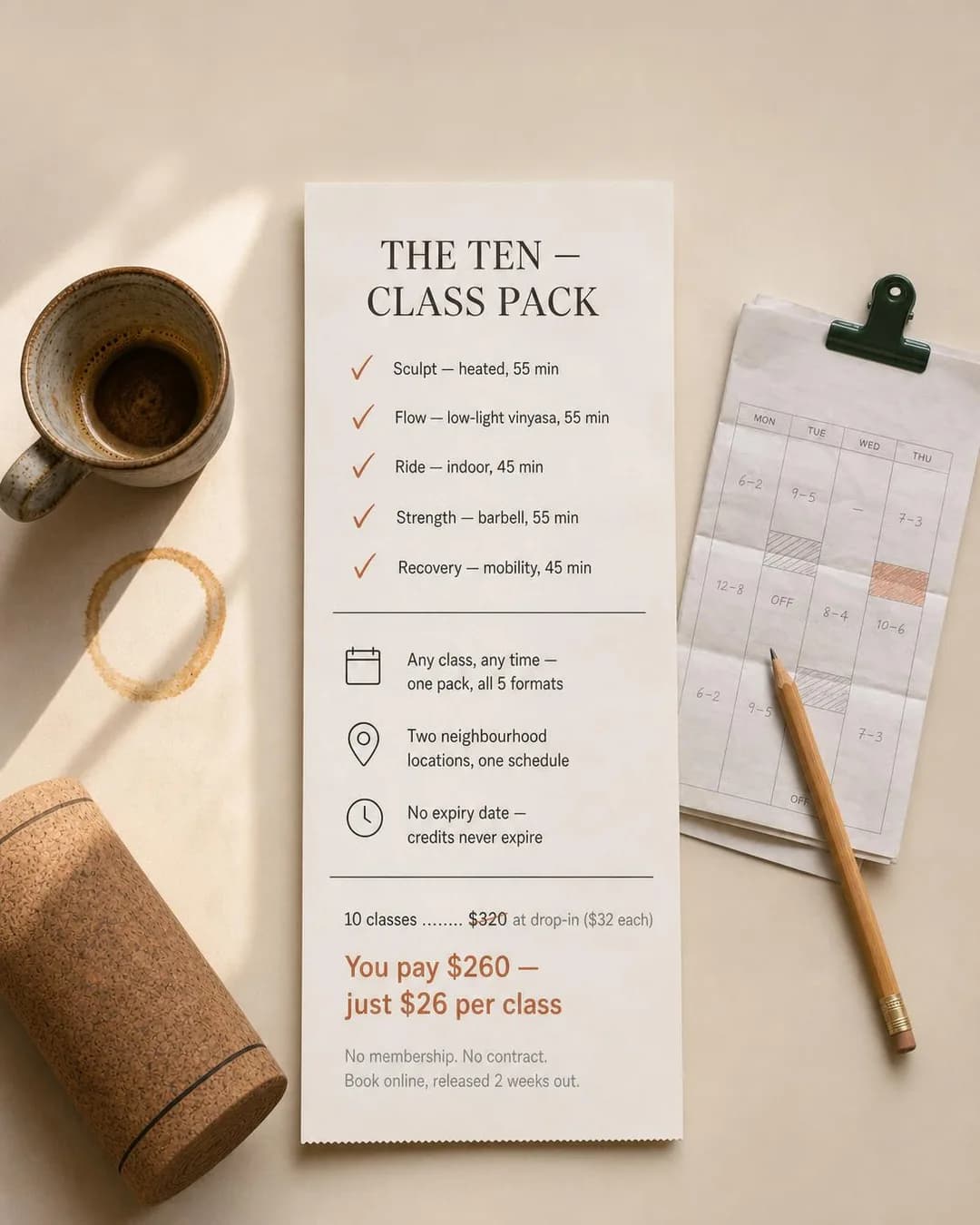 Example adTen classes, five formats, $26 eachSee the brief →
The same coach for a whole block
Awareness- Who it is for.
- Studio — people who have been through four instructors in a term at a big-box class and had the correction they were given in March never come up again.
- Angle.
- Story & Founder POV — Continuity is the claim a two-coach studio can make and a chain structurally cannot, and it is impossible to assert without sounding sentimental. An operator's point of view solves it by producing evidence instead — a loading card with eight weeks of numbers on it — which is the argument in a prop rather than a sentence.
 Example adSame coach. Same group. Eight weeks.See the brief →
The thirty-minute lunch class
Leads- Who it is for.
- Studio — office workers with children, a commute or both, who gave up on the after-work session and have an hour at midday nobody else is asking for.
- Angle.
- Benefit & Outcome — Convenience converts when the obstacle is a calendar rather than a doubt. The specifics do the persuading — starts on the hour, back at the desk by one, showered — and every one of them is a promise the timetable has to keep, including the shower, which is the detail the reader is actually calculating.
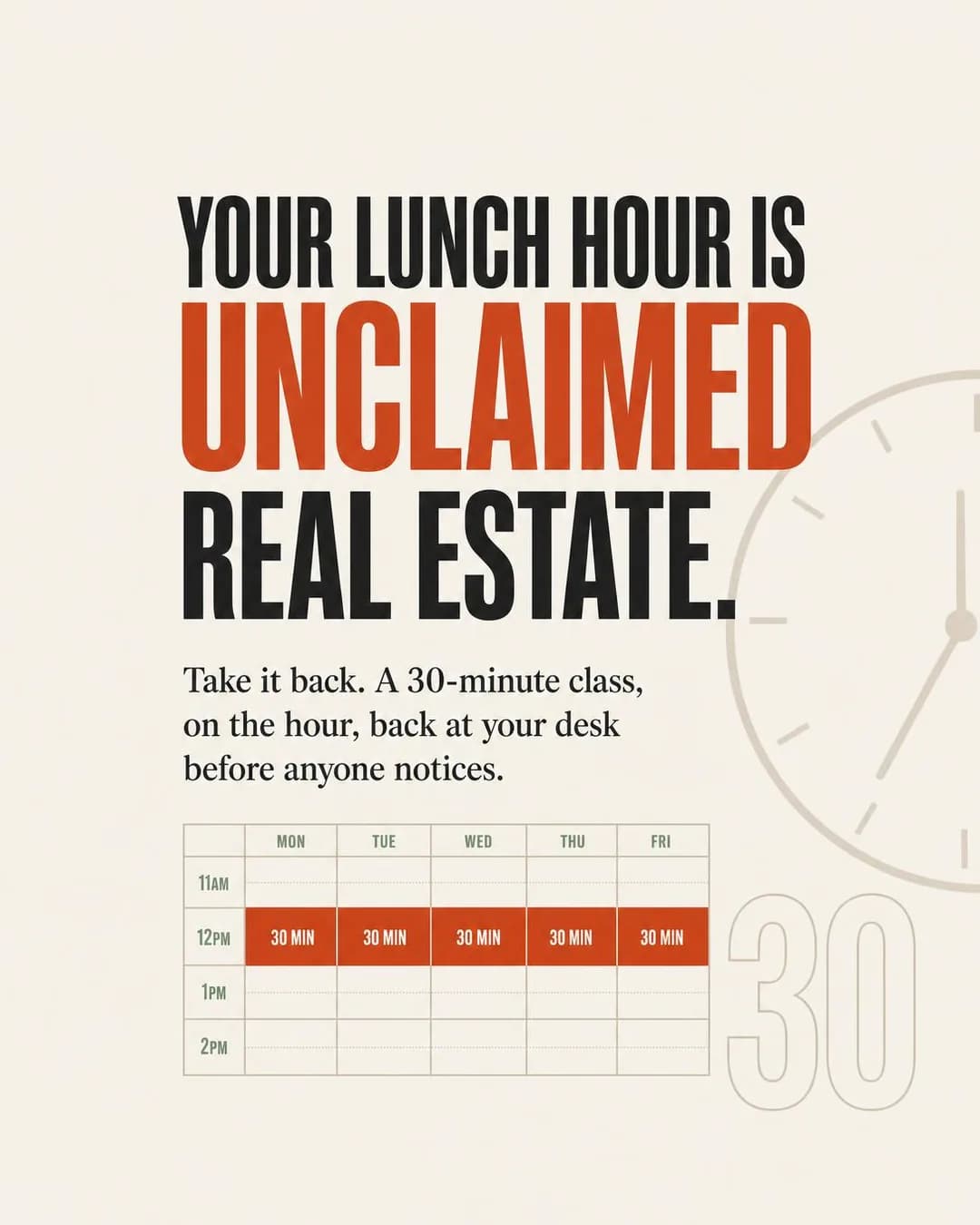 Example ad30 minutes. Back by 1pm. Showered.See the brief →
Published coach qualifications
Leads- Who it is for.
- Studio — people training around an old injury who need to know, before they book, whether the person taking the class has coached a shoulder like theirs.
- Angle.
- Proof & Trust — Expert Authority is usually asserted — certified, experienced, passionate — and assertion is worthless in a category where everyone uses the same words. Printing the years, the rehab background and the specialism next to the name turns the credential wall into the evidence. Fill it with your actual coach; an invented qualification for someone putting hands on an injury is a different order of problem from an invented review.
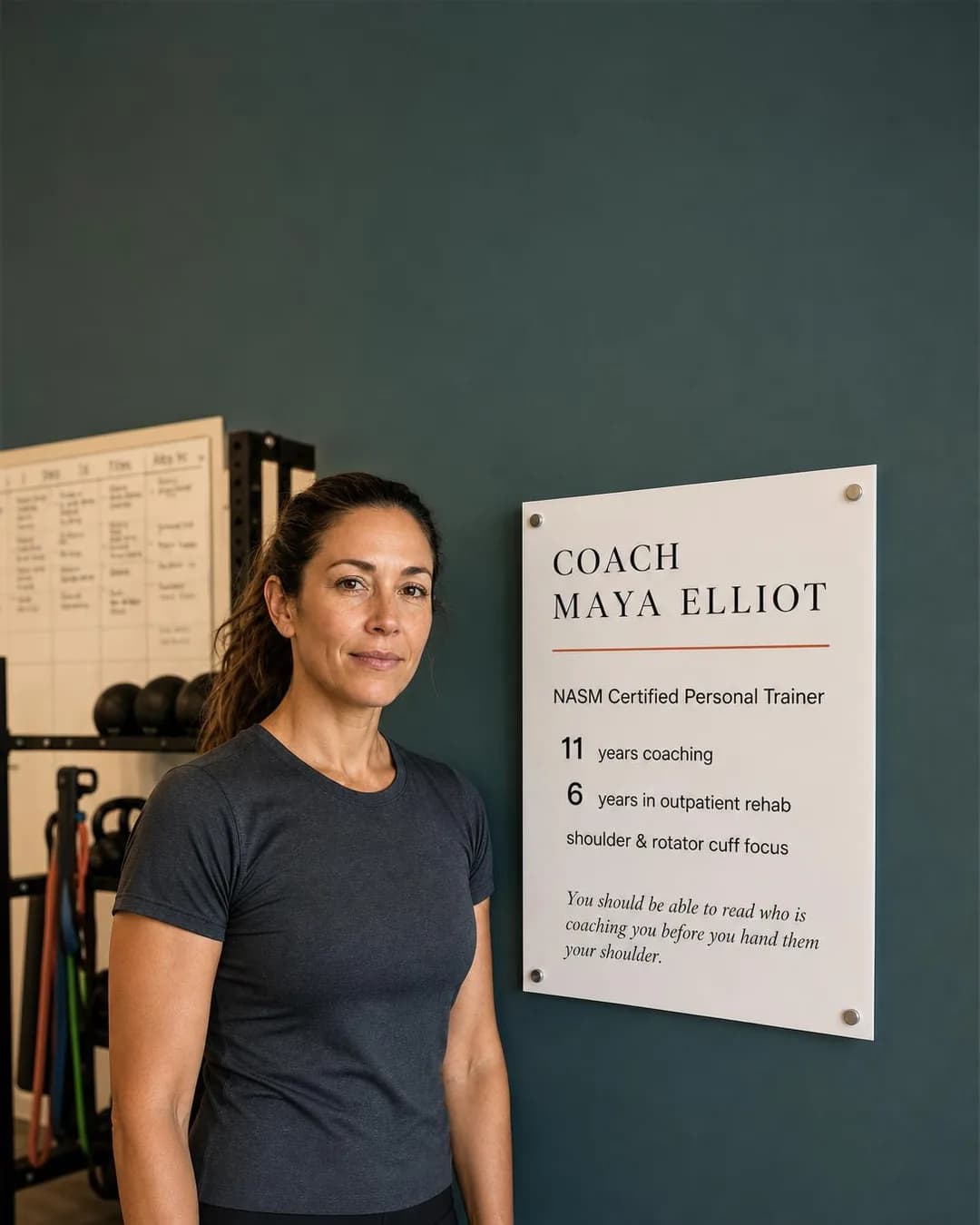 Example adRead her credentials before she coaches youSee the brief →
The strength-over-cardio argument
Traffic- Who it is for.
- Studio or strength gym — people who have run on a treadmill three mornings a week for years and walk past the free weights because that half of the room seems to require knowledge nobody gave them.
- Angle.
- Comparison & Positioning — A contrarian position is the right shape for a reader who has never been given a reason to cross the room, and coaching versus volume is an honest case. It is also the row that went wrong on the Browse page: the brief sold the training and the model sold the body — ‘Same body’ rendered into the image. Make every line about the numbers in the logbook, never about the person in the mirror, and the argument survives intact.
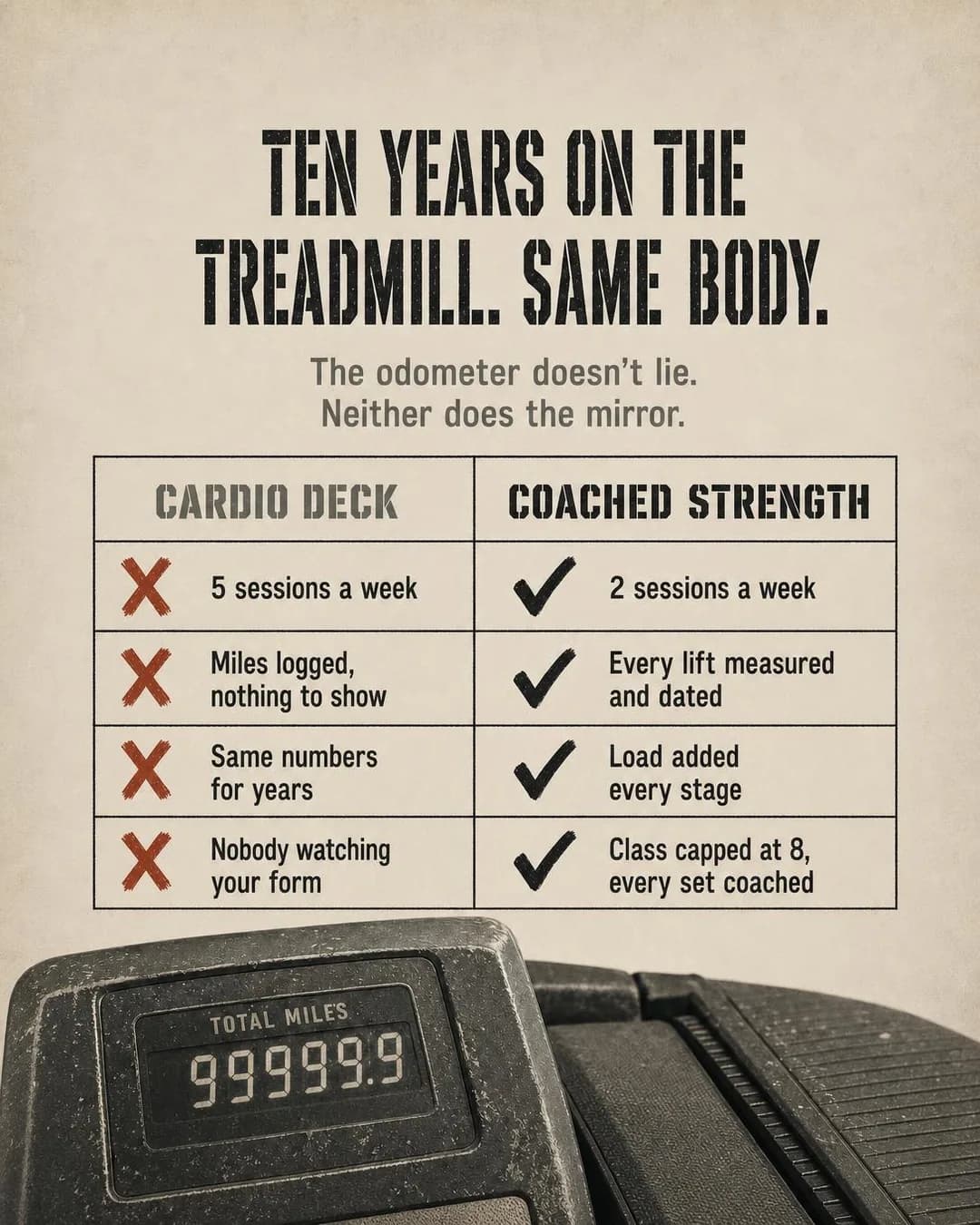 Example adMiles logged. Nothing to show.See the brief →
Cancel in the app, in two taps
Leads- Who it is for.
- Access gym — people still paying for a gym they stopped attending, because cancelling means a phone call, a form and a conversation with someone whose job is to talk them out of it.
- Angle.
- Objection & Risk Reversal — No Commitment only works when it is specific about the mechanism of leaving, and this reader has met the retention script personally. Two taps, no call, no form: that is a description, not a boast. It is also a promise the operations side has to keep — advertise a two-tap cancellation and the cancellation had better be two taps.
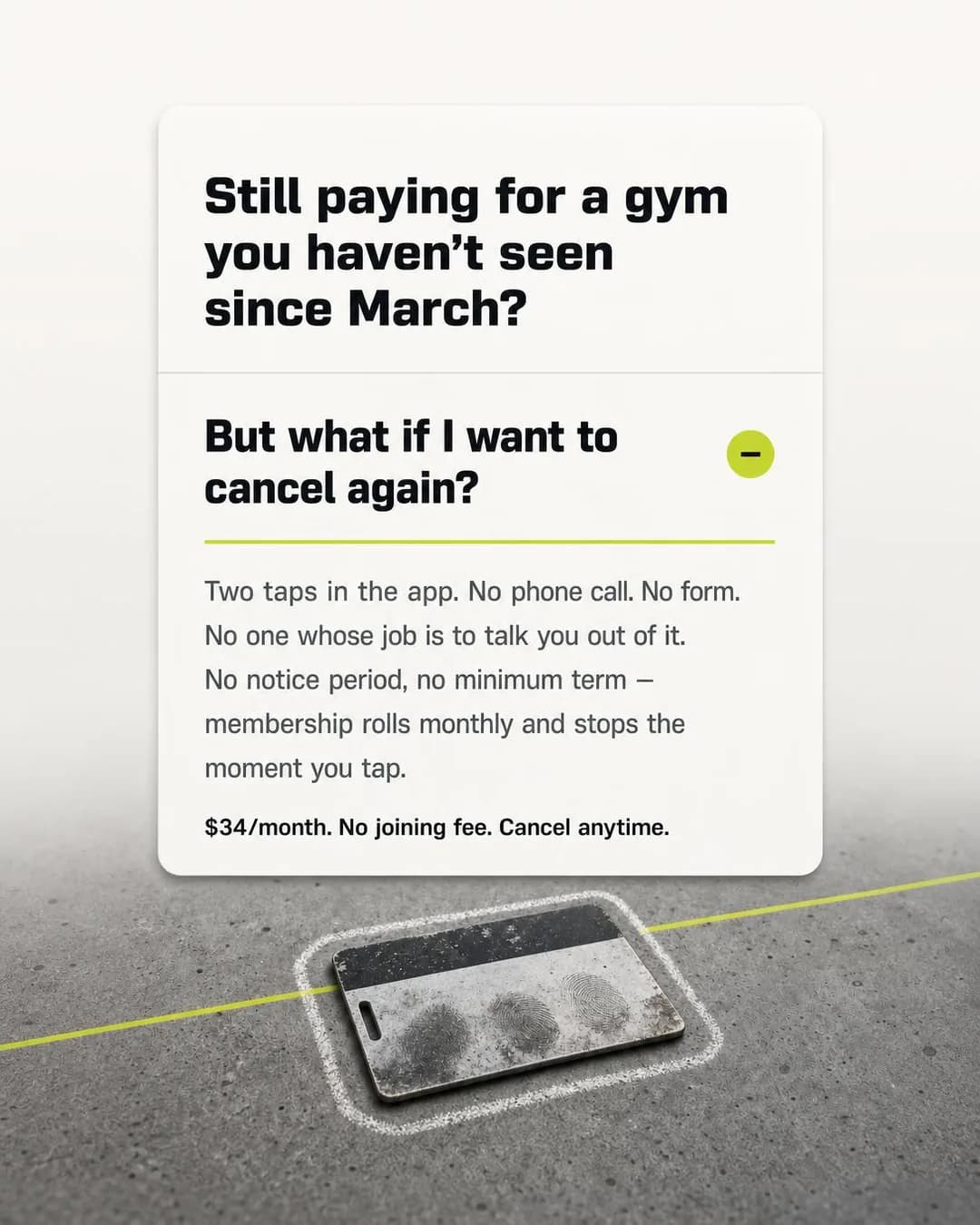 Example adCancel in two taps. No phone call.See the brief →
The rack that is free at six
Traffic- Who it is for.
- Access gym — lifters who train after work, arrive at ten past six, and lose half the session negotiating rest times with a stranger.
- Angle.
- Problem & Pain — Friction works when the reader has stopped counting the cost, and ‘your 45-minute programme is now an hour-ten’ puts a number on it. The fix has to be a thing you can show — doubled racks, a live occupancy counter — which is why it is a Traffic buy: the counter has to be looked at before it means anything.
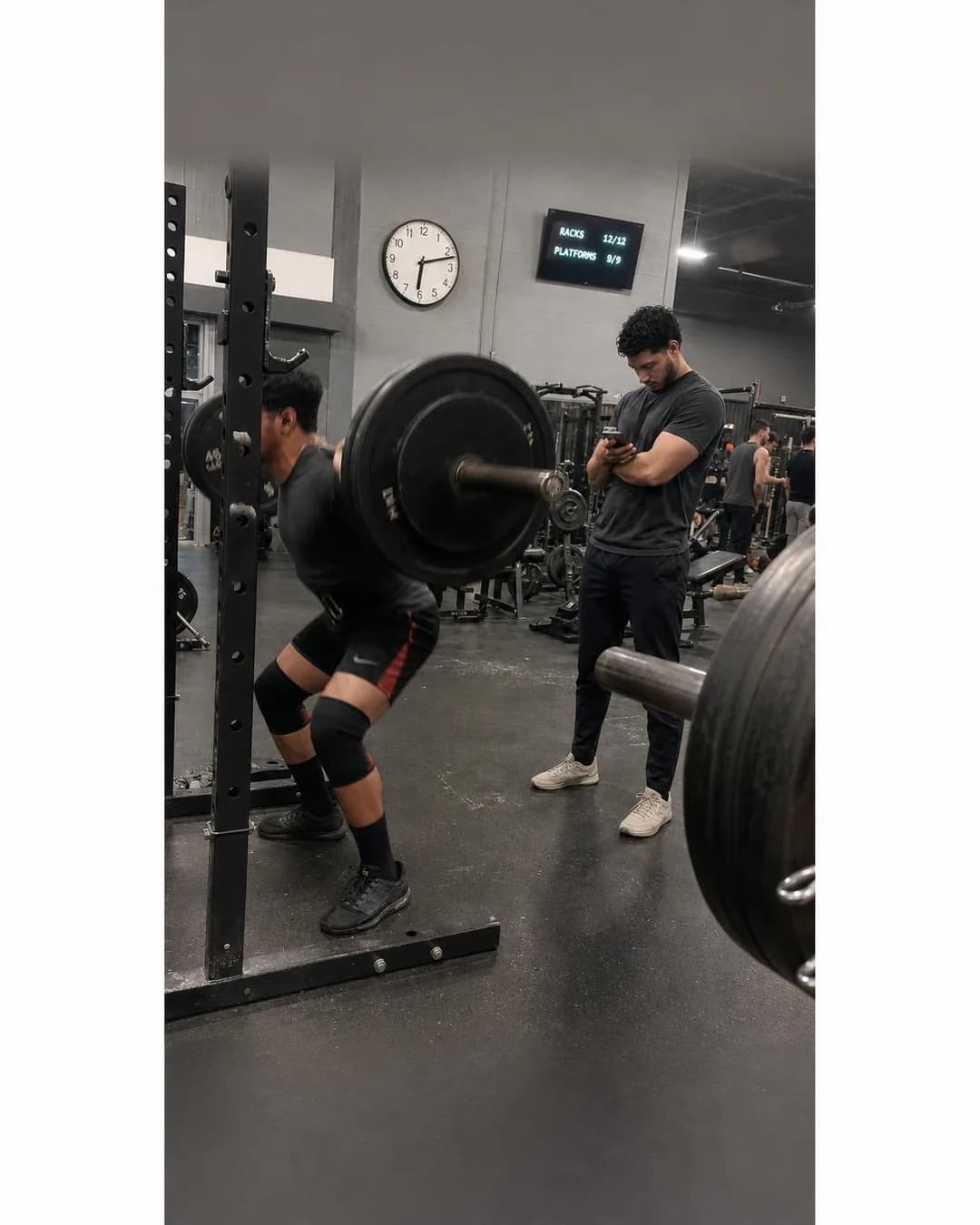 Example adYour squat day isn't a group projectSee the brief →
How 24/7 access actually works
Traffic- Who it is for.
- Access gym — night-shift and early-start workers who have never been able to use a staffed gym and are not sure an unstaffed building at two in the morning is a service or a liability.
- Angle.
- Product & Mechanism — How It Works earns its place when the mechanism is invisible from outside and the hesitation is about the mechanism rather than the price. Three panels — tap, unlock, logged — with the cameras and the call point in the footer, where they reassure without leading on fear. The most under-run ad in the access-gym category, and the one its best audience needs most.
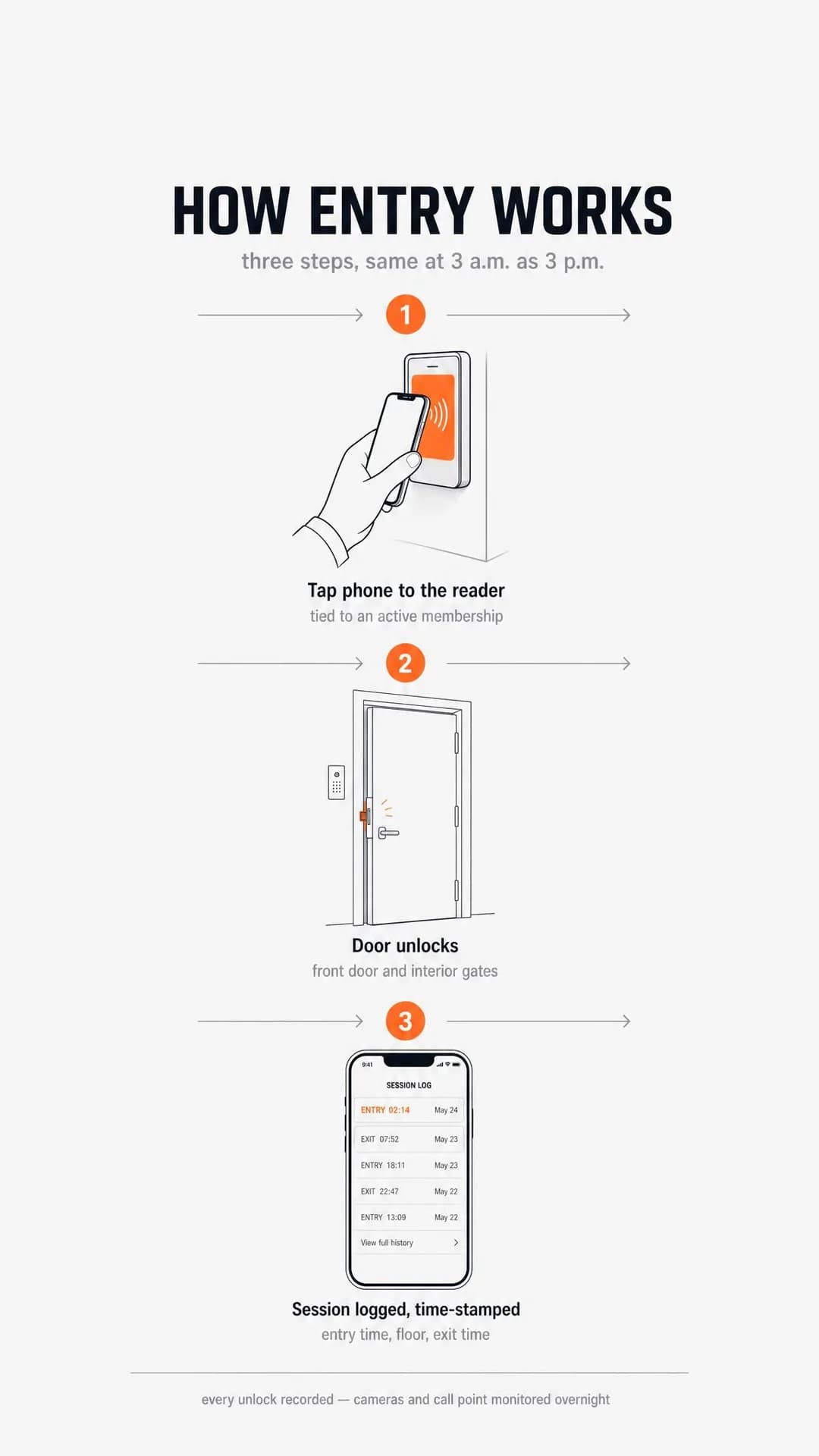 Example adPhone tap, door unlock, loggedSee the brief →
The price lock before January
Leads- Who it is for.
- Access gym — people who have joined in the first week of a year more than once, always at the year's highest price, into the building's busiest six weeks.
- Angle.
- Scarcity, FOMO & Timing — A price increase is the one honest form of urgency a gym has, because it is a fact with a date on it rather than a device. Naming the reader's pattern — same month, same mistake — is more motivating than any discount, and it moves the join out of the January auction, which is the budget section's whole argument.
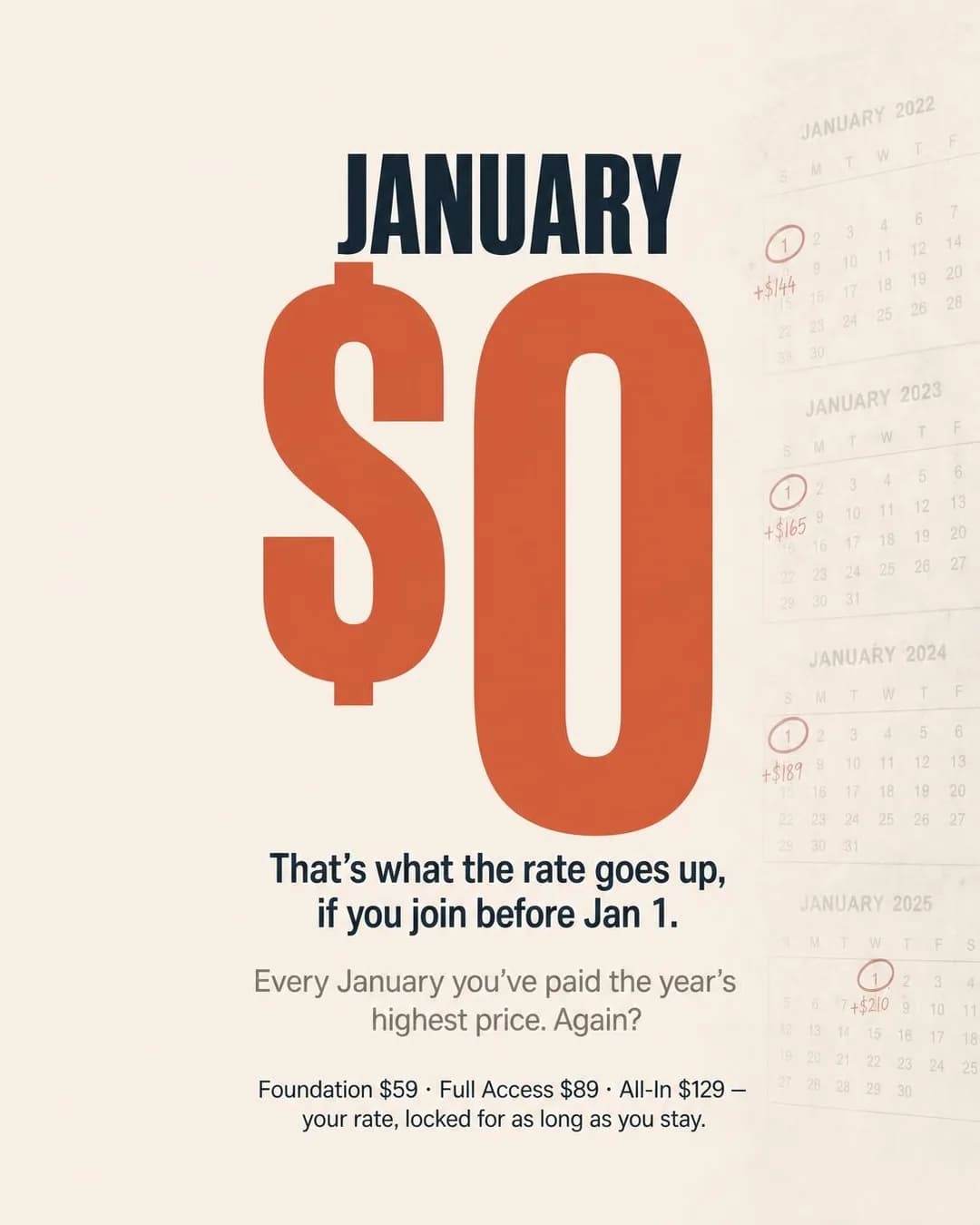 Example adJoin now. Lock your rate. Forever.See the brief →
The quiet re-start
Leads- Who it is for.
- Either — adults who used to train, have not for years, and are held back less by the workout than by a room where everyone else already knows how the machines adjust.
- Angle.
- Identity & Emotion — Relief is the product here; the training is what the other rows are about. ‘You don't have to figure it out in front of anyone’ names a fear that is not about fitness or weight, which is what lets the page's cleanest ad make no claim about the reader's body at all. Four private sessions before the main floor is the mechanism that makes the relief believable.
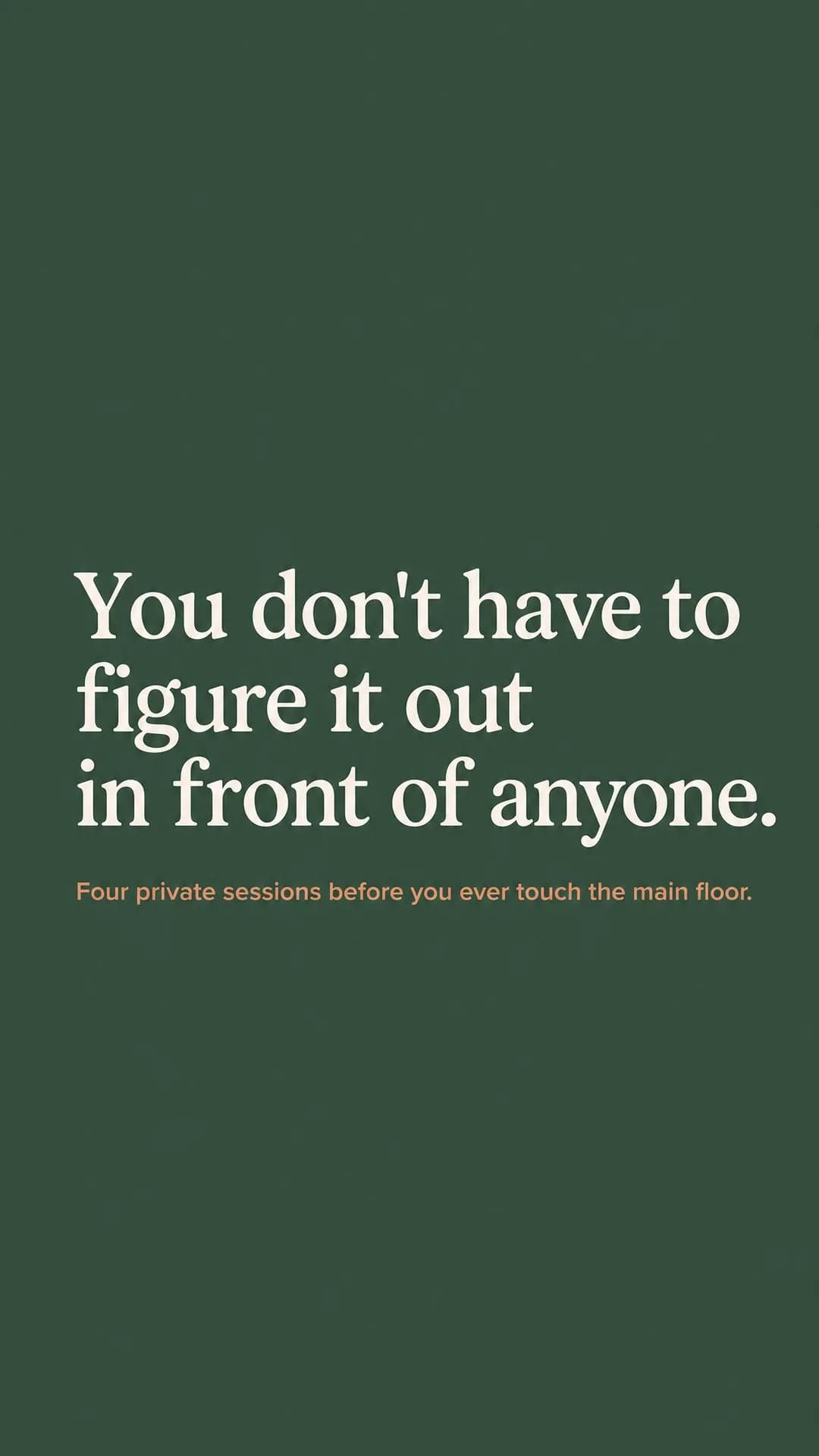 Example adThe confusion happens in privateSee the brief →
The intro offer
Sales- Who it is for.
- Either — someone comparing three places this week who will decide on whichever one lets them try it for the least money and the least commitment.
- Angle.
- Offer & Economics — The most-run ad in the category and the one the batch deliberately left out, because it is only worth anything with a real published price and a real end date — two weeks unlimited for a fixed figure, a first class free, a drop-in at the posted rate. Write it from your price list rather than a template, and keep the terms on the page the button goes to.
No example ad for this offer on the examples page yet.
The off-peak membership
Leads- Who it is for.
- Either — people whose hours let them train at ten in the morning or two in the afternoon, and who are currently paying the full rate to avoid a building they never see full.
- Angle.
- Offer & Economics — The other row the batch skipped, and the access gym's best answer to its own six o'clock problem: price the empty hours, and the reader who can use them qualifies themselves. It needs a real rate and real hours, both on the page the click lands on.
No example ad for this offer on the examples page yet.
Every lever survives — and the ad decides which rulebook the ad set is under
Start with what you keep, because it is everything. Meta's Marketing API accepts exactly four special ad categories — housing, employment, financial products and services, and social issues, elections and politics — and fitness is not among them. So age is yours, the radius is yours down to the API's custom-location floor of 0.63 miles or one kilometre, lookalikes and exclusions are yours. If a guide tells you to leave age open because ‘Meta restricts health advertisers’, it has confused you with a real estate agent, exactly as the dental guides do.
Now the rule that is specific to this trade, and it is conditional, which no other industry on this site is. The Health and Wellness standards say that ‘ads promoting or marketing dietary, health, or weight loss or weight gain products and services must be targeted to people at least 18 years or older’ — and then list what ‘the age targeting restrictions above don't apply to’, which includes ‘products and services marketed for general wellbeing, such as fitness services and equipments, health clubs’. A gym is on the exempt side of that line for as long as its ad is about training, schedule, coaching and access. Put ‘lose weight’ in the primary text and the same gym is on the other side: the ad set must be 18+, and the copy is inside the standards' clickbait clause about exaggerated claims and outcomes promised within a timeframe. Our own examples page first read that as a blanket floor; read in full, it is a floor you choose to stand under by what you write. That is the most practical sentence on this page — the creative sets the targeting rule, so decide which ad you are writing before you open the ad set.
The rule that applies on both sides of the line is the one that caught the Browse page's own output: no ‘statements of inferiority about physical appearance’ — terms, descriptions or questions that are negative about a person's appearance, specific body parts or hygiene. Meta's personal attributes policy adds that an ad may not assert or imply a person's physical or mental health, directly or by implication, so ‘Out of shape?’ fails twice. As with the dentist, the audience brief and the ad copy are two different documents. ‘People still paying for a gym they stopped attending’ is a fine targeting instrument and a fine first line, because it describes a subscription and not a body. ‘Still carrying the January weight?’ describes a body.
Two practical notes. A member list is not protected health information the way a patient list is, so it is a usable seed and a usable exclusion — but Meta's Business Tools terms still prohibit data based on health information, including the names given to events, conversions and custom audiences. ‘Weight Loss Enquiry’ as a custom conversion is the shape that gets flagged; ‘Trial Booked’ is the same event named for what happened. And geography for an access gym is a route rather than a circle: the night-shift reader trains between work and home, so a pin on the building and a pin on the industrial estate two miles away are both your catchment, and a single wide radius is the lazier version of both.
- Special ad categoryNot required
- Fitness is not one of the four. Leave it off — and if a habit from a housing account has it on, you are giving away age, lookalikes and your radius for nothing.
- AgeSet it to the ad
- Exempt from the 18+ floor while the ad sells fitness, schedule and access; mandatory 18+ the moment it markets weight loss. Either way, set the bottom to your membership terms — if you do not admit sixteen-year-olds, do not advertise to them — and band the top to the offer: the lunch class and the re-start programme have different readers.
- RadiusUse it
- The API floor is 0.63 miles or one kilometre. A studio's real catchment is a ten-minute journey and an access gym's is the route between work and home. Start small, add a second pin rather than widening the first, and let delivery tell you when it is too tight.
- Detailed targeting (interests)Rarely
- Inside a two-mile radius the geography is the targeting. A ‘fitness’ interest is mostly people who already have a gym, and layering it on a small radius usually leaves an audience too small to exit the learning phase.
- LookalikesUse it
- Seed from current members or from people who attended a trial — not from everyone who ever filled a form. Unlike a patient list, a member list is a usable seed; mind the names you give the audiences.
- Custom audiencesUse it
- Timetable and pricing page visitors, video viewers, profile engagers, and — the best audience this trade has — lapsed members, who already know where the machines are.
- ExclusionsUse it
- Current members out of every acquisition ad set. The January price lock shown to someone paying ten dollars more than the locked rate is not a lead, it is a complaint, and inside a small radius it will happen on day one.
- Event and audience namesCareful
- Name events for the action — Trial Booked, Pack Purchased — never for the goal. A conversion called ‘Weight Loss Consult’ is flagged as health data whatever the underlying data is.
Instant Form, DM or landing page?
Three answers, and the business decides. For the studio, the honest one is the DM. A boutique studio already lives in Instagram messages — that is where its members ask whether a class is full and whether the 6:15 is beginner-friendly — and Meta's lead ads can send people straight into a conversation on Messenger, Instagram or WhatsApp, with an ‘Instant forms and Messenger’ conversion location that runs one campaign and lets delivery pick the form or the chat per person. The condition is staffing: a click-to-message ad with nobody on the thread for four hours is paid-for silence. If the front desk answers messages inside the hour during opening hours, buy the conversation; if it does not, buy the form.
The form, when you buy it, should be the Higher-intent type. Meta's two Instant Form types differ by one step: ‘More volume’ submits in a thumb movement from pre-filled profile data, ‘Higher intent’ adds a review screen. The review screen is a filter you are paying for deliberately — fewer leads, more of them who remember filling it in when the coach rings — and for a trial class, where the cost of a no-show is a spot somebody else wanted, that is the right trade. Add one question that matters: which class, or which time of day.
For the access gym it is usually a page, for two different reasons. If the join flow completes online, send the click to it and let Sales optimise against the purchase — the cancel-anytime ad and the price lock both want the reader to do the thing now. And the arguments — the unstaffed door, the occupancy counter — need a page to be believed before anyone will hand over a card; a form asks for the commitment before the doubt has been answered. Class packs and intro offers are a checkout, full stop.
Never the homepage. A reader who tapped an ad about four private sessions before the main floor and lands on a rotating hero of a spin class has been asked to start their search again, and the whole point of the ad was that they would not have to.
The recommendation: Studio: a click-to-message ad if someone answers the DMs within the hour, otherwise an Instant Form on Higher intent with one question. Access gym: the online join page, or a landing page for anything that needs to be believed first. Class packs and intro offers: the checkout. Never the homepage.
Creative direction
The rule that decides everything else is one the Browse page learned the hard way. Every one of its ten briefs was written to sell schedule, contract, coaching and access rather than a body, and the single brief that came closest to training outcomes came back with ‘TEN YEARS ON THE TREADMILL. SAME BODY.’ and ‘Neither does the mirror.’ rendered into the image, where no alternate headline can reach it. Steering the brief is not the same as controlling the output, and this is the category where the gap is expensive: that line is the statement of inferiority about appearance the standards name, and it is baked into the pixels. The fix is small and general — ‘same numbers for years’ is about the training, ‘same body’ is about the person. Make every line the first kind, and check the image, not just the copy.
The second rule follows from the targeting section: decide which ad you are writing before you write it. A fitness ad and a weight-loss ad are under different rulebooks and the word that moves you between them is small. The ten Browse ads never use it — not as a dodge, but because the argument a gym can make that a creator cannot is about the building and the timetable, and that argument does not need the word.
Third, the test the cleanest ad on the Browse page passes: would it survive with the photograph removed? A solid-colour card that says ‘The confusion happens in private’ is an ad for a gym with no body in it, and it would comply with rules that catch most of the category. If your ad only works because of what the body in it looks like, it is the genre you cannot run, in a nicer font.
- Sell what the gym has and a creator does not: the contract, the timetable, the rack, the coach, the door. The results claim has been discounted to zero by repetition.
- Every line about the training or the building, never about the reader's body. ‘Same numbers for years’ passes; ‘same body’ does not — and check the rendered image, because that is where it failed.
- Know which rulebook you are in before you write. ‘Weight’ in the ad means an 18+ ad set and no outcomes promised by a date; leave it out and you are a fitness service marketed for general wellbeing.
- Would it survive with the photograph removed? If not, it is the transformation genre in a nicer font.
- Every specific is a promise. Thirty minutes, back by one, showered, two taps to cancel, twelve racks — the timetable, the app and the floor have to keep each of them, or the ad is a refund request.
- If a number, a clock, a calendar or a screen carries the claim, composite it from something real. Three Browse ads rendered their own evidence and all three got it wrong — a session log out of order, a calendar with two 1sts, an occupancy board reading full in an ad about open racks.
- One business model per ad. A studio frame and an access-gym frame share nothing but the word gym, and an ad that tries to be both reads as a chain.
- Real people only. The Browse page's coach portrait and credentials wall are both invented, and an invented rehab qualification on someone who will handle an injured shoulder is not a mock-up, it is a claim.
- Export 4:5 at 1440 × 1800 for feed and 9:16 for Stories and Reels; the aspect-ratio tolerance here is 1% against Facebook's 3%, so a crop a few pixels out passes there and fails here. Skip 1.91:1 — Instagram Feed accepts it, that being the exact maximum ratio in the spec, but the surfaces built for a wide asset are Facebook's.
- Write to 40 characters of headline and 125 of primary text. The Browse page's run does not: one headline is over, at 43, and all ten primary texts are, at 276 to 445. Longer is truncated rather than rejected, so the first sentence carries the ad — on this page that is usually a time of day.
Funnel structure
Three stages, and the third is the one most gyms already own and never advertise to. Cold buys the first visit, warm answers the doubt, and the membership list is both an exclusion and — split into current and lapsed — two audiences that behave nothing alike. Lapsed members are the cheapest acquisition in the building: they know where the machines are, they left for a reason that may have changed, and the re-start ad was written for them before it was written for anyone else.
Keep it this simple on purpose. A single-site gym's budget is small against the evidence Meta's delivery system wants, and every extra ad set divides the same evidence into thinner piles. Variation belongs at the ad level — the studio ad and the access-gym ad live in the same ad set if you run both businesses — not at the ad-set level.
Cold
≈60% of budgetAudience. Radius around the building, a second pin on the commute if you are an access gym, age banded to the offer and to your membership terms, current members excluded.
Running. Two to four offer ads, one business model each. Leads to a form or a message thread; Sales for the class pack; Traffic for the door and the counter.
Warm
≈25% of budgetAudience. Timetable and pricing page visitors, video viewers, profile engagers, people who opened a form and did not submit — the last 30–90 days.
Running. The proof: the coach's card, the credentials wall, the occupancy counter once they have seen it. Leads, or Sales where the join completes online.
Members
≈15% of budgetAudience. Your own list, as two audiences: current members, who are excluded above; and lapsed members, who are the best cold audience you have and are not cold at all.
Running. Win-back and the re-start for the lapsed; the next block, the pack upgrade and the referral month for the current. Seasonal rather than always-on.
Budget and testing, in a trade whose year arrives in January
Do the learning-phase arithmetic before anything else, because it decides how much of Meta's optimisation you are actually buying. An ad set needs roughly 50 optimisation events a week to leave the learning phase; below that it sits in ‘learning limited’, which is not a penalty but is the system saying it cannot optimise with what it has. So take your own cost per booked trial — whatever it genuinely is — and multiply by 50. That is the weekly spend at which one ad set has full information. For a single-site studio the honest answer is usually a fraction of it, and that is the reason the funnel above has three ad sets rather than nine. A studio optimising for pack purchases, or an access gym optimising for online joins, is closer to the line than any other local business in this cluster, because the event is a checkout and not a phone call.
Then leave it alone. Pausing an ad set, or changing its optimisation event, audience or creative, is a significant edit and restarts learning; budget and bid changes can too, depending on size. An account adjusted every morning is an account that never finishes learning, and in a trade where the owner is also the head coach the daily fiddle is the most expensive habit available.
Now the calendar, which matters more here than in any trade on this site except apparel. January is the category's whole year for a lot of gyms, and it is also the most crowded auction of the year, because every gym within your radius has the same idea in the same week. The price-lock ad on the Browse page is the alternative in one image: sell December to the people who would otherwise join in January, at a rate that locks, and you have moved your cheapest joins out of your most expensive month. September is the second peak — the post-summer restart — and the summer dip is real for the access gym and less so for a studio with a midday timetable. Budget should follow that curve rather than sit flat: heavier in the month before each peak, where the auction is quieter and the reader is already deciding, lighter in the peak itself.
Judge the account on attended first sessions, not on leads — and not on joins either, if your cancellation is genuinely two taps. A lead that never turns up cost you a spot somebody else wanted; a January join that cancels in February cost you the acquisition and a refund conversation. The number that tells you whether the ads are working is how many people are still on the floor in week six, by ad, and that is a spreadsheet the front desk can keep.
- Test the offer and the business model, not the headline. Whether a reader wants a cancel-anytime contract or a coach who remembers their squat is the variable with the largest range here.
- One change at a time, with seven days to read it — the learning phase is measured over a week, so anything shorter is noise.
- Read cost per attended first session, not cost per lead. The front desk and the no-show rate are the second half of this funnel.
- Track week-six retention by ad. The cheapest join in January is very often the first cancellation in February.
- Watch the disapproval column as a creative signal. In this category a rejected ad is usually a line about the reader's body that got through the brief.
- Before you blame the creative, check whether the ad set ever left learning. Half of ‘Instagram doesn't work for gyms’ is an ad set that never got the evidence to try.
Six of these ads, in full
Every ad below was generated by best-in-slot for a gym or studio that does not exist, with its audience, angle and objective pinned before the run — and published exactly as it came back. They are six of the Instagram examples for a gym or studio; the rest, with the full brief and the alternate headlines behind each one, are on that page.
Offer & Economics · 4:5 · Sales
Ten classes, five formats, $26 each
Written for: Shift workers who cannot commit to the same weeknight.
The full brief and why it works →
Identity & Emotion · 9:16 · Leads
The confusion happens in private
Written for: Adults who have not trained in several years.
The full brief and why it works →
Objection & Risk Reversal · 4:5 · Leads
Cancel in two taps. No phone call.
Written for: People still paying for a gym they stopped attending.
The full brief and why it works →
Benefit & Outcome · 4:5 · Leads
30 minutes. Back by 1pm. Showered.
Written for: Office workers whose evenings are already spoken for.
The full brief and why it works →
Product & Mechanism · 9:16 · Traffic
Phone tap, door unlock, logged
Written for: Night-shift and early-start workers.
The full brief and why it works →
Proof & Trust · 4:5 · Leads
Read her credentials before she coaches you
Written for: People training around an old injury.
The full brief and why it works →
Mistakes specific to this trade
The first three are the same mistake at three layers — letting the ad be about the reader's body — and between them they account for most of the rejections and most of the wasted spend in the category.
Paying to run the transformation post
The split image with a date stamp is what the category posts for free, and in a paid slot it runs straight into the standards: the before shot is negative about a body, the caption promises the after by a date. A creator can post it; you cannot pay to. Sell the building and the timetable instead, which is also the only message in the feed the reader has not already discounted.
Letting a line about the training become a line about the body
The Browse page's contrarian ad was briefed on coaching versus cardio volume and came back with ‘Same body’ rendered into the image — a statement of inferiority about appearance, baked into the pixels where no alternate headline can reach it. ‘Same numbers for years’ is the identical argument and passes. Check the image, not just the copy.
Saying ‘weight loss’ without moving the ad set to 18+
The Health and Wellness floor attaches to what the ad markets, not to the trade. Fitness services and health clubs marketed for general wellbeing are exempt; an ad that markets weight loss must be targeted to adults 18 and over and is inside the standards' clickbait clause. The word moves you across the line, so decide which ad you are writing before you open the ad set.
Running one ‘fitness’ ad for both business models
An access gym sells a contract and a studio sells a coach, and an ad written to be both reads like a chain. Pick the business per ad, tag it in the brief, and let the ‘who it is for’ line do what the ad set cannot.
Spending the year's budget in January's auction
Every gym within your radius is bidding in the same week for the same reader at the year's highest price. Sell December with a rate lock, spend the month before each peak rather than the peak itself, and let the calendar set the budget rather than a flat monthly figure.
Showing the join offer to current members
Without an exclusion, a two-mile radius guarantees the January price lock is shown to someone paying ten dollars more than the locked rate. That is not a lead, it is a complaint at the front desk, and it will happen on day one.
Publishing an invented coach or an invented client's numbers
Two of the ten Browse ads carry one: a generated coach holding a generated client's loading card, and a credentials wall for a coach who does not exist. The formats are excellent and the fix is five minutes — your coach, your card, a member who agreed to appear. An invented rehab qualification on someone who will handle an injured shoulder is a claim, not a mock-up.
Trusting a rendered counter, calendar or session log
Three Browse ads rendered the object that carried their claim and all three got it wrong: an audit log out of order in an ad about precise logging, a calendar with two 1sts, an occupancy board reading 12/12 in an ad about open racks. If a number, a clock or a screen is the proof, composite it from a real one.
Buying click-to-message with nobody on the thread
A studio's DMs are the right destination only while a person answers them. Four hours of silence after a paid click is the most expensive no-show in the account; if the desk cannot answer inside the hour, buy the form instead.
Advertising cancel-anytime when cancelling is a phone call
Two taps in the app is a description the reader will test on the day they leave, and the review they write afterwards is about the ad, not the gym. Advertise the cancellation you actually have — and if it is not two taps, fix that before you buy the ad, because it is the cheaper of the two.
Counting leads instead of attended first sessions
A booked trial that never turns up cost you a spot somebody else wanted, and the cheapest lead source is reliably the one with the worst show rate. Read attendance by ad, then week-six retention by ad, and the budget allocates itself.
Layering fitness interests on a two-mile radius
The geography is already the targeting, and a ‘gym’ interest is mostly people who already have one. The layered audience is too small to leave the learning phase, which costs more in delivery than the precision was ever worth.
Questions
- Are gym ads age-restricted on Meta?
- Only when the ad markets weight loss. Meta's Health and Wellness standards require ads promoting dietary, health or weight-loss products and services to be targeted to adults 18 and over, and then exempt products and services marketed for general wellbeing — the policy's own examples are fitness services and equipment and health clubs. So a membership sold as training is exempt and the same membership sold as weight loss is not. Fitness is not a special ad category either, so age, radius, lookalikes and exclusions all stay available.
- Can I use before-and-after photos for my gym?
- Nothing in the standards names a gym's before-and-after specifically; the permission they spell out is for cosmetic procedures. What they do prohibit is what the format usually relies on — statements that are negative about a person's appearance or body parts, the close-up pinching a body area, and outcomes promised within a timeframe — and a weight-loss context puts the ad set at 18+. If the image only works because of what the body in it looks like, it is the genre a paid slot cannot carry. Sell the schedule, the coach and the contract instead.
- Which objective should a gym buy?
- Leads for most of it — a trial class, a tour, a re-start session, a rate lock. Sales for a class pack, an intro offer or an access gym whose join flow completes online, because a checkout is the cleanest event the platform can optimise on. Traffic for the arguments that need a page first, such as how an unstaffed door works. The ten ads on our gym examples page were pinned 5 Leads / 3 Traffic / 1 Sales / 1 Awareness, which is where this trade sits between local services and ecommerce.
- Instant Form, DM or landing page?
- A boutique studio that answers its Instagram messages within the hour should buy the conversation — Meta's lead ads can send people straight into Messenger, Instagram or WhatsApp. One that cannot should use an Instant Form on the Higher-intent type, which adds a review step and filters the no-shows. An access gym should send the click to the online join page, or to a page for anything that has to be believed first. Packs and intro offers go to the checkout. Never the homepage.
- Instagram or Facebook for a gym?
- Instagram reaches 80% of adults aged 18 to 29, 62% of 30- to 49-year-olds and 40% of 50- to 64-year-olds; Facebook reaches 68%, 80% and 74%. A boutique studio's core member is in the first band, so this app leans studio; an access gym's membership spreads across all three and its cancel-anytime, price-led half skews older, so the Facebook twin of this page leans access gym. A gym that is both should expect the two platforms to fill different halves of the floor.
- How much should a gym spend, and when?
- Multiply your own cost per booked trial by 50 for the weekly spend at which one ad set is fully out of Meta's learning phase, and be honest about what fraction of it you can afford — that is why the funnel here is three ad sets and not nine. Then follow the calendar: January is the category's peak and its most expensive auction, so sell December with a rate lock, spend the month before each peak rather than the peak itself, and judge the result on attended first sessions and week-six retention, not on leads.
- Do these ads work for a boutique studio or a 24/7 gym?
- Both, and each section above says which it is talking to. The two are the same trade with opposite offers — a coach, a capped room and a class pack against a contract, a door and a price — so the offer rows are split five to the studio, four to the access gym and three to either, and the Browse page labels each of its ten ads the same way.
Sources
Every platform claim on this page was read against these on . Meta’s policies move; if one of these disagrees with this page, it is right and we are stale.
- Meta Advertising Standards — Health and Wellness (18+ targeting for weight-loss services; fitness services and health clubs marketed for general wellbeing exempt; prohibited claims)
- Meta Advertising Standards — Privacy Violations and Personal Attributes
- Meta Marketing API — special ad categories (fitness is not one)
- Meta Marketing API — basic targeting reference (custom location radius: 0.63–50 miles, 1–80 km)
- Meta for Business — lead ads that click to message (Messenger, Instagram, WhatsApp; the Instant forms and Messenger conversion location)
- Meta Business Help Centre — choosing Ads Manager advertising objectives
- Meta Business Help Centre — about the learning phase
- Meta Business Help Centre — significant edits and the learning phase
- Meta Business Help Centre — about Instant Form types
- Meta Business Help Centre — about sensitive health information (event and audience names)
- Meta ads guide — image ad specifications, Instagram Feed
- Pew Research Center — Americans' social media use, November 2025
That is the playbook. Now make the ads.
Paste your site. It reads your timetable, your memberships and your coaches, then writes the concepts, renders the images and drafts the copy — for a category where the image can break a rule the copy never mentions.
No credit card · 50 free credits (about 5 ads or Instagram posts)
Every angle recommended above is documented in the best-in-slot ad angle library, and the ads are from gym and fitness studio instagram ad examples. More industries are at all ad guides.