
Ad Examples · Gyms & Fitness Studios × Instagram · 10 ads
Gym and fitness studio Instagram ad examples
Ten finished ads for gyms and studios — with the audience, angle and objective behind each one, because we generated them rather than collected them.
Search for gym ad examples and the results are one genre wearing ten different logos. A split image with a date stamp. A number on a scale. A body shot with a caption about who somebody used to be. The category advertises its results because results are what it sells, and the effect after a few thousand impressions is that a reader scrolls past all of it — including yours. There is also a problem with that playbook that almost nobody running a gym has been told: most of it is not available to you in a paid slot.
Meta's advertising standards require that ads marketing dietary, health, weight-loss or weight-gain products and services be targeted to adults 18 and over — fitness services and health clubs marketed for general wellbeing are exempt, so the floor attaches to what the ad says rather than to the trade — and they prohibit statements of inferiority about physical appearance, the close-up on a body part, and sensational claims promising an outcome inside a set timeframe. A creator posting the identical transformation image organically is under none of those constraints. So a gym on this platform is competing against content it is not allowed to copy — which sounds like a disadvantage and is closer to an instruction.
Every one of the ten ads below was therefore briefed to sell something other than a body: a contract you can cancel in two taps, a rack that is free at six o'clock, a class pack that never expires, the same coach for a whole eight-week block, four private sessions before you touch the main floor, a door that opens at two in the morning, a lunch hour nobody else has a claim on, a rate that locks before January, a coach's rehab background printed on the wall. Five of the briefs are for a boutique studio and four for a 24/7 access gym, because those are two businesses sharing one trade and one URL, and a page that quietly served only one of them would be a page for half its readers.
They were not collected. Each was generated with the audience, the angle and the objective chosen up front, so the brief printed beside an ad is the brief that produced it rather than a description written afterwards about somebody else's work. The gyms are invented — ten of them, an unstaffed 24/7 building, a twelve-cap strength studio, a shift-worker class pack, none of them real — so no operator's creative is borrowed and no member's face is used. Nothing was edited after the fact: the image, the body text, the headline and the alternates under each ad all came out of one run and are printed exactly as they arrived.
One of the ten was produced twice, and the distinction is worth stating plainly. The batch ran in a single pass and nine came back; the tenth failed outright when the model returned malformed JSON, and a second run regenerated it. That produced an entirely new ad — a new concept and a new image, not a repair of a broken one — because this pipeline resumes at the level of a sample rather than a step. So one ad below is a second attempt after a crash. None is a second attempt after a first one we did not like, which is the distinction that keeps the rest of this page honest.
And it is worth knowing what that honesty costs before you scroll, because two ads here should not be run as they stand. One carries a coach's face and a client's training numbers that were both invented. The other is the reason this whole page exists: it is the single brief that came closest to training outcomes, and the model found its way back to the reader's body anyway — “Ten years on the treadmill. Same body.” rendered straight into the image, which is exactly the statement about physical appearance the standards prohibit. Steering the brief is not the same as controlling the output. In this category that gap is the whole job, and the notes below say which side of it each ad landed on.
What changes because it is Instagram
Start with the thing that makes this trade different from every other one on this site: the feed is already saturated with your category, and almost all of it is the one genre you are not allowed to imitate. Fitness content on Instagram is transformation content — the split image, the number on a scale, the caption about who somebody used to be. Meta's advertising standards rule most of that out for a paid slot. Ads promoting dietary, health, weight-loss or weight-gain products and services must be targeted to adults 18 and over — a floor that attaches to what the ad markets rather than to the trade, because the same standards exempt fitness services and health clubs marketed for general wellbeing, so a gym stands under it the moment its ad sells weight loss and not before; “statements of inferiority about physical appearance” are prohibited outright; so is the close-up on a body area by pinching fat; and so is sensational language promising a specific outcome inside a set timeframe. A creator posting the identical image organically is under none of those constraints. You are competing with content you cannot legally copy.
Which is why not one of the ten briefs below sells a transformation. They sell the things a gym actually has that a creator does not: a contract you can cancel in the app, a rack that is free at six o'clock, a class pack that does not expire, the same coach for a whole block, a door that opens at four in the morning, a coach whose qualifications are on the wall. That is the compliant playbook and, on the evidence of the category, the better one — everybody else is already shouting about results, and the reader has learned to discount it.
The second thing Instagram decides is which of the two businesses you are. One URL covers a 24/7 access gym selling on price, convenience and cancel-anytime, and a boutique studio selling class packs on community, instructor and schedule — the same trade with opposite offers. Pew's November 2025 survey puts Instagram at 80% of adults aged 18 to 29, 62% of 30- to 49-year-olds and 40% of 50- to 64-year-olds, against Facebook's 68%, 80% and 74%. The studio's core member sits in the first band and the access gym's spreads across all three, so this app leans studio and the Facebook twin of this page will lean access-gym. Both are represented below rather than one quietly standing in for the other.
Third, and unusually for a local business: none of this is a special ad category. Health and fitness is not among the four Meta accepts — housing, employment, financial products and services, and social issues — so a gym keeps every targeting lever a real estate agent loses. Age is yours, a three-mile radius is yours, lookalikes and exclusions are yours. That matters more here than almost anywhere, because a gym's entire addressable market is people who will physically walk in, and unlike the housing pages in this cluster you can actually buy that shape.
Finally the shapes, and one number worth knowing. Meta recommends 4:5 at 1440 × 1800 for Instagram Feed — identical to Facebook Feed, so a single export serves both — but the aspect-ratio tolerance here is 1% against Facebook's 3%, so a crop a few pixels out of true passes there and not here. Eight of the ads below are 4:5 and two are 9:16 for Stories and Reels, and none is 1.91:1 — which is a choice rather than a rule, and a correction to what this page said before 7 September 2026. Instagram Feed's technical requirements accept aspect ratios from a minimum of 4:5 to a maximum of 1.91:1, so a landscape asset is not out of bounds here; it is simply not what Meta recommends, and the surfaces built to want one — Facebook's right-hand column and search results — are on the other app, which is where our own publisher routes that export. The Facebook twin of this page is where you can see the shape.
Source: Meta Advertising Standards — Health and Wellness (18+ targeting for weight-loss services; fitness services and health clubs marketed for general wellbeing exempt) · Meta Advertising Standards — Privacy Violations and Personal Attributes · Meta Marketing API — special ad categories (health and fitness is not one) · Meta ads guide — image ad specifications, Instagram Feed · Pew Research Center — Americans' social media use, November 2025
Want the campaign, not just the creative? Instagram ads for gyms and fitness studios → is the playbook these ads came out of: which objective to buy, the offers worth running, the targeting levers this trade keeps, and the policy that decides what the copy may say.
Generate ads for your own gym or studio
Paste your site and best-in-slot reads it the way these invented gyms were read — timetable, memberships, coaches, positioning — then writes the concepts, renders the images and drafts the copy. Free to start, no card.
The Phantom Membership
LeadsStill paying for a gym you haven't seen since March?
- Audience
- People still paying for a gym they stopped attending — Signed a twelve-month contract in a January, went for six weeks, and have been paying ever since because cancelling means a phone call, a form and a conversation with someone whose job is to talk them out of it.
- Angle
- No Commitment (Objection & Risk Reversal) — Emphasizes cancel-anytime, no contract, or no long-term obligation.
Still paying for a gym you haven't seen since March? You're not lazy. You're just locked into a membership that makes leaving harder than staying. Two taps in the app cancels here. No phone call. No form. No retention script. $34/month, cancel whenever you decide you're done.
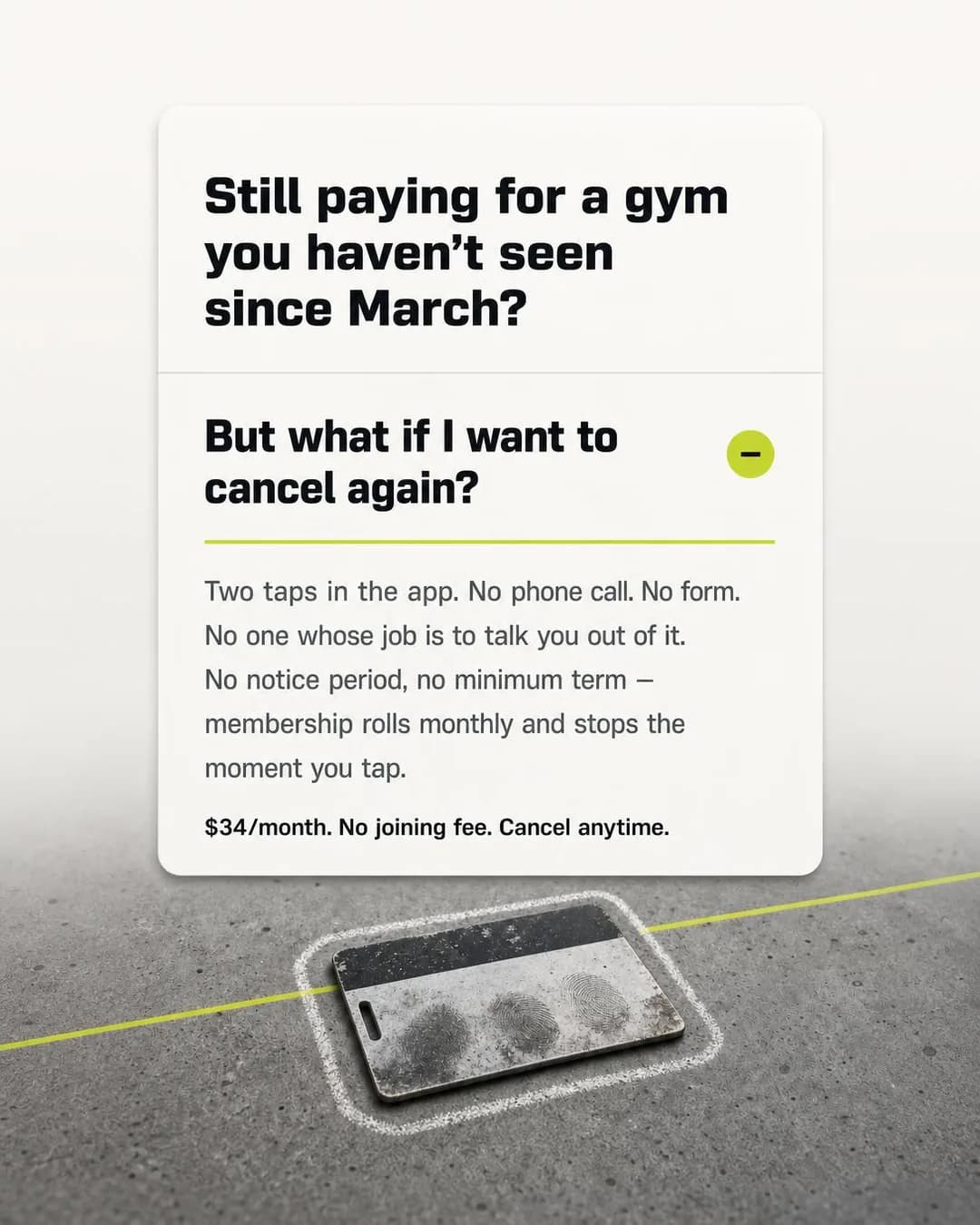
Cancel in two taps. No phone call.
24/7 access. Cancel anytime.
The objection this ad answers is not price and not equipment — it is the memory of the last cancellation. No Commitment only works when it is specific about the mechanism of leaving, and this one is: two taps, no phone call, no form, and “no one whose job is to talk you out of it.” That last clause is the whole ad. Everybody who has cancelled a gym membership has met that person, and naming them is what makes the promise land as a description rather than a boast. Notice the FAQ question the run chose to answer: not “can I cancel?” but “but what if I want to cancel again?”, which quietly presumes a reader who has been burned before and is the sharpest line in the batch.
The image is the batch's best joke and worth looking at properly — a worn access fob lying on concrete inside a chalk outline, the dead membership as a crime scene. It is doing the concept's work rather than decorating it. Two things to weigh before running anything like it. The headline is a second-person question (“Still paying for a gym you haven’t seen since March?”), which is the exact grammatical shape the dentist page in this cluster warns about — the difference is that it asserts a fact about a subscription rather than about a body, so the personal-attributes policy is not in play. Keep that distinction: the form is only a problem when the thing being asserted is a person's health, appearance or financial standing. And “since March” is a specific month that reads as intended for about a quarter of the year; the $34 and the no-joining-fee are invented and are yours to replace.
Other headlines from the same run
- $34/month. Leave whenever you want.
- No contract. No notice period. Done.
- The gym that actually lets you leave
- Train now. Cancel later. No drama.
Call to action
The whole ad argues that joining is low-risk because leaving is easy, so the button should let them act on that in one step. Learn more is the right swap if the cancellation terms need a page to be believed, which for this specific reader is a fair bet. Avoid Subscribe — Meta's Subscribe button is built for content subscriptions and sets the wrong expectation for a rolling membership.
The Stranger Split-Set Shuffle
Traffic6:10pm: your squat day just became a group project.
- Audience
- Lifters who train after work and lose half the session queuing — Arrive at ten past six, find every rack taken, work in with a stranger or rearrange the whole session around what is free, and are home an hour later than the workout actually needed.
- Angle
- Friction / Annoyance (Problem & Pain) — Focuses on an irritating part of an existing workflow, routine, or product experience.
6:10pm: your squat day just became a group project. You're negotiating rest times with a stranger, syncing phone timers, and explaining your warm-up sets like you're co-parenting a barbell. Your 45-minute program is now an hour-ten because every rack is a timeshare. We doubled our rack count to 12 and publish live occupancy every 90 seconds so you never walk into this again. Check the counter before you leave the house. $89/month, zero wait.
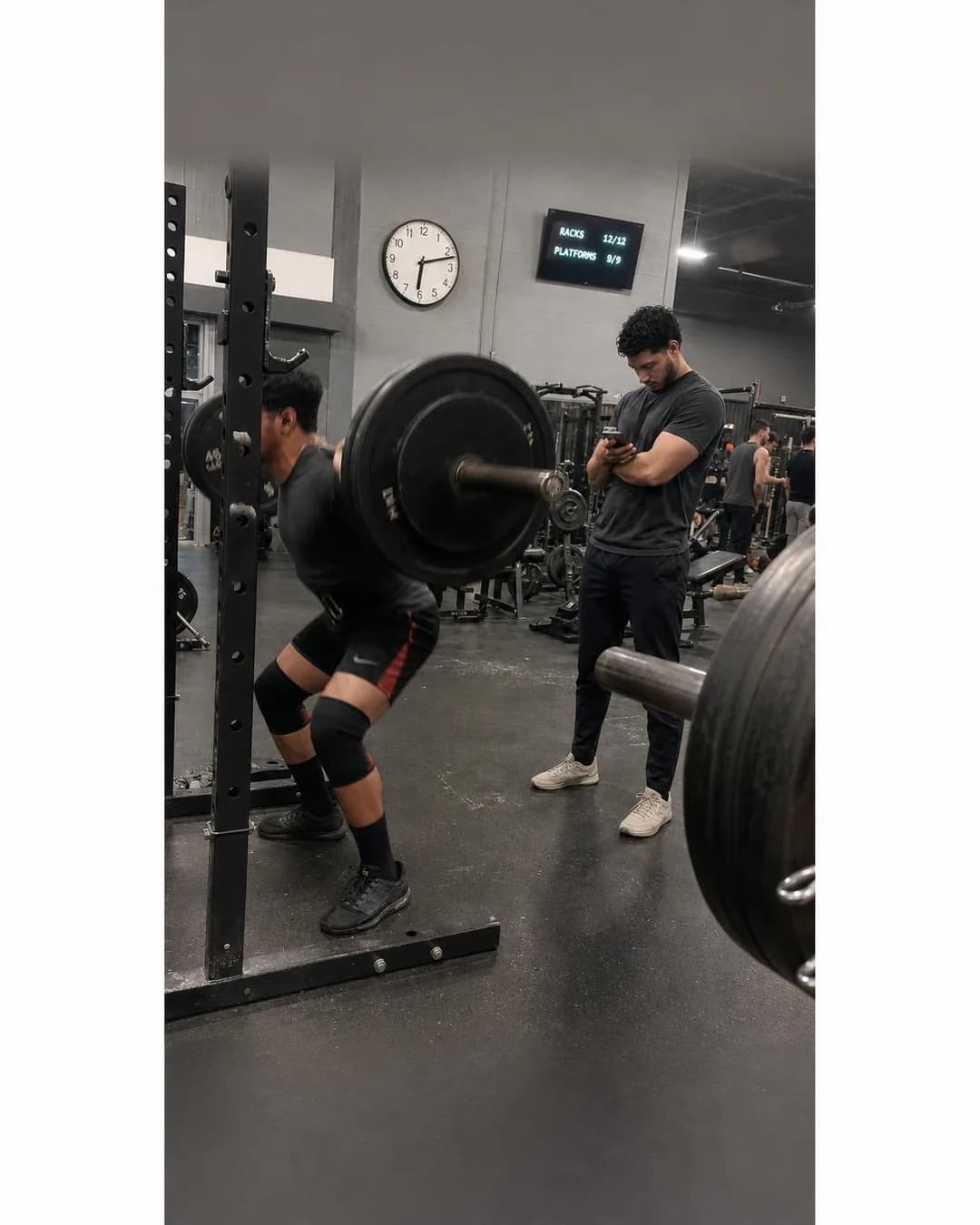
Your squat day isn't a group project
Check occupancy before you leave
Friction & Annoyance works when the reader has stopped noticing the friction, and the run found a sharper version of it than the brief did. The brief said the six o'clock queue; the copy came back with what the queue actually costs — “you’re negotiating rest times with a stranger, syncing phone timers, and explaining your warm-up sets like you’re co-parenting a barbell.” Nobody who lifts after work needs that explained, and “your 45-minute program is now an hour-ten because every rack is a timeshare” puts a number on a cost people absorb without counting. The register is right too: this is the Raw Phone Pic direction and it genuinely reads as one — a slightly blurred lifter mid-set, a bystander with folded arms and a phone, the flat overhead light of a real gym at peak hour. Nothing about it looks commissioned, which is the entire point of that style.
And then the same defect the other two rendered-object ads on this page have, which by the third instance is a pattern rather than bad luck. The wall display reads RACKS 12/12 and PLATFORMS 9/9 — in an ad whose solution is a live counter showing open racks, the counter is showing the gym full. The clock behind the lifter reads about half past six while the copy opens at 6:10pm. Both are the kind of thing nobody notices in a feed and everybody notices in a screenshot, and both point at one rule for this whole category of ad: if a number, a clock, a calendar or a screen is going to carry your claim, composite it in from something real rather than asking for it in the prompt. The photograph is excellent. The two objects inside it that were supposed to prove the point are the two that contradict it.
Other headlines from the same run
- 12 racks. Zero negotiations.
- Know before you go. Train solo.
- Stop splitting racks with strangers
- Live counter. Open racks. Your time.
Call to action
Traffic, and correctly — the promise is a live occupancy counter, which is a thing you have to go and look at before it means anything. Send them to it. Sign up is the swap once somebody has seen the counter and believed it, which is a better retargeting audience than a cold one, and Contact us suits a gym whose real answer to the six o'clock problem is a conversation about off-peak rates.
The Receipt Breakdown
SalesTen classes, five formats, zero expiration — $26 each, add it up.
- Audience
- Shift workers who cannot commit to the same weeknight — Want to train three times a week and cannot say which three until the rota goes up on a Thursday, so every unlimited membership they have bought has been a standing charge for classes they could not attend.
- Angle
- Value Stack (Offer & Economics) — Itemizes everything included and frames the combined value against the purchase price.
Your rota changes every week. Your workout shouldn't have to. Ten classes. Five formats. Use them when you're free — strength on a Tuesday, recovery on Sunday, or three rides in one week if that's what the schedule allows. $260 for the pack, $26 per class, and the credits never expire. No membership. No monthly charge. Just movement that fits around shift work, not the other way around.
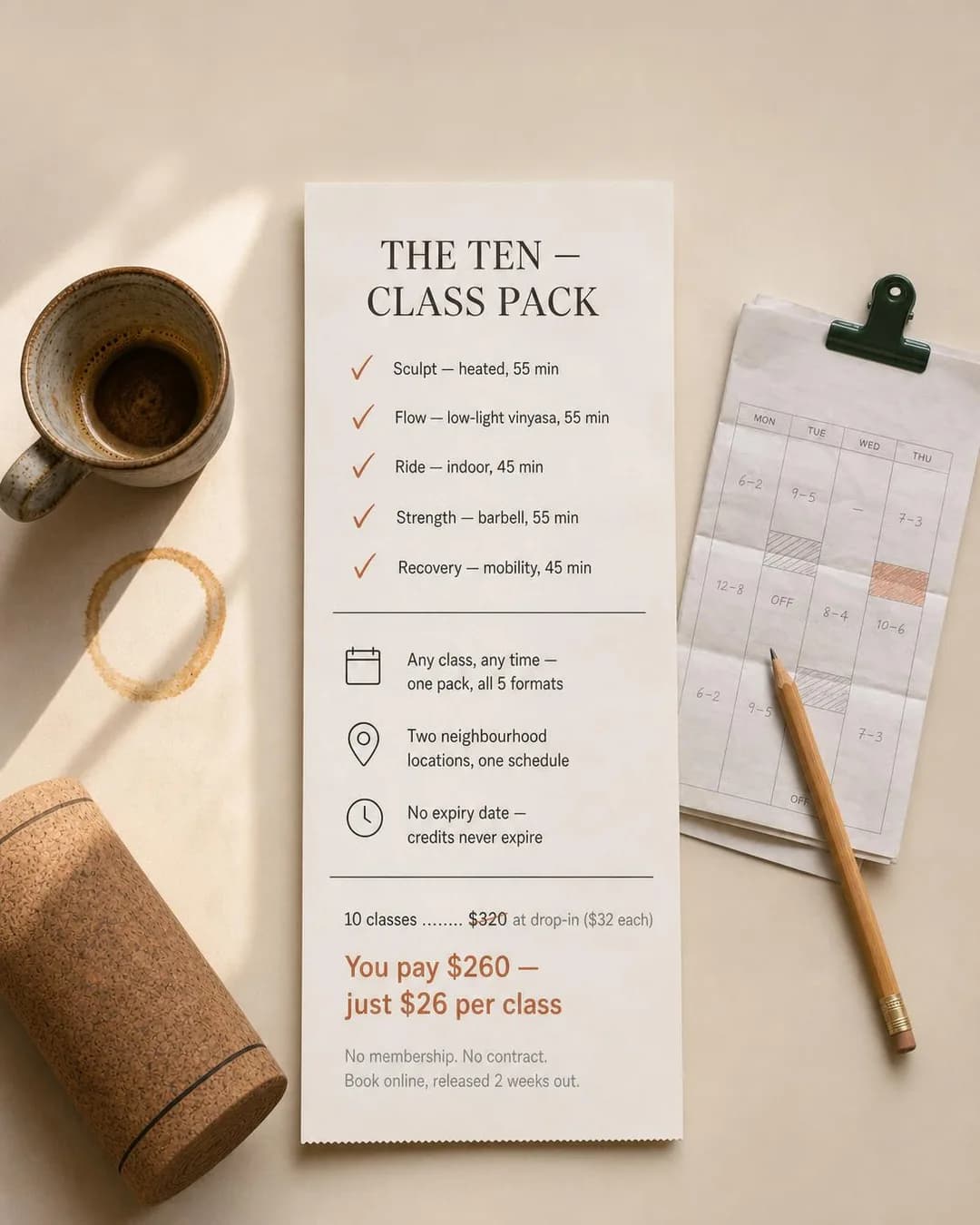
Ten classes, five formats, $26 each
Book when your rota clears
Value Stack is usually the laziest family in the library — a list of things you get, each with a fake dollar value beside it. This one earns it by making the stack a receipt and letting the arithmetic be checkable, which is the difference between a claim and a proof. Every number foots: ten classes at the $32 drop-in rate is the $320 struck through, $260 is what you pay, and $260 across ten is the $26 per class in the coloured line. That is rarer in rendered output than it should be — the comparison table on the real estate page in this cluster does not foot — and it is the first thing to check before you run any ad built on a sum.
The object beside the receipt is the better half. It is a shift rota on a clipboard — MON to THU, 6–2, 9–5, 12–8, OFF, 8–4 — with the awkward cells shaded, which is the audience brief rendered as a thing rather than described in a sentence. A shift worker who cannot say which three nights she is free until Thursday does not need to be told that credits never expire; she needs to see her own week on the table next to the offer. One tension worth naming, because it cuts against this page's own argument: warm wood, a coffee ring and a cork roller is precisely the boutique-wellness idiom that the note above calls camouflage. What saves it is that the thing in the middle of the frame is a receipt doing arithmetic, not a body. Change the object and this becomes a very expensive stock photograph.
Other headlines from the same run
- No expiry. No membership. Just $26/class
- Shift work-friendly. Credits never expire
- $260 for ten classes across all formats
- Buy once. Use anytime. $26 per class
Call to action
The one ad in this batch pinned to a Sales objective, and correctly — a class pack is a fixed-price thing genuinely bought in a browser, unlike a membership, which is signed. Send it to a checkout. Sign up is the swap if packs are only purchasable inside an account, and Learn more if the timetable is doing more of the persuading than the price is.
The Handwritten Card
AwarenessI still have the card from your first squat.
- Audience
- People who have cycled through four instructors in a term — Have been to the big-box class where a different name is on the board each week, nobody knows what they did last session, and the correction they were given in March never came up again.
- Angle
- Employee / Operator POV (Story & Founder POV) — A team member, specialist, operator, or insider explains how the company thinks or works.
I still have the card from your first squat. Depth below parallel, watch left shoulder. That was week one. By week eight you added forty-five pounds and fixed the hitch. I know because I wrote it down every session. That's what happens when the same twelve people train with the same coach for eight weeks straight. No rotation, no strangers, no starting over. Foundations Block starts in three weeks. Twelve spots.

Same coach. Same group. Eight weeks.
Start your first block Monday.
The claim a two-coach studio can make and a chain structurally cannot is continuity, and continuity is almost impossible to assert without sounding sentimental. This ad solves that by producing evidence instead: a worn loading card in the coach's hands, four fortnightly dates, squat going 135 / 155 / 175 / 195, bench 95 / 105 / 115 / 125, deadlift 185 / 205 / 225 / 245. The progression is internally consistent across all three lifts and all four dates, which is not a given at this size. But the line that does the work is the one at the bottom in a different hand — SQUAT DEPTH: Below Parallel, WATCH LEFT SHOULDER. A rotating instructor never carries a note like that forward. That is the entire argument, and it is in the prop rather than the copy.
This is the ad on the page you must not run as generated, and the reason is the same one the SaaS and apparel pages in this cluster each carry. The coach does not exist — the face was generated — and “AIDAN R.” is an invented client whose training numbers are on display. An operator-POV ad works because the reader assumes the person in the frame runs the place, and a client's loading history is their data, not the gym's marketing asset. Take the structure, which is excellent: your actual coach, holding an actual card, from a member who agreed to appear. It is also worth noticing this was pinned to Awareness, the only one in the batch, and that this is the sort of ad Awareness is genuinely for — nobody books a class off it, and it is the reason someone recognises the name six weeks later.
Other headlines from the same run
- I still have your loading card.
- Twelve people. One coach. No rotation.
- The coach who remembers your squat.
- Eight weeks with someone who tracks.
Call to action
An Awareness ad about who runs the place has nowhere urgent to send anyone, and asking for a booking off the back of a portrait is asking too early. Give them the coaches page. Contact us suits a studio that would rather this person spoke to a human before seeing a timetable, which for a small operation is a defensible preference.
The Room Before the Room
LeadsYou don't have to figure it out in front of anyone.
- Audience
- Adults who have not trained in several years — Used to be strong, know what good form felt like, and are held back less by the training than by walking into a room where everyone else already knows where things are and how the machines adjust.
- Angle
- Relief / Peace of Mind (Identity & Emotion) — Sells the removal of stress, uncertainty, worry, or mental load.
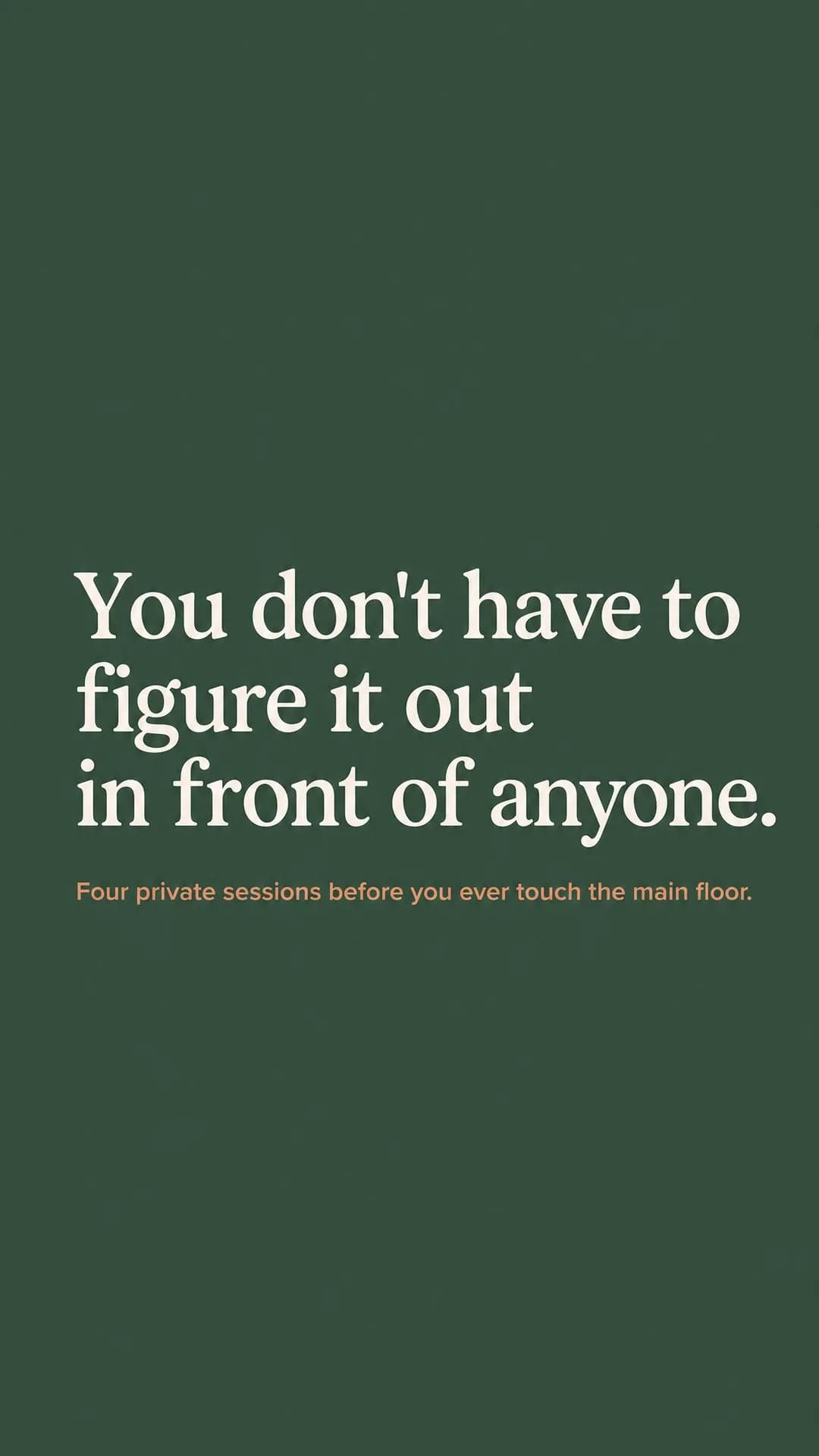
The hardest part of starting again isn't the workout — it's walking into a room where everyone else already knows what they're doing. Our Re-Start Series gives you four private, one-to-one sessions in a separate studio before you ever step onto the main floor. You rebuild the basics — how to load a bar, how the equipment adjusts, how to pace yourself — at your speed, with no one watching. The confusion happens here first, not out there.
The confusion happens in private
Private coaching, then the floor
This is the page's thesis in one card: an advertisement for a gym with no body in it. The fear it names is not fitness and not weight — it is being watched while you work out how the machine adjusts, in a room where everybody else already knows. “You don’t have to figure it out in front of anyone” addresses that exactly, and the sub-line does the practical half: four private sessions before you ever touch the main floor. Relief is the right family here because the product genuinely is relief; the training is what the other nine ads are about.
Two things this demonstrates that are worth carrying into your own version. First, the format — a solid-colour quote card is the cheapest thing in the style library to produce and the hardest to hide behind, because with no photograph there is nothing but the sentence. It either lands or it does not. Second, and more important for this category: this ad would comply comfortably with rules that catch most fitness advertising. Nothing here asserts anything about the reader's body, nothing promises an outcome in a timeframe, and there is no before, no after and no scale. It is worth asking of every fitness ad you write whether it would survive with the photograph removed — this one is entirely that test.
Other headlines from the same run
- Four sessions before the crowd
- You don't restart in public here
- Rebuild your foundation alone first
- No audience for your first week back
Call to action
The offer is four coached sessions, which is a booking rather than a purchase, and the ad has spent its whole frame making that first appointment feel small and private. Send it to a calendar. Contact us is the honest alternative for a gym that would rather this particular person spoke to someone before they see a booking form — for this audience specifically, that is a reasonable trade.
The Unlock Sequence
TrafficPhone taps, door unlocks, time-stamped — that's the whole process.
- Audience
- Night-shift and early-start workers — Finish at eleven or start at five, have never been able to use a gym with staffed hours, and are unsure whether an unstaffed building at two in the morning is a real service or a liability.
- Angle
- How It Works (Product & Mechanism) — Explains the process from input to mechanism to result.
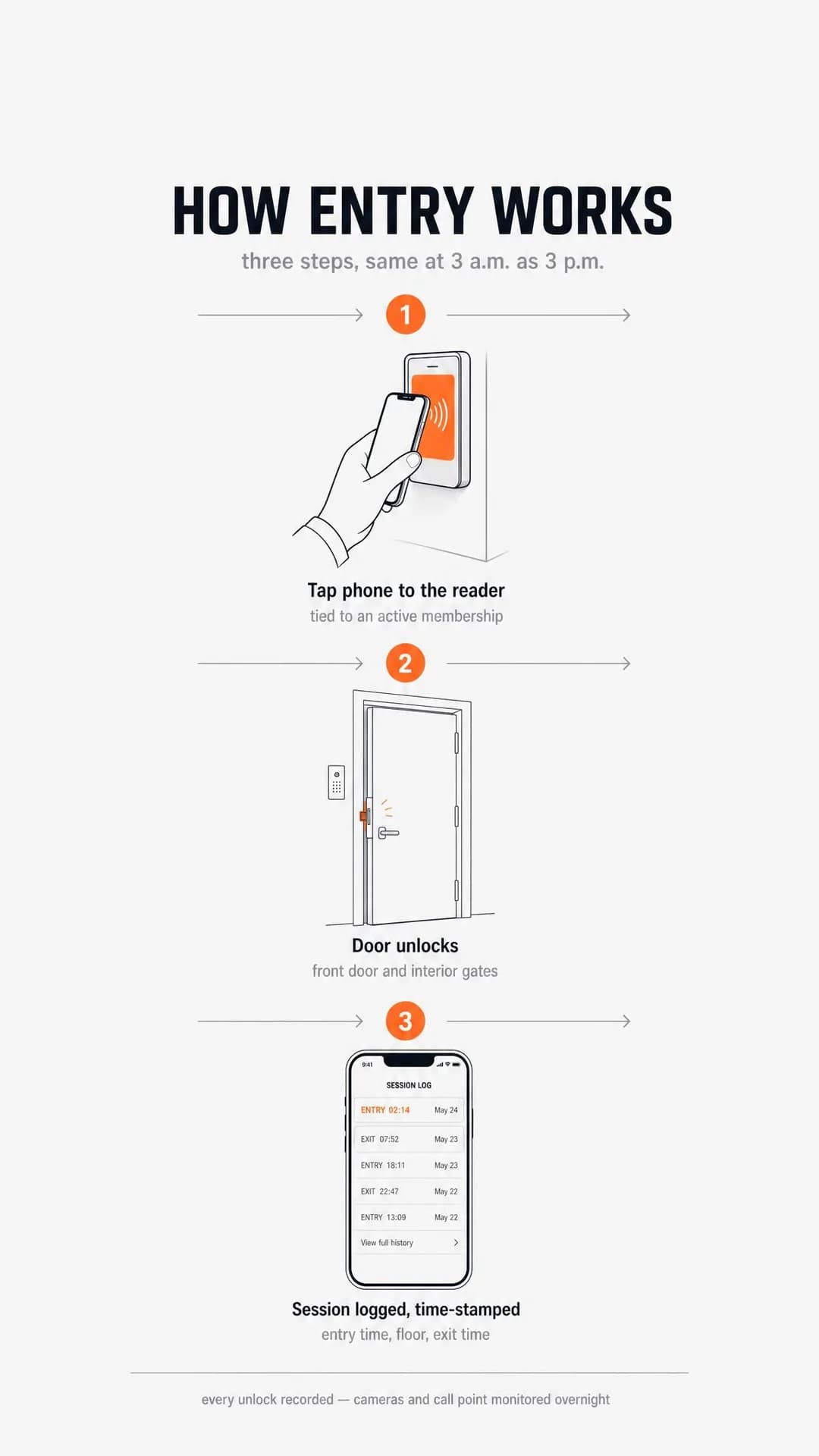
Phone tap. Door unlocks. Session logged. That's the whole sequence. No front desk, no staff shift, no waiting on someone to let you in at 2 a.m. Every entry is time-stamped and tied to your active membership. Cameras and a call point cover the floor overnight. Same process at three in the morning as three in the afternoon. $39/month, unlimited access, cancel anytime in the app.
Phone tap, door unlock, logged
Unstaffed gym, app-based entry
How It Works earns its place when the mechanism is genuinely invisible from outside and the reader's hesitation is about the mechanism rather than the price. An unstaffed building at two in the morning is exactly that: the question is not whether 24/7 access is worth $34, it is whether the door opens and what happens if something goes wrong. Three panels answer it — tap the phone to the reader, the door and interior gates unlock, the session is logged with entry time, floor and exit time — with the security half in the footer rather than the headline, where it reassures without leading on fear. The subtitle does the real reframing: “three steps, same at 3 a.m. as 3 p.m.”
And then the flaw, which is a good one because it lands precisely where the ad is making its claim. The phone in panel three shows a session log, and the log does not sort. Read top to bottom it is newest-first — ENTRY 02:14 on May 24, then EXIT 07:52 on May 23, then ENTRY 18:11 on May 23 — but 18:11 is later in the day than 07:52, so those two rows are the wrong way round. An ad whose entire argument is that every unlock is recorded precisely has shipped a rendered audit trail that is out of order. Nobody will catch it in a feed; anybody evaluating the claim will. Rebuild that panel from a real screenshot rather than a drawing of one, which is the general lesson for any ad that renders an interface as evidence.
Other headlines from the same run
- Three steps. Any hour. No staff.
- Entry works the same at 2 a.m.
- Tap to unlock. Time-stamped entry.
- No front desk. Just door hardware.
Call to action
Pinned to Traffic, and rightly — this reader is resolving a doubt, not choosing a gym, and the page about access and overnight security is what finishes the job. Sign up is worth testing against people who have already read that page, and Contact us suits a site where the honest answer to “what if something happens at 2 a.m.” is a phone number rather than a paragraph.
The Hour Nobody Claims
LeadsYour lunch hour is unclaimed real estate. Take it back.
- Audience
- Office workers whose evenings are already spoken for — Have children, commutes or both, have given up on the after-work session entirely, and have an hour in the middle of the day that nobody else is asking for.
- Angle
- Convenience (Benefit & Outcome) — Makes an existing task, routine, or purchase easier to complete.
Nobody at home is asking for your lunch hour. Nobody at work owns it either. It's the one slot on your calendar that belongs to you — if you actually use it. Thirty minutes. Starts on the hour. Back at your desk before 1pm, showered and dressed. No guilt, no scrambling, no wasted time. Just one standing appointment with yourself, five days a week.
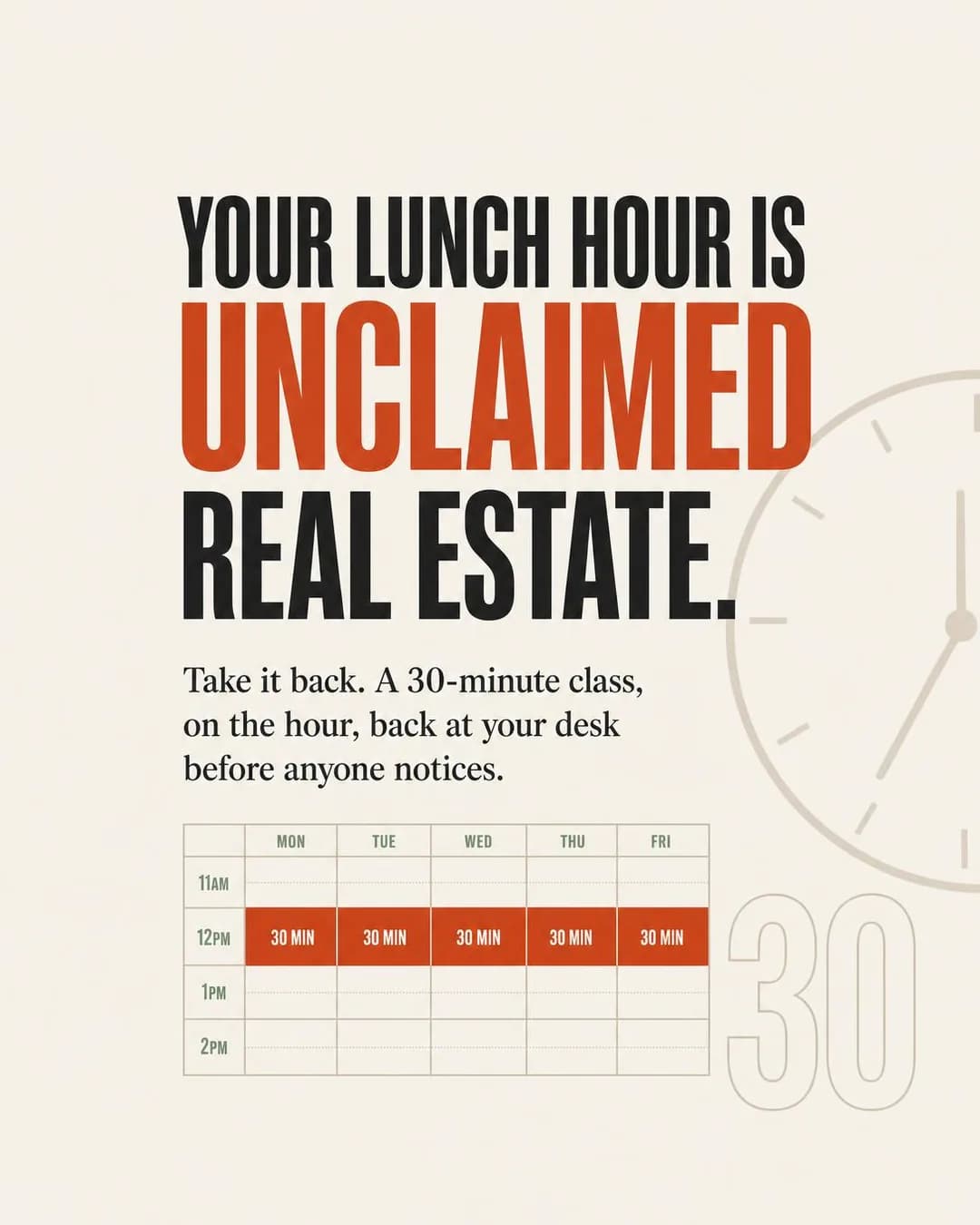
30 minutes. Back by 1pm. Showered.
Book your midday slot now.
Convenience is the least glamorous family in the library and the one that converts when the obstacle is a calendar rather than a doubt. This reader is not unconvinced about training; they have children or a commute or both, and the after-work session stopped being possible some time ago. The insight the run found is sharper than the brief was: not that a thirty-minute class exists, but that the lunch hour is the only slot nobody else has a claim on. “Nobody at home is asking for your lunch hour. Nobody at work owns it either.” That reframes a gap in a timetable as a piece of property, and “one standing meeting with yourself” in the alternates is the same idea compressed into five words.
Two practical things. The specifics are doing all the persuading — thirty minutes, starts on the hour, back at the desk before one, showered — and every one of them is a promise your timetable has to keep, including the shower, which is the detail most gyms would quietly drop and the one an office worker is actually calculating. And this is the cleanest ad in the batch from a policy standpoint: it makes no claim about the reader's body at all, which is worth noticing given what happened to the contrarian ad two rows down. Selling the schedule rather than the outcome is not just the compliant route, it is the one with something specific to say.
Other headlines from the same run
- The hour nobody else is asking for.
- Lunch is the only slot you still own.
- Reclaim 12pm–1pm. Every week.
- One standing meeting with yourself.
Call to action
The entire ad is an argument that one specific slot is free, so send them to the timetable where they can take it. Learn more suits a studio whose midday programme needs explaining before anyone commits a lunch hour to it; Sign up only if the class genuinely requires membership, which would undercut the ad's own low-commitment premise.
The Odometer Doesn't Lie
TrafficTen years on the treadmill. Same body you started with.
- Audience
- People who have only ever used the cardio machines — Have run on a treadmill three mornings a week for years, have seen no change in a long time, and walk past the free weights because that half of the room appears to require knowledge they were never given.
- Angle
- Contrarian (Comparison & Positioning) — Makes a position that runs against conventional wisdom.
Ten years on the treadmill. Same body you started with. The odometer doesn't lie. Neither does the mirror. You've logged the miles. You've put in the time. But the number on your body hasn't moved. Strength changes shape. Cardio just logs distance. Two coached sessions a week, every lift measured and dated, load added every stage. No treadmills on the floor. By design.
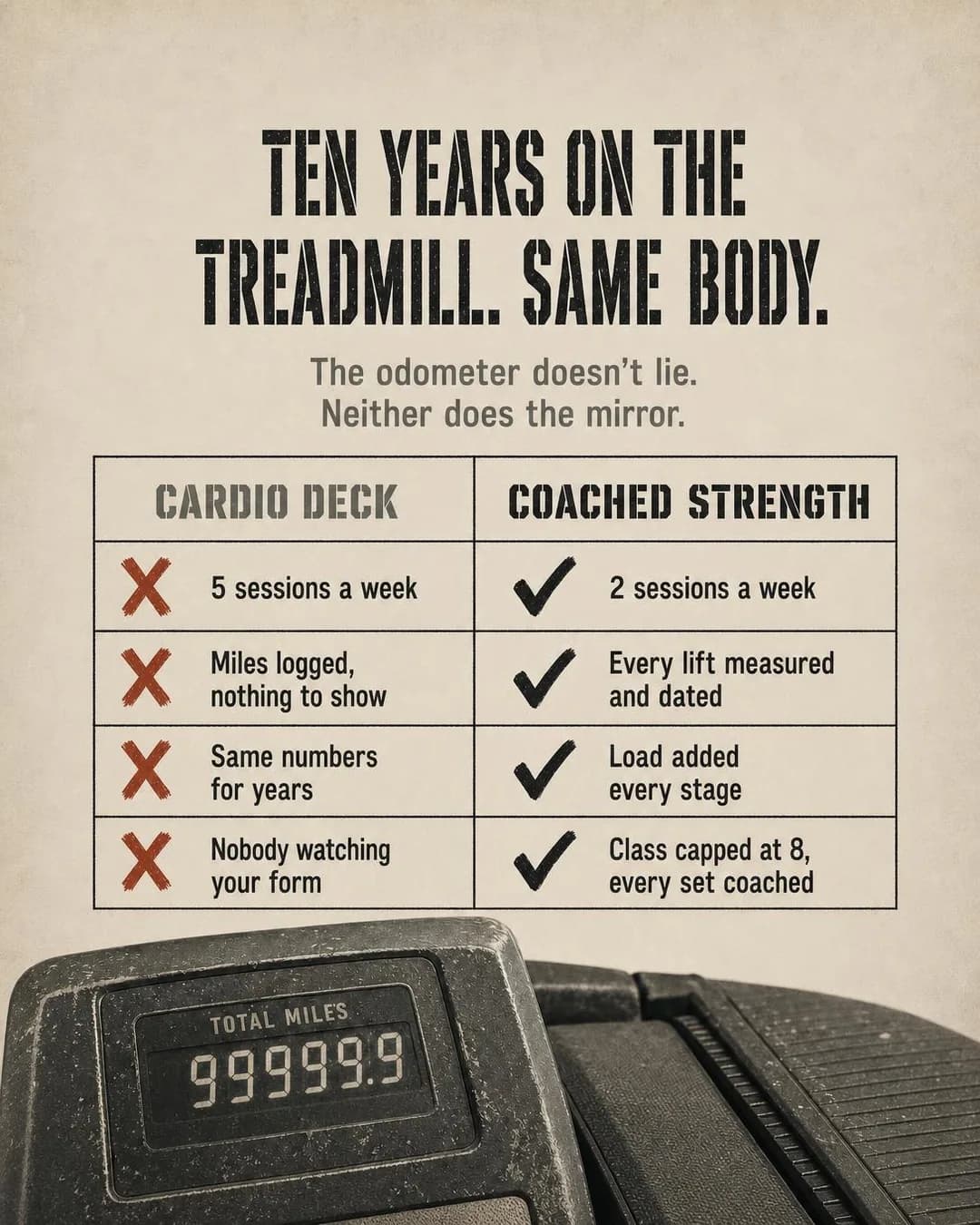
Miles logged. Nothing to show.
Coached strength. Twice a week.
Read the argument first, because it is a good one. A four-row comparison table sets Cardio Deck against Coached Strength — five sessions a week against two, miles logged against every lift measured and dated, the same numbers for years against load added every stage, nobody watching your form against a class capped at eight. That is a real claim about coaching versus volume, it is the honest case a strength studio has against the treadmill bank, and the odometer maxed out at 99999.9 in the corner is a genuinely good piece of art direction.
And it is the ad on this page you must not run, for a reason that matters more than any other note in this cluster. The headline rendered into the image is “TEN YEARS ON THE TREADMILL. SAME BODY.”, and the line under it is “The odometer doesn’t lie. Neither does the mirror.” Meta's advertising standards prohibit statements of inferiority about physical appearance — terms, descriptions or questions that are negative about an individual's appearance or specific body parts — and “same body”, “nothing to show” and an appeal to the mirror are exactly that. Worse, it is baked into the image, so none of the four alternate headlines rescues it. The whole point of this batch is that every one of the ten briefs was written to avoid body transformation, and this is the brief that came closest to training outcomes — and the model found its way back to the reader's body anyway. That is the single most useful thing on this page for anyone generating fitness ads: steering the brief is not the same as controlling the output, and this category is where that gap is expensive. The fix is small and keeps the argument intact. “Same numbers for years” is a statement about the training. “Same body” is a statement about the person. Make every line the first kind.
Other headlines from the same run
- Two sessions beat five cardio days
- Strength changes shape. Cardio logs time.
- The treadmill lied to you for years
- Load matters. Volume doesn't.
Call to action
Pinned to Traffic, and that is the right call for an argument this reader has not heard before — give them the page about how the coached sessions are structured rather than a calendar. Book now belongs on the retargeting version, once somebody has read it. Whichever you pick, rewrite the creative first.
Same Month, Same Mistake
LeadsEvery January, you've paid the year's highest rate. Again?
- Audience
- People who join every January and pay the January rate — Have joined in the first week of a year more than once, always at the highest price of the year, into the busiest six weeks the building has, and have never considered that both of those are avoidable.
- Angle
- Price Increase (Scarcity, FOMO & Timing) — Gives urgency by announcing that the current price will rise.
You've done this before. Waited until January, joined at peak price, into the busiest weeks of the year. The pattern is so reliable we can literally chart it. Join before January 1st and your rate locks — $59, $89, or $129 — for as long as your membership stays active. No annual increase. No inflation adjustment. The number stays the number. Or wait three weeks and pay more for the same floor, forever.
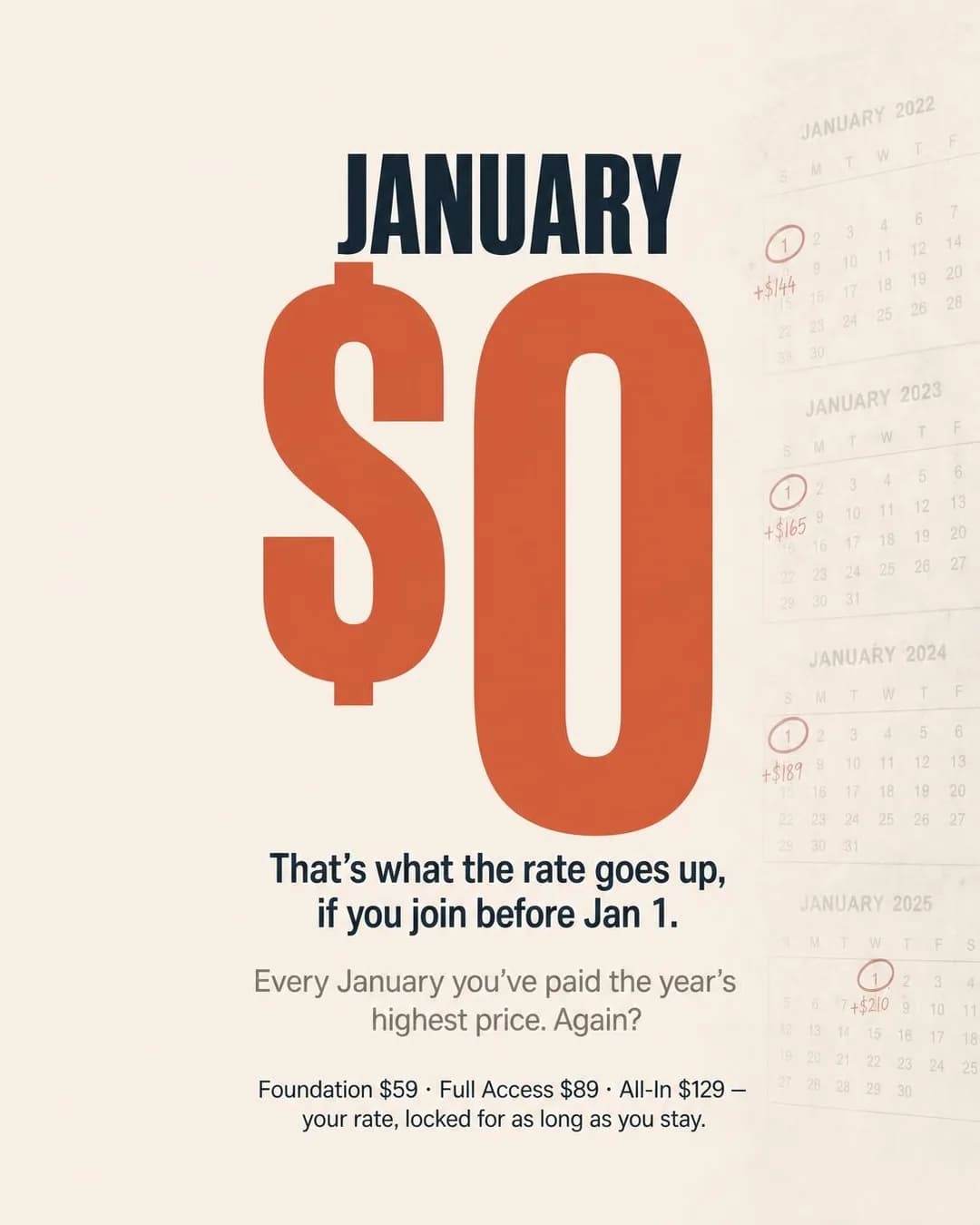
Join now. Lock your rate. Forever.
Rate locks before January 1st
The construction is the cleverest thing in the batch and worth stealing. The frame is dominated by “JANUARY $0” in stat-hero type, which reads as a price until the line underneath turns it inside out: that is what the rate goes up by, if you join before January 1st. A stat hero normally shouts a number at you; this one sets a trap and then springs it, which buys a second look in a feed that gives you less than that. Down the right-hand edge, four torn calendar pages — January 2022, 2023, 2024, 2025 — each with the 1st circled and the year's rise pencilled beside it: +$144, +$165, +$189, +$210. Those foot against the copy: divided across twelve months they are roughly $12 to $17.50, and the alternate headline says “$10–$18/mo less”. Rendered numbers agreeing with written ones is not the norm, and it is the first thing to check.
The calendars themselves are where it falls apart, and in the way image models always do. January 2022 renders the 1 twice — correctly on the Saturday in the first row, and again circled at the start of the second — and the last row reads “39 30” where it should read 29 30. January 2024 circles the 1st on a Sunday when it fell on a Monday. None of this is visible at a glance and all of it is visible to anyone who looks, which is the standing hazard with any ad that renders a calendar, a table or a receipt as evidence. Rebuild the grid from a real one. Everything else here — the trap, the annotations, the escalating figures — survives intact, and the prices are invented and yours to replace.
Other headlines from the same run
- Last chance at this year's price
- Your rate locks before Jan 1st
- Same gym, $10–$18/mo less. Always.
- December price ends in 3 weeks
Call to action
The offer is a rate locked by a date, so the button should let them lock it. Get offer is defensible and slightly worse: this is not a discount, it is the absence of an increase, and a reader who taps expecting money off lands on a normal price list. Learn more if the lock's terms — what breaks it, what happens if you pause — need a page to be credible, which for a claim containing the word “forever” they probably do.
The Wall as Evidence
LeadsRead her credentials before she touches your shoulder.
- Audience
- People training around an old injury — Have a shoulder or a lower back that decides what they can do, have been told to be careful by a physiotherapist, and need to know whether the person taking the class has ever coached anyone in that situation.
- Angle
- Expert Authority (Proof & Trust) — Uses a credentialed professional or specialist to explain or recommend the product.
11 years coaching. 6 years in outpatient rehab. Shoulder & rotator cuff focus. That's what's printed on the wall next to her name. Before you book a session, you already know if she's coached someone with your shoulder before. No guessing. No googling her later. Every coach's background is posted by the front desk and printed on the weekly timetable. Drop in for $32 or book a 1:1 if you need closer attention on an old injury.
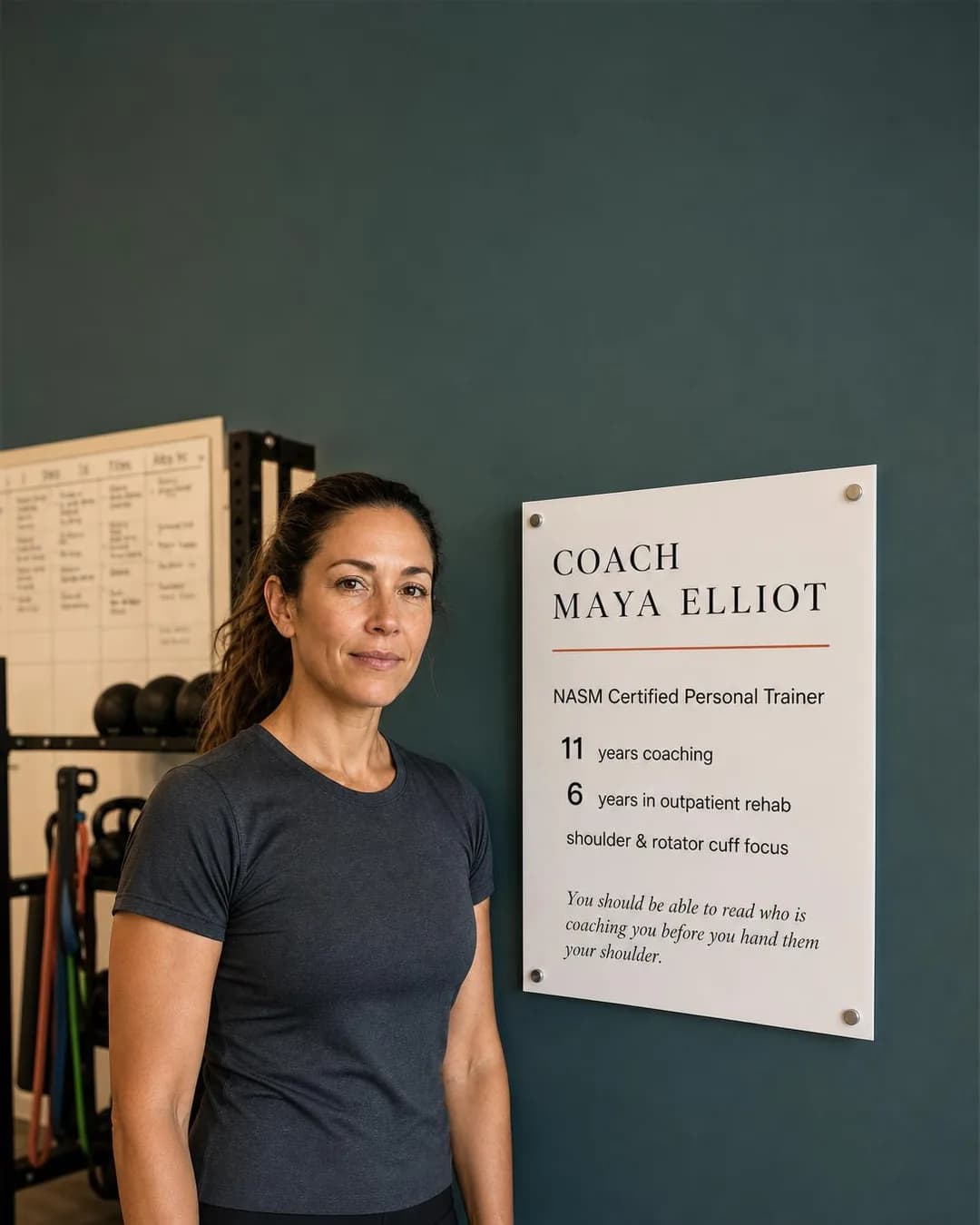
Read her credentials before she coaches you
Coaches with rehab backgrounds
Expert Authority is usually asserted — certified, experienced, passionate — and assertion is worth nothing in a category where everyone says the same words. This ad turns the credential wall into the evidence itself: eleven years coaching, six in outpatient rehab, shoulder and rotator cuff focus, printed next to her name where anyone can read it before booking. The framing line is the good one: “Read her credentials before she touches your shoulder.” For the audience this was written for — people training around an injury a physiotherapist has warned them about — that is the only question, and most gyms answer it with a wall of smiling headshots and no information at all.
The hazard is the same one the coach portrait two rows up carries, and it is sharper here because the invented material is professional rather than personal. “11 years coaching. 6 years in outpatient rehab” is a qualifications claim about a person who does not exist, and publishing invented credentials for someone who will be putting hands on an injured shoulder is a different order of problem from an invented customer quote. Take the format — it is excellent, and almost nobody in this trade does it — and fill it with your actual coach's actual certifications, which is a five-minute job and the entire value of the ad. If a coach's rehab background is genuinely the reason someone should choose you, it is also the thing you can least afford to approximate.
Other headlines from the same run
- 11 years coaching. 6 in rehab. Posted.
- Know who's programming your shoulder work
- Credentials printed. Not hidden.
- Training around injury? Check the wall first.
Call to action
Someone who has read a coach's rehab background and recognised their own injury in it is as close to booking as this page gets. Contact us is the better default for a studio that wants to triage an injury before putting somebody in a class — which, for this specific audience, is the more responsible option and worth the conversion cost.
Questions
- Are gym and fitness ads restricted by Meta?
- Not as a special ad category — health and fitness is not one of the four, so you keep age, radius, lookalikes and exclusions. The restrictions are on the creative instead. Ads promoting dietary, health, weight-loss or weight-gain products and services must be targeted to adults 18 and over — fitness services and health clubs marketed for general wellbeing are exempt, so the floor depends on what the ad says rather than on the trade — and Meta prohibits statements of inferiority about physical appearance, close-ups pinching a body area, and sensational claims promising an outcome in a set timeframe. In practice that rules out most of how this category advertises.
- Why does none of these ads mention weight loss?
- Partly because of the rules above, and partly because it is the weaker argument. Every competitor in the feed is already promising results, and the reader has learned to discount it. What a gym has that a creator posting the same image does not is a contract, a timetable, a rack that is free at six, and a coach who will still be there in March — so that is what these ten were briefed to sell.
- Do these work for a boutique studio or a 24/7 gym?
- Both, deliberately. The two are the same trade with opposite offers — one sells membership on price and convenience, the other sells class packs on instructor and schedule — so the batch is roughly balanced between them and each ad below is labelled with which model it was written for.
- Can I copy these ads?
- Take the approach, not the pixels. The gyms are invented and the images were generated for this page, so there is no operator's creative here to lift. What transfers is the pairing of an audience with a specific argument — and in this category, the choice to argue about the schedule rather than the body. Every angle used below is documented in full in our ad angle library, linked from each ad.
Seen enough? Make your own.
Paste your site. It reads your timetable, your memberships and your coaches, then writes the concepts, renders the images and drafts the copy — for a category where the image can break a rule the copy never mentions.
No credit card · 50 free credits (about 5 ads or Instagram posts)
Every angle used above is documented in the best-in-slot ad angle library. More industries and placements are at all ad examples.