
Ad Angle Library #7 · 11 angles
Offer & Economics ad angles
Improve the perceived economic value of the purchase.
Every family before this one filled in the same slot in the formula that opens the source document — Persona × Awareness Stage × Angle × Hook × Format × Offer × Execution — and left the last-but-one term alone. The offer was there in problem, benefit, mechanism, proof and comparison ads, but it sat underneath the argument, mentioned once near the button while the sentence above it did the actual persuading. Offer & Economics is the family where that stops. Eleven angles, and in every one of them the offer isn’t supporting the ad — it is the ad.
It shows up in the taxonomy as something none of the other nine families do: eleven angles, and all eleven marked Hot. Every other family runs from Cold through to Hot because its underlying argument works on someone who hasn’t met the product yet — a problem is real whether or not you’ve heard of the brand fixing it. An economics argument isn’t like that. Nothing here means anything to somebody who hasn’t already decided the product does what it claims; you can’t discount a thing a stranger doesn’t want yet, and a payment plan answers a question — can I afford this — that only gets asked once “should I buy this” has already been answered yes.
Which means the usual organising axis for “which one, when” doesn’t exist in this family, and forcing one onto it would be inventing a distinction the taxonomy doesn’t support. So this issue groups by what the offer actually does to the number instead — cut it, grow what’s on the other side of it, change how it reads, or change when it’s collected. Four operations, eleven angles, and once you see the axis the choice between them stops being about funnel stage and starts being about which part of the number is actually in question for a given reader.
One risk runs through the whole family, and the taxonomy notes a version of it under nearly every angle: whatever you train the reader to expect this time is what they’ll wait for next time. A discount teaches somebody the real price is whatever price they first saw. A bonus that turns out to be filler teaches them your extras aren’t worth having. A fake anchor teaches them to distrust every number you publish afterward. None of that shows up in the campaign that runs it — it shows up in the one after, in a customer who has quietly learned how to negotiate you down. That’s why every angle below belongs to a specific reader in a specific moment, not to a permanent state of the pricing page.
Which one, when
- Cut the priceDiscount · BOGO / Multi-Buy · Introductory Offer
- Three ways to make the number itself smaller, and the differences are about who qualifies and for how long. Discount is a moment, open to anyone, gone by a date. BOGO / Multi-Buy trades a bigger order for a lower price per unit. Introductory Offer is a discount with exactly one qualifying condition — never having bought before — that never expires for the segment it targets. All three borrow against a later full-price sale, so run them only where you can actually defend the number that follows.
- Grow the other sideBundle · Value Stack · Bonus · Free Shipping
- Four ways to leave the sticker price alone and add to what it buys instead. Bundle changes what’s actually for sale; Value Stack changes how the ad argues for the price of what’s already for sale; Bonus adds without the headline number moving at all; Free Shipping removes a cost that was about to arrive as a surprise at the worst possible moment, right before payment. This is the row that protects a premium price, because not one of the four teaches the reader that your original number was wrong.
- Reframe the numberPrice Anchoring · Cost Per Day / Use
- Nothing about the offer changes in either of these — not the price, not what’s included, only how the reader’s head processes the figure. Anchoring hands them a bigger number to compare against; Cost Per Day / Use hands them a smaller one to divide into. The cheapest pair in the family to write, and the easiest to get caught faking: an anchor with no real history, or a division with no relationship to how the reader actually pays, reads as a trick the moment somebody checks it.
- Reschedule the paymentFinancing / Installments · Subscription Savings
- The total doesn’t move in either of these; only when it’s collected does. Financing spreads a one-off price into smaller real charges; Subscription Savings rewards committing to a recurring one instead of paying per use. Both ask the reader to think about the schedule rather than the total — and both need the total spelled out somewhere on the page, because somebody always does the multiplication.
About the examples. Every ad below was generated by best-in-slot for best-in-slot — one product, one underlying problem, 11 different arguments about it. That repetition is the point: hold the product and the pain still, and the angle is the only thing left changing. Each is shown exactly as it came out.
Discount
HotUses a direct price reduction as the primary persuasion argument.
The plainest move in the family, and the one every other angle here is implicitly a more disciplined alternative to: cut the number, announce it, put a date on it. It works because it requires no argument — a reader doesn’t have to be persuaded that a lower price is better, only informed that one exists — which is also why it’s the angle most teams reach for first and think about least.
Keep it away from the moment Price Objection (issue #6) owns. That angle defends the number to somebody who has just flinched at it, and its whole discipline is never discounting in the same breath as the defence, because cutting the price the instant you’ve justified it concedes the argument you just made. Discount belongs to a different reader at a different time — someone who was never going to be argued into the full number, only moved by a real deadline.
The taxonomy’s weakness is the whole risk: an unexplained, recurring discount teaches the reader that your price is a suggestion, and the fix isn’t smaller discounts, it’s fewer of them with a reason attached — a launch, a real inventory reason, a date on the calendar rather than a banner that’s been “ending soon” for a year. A discount with no reason is a permanent price cut wearing a costume, and readers work that out faster than most brands think.
- Works because
- Immediate and universally understood.
- Fails when
- Can train customers to wait for sales.
Write one like this
- 20% off your first 100 credits. Ends Sunday, not “ends soon”.
- We cut the price for launch week. It goes back up Monday.
- Your first ad is on us. Every one after that is full price, and we’re not going to pretend otherwise.
- One week, one discount, one honest reason: we want the first thousand brands live before we raise it.
Don’t discount without a real, stated reason and a real end date. An open-ended discount isn’t a promotion, it’s your actual price with an asterisk, and the reader will wait for the asterisk to come back.
Your first month: half price. Most ad tools charge full freight while you're still figuring out if they work. We don't. Get the Starter plan — 1,000 credits, ~66 finished Meta ads — for $19.50 instead of $39 for your first 30 days. One link in, finished ads out, published straight into your Ads Manager. Nothing goes live until you say so.
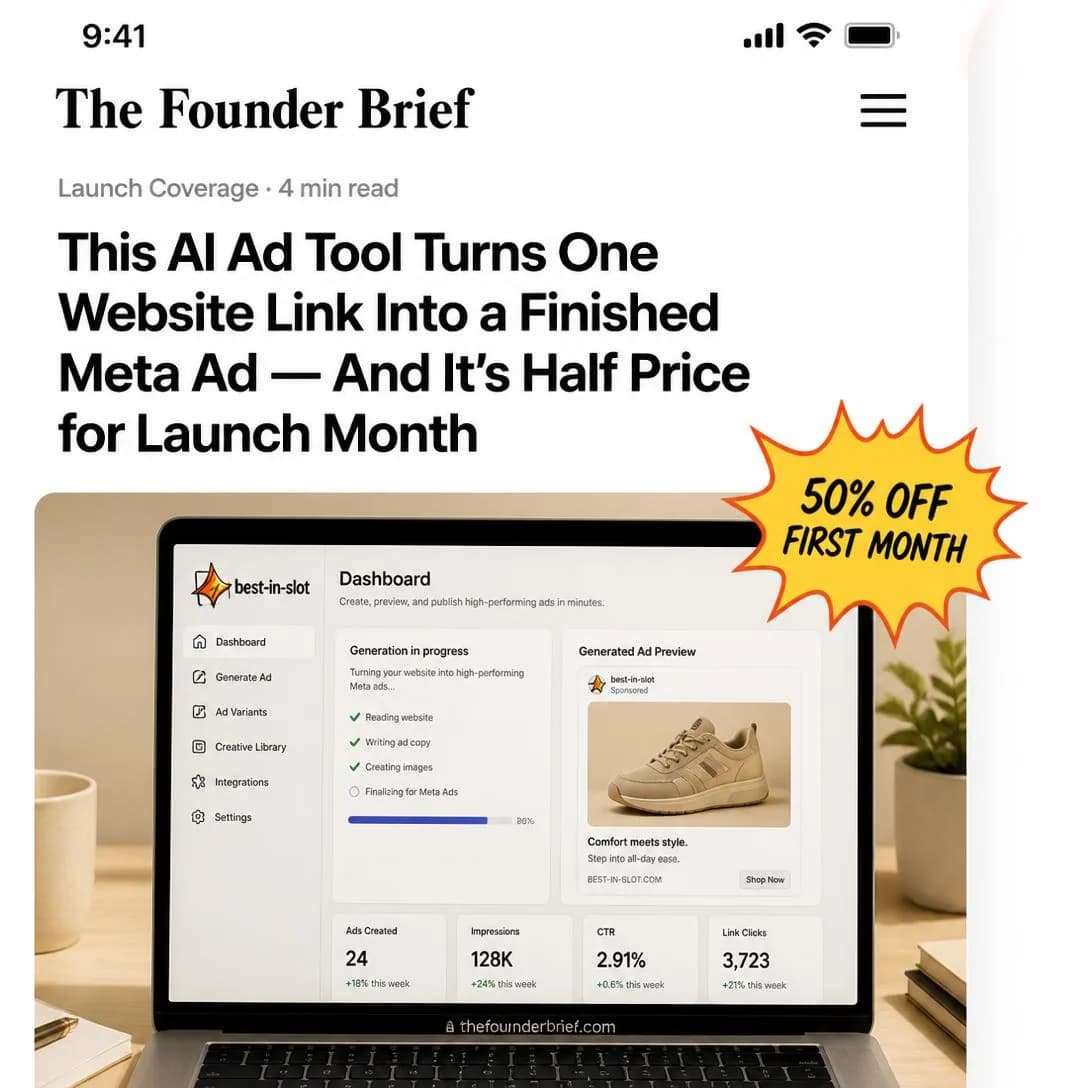
First month: $19.50 instead of $39
Launch offer — 50% off month one
Bundle
HotPackages multiple products, services, or units together for stronger perceived value.
Packages several things into one purchase so the reader doesn’t have to assemble them separately. It solves a specific problem — “I need more than one of these” — that a single-item price never addresses on its own, and it earns its place whenever the pieces genuinely go together for the person buying them: someone running one brand needs the angle families, someone running an agency needs the seats to go with them.
The taxonomy’s weakness — added decision complexity — is a warning about how many bundles to run, not whether to run one. A single, named bundle removes a decision (buy the pieces or buy the set); a page of build-your-own options adds one back, and adding a decision is the opposite of what a bundle is for. If the ad needs a dropdown to explain the offer, it has stopped being a bundle and started being a form.
Bundle and Value Stack, next, get written as the same ad and aren’t. Bundle is the offer — what’s actually included at what price. Value Stack is the argument for that offer — the line-by-line case for why the combined price is small next to the combined value. A bundle ad that doesn’t make that case is just a longer receipt; pair the two whenever the bundle’s value isn’t obvious at a glance.
- Works because
- Raises AOV and value perception.
- Fails when
- Adds decision complexity.
Write one like this
- Every angle family, every size, one price. Buy them separately and you’ll pay for the same photo three times.
- The starter bundle: 200 credits, all four Meta sizes, your brand kit set up once.
- Two brands, one plan, no second setup fee. Built for the week you’re running both.
- Everything in the agency bundle is something our support inbox got asked for by name.
Don’t bundle things that don’t belong together for the buyer in front of you. A bundle assembled to move slow inventory reads as exactly that, and it teaches the reader to distrust your next one.
You used to need three people to make one ad. A designer for the visuals. A copywriter for the hook. A photographer for product shots. Now? 15 credits gets you the whole package — concept, hero image, all four Meta sizes, and scroll-stopping copy. One click. One price. Done in a minute.

The whole ad team. One flat rate.
Start free — no card needed
Value Stack
HotItemizes everything included and frames the combined value against the purchase price.
Itemizes everything included and lets the reader add it up themselves, which is a different mechanism from a discount even though both end with “and this is worth more than you’re paying”. A discount changes the price; a value stack changes nothing about the price and instead argues the number was always small relative to what it buys. It’s an argument, not an offer, and it can be written for a single purchase as easily as for a bundle — list what one plan actually includes and most readers have never seen it laid out.
The taxonomy’s weakness — infomercial if overdone — is really a warning about the weakest line in the stack, because a reader mentally deletes whatever item they don’t believe and judges the rest of the ad by how honest that deletion made the total look. Four real items each with a price a reader would recognise beats nine items where three are padding. If you wouldn’t sell an item on its own, don’t put a price on it inside the stack.
It works hardest where the purchase looks simple from outside but isn’t — a plan that reads as “you get some ads” when what it actually includes is eleven angles, four sizes, unlimited revisions, and a brand kit that carries over. The stack’s job is to make the reader see the plan they already have, or the one they’re about to buy, the way you see it.
- Works because
- Strong for services, education, SaaS, and info products.
- Fails when
- Can feel infomercial-like if overdone.
Write one like this
- One plan: 11 angles, 4 sizes, unlimited revisions, brand kit included. Priced like it’s one of those.
- Here’s everything $49 actually gets you, itemized, because most people guess wrong.
- Eleven angles is roughly an agency’s monthly output. This plan makes them before lunch.
- Add it up yourself: the angles, the sizes, the reruns. Then look at the price again.
Don’t stack an item you wouldn’t sell on its own. A reader who doubts one line in the stack starts doubting the total, and the whole angle only works if the arithmetic survives being checked.
I did the math on what one Meta ad actually replaces. I feel stupid. So I've been paying separately for all of this: a concept/ideation session, an image generator for the hero shot, someone to resize into all 4 Meta formats, and a copywriter for the ad text. Then I published it manually. Started using best-in-slot (bestinslot.ai). One click. It does the concept, the hero image, all four Meta sizes, AND the copy, then drops it straight into Ads Manager paused. Whole thing took about a minute. Cost me 15 credits. That's a fraction of a cent per ad. I don't know whether to be happy or annoyed at past me.
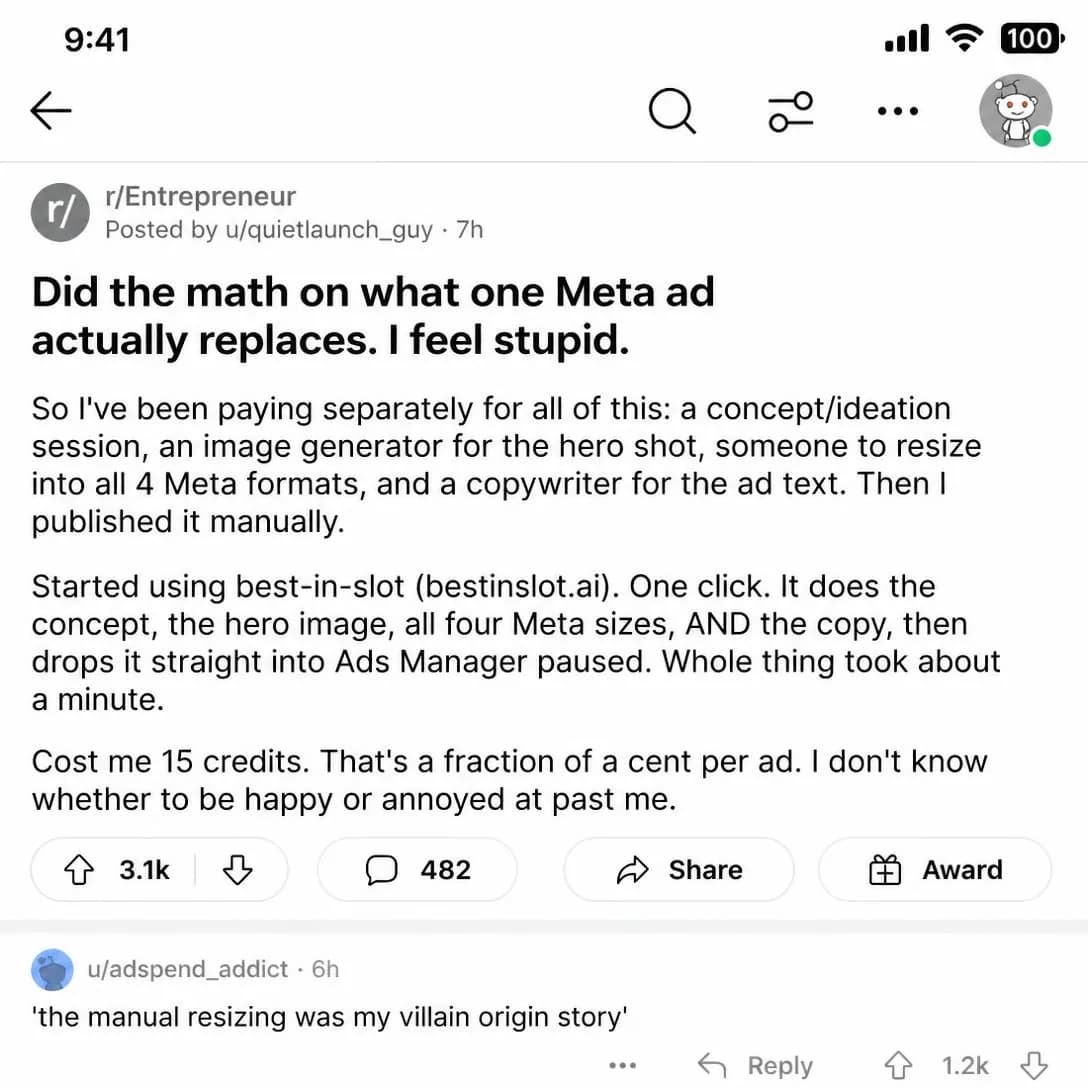
15 credits. 6 line items. Do the math.
Best in every slot.
Bonus
HotAdds extra value without reducing the main product’s headline price.
Adds value without moving the headline price, which the taxonomy states almost as a direct rebuttal to Discount: a bonus protects premium positioning in a way a discount structurally can’t, because the number the reader compares against everyone else’s stays exactly where it was. You’re not saying the price was too high. You’re saying the price was always right, and here’s more inside it.
Its entire risk is the one line the taxonomy gives it: the bonus must actually be desirable. A bonus nobody wanted is worse than no bonus, because it announces that you had spare inventory of something and needed a reason to attach it to a sale. The credible version is something the buyer was already going to want next — a second brand slot, a bigger credit top-up, early access to a family that isn’t public yet — not a generic extra bolted on to make the offer look bigger on a slide.
It also sidesteps the renewal problem that dogs Introductory Offer below: because the sticker price never moved, there’s no full-price cliff waiting at the end of a bonus period the way there is at the end of a discounted first term. The bonus can simply stop being repeated, and the price the customer has been paying the whole time is the price they keep paying.
- Works because
- Protects premium positioning better than discounting.
- Fails when
- Bonus must actually be desirable.
Write one like this
- Sign up this month and your plan comes with double credits for the first year. Price doesn’t change — we just added more to it.
- Every annual plan now includes a second brand seat. Same price as last week.
- The bonus isn’t a discount. It’s fifty extra credits landing in an account that already had enough.
- We didn’t cut the price. We added the thing our best customers kept asking for, free, to everyone.
Don’t attach a bonus nobody wanted. An undesirable extra reads as inventory you needed to move, and it makes the whole offer look padded rather than generous.
You pay for one ad. We give you four. Every ad you build gets re-framed into all four Meta formats — Feed, IG, Stories, Right Column — automatically. No extra credits. No upsells. Just four placements for the price of one build. 15 credits = 4 fully-formatted ads. That's the deal.
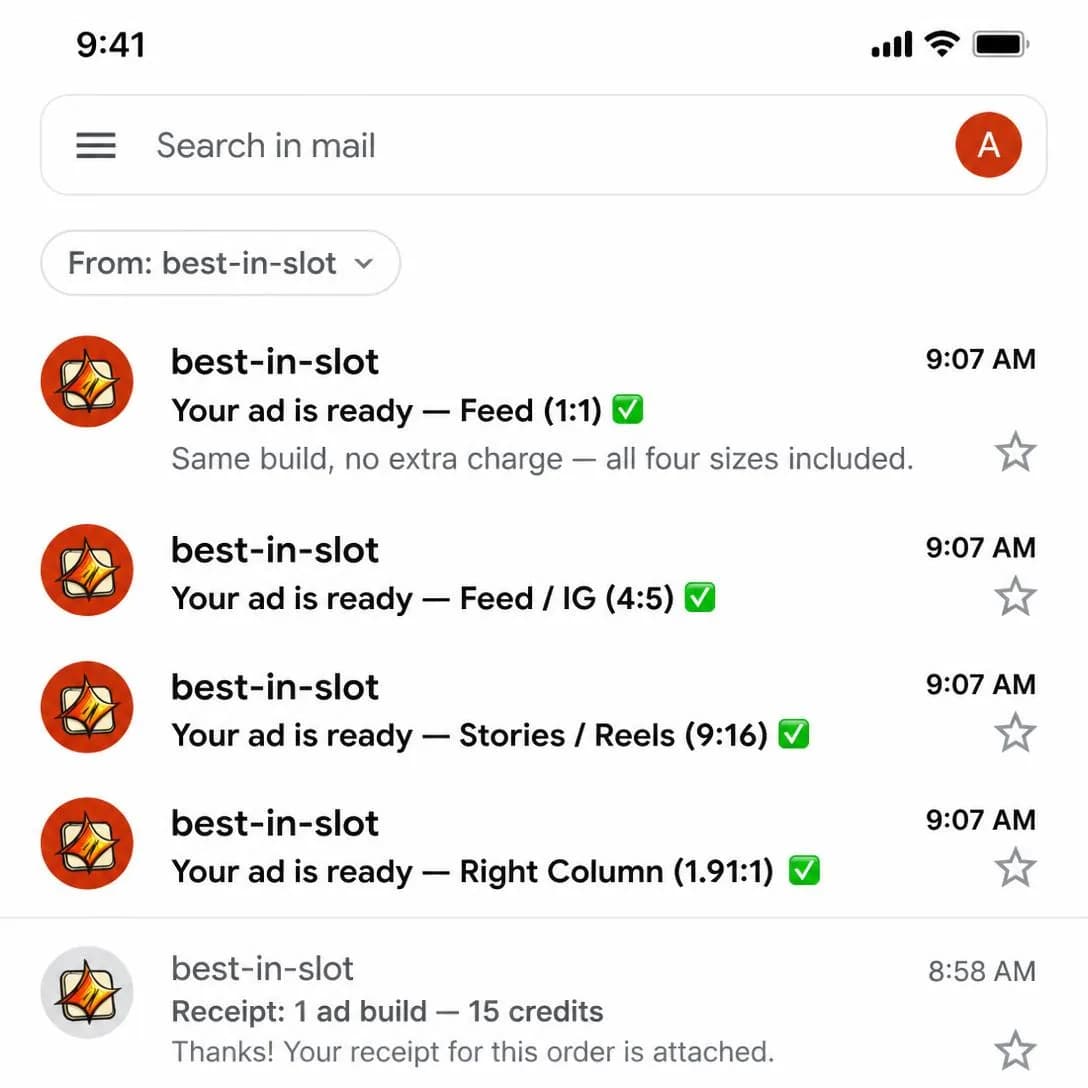
One ad build. Four Meta formats. Free.
Feed, IG, Stories, Right Column
Free Shipping
HotRemoves shipping cost as the purchase barrier.
In retail this removes a specific, well-documented moment: the number that shows up at the very end of checkout and wasn’t in the price the reader had already agreed to in their head. Translate the mechanism rather than the word — for anything sold as a plan or a credit pack, the equivalent isn’t a delivery fee, it’s the surcharge that shows up after the decision was already made: a per-size export fee, a “contact sales” wall on a feature you assumed was included, a watermark that only comes off on a higher tier. Whatever your version of that moment is, this angle is the promise that it doesn’t exist.
The taxonomy is honest that this hurts margins, and it’s worth being equally honest back: the cost doesn’t vanish, it gets folded into the number the reader already agreed to. That’s a fine trade if the base price can carry it, and a bad one if it can’t — because the alternative to a hidden fee isn’t always “no fee”, sometimes it’s a higher sticker price that at least doesn’t ambush anyone at the finish line.
Say what’s included rather than just what’s free, because “free shipping” has been offered by everyone for long enough that the phrase alone barely registers. “All four Meta sizes exported, no extra credits” is checkable and specific in exactly the way “free shipping” used to be before it became wallpaper.
- Works because
- Strong ecommerce conversion lever.
- Fails when
- Can hurt margins.
Write one like this
- No per-size fee. One generation, every Meta export, already in the price.
- The watermark comes off on every plan, not just the ones above yours.
- No “contact sales” wall on the feature you actually came here for.
- What you see on the pricing page is what you pay. No surcharge shows up at export.
Don’t just say “free” — name the specific fee it’s replacing. The word alone has been used by every competitor for a decade; the fee it removes is the only part that’s still checkable.
You know that checkout feeling when 'free shipping' suddenly isn't? We built best-in-slot the opposite way: 50 credits, zero credit card, no surprise fees. Paste your website link, get a finished Meta ad—concept, hero image, copy—in about a minute. You see the ad BEFORE you ever pay a cent. Same trust as real free shipping. Nothing tacked on.
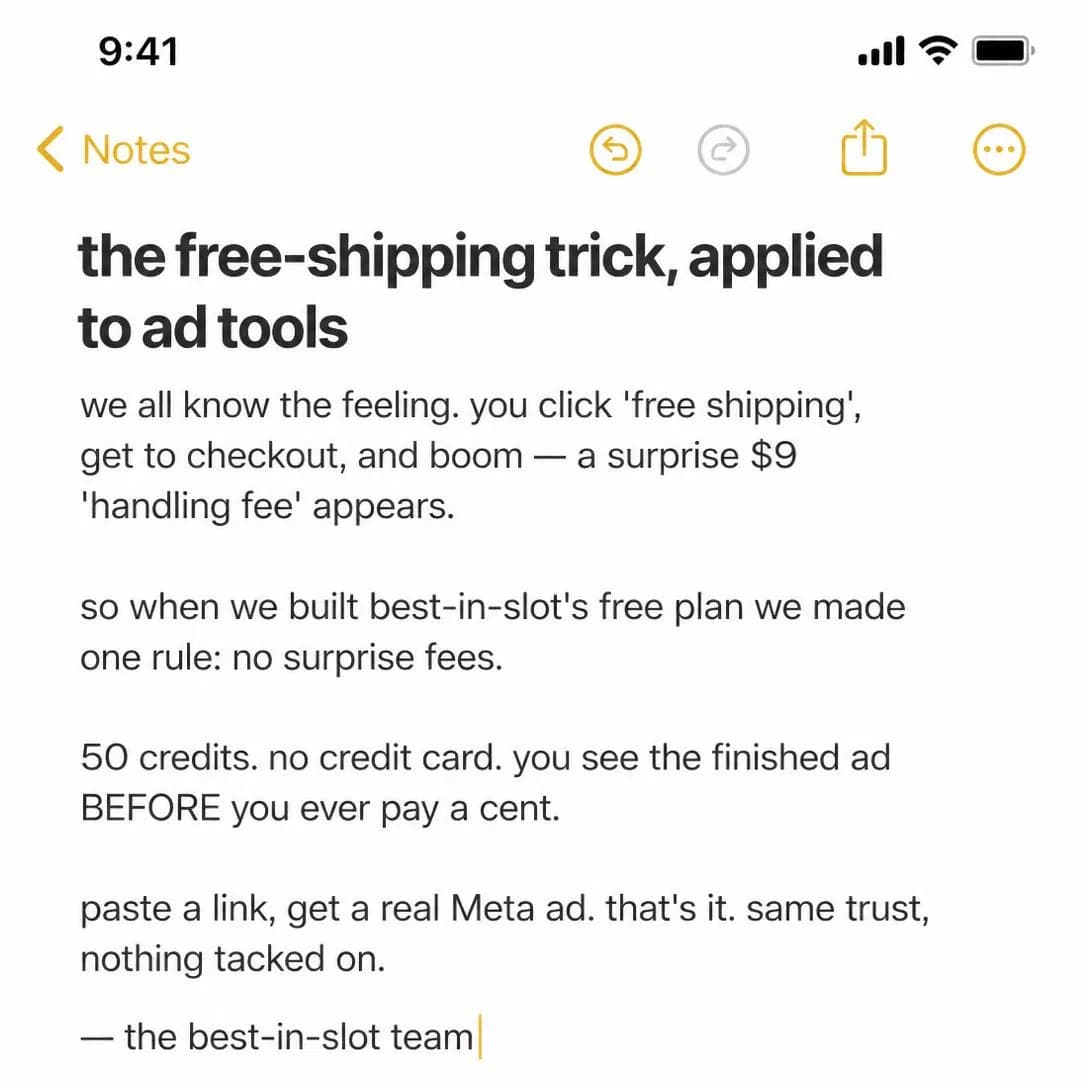
50 free credits. No card required.
Start with 50 credits, $0
BOGO / Multi-Buy
HotRewards buying multiple units or products.
Rewards buying more of the same thing at once, which makes it the sibling of Bundle rather than its twin: Bundle solves “I need several different things”, this solves “I need more of one thing”. The natural home for it is any product where usage genuinely scales — an agency running several client brands, a store with more than one product line to advertise — because the offer only converts where more is something the buyer was actually going to need.
The taxonomy’s warning about cheapening the brand has a version specific to anything sold as capacity rather than goods: offer “buy one brand, get a second free” too often or too broadly and you’ve told the market that a brand slot — the thing your pricing page prices individually — doesn’t actually cost you anything to provide. Multi-buy has to look like a volume reward for a real pattern of use, not a hint that the unit price was inflated to begin with.
Aim it precisely at the segment whose usage actually is multiple: agencies, portfolio operators, anyone already running more than one brand before they saw the ad. Offered to someone with exactly one product to advertise, the second unit is dead weight dressed as a deal, and dead weight is what the taxonomy’s weakness is actually describing.
- Works because
- Strong volume and AOV driver.
- Fails when
- Can imply excess inventory or cheapen the brand.
Write one like this
- Running client brands? The second one’s on the house, this month.
- Buy the 500-credit pack and the price per credit actually drops.
- Two brands, one plan, no second setup. Built for agencies, not padded for everyone.
- The bigger pack isn’t a discount. It’s the price per ad actually getting smaller.
Don’t offer multi-buy to someone with exactly one thing to advertise. A second unit nobody needs isn’t a deal, and pushing it teaches the reader your per-unit price was never real.
Pay once. Get four ad sizes, five headlines, five primary texts — all from one 15-credit run. No extra charges for stories, feed, or right column. No upsells for copy variations. Just one click, one price, every placement covered. bestinslot.ai
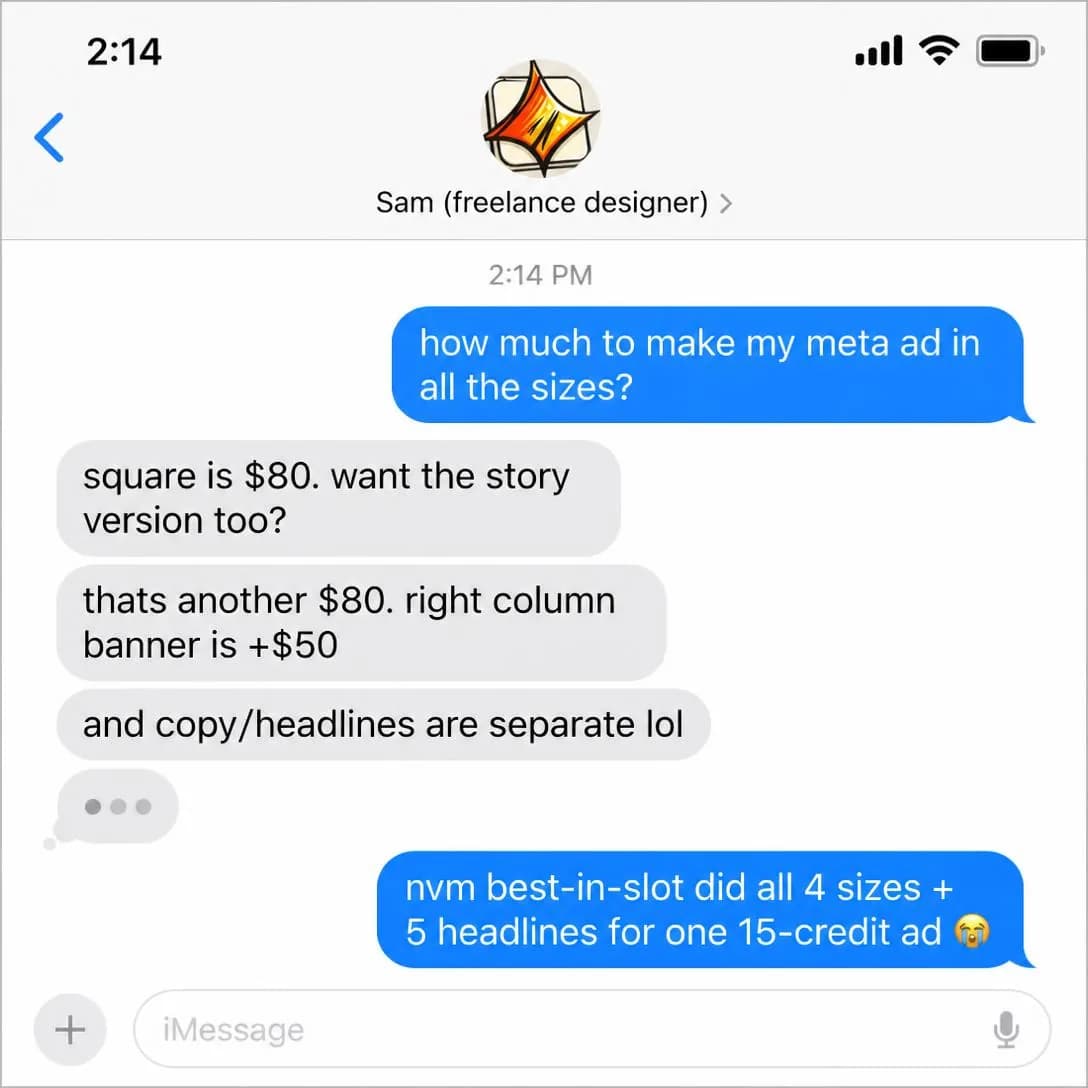
One ad. Four sizes. Same price.
Four sizes + copy. One price.
Introductory Offer
HotGives first-time customers special economics or terms.
Special economics for a first-time buyer only, and worth separating carefully from two neighbours it gets confused with. It isn’t Free Trial / Sample (issue #6), which delays payment entirely so the reader can decide before any money moves. It isn’t a plain Discount either, which is open to anyone and bounded by a date. Introductory Offer is a real, paid transaction at reduced terms, permanently available to anyone meeting exactly one condition: never having bought before.
The taxonomy’s weakness is the whole design problem: full-price renewal creates disappointment, and it creates the most disappointment precisely when the customer has just started forming a habit around the low price. The fix is arithmetic done in the ad itself, not left for the invoice to reveal — state both numbers, the intro price and what it becomes, in the same sentence. A customer who was told the second number up front feels like they got a fair head start; a customer who discovers it on a renewal receipt feels like they were had, at the exact moment you most needed them to feel otherwise.
It pairs naturally with No Commitment (issue #6), for the same reason a low price and an easy exit solve the same fear from two directions — the intro price lowers the cost of finding out, the cancel-anytime line lowers the cost of being wrong. Together they’re the strongest opening a subscription business has; separately, the intro price without a visible exit just reads as a trap with a countdown.
- Works because
- Lowers the acquisition barrier.
- Fails when
- Full-price renewal can create disappointment.
Write one like this
- First month is $9. After that it’s $29 — we’re telling you now so the invoice isn’t the first time you hear it.
- New here? Your first 100 credits cost less than credit 101 ever will.
- The intro price is real. So is the number it becomes — both are on this page.
- Half price for your first month. Cancel before the second and you’ll never see the other number.
Don’t let the full price be a surprise the invoice delivers. State both numbers in the ad — the moment a customer discovers the renewal price on their own is the moment you lose them.
Your first 3 ads are on us. 🎯 No trial period. No credit card upfront. Just 50 free credits — enough to generate three full Meta ads, concept to copy to publish. See if it works for your business before you spend a dollar. Start free at bestinslot.ai

50 free credits. ~3 finished ads.
No card required to start
Price Anchoring
HotCompares the current price with a higher reference value.
Puts a second, higher number next to the current one so the reader’s read of the price changes without the offer itself changing at all. Nothing is discounted, nothing is added — the entire mechanism is contrast, and contrast is doing real cognitive work: the same $49 looks expensive next to nothing and reasonable next to $150, and the reader arrives at “reasonable” having done none of the reasoning themselves.
The taxonomy’s weakness is the whole risk and it isn’t subtle: a weak anchor feels manipulative, and readers have spent a decade watching retailers strike through invented “was” prices that were never actually charged. The anchor has to survive being asked “compared to what” — a documented prior price, what an agency would genuinely charge for the same output, a rate you can point to rather than one you picked because it made the arithmetic flattering.
It’s a different move from Price vs. Value in Comparison & Positioning (issue #5), even though both put a bigger number on the page. Price vs. Value builds a qualitative case — this figure divided by what it does for you is small — and asks the reader to follow an argument. Price Anchoring is pure contrast, no argument required, which is exactly why it earns the first glance and Price vs. Value earns the read that follows it. They work well stacked in the same ad, in that order.
- Works because
- Changes price perception and increases perceived savings.
- Fails when
- Weak anchors can feel manipulative.
Write one like this
- An agency quoted $1,800 for this brief. This plan ran the same brief for $49.
- $150 for 100 credits when we launched. $49 now that generation is faster. Same output.
- What a freelance designer charges for one ad: $180. What this plan charges for fifty: $49.
- That’s the actual rate card from three agencies we asked. This is ours.
Don’t invent the anchor. A “was” price with no history behind it is the fastest way to make every other number on the page look invented too.
Last month, a freelancer quoted me $400 for one Facebook ad. One. This month, I made 66 ads for $39. Same quality. Same formats. Ready to publish in Meta Ads Manager. The math isn't close — best-in-slot turns your website into finished ads for about $0.60 in credits each. No back-and-forth. No revisions. Just paste your link and watch it work.
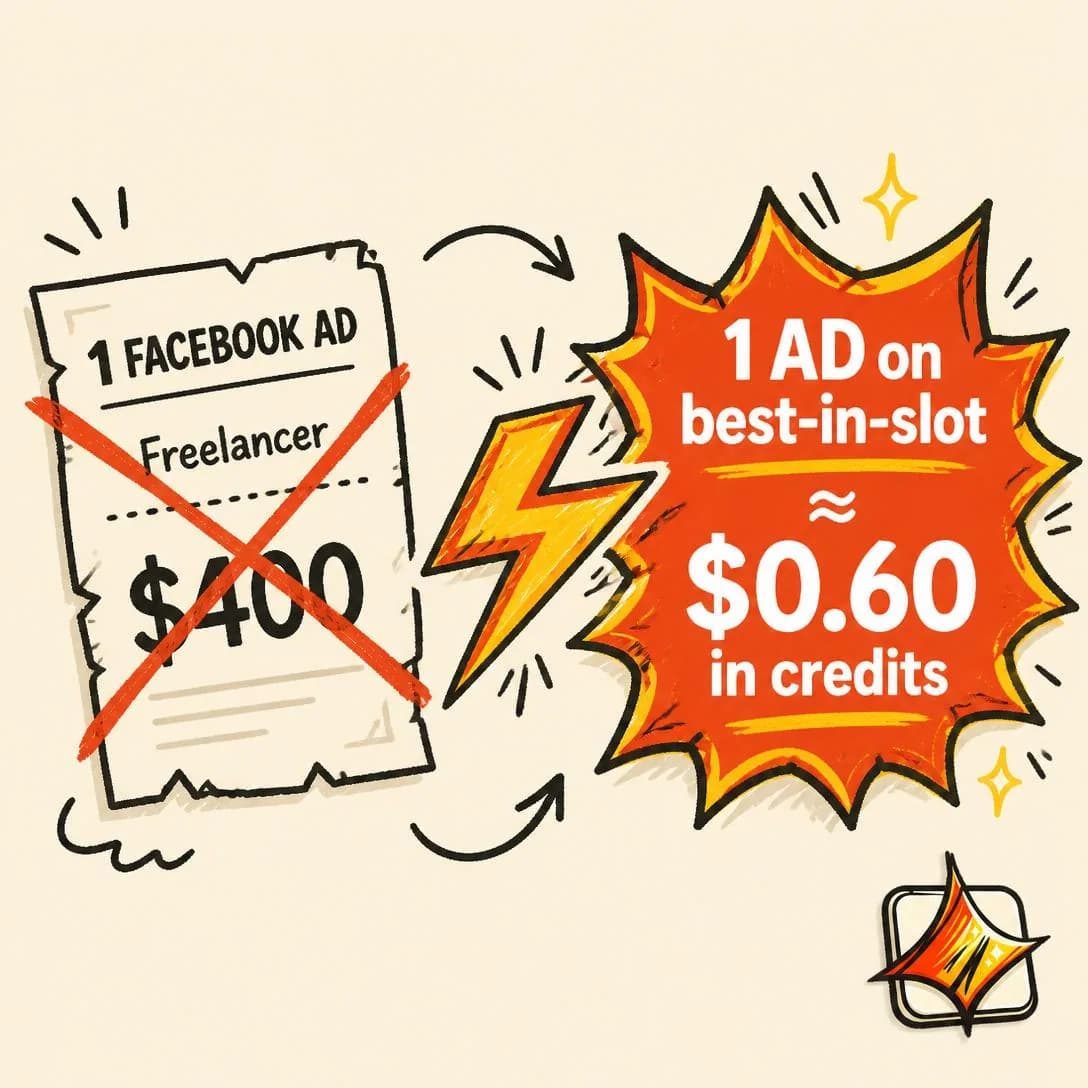
$400 freelancer vs $0.60 in credits
Finished ads in 60 seconds
Cost Per Day / Use
HotBreaks a large price into a smaller daily, monthly, or per-use amount.
Divides one large number into a small recurring one, which is a different move from anchoring even though both change how the price reads without changing what it is. Anchoring gives the reader a bigger number to compare against; this gives them a smaller one to think in. Large, infrequent numbers get audited — the reader stops and does the sum on whether $588 a year is worth it. Small, frequent ones tend to get nodded past, which is the entire mechanism this angle is spending.
The taxonomy’s weakness is precise: it feels salesy if the math is contrived, and the classic contrived version divides an annual price by 365 to arrive at a coffee-sized number that has nothing to do with how the reader actually experiences paying for the thing. Nobody is billed once a day, and dividing by a unit nobody uses is the tell that gives the whole angle away.
Divide by the unit that matches actual use instead — per ad generated, per campaign run, per month if that’s genuinely how the plan bills — and the number stops being a rhetorical trick and starts being a real description of the price. “Under a dollar an ad” works if the plan makes roughly that many ads a month; it stops working the moment somebody runs the numbers on their own account and gets a different figure.
- Works because
- Makes expensive products feel more accessible.
- Fails when
- Can feel salesy if the math is contrived.
Write one like this
- Fifty ads a month on the standard plan. That’s under a dollar each.
- Not $588 a year. Eleven angles tested every month for less than one boosted post costs today.
- One credit, one ad. Run the math on what you’re actually generating this month, not our example account.
- Under a dollar an ad, if you’re making the ads the plan is built for. Check your own count before you buy.
Don’t divide by a unit nobody experiences. A per-day number for something billed annually is the contrived version the taxonomy warns about, and readers who run their own numbers will catch the gap.
You spend $39 on coffee in four days. That same $39 could run 66 Meta ads a month instead. We're not saying skip the latte — just that your Starter plan costs less than one daily coffee and actually makes you money back. Paste your site, pick an angle, publish to Meta. All four ad sizes, full copy, paused until you say go. bestinslot.ai
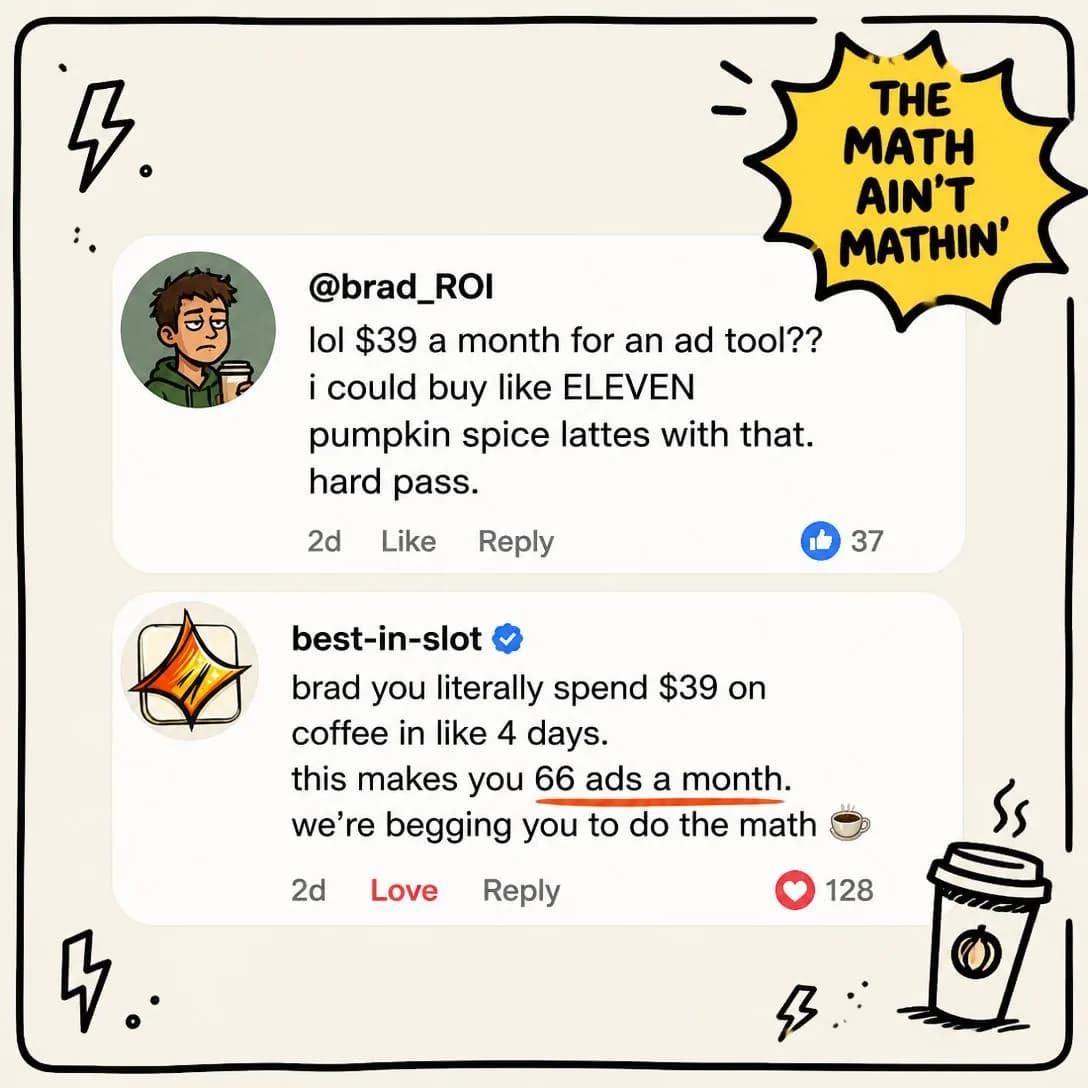
$1.30/day = 66 Meta ads per month
Start free. No card required.
Financing / Installments
HotFocuses on affordability through payment structure rather than absolute price.
A different operation entirely from Cost Per Day / Use, even though both end in a smaller number. That angle is arithmetic performed on the page — the total is still paid at once, only how it’s described has changed. Financing actually changes the payment: real, smaller charges, collected over real time, usually through a third party who’s taking on part of the risk. One is a reframe; the other is a mechanic, and confusing the two in copy makes a promise the checkout page then has to keep.
The taxonomy’s weakness is worth taking literally: financing does not fix weak underlying value, it just changes when the reader notices they made a bad call. A product worth the total will feel easier to buy in installments and stay felt-worth-it every month after. A product not worth the total produces exactly the same regret, spread across twelve invoices instead of concentrated in one — a worse experience for the customer and a slower-arriving one for you.
Fits highest-ticket purchases best — an annual plan, a large one-off credit pack — where the total is genuinely large enough that the schedule, not the size, is the actual objection. Spell out the real numbers: what each installment is, how many there are, what the total comes to if someone adds it up. The reader who does that math and finds it matches what you said is the reader who trusts the next number you show them, too.
- Works because
- Strong for high-AOV products.
- Fails when
- Does not fix weak underlying value.
Write one like this
- The annual plan is $348. Or $29 a month, same total, spread across the year.
- Three payments of $99 instead of $297 up front. Add it up — it’s the same number, just not all at once.
- Nothing about the price changes. Only when you pay it does.
- Twelve months, twelve equal charges, one plan. No interest, no catch — just a different schedule.
Don’t use financing to sell something that isn’t worth the total. Installments spread the regret across twelve invoices instead of removing it, and the twelfth one still arrives.
I almost paid a freelancer $2,000 for one Facebook ad last month. One. Then I did the math on best-in-slot: $39/mo = ~66 finished ads. That's 59 cents per ad. Not per invoice. Per ad. Why does no one talk about it this way? You're not buying a retainer, you're buying credits — and you only spend when you actually make an ad.
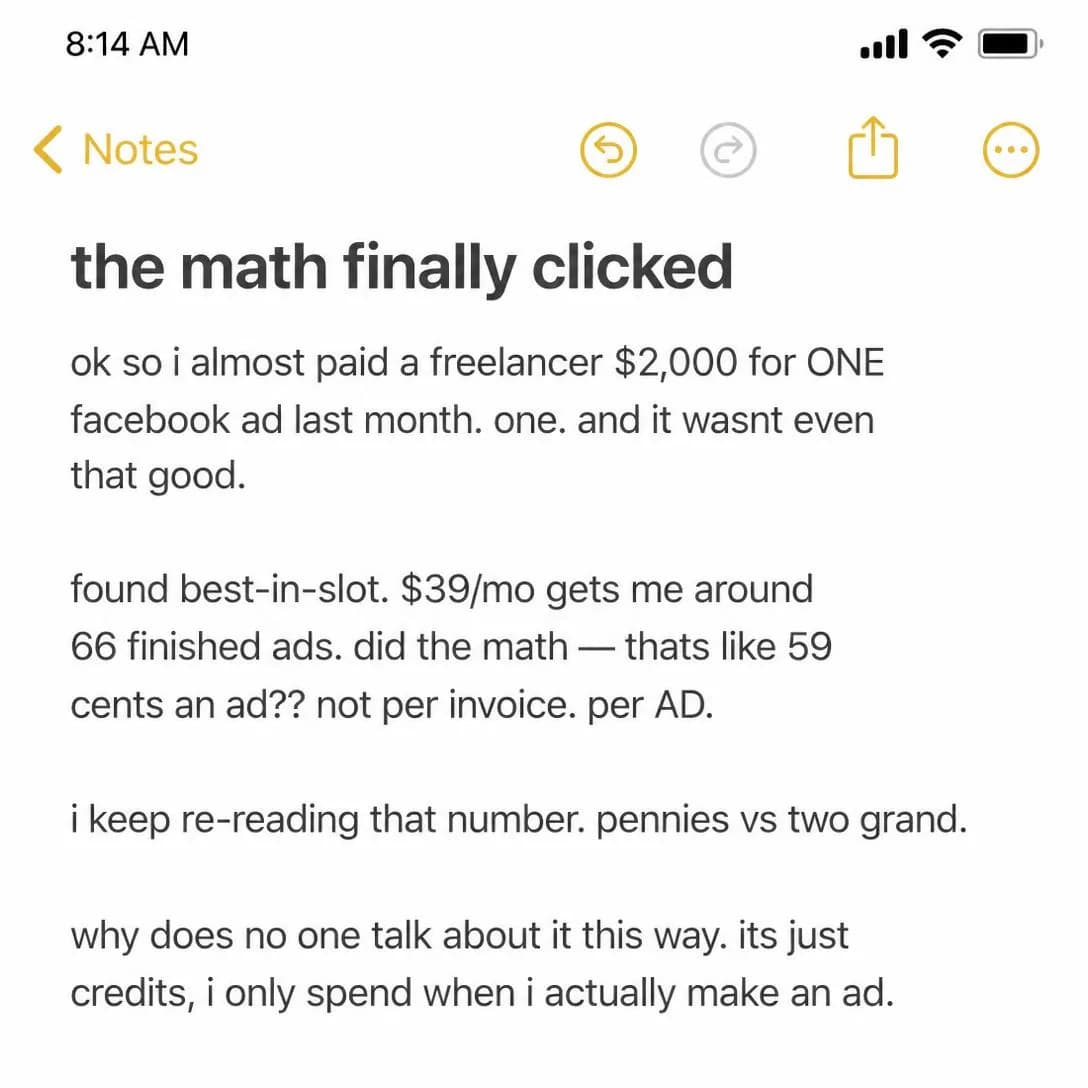
59¢ per ad, not $2K per invoice
Best in every slot.
Subscription Savings
HotShows the economic advantage of recurring purchase or subscription.
Shows the economic case for committing to a recurring purchase instead of paying per use — the annual plan against the monthly one, the standing order against buying credits piecemeal every time they run out. The mechanism is straightforward: consistent volume is worth more to you than sporadic volume, and this angle is the honest version of sharing that math with the customer instead of keeping the discount internal.
It sits in direct tension with No Commitment (issue #6), and it’s worth naming rather than pretending it isn’t there: No Commitment sold cancel-anytime as the reason it was safe to start, and Subscription Savings now asks that same reader to commit to exactly the recurring purchase it promised was optional. Not a contradiction if sequenced correctly — No Commitment earns the trial, Subscription Savings earns the upgrade to annual once the product has proven it’s worth committing to — but running both at a cold reader in the same campaign undercuts each other, because one is arguing for the exit and the other is arguing against using it.
The taxonomy’s weakness is commitment concerns, and the fix is concrete math plus an explicit reminder that leaving is still real. Show the monthly-equivalent price next to the annual one so the saving is a number, not an adjective, and say plainly that the cancellation terms from the plan they already trust still apply. A saving that arrives bundled with a locked contract reads as a trap; the same saving next to a visible exit reads as a reward for staying somewhere they were always free to leave.
- Works because
- Encourages retention and lifetime value.
- Fails when
- Adds commitment concerns.
Write one like this
- $29 a month, or $290 a year — two months free for committing to what you were already going to do.
- Same cancel-anytime terms. The annual plan just costs less per month for saying so up front.
- Credits at $0.30 each on demand. $0.19 each on the annual plan. Same product, better math for staying.
- Switching to annual doesn’t lock you in. It just stops charging you a premium for flexibility you weren’t using.
Don’t pair a real saving with a locked contract. Show the same exit terms the reader already trusts, or the saving reads as the price of giving up the thing that got them to buy in the first place.
You're overpaying for ad credits and don't even know it. Most people grab a $10 top-up when they need ads fast — 20¢ per credit. A $39/month plan? Under 4¢ each. That's 5X cheaper. Do the math before you buy.
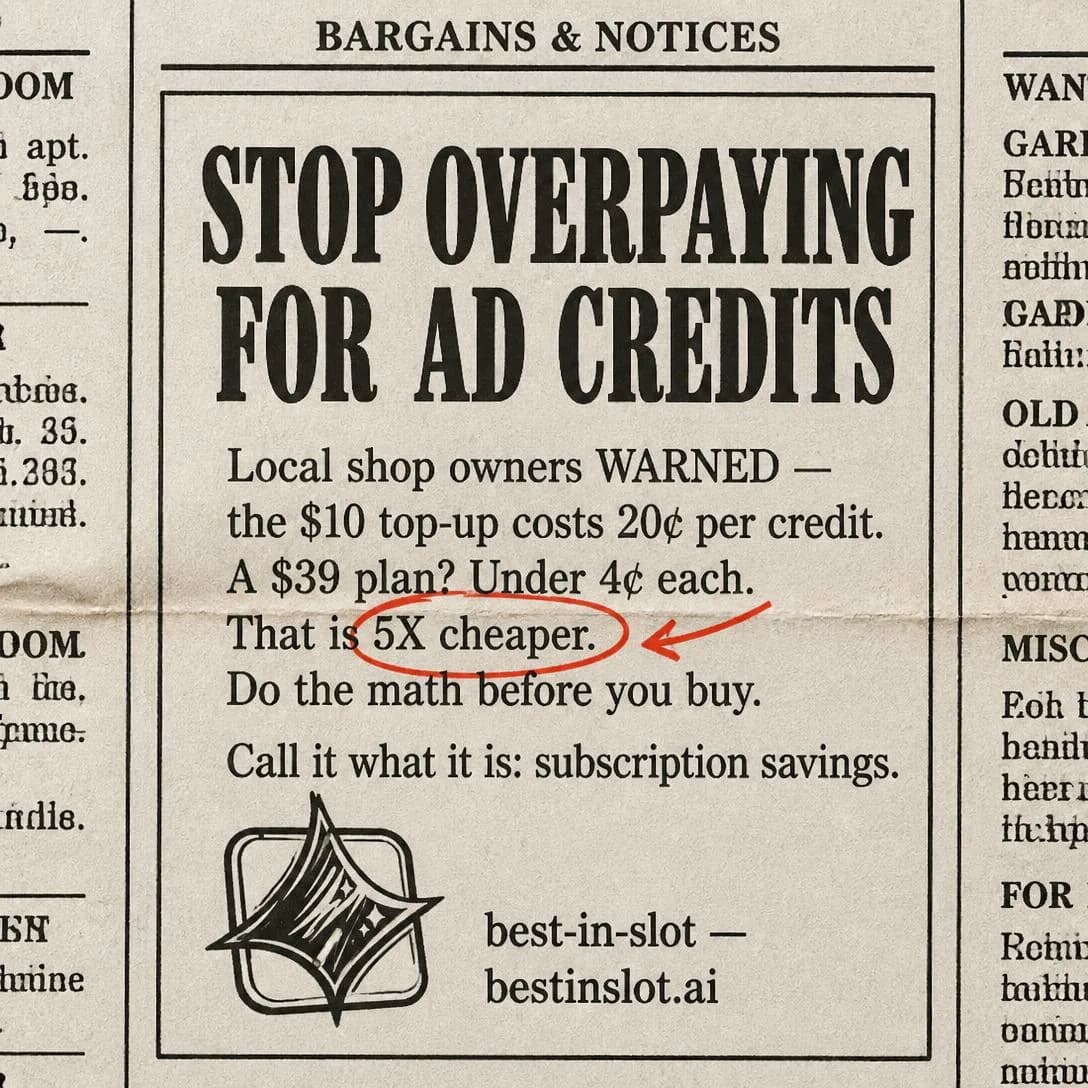
5X cheaper per credit on a plan
Plans start at $39/month
Testing them against each other
Testing this family against itself answers a different question than testing Problem & Pain or Proof & Trust does, because every reader who sees any of these eleven has already cleared the bars the earlier families exist to clear — they want the outcome and believe you can deliver it. What’s left to discover is which specific piece of arithmetic was actually holding them back: the total looked too big, the schedule felt wrong, the price didn’t look defensible next to nothing, or they simply hadn’t been given a reason to act this week instead of next month. Run a Discount against a Cost Per Day / Use against a Financing offer at the same warm audience, and the winner is a diagnosis of what kind of number problem your funnel actually has, not a copywriting preference.
Read a loss here differently than a loss anywhere else in the library, too. If nothing in this family moves the reader, the honest conclusion usually isn’t “try a bigger discount” — it’s that the number was never the objection, and the real one is sitting further up the funnel in Objection & Risk Reversal (issue #6) or was never answered by Proof & Trust in the first place. This family can make a good offer convert faster. It cannot make a reader who doesn’t believe you yet reach for their card, no matter how the number is arranged.
Pick an angle. Get the ad.
No credit card · 50 free credits (about 5 ads or Instagram posts)