
Ad Guides · Real estate agents × Instagram
Instagram ads for real estate agents
The housing special ad category takes your targeting apart. Here is what is left, and how to do the qualifying inside the ad instead — checked against Meta's own documentation this month.
Two things almost every guide to Meta ads for real estate agents tells you to do are not possible, and one thing they all tell you to avoid stopped being a problem in April. You cannot target a ZIP code, a neighbourhood or a metro area — none of them are selectable for a housing ad. You cannot build a lookalike audience from your past clients, because lookalikes are unavailable in this category outright. And you can, since HUD's Dear Colleague letter of 24 April 2026, share school-quality and neighbourhood-crime information with buyers, provided you do it consistently and without discriminatory intent. Guides written before that letter say the opposite, and most of them have not been touched since.
This page is the version with the documentation open. What follows is the playbook for a single agent or a small brokerage buying Instagram ads: which of the six objectives are worth anything once the category applies, which offers belong on Instagram rather than on Facebook, what actually survives in the ad set, where the click should land, and how to write an ad that finds the right person when the targeting cannot. Every platform claim is footnoted and dated at the bottom.
The shape of the problem is the mirror image of the dentist guide in this cluster, and it is worth stating in one sentence because everything else follows from it. A dental practice keeps every targeting lever and may not describe the reader in the copy. A real estate agent loses almost every targeting lever and may describe the reader all they like. So the qualifying moves: it comes out of the ad set, where it normally lives, and goes into the first line of the ad, where you have to do it by hand.
The ads shown below are real output, not mockups drawn for the argument. Six of them come from the ten on the real estate Instagram examples page, published exactly as generated, for businesses that do not exist. The prices, days-on-market figures and occupancy rates in them are invented — read them as placeholders marking where a number goes, and in your version that slot needs a figure you can pull from your own MLS and defend to a client.
Two things this page is not. It is not legal advice, and Fair Housing is the one area on this site where that sentence is doing real work: the category exists because of a Justice Department settlement over discriminatory housing ads, your state and local rules sit on top of the federal ones, and courts have held that racially-coded commentary about schools and crime can be evidence of discriminatory intent even when the underlying data is factual. And it is not a benchmark report — there are no cost-per-lead numbers here, because a figure from somebody else's market is worth less than the arithmetic you can do with your own, which is in the budget section.
Generate Instagram ads for your listings and your practice
Paste your site and best-in-slot reads it the way the invented brokerages above were read — services, clients, positioning — then writes the concepts, renders the images and drafts the copy. Free to start, no card.
Instagram is your age targeting, because the ad set no longer is
Start with the consequence nobody draws. A housing ad set has its age range fixed to 18 through 65+ and its gender set to all — those controls are simply not yours any more. But the two apps do not have the same people on them, so choosing which one to buy is choosing an age distribution. Pew's November 2025 survey puts Instagram at 80% of adults aged 18 to 29. Facebook reaches 74% of 50- to 64-year-olds and 57% of the over-65s, where Instagram reaches 40% and 19%. That is a targeting decision wearing a media-planning costume, and after the special ad category has finished with your ad set it is close to the only one left.
Which tells you what an Instagram budget is for in this industry: buyers and renters. First-time buyers who think they need twenty percent down, renters who have never run the numbers, relocating professionals, accidental landlords in their thirties who inherited a house and a phone that will not stop ringing. The seller side — downsizers, estate sales, the owner of a house that outlasted the family in it, the expired listing whose owner is sixty-two — skews to exactly the cohort where this app loses more than half its reach. Run those on the Facebook twin. An agent who buys listing-acquisition ads on Instagram because that is where they personally spend their evenings is paying a reach premium to talk to people's children.
The shape argument is the second thing, and in this category it fights you. Meta's ads guide recommends 4:5 for feed and full-screen 9:16 for Stories and Reels, and those are the only two shapes worth exporting here: unlike the Facebook cell of this cluster the 1.91:1 export has nowhere useful to go, because our own publisher routes that ratio to Facebook's right-hand column and search results and to no Instagram position. (Instagram Feed's technical requirements do accept up to 1.91:1 — corrected 7 September 2026; the shape is allowed, the surfaces built for it are Facebook's.) That matters more than it sounds. Every agent has a folder of listing photography, all of it landscape, shot on a short lens backed into the corner of a room precisely to make the room read as a room. Crop it to portrait and you throw away the width that was the entire point of the lens. Instagram rules out the one asset you already own, and it is doing you a favour, because that asset is also the one every competitor in your market is posting.
The third difference is what you are allowed to do with the ad set's remaining scraps, and it is not nothing. Detailed targeting is not switched off — behaviour and demographic targeting are prohibited and interest exclusions are prohibited, but a previously approved list of interests remains selectable. Guides say either "you can still target interests" or "all targeting is gone", and both are wrong in a way that costs you: the honest instruction is to open the picker, see what your account offers under this category, and expect a short list.
Which objective to buy
Ads Manager offers six — Awareness, Traffic, Engagement, Leads, App promotion and Sales — and for a real estate agent under the housing category, one of them does almost all the work and one of them is a trap that the dentist guide in this cluster actively recommends. That contrast is the fastest way to understand what the category has done to you.
Leads is the default and should be nearly all of the budget. Eight of the ten ads on the examples page were written for it, two for Traffic, and none for Sales or Awareness — which is not a stylistic preference but the category speaking. Nobody buys a house from an Instagram ad. The most an ad here can cause is a conversation, and Leads is the objective that optimises toward one.
Awareness is the trap. On the dentist page it is a rational buy, because a practice can draw a three-mile circle and a household either drives past the building or does not. Here the smallest circle you may draw is fifteen miles, you may not exclude anywhere inside it, and you may not narrow it by age. That is a few hundred thousand people, the overwhelming majority of whom are not moving this year, and Awareness is the objective that asks you to pay to be seen by all of them. Same button, opposite verdict, and the reason is entirely in the ad set.
- LeadsDefault
Nearly all of it. Choose the destination with care: a seller lead is a form, a buyer lead is usually a search page, and getting that backwards is the most expensive mistake in the destination section below.
- TrafficSometimes
For the two things that need to be read before they can be acted on — a new-construction phase release with a site plan and a price list, and the page that explains who you are. Both of the examples page's Traffic ads are one of those two.
- EngagementRarely
It optimises for the cheapest available reaction, and in an unqualifiable fifteen-mile audience the cheapest reaction is from people with no intention of moving. Its one defensible use is building a video-viewer pool to retarget, which is the stage where your ad set finally gets to be specific again.
- AwarenessNo
The inverse of the dentist guide, and the difference is the category. With a fifteen-mile floor, no age band and no exclusions, an Awareness buy is a bill for reaching people who are not moving. Brand-building in real estate is worth doing; this is not the instrument.
- SalesNo
There is no checkout. The only real exception is a business adjacent to the agency — a rental-management retainer sold online, say — and that is a different product with a different funnel.
- App promotionNo
Portals and large brokerages have search apps and can justify installs. An agent does not: you would be paying a stranger's install cost to deliver a listing feed they can already get in a browser.
What to advertise on Instagram, and the argument that wins it
The offer list is where a real estate campaign is actually decided, and it is the part that has to be written for this app rather than for the industry. Everything below skews to the people Instagram reaches — buyers, renters, younger landlords — with the seller-side offers marked as belonging to the Facebook twin so you are not tempted to run all of them everywhere.
Each row pins four decisions: who the offer is really for, which angle family argues it best (each is a page in the angle library, with the sub-angles spelled out), which objective buys it, and, where the examples page has one, a finished ad that shows the whole thing assembled. Two of the eleven belong to adjacent businesses — property management and short-term-rental management — because the same person very often runs them, and because they are the two offers on this list that do not depend on somebody deciding to move.
One structural note. Every one of these ads has to open on a person rather than on a property, and the reason is in the targeting section: the ad set cannot qualify anyone, so the first line has to. That is why the angle recommendations here lean on families that name a situation — Problem & Pain, Objection & Risk Reversal, Comparison & Positioning — rather than on the ones that describe a product.
First-time buyers and the down-payment myth
Leads- Who it is for.
- Long-term renters who believe they need twenty percent and have never actually run the numbers. The single largest audience this app can reach for you.
- Angle.
- Comparison & Positioning — The obstacle is a false belief rather than a missing product, so the ad's job is to correct arithmetic, not to sell a house. Myth-busting is the only family that can do that without sounding like a lecture, and it earns the click because the reader wants to know if they were wrong.
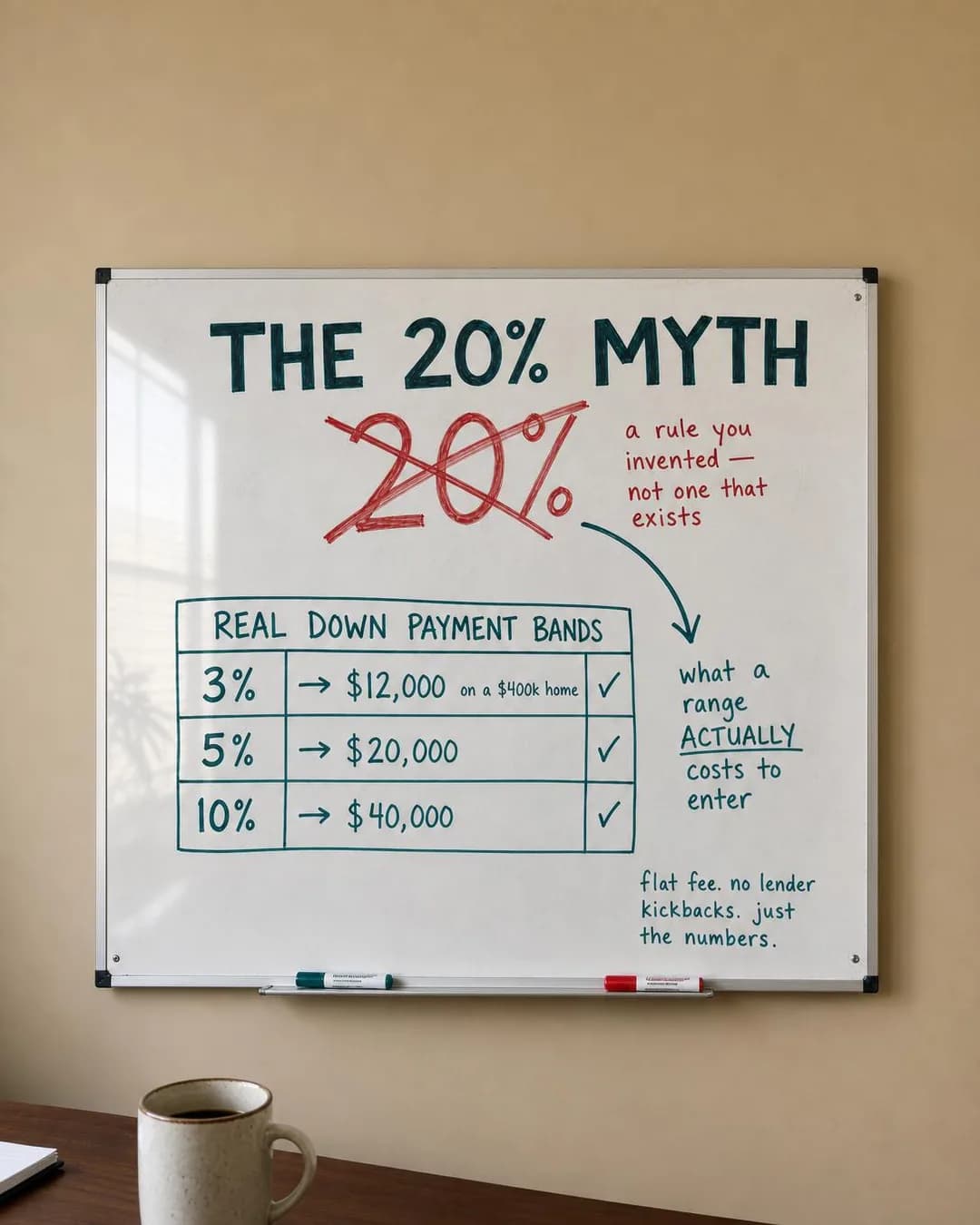 Example ad20% down is a myth you inventedSee the brief →
Relocation and out-of-state buyers
Leads- Who it is for.
- Someone who has taken a job three states away and has one weekend to find somewhere to live.
- Angle.
- Objection & Risk Reversal — The objection is not price, it is buying something they have stood in for four minutes. Name the process that removes the risk — filmed showings, a video walkthrough of every house they cannot attend — and the ad has answered the only question they have.
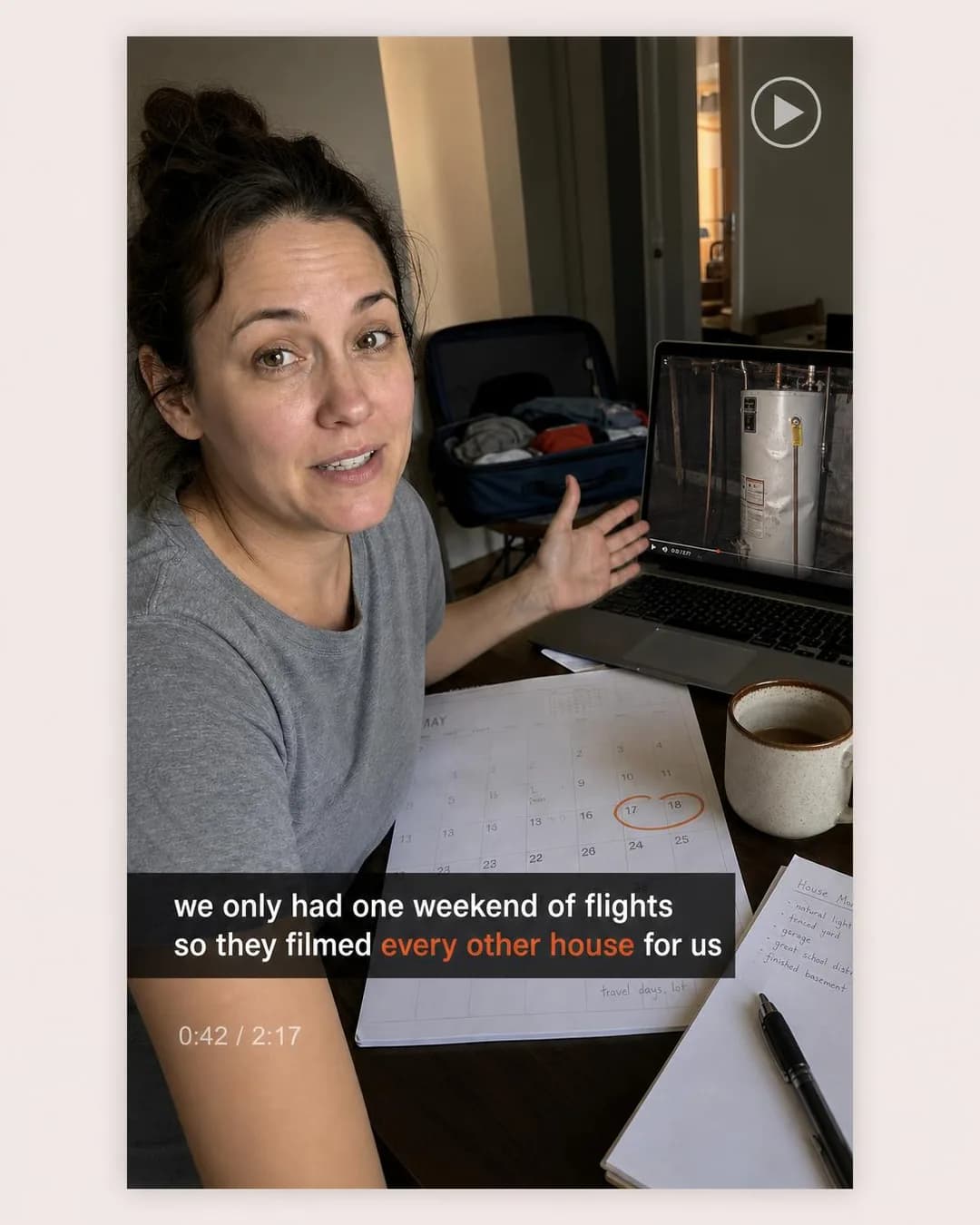 Example adOne weekend. Every other showing filmed.See the brief →
Property management for accidental landlords
Leads- Who it is for.
- Someone in their thirties who inherited a house, or kept one after moving, and is now a landlord who did not apply for the job.
- Angle.
- Benefit & Outcome — They are not looking for a service category, they are looking for the phone to stop. Sell the absence — the night nobody calls — rather than the management agreement, and pick the outcome the reader can picture from their own last bad week.
 Example adYour phone. Silent. Every night.See the brief →
Short-term rental management
Leads- Who it is for.
- An owner self-managing one listing, adjusting the nightly rate by hand and suspecting they are leaving money on the table.
- Angle.
- Product & Mechanism — This reader is operationally minded and already half-sold on the idea; what they doubt is that anyone can do it better than their spreadsheet. Show the mechanism — how the pricing actually resets — because with this audience the mechanism is the proof.
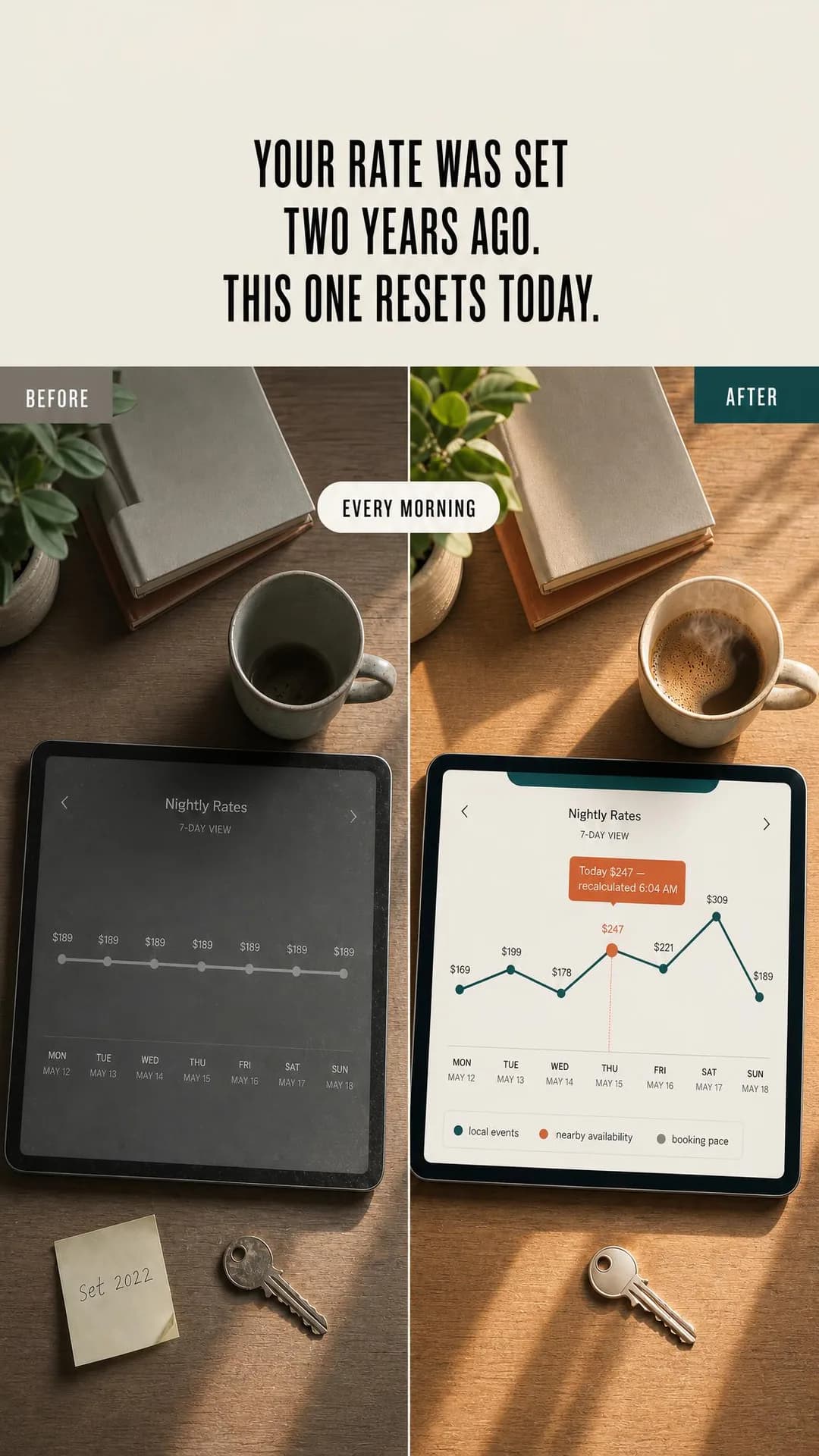 Example adDaily pricing that resets at dawnSee the brief →
New construction and phase releases
Traffic- Who it is for.
- Buyers who have lost three bidding wars on resale and want a house nobody else is fighting over.
- Angle.
- Scarcity, FOMO & Timing — The rarest thing in this industry: scarcity you did not invent. A phase release has a real, countable number of homes in it, and an ad that states the count is reporting rather than pressuring — which is also the only version of urgency worth running in a regulated category.
 Example ad5 of 11 Phase One homes remainSee the brief →
Home valuation and instant-offer comparisons
Leads- Who it is for.
- An owner who has been given a cash number by an iBuyer and has no idea what it nets against a listed sale.
- Angle.
- Offer & Economics — They already have one figure and no second one, so the ad's whole job is to supply the comparison. Anchoring works here because the anchor is already in the reader's head — you are not introducing a price, you are finishing a sum they started.
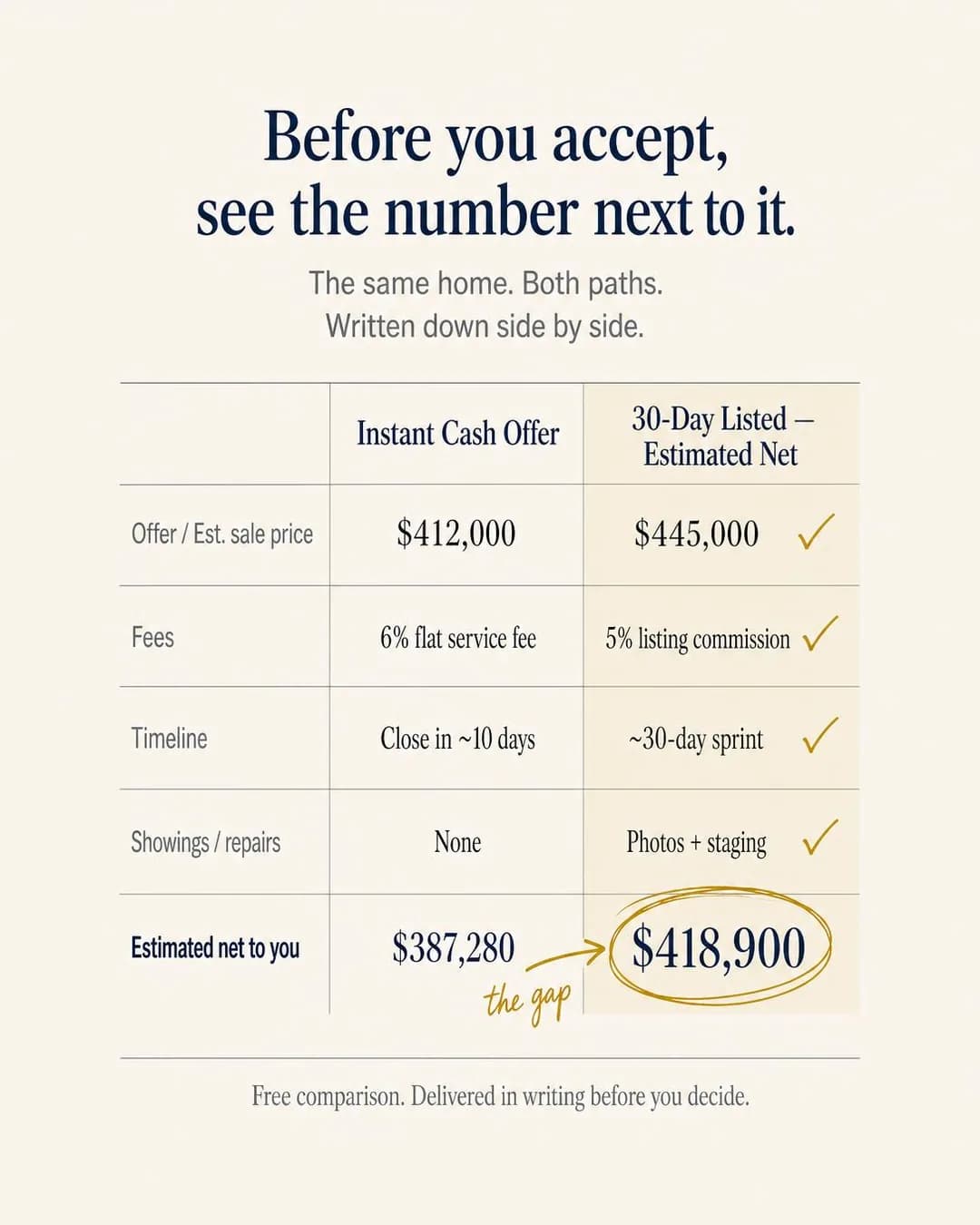 Example adSee both numbers before you decideSee the brief →
The street-level market report
Leads- Who it is for.
- Owners who are not selling this year but check what their street is doing, and will remember who sent the number when they are.
- Angle.
- Proof & Trust — The slowest offer on this list and the one that compounds. Statistical proof is the family for it because the report is the product: an unbroken run of monthly reports is a claim about reliability that no adjective can make.
 Example ad144 reports. Zero skipped months.See the brief →
Expired and withdrawn listings
Leads- Who it is for.
- A seller whose listing came off the market unsold and has been told, repeatedly, that the price was the problem.
- Angle.
- Problem & Pain — Reframing the misdiagnosis is the whole ad — the failure had a cause, and it was probably not the number. Note this is a seller offer on a buyer's platform: it is here because the examples page demonstrates it, and it belongs on the Facebook twin where its audience actually is.
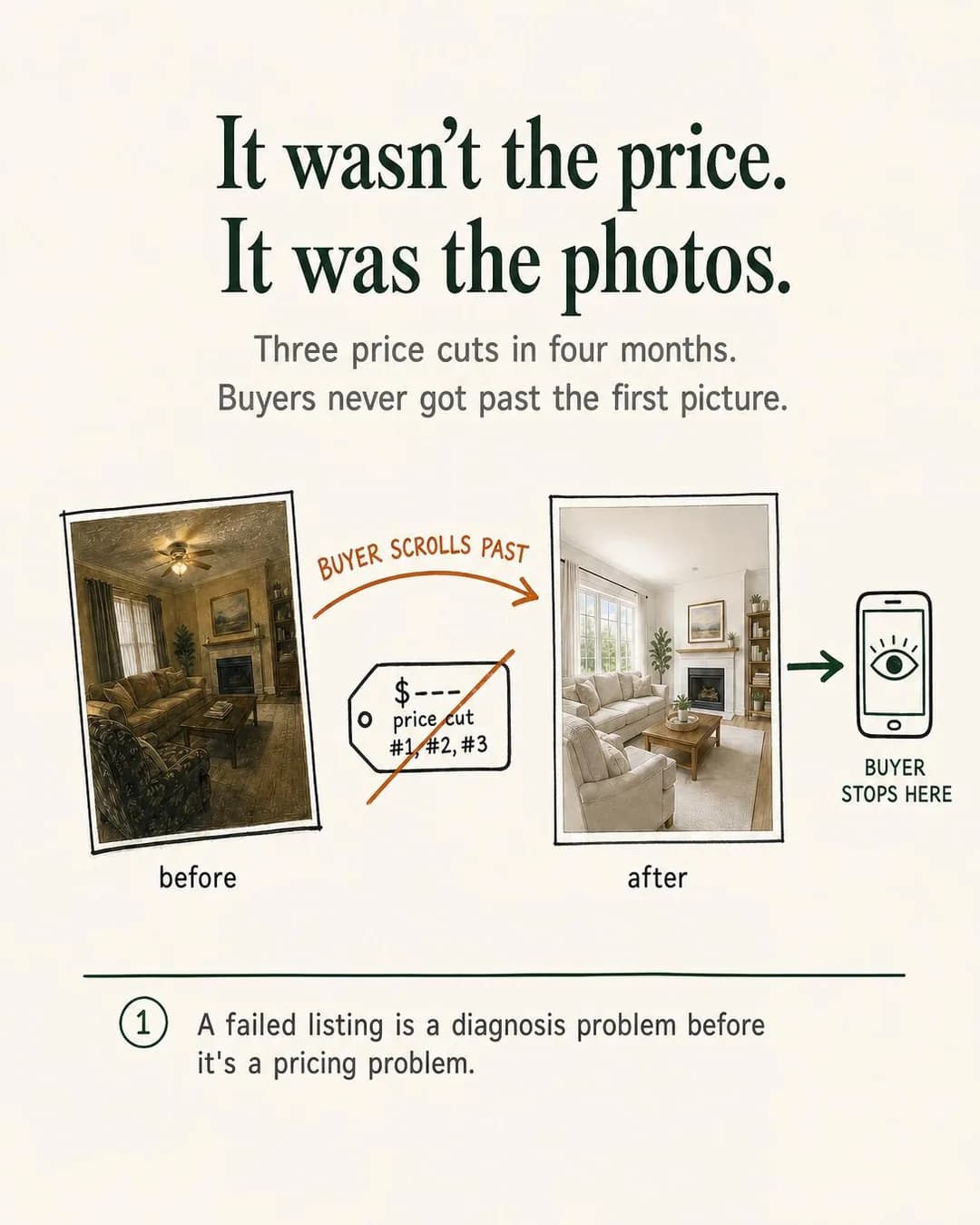 Example adIt wasn't the price. It was the photos.See the brief →
Downsizing and estate sales
Leads- Who it is for.
- Owners of a house that outlasted the family in it, usually coordinating siblings and a deadline nobody chose.
- Angle.
- Identity & Emotion — The transaction is the smallest part of what they are dreading. Relief is the argument — one coordinator instead of three vendors — and it is the offer on this list where a warm, unhurried ad beats a sharp one. Also a Facebook-first offer, for the same age reason as the row above.
 Example adOne coordinator. Not three vendors.See the brief →
The agent or the brokerage itself
Traffic- Who it is for.
- Sellers who hired a well-known name and were handed to an assistant they never chose.
- Angle.
- Story & Founder POV — The only offer here that is not a transaction, and the one thing a two-person brokerage can say that a large one structurally cannot: the person in the ad is the person who turns up. Buy it as Traffic and let the page do the work.
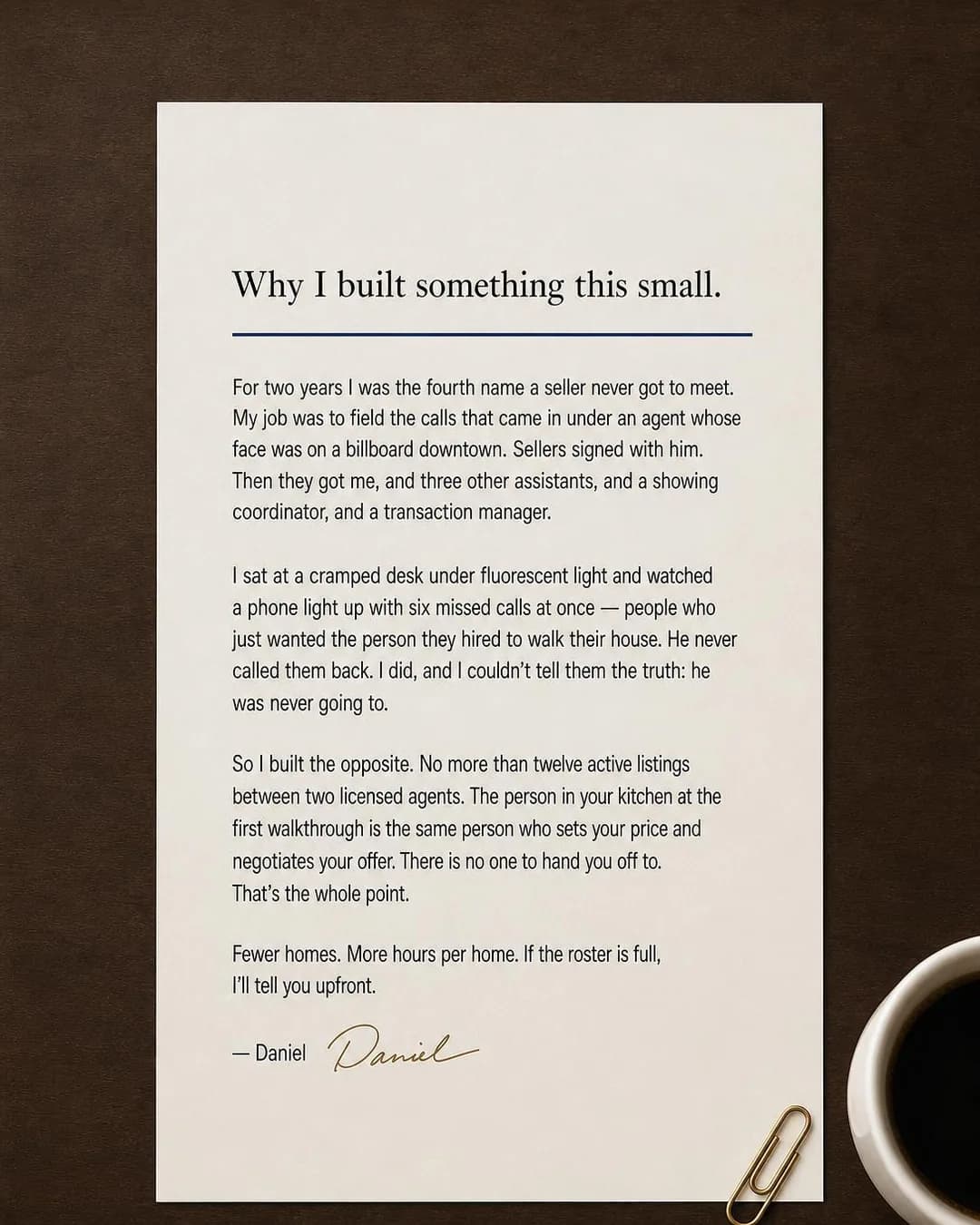 Example adTwo agents. Twelve listings. No hand-offs.See the brief →
Just listed and open houses
Leads- Who it is for.
- Nominally buyers in the area; in practice, the sellers watching how you market a house before they pick who lists theirs.
- Angle.
- Scarcity, FOMO & Timing — Worth being honest about, because it is the ad every agent runs and the one whose value is misattributed. As a buyer-acquisition instrument in a fifteen-mile circle it is weak — most people seeing it are not buying that house. Its real return is seller-facing proof, so judge it as marketing to your next listing appointment and budget it accordingly.
No example ad for this offer on the examples page yet.
What the housing category takes, and the little it leaves
Any ad promoting the sale or rental of housing must run in the Housing special ad category — one of exactly four Meta accepts, alongside employment, financial products and services, and social issues, elections and politics. Declaring it is not a choice you get to weigh: Meta's classifiers will apply the category from the creative whether or not you ticked the box, and finding out that way means finding out after your ad set has been rebuilt underneath you.
What it removes is most of an ad set. Age is fixed to 18 through 65+ and gender to all. Lookalike audiences are unavailable. Saved audiences are unavailable. Postal codes, neighbourhoods, subcities, subneighbourhoods, metro areas, small geographic areas and electoral districts are all unsupported as location types, and any city, address or dropped pin carries a minimum radius of fifteen miles or twenty-five kilometres in the US and Canada, fifteen kilometres in Europe. Two restrictions here are almost never mentioned and both matter: you may not exclude a location either, so there is no carving the far side of the highway out of your circle; and behaviour and demographic targeting are prohibited along with interest exclusions, leaving only a previously approved list of interests selectable.
Customer-list audiences are the fiddly case and the one to check rather than assume. They are not simply gone — a list carries an eligibility flag, and a business admin has to review and accept Meta's non-discrimination policy before the account can run these ads at all. Website and engagement custom audiences are the interesting silence: Meta documents the lookalike and saved-audience removals explicitly and says much less about those, so the honest instruction is to build one and see whether the ad set accepts it, rather than trusting a guide. Including this one.
All of which means the ad set can no longer tell you who saw the ad, so the ad has to. Every ad on the examples page opens by naming a person — sellers whose listing expired, renters who think they cannot buy yet, the owner of a house that outlasted the family in it — and on any other page in this cluster that would be a note about craft. Here it is the last targeting instrument you own, and it is inside the picture.
- Special ad categoryRequired
- Housing is one of the four. Not declaring it does not avoid it — the classifiers apply it from the creative, and the failure mode is an ad set that stops behaving the way you configured it.
- AgeGone
- Fixed to 18–65+. Which is why the choice between this app and Facebook is the closest thing to an age lever you have left; see the section above.
- GenderGone
- All genders. Omit the parameter or set it to the default.
- Radius15-mile floor
- Fifteen miles or twenty-five kilometres from any city, address or pin in the US and Canada; fifteen kilometres in Europe. There is no smaller circle, so a suburban agent and the city forty minutes away are buying overlapping audiences.
- ZIPs and neighbourhoodsUnavailable
- Postal codes, neighbourhoods, subcities, subneighbourhoods, metro areas, small geographic areas and electoral districts are all unsupported location types. Every guide recommending ZIP-level targeting for listings predates this and has not been checked since.
- Location exclusionsDisallowed
- The under-reported one. You cannot subtract an area from your circle, which means the usual trick of buying wide and excluding the parts you do not serve is unavailable to you specifically.
- Lookalikes and saved audiencesUnavailable
- Both, explicitly. The past-client lookalike that half the advice in this industry is built on cannot be created for a housing ad set.
- Detailed targetingNarrowed
- Not switched off and not intact: behaviour and demographic targeting are prohibited, interest exclusions are prohibited, and what remains is a previously approved list. Open the picker before you plan around it.
- Customer listsCheck first
- Carries an eligibility flag, and a business admin must accept the non-discrimination policy before the account can run housing ads. Sort that out before a campaign is due to launch rather than on the day.
Instant Form or landing page?
The answer splits by side of the transaction, which is unusual — most industries have one right answer — and getting it backwards is the most expensive mistake available on this page.
Seller-side offers are a form. A valuation, an instant-offer comparison, a market report: the reader wants a number and you want a conversation, and there is no page that improves on asking. Use the Instant Form's higher-intent type, which adds a review step letting the person confirm what they entered, and add two or three qualifying questions — timeframe, address, whether they have already had an offer. You will get fewer leads and more of them will pick up the phone, which is the trade you want in a business where you personally follow up every one.
Buyer-side offers are a page, and specifically a page they can search. A buyer who taps an ad about first-time purchasing and lands on a form has been asked to hand over their phone number in exchange for nothing; the same buyer landing on live inventory with a filter has something to do for the next twenty minutes, and they register when they want to save a search. That is a better lead and it costs you nothing to collect. The exception is relocation, where the offer genuinely is a conversation rather than a listing feed.
For both, do not send anyone to a brokerage homepage. The ad made one specific promise — the twenty percent figure was wrong, your listing did not fail on price — and a homepage answers a different question. If there is no page for the offer, a form that matches the ad beats a beautiful site that does not.
The recommendation: Sellers get an Instant Form on “higher intent” with two or three qualifying questions; buyers get a searchable inventory page, not a form; nobody gets the homepage.
Creative direction
The rule that changed most recently is the one worth leading on, because almost every competing guide is still wrong about it. On 24 April 2026 HUD issued a Dear Colleague letter (HUD No. 26-028) stating that sharing neighbourhood crime rates and school-quality information is permissible when that information is shared consistently and without discriminatory intent, and the National Association of REALTORS® updated its guidance to match. The blanket “never mention schools” advice that has circulated for a decade is no longer the rule. What has not changed is the thing underneath it: the requirement is consistency and objectivity — the same kind of neighbourhood information offered to every client regardless of their background, factual rather than editorial — and courts have found that racially-coded commentary about crime and schools can be evidence of discriminatory intent even where the data itself is accurate. So it is sayable. It is not sayable selectively, and it is not sayable with an opinion attached.
The second thing is the opening line, and it carries more weight here than on any other page in this cluster. Because the ad set cannot qualify anyone, the first sentence is your targeting: it has to make the right person recognise themselves within about a second and let everybody else scroll past without costing you a click. Open on the situation, not the house. “It wasn't the price. It was the photos.” finds a specific person. A wide-angle living room finds nobody.
Third, shoot for the shape rather than cropping into it. Instagram gives you 4:5 and 9:16 and nothing else, and your existing listing photography is landscape by design. Reshoot the two or three frames the ad actually needs vertically, or build the ad out of something that is not a room — a document, a calendar, a comparison table, a phone that is not ringing. Six of the ten ads on the examples page are not photographs of houses at all, which is not a stylistic accident.
- Open on the person, not the property. The first line is the only targeting you have left.
- Render at 4:5 for feed and 9:16 for Stories and Reels. Skip 1.91:1 — Instagram Feed accepts it as its maximum ratio, but that shape is built for Facebook's right-hand column and search results, and our publisher routes it there. Meta's spec is 1440 × 1800, the same as Facebook Feed, so one export serves both — but the aspect-ratio tolerance here is 1% against Facebook's 3%, so a crop that is a few pixels out passes there and not here.
- Write to 40 characters of headline and 125 of primary text — Meta's recommendations for an Instagram Feed image ad. The run on the Browse page does not: one headline of ten is over, and all ten primary texts are, one of them at 573 characters. That matters more here than anywhere else in this cluster, because the opening line is your targeting — if it falls behind the truncation, the ad has stopped qualifying anyone.
- Do not crop landscape listing photography to portrait. It was shot wide on purpose; reshoot vertical or build the ad from something other than a room.
- School and crime information is allowed again — shared consistently, factually, and with every client rather than selected ones.
- Never imply who a neighbourhood is for, or who would “fit in”. That is steering, and it is the line the whole category exists to police.
- Put a real number in, and make it one you can pull from your own MLS and defend in a listing appointment.
- Show the agent. In a category where the ad set is anonymous, the face is the only continuity a reader gets between the ad and the appointment.
- Say what the reader gets before you say what you want. Fifteen miles of unqualified audience punishes a slow open harder than any other setting on this site.
Funnel structure
Three stages, and the middle one is doing more work here than in any other cluster. Cold is a blunt instrument by regulation — a fifteen-mile circle you cannot narrow, cannot exclude from and cannot age-band — so its job is not efficiency, it is finding the people who react. Warm is where the ad set finally gets to be specific again, and it is where a housing campaign actually converts.
Which means the usual budget instinct is wrong here. In most industries you spend most of the money cold and retarget on the remainder; in this one, plan for the warm stage to earn its keep and resist the temptation to pour everything into a circle that cannot be aimed.
Cold
≈55% of budgetAudience. The fifteen-mile circle, category declared, no age, no exclusions. Whatever remains of the approved interest list, if anything useful does.
Running. Two or three offer ads that open by naming a person. Leads, or Traffic for the two that need reading first.
Warm
≈35% of budgetAudience. Video viewers, profile and post engagers, site visitors — subject to what your account will actually accept under the category, which is worth testing before you plan around it.
Running. The proof and the mechanism: the market report, the agent, the process that removes the risk. This is where the leads come from.
Sphere
≈10% of budgetAudience. Past clients and your database, as a customer list — eligibility flag and the non-discrimination acceptance sorted out in advance.
Running. The monthly report and the anniversary touch. Slow, cheap, and the source of most referral business in this trade.
Budget and testing
The arithmetic every advertiser should do is the learning-phase one, and in this category it comes out worse than anywhere else on this site. Meta's delivery system needs roughly 50 optimisation events per ad set per week to leave the learning phase; below that an ad set sits in “learning limited”, which is not a penalty but is an admission that the system cannot optimise with what it has been given. Multiply your own cost per lead by 50 and that is the weekly spend at which one ad set is working with full information. Housing leads are expensive precisely because the audience cannot be qualified before delivery, so that number is high — and it is the argument for one cold ad set with several ads in it rather than one ad set per offer.
Do not respond to that by widening. Widening is what the category already did to you, and the only lever left that improves cost per lead is the creative — specifically the opening line, which is where the qualifying happens. An agent who doubles the radius has bought more of the same problem; an agent who rewrites the first sentence has bought targeting.
Then leave it alone. Pausing an ad set, or changing its optimisation event, audience or creative, counts as a significant edit and restarts the learning phase, and budget or bid changes can too depending on their size. Daily adjustment feels like management and is the largest self-inflicted cost in a small account.
Seasonality is sharper in this industry than in most and it is regional, so plan against your own market's calendar rather than a national one. The listing season and the relocation season are the two moments where the same budget buys materially more, and the year-end lull is the right time to run the slow offers — the market report, the agent page — that compound rather than convert.
- Test the opening line, not the photograph. It is the only part of the ad doing your targeting.
- One change at a time, with seven days to read it — the learning phase is measured over a week, so anything shorter is noise.
- Judge on appointments held, not leads collected. A fifteen-mile circle generates enquiries from people who are not moving, and lead count is the metric that flatters that hardest.
- Check whether the ad set ever left learning before blaming the creative. In this category more of them do not than do.
- Track which offer produced the appointment, not just which ad got clicked. Buyer offers and seller offers convert on completely different timelines and averaging them together hides both.
Six of these ads, in full
Every ad below was generated by best-in-slot for a real estate business that does not exist, with its audience, angle and objective pinned before the run — and published exactly as it came back. They are six of the Instagram examples for a real estate business; the rest, with the full brief and the alternate headlines behind each one, are on that page.
Comparison & Positioning · 4:5 · Leads
20% down is a myth you invented
Written for: Long-term renters who think they cannot buy yet.
The full brief and why it works →
Objection & Risk Reversal · 4:5 · Leads
One weekend. Every other showing filmed.
Written for: Buyers relocating from out of state.
The full brief and why it works →
Benefit & Outcome · 9:16 · Leads
Your phone. Silent. Every night.
Written for: Accidental landlords managing one house.
The full brief and why it works →
Product & Mechanism · 9:16 · Leads
Daily pricing that resets at dawn
Written for: Owners self-managing one short-term rental.
The full brief and why it works →
Problem & Pain · 4:5 · Leads
It wasn't the price. It was the photos.
Written for: Sellers whose listing expired unsold.
The full brief and why it works →
Identity & Emotion · 4:5 · Leads
One coordinator. Not three vendors.
Written for: Owners of a house that outlasted the family in it.
The full brief and why it works →
Mistakes specific to this trade
The first four are all the same mistake wearing different hats: planning a campaign around an ad set that the housing category will not let you build.
Planning around ZIP-code targeting
Postal codes are an unsupported location type for housing ads, along with neighbourhoods, subcities, metro areas and electoral districts. This is the single most common recommendation in real estate ad advice and it has been impossible for years. If a strategy starts with “target these three ZIPs”, it is not a strategy you can buy.
Building a lookalike from past clients
Lookalike audiences are unavailable in this category, full stop. The past-client seed list is the backbone of most agency proposals in this industry and it cannot be used for the ads those proposals are about.
Assuming you can exclude the parts you do not serve
You cannot. Location exclusion is disallowed for housing, so the standard trick of buying a wide radius and subtracting the awkward half is unavailable. Plan for the whole circle, because you are paying for the whole circle.
Not declaring the category and hoping
Meta's classifiers apply it from the creative anyway. The only thing not declaring buys you is the surprise of discovering that your ad set's age range and audiences were rebuilt without you, mid-campaign, at whatever point the classifier caught up.
Still refusing to mention schools
HUD's letter of 24 April 2026 says school-quality and crime information may be shared when shared consistently and without discriminatory intent, and NAR updated its guidance accordingly. Buyers ask about schools constantly; an agent who cannot discuss them is competing with agents who now can. What is still prohibited is doing it selectively or with editorial attached.
Describing the kind of person a neighbourhood suits
“Perfect for young families.” “A great fit for people like you.” This is steering, it is the conduct the special ad category exists because of, and it does not stop being steering when it is warm and well-meant. Describe the house and the process. Never the neighbours.
Opening the ad on a wide-angle living room
It is the reflex, and it wastes the only targeting instrument you have. Nobody scrolling recognises themselves in a photograph of a room. They recognise themselves in a sentence about a listing that expired, or a down payment they cannot save, and that recognition is what the ad set is no longer able to do for you.
Cropping the listing shoot to portrait
Property photography is shot wide on a short lens so a room reads as a room. Cropping to 4:5 throws away exactly the width that was the point, and the result looks like a photograph of a wall. Reshoot the two frames the ad needs, vertically.
Buying Awareness because “people need to know my name”
They do, and this is the wrong way to pay for it. A fifteen-mile unqualifiable circle is the most expensive audience on this platform to buy impressions against. Build recognition with the slow offers — the street-level report, the agent's own page — where the click at least tells you who was interested.
Judging the campaign on lead volume
The category guarantees that a large share of your enquiries come from people who are not moving, so lead count is the number most flattered by the thing that is actually wrong. Count appointments held, and count them by offer.
Running listing-acquisition ads on Instagram
Sellers, downsizers and expired-listing owners skew to the cohort where Instagram reaches 40% of 50- to 64-year-olds and 19% of the over-65s, against Facebook's 74% and 57%. Since the category took your age targeting away, the app is the age decision — and this is the offer most often run on the wrong one.
Questions
- Do real estate ads have to use Meta's housing special ad category?
- Yes, if the ad promotes the sale or rental of housing. It is one of exactly four categories Meta accepts, alongside employment, financial products and services, and social issues, elections and politics. Declaring it is not optional in practice either — Meta's classifiers apply the category based on the creative whether or not you selected it, and having that happen mid-campaign is worse than doing it deliberately at setup.
- Can I target specific ZIP codes or neighbourhoods for a listing?
- No. Postal codes, neighbourhoods, subcities, subneighbourhoods, metro areas, small geographic areas and electoral districts are all unsupported location types for housing ads, and any city, address or pin carries a minimum radius of 15 miles or 25 kilometres in the US and Canada (15 kilometres in Europe). You also cannot exclude a location, so buying wide and subtracting is not available either.
- Can I build a lookalike audience from my past clients?
- No — lookalike audiences are unavailable for housing campaigns, and saved audiences are too. Customer-list audiences are a separate question: they carry an eligibility flag and a business admin has to review and accept Meta's non-discrimination policy before the account can run these ads. Sort that out before a launch date, not on one.
- Is it true that I can't mention schools or crime rates?
- Not since 24 April 2026. HUD's Dear Colleague letter (HUD No. 26-028) says sharing neighbourhood crime and school-quality information is permissible when shared consistently and without discriminatory intent, and NAR's guidance was updated to match. The requirements underneath still bind: the same kind of information for every client, objective and factual rather than editorial, and no racially-coded commentary — courts have treated that as evidence of discriminatory intent even when the underlying data is accurate.
- Instagram or Facebook for a real estate agent?
- It depends which side of the transaction you are buying. Because the housing category fixes your age range at 18–65+, the platform choice is effectively your age targeting: Instagram reaches 80% of adults aged 18–29, which is where first-time buyers, renters and younger landlords are. Facebook reaches 74% of 50- to 64-year-olds and 57% of the over-65s — sellers, downsizers and expired listings. Run buyer-side offers here and listing acquisition there.
- Lead form or landing page?
- Seller offers are a form — a valuation or an instant-offer comparison ends in a conversation, so use the Instant Form's higher-intent type with two or three qualifying questions. Buyer offers are a searchable inventory page: a buyer who lands on a form has been asked for their number in exchange for nothing, while a buyer who lands on live listings has twenty minutes of something to do and registers when they want to save a search. Neither gets the homepage.
- How much should an agent spend?
- Do the arithmetic rather than copying a figure. Meta needs roughly 50 optimisation events per ad set per week for delivery to leave the learning phase, so multiply your own cost per lead by 50 to get the weekly spend at which one ad set is fully optimised. In this category that number is high, because the audience cannot be qualified before delivery — which is an argument for consolidating into one cold ad set and improving the opening line, not for widening the radius.
Sources
Every platform claim on this page was read against these on . Meta’s policies move; if one of these disagrees with this page, it is right and we are stale.
- Meta Marketing API — special ad categories and housing targeting restrictions
- Meta Marketing API — audiences in special ad category campaigns
- Meta Business Help Centre — about ads for housing
- National Association of REALTORS® — FAQs on steering, crime and schools (HUD Dear Colleague letter No. 26-028, 24 April 2026)
- Meta Business Help Centre — choosing Ads Manager advertising objectives
- Meta Business Help Centre — about the learning phase
- Meta Business Help Centre — significant edits and the learning phase
- Meta Business Help Centre — about Instant Form types
- Meta ads guide — image ad specifications, Instagram feed
- Pew Research Center — Americans' social media use, November 2025
That is the playbook. Now make the ads.
Paste your site. It reads your listings, your market and your brand, then writes the concepts, renders the images and drafts the copy — for a category where the ad set cannot do your targeting.
No credit card · 50 free credits (about 5 ads or Instagram posts)
Every angle recommended above is documented in the best-in-slot ad angle library, and the ads are from real estate instagram ad examples. More industries are at all ad guides.