
Ad Examples · Real estate agents × Instagram · 10 ads
Real estate Instagram ad examples
Ten finished ads for real estate businesses — with the audience, angle and objective behind each one, because we generated them rather than collected them.
Pages of real estate ad examples are mostly two things, and neither of them is an ad. One is the listing carousel: eight wide-angle interiors and a price, a brochure that stops working the day the house goes under contract. The other is the JUST SOLD graphic with a headshot in the corner, which is a scoreboard aimed at other agents. Both are collected as screenshots, and a screenshot cannot tell you the only things that transfer — who the ad was for, what it argued, and what it was supposed to make happen.
So these were not collected. Every ad below was generated with the audience, the angle and the objective chosen up front, which means the brief printed beside each one is the brief that actually produced it, not a guess written afterwards about someone else's work. The businesses are invented — ten of them, a relist specialist, a two-agent brokerage, a property manager, a townhome developer, a short-term rental operator, none of them real — so no brokerage's creative is being borrowed and no agent's face is being used.
Nothing was edited afterwards. The image, the body text, the headline and the four alternate headlines under each ad all came out of one run and are printed exactly as they arrived. That is the point: a page arguing that a machine can make a usable ad is worth nothing if a person quietly fixed the ads first.
This run went clean, which is worth saying because silence is the easy way to fake it. Ten ads, one pass, no regenerations: the apparel page in this cluster had to produce two of its ads a second time after an interrupted batch, and this one did not. Every image and every line below is a first attempt, and none was picked from a set of alternatives.
The numbers in them are invented too. Sold prices, days on market, occupancy rates and down payment figures belong to businesses that do not exist and are not research about any real market. Read them as placeholders showing where a real figure goes and how specific it has to be to carry an ad — in your version, that slot needs a number you can pull from your own MLS and defend to a client.
One thing you can read straight off the briefs before looking at a single image: not one of the ten was written for a Sales objective. Eight are Leads and two are Traffic. That is not a stylistic preference, it is the category — nobody buys a house from an Instagram ad, and the most an ad here can cause is a conversation. Every page on this site pins the objective before generating, and this is the page where the pinning tells you something about the industry rather than about the ad.
What changes because it is Instagram
Start with the spec, because in this category it fights you. Meta's ads guide recommends 4:5 for feed image ads and full-screen 9:16 for Stories and Reels; eight of the ads below are 4:5 and two are 9:16, exported at the sizes best-in-slot ships (1080 × 1350 and 1080 × 1920), each rendered at its own shape rather than cropped into it. Real estate is the one industry on this site whose native asset is the wrong shape: property photography is shot wide, a short lens backed into the corner of a room to make the room read as a room, and every frame that comes back from a listing shoot is landscape. Crop it to portrait and you throw away the width that was the entire purpose of the lens. Facebook's feed will still take a 1:1 or a 1.91:1 link ad and let a listing photo be a listing photo; Instagram will not, and that constraint is doing you a favour — it rules out the one asset every agent in your market already has a folder of.
The half that matters more is not a preference, it is a legal regime, and it is why a real estate ad is a different object from a SaaS ad or an apparel ad. Any ad that promotes the sale or rental of housing has to run in Meta's Housing special ad category, and declaring it removes most of the ad set: age is fixed to 18–65+, gender to all genders, lookalike audiences are unavailable, behaviour and demographic targeting are restricted, ZIP codes, neighbourhoods, subcity areas and metro areas are not selectable at all, and location selection has a floor of a 15-mile / 25-kilometre radius in the US and Canada. This is not optional and there is no clever way around it — the category exists because of a Justice Department settlement over discriminatory housing ads, and Meta's own classifiers will apply it from the creative whether or not you declared it.
The practical consequence runs through every ad below. A 15-mile circle drawn around a suburb is a few hundred thousand people, the overwhelming majority of whom will not move this year, and you pay to reach all of them. So the qualifying that an ad set normally does, the creative has to do instead — which is why every ad here names its person in the opening line rather than opening on a house. Sellers whose listing expired. Renters who think they need twenty percent. The owner of a house that outlasted the family in it. On the apparel page that would be a note about craft; here it is the only targeting instrument left, and it is inside the picture.
One lever does survive, and it is the placement itself. Pew put Instagram at 80% of US adults aged 18 to 29 and 19% of those 65 and older in its November 2025 survey, so choosing Instagram over Facebook skews young in a way the ad set is no longer allowed to. That is a legitimate reason to run the first-time-buyer ad here rather than there — and an honest reason to suspect the downsizing ad on this page belongs on the Facebook cell instead. Its note says so.
The rules reach the words as well as the aim, which is the part agents get wrong most often. The Fair Housing Act prohibits advertising that states a preference, limitation or discrimination based on a protected class, and that rules out a stack of phrases otherwise native to the category — “perfect for a growing family”, “great for young professionals”, “walking distance to church”. None of those is targeting. All of them are on the creative, where no image model is filtering for you.
One boundary in that filter moved recently enough to be worth stating with a date on it, because it turns up inside an ad on this page. Agents were told for years never to discuss school quality, on the theory that it acts as a proxy for race. On 24 April 2026 HUD issued a Dear Colleague letter saying it is not a Fair Housing Act violation to share information with prospective buyers about neighbourhood crime rates and school quality, provided it is shared consistently and without discriminatory intent, and NAR has updated its guidance to match. What did not change is the distinction underneath: objective data shared with everyone is information, an assessment is an opinion, and racially coded commentary about schools or crime is still evidence of intent. Keep the source and drop the adjective.
Source: Meta ads guide — image ad specifications by placement · Meta Marketing API — special ad category targeting restrictions · US Department of Justice — settlement with Meta over discriminatory housing advertising · Pew Research Center — Americans' social media use, November 2025 · National Association of REALTORS® — FAQs on steering, crime and schools (HUD Dear Colleague letter No. 26-028, 24 April 2026) · HUD — Fair Housing Advertising, 24 CFR Part 109 (withdrawn 1996, still cited as HUD's position)
Want the campaign, not just the creative? Instagram ads for real estate agents → is the playbook these ads came out of: which objective to buy, the offers worth running, the targeting levers this trade keeps, and the policy that decides what the copy may say.
Generate ads for your own brokerage
Paste your site and best-in-slot reads it the way these invented businesses were read — service, audience, positioning — then writes the concepts, renders the images and drafts the copy. Free to start, no card.
The Photos Were the Problem
LeadsYour agent cut the price three times. Nobody looked at the pictures.
- Audience
- Sellers whose listing expired unsold — Sat on the market four months while their agent proposed three price cuts and nothing else, took the sign down still owning the house, and have been cold-called by a dozen agents every week since.
- Angle
- Misdiagnosis / Reframe (Problem & Pain) — Reframes the cause of the problem: “It isn’t X causing this. It’s Y.”
Your agent cut the price three times. Buyers still scrolled past. It wasn't the number. It was the photos. Dim, dated shots taken on a phone tell buyers this house sat for a reason — before they ever read the price. We treat expired listings as diagnosis problems. Full reshoot, listing autopsy, written repricing plan. Then we relaunch it as a new event, not a markdown. Flat $475 for the autopsy and repricing plan, credited if you list with us. 2.4% commission at close, no cancellation fee in the first 30 days.
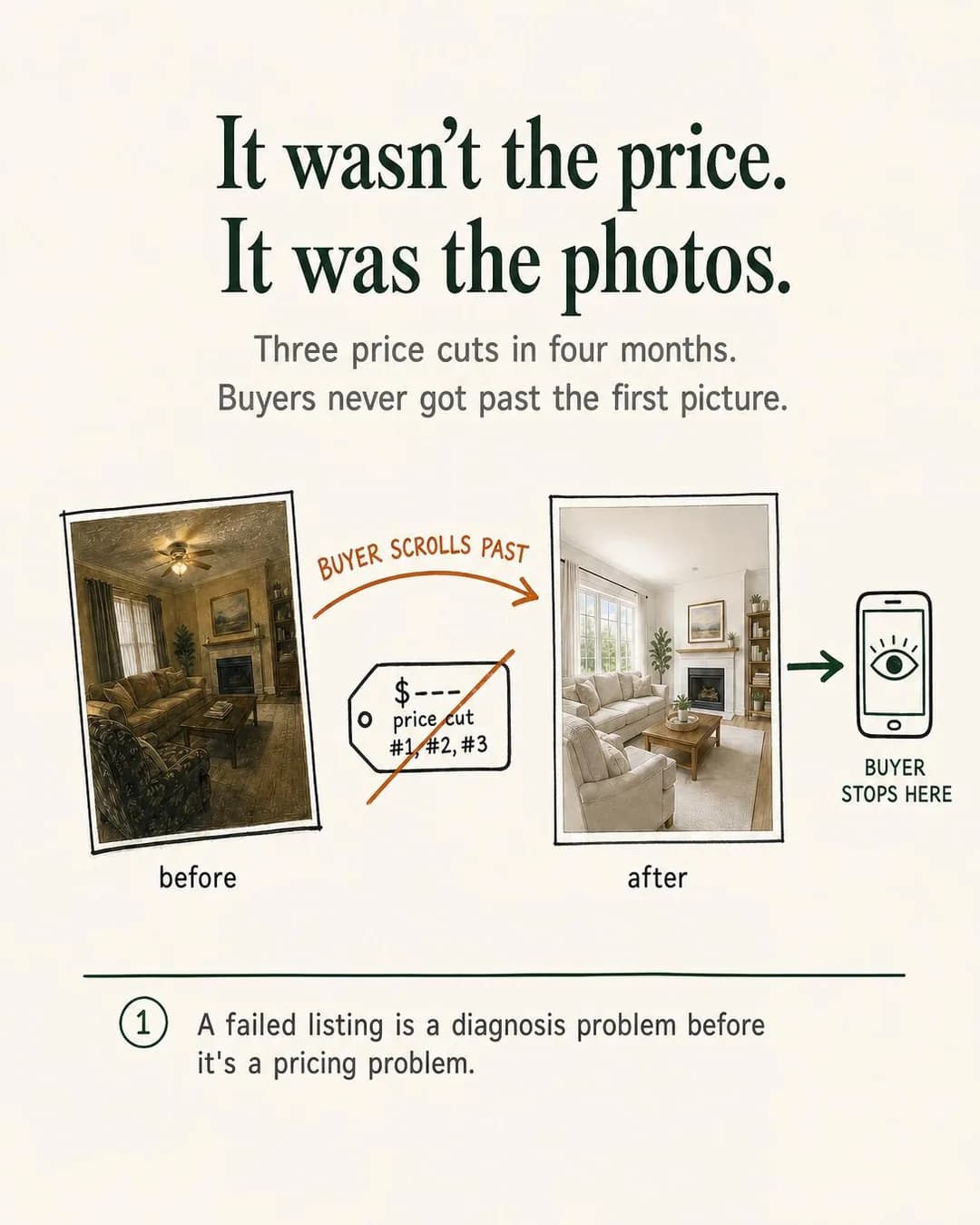
It wasn't the price. It was the photos.
Relaunch it the right way
This seller has already been diagnosed three times and the diagnosis was always price. A fourth agent arriving with “let's get the pricing right” is repeating the conversation that just failed, and it carries the accusation the seller has spent four months resenting — that they were greedy. Misdiagnosis / Reframe is the only family in the library built to open this conversation, because its whole job is to supply a different culprit: it wasn't the number, it was the first photograph. That explanation is plausible, it is checkable against their own listing in about four seconds, and it costs the reader nothing to accept. An explanation a person can agree with without conceding anything is the one that gets clicked.
The diagram earns its place over a plain before/after by charting a mechanism instead of showing a difference: bad photo → buyer scrolls past → three price cuts struck through → good photo → “buyer stops here”. The price tag is inside the frame specifically to be ruled out, which is the reframe made visual. Notice too how far the render was willing to go on the left-hand image — genuinely dim, genuinely yellow, genuinely crooked. Asked for a bad photograph, an image model usually returns a slightly less good photograph; this one committed, and the argument only works because it did. The invented economics are the part to handle carefully: a $475 listing autopsy credited against a 2.4% commission is a well-built productised first step, and it is also a fee and a commission rate you would be publishing as your own.
Other headlines from the same run
- Buyers scrolled past before they saw the number
- Three price cuts won't fix bad photos
- Your listing failed at the first picture
- Bad photos cost you four months
Call to action
This is the warmest audience on the page — they own an unsold house and are being cold-called daily — and the ad sells a specific, priced first step rather than a relationship, so send the click to a calendar. Learn more is the right swap if the $475 needs a page to justify it first, which for someone who just spent four months paying for a service that did not work is a reasonable bet. Not Get offer: the fee is a fee, and a reader who taps expecting a discount lands on an invoice.
The Twenty Percent Ledger
LeadsTwenty percent down is a rule you invented, not one that exists.
- Audience
- Long-term renters who think they cannot buy yet — Have paid rent reliably for six or eight years, believe the number they need saved is twenty percent of the purchase price, and have quietly decided to revisit the whole question in a few years.
- Angle
- Myth Busting (Comparison & Positioning) — Challenges and disproves a common belief in the category.
You've been waiting to save 20% down. That number? You made it up. Most buyers enter a range at 3%, 5%, or 10% — not twenty. A 60-minute Range Reality Session shows you the actual down payment bands for your target price, with no lender incentive to inflate the number. $225 flat, and you leave with a written breakdown you can trust.
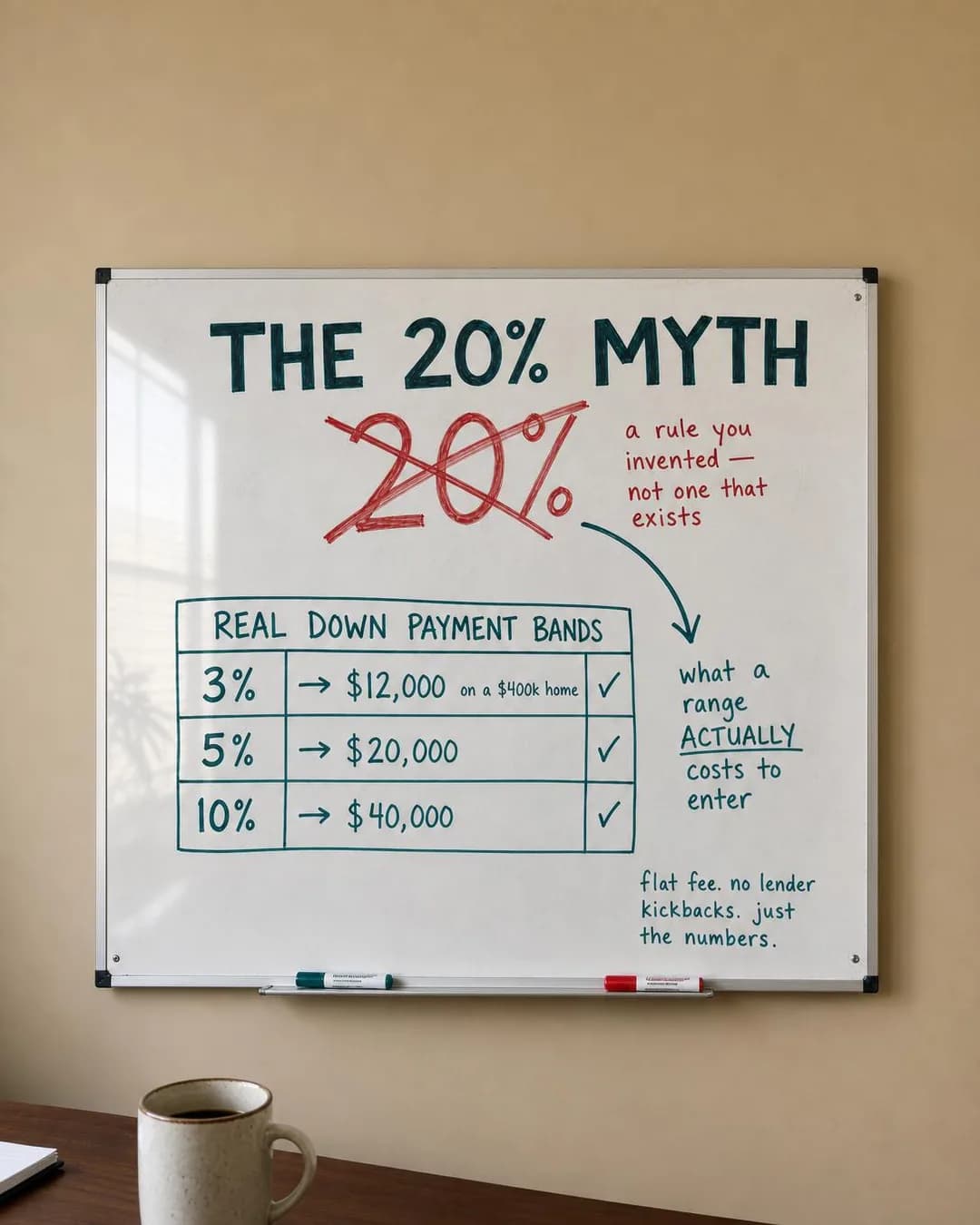
20% down is a myth you invented
Flat-fee clarity. No lender kickbacks.
This audience is not shopping. They have already concluded they cannot shop, and the conclusion rests on a single wrong number — which makes Myth Busting an unusually literal fit, because there is exactly one belief standing between this person and the market and it is falsifiable in one frame. The ad is built accordingly: the crossed-out 20% is the largest object in the picture, and what replaces it is a table rather than a reassurance. “You can buy sooner than you think” is an ad. Three percentages with dollar figures beside them is an argument.
Two things in the render repay a closer look. The arithmetic is right — 3%, 5% and 10% of a $400,000 home really are $12,000, $20,000 and $40,000, and all three are correct inside the image. Numerals rendered as pixels remain where image models fail most often, and an ad whose entire case is a table is an ad a single wrong digit destroys, so that column is a check you run every time; it is the error your reader will catch and you will not. Second, the concept stage proposed a leather ledger flat-lay and what came back is a whiteboard, because the visual direction pinned in the brief outranks the concept writer's imagination downstream. The pin also produced the better ad: a hand-drawn table reads as someone working the problem out, where a ledger would have read as a brand asserting a conclusion.
Other headlines from the same run
- The real bands are 3%, 5%, or 10%
- Stop waiting for a number that doesn't exist
- Most buyers don't put down twenty percent
- See what your range actually costs to enter
Call to action
The opposite call to the relist ad above, and for a specific reason: this reader is cold. They were not thinking about buying a house thirty seconds ago, and a $225 session is a large ask on first contact. Send them to a page that finishes the argument and lets them book at the bottom. Download is worth testing if the bands exist as a one-page PDF — it converts the same intent at a lower price and gives you the email either way.
The Silent Nightstand
LeadsYour phone stays dark. The pipe call goes somewhere else.
- Audience
- Accidental landlords managing one house — Kept a house instead of selling it when they moved or inherited it, are the phone number on the lease, and have taken a plumbing call in the middle of the night from a tenant they otherwise like.
- Angle
- Ease (Benefit & Outcome) — Emphasizes getting the result with less effort, complexity, or skill.
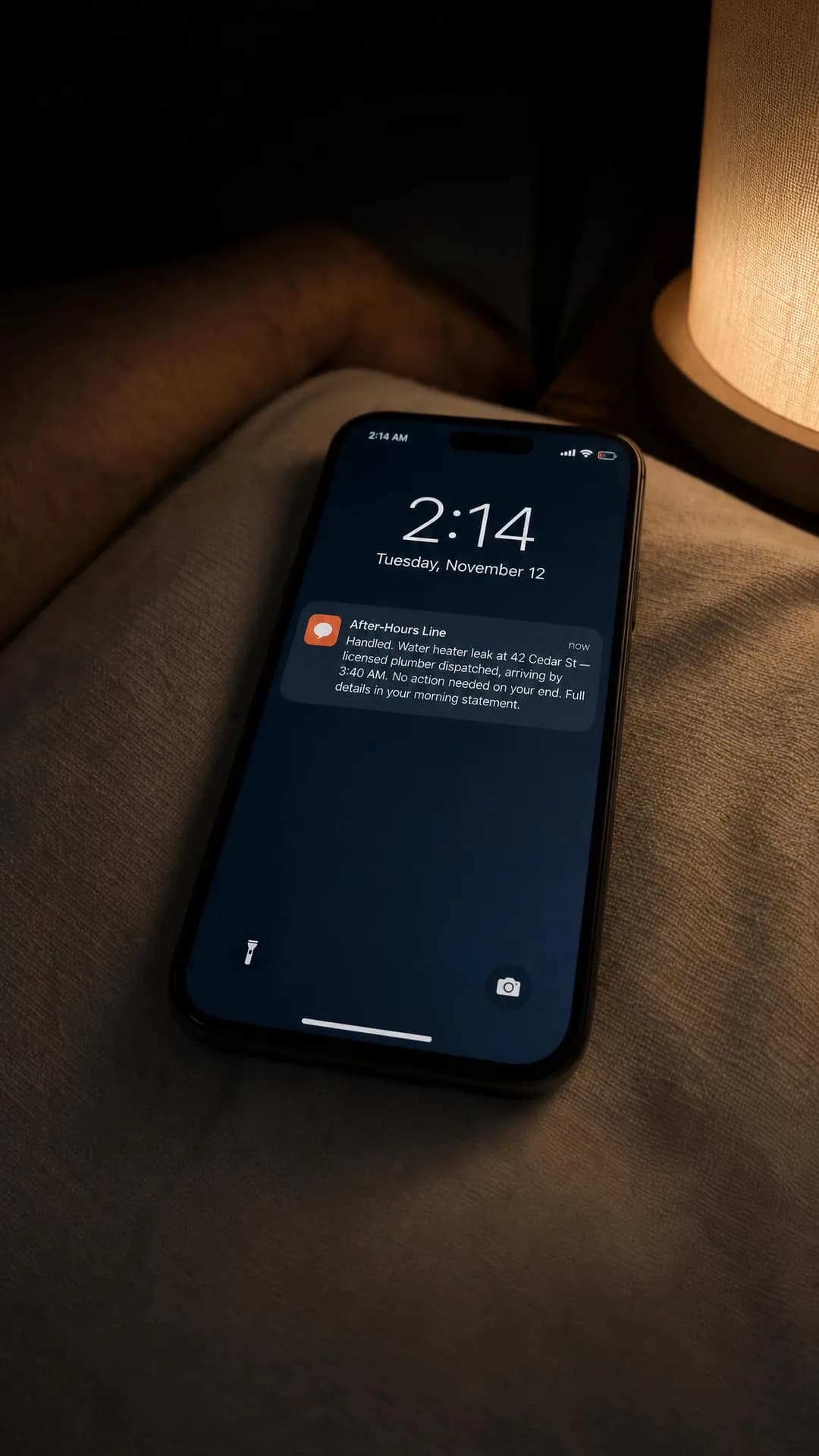
Your tenant's water heater leaked at 2:14am last Tuesday. You slept through it. A licensed plumber was dispatched within two hours, the issue was handled, and you got a plain-language update in the morning. That's what $149/month buys: your phone stays silent after dinner. Full management for one or two rental houses—rent collection, maintenance dispatch, one point of contact, no long-term contract.
Your phone. Silent. Every night.
Property management, $149/mo
Ease is a weak angle asserted and a strong one staged, and this ad stages it as an event that did not happen. The pinned direction was a lock-screen notification stack and the run used the format against type: one notification instead of a pile, and the notification is good news — “Handled. Water heater leak at 42 Cedar St — licensed plumber dispatched, arriving by 3:40 AM. No action needed on your end.” The reader supplies the version of that screen they have actually seen, at that hour, and the gap between the two is the entire argument. It works because the accidental landlord's pain is not really a cost, it is a phone.
The details agree, which for a screenshot format is the whole credibility test: the body copy says the leak was at 2:14 a.m. last Tuesday and the lock screen reads 2:14, Tuesday, November 12. When your proof is a picture of a screen, every number on the glass is a claim, and one mismatch turns a staged screen into an obviously staged one. Worth noting the second decision too — this is a photograph of a phone lying on bedsheets under a lamp, not a clean device mockup. In Stories, between things a person chose to watch, an object sitting in a room outperforms a rendered rectangle, and that is also why this is one of the two 9:16 ads here.
Other headlines from the same run
- $149/month. No 2am tenant calls.
- Sleep through the pipe leak.
- Full management for one house.
- The landlord call that never came.
Call to action
The price is already on the ad, so the landing page's job is the rest of the terms — what the $149 includes, the no-contract claim, the 60-day notice — before it asks for an address. Contact us is the honest primary if you qualify these owners by phone anyway, which most managers of small portfolios do. Avoid Sign up unless there is a genuine self-serve start behind it; nobody hands over a rental house through a form.
The Circled Gap
LeadsBefore you accept, see the number next to it.
- Audience
- Homeowners weighing an instant cash offer — Got the postcard, entered their address on the site out of curiosity, and now have a number in hand with no way to tell whether the speed is worth what it costs them.
- Angle
- Price Anchoring (Offer & Economics) — Compares the current price with a higher reference value.
That cash offer you got in the mail? Here's what it looks like next to the 30-day listing number — same home, both paths, written down side by side. Most sellers never see this comparison before they sign. We deliver it free, in writing, within 48 hours. No pressure toward either option. Just the two columns so you can decide with the actual gap in front of you, not a guess.
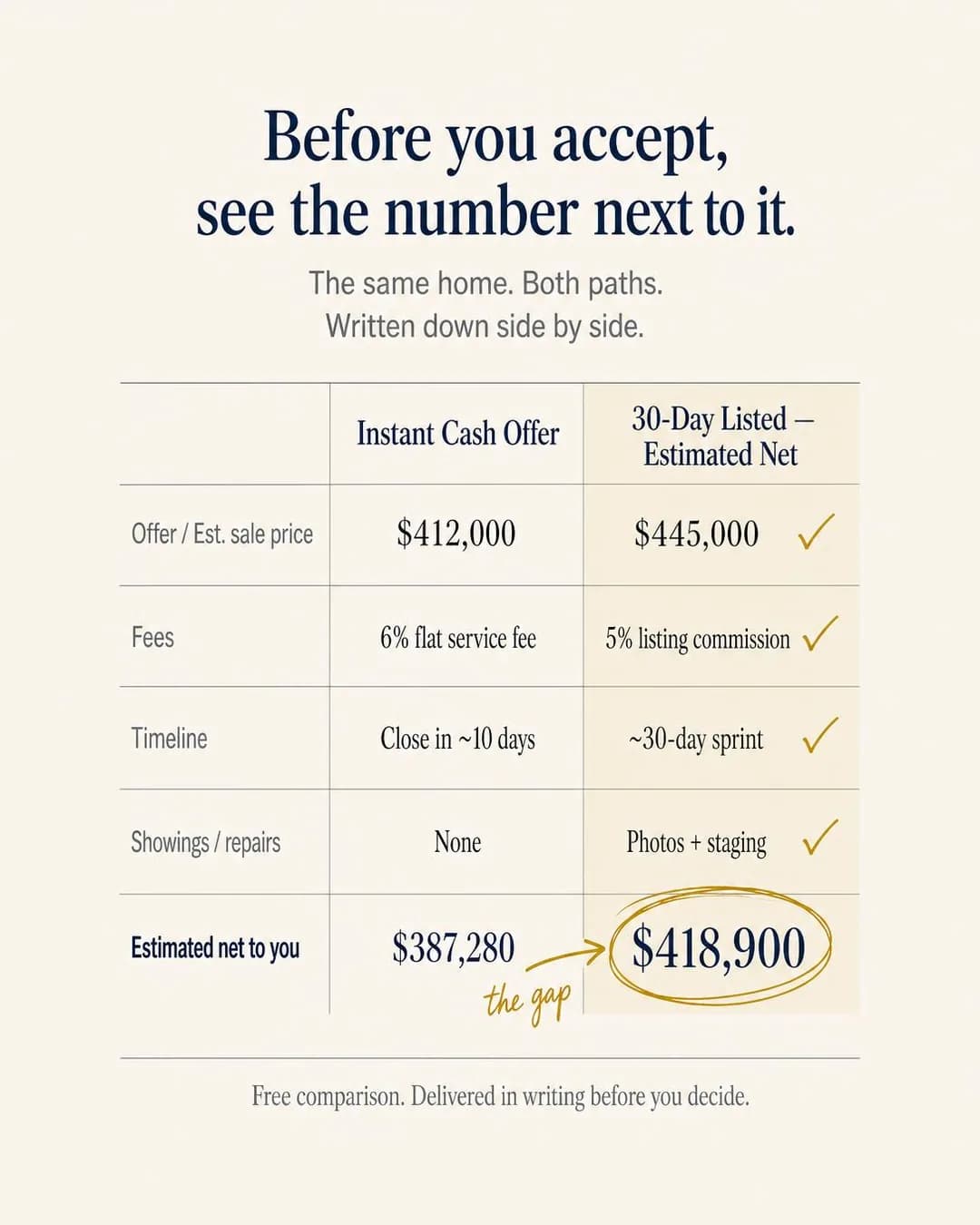
See both numbers before you decide
Free comparison packet
Price Anchoring usually means putting your number beside a worse number you chose. Here the worse number arrived in the seller's mailbox on its own, which is why this works: the reader is already holding an anchor, and the ad's move is to place a second figure next to it rather than to argue the first one down. “No pressure toward either option” is not softness, it is the mechanism — a brokerage that will publish both columns is claiming a kind of neutrality that the instant-offer letter cannot claim back, and the free written comparison is a lead magnet that doubles as the proof of the claim.
Now check the table, because this is the most instructive flaw on the page. The cash column foots exactly: $412,000 less a 6% service fee is $387,280, to the dollar. The listed column does not — $445,000 less 5% commission is $422,750, and the ad reports $418,900, a $3,850 shortfall that is presumably the unpriced “photos + staging” row but is never labelled. So the column that flatters the advertiser is the one a reader cannot verify, in an ad whose entire promise is that you will finally get to verify something. A seller weighing a $400,000 decision is exactly the person who will run those subtractions. Shipped as generated, because the lesson is sharper than the fix: when your creative is a spreadsheet, every cell is a claim, and the ones on your own side of the table are the ones to check twice. The commission figures deserve the same care — they are your rates, publicly stated, and negotiable.
Other headlines from the same run
- Cash offer vs. 30-day net — in writing
- The comparison most sellers never get
- Know the gap. Then choose your path.
- Two options. One honest breakdown.
Call to action
Rare on this page and correct here: the ad promises a specific free deliverable — a written comparison packet inside 48 hours — and Get offer is the only button in Meta's vocabulary that names a thing you receive. It works because the promise is real and free. The moment the packet becomes a call disguised as a packet, the button is a lie and Contact us was always the honest version.
One Call, Not Three
LeadsYou answer the phone once. Not for the sorter, then the sale, then the cleaners.
- Audience
- Owners of a house that outlasted the family in it — Thirty years in the same address, the last bedroom emptied a decade ago, and every conversation about selling stops at the garage, the attic and the question of what happens to all of it.
- Angle
- Relief / Peace of Mind (Identity & Emotion) — Sells the removal of stress, uncertainty, worry, or mental load.
You answer one phone call. Not three. Most families hire a sorting crew, an estate-sale company, and a listing-prep team separately — then spend weeks playing operator between strangers who've never met. We run all three as one coordinated job, with one named person managing the timeline from your first walkthrough to the day your agent photographs the house. You make decisions once. We handle the rest.

One coordinator. Not three vendors.
From full house to list-ready.
Relief / Peace of Mind is where downsizing ads normally go wrong, because relief invites sentimentality and this is the audience least interested in being sentimentalised at. What the run produced instead is structural: “One coordinator. Not three vendors.” The insight underneath it is that the paralysis is logistical, not emotional — the sorting crew, the estate-sale company and the listing-prep team are three separate hires who have never met, and the family becomes the switchboard between them. Naming that is more respectful than naming the feeling, and every one of the five headlines stays on the logistics rather than the memories.
The image is the one place on this page where a real brokerage has to stop and think. The pinned direction was Portrait of the owner / user and the render obeyed: a woman of evident later years at a kitchen table, moving boxes behind her. The copy never mentions age — it is entirely about coordinating vendors — but the picture states one. That distinction matters more in housing than in any other category on this site: HUD's fair housing advertising guidance, 24 CFR Part 109, treats the selective use of human models as an advertising practice capable of signalling a preference, and although it was withdrawn from the Code of Federal Regulations in 1996 it is still cited as HUD's position and still taught in fair housing training. One photograph is not a violation; a body of advertising whose models all say the same thing is the pattern the guidance is about. Keep the copy on the house's situation rather than the owner's age, as this run did, and know what the frame is saying even when the words do not.
Other headlines from the same run
- Stop playing operator between crews.
- Sorting, sale, and list-ready. One job.
- One call clears the house and lists it.
- No juggling schedules. One timeline.
Call to action
Nothing about this decision is completed by a form. The service is a walkthrough and a timeline, the reader is weighing a year of their life, and the honest next step is a person — so Contact us, with a phone number that a human answers, beats any button that implies self-service. Book now is the upgrade once you trust that a first call converts; Learn more is the safer cold-audience version if the three-vendor claim needs a page to land.
Twelve Years, Never Missed
Leads144 reports. Same 40 blocks. Zero skipped months.
- Audience
- Homeowners tracking their own street — Not selling this year and not sure about next, but they look up the neighbour's sold price the week it closes and know the estimate on the big listing sites is wrong about their house.
- Angle
- Data / Statistical Proof (Proof & Trust) — Uses research, usage data, performance metrics, or quantified results.
144 consecutive reports. Same forty blocks. Not one missed month in twelve years. Most agents claim they know your neighborhood — we've published the proof every first Monday since 2013. Every closed sale. Every street. Free, whether you ever call us or not. The archive's open if you want to check.
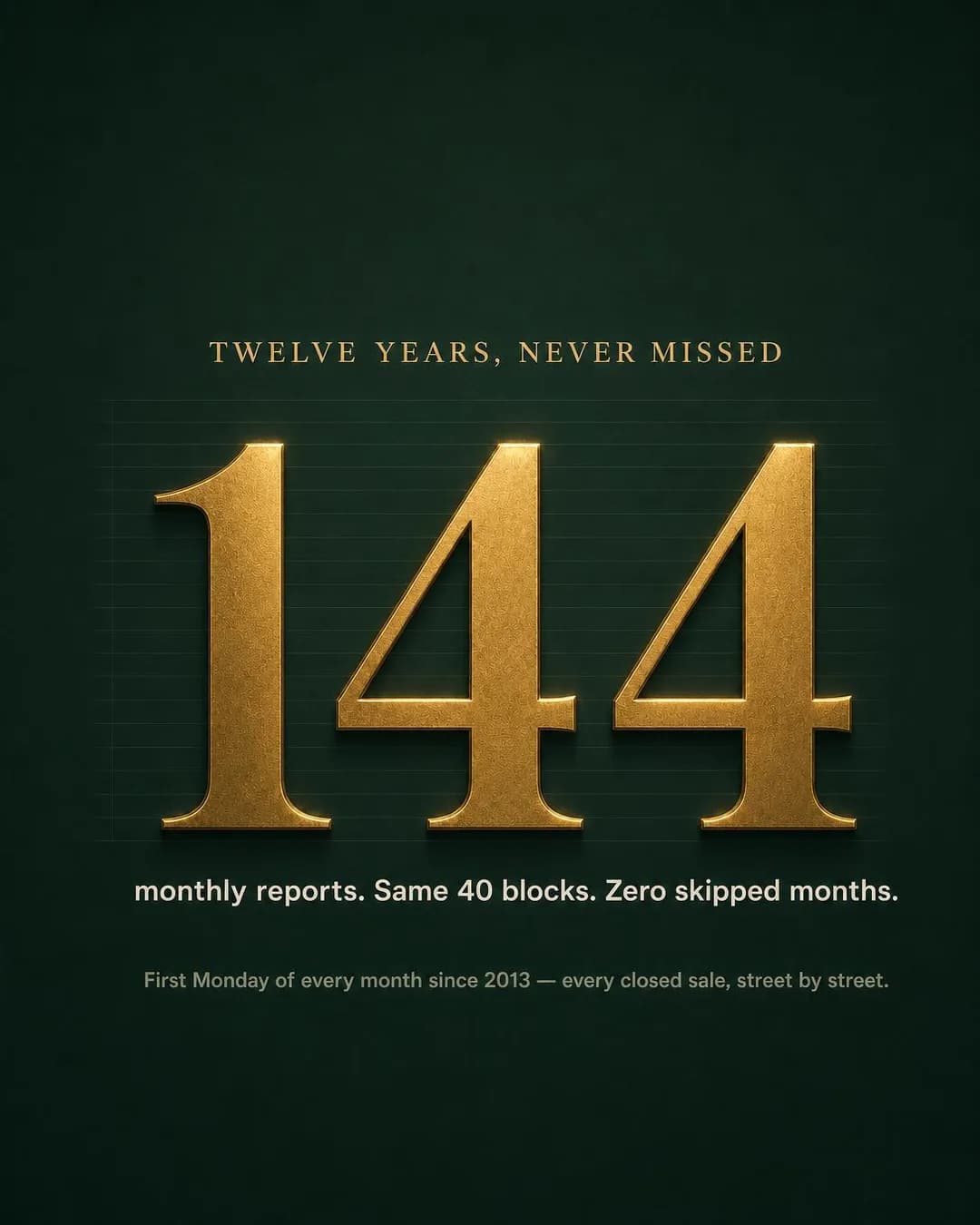
144 reports. Zero skipped months.
Free monthly. Always has been.
Every agent in every market claims to know the neighbourhood, which makes local expertise the least differentiating claim in the industry and Data / Statistical Proof the only way out of it. The move here is to replace the claim with a record: 144 consecutive monthly reports on the same forty blocks, published whether or not anyone calls. That converts an assertion into something with a falsifiable shape — you can go and check whether the archive exists — and it quietly disqualifies every competitor who would have to start the streak today. The strongest line is the least salesy one: “Free, whether you ever call us or not.”
The stat-hero format is the right container because the number is the ad and 144 is a number that only means something if it is unbroken; rendered at that scale, the reader does the division themselves. One thing did drift, and it is the check this format always needs: the ad dates the streak from 2013 and calls it twelve years, which is internally consistent with itself and at least a year short against the date this page was published. Invented history has to be arithmetic that still works on the day the ad runs, and a durability claim is exactly the kind that goes stale while sitting in an ad account. Left as generated — the flaw is the lesson, and a real version of this ad would be regenerated with the count that matches the calendar.
Other headlines from the same run
- Twelve years of receipts.
- Same streets. Every sale. Since 2013.
- We publish the proof every month.
- Your block's data. Twelve years deep.
Call to action
The deliverable is a monthly PDF and Download is the button that says so — the least oversold option in Meta's vocabulary and the right one when the offer genuinely asks nothing back. Subscribe is arguably better fitted to the actual product, since the report recurs and the value compounds with each month a homeowner receives one, but only run it if the signup really does start a subscription. Not Contact us: this reader is not selling this year, and asking for a conversation converts the one ad on the page designed to be patient into the one that is not.
The Phase One Countdown
TrafficSix of eleven Phase One homes are already gone.
- Audience
- Buyers losing out in the resale market — Have written four offers over asking and lost all four, watch every decent listing go pending in a weekend, and are starting to price in a longer commute rather than a bigger budget.
- Angle
- Limited Stock (Scarcity, FOMO & Timing) — Uses finite inventory or supply as the urgency mechanism.
6 of 11 Phase One homes are already reserved. That's not a marketing line — it's the current lot count. Five remain, all at pre-Phase Two pricing: The Prescott from $389,900, The Kessler from $438,900. Once these eleven sell, Phase Two releases at approximately 15% higher. $2,500 refundable deposit holds your pick of what's left.

5 of 11 Phase One homes remain
From $389,900. Reserve your lot.
Scarcity is the most abused family in this industry and the easiest to disbelieve — every listing “won't last”, every open house is a last chance. Limited Stock survives that only when the scarcity is a production fact rather than a mood, and new construction is the rare case in real estate where it genuinely is: there are eleven Phase One homes because eleven were built, and Phase Two prices higher when they are gone. The copy leans on precisely that distinction — “That's not a marketing line — it's the current lot count” — and then pairs it with what this audience actually wants, which is the opposite of urgency: “No bidding war. Fixed price list.” A buyer who has lost four offers over asking is not short of urgency. They are short of a price they can trust.
Then count the site plan. The line printed across the top reads “PHASE ONE — 6 OF 11 HOMES GONE” and the drawing beneath it carries roughly thirty lots stamped RESERVED. The type is correct and the picture contradicts it, which is the most common way an image model fails a proof: it can letter a label accurately and it cannot count objects. That matters more here than a wrong colour ever would, because the entire ad is a count — a reader who looks at the map instead of the caption sees a development that is nearly sold out sitting under a headline promising five homes left, and concludes the number was marketing after all. Shipped as generated, because it is the cheapest available lesson: when the claim is a quantity, the quantity has to be true in the artwork too. Site plans, shelves, card grids, review walls — count them before you spend money.
Other headlines from the same run
- New build, same street, lower price
- Before Phase Two pricing kicks in
- No bidding war. Fixed price list.
- Last five at launch pricing
Call to action
A Traffic objective and a $2,500 refundable deposit at the far end of the funnel: this click goes to floor plans and a price list, not to a reservation form. Book now belongs on the retargeting pass, and for new construction the thing worth booking is a site visit rather than a phone call — the model home is the asset. Not Get offer, tempting as launch pricing sounds: it is a schedule, not a promotion, and the ad is more credible for saying so.
The Rate That Resets at Dawn
LeadsYour nightly rate was set two years ago. This one resets today.
- Audience
- Owners self-managing one short-term rental — Set their nightly rate once two years ago, have watched a dozen similar listings appear within a mile of theirs, and are now looking at a booking calendar with more white on it than last season.
- Angle
- How It Works (Product & Mechanism) — Explains the process from input to mechanism to result.
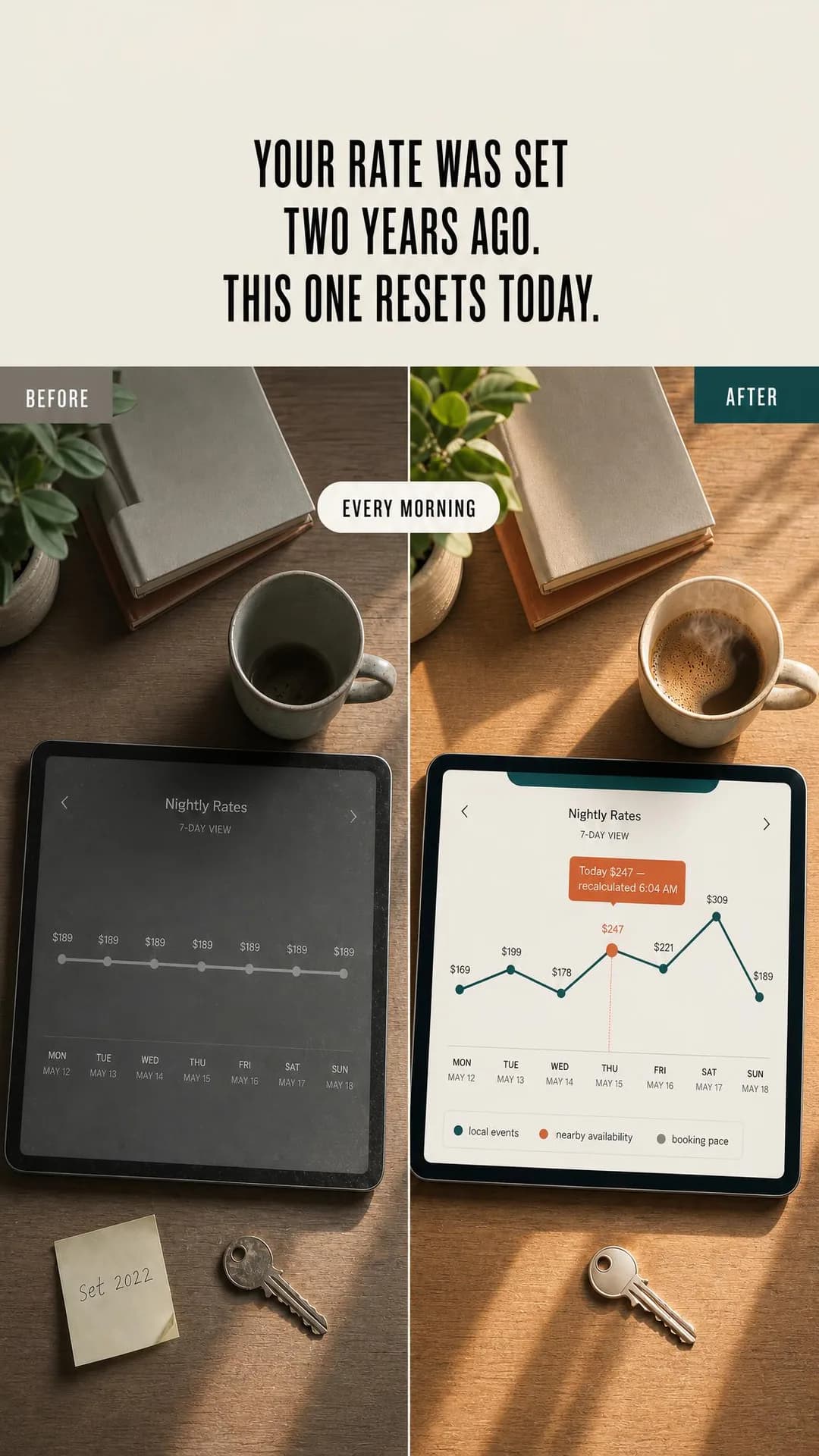
Your nightly rate was set two years ago. This one resets today. Every morning at 6:04 AM, your rate recalculates based on local events, nearby availability, and booking pace. Not a seasonal chart. Not a guess. A daily pricing decision that moves with the market while you sleep. 19% of collected revenue, all-inclusive. First month capped at 12%. No setup fee, no contract.
Daily pricing that resets at dawn
19% all-in, no contract
The owner in this brief did not ask for a mechanism, they noticed a thinning calendar — and the run was right to refuse to sell them the symptom. How It Works answers the only question that separates a manager worth 19% from a cleaner with a spreadsheet: what exactly do you do every day that I am not doing? The answer is legible in a single frame. A flat $189 across seven nights on the left, a curve from $169 to $309 on the right, “Today $247 — recalculated 6:04 AM” pinned to the middle. That 6:04 is doing more work than it looks: a round number reads as a policy, an odd one reads as a log entry from a system that actually ran this morning.
Two details reward a second look, one good and one to check. The good one is the sticky note in the “before” panel — “Set 2022”, the reader's own sin written on a Post-it, which lets the ad make its accusation without insulting anybody, because the handwriting is theirs. The one to check is the legend under the right-hand chart: it lists three series (local events, nearby availability, booking pace) beneath a chart plotting one line. Nobody will complain, but it is the small chart illiteracy that generated imagery produces constantly, and it is worth knowing that the legend here is decoration rather than data. This ad also joins the street-level report in dating its own backstory to a year that has quietly gone stale — two of ten did that, which makes it a check to run rather than a coincidence.
Other headlines from the same run
- Your rate moves with the market
- Pricing recalculated every morning
- Set once vs. reset daily
- One property, managed like a business
Call to action
Handing over a whole property and a revenue share is not a form-fill decision, and single-property owners almost always want to hear a person before they hand over a key — so lead with the conversation. Learn more is the right primary if your page can show the 19% arithmetic against a flat $189 week convincingly enough to do the persuading for you. Subscribe is wrong even though the product recurs: the reader is not subscribing to anything, they are hiring someone.
The Assistant Who Answered
TrafficI was the fourth name a seller never got to meet.
- Audience
- Sellers who hired a name and got a team — Signed with the agent on the billboard, then dealt with four assistants, a showing coordinator and a transaction manager, and could not get the person whose face was on the sign to walk their house.
- Angle
- Why We Built This (Story & Founder POV) — Explains the customer problem or frustration that motivated the product’s creation.
I was the fourth name a seller never got to meet. For two years I fielded calls under an agent whose face was on a billboard downtown. Sellers signed with him. Then they got me, and three other assistants, and a showing coordinator, and a transaction manager. I couldn't tell them the truth: he was never going to call them back. So I built the opposite. No more than twelve active listings between two licensed agents. The person in your kitchen at the first walkthrough is the same person who sets your price and negotiates your offer. There is no one to hand you off to.
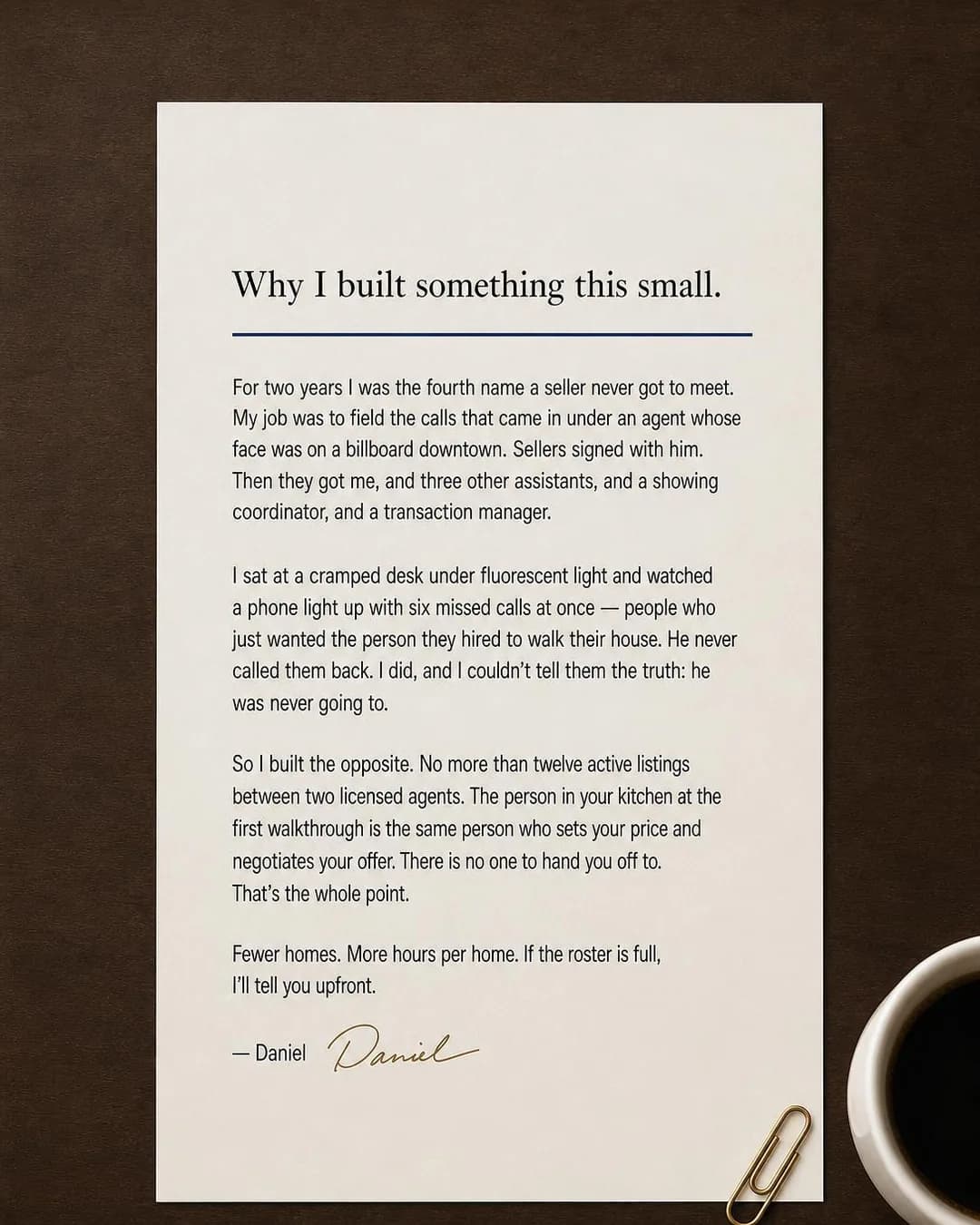
Two agents. Twelve listings. No hand-offs.
No assistants. Just continuity.
Why We Built This is the angle that turns a limitation into the product, and the run found the version with teeth. The founder is not the wronged customer in this story, he is the mechanism of the wrong: he was one of the four assistants, the one who returned the calls the billboard agent never would. That is a confession rather than a boast, and it buys the claim something a testimonial cannot — he is not guessing what happens inside a high-volume team, he staffed it. “I couldn't tell them the truth: he was never going to call them back” is the line the whole ad rests on, and it works because it costs the writer something to say.
Two practical observations. The first is craft: this is roughly two hundred words of body text rendered as pixels, in a letter format that fails completely if a single line garbles — and it came back clean, justified, correctly punctuated, with a signature. Long-form text inside an image was unusable two years ago; check every line anyway, because when it does break here it breaks the format entirely. The second is the one that matters: Daniel does not exist. A founder's letter is a personal history, and a generated one is a fabricated biography with a signature under it — a different and worse thing than a generated product photo. The format transfers, the specificity transfers, the willingness to name what you did before this transfers. The story has to be yours and true, and if it is, you did not need a model to write it.
Other headlines from the same run
- The person you hire is who shows up.
- I was the name you never got to meet.
- Built small enough to answer myself.
- Fewer homes. More hours per home.
Call to action
The letter writes its own call to action in the last line — “if the roster is full, I'll tell you upfront” — so the destination has to honour it: a page that states current capacity, today, out of twelve. That single number does more converting than any button, and it is also the thing that makes the whole cap claim checkable rather than charming. Contact us is the primary if you would rather qualify by phone; the Traffic objective here says read the letter first, decide second.
The One-Weekend Relocator
LeadsOne weekend of flights budgeted. We cover every other showing.
- Audience
- Buyers relocating from out of state — Have a start date, a temporary rental and one weekend of house-hunting flights budgeted, and are being asked to make the largest purchase of their life on the strength of twenty photographs shot with a wide lens.
- Angle
- “Will It Work for Me?” (Objection & Risk Reversal) — Proves fit across personas, use cases, circumstances, or customer types.
You get one weekend to fly in. Maybe two if HR is feeling generous. After that, you're supposed to just... pick a house based on listing photos and hope the foundation isn't cracked. Our ground team films every other property you want to see — unedited walkthrough, flaws included, water heater and all. You make the call from your temp apartment with actual information, not faith.
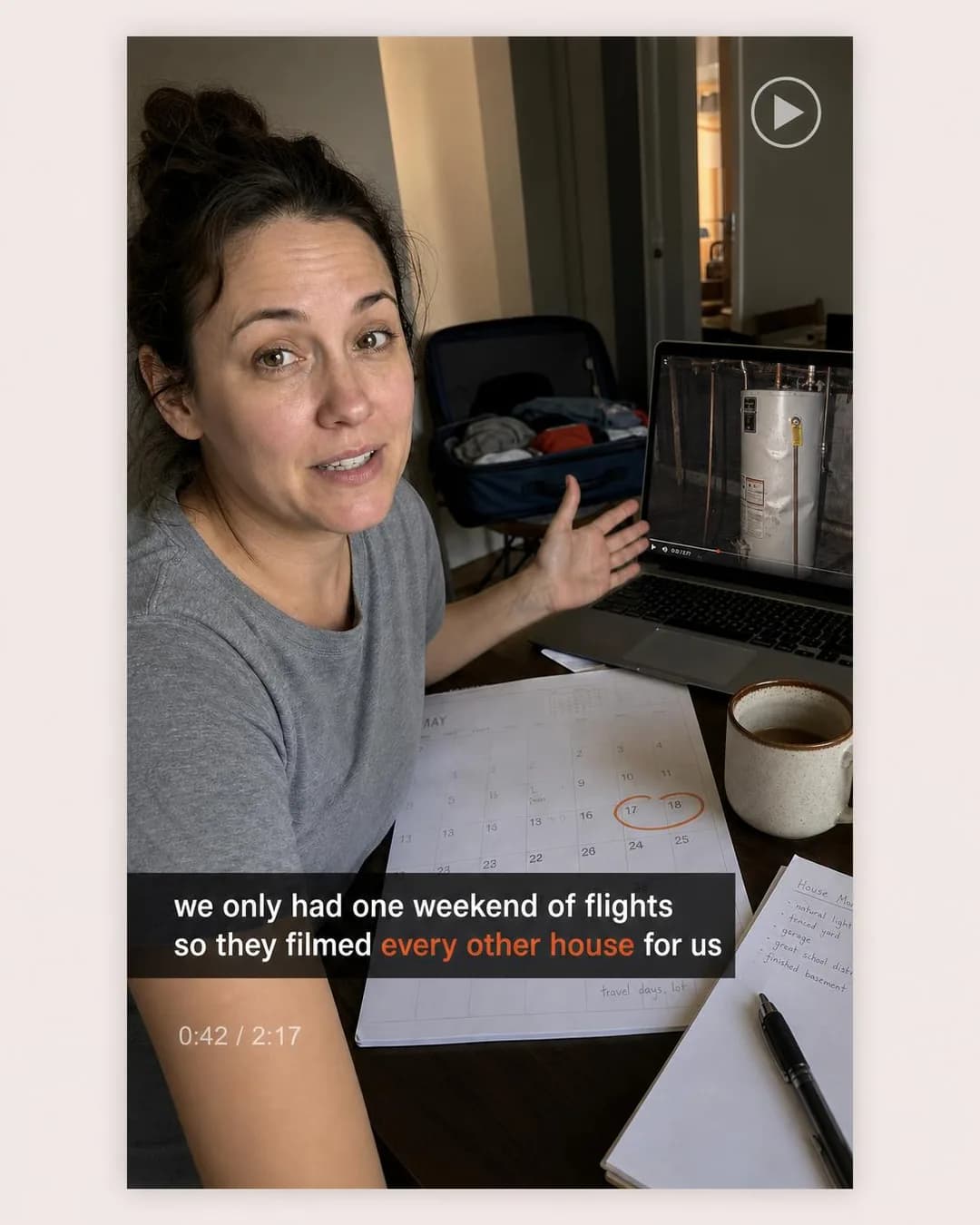
One weekend. Every other showing filmed.
Filmed walkthroughs. Inspection-out.
“Will It Work for Me?” is the right family because the objection here is not price or trust in the agent, it is a structural shortage of days. The buyer has a start date, a temporary rental and one weekend of flights, and the fear is running out of trip before running out of houses. The ad answers with a substitution rather than a reassurance — the ground team goes to every showing you cannot — and the proof is in the register of the footage: “unedited walkthrough, flaws included, water heater and all.” A brokerage that films the water heater is claiming something a brochure cannot claim back, and the laptop in the frame is playing exactly that shot rather than a kitchen.
The format is the most Instagram-native thing on the page and the most carefully staged: a phone-camera selfie in a temp apartment, an open suitcase, a wall calendar with one weekend circled, a caption bar in the platform's own grammar, a 0:42 / 2:17 scrubber implying there is more video behind it. It reads as a customer's own post for the second or two that decides whether an ad gets read — which is the entire purpose of the direction. It is also, obviously, not a customer: the woman does not exist and neither does her relocation. Run this format with a client who actually filmed it, or you are back in the same territory as the invented reviewers on the apparel page.
One more thing is sitting in the corner of the frame, and it is the most useful accident in this batch. The buyer's handwritten wishlist reads natural light, fenced yard, garage, great school district, finished basement. Under the guidance agents worked to for years, “great school district” was the line you never put in writing. That moved on 24 April 2026, when HUD said sharing school quality information is not a Fair Housing Act violation where it is shared consistently and without discriminatory intent — so the subject is no longer forbidden. The adjective still is the risky part: “great” is an assessment rather than data, and an assessment about a district is the exact register the steering analysis has always turned on. The model has no idea any of that is true. It wrote a plausible wishlist, which is its job, and the compliance read is yours.
Other headlines from the same run
- We cover the showings you can't make
- Run out of flights? We keep looking.
- Relocating on a company timeline?
- Buy remotely. Not blind.
Call to action
The service is a person on the ground in a city the reader does not live in, and the only thing that resolves the objection is discovering that person exists and answers. Book now works if you run scheduled intro calls, which suits a buyer living on a corporate timeline better than an open-ended enquiry form does. Learn more is the weak option here: the ad has already explained the model, and a second explanation is not what someone with a start date in six weeks needs.
Questions
- Do Instagram ads work for real estate agents?
- They work when the ad is not a listing. The listing carousel is the default and it is the weakest asset an agent owns: it expires the week the house goes under contract, it shows the same photographs the portals are already showing for free, and it is only relevant to the handful of people inside a 15-mile radius who want that specific house this month. You are paying for the whole radius either way — Meta's housing rules see to that — so advertise the thing the whole radius might eventually need. Every ad on this page sells a method rather than a property: a diagnosis for a failed listing, a down payment breakdown, a street-level sold report, a management fee that ends the midnight phone calls.
- Why can't I target real estate ads by ZIP code?
- Because housing is a special ad category. Meta created it after a Justice Department settlement over discriminatory housing advertising, and declaring a housing ad removes most of the ad set: age is fixed to 18–65+, gender to all genders, lookalike audiences are unavailable, behaviour and demographic targeting is restricted, and ZIP codes, neighbourhoods, subcity areas and metro areas are not selectable at all — location has to be a radius of at least 15 miles (25 km) in the US and Canada. Skipping the declaration is not an option either: Meta's classifiers apply the category from the creative, and being caught working around it is treated as evasion. Plan for it by doing the qualifying inside the ad, in the first line, the way the ten below do.
- What size should a real estate Instagram ad be?
- Portrait: 4:5 for feed and 9:16 for Stories and Reels, which best-in-slot exports as 1080 × 1350 and 1080 × 1920. The trap specific to this industry is that your existing photography is the wrong shape. Listing photos are shot wide and land as horizontal frames, and cropping one to 4:5 removes the width the wide lens was for. Facebook's feed will still run a 1:1 or 1.91:1 link ad; Instagram is portrait-first, so either compose for portrait from the start or use the frame for something other than a room. Render each shape separately rather than letting Meta crop one image into both.
- Should I advertise a listing or advertise myself?
- Advertise a method. Not one of the ten ads below is a listing, and only two show a person at all — the rest lead with the argument: a repricing autopsy, a ledger of real down payment bands, a silent phone at 2 a.m., a twelve-year record on one set of streets. A listing ad has a shelf life of weeks and competes on photographs you do not own the distribution of. A headshot ad has nothing to argue at all. A method survives the sale, it is the thing a seller is actually choosing between agents on, and it is the only one of the three that gives a stranger in your radius a reason to remember you six months before they need you.
- Can I use these ads?
- Take the approach, not the pixels — and in this category, check the words twice. The businesses are invented and the images were generated for this page, so there is nothing here to lift; the value is the pairing of an audience with a specific argument, and every angle used below is documented in full in our ad angle library, linked from each ad. Two cautions are particular to real estate. Every figure in these ads is invented, and in this industry the figures are also claims you may have to document — a commission rate, a management fee, a down payment band, a days-on-market number. And the Fair Housing Act reaches the creative, not just the targeting: an ad may not state a preference or limitation based on a protected class, which rules out a lot of language that sounds warm and is not allowed. Read your own copy against that before it goes live.
Seen enough? Make your own.
Paste your site. It reads your listings, your market and your brand, then writes the concepts, renders the images and drafts the copy — for a category where the ad set cannot do your targeting.
No credit card · 50 free credits (about 5 ads or Instagram posts)
Every angle used above is documented in the best-in-slot ad angle library. More industries and placements are at all ad examples.