
Ad Guides · Real estate agents × Facebook
Facebook ads for real estate agents
The seller-side playbook — listing acquisition, expired listings, estate sales and prep finance — for the platform where those owners actually are.
This is the listing-acquisition guide. Its companion page covers Instagram, where the buyers and renters are; everything below is about the other side of the transaction, and the split is not a matter of taste. Because the housing special ad category fixes your ad set's age range at 18 through 65+, the app you buy is the closest thing to age targeting you have left — and Pew's November 2025 survey puts Facebook at 74% of US adults aged 50 to 64 and 57% of the over-65s, against Instagram's 40% and 19%. Sellers, downsizers, executors, landlords selling a house bought in the nineties, the couple whose listing expired at sixty-two: all roughly twice as reachable here.
Which sets up the problem this page exists to solve, and which almost no real estate marketing addresses. Facebook delivers you to the exact cohort whose defining characteristic you are forbidden to name. Meta's personal attributes policy prohibits copy that asserts or implies a person's age. The Fair Housing Act's advertising clause makes it unlawful to publish an ad about the sale of a dwelling that indicates a preference based on familial status, among five other classes — and the natural seller vernacular is soaked in familial status: “empty nesters”, “now that the kids have moved out”, “too much house for the two of you”. Many state and local fair housing laws add age outright. So the ad knows precisely who it is talking to and must not say it.
The answer runs through every section below, and it is the thing worth taking away even if you read nothing else: on the seller side you can qualify on a property event instead of on a person. A listing that expired. A tenant with eleven months left. A house eleven hundred miles from the executor who inherited it. A contractor's quote for sixty-three thousand dollars. None of those is a protected class, none implies an age, and each selects a narrower and more valuable reader than a demographic would — because a property event arrives with a decision already attached. That makes the seller side structurally safer to advertise than the buyer side, which is the reverse of what most guides assume.
Everything here is written for an agent or a small brokerage buying their own ads. Every platform claim is footnoted and dated at the foot of the page, because Meta moved several of these this year and most trade advice online predates the moves. The ten finished ads on the examples page were generated for this guide rather than collected, and four of them must not run as they are — those four are the most useful part, and each one's flaw is named where it happens.
Generate seller-side ads for your own brokerage
Paste your site and best-in-slot reads your listings, your market and your brand, then writes the concepts, renders the images and drafts the copy. Free to start, no card — and every ad lands paused, which in this category is the setting that matters.
Why Facebook rather than Instagram, and what it costs you
The reach argument is the whole reason to be here and it is worth stating as arithmetic rather than as a vibe. After the special ad category has finished with your ad set, you have no age control, no gender control, no ZIP codes, no neighbourhoods, no lookalikes and no location exclusions. What you still choose is the app. Facebook reaches 74% of 50- to 64-year-olds and 57% of the over-65s; Instagram reaches 40% and 19%. If your offer is listing acquisition, buying Instagram is paying a reach premium to talk to your prospects' children. If your offer is a first-time-buyer explainer, the reverse is true and the other page covers it.
What Facebook gives back on shape, you should mostly decline. Instagram is portrait-only, which rules out the landscape listing photography every agent has a folder of. Facebook takes 1.91:1, which in our own publisher routes to the right-hand column and search results — placements Instagram has no equivalent for at all — while 4:5 goes to both feeds and 9:16 to stories and reels across both apps. The landscape slot is genuinely back. The trap is that the asset waiting to fill it is the wide-angle interior, which is the one thing every competitor in your market is already posting for free and which stops being relevant the week the house goes under contract. Both 1.91:1 ads on the examples page are text.
The copy budget is tighter here than on Instagram, which is the opposite of what most people expect. Meta's ads guide recommends a 27-character headline and 50–150 characters of primary text for Facebook Feed, against 40 and 125 for Instagram Feed. Twenty-seven characters is roughly four words. When we measured the batch built for this page, nine of the ten headlines the ads lead with were over it and 37 of the 40 alternates were too; all fifty primary texts exceeded 150, running from 261 to 563 characters. Longer is truncated rather than rejected, but at four words the truncation lands inside your first clause, so the rule is simply that the argument has to be intact before the cut.
And it is not one budget, which is what makes that rule binding rather than advisory. Facebook has nine image surfaces — Feed, in-stream video, video feeds, Marketplace, Stories, ads on Reels, search results, Business Explore and the right-hand column — against Instagram's four, and they do not agree. Marketplace recommends a square at 1080 × 1080, 125 characters of primary text, a 40-character headline and a 30-character description; Facebook Feed recommends 4:5 at 1440 × 1800, 50–150 characters, 27 characters of headline and shows no description at all. Leave Advantage+ placements on, which almost every campaign does, and one ad fills all nine from a single export and a single headline. You choose the file; you do not choose the frame. Eight of the ten ads on the examples page have a description short enough for Marketplace, in a field the feed will never render.
None of this changes because the campaign is declared housing — the special ad category takes targeting away and leaves the creative specifications exactly where they were. What it changes is the price of a truncated first clause. With no ZIP, no neighbourhood, no location exclusion and a fifteen-mile floor under the radius, the creative is doing the qualifying the ad set is no longer permitted to do, and the first forty characters are where it does it.
And one operational gate that stops a first housing campaign dead, which is not discoverable from the creative side at all. A business admin must review and accept Meta's non-discrimination policy before these ads will run: the Marketing API answers with error 2859024, “Certification Required”, and points at Business Settings. Its neighbour, 2909035, is what you get for a custom age range, a saved audience, a lookalike or a location radius under the floor — each with its own message naming the control. Do that at setup rather than discovering it on the morning a listing launches.
Which objective to buy
Ads Manager offers six — Awareness, Traffic, Engagement, Leads, App promotion and Sales. The seller side answers this differently from the buyer side in exactly one place, and it is the place the Instagram guide in this cluster says no: Awareness. That guide is right for buyers, where an unremembered brand is worth nothing because the decision is made in weeks. Sellers decide over years, inside a radius you already work, and being the name a household already knows when the conversation finally happens is a substantial part of what a listing agent sells. It is still the objective most often bought for the wrong reason.
Everything else is the same as it is anywhere in this category, and for the same reason: nothing about a house completes inside an ad session, so the most an ad can cause is a conversation. Seven of the ten ads on the examples page were written for Leads, two for Traffic and one for Awareness. None for Sales, and there is no version of this trade where that changes.
- LeadsDefault
The seller-side default and the objective seven of the ten example ads were written for. A listing appointment is a conversation, and this is the objective that buys conversations — via an Instant Form, a click to message, or a landing page with a form on it. Optimise for the form completion, not for the click.
- TrafficSometimes
Right when the offer needs a page to be believed before anyone will give you a name — a published fee breakdown, a carrying-cost worksheet, a market report. Two example ads use it. The failure mode is buying Traffic because it is cheap and then measuring it as though it were Leads.
- AwarenessSometimes
The one place this guide diverges from its Instagram twin, which rates it No. Defensible on the seller side and only under three conditions: you work a defined area, you have something true to be known for, and you can wait. A listing decision arrives years after the impression, so this is a reach-and-frequency buy against a radius you already serve. Not a substitute for having an offer.
- EngagementRarely
Buys reactions and comments, which in this trade are mostly from other agents and from people who like houses. There is a narrow use — warming an audience you will retarget, since engagement custom audiences still work — but if that is the plan, say so and measure it there rather than admiring the likes.
- SalesNo
There is no checkout. Even the productised first steps on this page — a report, a walkthrough, a lease-transfer packet — are sold in a conversation, and pinning Sales tells delivery to look for purchase behaviour that will never fire. The apparel and SaaS pages in this cluster are where this objective belongs.
- App promotionNo
Unless you are a brokerage with an app worth installing, which almost none are. A home-search app is a portal's product, and the portals outspend you.
Twelve seller-side offers, and the angle for each
The rule underneath every row: the offer names something that happened to a house, not somebody it happened to. That is what makes it both a legal qualifier and a better one — a property event carries a decision, a demographic does not. Ten of the twelve link to a finished ad on the examples page; the last two have none on purpose, and say why rather than borrowing a neighbouring ad.
Note what is absent. There is no listing ad on this list. A boosted listing is relevant to the few people in a radius you pay for in full who want that specific house this month, and it expires at contract. Everything below survives the sale, which is what makes it worth putting a budget behind.
The pre-listing repricing report
Leads- Who it is for.
- Owners anchored to a sale price from two years ago
- Angle.
- Problem & Pain — Cost of Inaction, because this seller believes they are being patient when they are making a decision weekly. The family's job is to price the waiting — and to supply a culprit that is not the seller's own greed, which is the accusation that makes this conversation fail.
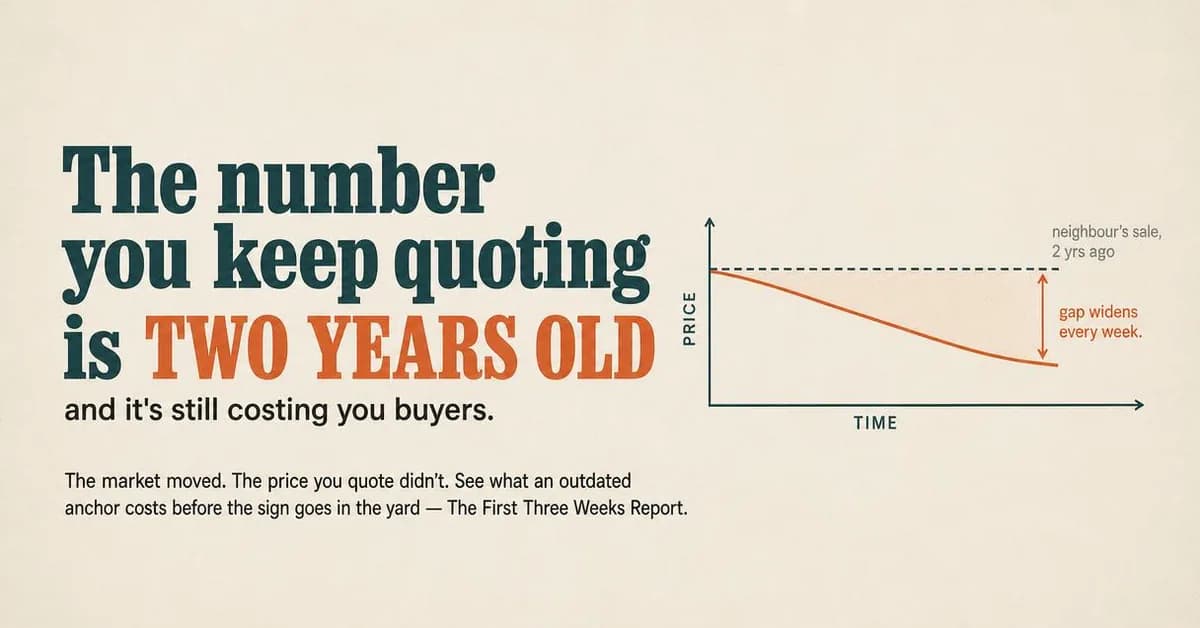 Example adThe number you quote is two years oldSee the brief →
Pre-listing prep, repaid at closing
Leads- Who it is for.
- Sellers who know what the house needs and cannot fund it now
- Angle.
- Offer & Economics — Financing / Installments, because the objection is timing rather than amount. They have been quoted twice; what stops them is that the money is due now and the proceeds arrive in three months. Read the credit warning in the targeting section before running this one.
 Example adThe prep bill moves to closingSee the brief →
Buy the next house before listing this one
Leads- Who it is for.
- Owners with equity, no cash, and no intention of moving twice
- Angle.
- Benefit & Outcome — Simplification. The product is the removal of a sequence — rental, storage, two moving quotes, three closing dates — so the ad has to show the sequence rather than describe the service. Also a credit offer; see the targeting section.
 Example adOne case team runs the whole moveSee the brief →
Selling an inherited house for an out-of-state executor
Leads- Who it is for.
- Executors responsible for a property they cannot see
- Angle.
- Identity & Emotion — Security / Protection. The feeling is not grief or urgency, it is the background dread of being answerable for a building eleven hundred miles away with a sibling asking for updates. Sell the weekly report and the single point of contact, not the listing.
 Example adSomeone has to lock that doorSee the brief →
The carrying-cost worksheet for a stalled FSBO
Traffic- Who it is for.
- Owners six weeks into selling it themselves
- Angle.
- Comparison & Positioning — Hidden Cost of Cheap, because the belief in the way is “this is free” and the answer is arithmetic rather than argument. Mortgage, insurance and utilities on an empty staged house is the cost they have not counted. Do not assert a buyer-agent commission figure while you do it — see the mistake below.
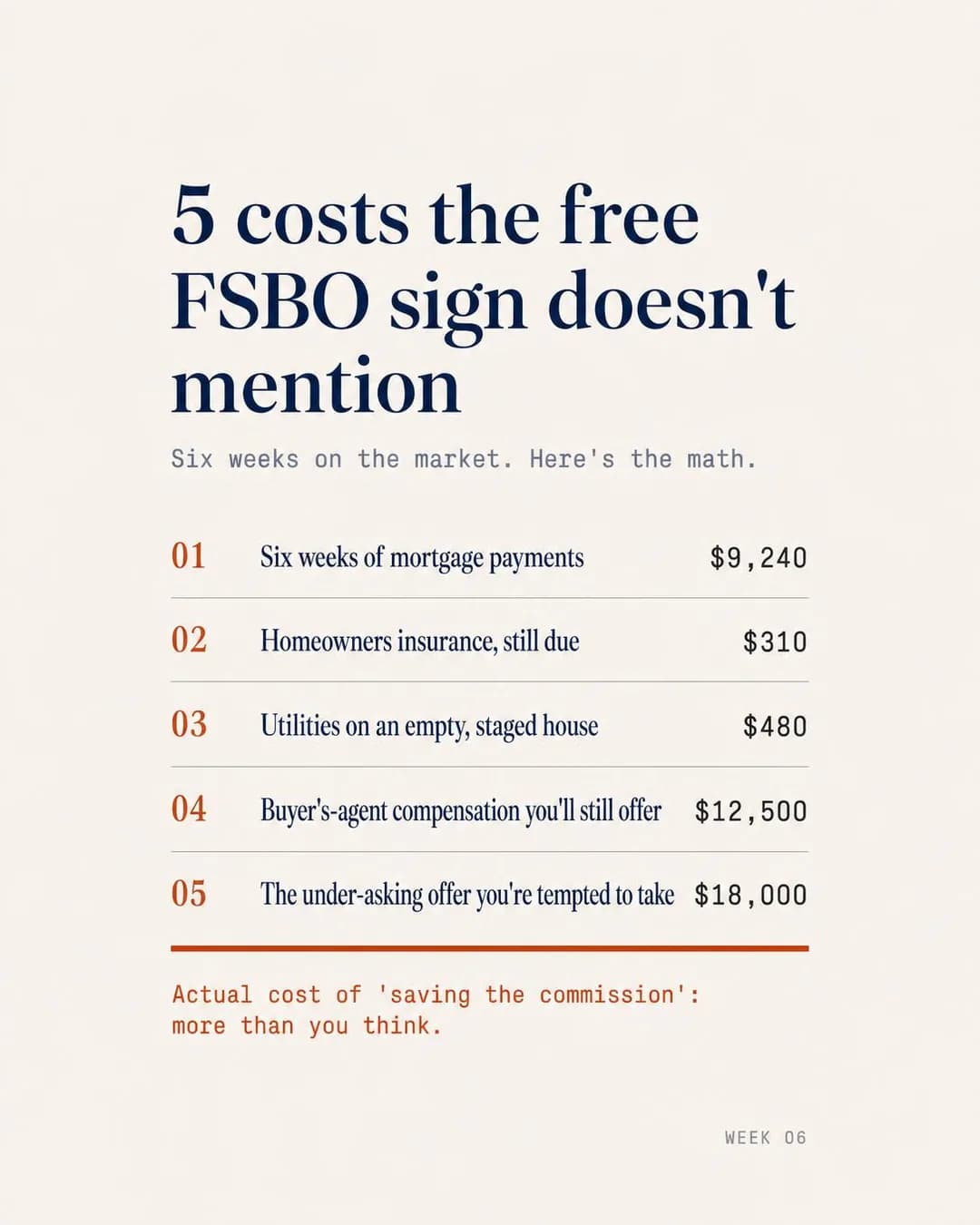 Example adThe hidden cost of going soloSee the brief →
The itemised fee, published with the listing
Traffic- Who it is for.
- Sellers holding a full-fee proposal beside a discount one
- Angle.
- Story & Founder POV — Why We're More Expensive — the family most agents will not touch, and the only one that answers the question actually being asked at the kitchen table. It works only as a receipt: photographer, stager, print run, who staffs the open house. A percentage defended in prose is not this offer.
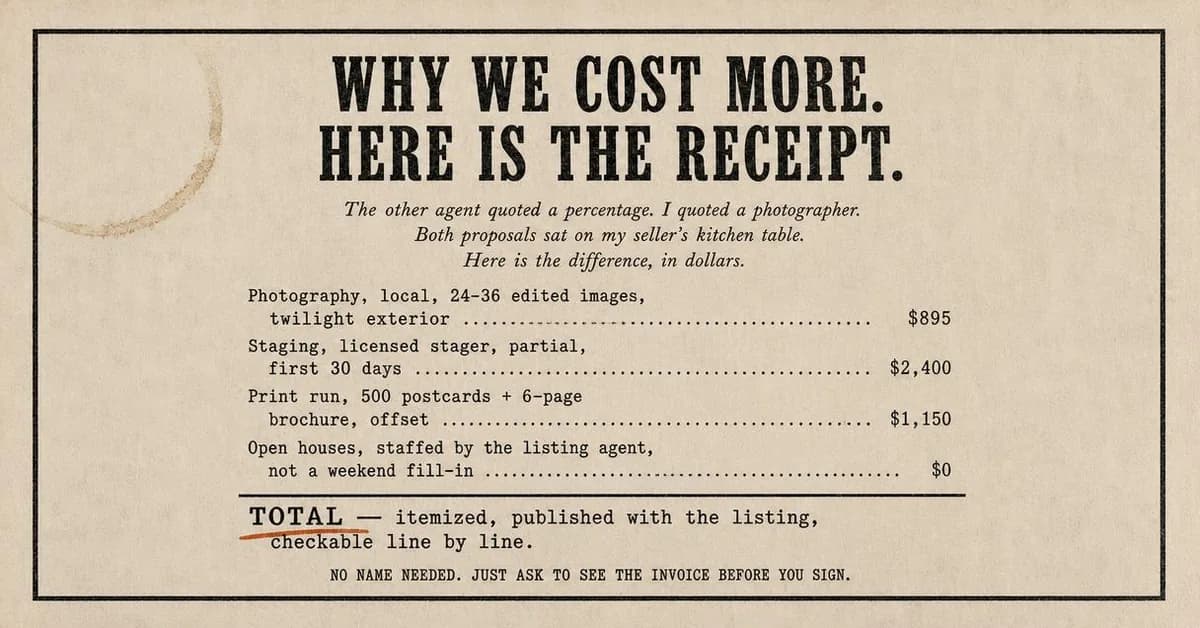 Example adI quoted a photographer, not a %See the brief →
The house you have now sold twice
Awareness- Who it is for.
- Sellers who would rather call somebody who has been in the house
- Angle.
- Proof & Trust — Repeat Customer, a family that barely functions elsewhere and is close to unbeatable here: a house changes hands about once a decade, so having sold the same one twice is proof no budget can buy. The one row on this list where Awareness is the right buy.
 Example adThe second time we sold this houseSee the brief →
Selling a rental with the tenant still in it
Leads- Who it is for.
- Small landlords told the house must be vacant first
- Angle.
- Objection & Risk Reversal — The Complexity Objection. They are not unconvinced the house should sell; they have been told it must be emptied, which means ending a tenancy and carrying a vacant house through the sale. Name the three documents — estoppel, deposit ledger, lease assignment — because specificity is the whole answer.
 Example adSell occupied. Keep the rent coming.See the brief →
The January prep intake, before the spring rush
Leads- Who it is for.
- Owners who have said “after Christmas” twice
- Angle.
- Scarcity, FOMO & Timing — Early Bird, and honest scarcity for once: paint, staging and photography have real lead times and everybody wants them in the same six weeks. If you advertise a cap, you have to hold the cap — a scarcity claim is the one a reader checks by turning up thirteenth.
 Example ad12 homes. 7 taken. 5 left.See the brief →
The walkthrough that names three fixes and stops
Leads- Who it is for.
- Sellers holding a contractor's quote for the whole house
- Angle.
- Product & Mechanism — Mechanism Reveal, because the product is a way of reading a document the seller already owns. It also outsells a free comparative market analysis for a counter-intuitive reason: every agent in the radius offers to tell you what to do, and this one tells you what not to spend.
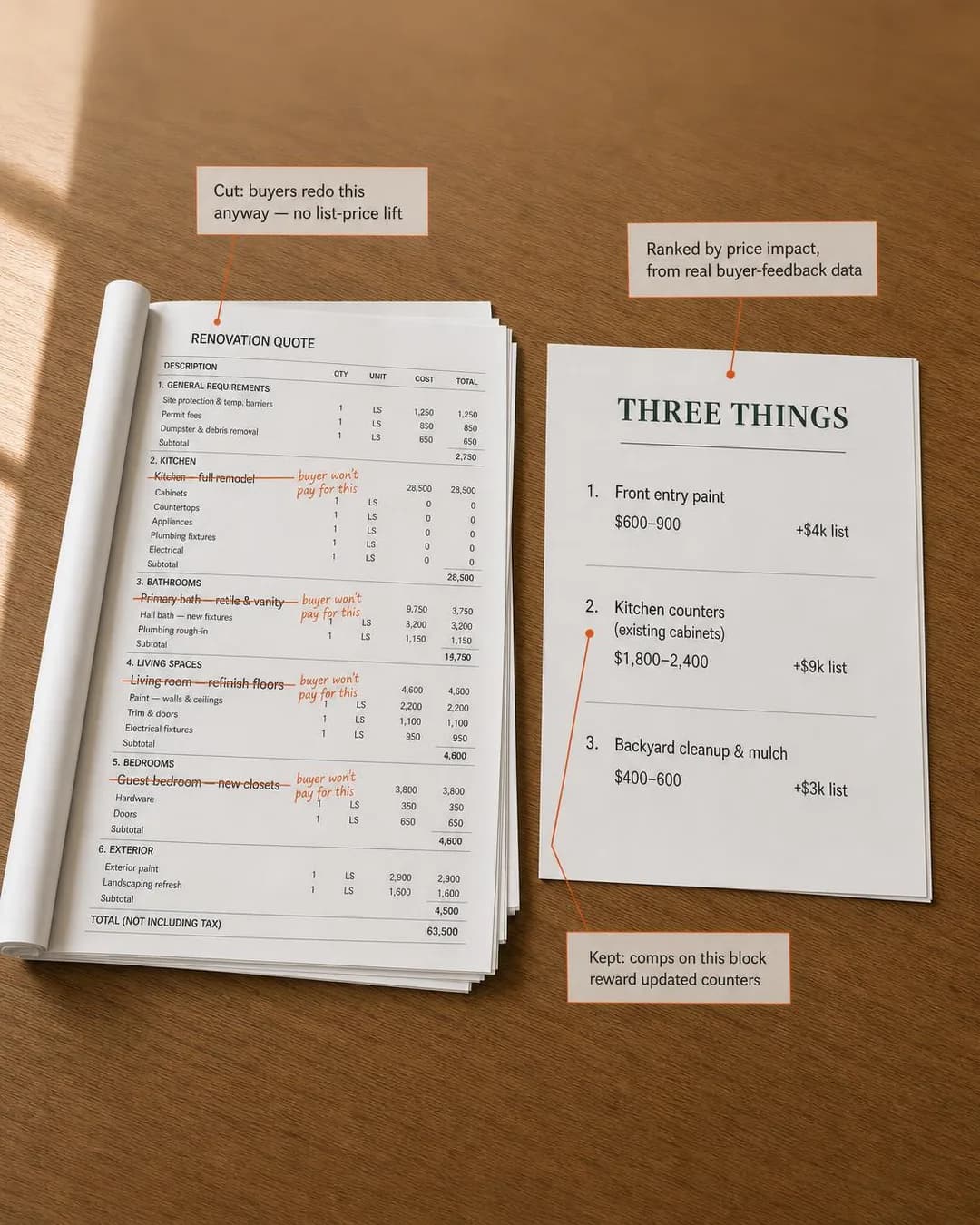 Example adBuyers redo most of your quote anywaySee the brief →
The expired listing, relisted
Leads- Who it is for.
- Owners whose listing came off the market unsold
- Angle.
- Problem & Pain — Misdiagnosis / Reframe — the failure had a cause and it was probably not the number, which is the only opening that does not repeat the conversation that just failed. This batch has no example because the Instagram page already carries one; that ad belongs on this platform, where its audience is, and it is the clearest single demonstration of the family in the cluster.
No example ad for this offer on the examples page yet.
What is my home worth
Leads- Who it is for.
- Owners idly curious, years before they list
- Angle.
- Benefit & Outcome — The most-run seller offer in the industry and deliberately absent from this batch, because an automated valuation is the offer whose lead quality is worst and whose volume is best — which is exactly the trap the budget section describes. Run it only if you have the follow-up to work a two-year-old lead, and never as your only seller offer.
No example ad for this offer on the examples page yet.
The category you know about, and the second one you probably do not
Everything the housing special ad category takes is documented on the Instagram guide in this cluster and is identical here — age fixed to 18–65+, gender to all, no lookalikes or saved audiences, no ZIPs, neighbourhoods or metro areas, no location exclusion, narrowed detailed targeting, a radius floor of 15 miles in the US and Canada and 15 kilometres in Europe. Read that page for the lever-by-lever version. What follows is what is different about running this on the seller side.
The first difference is that three of the most effective seller offers are also credit advertisements. A prep advance repaid at closing, a buy-before-you-sell programme underwritten against equity, anything rendering a mortgage pre-approval: those promote a credit opportunity, and financial products and services has been a required special ad category for US advertisers since January 2025 — Meta's own reference page gives the start date twice and disagrees with itself, 14 January in the banner and 21 January in the milestones, so treat it as live for anything you are running now. The good news is that its restrictions are the same ones housing already imposes, so declaring it costs you no additional reach. The bad news is that a wrong declaration is not a paperwork error — Meta's classifiers read the creative regardless, and being seen to work around a category is treated as evasion. If the ad advertises money moving before the sale, declare it.
The second difference is the certification gate, which catches almost every first-time housing advertiser. A business admin has to accept Meta's non-discrimination policy in Business Settings before any of this runs; until they do, the API returns error 2859024, “Certification Required”. It is not a creative problem, it is not a billing problem, and nothing in Ads Manager's campaign flow puts it in front of you at the moment you need it.
The third is the one thing on the seller side that genuinely works better than on the buyer side, and it is worth building deliberately. Custom audience inclusion survives the category. Your past-client list, your sphere, the people who opened your market report, everybody who watched the video about the tenant-occupied sale: those are addressable, and on the seller side they are the highest-value audience you will ever assemble, because a past client is a future seller with a known address. Meta's own documentation flags that customer lists carry an eligibility requirement and the same non-discrimination acceptance, so check before you upload.
- Housing categoryRequired
- Declare it. Meta's classifiers apply it from the creative anyway, and working around it is treated as evasion rather than as an oversight.
- Financial products categoryCheck the offer
- Required in the US since 21 January 2025 for ads promoting a credit opportunity. Three common seller offers qualify — prep advances, buy-before-you-sell, anything showing a pre-approval. Same restrictions as housing, so it costs no reach.
- Non-discrimination certificationDo it first
- A business admin accepts the policy in Business Settings. Without it the API returns error 2859024 and nothing delivers. This is the most common reason a first housing campaign does not start.
- AgeGone
- Fixed at 18–65+, and error 2909035 if you try. Which is why the choice of app is the age decision — and why this page exists separately from its Instagram twin.
- Custom audiencesUse them
- Inclusion, exclusion and expansion all survive. On the seller side this is the best asset you have: past clients are future sellers at known addresses. Check the eligibility requirement on customer lists before uploading.
- Lookalikes and saved audiencesUnavailable
- Both removed, with their own 2909035 messages. The instinct to build a lookalike from a past-client list is the right instinct and the category forbids it.
- Radius15-mile floor
- 25 km in the US and Canada, 15 km in Europe. A 15-mile circle over a suburb is a few hundred thousand people, almost none of whom will sell this year, and you pay for all of them. That is the cost the creative has to earn back.
- Location exclusionDisallowed
- The standard buy-wide-and-subtract move is unavailable, so you cannot carve out the half of the radius you do not serve. Plan the budget around a circle you cannot shape.
- The creativeWhere the qualifying happens
- A property event, never a person. An expired listing, a tenant in place, a contractor's quote. Naming a situation is a targeting instrument; naming a kind of person is a Fair Housing problem.
Instant Form, message, or landing page?
The Instagram guide splits this by side of the transaction. This page is one side, so the split is different: it runs on how much the lead is worth and how fast you answer. A seller lead is the most valuable lead in this industry and among the rarest — one listing is a year of a small brokerage's marketing budget — which inverts the usual advice that more leads at a lower cost is better.
That is why the volume settings are wrong here. Meta's Instant Forms come in two types, More volume and Higher intent, the second adding a review step before submission. Everywhere else on this site, More volume is the sane default. On the seller side it fills your CRM with people who tapped a pre-filled form on the way past, and every one of them costs a phone call to disqualify. Use Higher intent, and ask one qualifying question that is about the property rather than the person — the address, or how long they have owned it.
Send the click to a landing page instead whenever the offer contains a number you have to defend: a published fee, a prep advance and its terms, a flat packet price. Those need the page before they need the form, because a seller who submits without understanding the terms is a seller who withdraws at the appointment. And where you have credit terms on the creative, the page is also where the disclosures live.
The third option is the one most listing agents under-use. Lead ads can click to message on Messenger, Instagram or WhatsApp, and the “Instant forms and Messenger” conversion location runs one campaign and lets delivery choose per person. For a seller thinking about it rather than deciding, a thread is a much lower commitment than a form and a much better conversation — but only if somebody answers within the hour. If nobody does, it is worse than a form, because an unanswered message is a bad first impression rather than an unworked lead.
The recommendation: Instant Form on Higher intent with one property question for the productised first steps; a landing page for anything with a number you would have to defend, credit terms included; click to message only if someone answers inside the hour. Never More volume — on the seller side, cheap leads are the expensive kind.
Creative direction
Start with the rule the whole page turns on, because it is a writing instruction rather than a legal caveat. Qualify on the property, never on the household. “Your listing expired in March” and “you have a tenant with eleven months left” are precise, they select hard, and they are about a house. “Empty nesters”, “now that the kids have gone”, “perfect for a growing family” are about people, and familial status is one of the six classes the Fair Housing Act's advertising clause names. The test to apply to all five headlines every time: does this sentence describe something that happened, or does it describe who somebody is?
The second rule is about faces, and it is the one that surprises people. Eight of the ten ads on the examples page contain no people at all, and that is a defensible default rather than a stylistic one — in housing advertising the people you show are read as the people the housing is for, and HUD's 24 CFR Part 109, withdrawn in 1996 but still cited as HUD's position, addressed the selective use of human models directly. Where a face does appear on that page it belongs to the agent, which is the defensible use. If you are going to put people in a housing ad, do it deliberately.
Third: keep rendered documents short. This is a craft rule that came straight out of building the examples page and it has a sharp edge. Five of the ten ads render invoices, quotes or receipts, and the arithmetic held perfectly on the short ones — a four-line storage invoice, a three-line moving quote, a four-item prep bill all add up exactly. The one that ran to six itemised sections has three wrong subtotals and a grand total that does not match its own parts. Since the entire appeal of a document-realism ad is that a reader can check it, the length at which it stops being checkable is the length to stay under.
Fourth: twenty-seven characters. Facebook Feed's headline recommendation is shorter than Instagram's, so the argument has to be intact in about four words. On the examples page the headlines that survive that cut are the ones leading with a number and a noun — “12 homes. 7 taken. 5 left.” — and the ones that do not are the ones opening on a subordinate clause. Write the four-word version first and let the primary text carry the rest.
Fifth, and this is where a seller-side ad most often goes wrong on substance rather than policy: every figure you publish is a claim you will be asked to defend in a listing appointment. Days on market, list-to-sold ratios, repeat-client percentages, the price impact of a repair. The generator will invent all of them cheerfully and they will read beautifully. Replace each one with something from your own MLS or cut it — an ad that argues without a statistic is weaker than one with a real number and stronger than one with an invented number a client checks.
Finally, the rule that changed recently and that most competing guides still get backwards. Since HUD's Dear Colleague letter of 24 April 2026, sharing neighbourhood crime and school-quality information is permitted rather than prohibited, provided it is shared consistently and without discriminatory intent. That is a genuine expansion of what a seller-side ad may discuss. What did not change is the distinction underneath: objective data shared with everyone is information, and racially coded commentary about schools or crime remains evidence of intent even where the underlying data is accurate. Keep the source, drop the adjective.
- Qualify on a property event, never on a household. A listing that expired, a tenant in place, a quote in hand.
- No familial-status language, however warm it sounds — “empty nesters”, “now that the kids have moved out”, “too much house for two”.
- No implied age, which Meta's personal attributes policy prohibits independently of Fair Housing.
- Default to no people in the frame. If a face appears, let it be the agent's, deliberately.
- Keep rendered documents short enough that a reader can add them up, because they will.
- Four words in the headline. Write that version first.
- Check it against 40 as well as 27 — Marketplace and Instagram Feed both recommend 40, Facebook Feed recommends 27, and the same ad is delivered to all three.
- Compose the 4:5 so it survives a square crop, or export a 1:1 as well. Marketplace asks for 1080 × 1080 and will crop your portrait to get it.
- Write the 30-character description even though Facebook Feed will not show it. Marketplace will, and it costs nothing.
- Every published figure comes from your own MLS or comes out.
- Schools and crime are permitted when shared consistently and factually — data yes, adjectives no.
- If the offer moves money before the sale, it is a credit ad too. Declare it and put the terms on the page.
- Do not fill the 1.91:1 slot with a wide-angle interior just because it finally fits.
Funnel structure
The seller funnel is a calendar rather than a ladder, and that is the difference from every other page in this cluster. A buyer decides in weeks and a seller decides over years, so the job is not to accelerate somebody through three stages this month — it is to be present, credible and specific at an unknown future moment, and to capture the people who happen to be at that moment now.
Which changes what the middle stage is for. Cold is a circle you cannot shape, so its only job is to find reactions. Warm is where the productised first steps live and where most of the budget should go, because somebody who read the fee breakdown or downloaded the carrying-cost worksheet has raised their hand about a property rather than about a house. Sphere is the stage this platform makes uniquely valuable: custom audiences survive the special ad category, past clients are future sellers at known addresses, and on Facebook they are actually reachable.
Cold
40% of budgetAudience. The 15-mile circle, unshaped, unaged, unexcluded — everyone the category leaves you.
Running. The offers that qualify hardest in their first line: the repricing report, the tenant-occupied sale, the FSBO worksheet. Judge them on who reacts, not on cost per thousand.
Warm
40% of budgetAudience. Video viewers, page engagers, site visitors, anyone who opened a report. Retargeting survives the category and this is where it earns its keep.
Running. The priced first steps — the walkthrough, the prep advance, the lease-transfer packet — plus the published fee for anyone who read it and did not act.
Sphere
20% of budgetAudience. Past clients, your database, the people who already know your name. Custom audience inclusion is available; the lookalike you want to build from it is not.
Running. The repeat-client record and the January intake. Low budget, permanent, and the highest-converting thing on the account.
Budget and testing
Do the learning-phase arithmetic before you plan anything else, because on the seller side it comes out worse than anywhere on this site and pretending otherwise wastes the first two months. Meta's delivery system wants roughly 50 optimisation events per ad set per week to leave the learning phase. A small brokerage does not get 50 seller leads a week; it may not get 50 in a quarter. So you will be running learning-limited more or less permanently, and the correct response is not more budget on the same event — it is optimising for something further up that actually fires often enough to teach delivery anything, and judging the account on the rare event yourself.
That is also the honest argument against the home-valuation offer that dominates this industry. It is the one seller offer that produces enough volume to satisfy the learning phase, which is exactly why it is everywhere — and its leads are people who were curious two years before they will list. If you run it, run it knowing you have bought a follow-up problem rather than a listing, and staff for that. If you cannot work a two-year-old lead, the volume is a cost.
The calendar is the other half of the plan, and it is more specific in this trade than in most. The listing supply decision happens in the weeks after New Year, for a market that peaks in spring, which means the money should go in before the auction gets expensive rather than during it — the January intake ad on the examples page is that idea as a creative. The same logic applies in reverse in the autumn, when sellers who failed to sell over the summer are deciding whether to relist or withdraw, and expired-listing offers are cheaper and more welcome than at any other point in the year.
Judge the account on listing appointments taken and listings signed, not on leads. Cost per lead is the number Ads Manager shows you and it is the number that will mislead you fastest here, because the cheapest seller leads are systematically the worst ones. Two expensive leads that became appointments beat forty cheap ones that became a call list. No benchmark figures appear on this page for the same reason they appear nowhere else in this cluster: the ranges published online are averages across markets that have nothing to do with yours, and quoting one would be inventing a number in a guide that spends four paragraphs telling you not to.
- Test the first line, not the image. On the seller side that line is the entire targeting mechanism, and it is the cheapest thing on the ad to change.
- Run the four-word headline against the long one. The recommendation is 27 characters and almost nothing you write will fit it — find out whether that costs you anything before assuming it does not.
- Test a property-event opener against a benefit opener for the same offer. This is the one comparison that tells you whether the qualifying is working.
- Give an ad set a fortnight before judging it. Changing the optimisation event, the audience or the creative is a significant edit and restarts the learning phase you were already struggling to leave.
- Test Higher intent against More volume once, on your own account, and measure it at appointments rather than at leads. The result usually settles the argument permanently.
- Do not test four creatives against a budget that cannot fill one ad set's learning phase. Two, properly funded, beats four starved.
Six of these ads, in full
Every ad below was generated by best-in-slot for a real estate business that does not exist, with its audience, angle and objective pinned before the run — and published exactly as it came back. They are six of the Facebook examples for a real estate business; the rest, with the full brief and the alternate headlines behind each one, are on that page.
Problem & Pain · 1.91:1 · Leads
The number you quote is two years old
Written for: Owners anchored to a number a neighbour got.
The full brief and why it works →
Objection & Risk Reversal · 4:5 · Leads
Sell occupied. Keep the rent coming.
Written for: Small landlords selling a house with a tenant in it.
The full brief and why it works →
Story & Founder POV · 1.91:1 · Traffic
I quoted a photographer, not a %
Written for: Sellers weighing a full-fee agent against a discount listing.
The full brief and why it works →
Proof & Trust · 4:5 · Awareness
The second time we sold this house
Written for: Sellers who want the agent their family already used.
The full brief and why it works →
Scarcity, FOMO & Timing · 9:16 · Leads
12 homes. 7 taken. 5 left.
Written for: Owners who have decided to list in the spring.
The full brief and why it works →
Product & Mechanism · 4:5 · Leads
Buyers redo most of your quote anyway
Written for: Sellers told to renovate the whole house first.
The full brief and why it works →
Mistakes specific to this trade
The category mistakes — planning around ZIP codes, building a lookalike from past clients, hoping you will not have to declare — are covered on the Instagram guide and are identical here. These are the ones that belong to the seller side and to this platform, and three of them are visible in the finished ads on the examples page rather than hypothetical.
Publishing a buyer-agent commission as if it were fixed
The single most consequential error available to a seller-side ad right now, and one of the generated ads on the examples page walks straight into it with a line item reading “Buyer's-agent compensation you'll still offer — $12,500”. Since MLS policy changed on 17 August 2024, offers of compensation may not be published on an MLS at all, and NAR's own settlement FAQs describe listing and buyer agreements carrying a conspicuous disclosure that compensation is not set by law and is fully negotiable. An ad asserting a fixed figure contradicts the disclosure your own paperwork has to make, in the corner of this industry that has just been through an antitrust settlement about exactly this.
Describing who the house is for
It arrives innocently, because the warmest way to write to a downsizer is to describe their life. “Now that it is just the two of you.” “Perfect for a growing family.” “The house has outgrown you.” Familial status is one of the six classes in the Fair Housing Act's advertising clause, and Meta's personal attributes policy separately prohibits implying age. The property-event version is always available and is always the stronger ad: describe the four bedrooms nobody has slept in since 2019, not the family who left them.
Letting a generated headline state a preference
One headline in the batch built for this page reads “The property needs a local owner”. The intended meaning is that an empty house needs somebody nearby keeping an eye on it. The meaning it carries is a preference about who should own a dwelling, which is the shape the advertising clause exists to prohibit. Read all five headlines against that test before any of them run, because the model produces the fifth one as confidently as the first.
Advertising credit without declaring it
A prep advance repaid at closing, a bridge purchase underwritten against equity, an ad rendering a mortgage pre-approval: all promote a credit opportunity, and financial products and services has been a required US special ad category since 21 January 2025. Since its restrictions match housing's exactly, declaring it costs nothing — which makes not declaring it a pure downside, and Meta reads the creative either way.
Trusting a number the image model drew
Five of the ten ads on the examples page render financial documents, and the short ones add up perfectly while the one with six itemised sections has three wrong subtotals and a total that does not match its own parts. The ad whose whole promise is “here is the math” is the ad a reader will check. Add up anything your creative renders, every time, and keep the documents short enough that adding up is quick.
Optimising for cost per lead
It is the headline number in Ads Manager and it is the one that will mislead you fastest in this trade, because the cheapest seller leads are systematically the worst. More volume Instant Forms, a valuation widget and a broad radius will get your cost per lead down and your listings-signed count nowhere. Measure appointments.
Boosting the listing post
It is the most-bought real estate ad and the weakest use of the money. You are paying for a radius you cannot narrow, to show a house that only a handful of people in it want, in a window that closes at contract, using photographs the portals are already distributing for free. Advertise something that survives the sale.
Filling the 1.91:1 slot because it finally fits
Facebook takes the landscape shape Instagram has no placement for, and the asset waiting to fill it is the wide-angle interior from the last listing shoot. That is the one asset every competitor in your market also has. Both landscape ads on the examples page are text, and that is not an accident.
Discovering the certification on launch morning
A business admin must accept Meta's non-discrimination policy in Business Settings before a housing campaign delivers at all — error 2859024, “Certification Required”. Nothing in the campaign flow surfaces it when you need it, and it is a five-minute job done a week early and a ruined morning done late.
Running one campaign for buyers and sellers
The two sides want opposite platforms, opposite offers and opposite objectives, and the category has removed the age control that would otherwise let one ad set serve both. Buyer offers belong on the Instagram page in this cluster. Splitting them is not tidiness; it is the only targeting decision you have left.
Questions
- Facebook or Instagram for a real estate agent?
- It depends which side of the transaction you are buying, and the housing category makes the choice consequential: because your ad set's age range is fixed at 18–65+, the app is effectively your age targeting. Facebook reaches 74% of 50- to 64-year-olds and 57% of the over-65s — sellers, downsizers, executors, long-term landlords. Instagram reaches 80% of 18- to 29-year-olds, which is first-time buyers and renters. Run listing acquisition here and buyer-side offers there. The tell that you have it backwards is a listing-acquisition ad running on the app where your own feed lives rather than where your sellers' does.
- How do I target homeowners if I cannot target by age or ZIP code?
- You do not target them, you qualify them in the first line of the ad. The special ad category fixes age and gender, removes lookalikes and saved audiences, prohibits location exclusion and makes ZIP codes, neighbourhoods and metro areas unselectable, with a 15-mile radius floor. What replaces it on the seller side is better than people expect: qualify on a property event rather than a demographic. “Your listing expired in March”, “you still have a tenant in it”, “you are holding a quote for the whole house” each select a narrower and more valuable reader than an age band would, and none of them goes near a protected class.
- Is a prep-advance or buy-before-you-sell ad really a credit ad?
- If it advertises money moving before the sale, treat it as one. Financial products and services is a required US special ad category as of 21 January 2025, and an advance repaid at closing or a purchase underwritten against equity promotes a credit opportunity. The practical news is good: its restrictions are the same ones housing already applies, so the declaration costs you no reach at all. The risk is entirely on the other side — Meta's classifiers read the creative whether or not you declared, and working around a category is treated as evasion rather than as an oversight.
- Why is Awareness worth buying here when the Instagram guide says no?
- Because sellers decide on a different clock. A buyer's decision runs in weeks, so an unremembered brand is worth nothing and Awareness is a vanity buy — which is what that page correctly says. A listing decision arrives years after the impression, inside a radius you already work, and being the name a household already knows when it finally happens is a real part of what a listing agent sells. Three conditions, though: a defined area, something true to be known for, and the patience to wait. It is not a substitute for having an offer, and it is still the objective most often bought for the wrong reason.
- What should a seller-side ad send people to?
- An Instant Form set to Higher intent, with one qualifying question about the property rather than the person. The instinct to use More volume is wrong on this side of the transaction: a seller lead is among the most valuable in the industry and among the rarest, so filling the CRM with people who tapped a pre-filled form on the way past costs you a phone call each to disqualify. Use a landing page instead whenever the offer contains a number you would have to defend — a published fee, an advance and its terms — and click to message only if somebody genuinely answers within the hour.
- Can I mention school quality or crime rates now?
- Yes, with care, and this is where most competing guides are still wrong. HUD's Dear Colleague letter of 24 April 2026 states that sharing neighbourhood crime and school-quality information does not violate the Fair Housing Act when it is shared consistently and without discriminatory intent, and NAR has updated its guidance to match. What has not changed is the line underneath: objective data given to every client is information, an assessment is an opinion, and racially coded commentary about schools or crime is still evidence of intent even where the underlying data is accurate. Cite the report, publish it for everyone, and let the reader draw their own conclusion from it.
- How many leads should I expect?
- Fewer than the learning phase wants, which is the planning fact that matters more than any benchmark. Meta needs roughly 50 optimisation events per ad set per week to leave learning; a small brokerage may not see 50 seller leads in a quarter, so you will run learning-limited more or less permanently. Plan for it by optimising on an event further up the funnel that fires often enough to teach delivery something, and judge the account yourself on listing appointments taken. This page publishes no cost-per-lead benchmark on purpose: the figures circulating online are averages across markets unrelated to yours, and quoting one would be inventing exactly the kind of number the creative section tells you to delete.
Sources
Every platform claim on this page was read against these on . Meta’s policies move; if one of these disagrees with this page, it is right and we are stale.
- Meta ads guide — image ad specifications by placement
- Meta ads guide — image ad specifications, Facebook Marketplace (1:1 at 1080 × 1080; primary text 125, headline 40, description 30)
- Meta Marketing API — Special Ad Categories, including the financial products milestone and error codes 2859024 and 2909035 (page updated 21 May 2026; read 3 September 2026)
- Meta Advertising Standards — Privacy Violations and Personal Attributes
- Meta — about lead ads and the Instant forms and Messenger conversion location
- 42 U.S. Code § 3604 — Discrimination in the sale or rental of housing; subsection (c) is the advertising clause
- US Department of Justice — settlement with Meta over discriminatory housing advertising
- Pew Research Center — Americans' social media use, November 2025
- National Association of REALTORS® — settlement FAQs; MLS policy changes effective 17 August 2024 (read 3 September 2026)
- National Association of REALTORS® — FAQs on steering, crime and schools (HUD Dear Colleague letter No. 26-028, 24 April 2026)
- HUD — Fair Housing Advertising, 24 CFR Part 109 (withdrawn 1996, still cited as HUD's position)
That is the playbook. Now make the ads.
Paste your site. It reads your listings, your market and your brand, then writes the concepts, renders the images and drafts the copy — for a category where the ad set cannot do your targeting.
No credit card · 50 free credits (about 5 ads or Instagram posts)
Every angle recommended above is documented in the best-in-slot ad angle library, and the ads are from real estate facebook ad examples. More industries are at all ad guides.