
Ad Examples · Real estate agents × Facebook · 10 ads
Real estate Facebook ad examples
Ten finished seller-side ads for real estate businesses — with the audience, angle and objective behind each one, because we generated them rather than collected them.
The default real estate Facebook ad is the boosted listing post, and it is the most-bought and least-considered ad in the industry. It is a brochure with money behind it: eight wide interiors and a price, aimed at a radius of a few hundred thousand people, almost all of whom will never want that specific house, and it stops working the week the property goes under contract. The second most common is the JUST SOLD graphic with a headshot in the corner, which is a scoreboard pointed at other agents. Neither is on this page.
Every ad below was generated with the audience, the angle and the objective chosen up front, so the brief printed beside each one is the brief that actually produced it rather than a guess written afterwards about somebody else's work. The businesses are invented — ten of them, a repricing specialist, a prep-finance service, an estate coordinator, a two-agent brokerage, a tenant-occupied listing agent, none of them real — so no brokerage's creative is borrowed and no agent's face is used.
Nothing was edited afterwards. The image, the body text, the headline and the four alternate headlines under each ad all came out of one run and are printed exactly as they arrived. That is the point: a page arguing that a machine can make a usable ad is worth nothing if a person quietly fixed the ads first.
This run went clean in the operational sense — ten ads, one pass, no regenerations, the third batch in this cluster to manage it after real estate on Instagram and dentist on Instagram. It did not go clean in the editorial sense, and that distinction is the most useful thing on the page. Four of the ten must not run as they are, and the reasons are specific rather than stylistic: one publishes a buyer-agent compensation figure as though it were a fixed cost, one asserts a local market decline it has no data for, one carries a headline that states a preference about who should own a house, and one annotates a renovation quote whose arithmetic does not survive being added up. Each is named in its own note, below its own ad, with the fix.
This is the seller-side half of the cluster. The Instagram page next door is the buyer side, and the split is not a matter of taste: because the housing special ad category fixes your age range at 18–65+, the choice of app is the closest thing to age targeting left, and Pew puts Facebook at 74% of 50- to 64-year-olds and 57% of the over-65s against Instagram's 40% and 19%. Listing acquisition, downsizing, estate sales and expired listings live here. The Instagram page said so and handed them over; this is where they landed.
One thing you can read off the briefs before looking at an image: seven of the ten were written for Leads, two for Traffic and one for Awareness, and not one for Sales. That is the trade rather than the platform — nobody buys or sells a house inside an ad session, and the most an ad here can cause is a conversation. The single Awareness buy is the two-agent brokerage ad, and it is defensible for a reason worth borrowing: a listing agent's addressable market is the few thousand households that will eventually sell within a radius they already work, and being remembered by them six months early is the whole product.
The figures are invented too, and in this trade that matters more than in any other on this site. A days-on-market number, a repeat-client percentage, a commission rate, a prep-advance cap: these are not flourishes, they are claims you would be publishing as your own and defending in a listing appointment. Read every one below as a placeholder showing where a real figure goes and how specific it has to be to carry an ad.
What changes because it is Facebook
Start with the thing that makes this cell exist. A housing ad set has its age range fixed to 18 through 65+ and its gender set to all — those controls are gone, and there is no version of the campaign where you get them back. But the two apps do not carry the same people, so choosing between them is choosing an age distribution, and it is the only such choice you have left. Pew's November 2025 survey puts Facebook at 74% of US adults aged 50 to 64 and 57% of those 65 and over; Instagram reaches 40% and 19% of the same two groups. Sellers, downsizers, executors of an estate, the owner of a rental house bought in 1998, the couple whose listing expired at sixty-two — every one of them is more reachable here by a factor of roughly two. This is a media-planning decision doing the work that targeting is not allowed to do, and it is the entire reason the seller-side offers are on this page and the first-time-buyer offers are on the other one.
Now the trap that creates, which is this page's real subject and which no competing guide states. Facebook delivers you to the exact cohort whose defining characteristic you are not allowed to name. Three separate rules converge on it. Meta's personal attributes policy prohibits an ad that asserts or implies a person's age, among a longer list — the same clause that outlaws the dental vernacular on the dentist page in this cluster, arriving here from the opposite direction. The Fair Housing Act's advertising clause, 42 U.S.C. § 3604(c), makes it unlawful to publish any advertisement about the sale or rental of a dwelling indicating a preference, limitation or discrimination based on race, color, religion, sex, handicap, familial status or national origin — age is not on that federal list, but familial status is, and the natural seller-side vernacular is soaked in it: “empty nesters”, “now that the kids have moved out”, “the house is too big for just the two of you”. And many state and local fair housing laws add age outright. So the ad knows exactly who it is talking to and may not say it.
What all ten ads below do instead is the move worth taking away from this page: they qualify on a property event rather than on a person. A listing that expired. A tenant with eleven months left on a lease. A house eleven hundred miles from the executor who inherited it. A contractor's quote for $63,500. None of those is a protected class, none implies an age, and every one of them selects a narrower and more valuable reader than a demographic would — because a property event comes with a decision attached and a demographic does not. That is the structural advantage the seller side has over the buyer side, and it is the inverse of the Instagram page's problem, where the only qualifier available was a person and naming one walks toward the line rather than away from it.
The shape comes back on this platform, and you should mostly decline it. Instagram is portrait-only, which rules out the landscape listing photography every agent has a folder of; the Instagram page argues that this is a favour, and it is. Facebook takes 1.91:1 — in our own publisher that ratio routes to Facebook's right-hand column and search results, surfaces with no Instagram equivalent at all, while 4:5 goes to both feeds and 9:16 to stories and reels across both apps. Two ads here are rendered at 1.91:1 for that reason and neither is a listing photo: one is a typographic poster and one is a newspaper classified. The landscape slot is genuinely back, and the temptation that comes with it is the one asset in your folder that every competitor in your market is also posting.
The copy limits run the other way from what most people assume, and this batch measured it. Meta's ads guide recommends a 27-character headline and 50–150 characters of primary text for Facebook Feed, against 40 and 125 for Instagram Feed — the Facebook headline recommendation is the tighter of the two. Against that, nine of the ten headlines these ads lead with are over 27 characters, and 37 of the 40 alternates are too; the worst is 47. Every one of the fifty primary texts is over 150, ranging from 261 to 563 characters. Longer is not forbidden, it is truncated, and on a 27-character budget truncation arrives inside the first clause. The rule that follows is the one to actually apply: whatever the ad is arguing has to be intact before the cut, which on this page means the ads that lead with a number and a noun survive and the ones that lead with a subordinate clause do not.
And the budget is not one budget, which is the part that makes the previous paragraph binding rather than advisory. Facebook Feed is one of nine image surfaces on this app — the others are in-stream video, video feeds, Marketplace, Stories, ads on Reels, search results, Business Explore and the right-hand column — against Instagram's four, and their recommendations disagree. Marketplace asks for a square image at 1080 × 1080, 125 characters of primary text, a 40-character headline and a 30-character description; Facebook Feed asks for 4:5 at 1440 × 1800, 50–150 characters, a 27-character headline and shows no description line at all. Leave Advantage+ placements on, as most housing campaigns do, and one ad is rendered into every one of them from a single export and a single headline. You choose the file; you do not choose the frame. Eight of the ten descriptions below fit Marketplace's 30, in a field the feed will never show — and the practical rule is to write the headline to the shortest budget and compose the portrait so it survives a square crop, because the placement you did not think about is the one holding your reader.
One caveat worth stating plainly, because this page is about a special ad category: none of the copy or shape recommendations changes because a campaign is declared housing. The category takes targeting away and leaves the creative specs exactly where they were. What it does change is how expensive a truncated first clause is — with no ZIP, no neighbourhood, no location exclusion and a 15-mile floor under the radius, the creative is doing the qualifying that the ad set is no longer allowed to do, and the first forty characters are where it does it.
One last thing that is not about copy or shape, and that stops a first campaign dead. A business admin has to review and accept Meta's non-discrimination policy before a housing campaign will run at all — the API returns error 2859024, “Certification Required”, and points at Business Settings. Alongside it, error 2909035 is what you get for a custom age range, a saved audience, a lookalike or a location radius below the floor, each with its own message. None of that is discoverable from the creative side, and finding out by having an ad set refuse to deliver on the morning of a listing launch is worse than doing it deliberately at setup.
Source: Meta ads guide — image ad specifications by placement · Meta ads guide — image ad specifications, Facebook Feed (4:5 at 1440 × 1800; primary text 50–150, headline 27, no description line; 3% aspect-ratio tolerance) · Meta ads guide — image ad specifications, Facebook Marketplace (1:1 at 1080 × 1080; primary text 125, headline 40, description 30) · Meta Marketing API — Special Ad Categories (page updated 21 May 2026; read 3 September 2026) · Meta Advertising Standards — Privacy Violations and Personal Attributes · 42 U.S. Code § 3604 — Discrimination in the sale or rental of housing (subsection (c) is the advertising clause) · US Department of Justice — settlement with Meta over discriminatory housing advertising · Pew Research Center — Americans' social media use, November 2025 · National Association of REALTORS® — settlement FAQs (MLS policy changes effective 17 August 2024; read 3 September 2026) · National Association of REALTORS® — FAQs on steering, crime and schools (HUD Dear Colleague letter No. 26-028, 24 April 2026) · HUD — Fair Housing Advertising, 24 CFR Part 109 (withdrawn 1996, still cited as HUD's position)
Want the campaign, not just the creative? Facebook ads for real estate agents → is the playbook these ads came out of: which objective to buy, the offers worth running, the targeting levers this trade keeps, and the policy that decides what the copy may say.
Generate ads for your own brokerage
Paste your site and best-in-slot reads it the way these invented businesses were read — service, audience, positioning — then writes the concepts, renders the images and drafts the copy. Free to start, no card.
The Number That Ages
LeadsThat sold price you keep quoting is two years old and still costing you buyers.
- Audience
- Owners anchored to a number a neighbour got — Watched a house on the same street sell for a figure they have quoted at every dinner since, have not read a sold report in two years, and believe an asking price can always be cut later with nothing lost by starting high.
- Angle
- Cost of Inaction (Problem & Pain) — Shows what happens if the buyer does nothing and the current situation continues.
That number you keep quoting? It's two years old. The market moved — down 8%, maybe 12% depending on your street — and every buyer who walks through your door already knows it. They've run the comps. They see the gap. And the longer you anchor to a neighbour's sale from 2022, the fewer of them bother to come back. The First Three Weeks Report shows you what that outdated number is actually costing in lost traffic, so you can price to where the market is now, not where it was.
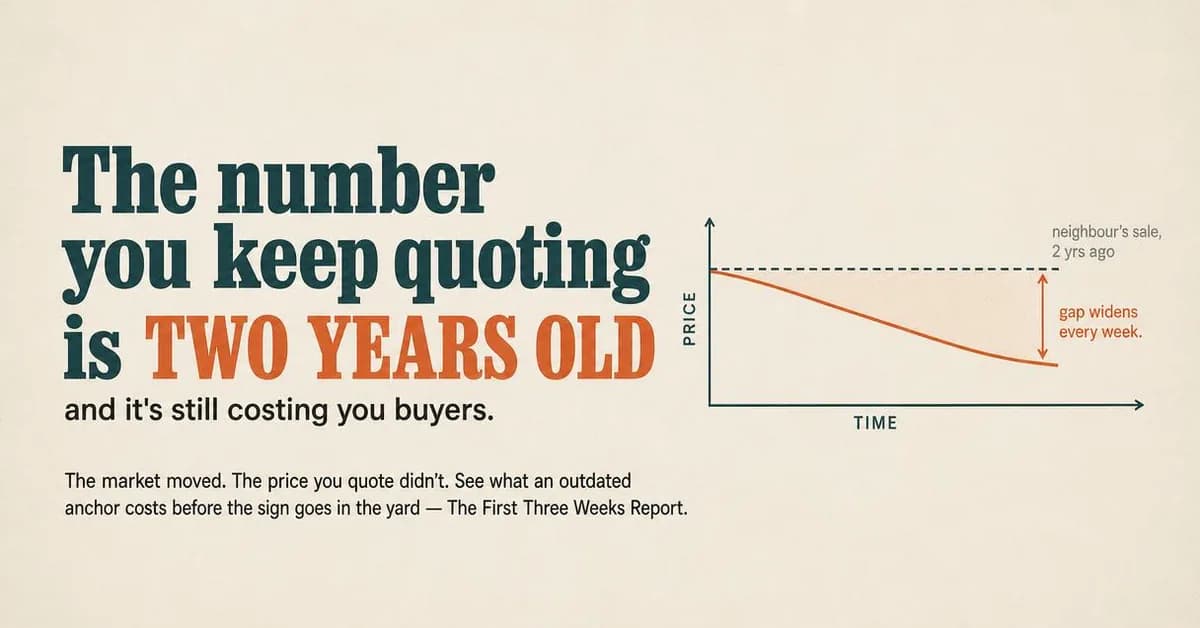
The number you quote is two years old
Get the current clearing price
Cost of Inaction is the right family here because this seller is not inactive in their own mind — they are waiting for the market to come back to a number, which feels like patience and is actually a decision being made every week. The family's job is to price the waiting, and the ad does it structurally rather than rhetorically: the chart's dashed line is the neighbour's sale, the curve is the market, and the shaded wedge between them is labelled “gap widens every week.” That wedge is the argument. Nothing about it accuses the seller of greed, which is the accusation every fourth agent makes and the reason this conversation usually fails.
Then read the image against the copy, because they do not make the same claim and only one of them is defensible. The chart has no numbers on either axis — PRICE and TIME, unlabelled — so it asserts a shape and nothing more, which is exactly right for a market you have not measured. The body copy asserts “down 8%, maybe 12% depending on your street” and “homes priced to stale comps lose 40% of their buyer interest in the first ten days”, and one variant attributes that to “our tracking”. Those are fabricated market statistics presented as research, and they are the reason this ad must not run as it stands: an agent publishing a local price decline is making a claim a client will quote back to them. Delete both figures and the ad survives intact, because the wedge was doing the work. Worth noting for a different reason: the brief pinned a bold typographic poster and the concept stage had proposed a dinner table shot from above with a phone in it — the pinned direction outranks the concept writer downstream, and here it produced the better ad. Also, this is the batch's clearest look at what a ratio variant does, because the 1.91:1 render is the square re-laid-out with the chart moved beside the headline rather than the square cropped.
Other headlines from the same run
- Anchored to a sale that's already stale
- That comp moved. Your price didn't.
- Old comps cost you real buyers today
- See what outdated pricing actually costs
Call to action
This reader has not decided to list and is being told their number is wrong, which is not a booking conversation on first contact. Send them to a page that shows the decay argument in full and lets them book at the bottom. Download works if the report exists as a PDF — it converts the same intent at a lower price and leaves you the email. Book now is the right primary only once the offer is a named, priced first step and the page has already earned it.
One Case Team, Not Five
LeadsYour equity qualifies the next house. One team runs the whole thing.
- Audience
- Owners who have to sell in order to buy — Have most of their money in the walls and very little of it in the bank, have been advised to sell first and rent for six months, and are not packing and unpacking a full house twice to make a chain work.
- Angle
- Simplification (Benefit & Outcome) — Replaces several tools, products, steps, or workflows with one simpler solution.
You're told to sell first, rent for six months, hire two movers, juggle three closing dates. Then someone asks if the timing lines up. It doesn't have to work that way. Your equity qualifies the next house. One case team coordinates both closings. You pack once, move once, and close both on the same timeline.

One case team runs the whole move
One move, one date
Simplification is the correct family and a hard one to render, because simplicity is invisible — you cannot photograph an absence. The run solved it by photographing the alternative: five creased documents on one side of the frame, a single tied folder on the other, and the seller's own anxiety on a sticky note (“So much to juggle. What if the timing doesn't line up?!”). Nothing in the picture explains the service. Everything in it explains the problem, which for this offer is the same thing, because the product is literally the removal of the left-hand side of the image.
The forensic pass is the reason this ad is worth studying closely. Three separate documents carry line items and totals, and all three add up: the storage invoice is $189 + $12 + $5 = $206, and the two moving quotes total $4,000 and $4,010 against their own line items exactly. Meanwhile the small print degrades into texture — the lender letter reads “based on the info- provided and a subject to verification additional documentation”, and the rental flyer's bullet renders as “Untinil lisstdry”. So the model got the arithmetic right and the prose wrong, which is the opposite of the usual failure and worth knowing before you brief a document-realism ad: numbers survive, sentences do not, at that point size. The date stamps are the other flag. Every document is internally consistent and dated April and May 2024, and this batch ran in September 2026 — the same defect the dentist Instagram page found in a lock screen, where the model builds a coherent document set and anchors it to its own sense of now rather than to today. Finally, the offer itself: “your equity underwrites the next purchase” and a rendered mortgage pre-approval for $765,000 make this a credit advertisement as much as a housing one, and financial products and services has been its own required special ad category in the US since 21 January 2025.
Other headlines from the same run
- Your equity buys the next house first
- Move once, not twice
- One team. One timeline. One move.
- Stop juggling five vendors
Call to action
Nobody arranges a bridge purchase from an ad, and the ad's own promise — one coordinated timeline — is a thing that has to be explained before it is believed. Send the click to a page that lays out the sequence and the financing behind it. Contact us is the honest primary if you qualify equity by phone anyway, which most brokerages running this offer do. Avoid Sign up: there is no self-serve product on the other side of it.
Nothing Goes On Your Card
LeadsThe paint, the carpet, the crew — none of it hits your card.
- Audience
- Sellers whose house needs work they cannot fund first — Know exactly which four rooms are costing them offers, have been quoted for the work twice, and are not putting several thousand dollars on a card for a house they are about to hand to somebody else.
- Angle
- Financing / Installments (Offer & Economics) — Focuses on affordability through payment structure rather than absolute price.
You've been quoted twice. You know the number. What's stopping you is paying it now. The paint, carpet, landscaping, and clean your house needs — all advanced upfront, all settled at closing. Your card stays in your wallet. If it doesn't sell, you owe nothing back. Up to $18,000 advanced. No interest, no fee if it sells within 120 days. Over 1,400 homes prepped, listed an average of 9 days faster.

The prep bill moves to closing
Up to $18k advanced upfront
Financing / Installments earns its place here because the objection is about timing rather than amount. This seller has been quoted twice and knows the number; what stops them is that the money is due now and the proceeds arrive in three months. So the ad is built around the instrument rather than the work: a contractor invoice, a card with nothing on it, and the terms in the largest type on the page. The offer-stack format is doing what it is for — the seller is not choosing between contractors, they are choosing whether the bill can wait.
The rendered invoice adds up, which for this format is the whole credibility test: $6,200 + $5,100 + $3,200 + $1,500 = $16,000, and the total says $16,000, sitting correctly under the $18,000 advance cap in the panel beside it. Two defects sit on top of that. The invoice's description and amount columns are offset by half a row, so “Painting” appears to have no price and a dangling $1,500 has no label — recoverable but wrong on a document whose realism is the argument. And the line “$0 out of pocket today” is rendered with a rule struck through it, so the ad crosses out its own best term; whether that is a divider colliding with the text or a genuine strikethrough, a reader sees the offer negated. The larger issue is regulatory rather than visual. “Advanced up to $18,000”, “no interest, no fee if it sells within 120 days”, “paid back only from your sale” are credit terms, advertised. That puts the campaign in the financial products and services special ad category alongside housing, and it puts the copy within reach of the rules about advertising credit terms generally. Also invented, and needing replacement before this runs: 1,400 homes prepped, listing 9 days faster, closing 4.1% above original list.
Other headlines from the same run
- Zero out of pocket until you sell
- Advanced now. Settled at closing.
- Your card stays in your wallet
- Pay the contractor from the sale
Call to action
The headline terms are already on the creative, so the landing page's job is the rest of them — the cap, the 120 days, what happens if the house does not sell, who the contractors are — before it asks for an address. That is also where the credit disclosures belong. Book now suits a version of this offer whose first step is a walkthrough rather than an application. Get offer is the wrong verb here: this is an advance, not a discount, and a reader who taps expecting money off lands on terms.
The Unlocked House at Night
LeadsAn empty house eleven hundred miles away is not safe on its own.
- Audience
- Executors selling a parent's house from out of state — Are named on paperwork for a house eleven hundred miles away, have taken three days of leave already to meet contractors who did not turn up, and have a sibling asking every week when it will be done.
- Angle
- Security / Protection (Identity & Emotion) — Emphasizes protecting family, money, property, data, health, time, or peace of mind.
You're eleven hundred miles away. The house is empty. The porch light is on a timer, but who's checking the back door? When you're the out-of-state executor, an inherited property isn't just a listing — it's a liability you can't watch. One coordinator walks the house, locks it, manages every vendor, and reports back weekly until closing. 71 days on average, start to finish.

Someone has to lock that door
Estate coordination, not just listing
Security / Protection is the unglamorous right answer for this reader, and the run understood the assignment better than the brief did. There is no house-for-sale in this picture. There is a hand putting a key into a lock at dusk, an unlit ranch house with the grass gone long, one porch light on, and a clipboard held in the other hand. The executor's actual feeling is not grief and not urgency — it is the low background dread of being responsible for a building they cannot see, and the photograph is that dread rather than an illustration of a service. Note also what it does not contain: no face. Eight of the ten ads on this page show no people at all, which in a category where HUD's own advertising guidance addressed the selective use of human models is a defensible default rather than an aesthetic one.
One headline in the set must not run: “The property needs a local owner.” In an ad about the sale of a dwelling, that is a statement of preference about who should own the house, which is the shape § 3604(c) exists to prohibit — and the meaning intended, that the property needs somebody local looking after it, is not the meaning it carries. It is also unnecessary, because the four other headlines in the set do the job without going near it. Two smaller things to fix before this ships: the primary text says eleven hundred miles and a headline says 1,000, so the two disagree on the same detail; and “71 days on average, start to finish” is an invented performance figure, which for a service sold to a fiduciary is the worst possible place to keep one. Replace it with your own or cut it — the ad's argument is the weekly report, not the average.
Other headlines from the same run
- Protect the house you can't see
- One person. One timeline. Done.
- For executors 1,000 miles away
- The property needs a local owner
Call to action
This is the one reader on the page who wants a person rather than a page. An executor is discharging a duty on somebody else's behalf, usually with a sibling asking for updates, and the first thing they need is confirmation that a named human will pick up. Learn more is the right swap where probate timelines need explaining before anyone will call, which in most states they do. Book now presumes a calendar this reader has not decided to put anything in.
Six Weeks of Carrying Cost
TrafficThe sign was free. The six weeks waiting on it weren't.
- Audience
- Owners selling it themselves to save the fee — Put their own sign in the garden six weeks ago, have had two viewings and one offer well under, and are now fielding calls from agents while trying to work out what the sale is actually netting them.
- Angle
- Hidden Cost of Cheap (Comparison & Positioning) — Shows the downstream costs, replacements, waste, or frustration created by cheaper alternatives.
You saved the agent fee. Then spent six weeks paying the mortgage on a house no one's living in. Mortgage, insurance, utilities — all still due while your FSBO sign waits for a buyer. Most sellers who go solo don't factor carrying cost into the math. We built a free worksheet that does. Plug in your list price and days-on-market, and see what those extra weeks actually cost you.
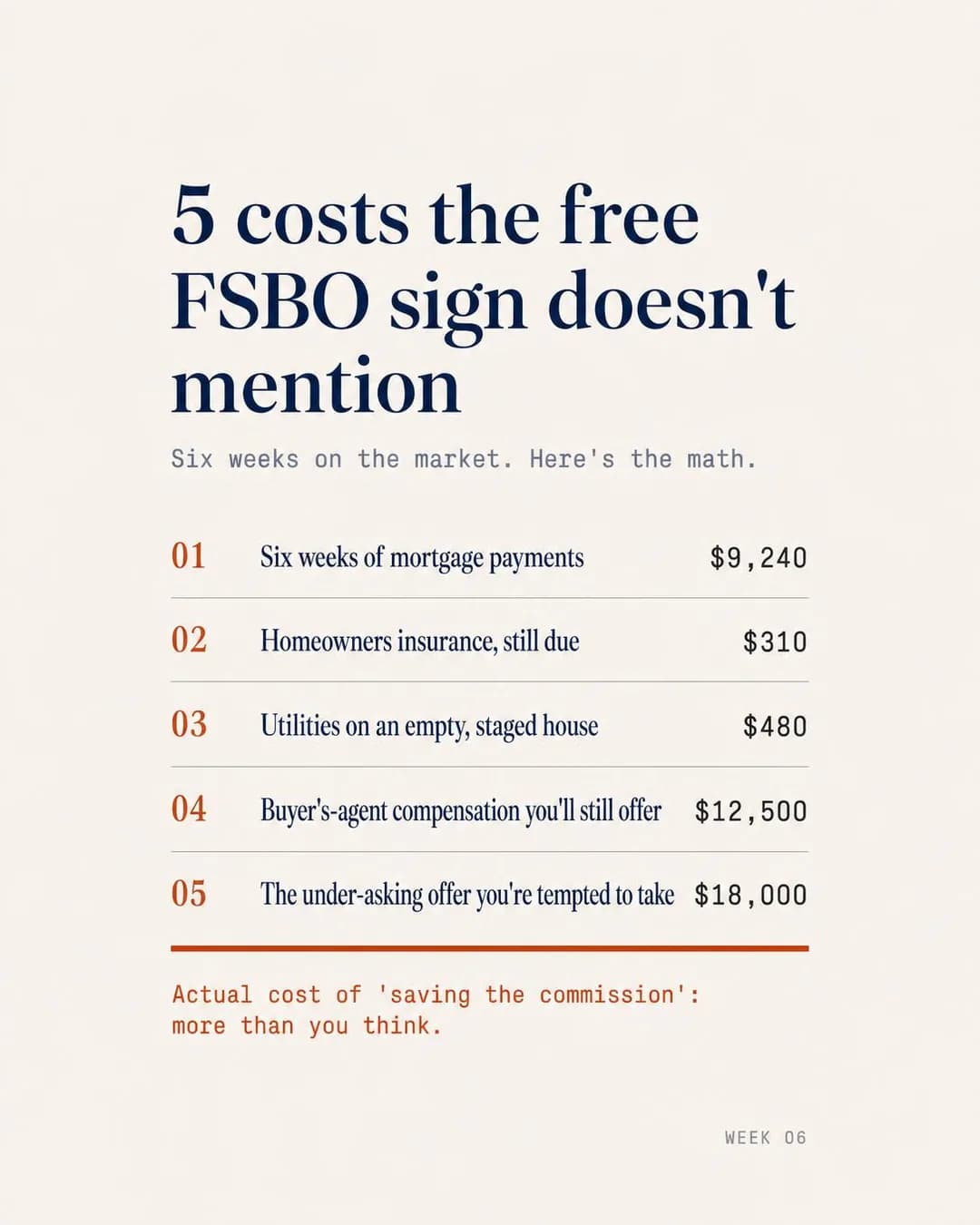
The hidden cost of going solo
See the three-scenario math
Hidden Cost of Cheap is exactly the family for an owner six weeks into selling their own house, because the belief in the way is not “agents are bad” but “this is free”, and the answer is arithmetic rather than argument. The listicle format suits it: five numbered rows, dollar figures right-aligned, a WEEK 06 stamp in the corner, and a closing line that refuses to soften it. The first three rows are also genuinely the right three — carrying cost is what a FSBO seller has not counted, and mortgage, insurance and utilities on an empty staged house is where the saving quietly goes.
Row 04 is why this ad must not run, and it is the most consequential defect in the batch. “Buyer's-agent compensation you'll still offer — $12,500” presents a specific buyer-broker payment as an inevitable line item. Since the MLS policy changes took effect on 17 August 2024, offers of compensation may not be published on an MLS at all, and NAR's own settlement FAQs describe listing and buyer agreements carrying a conspicuous disclosure that compensation is not set by law and is fully negotiable. An ad asserting the opposite — that a seller will still owe a fixed figure — contradicts the disclosure that agent's own paperwork is required to make, in the one area of the industry that has just been through an antitrust settlement about precisely this. Cut the row or reframe it as a negotiable concession the seller may choose to offer. Two smaller notes: row 05, “the under-asking offer you're tempted to take”, is a counterfactual rather than a cost and does not belong in a column being summed; and the ad never sums anything anyway. It is headed “Here's the math” and totals nothing, which for a listicle whose entire promise is arithmetic is a format leaving its best move on the table.
Other headlines from the same run
- Free sign. Six weeks of bills.
- FSBO math that actually adds up
- What carrying cost really means
- Flat-fee listing: $1,450 total
Call to action
The ad names a worksheet, so send people to the worksheet rather than to a booking form — this reader is still trying to prove to themselves that they were right, and a calculator lets them lose the argument privately. Download is the better primary if it exists as a spreadsheet, because a FSBO seller will actually fill one in and you get the email. Do not send this to a calendar: a seller six weeks into doing it themselves is not ready to concede in a conversation.
The Math on the Table
TrafficThe other agent quoted a percentage. I quoted a photographer.
- Audience
- Sellers weighing a full-fee agent against a discount listing — Have two proposals on the kitchen table with a wide gap between the percentages and no explanation of what the gap buys, and suspect the cheaper one is cheaper for a reason nobody has said out loud.
- Angle
- Why We’re More Expensive (Story & Founder POV) — Founder explains the quality, sourcing, labor, service, or economics behind a premium price.
The other agent quoted a percentage. I quoted a photographer. Both proposals sat on my seller's kitchen table. One was a single number on letterhead. The other was an itemized invoice: $895 for a local photographer, 24–36 edited images, twilight exterior included. $2,400 for a licensed stager. $1,150 for 500 postcards and a six-page brochure, offset-printed. $0 for open houses — because I staff them myself, not whoever is free that Sunday. The gap between the two fees? That's the receipt. Ask to see it before you sign anything.
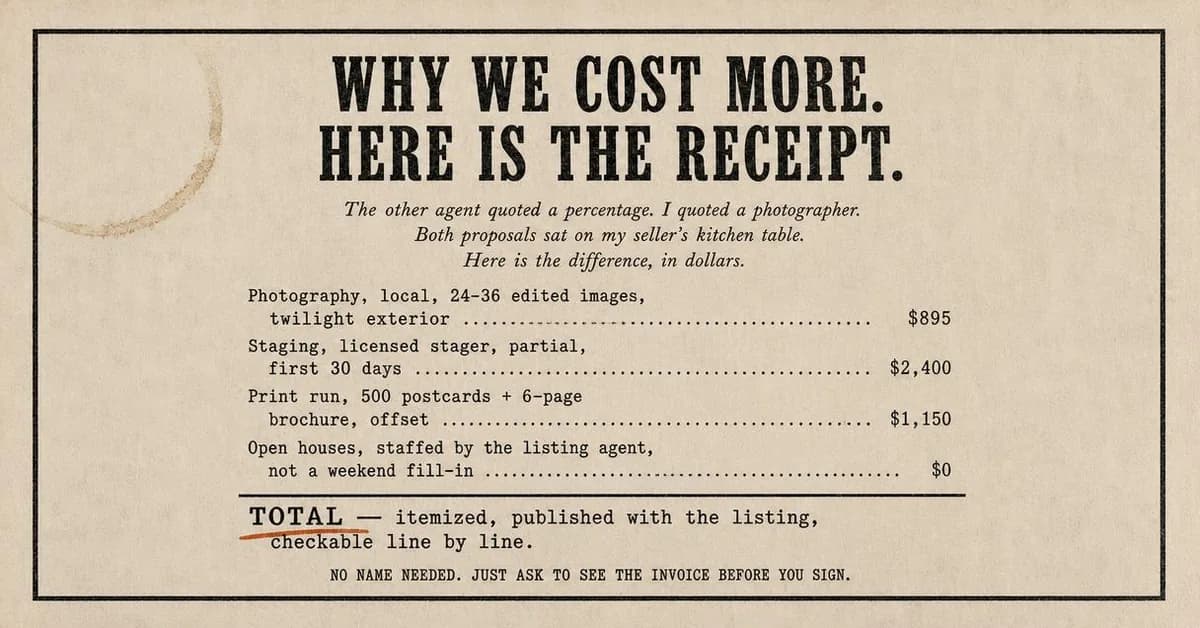
I quoted a photographer, not a %
See the receipt before you sign
Why We're More Expensive is a family most agents will not touch, and the newspaper classified is the format that makes it possible, because the argument needs to look like a receipt rather than a rebuttal. Setting it in letterpress serif on aged paper with a coffee ring does something a clean modern layout could not: it reads as a document that already exists, which is the ad's entire claim — the itemisation is published with the listing, not written for the ad. Every line item is legible and correctly typeset, which given that this is rendered pixels rather than laid-out text is not a small thing.
The defect is at the bottom, and it is a good one to notice because it is a category of error rather than a slip: the line marked TOTAL has no total. It reads “TOTAL — itemized, published with the listing, checkable line by line”, so the one number the format has spent the whole ad promising is the one it declines to give, and a reader's eye lands on the word TOTAL and finds prose. The items are $895, $2,400, $1,150 and $0, so the answer is $4,445, and the ad is stronger for saying it. That is the second ad on this page to build a table and skip the sum, which is worth treating as a standing check rather than a one-off. Two further notes. The headlines run the longest in the batch — 39, 42 and 47 characters against a 27-character Facebook recommendation — and “$895 photographer. $2,400 stager. $0 surprises.” is the single worst offender on the page, which is a shame because it is also the best of the five. And the closing line, “NO NAME NEEDED. JUST ASK TO SEE THE INVOICE BEFORE YOU SIGN”, is the unbranded instruction surfacing as copy: told to produce an ad with no brand name in it, the model wrote the absence into the argument.
Other headlines from the same run
- The invoice, published with the listing
- Here's what the gap actually buys
- Line-item pricing, visible before you sign
- $895 photographer. $2,400 stager. $0 surprises.
Call to action
The ad's own close is “ask to see the invoice before you sign”, which is an instruction to compare rather than to commit, so the landing page should be the full itemisation for a real listing. That is a page worth having regardless of the ad. Contact us suits the version of this offer that ends in a listing appointment, which is where it ends anyway. Get offer is wrong: nothing here is discounted, and the point of the ad is that it is not.
The Same Sign Twice
AwarenessThis is the second time we've put a sign in that yard.
- Audience
- Sellers who want the agent their family already used — Remember the name on the sign when their parents sold, distrust the brokerage that mails a glossy postcard every fortnight, and would rather ring somebody who has already been in the house.
- Angle
- Repeat Customer (Proof & Trust) — Emphasizes repurchase, renewal, retention, or long-term loyalty.
This is the second time we've put a sign in that yard. First time was 1994, when your parents bought it. Now you're ready to sell. We remember the water pressure in the upstairs bathroom and the way the porch light catches at dusk. That's what thirty years in the same neighborhoods gets you — not a pitch, just a memory of the house itself.

The second time we sold this house
Same neighborhoods since 1994
Repeat Customer is a family that barely functions in most industries and is close to unbeatable in this one, because a house changes hands about every decade and an agent who has sold the same house twice has proof no marketing budget can buy. The ad is one sentence — “This is the second time I've put a sign in that yard” — and the sentence does everything: it establishes tenure, it implies the neighbourhood, and it puts the reader's own family in the frame without describing them. That is the seller-side qualifier working exactly as this page argues it should, on a property event rather than on a person.
This is also the only ad on the page with a face in it, which makes it the right place to say something the category needs. In housing advertising the people you show are read as the people the housing is for, and HUD's 24 CFR Part 109 — withdrawn in 1996 but still cited as HUD's position, and cited as such on the Instagram page in this cluster — addressed the selective use of human models directly. Here the model is the agent rather than a buyer, which is the defensible use of a face, and the composition is a single person, which is the version to be deliberate about rather than accidental about. Two things to fix. “41% of last year's closings were with a family we'd sold for before” is rendered into the image and invented; it is the most persuasive line in the ad and the one you would have to document. And the internal clock is off again: the copy says the first sale was 1994 and the image says thirty years, which lands in 2024 rather than the 2026 this ran in — the same two-year drift as the document dates in the buy-before-you-sell ad, from the same cause. One headline, “We remember when your parents bought it”, asserts a family relationship in the second person and is the one to drop from the rotation.
Other headlines from the same run
- 41% repeat families. Same agent.
- We remember when your parents bought it
- Two agents. Thirty years. Same streets.
- The house we listed twice
Call to action
The only Awareness buy on the page, and the CTA should match the intent rather than the offer — there is no offer. Send the click to the brokerage's story and its record on those streets and let it sit. Contact us is the swap once the ad has run long enough that people recognise the name, which is the point of buying Awareness in a radius you work. Book now would be asking for a listing appointment from somebody who was not thinking about moving thirty seconds ago.
The One-Folder Close
LeadsSelling occupied takes one folder, not a moving truck.
- Audience
- Small landlords selling a house with a tenant in it — Own one or two rental houses, want out of the second one, and have been told by two agents that it must be vacant first — which means ending a tenancy, losing the rent and holding an empty house through the sale.
- Angle
- Complexity Objection (Objection & Risk Reversal) — Shows how easy setup, onboarding, learning, or use actually is.
Most agents told you to empty the rental first. That means ending a lease, losing months of rent, and holding a vacant house through the sale. The paperwork you're worried about? Three documents. Estoppel certificate, deposit ledger, lease assignment. We assemble all three for $650 flat, due at closing. You list occupied, we coordinate showings around tenant notice rights, and buyers who want the income stream intact make offers in an average of 41 days. No eviction. No vacancy gap. One folder.

Sell occupied. Keep the rent coming.
List with a tenant in place.
The Complexity Objection is the whole transaction for this owner: they are not unconvinced that the house should be sold, they have been told twice that it must be empty first, and emptying it means ending a tenancy, losing the rent and carrying a vacant house through a sale. So the ad answers a question rather than making a claim, and the FAQ card is the format that lets it — question in serif at the top, answer beginning with the word “No.”, and a tabbed folder in the photograph whose three tabs are the three documents the answer names.
This is the cleanest ad in the batch and it is worth saying why, because the others are instructive and this one is usable. The domain vocabulary is correct and specific — an estoppel certificate, a security deposit ledger and a lease assignment genuinely are the three instruments in a tenant-occupied sale, and getting that right is what separates an ad written about a trade from one written inside it. The tabs in the image match the documents in the body text exactly, with no drift between picture and prose. There is no protected-class exposure, no rendered arithmetic to get wrong, and one price rather than a table of them. Two things still need your own numbers before it runs: “$650 flat” and “buyers who want the income stream intact make offers in an average of 41 days”, the second being an invented performance figure of the kind this page keeps finding. And one geographic caveat the copy does not know it is making: “alongside your closing attorney” is right in attorney states and wrong in the title-company states next door.
Other headlines from the same run
- Three documents. One closing. No vacancy.
- The lease-transfer packet is $650 flat.
- Occupied properties close in 41 days.
- No eviction required to sell a rental.
Call to action
A small landlord with a tenant in place has a specific factual question — how many months are left, what notice the lease requires — and wants to ask it rather than read around it. Contact us converts that. Learn more is the better primary if the lease-transfer packet has a page explaining what each of the three documents does, which is worth building because it is also the page that answers the objection without a phone call. Book now presumes a decision this owner has not made.
The Twelfth Slot
LeadsOnly 12 homes get this January. Slot seven just filled.
- Audience
- Owners who have decided to list in the spring — Have said 'after Christmas' twice, imagine spring as a starting gun rather than a queue, and have not worked out that everything they need doing takes six weeks to book.
- Angle
- Early Bird (Scarcity, FOMO & Timing) — Rewards buyers who act before others.

Slot seven just filled. Five left. Every January, we take on exactly 12 homes. Paint, stage, photograph — all finished before the March rush starts. You get a fixed prep calendar, not a place in line behind eleven other sellers. Once we're full, the next cohort is a year away.
12 homes. 7 taken. 5 left.
January intake closing soon
Early Bird is the honest version of scarcity for this offer, and the distinction matters: the ad is not inventing a deadline, it is describing a queue that genuinely exists, because paint, staging and photography all have lead times and everybody wants them in the same six weeks. The post-it stack in a 9:16 frame reads as somebody's own planning rather than as a campaign, which is the right register for a seller who has said “after Christmas” twice, and the brass 7/12 tag clipped to the envelope at the bottom is a nice piece of physical bookkeeping.
The numbers hold, and this is the ad that proves the batch's arithmetic was not luck. The image says only 12 homes this January, slot 7 just filled, and the tag reads 7/12; the copy opens “Slot seven just filled. Five left.” and one headline is “12 homes. 7 taken. 5 left.” Four surfaces, one set of numbers, no contradiction — which is the outcome the cluster's own record says to expect least, since the gym calendars and the dentist emergency clock both failed exactly here. The one line worth reading twice is “act now = fixed calendar, not a queue behind 11 others”, which parses as the contrast it intends and momentarily looks like it disagrees with the count. Two things to check before running it: “10–18 days start to finish” is invented, and the cap itself is a factual claim — an ad that says you stop at twelve is an ad you have to stop at twelve for, because a scarcity claim is the one a reader will check by turning up thirteenth.
Other headlines from the same run
- Fixed calendar or back of the line?
- Slot 7 just closed. Yours next?
- Finished before March. Not during.
- We stop at twelve. No exceptions.
Call to action
The only ad on the page where Book now is clearly right as the primary, because the offer is a slot and the scarcity is the argument — sending a reader to a page to think about it undoes the ad. The calendar should show the remaining January dates rather than a generic booking form, since the count is the thing that has to stay true. Learn more is the swap if the prep programme needs explaining before anyone will hold a date.
Four Rooms vs Three Lines
LeadsYour contractor quoted four rooms. The comps only pay for three.
- Audience
- Sellers told to renovate the whole house first — Have a contractor's quote covering four rooms, a friend insisting on a new kitchen, and no way to tell which of it a buyer will pay for and which of it is money left in somebody else's house.
- Angle
- Mechanism Reveal (Product & Mechanism) — Explains why the product works differently from alternatives.
Your contractor quoted $63,500. The comps pay for $6,700 of it. Most pre-sale renovations fix what buyers redo anyway. A 90-minute walkthrough uses recent comp data from your block to isolate the three items — and only three — that actually lift your list price. Everything else stays as-is. Report delivered in 24 hours. $450, credited in full if you list within 90 days.
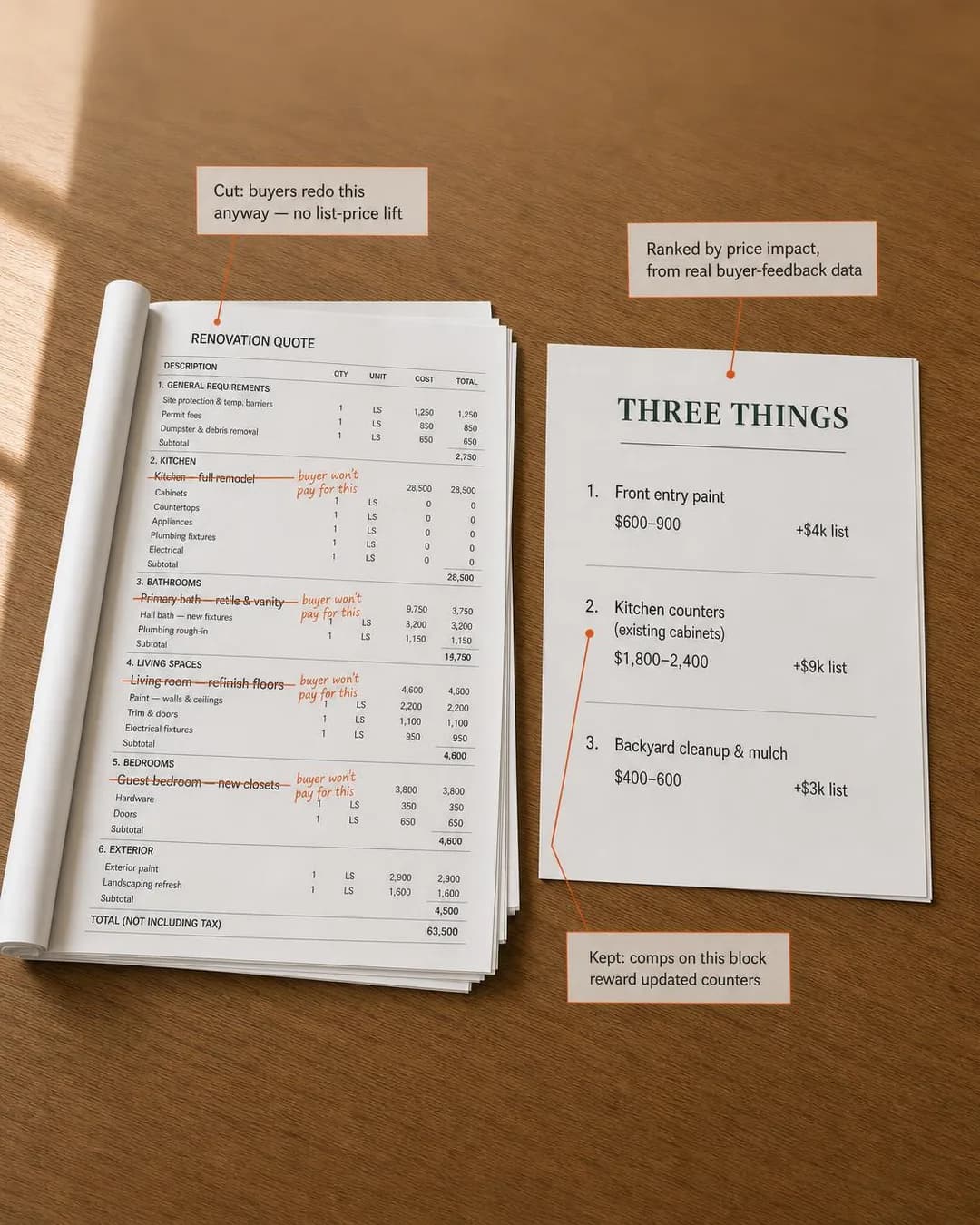
Buyers redo most of your quote anyway
Walkthrough + report: $450
Mechanism Reveal is the right family and the callout format is the right execution, because the product is a way of reading a document the seller already owns. Two objects on a desk: the contractor's quote with four sections struck through in orange and “buyer won't pay for this” written beside each, and a single card headed THREE THINGS listing front entry paint, kitchen counters and backyard cleanup with a cost band and a claimed list-price lift against each. The argument is entirely in the relationship between the two pieces of paper, which is the most sophisticated thing any ad in this batch attempts.
It is also the ad that breaks, and it breaks in the place that matters most. Add up the renovation quote it is annotating and it does not survive: the bathrooms section lists 3,750, 3,200 and 1,150 and claims a subtotal of 19,750; living spaces lists four items totalling 8,850 and claims 4,600; bedrooms lists 3,800, 350 and 650 and claims 4,600 against an actual 4,800. Three of the six sections add up and three do not, and the grand total of 63,500 does not match the sum of its own subtotals either — though it does match the $63,500 in the body copy, so the ad is consistent with itself at the top level and incoherent underneath. That is the batch's clearest lesson about rendered numbers, and it is more useful than “models cannot do arithmetic”, because five other ads on this page add up perfectly. What separates them is length: a four-line invoice holds, a six-section itemised quote collapses. Keep rendered documents short. Compounding it, the THREE THINGS card claims “+$4k list”, “+$9k list” and “+$3k list” under a callout reading “Ranked by price impact, from real buyer-feedback data” — an ad asserting in so many words that its invented numbers are real. That is fabricated evidence rather than a placeholder, and it is why this one must not run as it stands. The fix is not a re-roll: cut the price-impact column and the “real data” callout, keep the two pieces of paper, and the mechanism still lands.
Other headlines from the same run
- Three fixes. Not four rooms.
- Comp data decides what's worth fixing
- Stop renovating rooms buyers replace
- Spend less. List sooner. Keep margin.
Call to action
The offer is a named, priced, time-boxed first step — a 90-minute walkthrough at $450, credited if you list — which is the profile that converts to a calendar rather than to a page. Learn more is the right swap while the $450 still needs justifying, particularly against the free comparative market analysis every other agent in the radius is offering; the answer is that this one tells you what not to spend. Get offer is wrong for the same reason as elsewhere on this page: it is a fee.
Questions
- Do Facebook ads work for real estate agents?
- They work when the ad sells a method rather than a property, and on Facebook specifically they work on the seller side. Because the housing special ad category fixes your age range at 18–65+, the app you choose is the closest thing to age targeting you have left, and Facebook reaches 74% of 50- to 64-year-olds against Instagram's 40%. That is where listing acquisition lives — expired listings, estate sales, rental houses being sold after twenty years, owners who have decided to move in the spring. None of the ten ads below is a listing. Each one sells a first step a seller can say yes to: a repricing report, a prep advance repaid at closing, a lease-transfer packet, a ninety-minute walkthrough that tells you which three things to fix.
- Should I boost my listing posts?
- It is the most common real estate ad and the weakest thing you can do with the money. A boosted listing is relevant only to the handful of people inside a radius you are paying for in full who want that particular house this particular month, and it expires when the house goes under contract. You are buying the whole radius either way — Meta's housing rules make sure of it, with a 15-mile floor in the US and Canada and no ZIP, neighbourhood or metro selection at all — so buy something the whole radius might eventually need. A method survives the sale. A listing does not, and a headshot has nothing to argue.
- Can I target homeowners over 55 on Facebook?
- No, and it is worth understanding how thoroughly no. Declaring the housing special ad category fixes age to 18–65+ and gender to all, removes lookalike and saved audiences, prohibits location exclusion, restricts detailed targeting and forces a minimum location radius. Try it anyway and the API answers with error 2909035 and a message naming exactly which control you may not use. Skipping the declaration is not a route around it either, because Meta's classifiers apply the category from the creative and working around it is treated as evasion. What replaces the lever is on this page: choose the app for its age distribution, then qualify inside the ad on something that happened to a house rather than something true of a person.
- What size should a real estate Facebook ad be?
- 4:5 at 1440 × 1800 for feed, which is the same portrait shape Instagram recommends, so one export serves both — though Facebook allows 3% aspect-ratio tolerance where Instagram allows 1%, so a crop a few pixels out passes here and fails there. Facebook also takes 1.91:1, which Instagram has no placement for at all: in our publisher it routes to the right-hand column and search results. Two ads here use it. The temptation it creates is to fill that landscape frame with listing photography, which is the one asset every competitor in your market already posts for free. Both 1.91:1 ads on this page are text.
- Can I use these ads?
- Take the approach, not the pixels, and in this category read the words twice before anything runs. The businesses are invented and the images were generated for this page, so there is nothing here to lift; the value is the pairing of an audience with a specific argument, and every angle used below is documented in full in our ad angle library, linked from each ad. Three cautions are particular to seller-side real estate. Every figure in these ads is invented and in this trade a published figure is a claim you have to document — a commission, a days-on-market number, a repeat-client percentage. Anything advertising money that moves before the sale, which is three of the ten ads here, is a credit advertisement as well as a housing one and belongs in a second special ad category. And the Fair Housing Act reaches the creative rather than only the targeting, so an ad may not indicate a preference based on a protected class — which on the seller side means watching for familial-status language much more closely than for anything else.
Seen enough? Make your own.
Paste your site. It reads your listings, your market and your brand, then writes the concepts, renders the images and drafts the copy — for a category where the ad set cannot do your targeting.
No credit card · 50 free credits (about 5 ads or Instagram posts)
Every angle used above is documented in the best-in-slot ad angle library. More industries and placements are at all ad examples.