
Ad Guides · Home Remodeling × Instagram
Instagram ads for home remodeling companies
The save outlives the lead by 640 days — and there is no save in Meta's optimisation goals. So buy the visit, which is on the same two-year clock, and turn expansion off before you call anything retargeting.
The examples page beside this one ends on a number: an engagement audience built from an Instagram business profile retains for up to 730 days, an audience built from Lead Generation Ads retains for 90, and in a trade where a kitchen closes two to six months after the click, the person who filled in your form ages out of the account before the drawings are finished while the person who merely saved the picture is still reachable two years later. That is the argument. This page asks the question that comes after it, which is the only question worth a second page: can you buy it?
No. There is no save in Meta's optimisation goals. The `optimization_goal` enum is the complete list of things the delivery system can be told to want — impressions, reach, link clicks, landing page views, leads, quality leads, conversations, calls, post engagement, ThruPlay, offsite conversions and a couple of dozen more — and not one of them is a save. The behaviour this trade's entire account would like to accumulate is the one behaviour the auction has no price for. Every remodeler who has been told to "go for saves" has been told to buy something that is not for sale.
What is for sale is the neighbour, and it is the most useful thing on this page. `VISIT_INSTAGRAM_PROFILE` is in the same enum — Meta's description is "Optimize for visits to the advertiser's Instagram profile" — and `INSTAGRAM_PROFILE` is one of the destinations an ad set can name. The visit sits on exactly the same 730-day clock as the save, because both are Instagram business profile engagement events. So the account a remodeling company can actually build here has three tiers rather than the usual two: buy the visit, which is a tap and priced like one; earn the save, which you cannot buy and can only deserve; and spend the lead budget on the pool the first two fill, months or a year later, when the decision finally arrives.
The third tier has a catch that decides whether any of this is real, and it is one parameter. Advantage+ audience exists to "expand the eligible audience pool the delivery system can search", and Meta publishes the list of things it will not expand: location constraints, minimum age, language, and custom audience exclusions. An included custom audience is not on that list. Since v23.0 the `advantage_audience` parameter defaults to 1 or has to be set explicitly on a new ad set — so unless somebody types the zero, your two-year retargeting pool is a hint you gave the delivery system on its way to spending your money on strangers. An exclusion is a wall. An inclusion is a suggestion.
What follows is the rest of it: which of the six objectives to buy on an app where the best outcome is not an outcome, which of the seventeen Instagram engagement events to build an audience from and why twelve of them are undocumented, which offers survive being filed in a folder for eleven months, what the financial products and services category does and does not say about a 730-day pool, where the ad should land, and the budget arithmetic of a trade that can finally leave the learning phase — on the cheap tier, not the one that makes money. The ads are real output rather than mockups drawn for the argument: eight of the ten on the remodeling Instagram examples page, published exactly as generated, for companies that do not exist. Every price in them is invented — a $275 measured walkthrough, a $16,800 bathroom, $31-a-square-foot tile, a $64,240 kitchen at $8.00 a day — and marks where your own number goes.
Two things this page is not. It is not legal advice: the three-day right to cancel, the deposit caps and the credit-advertising rules are federal and state law, they vary, they change, and they do not soften because the lead came from a 4:5 render — the Facebook guide in this pair works through them and your own counsel decides them. And it is not a benchmark report. There are no cost-per-lead or cost-per-save figures here, because the only useful versions of those numbers are yours.
Generate Instagram ads for your remodeling company
Paste your site and best-in-slot reads it the way the invented contractors above were read — services, service area, positioning — then writes the concepts, renders the images and drafts the copy. Free to start, no card.
What you are buying here, and the event you cannot buy
Start with who is here, because remodeling is the trade with two buyers and this app has one of them. Pew's November 2025 survey puts Instagram at 62% of 30- to 49-year-olds and 40% of 50- to 64-year-olds, against Facebook's 80% and 74%. The older band owns the houses with the equity and buys the whole-house work; the younger band is where the single-room jobs live — the hall bathroom, the kitchen refresh, the one wall that has been bothering somebody for six years — and those are the jobs a single crew can actually schedule. This is not a smaller copy of the Facebook audience. It is the half of your own order book that photographs well, reached at roughly three quarters of Facebook's rate in the band that buys it.
Then the clock, which is this cluster's most useful platform fact and belongs to this app alone. Meta's engagement custom audiences documentation sets a maximum retention of 730 days for an audience built from an Instagram business profile, the same for a Page, 365 for Shopping and augmented reality — and 90 days for Lead Generation Ads. Those two numbers describe the same household at two moments: the one who saved your floor-plan diagram in March, and the one who filled in your form in March. In this trade the drawings are not finished when the second one expires. The first is still addressable when the kitchen is installed.
Now the finding this page exists for. You cannot buy the save. Meta's ad set reference publishes the `optimization_goal` enum, which is the whole vocabulary of things delivery can be told to want, and a save is not in it — not as an ad save, not as a post save, not under engagement. `POST_ENGAGEMENT` is "Optimize for people more likely to engage with your post", which is the cheapest available reaction and in a feed full of kitchens that is a like. A save is not a reaction; it is a decision to come back. The auction has no price for it, which is exactly why it is worth having: the one signal in this account that cannot be bought has to be earned by the creative.
What you can buy is the visit, and it is on the same clock. `VISIT_INSTAGRAM_PROFILE` — "Optimize for visits to the advertiser's Instagram profile" — is in the enum, `INSTAGRAM_PROFILE`, `FACEBOOK_PAGE` and `INSTAGRAM_PROFILE_AND_FACEBOOK_PAGE` are all values of `destination_type`, and a profile visit is `ig_business_profile_visit`, an Instagram business profile engagement event with the same 730-day maximum retention as the save. So the buyable proxy for a two-year audience is a visit to your own grid. That is a real mechanism and it is specific to this app: there is no Facebook equivalent that fills a two-year pool at the price of a tap, and it is the reason the funnel below has a stage that buys an audience rather than a result.
Which of the seventeen events to build, because the menu is longer than the documentation. Meta's list of Instagram business profile engagement events has seventeen entries and five of them carry a description: `ig_business_profile_all` ("the most inclusive engagement type", a union of the others), `ig_business_profile_engaged`, `ig_user_messaged_business`, `ig_business_profile_visit` ("People who visited your Instagram business profile") and `ig_business_profile_ad_saved` ("People who saved either organic content or an ad from your Instagram business profile"). The other twelve — `ig_ad_save`, `ig_organic_save`, `ig_ad_like`, `ig_ad_cta_click`, `ig_ad_carousel_swipe` and the rest — are bare names in the same table with no description at all. Build on the five that are documented. Our own examples page named `ig_ad_save` for the save audience and it is corrected as of today: the description belongs to `ig_business_profile_ad_saved`, and the practical difference is that the documented event explicitly covers organic posts as well as ads, which in this trade is most of what gets saved.
Three mechanics worth knowing before you build one. Multiple rules are a union — "Users that match at least one of the rules will be added to the audience" — so a saved-plus-visited pool is one audience with two rules rather than two audiences you have to reconcile. An ad account can hold a maximum of 500 engagement custom audiences, which is more headroom than any remodeling company will use and is worth knowing before somebody builds one per campaign. And the documentation says an engagement audience is prefilled on creation with people who already engaged inside the retention window — the sentence is written about a Page and the Instagram section does not repeat it, so treat the backfill as a bonus rather than a plan, and build the audience the week you start rather than the week you need it.
Then the parameter that decides whether the pool is a pool. Advantage+ audience is described as a way to "expand the eligible audience pool the delivery system can search", and the constraints it will not expand are enumerated: "location constraints, minimum age, language, and custom audience exclusions". Custom audience *inclusions* are absent from that list, and from v23.0 `advantage_audience` within `targeting_automation` defaults to 1 or requires an explicit 1 or 0 on every new ad set. So on this app, in this trade, the sentence to take away is: your exclusion is a wall and your inclusion is a suggestion. The tier that spends money on the people who remembered you does not exist until somebody sets that value to zero, and the change only binds new ad sets, so an old one carries whatever it was created with.
Measurement, honestly. There is an action type for saves — `onsite_conversion.post_save`, labelled "Post Saves" — and the reference gives no platform for it and lists no Instagram-specific action types at all, so before you make saves a reported KPI, break the column by publisher platform in your own account and confirm it moves. For the visit tier the result is the thing you bought, which is the cleanest measurement in this account by a distance. And for the money, nothing has changed from the Facebook page: attribution is 1-day click, 7-day click and 1-day view, and a kitchen signed in the spring is invisible to all three.
Finally the specs and the counts, measured on this batch rather than assumed. Meta's ads guide recommends 4:5 at 1440 × 1800 for Instagram Feed — the same export Facebook Feed wants — with about 125 characters of primary text and a 40-character headline, an aspect-ratio tolerance of 1% against Facebook's 3% and a minimum width of 500 against 600. There are four image placements here against Facebook's nine, and none of the missing five wants a 1.91:1, which is why this batch contains none. This run wrote fifty headlines and every one of them fits 40, the longest at 39 characters — the first Instagram batch on this site with no exceptions, against 362 of 400 across the eight published here. Five fit Facebook's 27 and none of the ten lead headlines does. Nine of the ten description lines fit Marketplace's 30, in a field this app does not show. Six exports are 4:5, three are 9:16 for Stories and Reels, one is a square.
And the copy-length result, which is the most transferable thing the batch produced. Across the eight Instagram batches published here, exactly five of 400 primary texts fit the 125-character recommendation — and all five belong to one ad on this page, the floor-plan diagram, where they run 63 to 90 characters. The other 45 in this batch run 247 to 395. The Facebook twin got the identical result from its live-in kitchen photograph, five out of five at 74 to 99 characters, in the same trade from a completely different direction. So copy length is not a property of the platform or the trade: it tracks how much of the argument the image is already making. A dimensioned plan argues completely and leaves the copy nothing to explain. If you want short copy, do not ask for short copy — brief a picture that finishes the case.
Which objective to buy
Ads Manager offers the same six objectives here as anywhere — Awareness, Traffic, Engagement, Leads, App promotion and Sales — and this page differs from its Facebook twin on three of them. Traffic replaces Leads as the default, Awareness drops from a real recommendation to rarely, and Engagement is the trap that looks most like the right answer.
Traffic is the default, and on this app it has two destinations rather than one. The ordinary version sends a reader to a page that shows the document the ad argued from — the allowance sheet, the permit card, the day-by-day schedule. The version that is only available here sends them to your profile, bought against the profile-visit goal, and what you are purchasing is not a session, it is a two-year membership: the visit is an addressable engagement for up to 730 days. The Browse batch split five Traffic, four Leads and one Awareness, the near-mirror of the Facebook batch's six Leads and three Traffic, and that split is roughly the right shape for a remodeling account here.
Leads is the second line and it is aimed at a different audience than on the other page. On Facebook the lead ad is how a stranger becomes a consultation. Here it is mostly how somebody who has been carrying you around for eleven months finally books, which means it belongs pointed at the 730-day pool rather than at cold geography — and it inherits the Facebook guide's whole apparatus: Instant Forms on "Higher intent", the held consultation as the performance goal wherever volume allows, conversion leads optimisation if you can clear its gate. Remember what the form audience itself is worth, though: a Lead Generation Ads engagement audience retains for 90 days, which is the shortest memory in the account and the one most likely to be mistaken for the long one.
Awareness is where this page parts company with its twin, which argues for it harder than almost any guide in this cluster — the decision takes a year, it happens in a conversation you are not in, and you are buying being named in it. That argument is right and this app has a better instrument for it. A reach buy leaves nothing behind; a profile-visit buy reaches somebody and leaves an addressable trace that lasts two years. When the same money can produce an impression or a membership, buy the membership. Keep an Awareness line only for the thing a visit cannot carry, which is a 9:16 story about the shop, and expect it to be the smallest number in the plan.
Engagement is the trap, and it is worth being explicit because it is the objective every article about saves recommends. It optimises for the cheapest available reaction — Meta's own description of the post-engagement goal is "Optimize for people more likely to engage with your post" — and in a feed full of kitchens the cheapest reaction is a like from somebody who likes kitchens. A save is not a cheap reaction, it is a decision to come back, which is precisely why there is no goal for it. Buying engagement to get saves buys the population most willing to tap something, and then you retarget them for two years.
Sales is a flat no and this trade states it twice over: neither remodeling batch contains a Sales ad, which makes nine of the sixteen batches published here Sales-free and four trades — dentistry, real estate, roofing and remodeling — with none in either batch. Nobody buys a kitchen in a checkout, and the deposit that can be taken online is a lead with a card attached. App promotion is the same answer as everywhere: a kitchen is remodelled roughly once a generation.
- TrafficDefault
Two destinations, and the second one is why this page exists. A page for anything that argues with a document, and the profile for the top of the funnel — the profile-visit goal is in the API as "Optimize for visits to the advertiser's Instagram profile", and the visit it buys is an engagement event with a 730-day maximum retention. Only buy the visit if the grid can carry it.
- LeadsSometimes
Four of the ten in the Browse batch, and aimed at the pool rather than at strangers: this is where an eleven-month decision finishes. Instant Forms on "Higher intent", three or four qualifying questions, optimised on the held consultation where volume allows — the Facebook guide has the whole mechanism. Note that the form's own audience expires at 90 days, so the lead is the conversion, never the memory.
- AwarenessRarely
The one objective this page demotes against its twin, and not because the twin is wrong. On this app the same money can buy an impression or a profile visit, and the visit reaches somebody and leaves a two-year addressable trace behind it. Keep a small line for the 9:16 shop story, which is the ad nobody clicks and everybody remembers, and buy everything else as a visit.
- EngagementNo
The trap that looks like the answer. It optimises for the cheapest available reaction and a save is the most expensive one there is — a decision to come back rather than a tap. There is no save in the optimisation goals precisely because it cannot be bid for, and buying engagement instead recruits the people most willing to tap anything, whom you will then be retargeting for the next two years.
- SalesNo
Neither remodeling batch has a Sales ad, which makes nine of the sixteen batches here Sales-free and four trades with none in either. A paid assessment or a design retainer can genuinely be taken online, and buying it under Sales teaches delivery to find people who buy a $275 thing rather than people who sign a $64,000 contract. Optimise it as a lead.
- App promotionNo
A kitchen is remodelled roughly once a generation, and this app's strongest age band is substantially renters. Paying a stranger's install cost to deliver a booking screen for a once-in-twenty-years purchase is the most expensive lead in this guide.
What to advertise here, and the argument that wins it
The sorting rule on this page is not the Facebook page's, and it follows from the mechanism above. There, an offer belongs on the page if its argument is paperwork, because paperwork reads as evidence in that feed. Here an offer belongs if the ad is worth opening again in eleven months — because the behaviour this account is built to accumulate is the save, and a save is a promise to come back to something. Ask of every creative: if a stranger files this in a folder called Kitchen and opens it next spring, is there anything in it? A finished room fails that test. A dimensioned plan, a permit card, a priced sample board, a nine-day schedule, a cancellation notice and a year with four slots on it all pass.
That test also sorts the trade's jobs. The single-room work — the hall bathroom, the one wall, the kitchen refresh — is what this app's strongest bands actually buy and what a single crew can actually schedule, so it earns more of the budget here than it does on the other page. The whole-house and addition work is not absent; it is slower, and on this app it is a two-year relationship rather than a campaign.
Each row pins four decisions: who the offer is actually for, which angle family argues it best — every one is a page in the angle library — which objective buys it, and, where the batch has one, a finished ad showing the whole thing assembled. Ten of the twelve have one, which is every ad in this batch used exactly once. Two do not, and an absence is more honest than borrowing a neighbouring ad.
One warning before the table, and it is the same one the Facebook page gives because the policy does not care which app you are on: the aging-in-place row sells on the strongest emotional argument in the trade and every natural sentence for it is the prohibited one. Meta's personal attributes standard bars content that asserts or implies personal attributes, names disability and physical or mental health, and extends to implying you know "the personal attributes of their family". The Facebook batch burned that violation into an image; this batch briefed the fix — describe the room, never the person — and it held across every artefact. The creative section has the prescription.
A fixed-price measured walkthrough
Traffic- Who it is for.
- Households who have decided they need an addition, and have been pricing a bump-out for a year without anyone measuring the walkway they are actually complaining about.
- Angle.
- Problem & Pain — The cheapest first transaction in a category whose usual opening ask is five figures, and the one offer here that can honestly carry a Book now button. It is also the best-saved ad in the batch: a dimensioned plan is a document a reader opens twice, and the version we published talks the reader out of the larger job on the drawing itself — a dashed bump-out in the margin labelled NOT REQUIRED. The walkthrough happens inside the seven-day attribution window; the addition it prevents would have closed months outside it.
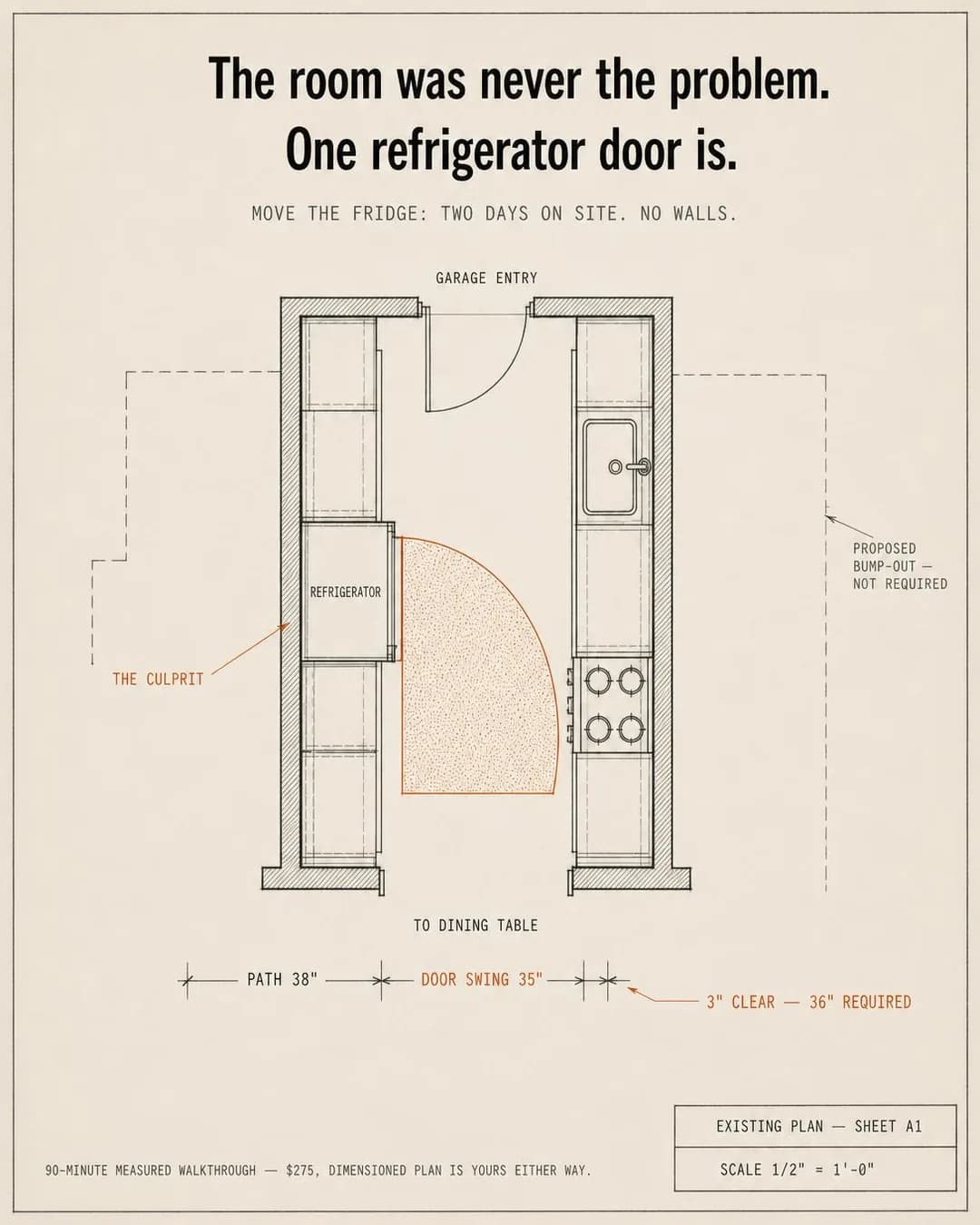 Example adNot a Small Room. A Bad Swing.See the brief →
A schedule counted in days, with a credit behind it
Leads- Who it is for.
- Families with one bathroom and nowhere else to shower, who have put the job off for three years because every quote described the schedule in loose weeks.
- Angle.
- Benefit & Outcome — The objection that kills a single-bathroom job is the calendar, and every competitor answers it with an adjective. Answer with a count instead: nine strips of tape on the door casing, numbered, one torn off a day, with a written credit for day ten. It is the rare offer in this trade that is genuinely bookable from a feed, and the whole ad is the count — so if your honest schedule is eleven days, put eleven strips up.
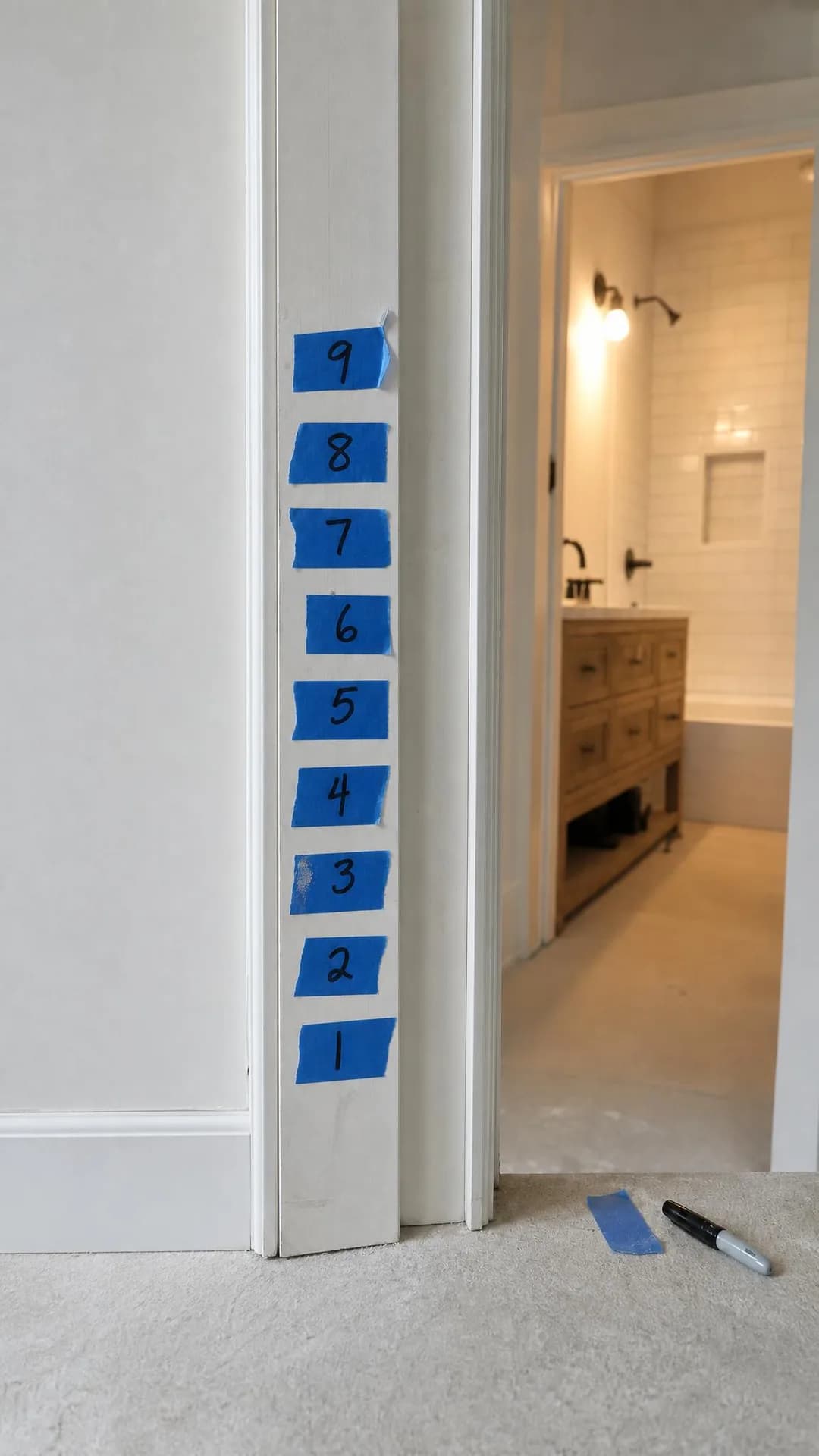 Example adNine working days. Guaranteed.See the brief →
Named materials instead of an allowance sheet
Traffic- Who it is for.
- Homeowners holding three bids within a few thousand dollars of each other, none of which names the tile.
- Angle.
- Product & Mechanism — An allowance is a round number standing in for a decision nobody has made, so three similar bids are not three prices for the same job. Put the material on the table with its installed price beside it and the argument needs no copy. This is the creative on the Browse page most likely to be saved rather than clicked — a reader collecting a kitchen files a labelled material and comes back to it, which is exactly the behaviour the audience tools here can address for two years.
 Example adNo allowances. Just real prices.See the brief →
The permit card in the window
Traffic- Who it is for.
- Homeowners who were offered a discount for skipping the permit and have not worked out who else ever looks at the work.
- Angle.
- Proof & Trust — Third-party validation is the family this trade owns and never uses: four inspections you do not choose, do not pay for and cannot hurry, signed by people you did not hire. The whole argument fits in nine words, and the object is photographable, which is what makes it an Instagram offer rather than a paragraph. Photograph your own card and redact the signatures — ours invented four municipal officials, which is the one detail on that page a city could reasonably object to.
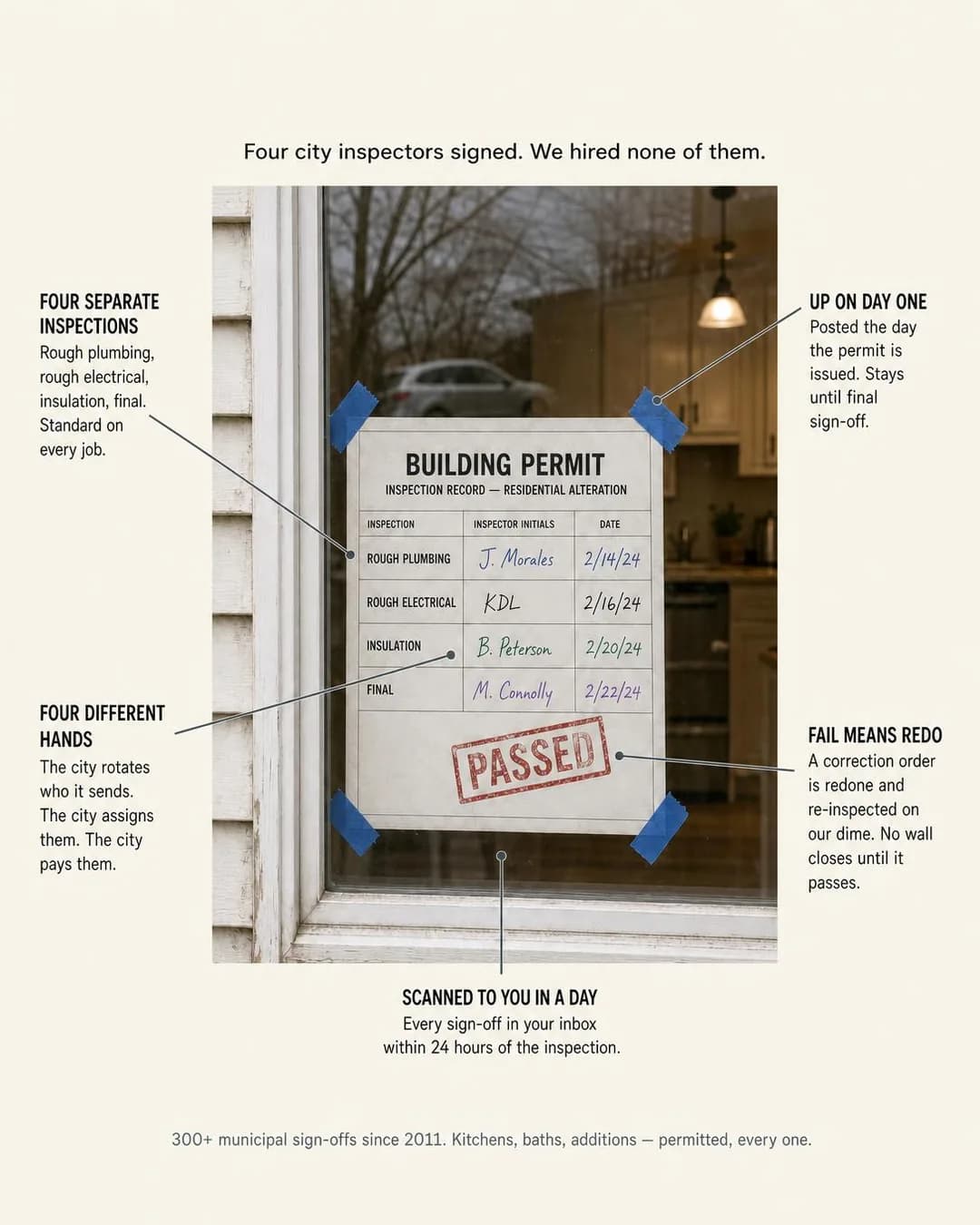 Example ad4 City Inspectors. We Hired None.See the brief →
The low bid, line by line
Traffic- Who it is for.
- Homeowners holding two bids within a few thousand dollars and a third twenty thousand under both, trying to work out whether it is a bargain or a different job.
- Angle.
- Comparison & Positioning — A cheap bid is usually a shorter list rather than a lower price, and the compliant way to say so is to itemise rather than to accuse. This is also the row that proves the roofing prescription travels: the Facebook twin lost this exact argument twice by changing whose ad it was, and briefing the advertiser's role — the design-build company that will do the work, not a consumer group, an inspector, a lender or a review site — fixed it in eleven words across every artefact.
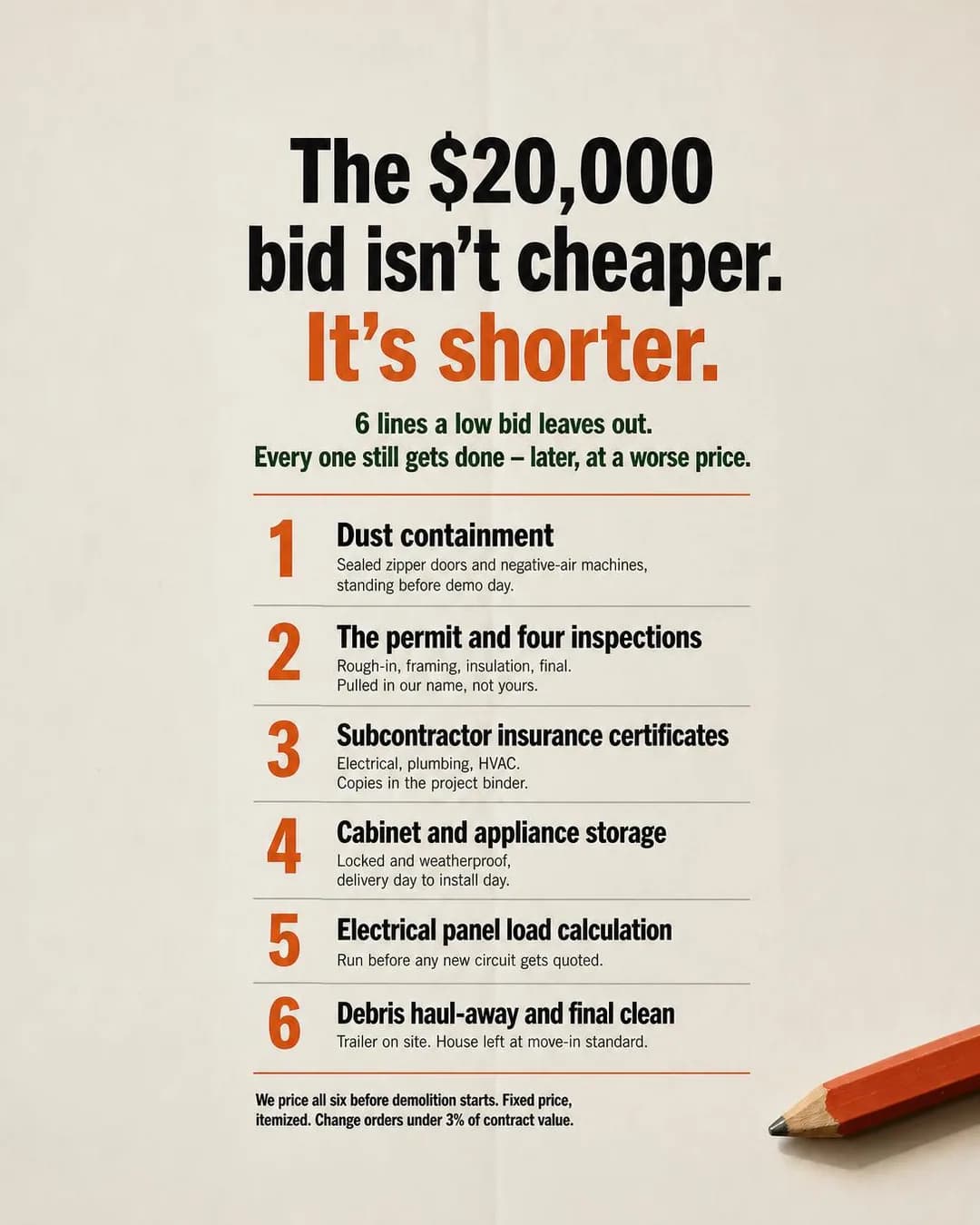 Example adThe $20k low bid is just missing lines.See the brief →
The three-day right to cancel, advertised
Leads- Who it is for.
- Couples who will not let a contractor into the house, because they have been told never to sign anything at the kitchen table.
- Angle.
- Objection & Risk Reversal — The strongest trust offer in remodeling is a piece of paperwork the advertiser is already obliged to produce. A contract signed at the buyer's home after you solicited the visit is a door-to-door sale under 16 CFR 429, cancellable until midnight of the third business day, with a completed Notice of Cancellation handed over in duplicate. Every competitor is bound by it and none of them mentions it. Check your own state as well — several run longer, and an ad promising three where the law gives five understates your own offer.
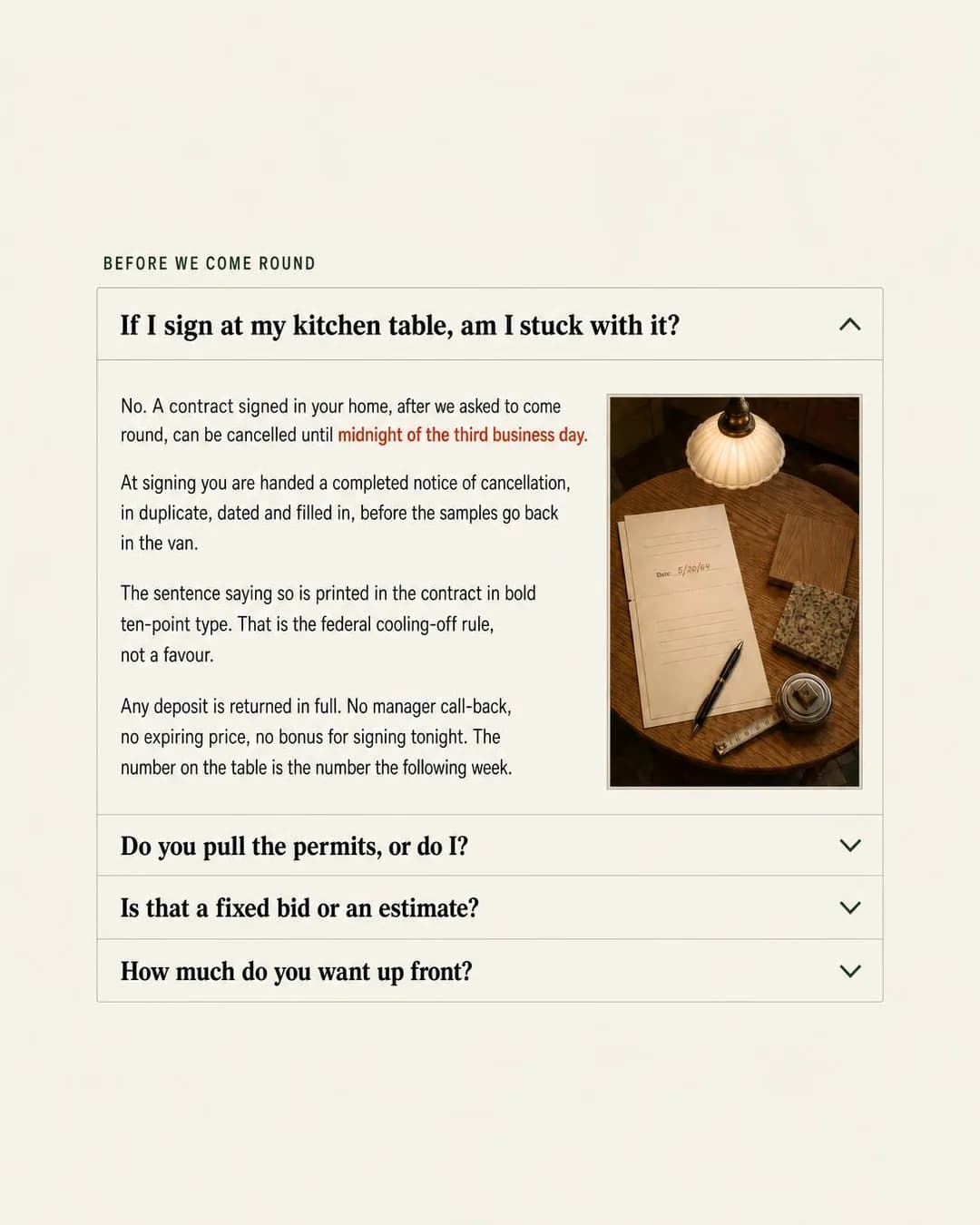 Example adWe hand you the paperwork to cancel us.See the brief →
The whole price, with the denominator
Leads- Who it is for.
- Homeowners who can afford the work and cannot get past the size of the total, and have never measured it against how long the kitchen they are replacing actually lasted.
- Angle.
- Offer & Economics — The objection is not affordability, it is a five-figure number with no denominator under it. Publish both: the fixed price, the service life, the division. Two rules apply and they are not the same rule — keep every figure supplied rather than computed, because this pipeline copies reliably and calculates badly, and keep any monthly payment out of it, since Regulation Z's triggering terms attach to the amount of a payment and not to a price divided by days.
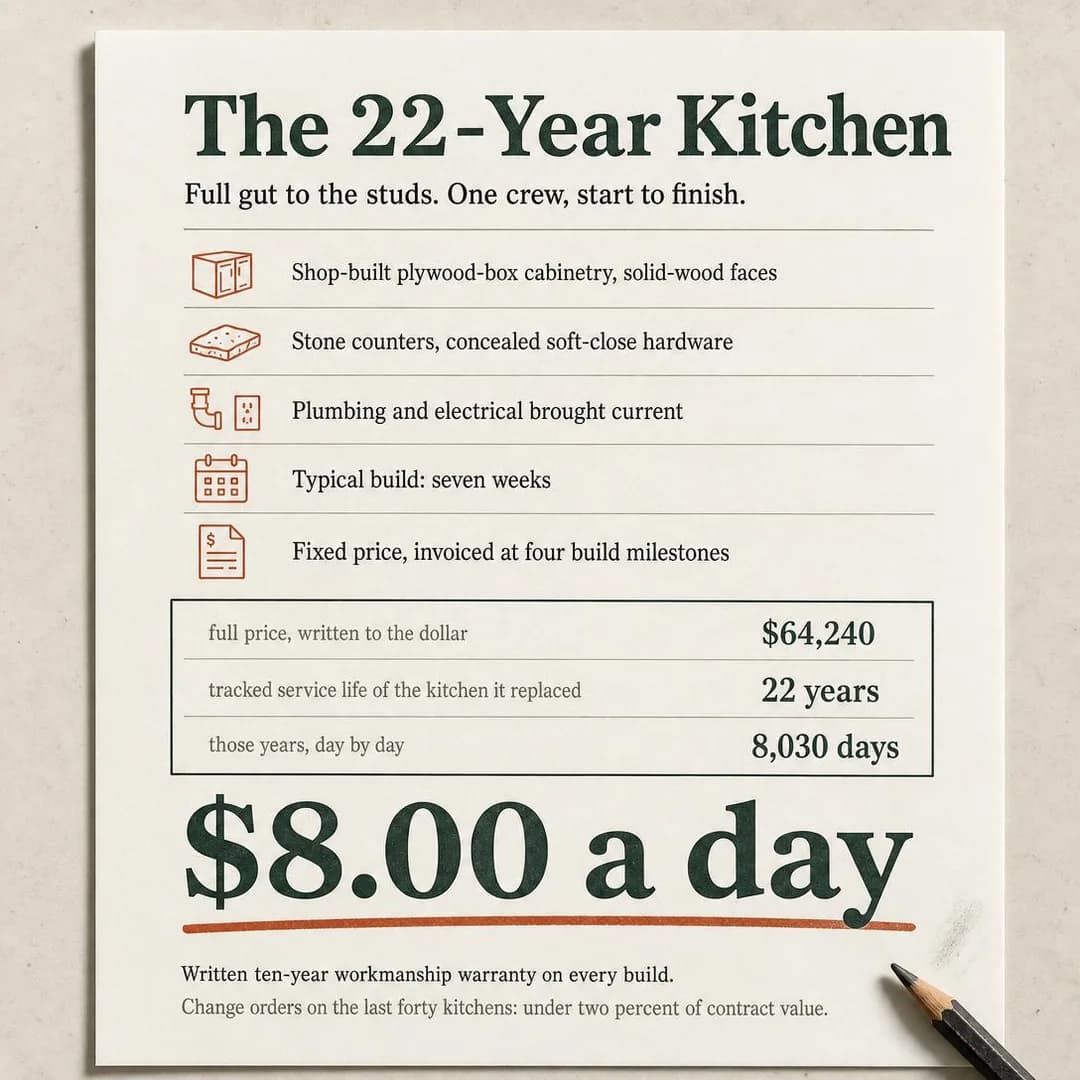 Example adThe 22-Year Kitchen: $8.00 a DaySee the brief →
Next year's crew starts, published
Traffic- Who it is for.
- Homeowners who assume a good contractor is a phone call away, and have started calling in the month they want the work done.
- Angle.
- Scarcity, FOMO & Timing — The only honest scarcity in this trade, because it is arithmetic rather than a deadline: one crew running one job at a time builds four kitchens a year. It is also the most saveable version of it — a calendar is a document somebody checks again in the autumn. Publish the real one, and take the town names out of any generated version before it runs, because ours invented a service area by lettering three sticky notes with real towns.
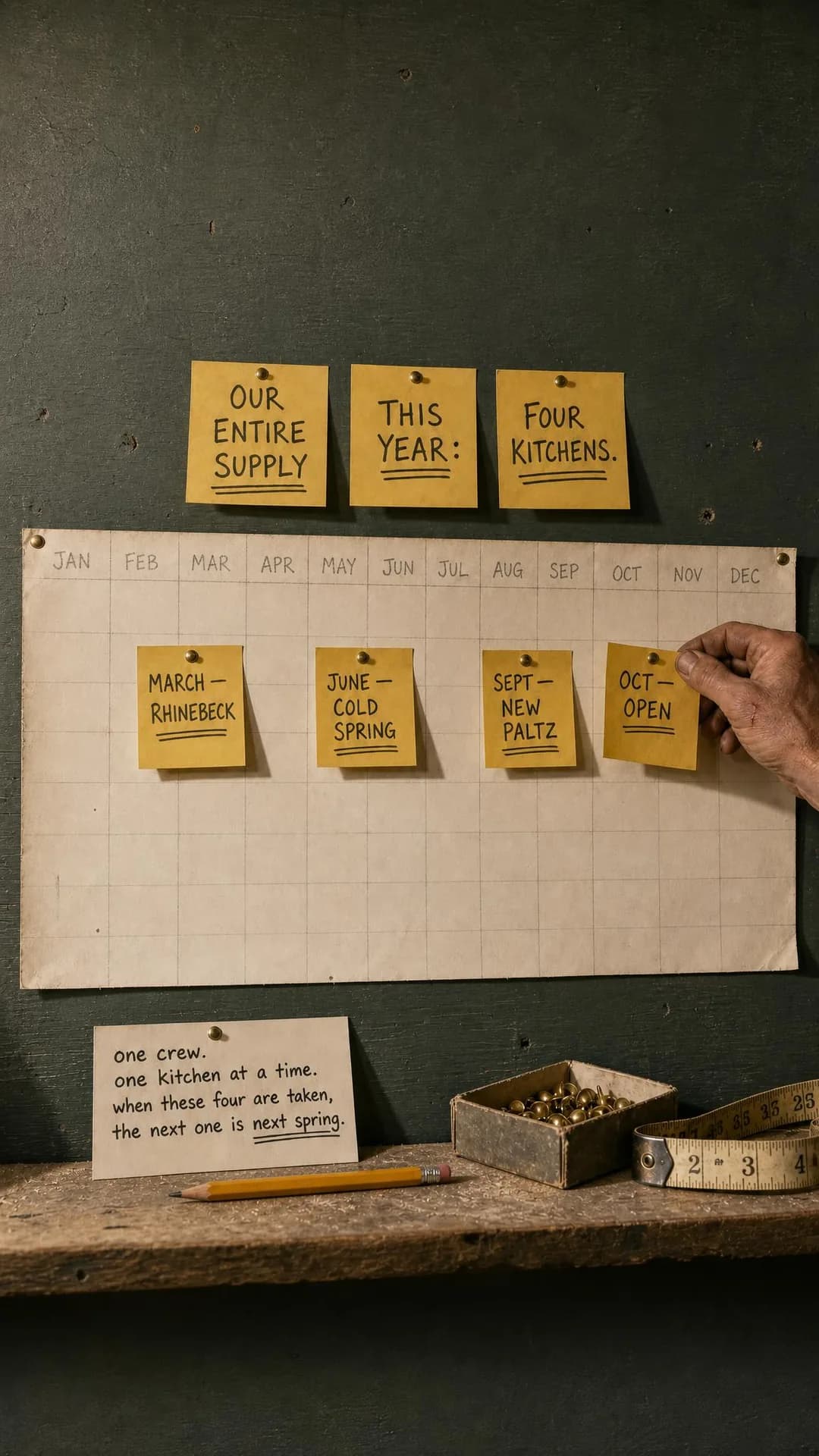 Example adOne Crew. Four Kitchens a Year.See the brief →
Curbless showers, sold as construction
Leads- Who it is for.
- Homeowners rebuilding a bathroom they intend to keep, who have noticed that every ad for this work seems to be about somebody's mother.
- Angle.
- Identity & Emotion — The best emotional offer in the trade and the one that must not run as written. Sell the joists, the bonded membrane, the 2% fall and the 48-hour flood test; sell the fact that the expensive invisible work is done now so the visible clinical work never has to be. Our version carries no person in the image and none in five headlines and five primary texts, and the buyer still recognises themselves. That is the whole fix, and it is worth copying verbatim by anyone selling this work.
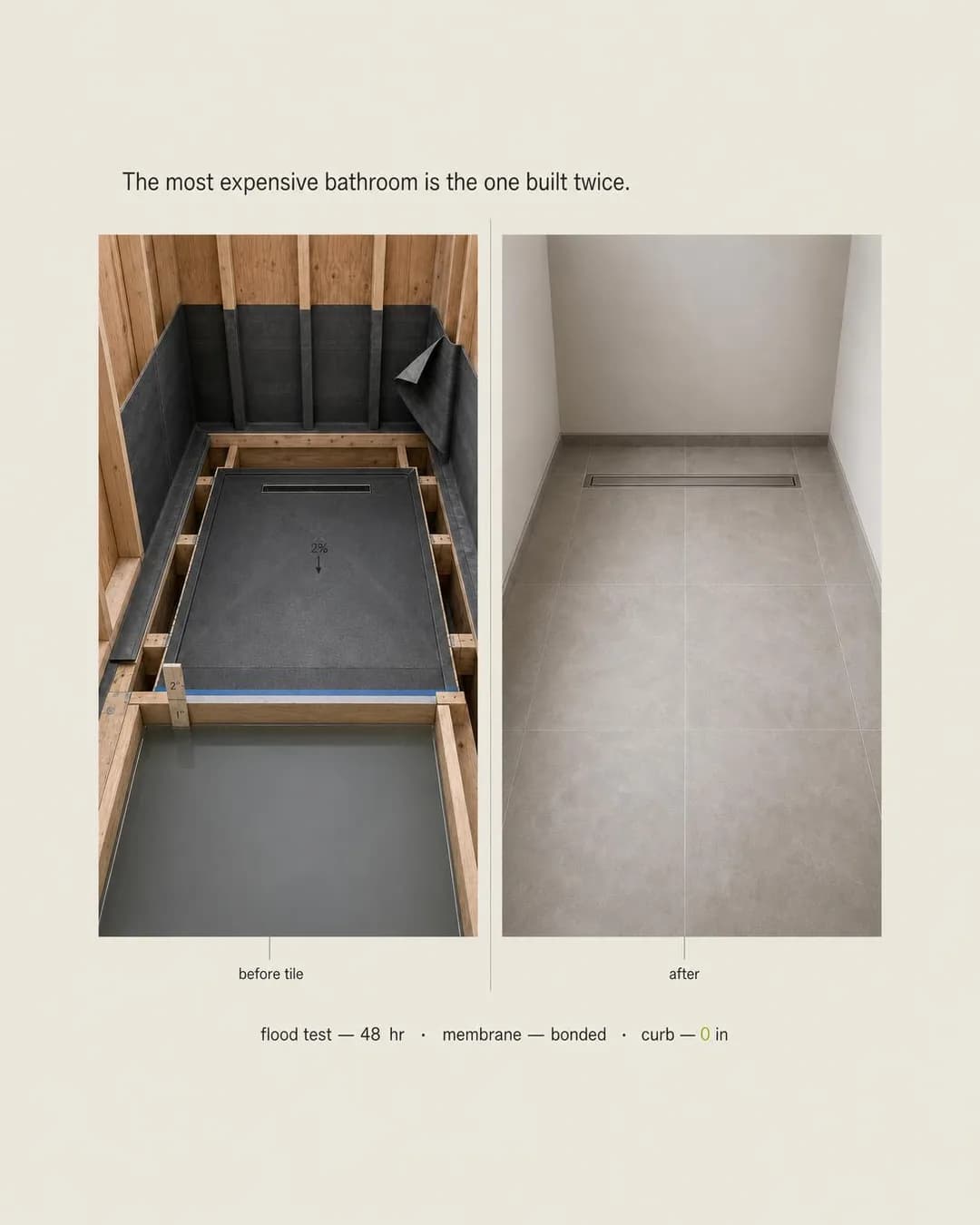 Example ad48-Hour Flood Test. Zero Curb.See the brief →
The shop, the bench and your street on the box
Awareness- Who it is for.
- Homeowners who have walked three showrooms, seen the same three catalogues in all of them, and assume the only variable left is which contractor orders it.
- Angle.
- Story & Founder POV — The family this app suits better than any other in the library, and the one ad on the Browse page that asks for nothing. It is the best creative in the batch to build a save audience against, because a reader files it rather than answering it. Name the role and forbid the name — this pipeline invents a proper name whenever a direction implies an author, and the brief that banned the nameplate, the signature and the embroidered shirt got a portrait with no name anywhere in eleven artefacts.
 Example adBuilt by Hand. Never Ordered.See the brief →
What the work actually costs in this town
Traffic- Who it is for.
- Everybody eighteen months out, who has searched the number twice, found a national average, and does not believe it.
- Angle.
- Offer & Economics — The single most-saved artefact this trade could publish and almost nobody does: a plain card of real local bands — hall bathroom, kitchen refresh, full gut, addition — with what moves a job from one band to the next. It is uncomfortable because it invites the cheaper competitor, and it is the ad a reader keeps for a year, which is the currency on this app. No ad in the current batch runs it. If you publish it, publish ranges you will honour and the reasons they move.
No example ad for this offer on the examples page yet.
Additions and ADUs, sold as a permit timeline
Traffic- Who it is for.
- Households who need a bedroom, an office or a rental unit and are weighing an addition against moving or a modular quote.
- Angle.
- Benefit & Outcome — The product is permitted square footage, and the honest ad sells the review period rather than the rendering: jurisdiction, drawings, what a correction letter does to the schedule. Nobody in the category advertises the calendar, which is exactly why it differentiates — and on this app it is a two-year relationship rather than a campaign, because the household that saves a permit timeline is not buying this quarter. No ad in the current batch runs it.
No example ad for this offer on the examples page yet.
Targeting: the audience you build, not the audience you buy
The cage is the same one the Facebook page describes, so take it briefly. Every campaign created through the Marketing API declares a special ad category and remodeling is not one of them, so the ordinary answer is NONE and a remodeler keeps every lever: age, ZIP codes, neighbourhoods, a radius down to 0.63 miles, lookalikes, saved audiences, exclusions. Advertise the project on a monthly payment and that campaign is a financial products and services campaign, which removes location exclusion, ZIP, neighbourhood, sub-city and metro-area targeting, lookalikes and saved audiences, fixes age at 18–65+ and sets a 15-mile floor. The category is declared on the campaign and Instagram placements sit inside it, so moving a financed ad here changes nothing except the reach — Meta's own documentation says the restrictions apply "across all ad buying surfaces, including the Marketing API".
The lever this page is actually about is not in the picker at all. It is the audience you accumulate: a saved-and-visited pool with a retention of 730 days, built from the five documented Instagram business profile events, which is the only asset in a remodeling account whose memory is as long as the decision. Two rules in one audience — `ig_business_profile_ad_saved` and `ig_business_profile_visit` — is a union, because "Users that match at least one of the rules will be added to the audience". Build a second, shorter one at 30 days from the same events for the people who are moving now. The retention window is the design decision, and it is the only place in this account where you get to choose how long your business remembers somebody.
Then the question the to-do list for this page said to check rather than assume, and the answer is a genuine gap in the documentation. Meta's special ad category page lists supported and removed features explicitly: Custom Audience Inclusion, Custom Audience Exclusion, Custom Audience Expansion, Advantage+ Audience and Detailed Targeting Expansion are supported; Saved Audiences and Lookalike Audiences are removed. Nowhere on that page does the word "engagement", the word "Instagram" or the word "retention" appear, and the one eligibility check it documents — `is_eligible_for_sac_campaigns` — is described for a *customer list* custom audience. So a 730-day engagement pool is neither named as restricted nor named as permitted, and unlike a customer list there is nothing to pre-check. The practical answer: it is the only precision you can plausibly keep inside a declared financing campaign, so build it, attach it, launch small and read the error before you assume it is delivering. Error 2909035 is what comes back for a removed audience type, and 2859024 — "Certification Required" — is the business admin who has not yet accepted the non-discrimination policy.
Now the parameter, because a pool nobody constrains is not a pool. Advantage+ audience expands "the eligible audience pool the delivery system can search", and the things it will not expand are published: "location constraints, minimum age, language, and custom audience exclusions". Inclusions are not on the list. From v23.0 the `advantage_audience` value defaults to 1 or must be stated explicitly on a new ad set, and the change does not apply when you update an old one — so an ad set built last year carries whatever it was created with, and one built today is expanding unless you said otherwise. If the tier is meant to spend on the people who remembered you, set it to 0 and check it after every duplication.
Which leaves one genuinely useful asymmetry: exclusions are hard everywhere. Excluding the pool from the visit-buying tier is honoured even under Advantage+ audience, and so is excluding your active jobs from everything — a homeowner three weeks into your demolition should not be seeing the entry offer. In an account where inclusion is a suggestion, the exclusion list is the only instrument you fully control.
The rest is geography and it is the Facebook page's geography, with one adjustment. A remodeler's audience is a housing stock rather than a radius — the post-war capes with the galley kitchens, the subdivisions whose builder kitchens are thirty years old — and that list is worth building once from the neighbourhoods your own signed jobs came from. The adjustment is the band: this app's strength is where the single-room work lives, so keep the whole-house geography for the Facebook budget and let the offers here match what a household in its thirties and forties actually buys next. Band the age to the offer, and never name a band in the copy, because age is on the personal attributes list.
- Saved-and-visited engagement audienceBuild it first
- Instagram business profile source, maximum retention 730 days, two rules in one audience: ig_business_profile_ad_saved ("People who saved either organic content or an ad from your Instagram business profile") and ig_business_profile_visit. This is the asset the whole page is about, it is the only thing here whose memory matches the trade's decision, and it cannot be bought in a hurry.
- The twelve undocumented eventsCareful
- Of the seventeen Instagram business profile events, five carry a description and twelve — ig_ad_save, ig_organic_save, ig_ad_like, ig_ad_cta_click, ig_ad_carousel_swipe and the rest — are bare names. Our own examples page named ig_ad_save for the save audience and has been corrected. Build on the documented five; if you use one of the others, verify what it actually collects before an account depends on it.
- A 30-day slice of the same eventsUse it
- The same source with a short retention is a different audience with a different job: people who engaged this month are deciding now, and they are where the consultation ads belong. Two audiences, one source, two windows — the long one is the memory and the short one is the pipeline. Do not run one ad set at both.
- Advantage+ audience expansionSet it deliberately
- advantage_audience within targeting_automation defaults to 1 or requires an explicit 1 or 0 on new ad sets from v23.0, and updates to existing ad sets do not trigger the requirement. Leave it on for the cold visit tier, where expansion is the point. Turn it off on anything aimed at the pool, or the retargeting budget is being spent on strangers with your audience as a hint.
- Custom audience exclusionsUse it — the only hard control
- Exclusions are on Meta's published list of constraints that are never expanded, which makes them the one audience instruction that means exactly what it says. Exclude the pool from the visit tier, exclude active jobs from everything, and exclude the recent-consultation list from the entry offers.
- Lead-form audiencesCareful — 90 days
- Audiences built from Lead Generation Ads retain for a maximum of 90 days, against 730 for the profile. In a trade whose drawings take longer than that, the form audience is a conversion record rather than a memory, and treating it as the retargeting pool is how an account forgets everybody it paid for.
- Special ad categoryDepends on the ad
- Not the business — the ad. Remodeling is not one of Meta's categories, so most campaigns declare NONE. Any creative promoting a monthly payment, a finance offer or a credit approval is a financial products and services ad and must declare it, and the restrictions apply across every surface including this one. Declaring it "to be safe" hands back ZIP targeting, exclusions, lookalikes and saved audiences for nothing.
- The pool inside a financed campaignUndocumented — check it live
- The category page lists Custom Audience Inclusion, Exclusion and Expansion as supported and never uses the words engagement, Instagram or retention; the eligibility flag it documents is for customer lists. So nothing says the 730-day pool is removed and nothing says it survives. Attach it, launch small, and read error 2909035 before assuming. Certification error 2859024 means a business admin has not accepted the non-discrimination policy yet.
- ZIP / neighbourhood targetingUse it — it is the housing stock
- The streets whose kitchens are the right age and whose owners have the equity. Build the list once from your own signed jobs; unlike a storm swath it does not expire. Removed outright under the financial category, which is the price of the financing ad and the reason it runs alone.
- RadiusUse it — tighter than you think
- A remodeling crew returns to the same address every day for months, so drive time compounds in a way it does not for a trade doing three calls a day. The ordinary floor is 0.63 miles or 1 kilometre. Under the financial category it becomes 15 miles or 25 kilometres, which for most companies is a circle over work they would decline.
- AgeBand it to the offer
- This app's strength sits where the single-room jobs live, so let the offers here match it rather than fighting it with a band aimed at the whole-house work. Under the financial category age fixes to 18–65+ with no say in it. Targeting a band is fine; naming one in the copy is not, because age is on the personal attributes list.
- Detailed targeting (interests and behaviours)Rarely
- Home-improvement interest segments select for people who enjoy the subject, which in this category is a large and mostly unbuying population — and on an app where the pool is the point, a third targeting layer just makes the cold tier too thin to leave the learning phase. The geography and the creative are doing the qualifying already.
Profile, page, form, or thread?
This page has a destination its Facebook twin does not, and it is the reason the funnel below has a stage that buys an audience. An ad set can name `INSTAGRAM_PROFILE` as its destination — `FACEBOOK_PAGE` and `INSTAGRAM_PROFILE_AND_FACEBOOK_PAGE` are the neighbouring values — and pair it with the profile-visit goal, so the click lands on your own grid and the visitor becomes addressable for two years. For a remodeling company that is not a consolation prize: the grid is the portfolio the trade actually has, and a household eighteen months out would rather scroll nine finished bathrooms than read a landing page.
It has one requirement and it is absolute. The profile is the landing page, so look at your last nine posts as a stranger would. If they are a logo, a holiday graphic, a hiring notice and four reposted memes, do not buy the visit — you are paying for a bounce and poisoning the only audience that matters, because the person who arrives and leaves is in the pool for 730 days either way. Nine good tiles first, then the buy.
A landing page is right for everything that argues with a document — the allowance sheet, the permit card, the day-by-day schedule, the price bands — and the rule from the other page holds without change: an ad whose premise is paperwork should produce the paperwork on the next screen. Never the homepage. Somebody who tapped an ad about allowances and landed on a rotating hero of finished kitchens has been asked to start over.
Instant Forms are for the consultation tier, and the mechanism is the Facebook guide's rather than this one's: conversion leads optimisation only works on Lead Ads, so a website form forecloses the only lead-quality instrument Meta sells for a sale that closes later. Use "Higher intent", add three or four qualifying questions, store the Meta Lead ID, and remember the asymmetry this whole page is built on — the lead is the conversion and the profile is the memory. Pointing those forms at the 730-day pool rather than at cold geography is what makes the third tier worth its budget.
The fourth option is the thread, and in this trade it earns its place for one reason: photographs arrive in it unasked. A cracked tile, a cabinet run measured badly, a phone held up at a ceiling stain. That is genuine triage and it is worth having where somebody actually answers and the conversation ends with a date. It is not a dispatch system and it is not a destination for an ad nobody is staffed to answer.
The recommendation: The profile for the top tier, bought against the profile-visit goal — but only where the last nine tiles can carry a stranger. A landing page for anything whose proof is a document. An Instant Form on "Higher intent" for the consultation tier, pointed at the 730-day pool rather than at cold geography, with the Meta Lead ID stored so conversion leads optimisation stays available. A thread only where a person answers it. Never the homepage.
Creative direction
Every rule on this page comes back to one test, because the account is built on an event you cannot buy: will a stranger open this again in eleven months? That is what a save is, and it is why the creative here is not the Facebook creative reformatted. A finished room fails the test — it is beautiful, it is the category default, and there is nothing in it to return to. A document passes: a dimensioned plan, a permit card, a priced sample board, a counted schedule, a cancellation notice, a calendar with four slots on it. Seven of this batch's ten are objects a person would keep, and those are the ads worth the render.
The second consequence of the save is that the ad is read with no context. A saved post is private, the poster is never told, and collections can be shared, so the version that eventually matters is the one opened in a folder next spring, possibly by the other decision-maker, with no landing page, no targeting and no memory of the campaign. The Facebook page reaches the same instruction from forwarding and screenshots; here it arrives from the folder. Put the company name, the offer and the number the argument rests on inside the frame.
Then the batch's own experiment, which was a counting test and produced the most precise result in this corpus. Six of the ten briefs pinned a countable and closed it against a successor — nine strips of tape and no tenth, five samples and no sixth, four inspection sign-offs, six numbered rows and no seventh, four sticky notes and no fifth, two aisle dimensions and no other number in the frame. Three came back exact. One held where it was pinned and not around it: the planner carried its four notes and the prompt added three more above the calendar, so pin the object, not the frame. One refused the premise in an instructive way — asked for five samples on a table, the concept stage drew one tile and labelled it SAMPLE 2 OF 5, which means the pipeline does not merely render typography more reliably than objects, it converts counts into typography when it can. And one lost outright: an FAQ card briefed for exactly three numbered lines came back with one expanded row and three collapsed ones, because a count of the picture's own structure loses to the visual direction, which owns the structure.
The tenth separated the two halves cleanly and gives the rule its final form. Briefed with two doorways, one relocated appliance and two aisle dimensions, it rendered exactly two doorways and exactly one appliance — and replaced both dimensions with a different set of its own. The shape of a count survives this pipeline; the numbers inside it do not. Brief what must be in the frame, then read what came back before you believe a figure in it.
Where a brief gets rewritten is the stage nobody looks at, and meta.json proves it per ad. Every prohibition this batch lost was lost at the image-prompt model and then rendered faithfully: "no tools in the frame" against a prompt that wrote a marker onto the hallway floor, "callouts to the four sign-offs and nothing else" against a prompt that wrote five, "no figures or dates" against a prompt that added a date line. It can also replace the argument outright — a briefed comparison between a four-inch curb and none came back as before-tile-versus-after, with the comparison gone. Two other stages invent differently: the image model promotes a prompt's "initials" into four full surnames on a government permit and letters sticky notes with real town names, and the copy stage reads the render and asserts those inventions as fact about the business. An invention that enters as pixels leaves as a service area two stages later. Read the prompt in meta.json before blaming the image model.
Arithmetic has a rule now and this batch supplied the control for it. The floor-plan ad's numbers were written by the image-prompt model — PATH 38", DOOR SWING 35", and a flagged 3" CLEAR — 36" REQUIRED — and the copy stage, generating separately, read the render and wrote "You need 33 inches of walkway back". Both subtractions are right. The cost-per-day ad had every figure supplied and returned all four exactly in three separately generated artefacts, and the arithmetic closes: 22 × 365 = 8,030, and 8,030 × $8.00 = $64,240. Set that beside the Facebook twin's financing ad, which computed an amortisation and rendered $609 against a true $626.17 four inches tall, and the line is not "it cannot do arithmetic" — a subtraction lands, a formula does not. Do anything with a rate in it on paper and put the answer in the brief.
Two prescriptions from other trades replicated here and are worth stealing outright. Name the advertiser's role and close the doors it might walk through — the design-build company that will do the work, not a consumer group, an inspector, a lender or a review site — and the comparison ad that came back as a neutral analysis service on Facebook comes back in the contractor's own first person here. And brief the room rather than the person: the curbless-shower ad carries no person in the image and none in five headlines and five primary texts, which is the compliant version of the trade's best emotional offer and the fix for the violation the Facebook batch burned into a frame.
Shapes and lengths, measured rather than assumed. Render 4:5 at 1440 × 1800 for the feed, hold the crop to 1% rather than Facebook's 3%, mind a minimum width of 500, and keep 9:16 for Stories and Reels, where three of these ten sit. Do not buy 1.91:1: the surfaces built to want it are Facebook's right-hand column and search results. Write the headline to 40 and check it against 27 if the same ad runs on Facebook Feed — every one of this batch's fifty headlines fits 40, the longest at 39, and five fit 27, though none of the ten lead headlines does. Write the 30-character description even though this app will not show it; nine of these ten fit. And expect long primary text unless the picture is carrying the whole argument: five of 400 published here fit 125 and all five are the floor-plan ad.
- Ask whether a stranger would open it again in eleven months. That is what a save is, and it is the only event in this account you cannot buy. A finished room fails the test; a plan, a schedule, a permit card and a priced sample board pass.
- Write for the folder. A saved post arrives months later with no landing page, no targeting and no context, possibly in front of the other decision-maker — so the company name, the offer and the number all belong inside the frame.
- Pin the object, not the frame. The planner carried exactly the four notes it was briefed for and the prompt stage furnished three more above it; a count of what the picture is made of loses to the visual direction, which owns the structure.
- If the number is the argument, set it in type and then check it against the drawing. Typography renders accurately here; drawn quantities and the captions about them do not.
- Expect the shape of a count to survive and the numbers inside it not to. Two briefed doorways rendered as two; two briefed aisle dimensions came back as a different pair entirely.
- Never let a model compute anything with a rate in it. A subtraction lands — 38 minus 35 rendered as the flagged 3 inches, and the copy wrote 36 minus 3 correctly — while the Facebook twin's amortisation printed $609 against a true $626.17.
- Supply every figure the picture will display. The ad whose four numbers were all briefed returned all four exactly across image, headlines and primary texts; the ads that left a slot open had it filled with credentials nobody has.
- Read the image prompt in meta.json before blaming the image model. Every prohibition this batch lost was lost at that stage and then rendered faithfully, including a marker on the floor, a fifth callout and a date line.
- Take invented place names out before it runs. The image model lettered three sticky notes with real towns, and the copy stage read the render and turned them into a claimed service area two stages later.
- Name the advertiser's role and close the doors: the design-build company that will do the work, not a consumer group, an inspector, a lender or a review site. Eleven words of brief fixed an argument the Facebook batch lost twice.
- Forbid an invented name whenever a direction implies a person. A portrait briefed as "the shop's cabinetmaker", with the nameplate, the signature and the embroidered shirt banned, came back with no name in eleven artefacts.
- Describe the room, never the person. "Safe for Mom" implies a family member's mobility, which Meta's personal attributes standard prohibits; "curbless entry, bonded membrane, blocking set behind the tile" sells the same job and asserts nothing about anybody.
- Read the rendered image for the violation, not just the brief. The Facebook twin's aging-in-place ad was briefed with construction details and no condition, and the model captioned the frame anyway — in the image, where no headline swap reaches it.
- Keep any monthly payment out of a cost-per-day ad. Regulation Z's triggering terms attach to the amount of a payment, not to a price divided by days, and one sentence turns a price ad into a credit advertisement that owes the term and the annual percentage rate.
- Render 4:5 at 1440 × 1800 and hold the crop to 1% rather than 3%. A file a few pixels out of true passes on Facebook and fails here.
- Do not buy 1.91:1 on this app, and check every 9:16 re-frame by eye. The surfaces built to want a wide export are on the other page.
- Write the headline to 40 and check it against 27 if the ad also runs on Facebook Feed. All fifty here fit 40 and five fit 27 — a short headline is something you spend, not something the model drifts into.
- Write the 30-character description even though this app will not show it. Marketplace does, it is free, and nine of these ten fit.
- Photograph your own shop, your own crew and your own permit card, with the signatures redacted. A styled kitchen with a fruit bowl in it is the category default and indistinguishable from stock, which is the definition of a wasted impression.
- Read invented figures as a set before publishing several ads at once. One company on that page builds four kitchens a year and another builds forty; a reader does not know they are different invented businesses.
Funnel structure
Three stages and a declared financing line, and the first stage is unusual enough to be the reason this section exists: it buys an audience rather than a result. Everywhere else in this cluster the top of the funnel is a teaching buy judged on whether the readers come back. Here it is a membership purchase — a tap puts somebody in an addressable pool for up to two years, which is roughly the length of the decision they are making, and whatever that tap costs you it is not what a held consultation costs.
The second stage is the asset and the third is the only one judged on money. Keep the whole structure this thin on purpose: every extra ad set divides the same small pile of evidence, and in this trade the pile is smaller than in any other on this site. Variation belongs at the ad level inside one ad set, and the thing that varies is the offer.
One structural warning that applies to the second and third stages and nowhere else. Both of them target the pool, which means both of them have to be built with expansion turned off — `advantage_audience` set to 0 — or they are cold ad sets wearing a retargeting label. Check it after every duplication, because a copied ad set is a new ad set and the default is the expanded one.
Visit and save
≈35% of budgetAudience. The housing-stock geography banded to the offer, with the pool and any active job excluded. Expansion on: this is the one stage where widening the search is the point.
Running. The saveable documents — the measured plan, the sample board, the permit card, the counted schedule, the price bands. Traffic, split between the profile-visit buy and the pages that carry a document.
The two-year pool
≈25% of budgetAudience. One engagement audience, Instagram business profile source, 730-day retention, two rules: saved and visited. Expansion off, or it is not this audience.
Running. The reassurance and mechanism arguments, patiently and at a low weight: the cancellation notice, the line-by-line bid, the curbless construction, the shop. Nobody here is booking this month, and that is the design.
Consultation
≈40% of budgetAudience. The 30-day slice of the same events, plus readers of the document pages, plus your own held-consultation list. Expansion off.
Running. Instant Forms on "Higher intent" with three or four qualifying questions, optimised on the held consultation where the volume allows, Meta Lead ID stored so conversion leads stays available. This is the tier the money comes out of.
Financing (declared)
Budget it as its own line of budgetAudience. Its own campaign, declared financial products and services: 15 mile floor, no ZIP or neighbourhood targeting, no exclusions, no lookalikes, age 18–65+. Attach the pool, launch small, and read the error before assuming it survived.
Running. The monthly-payment ad and nothing else, with the rate, the term and the total on both the ad and the page. Never a line about payments in any other campaign.
Budget, and the one stage in this trade that can actually leave the learning phase
Do the arithmetic before copying anybody's number. Meta's delivery system wants roughly 50 optimisation events per ad set per week to leave the learning phase; below that the ad set sits in "learning limited", which is not a penalty so much as an admission that the system cannot optimise with what it is being given. Take your own cost per event and multiply by 50, and that is the weekly spend at which one ad set delivers with full information.
Now run that twice, because this is the page where the answer differs by stage and it is the most practical thing in the section. A held consultation in remodeling is expensive and rare: a company doing twenty-five jobs a year cannot produce fifty held appointments a week at any spend, so the consultation ad set will sit in learning limited more or less permanently and no budget fixes it. Run the same multiplication on your own cost per profile visit and the answer comes out somewhere a real budget can reach, because a visit is a tap rather than an appointment in somebody's kitchen. So the visit tier is the one ad set in this trade — on either app, in either direction — that can genuinely clear the bar, and that is where the optimisation weight belongs. Ask the cheap stage to be optimised and the expensive stage to be aimed.
The corollary is a structure most accounts get backwards: this is the one guide in the cluster that recommends an app-specific ad set, and only one. The visit tier is app-specific by construction, because its destination is a profile on this app; everything else should keep Advantage+ placements and pool its evidence across all thirteen surfaces. Restricting placements anywhere else is buying the learning-phase problem on purpose.
Then the thing that makes this budget different from every other one in the cluster: the asset accrues and the spend does not come back this year. A pool at 730 days is, by construction, a bet whose payout arrives after most marketing budgets have been re-decided twice. Treat the size of the pool as a reported number in its own right — how many people entered it this month, and how many are still in it — and judge the money the way the Facebook twin says to: this quarter's spend against the contracts it produced two quarters later, from your own records, because no setting in the platform will produce that report.
Two habits keep it survivable. Decide the trial length in advance and in writing, and make it longer than your own sales cycle: the first ninety days will show cost, visits, saves and appointments and no revenue, by construction, and that is exactly when accounts get switched off. And keep the seasonality offset in mind, because the lag runs both ways here — spring kitchens are autumn contracts, so the autumn budget buys the spring calendar, while the pool you fill this winter is buying a kitchen two Christmases from now.
- Test the offer, not the headline. Swapping five words is a significant edit that restarts learning for a change too small to detect.
- Put the optimisation weight on the cheap stage. The visit tier can reach fifty events a week; the consultation tier cannot, and asking it to is how the whole account ends up in learning limited.
- Check advantage_audience after every duplication. A copied ad set is a new ad set, the default expands, and an expanded retargeting tier is a cold campaign with a hint.
- Judge the visit tier on the pool, not on the session. A profile visit that produced nothing today has still bought two years of addressability; a visit to a grid nobody would scroll has bought two years of somebody who left.
- Look at your last nine tiles before you raise the visit budget. The profile is the landing page, and it is the one landing page in this account you cannot A/B test.
- Before you blame the creative, check whether the ad set ever left learning. In this trade it is the likeliest single explanation, and on the consultation tier it is the expected state.
- Do not compare this app's cost per lead to Facebook's. Different tiers are buying different things here, and on a properly built account most of the spend is buying an audience rather than a lead.
- Track how long somebody stays in the pool before converting, and get the number from your own records. A year is ordinary in this trade, and a thirty-day verdict will indict the stage that pays.
- Re-measure the pool's size monthly. It is the only asset in this account that compounds, and the only one that quietly stops growing when the creative stops being worth saving.
Eight of these ads, in full
Every ad below was generated by best-in-slot for a remodeling company that does not exist, with its audience, angle and objective pinned before the run — and published exactly as it came back. They are eight of the Instagram examples for a remodeling company; the rest, with the full brief and the alternate headlines behind each one, are on that page.
Problem & Pain · 4:5 · Traffic
Not a Small Room. A Bad Swing.
Written for: Homeowners who have decided they need an addition.
The full brief and why it works →
Product & Mechanism · 4:5 · Traffic
No allowances. Just real prices.
Written for: Homeowners comparing three bids that are not the same job.
The full brief and why it works →
Proof & Trust · 4:5 · Traffic
4 City Inspectors. We Hired None.
Written for: Homeowners who were offered a discount for skipping the permit.
The full brief and why it works →
Benefit & Outcome · 9:16 · Leads
Nine working days. Guaranteed.
Written for: Families with one bathroom and no second one to use.
The full brief and why it works →
Objection & Risk Reversal · 4:5 · Leads
We hand you the paperwork to cancel us.
Written for: Couples who will not let a contractor into the house.
The full brief and why it works →
Offer & Economics · 1:1 · Leads
The 22-Year Kitchen: $8.00 a Day
Written for: Homeowners who have called the kitchen an extravagance.
The full brief and why it works →
Identity & Emotion · 4:5 · Leads
48-Hour Flood Test. Zero Curb.
Written for: Homeowners rebuilding a bathroom they intend to keep.
The full brief and why it works →
Story & Founder POV · 9:16 · Awareness
Built by Hand. Never Ordered.
Written for: Homeowners who have been told every kitchen is the same three cabinet brands.
The full brief and why it works →
Mistakes specific to this trade on this app
The first four are all versions of one error — assuming the thing you want is a thing you can buy — and they are first because every one of them is invisible in Ads Manager, which will report a perfectly healthy campaign doing none of what you think it is doing.
Trying to optimise for saves
There is no save in Meta's optimisation goals. The enum covers impressions, reach, link clicks, landing page views, leads, quality leads, conversations, calls, post engagement, ThruPlay and offsite conversions, and nothing in it is a save on an ad or a post. The save is the one signal in this account that has to be earned by the creative rather than bid for, which is why the creative section is a test — will a stranger open this again in eleven months — rather than a style guide. Buy the visit, which is in the enum, and let the save be the thing that tells you the ad was worth making.
Buying Engagement because it sounds like where the saves are
The post-engagement goal optimises for people "more likely to engage with your post", which in practice means the cheapest available reaction, and in a feed full of kitchens that is a like. A save is the most expensive reaction there is: a decision to come back. So an Engagement buy aimed at saves recruits the population most willing to tap anything — and because everything on this page is built on a 730-day pool, you will then be retargeting that population for two years.
Running the retargeting tier with expansion left on
The most expensive mistake on this page and the hardest to see. Advantage+ audience expands the pool the delivery system can search, and Meta's published list of what it will not expand is location, minimum age, language and custom audience exclusions — inclusions are not on it. From v23.0 advantage_audience defaults to 1 or must be set explicitly on a new ad set, and updating an old ad set does not trigger the requirement. So the tier that was supposed to spend on people who remembered you is spending on strangers with your pool as a suggestion, and the reporting looks fine.
Treating the lead-form audience as the long one
Engagement audiences built from Lead Generation Ads retain for a maximum of 90 days; the Instagram business profile source retains for 730. In a trade where the drawings are not finished at 90 days, that means your most qualified audience is also your most perishable one, and an account built on it forgets every household it paid for, roughly a quarter of the way through their decision. The lead is the conversion. The profile is the memory.
Building the audience on an undocumented event
Seventeen Instagram business profile engagement events exist and five carry a description. The save audience is ig_business_profile_ad_saved — "People who saved either organic content or an ad from your Instagram business profile", which explicitly includes your organic grid — while ig_ad_save sits in the same table with no description at all, along with eleven others. Our own examples page named ig_ad_save and has been corrected in the same release as this page. Build on the documented five, and if you use one of the bare names, verify what it actually collects before an account depends on it.
Buying profile visits to a profile that cannot carry them
The profile is the landing page, and the last nine tiles are above the fold. A grid of logos, holiday graphics and a hiring notice turns a visit buy into a paid bounce — and worse than a bounce, because the visitor is in your 730-day pool either way and you have just filled the only long-memory asset in the account with people whose one impression of you was an empty shop. Post nine things worth scrolling, then buy the visit.
Assuming the pool survives the financing category without checking
Meta's special ad category page lists Custom Audience Inclusion, Exclusion and Expansion as supported and Saved Audiences and Lookalike Audiences as removed, and it never uses the words engagement, Instagram or retention. The one eligibility flag it documents, is_eligible_for_sac_campaigns, is for customer lists, so there is nothing to pre-check for an engagement audience. That is a documentation gap rather than a permission. Attach it, launch small, and read error 2909035 before planning a financed campaign around it — and check that a business admin has accepted the non-discrimination policy, which is error 2859024.
Declaring the financial category on every campaign to be safe
Nothing breaks, which is why it survives: you simply hand back ZIP and neighbourhood targeting, location exclusion, lookalikes, saved audiences and any radius under fifteen miles in exchange for nothing at all. The category attaches to the ad, not to the business. Declare the truth about each campaign, keep payment language out of everything else, and run financing alone.
Making the whole account Instagram-only because one stage is
The visit tier is app-specific by construction — its destination is a profile on this app — and it is the only ad set in this guide with a reason to be. Restricting placements anywhere else asks a trade with expensive, rare events to find fifty of them a week inside a fraction of the audience, which is the combination most likely to leave an ad set in learning limited forever. Leave Advantage+ placements on for everything except the visit buy.
Building the audience the week you need it
The pool is the only thing in this account that cannot be bought in a hurry: it accrues at the rate people engage, and its value is that it is old. Meta's documentation does mention prefilling an engagement audience on creation with people who already engaged inside the retention window, but that sentence is written about a Page and the Instagram section does not repeat it, so treat any backfill as a bonus. Create the audiences on day one, at 730 days, before the first ad runs.
Briefing a count of the picture's own structure
Six briefs in this batch pinned a countable and closed it. The counts of things inside the frame came back exact — nine strips of tape, four sign-offs, six numbered rows — and the one that counted the picture's own structure lost: an FAQ card asked for exactly three numbered lines returned one expanded row and three collapsed ones, because the visual direction owns the structure. Count objects, never sections. And expect the shape of a count to survive while the numbers inside it drift.
Letting the picture invent facts about your company
The image model lettered three sticky notes with real towns, and the copy stage — which reads the finished render — turned them into a claimed service area and a shop location. The same route turns an invented credential into a fact repeated in five primary texts. Anything in the frame that looks like a name, a place or a number will be asserted as true two stages later, so fix it in the image or expect to fix it twice.
Selling the aging-in-place job by describing the person
Meta's personal attributes standard prohibits implying you know someone's disability or health and extends to the personal attributes of their family, which is exactly what "making a bathroom safe for Mom" does — the most natural sentence for the best emotional offer in the trade, and the prohibited one. The fix is on the Browse page and it works: two empty rooms, no body, no pronoun, and copy about joists, membrane, fall and a flood test. The buyer recognises themselves; the ad never recognises them.
Judging a 730-day asset on a thirty-day report
The whole point of this app in this trade is that its memory is longer than the decision, which means the account looks worst exactly when it is working hardest: the first quarter shows cost, visits, saves and appointments and no revenue by construction. Decide the trial length in advance and make it longer than your sales cycle, report the size of the pool as a number in its own right, and match spend to contracts by cohort from your own records, because Ads Manager's longest attribution window is seven days after a click.
Questions
- Can I optimise Meta ads for Instagram saves?
- No. Meta's optimisation goals are a published list — impressions, reach, link clicks, landing page views, leads, quality leads, conversations, calls, post engagement, ThruPlay, offsite conversions and the rest — and there is no save in it, on an ad or on a post. Buying Engagement instead optimises for the cheapest available reaction, which is a like from somebody who likes kitchens. What you can buy is the neighbour: the profile-visit goal is in the same enum as "Optimize for visits to the advertiser's Instagram profile", and a profile visit is an Instagram business profile engagement event with the same 730-day maximum retention as a save. Buy the visit, earn the save, and spend the lead budget on the pool they both fill.
- Which Instagram engagement event should a remodeling company build its audience from?
- There are seventeen Instagram business profile events and only five carry a description in Meta's documentation: ig_business_profile_all, ig_business_profile_engaged, ig_user_messaged_business, ig_business_profile_visit and ig_business_profile_ad_saved — "People who saved either organic content or an ad from your Instagram business profile", which usefully includes your organic grid as well as your ads. The other twelve, including ig_ad_save and ig_organic_save, are bare names with no description at all. Build one audience with two rules, saved and visited, at the 730-day maximum — multiple rules are a union, so anyone matching either is in it — and a second at 30 days from the same source for the people deciding now.
- How long can I retarget somebody who saved my Instagram ad?
- Up to 730 days. That is the maximum retention for an engagement audience built from an Instagram business profile, the same as a Page, against 365 for Shopping and augmented reality and 90 for Lead Generation Ads. Those numbers are the whole argument for this app in remodeling: a kitchen closes two to six months after the click and the decision often starts a year before that, so the household that filled in your form expires at 90 days while the one that saved the picture is still addressable when the cabinets are hung. Build the audience on day one, because it is worth what it has accumulated.
- Does my Instagram retargeting actually only reach the people I chose?
- Only if you turned expansion off. Advantage+ audience exists to expand the eligible audience pool the delivery system can search, and Meta publishes the constraints it will not expand: location, minimum age, language and custom audience exclusions. An included custom audience is not on that list, so it is a suggestion rather than a boundary. From v23.0 the advantage_audience parameter defaults to 1 or requires an explicit 1 or 0 on any new ad set, and updating an existing ad set does not trigger that requirement — so check it on every ad set you duplicate. Your exclusions are walls; your inclusions are hints.
- Does the save audience still work if I advertise remodeling financing?
- Nobody outside Meta can answer that from documentation, and the honest version is worth more than a guess. A campaign promoting a monthly payment must declare the financial products and services special ad category, which removes saved audiences, lookalikes, location exclusion, ZIP and neighbourhood targeting and any radius under fifteen miles. Meta's page on that category lists Custom Audience Inclusion, Exclusion and Expansion as supported — and never uses the words engagement, Instagram or retention — while the one eligibility check it documents, is_eligible_for_sac_campaigns, is for customer lists. So there is nothing to pre-check for an engagement audience. Attach the pool, launch small, and read error 2909035 before building a plan on it.
- Should a remodeling company run ads on Instagram or Facebook?
- Both, for different jobs. Facebook is where the household is — a kitchen is decided by two owners and that app has the better odds of reaching the second one — and it is where the paperwork arguments land, along with the whole mechanism for optimising on a held consultation. Instagram is where the project is collected and where the memory lives: the save and the profile visit are addressable for two years, which no Facebook surface matches for a decision this slow. Practically, the offers differ too. This app's strongest bands buy the single-room work a single crew can schedule; the whole-house and addition work is slower here and is a relationship rather than a campaign.
- What size should a home remodeling Instagram ad be, and how long should the copy run?
- Render 4:5 at 1440 × 1800, the same export Facebook Feed wants, but hold the crop to 1% rather than 3% and mind a minimum width of 500 rather than 600. Keep 9:16 for Stories and Reels and skip 1.91:1 entirely — the surfaces built to want it are Facebook's right-hand column and search results. Headline about 40 characters, which is more generous than Facebook Feed's 27, and primary text about 125, which almost nothing hits: across the eight Instagram batches published here, five of 400 primary texts fit 125 and all five belong to one ad on this page — the floor-plan diagram whose picture makes the entire argument. If you want short copy, brief a picture that finishes the case.
Sources
Every platform claim on this page was read against these on . Meta’s policies move; if one of these disagrees with this page, it is right and we are stale.
- Meta Marketing API — Engagement Custom Audiences: the seventeen Instagram business profile events (five described, twelve bare names), ig_business_profile_ad_saved "People who saved either organic content or an ad from your Instagram business profile", ig_business_profile_visit, the max retention table (Instagram business profile 730, Page 730, Instant Experiences 730, Shopping 365, augmented reality 365, Lead Generation Ads 90), "Users that match at least one of the rules will be added to the audience", the 500-audience per account limit, and the prefill sentence (written about a Page). Re-read 17 September 2026
- Meta Marketing API — ad set reference: the optimization_goal enum, which contains no save (VISIT_INSTAGRAM_PROFILE "Optimize for visits to the advertiser's Instagram profile", POST_ENGAGEMENT "Optimize for people more likely to engage with your post"), and the destination_type values including INSTAGRAM_PROFILE, FACEBOOK_PAGE and INSTAGRAM_PROFILE_AND_FACEBOOK_PAGE. Read 17 September 2026
- Meta Marketing API — Advantage+ audience: "expand the eligible audience pool the delivery system can search"; "Non-negotiable business constraints are NOT expanded, these include location constraints, minimum age, language, and custom audience exclusions"; from v23.0 advantage_audience defaults to 1 or requires an explicit 1 or 0 when creating a new ad set, with no such behaviour when updating one. Read 17 September 2026
- Meta Marketing API — Special Ad Categories: supporting features (Custom Audience Inclusion, Custom Audience Exclusion, Custom Audience Expansion, Advantage+ Audience, Detailed Targeting Expansion) against removed features (Saved Audiences, Lookalike Audiences); restrictions apply "across all ad buying surfaces, including the Marketing API"; FINANCIAL_PRODUCTS_SERVICES required for US advertisers from 14 January 2025; 15 mile / 25 km radius floor; age 18–65+; is_eligible_for_sac_campaigns documented for customer list audiences; errors 2859024 and 2909035. The page never uses the words engagement, Instagram or retention. Read 17 September 2026
- Meta Marketing API — ads action stats: onsite_conversion.post_save is labelled "Post Saves" with no platform stated, and the reference lists no Instagram-specific action types, which is why this page says to verify the column in your own account before reporting on saves. Read 17 September 2026
- Meta Conversions API for CRM Integration (conversion leads) — requires Facebook/Instagram Lead Ads with the 15–17 digit Meta Lead ID stored in the CRM; at least 200 leads per month; upload at least once per day; the optimised lead stage occurs within 28 days; conversion rate between 1% and 40%. Read 9 September 2026 for the Facebook guide
- Meta Graph API changelog, 27 April 2021 — 28d_click and 28d_view withdrawn as supported action_attribution_windows values; queries default to 7d_click
- Instagram Help Centre — saving posts: a saved post is visible only to the person who saved it and the poster is not notified. Read 9 September 2026
- Instagram Help Centre — creating and sharing collections of saved posts. Read 9 September 2026
- Meta ads guide — image ad specifications, Instagram Feed (4:5 at 1440 × 1800; primary text 125, headline 40; 1% aspect-ratio tolerance; minimum width 500)
- Meta ads guide — image ad specifications, Facebook Feed (headline 27, primary text 50–150, 3% tolerance, minimum 600 × 750) — the comparison this page measures against
- Meta ads guide — image ad specifications, Facebook Marketplace (description 30 characters, which is why this page tells you to write one)
- Meta Advertising Standards — privacy violations and personal attributes: ads must not assert or imply personal attributes, the list includes disability and physical or mental health, and content must not imply the advertiser is aware of someone's attributes "or the personal attributes of their family"
- 16 CFR 429.0 — definition of a door-to-door sale ($25 or more at the buyer's residence, seller-solicited, agreement made away from the seller's place of business). Read 9 September 2026
- 16 CFR 429.1 — the required cancellation statement, midnight of the third business day, bold face type of a minimum size of 10 points, and the Notice of Cancellation furnished in duplicate. Read 9 September 2026
- 12 CFR 1026.24 (Regulation Z) — advertising: (a) terms actually available, (c) rate stated as an annual percentage rate, (d)(1) triggering terms including the amount of any payment
- Meta Marketing API — basic targeting (custom_locations radius 0.63–50 miles, or 1–80 km)
- Meta Business Help Centre — about the learning phase
- Meta Business Help Centre — significant edits and the learning phase
- Meta Business Help Centre — about Instant Form types (More volume against Higher intent)
- Meta Business Help Centre — about profile visit ads. Recorded as not read: the page is a JavaScript shell that returns a title and no body, so every claim on this page about the profile-visit buy is cited to the Marketing API reference instead
- Pew Research Center — Americans' social media use, November 2025
That is the playbook. Now make the ads.
Paste your site. It reads your projects, your process page, your service area and your terms, then writes the concepts, renders the images and drafts the copy — for the one trade in this set where the sentence in the ad is a term of the contract you sign four months later.
No credit card · 50 free credits (about 5 ads or Instagram posts)
Every angle recommended above is documented in the best-in-slot ad angle library, and the ads are from home remodeling instagram ad examples. More industries are at all ad guides.