
Ad Examples · Home Remodeling × Instagram · 10 ads
Home remodeling Instagram ad examples
Ten finished ads for remodeling companies — a nine-day bathroom, a permit card, a selection board, a year with four slots — with the brief behind each, because we generated them rather than collected them.
Remodeling on Instagram is a folder. Somebody who will not hire a contractor for another eighteen months is saving kitchens into a collection called House, and the trade's advertising answers that with the same slider it runs everywhere else — drag left for the oak and the fluorescent tube, drag right for the island and the pendants. It is a collected picture of somebody else's finished room, and a collected picture cannot tell you the only things that transfer: who the ad was written for, what it argued, and what it was supposed to make happen next.
So these were not collected. Every ad below was generated with the audience, the angle and the objective pinned before the run, which means the brief printed beside each one is the brief that produced it rather than a caption written afterwards about somebody else's work. The companies are invented — ten of them, a shop that counts a bathroom out in strips of tape, one that will not price a job without physical samples on the table, one that runs a single job at a time and therefore has four slots in a year — so no competitor's creative is borrowed and no crew's faces are used.
The Facebook half of this cluster is built on a clock: attribution stops seven days after the click and a build contract is signed months later, so the money arrives after Meta has stopped looking. This page is the other end of the same problem. Nothing here fixes the measurement, but this app holds the one tool in the system whose memory is longer than the trade's decision — an engagement audience built from an Instagram business profile retains for up to 730 days, and the save is one of the engagements you can address. The lead form's audience expires at 90. So the person who filled in your form ages out before the drawings are done, and the person who only saved the picture is still reachable two years later, which is roughly how long they were always going to take.
That is why the batch was briefed the way it was. The Facebook run put a document in the frame five times out of ten, because a remodeling ad's argument is usually paperwork, and it left this cluster's sharpest rule behind it: typography renders accurately and counted objects do not. Six of these ten briefs pin a countable and close it — nine strips of tape, five samples and no sixth, four inspection sign-offs, six numbered rows and no seventh, four sticky notes and no fifth, two aisle dimensions and no other number in the frame. Nobody had briefed counting deliberately before, and the answer turned out to be worth the run.
All ten angle families were briefed once each across ten visual directions, none of them a direction the Facebook batch used, and the objective split is five Traffic, four Leads and one Awareness — the near-mirror of that batch's six Leads and three Traffic. Neither remodeling batch has a Sales ad, which now makes five trades in this cluster with none: nobody buys a kitchen in a checkout, and on this app they do not even buy the consultation. Eight of the ten came back in a single pass. The other two died at the image-prompt stage with the same malformed-JSON error — the response's first string never closes — and one of them did it three times running on identical input before going through on the fourth. It is the ordinary flaky parse this pipeline throws every few batches, and the honest description of the fix is that we re-ran it: the prompt it eventually produced is one of the longest in this corpus, so nothing about the brief made it smaller or safer. Nothing here was regenerated because we disliked it.
Every price is invented: a $16,800 hall bathroom with a $300-a-day credit past day nine, a $64,240 kitchen at $8.00 a day, tile at $31 a square foot against a $12,000 allowance, a $14,800 curbless conversion, a $20,000 gap between bids. Read them as placeholders marking where your own number goes. The proof figures are invented too — 340 bathrooms, 380 remodels, 300 municipal sign-offs, 400 installations, forty kitchens a year — and one of them is the kind that should simply be deleted rather than replaced: an ad on this page claims 92% of homeowners approve their whole scope in one meeting, which is a statistic about a company that does not exist. Each note says which figures belong to which ad.
Two things are worth watching for across the whole page, because they are properties of the pipeline rather than of any one ad. Invented details travel forward: the copy stage reads the finished image, so a place name the image model wrote onto a sticky note comes back as a claim about the company's service area, and a credential the image prompt invented is repeated in five primary texts as fact. And the stage that rewrites a brief is almost always the one nobody looks at — the model that turns a concept into four hundred words of art direction. Every prohibition this batch lost was lost there and then rendered faithfully. meta.json in each ad's directory carries that prompt, which is how each note below can say which stage did what.
What changes because it is Instagram
Start with who is here, because remodeling is the trade with two buyers and this app has one of them. Pew's November 2025 survey puts Instagram at 62% of 30- to 49-year-olds and 40% of 50- to 64-year-olds, against Facebook's 80% and 74%. The older band owns the houses with the equity in them and buys the whole-house work; the younger band is where the single-room jobs live, the hall bathroom and the kitchen refresh and the one wall that has been bothering somebody for six years. Those are also the jobs a single crew can actually schedule. So this is not a smaller copy of the Facebook audience. It is the half of your own order book that photographs well, reached at roughly three quarters of Facebook's rate in the band that buys it.
Then the constraint, which is the Facebook page's constraint arriving from the other end. That page is built on the seven-day attribution window: a kitchen closes months after the click and Meta has stopped watching by then. What this app adds is not a longer window — attribution is the same everywhere — but the one tool in the system whose clock is long enough for the trade. Engagement custom audiences built from an Instagram business profile retain for a maximum of 730 days, and one of the addressable engagements is the save: Meta's own description of ig_ad_save is "People who saved either organic content or an ad from your Instagram business profile". Audiences built from Lead Generation Ads max out at 90.
Set those two numbers beside each other and the account is backwards. The Instant Form is the destination the guide alongside this page argues for on mechanical grounds, and the audience it builds expires in 90 days — before a kitchen sold through that form has finished its drawings. The person who did nothing but save the picture is addressable for 730, which is roughly the length of the decision they are actually making. In this trade the save is worth 640 days more than the lead, and it is the cheaper of the two to buy.
Which changes what the creative is for. The Facebook page ends on the observation that a remodeling ad's real job there is to survive being screenshotted and forwarded to the other owner, because Meta sells you one member of a two-person decision at a time. Here the same problem has a native mechanic: a saved post is private, only the saver sees it, the poster is never told, and saves can be organised into collections that more than one person can see and add to. Two owners, one folder, eleven months. An ad that gets filed there is doing the thing this trade needs and none of it shows up as a click.
So the format inverts against the Facebook batch, deliberately. That batch put a document in the frame five times out of ten — a lien waiver, an allowance schedule, a completion date, a payment term, a build calendar — because a remodeling ad's argument is usually paperwork, and it established the corpus rule in its strongest form: typography renders accurately and counted objects do not. This batch attacks the second half of that. Six of these ten briefs pin a countable and close it against a successor — nine strips of tape and no tenth, five samples and no sixth, four inspection sign-offs, six numbered rows and no seventh, four sticky notes and no fifth, two aisle dimensions and no other number in the frame. Nobody had briefed counting deliberately before, on this site or, as far as we can tell, anywhere that publishes its briefs.
The law does not invert at all, and it is worth saying because the trade assumes rules are a platform's business. The federal three-day right to cancel attaches to a contract signed at the buyer's home after the seller solicited the visit — 16 CFR 429.0(a), $25 or more, agreement made away from the seller's place of business — and nothing about it softens because the lead came from a 4:5 Instagram render. Regulation Z still makes a monthly payment a triggering term. Meta's personal attributes standard still prohibits an ad that implies it knows something about a reader's family, which is the rule the Facebook batch's aging-in-place ad walked into with the violation burned into the image. Every one of those is a rule about what the advertisement says.
Then the specs, where the received wisdom is backwards in this trade's favour. Meta's ads guide recommends about 40 characters of headline for an Instagram Feed image ad against Facebook Feed's 27, and about 125 characters of primary text; the image is 4:5 at 1440 × 1800, the same export Facebook Feed wants, but the aspect-ratio tolerance is 1% here against Facebook's 3%, so a crop a few pixels out of true passes there and fails here. Instagram has four image placements against Facebook's nine, which is why the Facebook page has to compose for a Marketplace square as well as a feed portrait and this one does not — a 9:16 for Stories and Reels covers most of what is left, and three of the ads below are built that way.
Measured against this batch: all 50 headlines fit 40, which no other Instagram batch here has managed — across the eight published on this site 362 of 400 fit, and this is the first with no exceptions. Five fit Facebook's 27, though none of the ten lead headlines does, so a short headline is still something you spend rather than something the model drifts into. And the primary-text floor broke on this platform. Across the seven earlier Instagram batches not one of 350 primary texts fitted the 125-character recommendation; five of this batch's 50 do, they run 63 to 90 characters, and all five belong to one ad — the floor-plan diagram, whose picture makes the whole argument and leaves the copy nothing to explain. That is the same result the Facebook twin got from its live-in kitchen photograph, in the same trade, from a completely different direction. Length in this pipeline tracks how much of the case the image is already carrying. The other 45 run 247 to 395 characters. Nine of ten descriptions fit Marketplace's 30, in a field this app does not show at all; three ads are 9:16 for Stories and Reels, one is a 1:1, and every export was re-framed off a square draft.
Source: Meta Marketing API — Engagement Custom Audiences: Instagram business profile events including ig_ad_save ("People who saved either organic content or an ad from your Instagram business profile"), and the maximum retention days per source — Instagram business profile 730, Page 730, Lead Generation Ads 90. Read 9 September 2026 · Instagram Help Centre — saving posts: a saved post is visible only to the person who saved it and the poster is not notified. Read 9 September 2026 · Instagram Help Centre — creating and sharing collections of saved posts. Read 9 September 2026 · Meta ads guide — image ad specifications, Instagram Feed (4:5 at 1440 × 1800; primary text 125, headline 40; 1% aspect-ratio tolerance) · Meta ads guide — image ad specifications, Facebook Feed (headline 27, primary text 50–150, 3% tolerance) — the comparison this page measures against · Meta Graph API changelog, 27 April 2021 — 28d_click and 28d_view withdrawn as supported action_attribution_windows values; queries default to 7d_click · 16 CFR 429.0 — definition of a door-to-door sale ($25 or more at the buyer's residence, seller-solicited, agreement made away from the seller's place of business) · 16 CFR 429.1 — the required cancellation statement, midnight of the third business day, bold face type of a minimum size of 10 points, and the Notice of Cancellation furnished in duplicate · Meta Advertising Standards — privacy violations and personal attributes: ads must not assert or imply personal attributes, and must not imply the advertiser is aware of someone's attributes "or the personal attributes of their family" · 12 CFR 1026.24 (Regulation Z) — advertising: (d)(1) triggering terms including the amount of any payment, and the additional terms they require · Pew Research Center — Americans' social media use, November 2025
Generate Instagram ads for your own remodeling company
Paste your site and best-in-slot reads it the way these invented contractors were read — services, service area, positioning — then writes the concepts, renders the images and drafts the copy. Free to start, no card.
The Door Swing Culprit
TrafficThe room was never the problem. One refrigerator door is.
- Audience
- Homeowners who have decided they need an addition — Have been pricing a bump-out for a year because the kitchen feels impossible at dinner, and have never had anyone measure the walkway they are actually complaining about.
- Angle
- Misdiagnosis / Reframe (Problem & Pain) — Reframes the cause of the problem: “It isn’t X causing this. It’s Y.”
You don’t need an addition. You need 33 inches of walkway back.
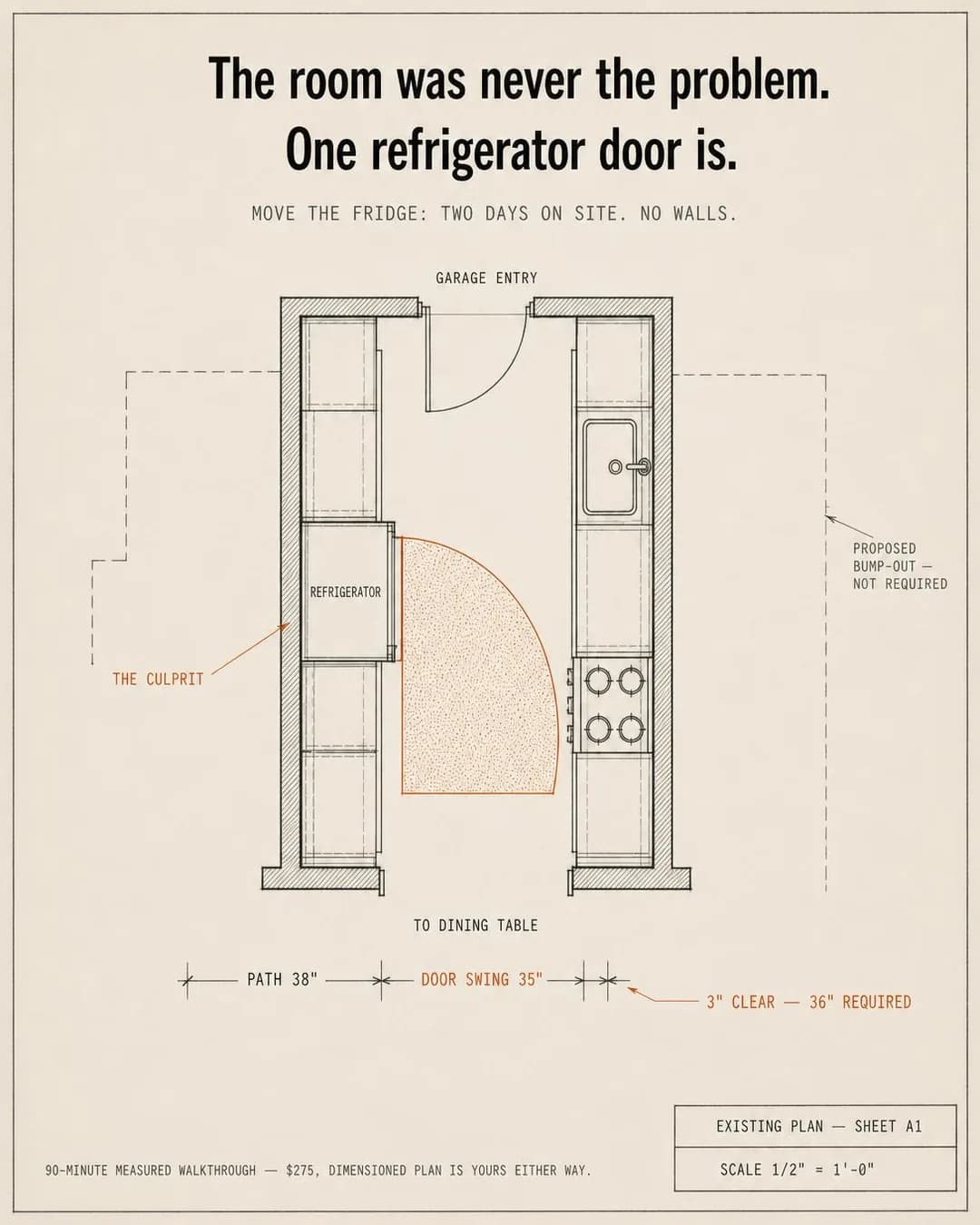
Not a Small Room. A Bad Swing.
Book a Measured Walkthrough.
Misdiagnosis/Reframe is the family and this is the argument the trade is least willing to make, because it talks a customer out of the larger job. The audience brief is a decision rather than a demographic — people who have already concluded they need an addition — and the ad answers with a drawing rather than a rebuttal: the room is fine, one refrigerator door is not, and the fix is two days rather than nine months of permits. The offer underneath it is a $275 measured walkthrough with the dimensioned plan yours either way, which is the same move the Facebook twin made with a $250 structural assessment and roofing made with a flat-fee inspection. The cheapest first transaction available is the one this category keeps forgetting it can sell.
The count held its structure and lost its values, which is the last and most precise result of this batch's counting test. Two doorways were briefed and two render, labelled GARAGE ENTRY and TO DINING TABLE. One relocated appliance was briefed and one renders, flagged THE CULPRIT. Two aisle dimensions were briefed at 30 and 42 inches, and what renders is a different set entirely: PATH 38", DOOR SWING 35", and a flagged gap reading 3" CLEAR — 36" REQUIRED. The image prompt wrote all four of those numbers and the image model transcribed them exactly. So the shape of a count survives the pipeline and the numbers inside it do not, which is the same lesson as the tape strips and the sticky notes arriving one more time: brief what must be in the frame, then read what came back before you believe a figure in it.
Two things this ad settles. The arithmetic is right in both artefacts and it narrows the rule rather than breaking it — 38 minus 35 is the 3 inches the drawing flags, and the copy, generated separately from the finished image, says "You need 33 inches of walkway back", which is 36 minus 3. Both are one-step subtractions written as type by text models; the $626.17 amortisation the Facebook twin got wrong was a formula. Do the formula on paper, and expect the subtraction to land. And the prohibition lost again, this time in the ad's favour: the brief said the plan should carry nothing but those annotations, and the prompt added a dashed outline in the margin labelled PROPOSED BUMP-OUT — NOT REQUIRED. That is the addition the reader came for, drawn and dismissed inside the same frame, and it is the best single stroke in the batch. Before running it, check the one claim that is not yours to make: 36" REQUIRED reads as code, clearances vary by jurisdiction and the NKBA's own guidance for a one-cook aisle is 42", so verify it locally or drop the word REQUIRED. The $275 and the $60,000 addition are invented, and the title block says the sheet is drawn at 1/2" = 1'-0" when nothing here is to scale.
Other headlines from the same run
- The 2-Day Fix vs. The Bump-Out
- Find the 3-Inch Bottleneck
- Measure Before You Demolish
- Keep the Walls. Move the Fridge.
Call to action
Traffic was pinned and Book now is the stronger button anyway, because the offer is a specific, priced, ninety-minute appointment rather than a project — send it to a calendar with the $275 on it. This is also the ad to point at anyone who asks what a remodeling account should optimise on: a measured walkthrough happens inside the seven-day attribution window, and the addition it talks somebody out of would have closed months outside it.
Nine Strips, Counted
LeadsNine working days, one strip of tape each. Count them.
- Audience
- Families with one bathroom and no second one to use — Have put the hall bathroom off for three years because there is nowhere else to shower, and every quote they have had described the schedule in weeks rather than in days.
- Angle
- Speed (Benefit & Outcome) — Emphasizes achieving the desired result faster.
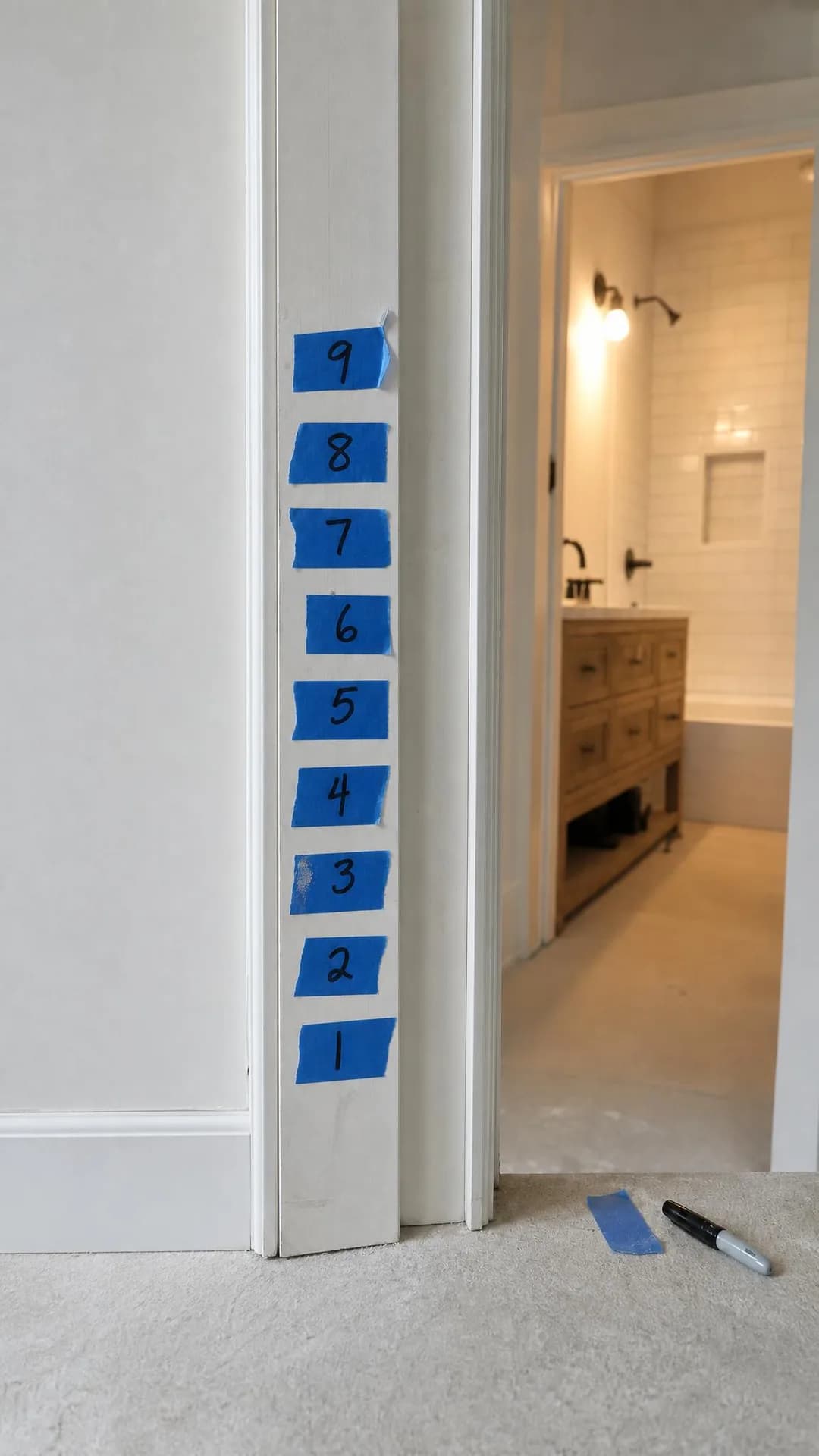
If you only have one bathroom, you can't hand someone a key for six weeks. A hall bath remodel takes nine working days. One crew, full gut to tile and vanity, verified with a photo sent to your phone every afternoon by 4:30. If day ten happens, it costs us $300 a day off your balance.
Nine working days. Guaranteed.
Guaranteed 9-day schedule.
Speed is the family and this is the ad the trade never makes with it, because everyone says fast and nobody counts. The audience brief is a decision rather than a demographic — a household with one bathroom and nowhere else to shower — which is why the objection being answered is the calendar rather than the price. Then the concept stage improved on the brief, which has not happened before in this corpus. The brief asked for one strip of painter's tape reading DAY 9 with eight spent strips beneath it; what came back is nine strips hand-numbered 1 to 9 climbing the door casing, which is the same claim rendered as something a reader can check by counting.
The count is exact — nine strips, 1 at the bottom and 9 at the top — and it is the first of this batch's six count checks. What failed is the prohibition beside it. The brief said no tools left in the frame, and there is a black marker with the cap off and a scrap of tape on the hallway floor. The useful part is where that happened: meta.json stores the image prompt, and the prompt itself wrote "On the hallway floor at the bottom edge, a scrap of blue tape and a black marker with the cap off." The image model rendered its instructions faithfully. The prohibition died one stage earlier than anyone would look for it, at the model that writes four hundred words of art direction and furnishes the scene while it works.
Invented and load-bearing: the $16,800 flat price, the $300-a-day credit past day nine, and "340 hall baths completed on this schedule since 2017". The credit is the sentence worth keeping and the one to put in a contract before it goes in an ad, because it is the only line here a competitor cannot repeat. The extractor fan the brief asked to have running is not visible, which is the ordinary limit of briefing a photograph: you can pin what the frame can hold and nothing else.
Other headlines from the same run
- Hall bath gut and refit: 9 days.
- Done in 9 days or we pay $300/day.
- One bathroom? Finished in 9 days.
- 9 working days. Flat price.
Call to action
Leads was pinned and Book now is defensible here, which is rare in this trade — the offer is a dated nine-day slot rather than a five-figure project, so there is something to book. Send it to a page that shows the day-by-day schedule and a real calendar. If your schedule is honestly eleven days, put eleven strips on the casing; the whole ad is the count.
The Tile the Bids Never Named
TrafficThree bids. Not one of them names the tile.
- Audience
- Homeowners comparing three bids that are not the same job — Have three proposals within a few thousand dollars of each other, all built on allowances, and no way to tell which one has priced the tile they actually want.
- Angle
- Ingredient / Material (Product & Mechanism) — Spotlights a specific ingredient, component, material, or input.
Three contractors gave you bids within $4,000 of each other. Not one of them named the tile. They wrote "allow $12,000 for tile" and left the room. We put this glazed ceramic field tile on your kitchen table, priced at $31 per square foot installed. No deferred decisions. The board is the estimate.

No allowances. Just real prices.
5 samples. Zero allowances.
Ingredient/Material is the family, and the argument is the one that separates a design-build shop from a bid: an allowance is a round number standing in for a decision nobody has made, so three bids within a few thousand dollars of each other are not three prices for the same job. The brief asked for the answer to that in objects — five physical samples on a table, each with the line-item price it is being held to.
What came back is one sample, and it is the most interesting result of the batch's counting test. The concept stage reduced five objects to a single glazed field tile, and the count reappeared as type: a small tag reading SAMPLE 2 OF 5 — BACKSPLASH, with the tile's own label under it, GLAZED CERAMIC FIELD TILE, $31 PER SQ FT INSTALLED. So the pipeline did not fail to count. It declined to draw a count and routed it into typography, which is where this corpus has always found counts to be reliable. Then the copy read the render and restored the five in words — "We bring five physical samples to your dining table", "This glazed ceramic tile is Sample 2 of 5" — so three artefacts agree about a number that only one object in the picture supports.
It is also, unbriefed, a better ad than the one that was asked for. In the bottom corner sits a stapled bid with one line legible: ALLOW $12,000 — TILE (TBD). The allowance and its replacement are in the same frame, which is the whole argument without a word of copy. Invented and worth replacing: the $31 per square foot, the $12,000 allowance, the three bids "within $4,000 of each other", "we stopped writing allowance lines in 2016", and the one to delete outright — "92% of homeowners approve their entire scope in one" meeting, a fabricated statistic that appears only in the copy and that nobody could support.
Other headlines from the same run
- Three bids. Not one named the tile.
- The 5-sample fixed price board.
- Five physical samples. One price.
- Know the tile before you sign.
Call to action
Traffic, and the landing page writes itself: your actual selection board photographed on a real table, with real installed prices beside each material. This is also the creative on this page most likely to be saved rather than clicked — a reader collecting a kitchen files a labelled material and comes back to it, which is exactly the behaviour the audience tools on this app can address for two years.
The Card in the Window
TrafficFour city inspectors signed. We hired none of them.
- Audience
- Homeowners who were offered a discount for skipping the permit — Had a contractor explain that pulling a permit adds six weeks and a few thousand dollars, and have not worked out who else ever looks at the work.
- Angle
- Third-Party Validation (Proof & Trust) — Uses awards, certifications, media coverage, independent testing, or industry recognition.
If a contractor offers a discount to skip the permit, ask yourself who else will ever inspect the framing. The city assigns four separate inspectors: plumbing, electrical, insulation, and final. We don’t choose them, and we don’t pay them. Every job gets permitted, and your final payment isn't due until the city signs off on the glass.
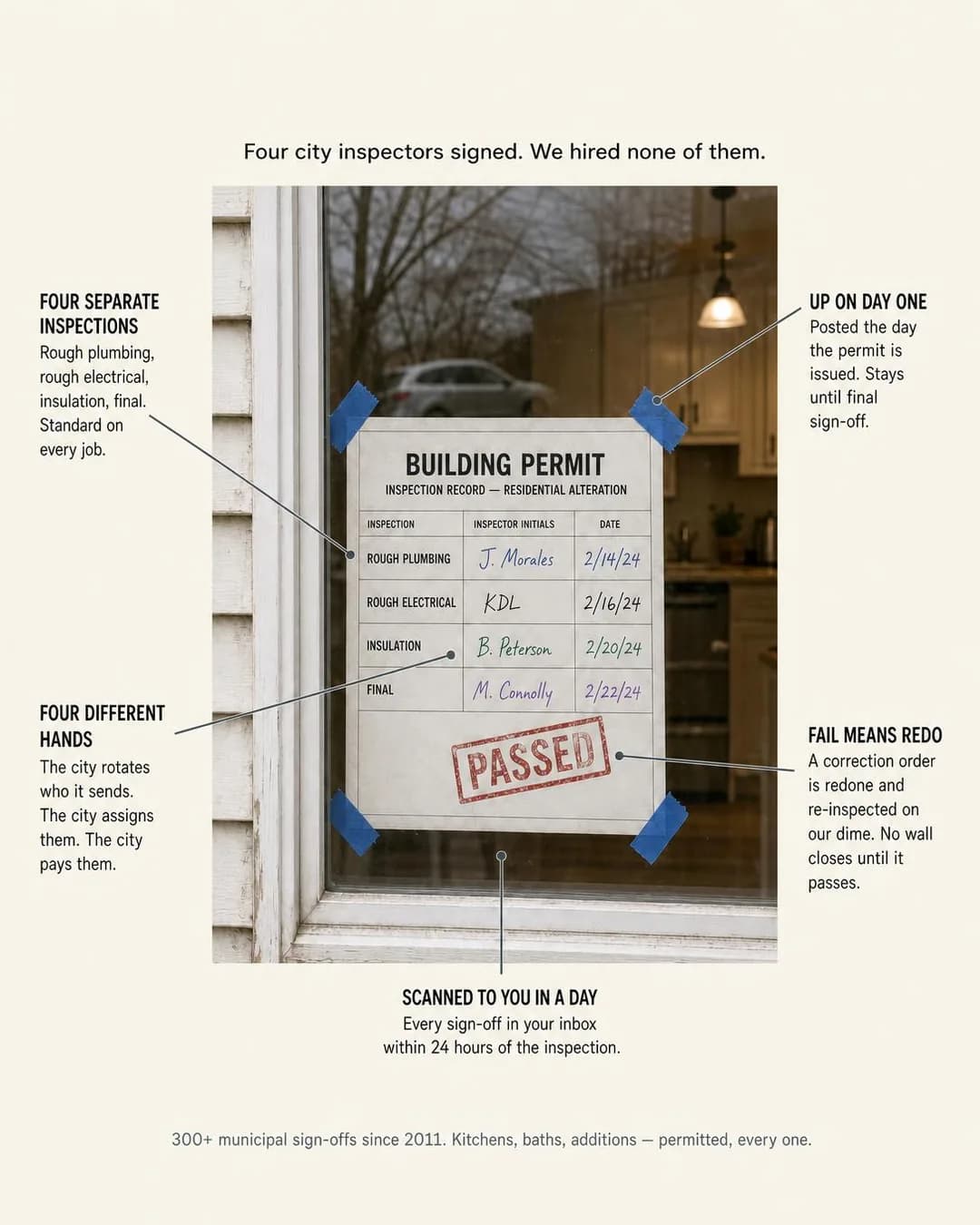
4 City Inspectors. We Hired None.
Permitted kitchens & additions
Third-Party Validation is the family this trade owns and never uses. The permit card is the object: four inspections the contractor does not choose, does not pay for and cannot hurry, taped in the window where the neighbours can read it. The run produced the whole argument in nine words — "Four city inspectors signed. We hired none of them." — and the count is exact again: four ruled lines, four different hands, four dates in ascending order across eight days.
And then it invented four municipal officials. The image prompt asked only for "a different person's initials" on each line; the image model rendered J. Morales, KDL, B. Peterson and M. Connolly — three full surnames signing a government document that does not exist. That is a different invention site from the one the ads above found. There the prompt writer added an object the brief had banned; here the prompt was conservative and the image model promoted initials into names. Both stages invent, and they invent different kinds of thing. Photograph your own card, redact the signatures, and use that instead: a fabricated inspector is the one detail on this page a city could reasonably object to.
Two more. The brief asked for callout lines to the four sign-offs and to nothing else; the prompt wrote five callouts, adding the tape corner, the PASSED stamp and the card's lower edge, so the prohibition lost at the same stage it lost on the tape ad. And the proof slot filled upstream: "300+ municipal sign-offs since 2011" is in the image prompt rather than being an invention of the image model, which is the first time this cluster has been able to name the stage that wrote a fabricated statistic. The permit dates read 2/14/24 to 2/22/24, two years stale, and "a scanned copy of each milestone within 24 hours" is a service commitment nobody briefed and somebody would have to honour.
Other headlines from the same run
- Final Pay Due After City Sign-Off
- No Permit Discount. Ever.
- 300+ City Sign-Offs Since 2011
- The Proof Is Taped in the Window
Call to action
Traffic, and the destination is the argument: a page that shows a real permit card from a real job with the signatures redacted, plus what each of the four inspections actually checks. The ad's claim is that somebody independent looked; the landing page has to be the evidence rather than a form.
Two Bids Side by Side
TrafficThe $20,000 bid isn't cheaper. It's shorter.
- Audience
- Homeowners holding one bid that is far cheaper than the others — Have two bids inside a few thousand dollars of each other and a third that is twenty thousand dollars under both, and are trying to work out whether the low one is a bargain or a different job.
- Angle
- Hidden Cost of Cheap (Comparison & Positioning) — Shows the downstream costs, replacements, waste, or frustration created by cheaper alternatives.
If one remodel bid came in $20,000 lower than the others, don't celebrate yet. Lay them side by side and check the line items. A bid that is $20,000 under usually isn't doing the work cheaper—it simply left out the permits, dust containment, and haul-away. Every single one still has to happen, and you will pay for them later as expensive mid-project change orders. We price all of it up front.
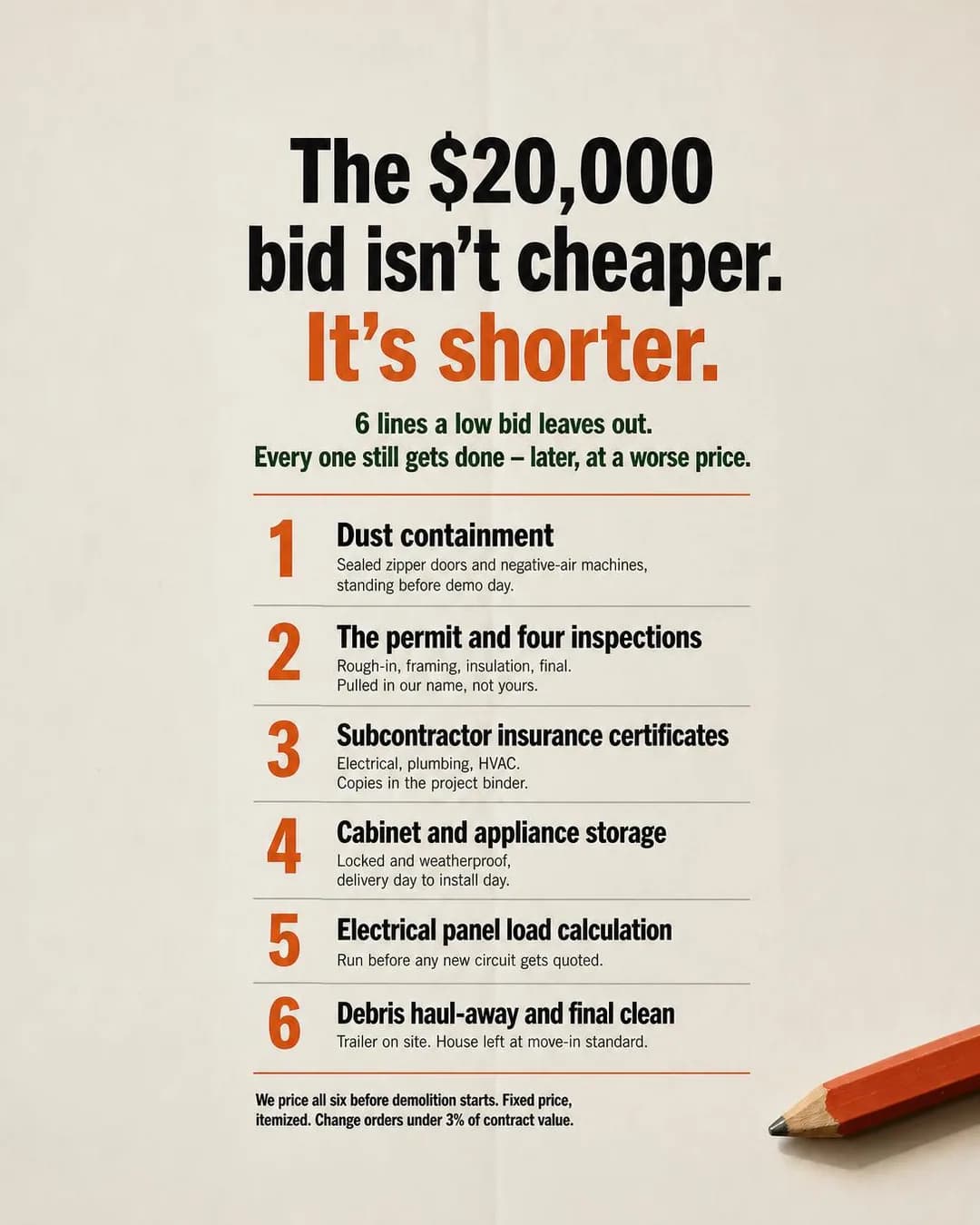
The $20k low bid is just missing lines.
Fixed-price, itemized bids.
Hidden Cost of Cheap, and this ad is the reason the batch exists in the shape it does, because the Facebook twin lost this exact argument twice. Asked for a remodeler's stay-versus-move comparison, that run invented a neutral flat-fee analysis service whose copy said it had no incentive to steer you either way — unrunnable by a remodeler, who is one of the two interested parties. Asked for a remodeler's financing ad, it came back as the lender. Both times the angle sat on a conflict of interest or a licence boundary and the model resolved the tension by changing whose ad it was. The roofing batch had already found the fix, so this brief applies it: name the advertiser's role, and close the doors it might otherwise walk through — the design-build company that will do the work, not a consumer group, an inspector, a lender or a review site.
It held, in both artefacts and without qualification. The image says "Pulled in our name, not yours" and "We price all six before demolition starts"; the copy says "We would rather lose a project to a lower number than quietly delete scope to win it." A remodeling company can run this as written, which is not true of either Facebook ad it descends from. Eleven words of brief, now replicated across two trades and three ads.
The count is exact — six numbered rows, and a subhead that says six — and one row drifted: it lists rough-in, framing, insulation and final where the brief said rough plumbing, rough electrical, insulation and final. Still four inspections, but check the list against your own jurisdiction before it runs. Invented: the $20,000 gap, "16 years and over 380 remodels", the $15,000 of change orders, and the change-order cap of 3% of contract value. That last one appears in the image and in a headline, so it is a contract term the ad is promising twice; it has to be in your contract before it is in your creative.
Other headlines from the same run
- Fixed-price remodels. No surprises.
- Change orders under 3% on contract.
- What a lowball remodel bid hides.
- Compare the lines, not just totals.
Call to action
Traffic is right: the reader is holding three bids and has just been told they are not the same job, so the click is the comparison. Send it to a page that puts a redacted real bid of yours beside a redacted low one, line for line. An ad whose whole premise is itemisation should be able to produce the items on the next screen.
The Pre-Filled Way Out
LeadsWe hand you the paperwork to cancel us.
- Audience
- Couples who will not let a contractor into the house — Believe an in home consultation is a two hour close, have been told by friends to never sign anything at the kitchen table, and do not know that the law already agrees with them.
- Angle
- No Commitment (Objection & Risk Reversal) — Emphasizes cancel-anytime, no contract, or no long-term obligation.
Before our samples go back into the van, we hand you the paperwork to cancel us. If you sign a remodeling contract at your kitchen table, federal law gives you three business days to change your mind. We hand you the cancellation notice in duplicate, pre-dated and ready. No manager phone calls, no disappearing discounts, and full refund of any deposit.
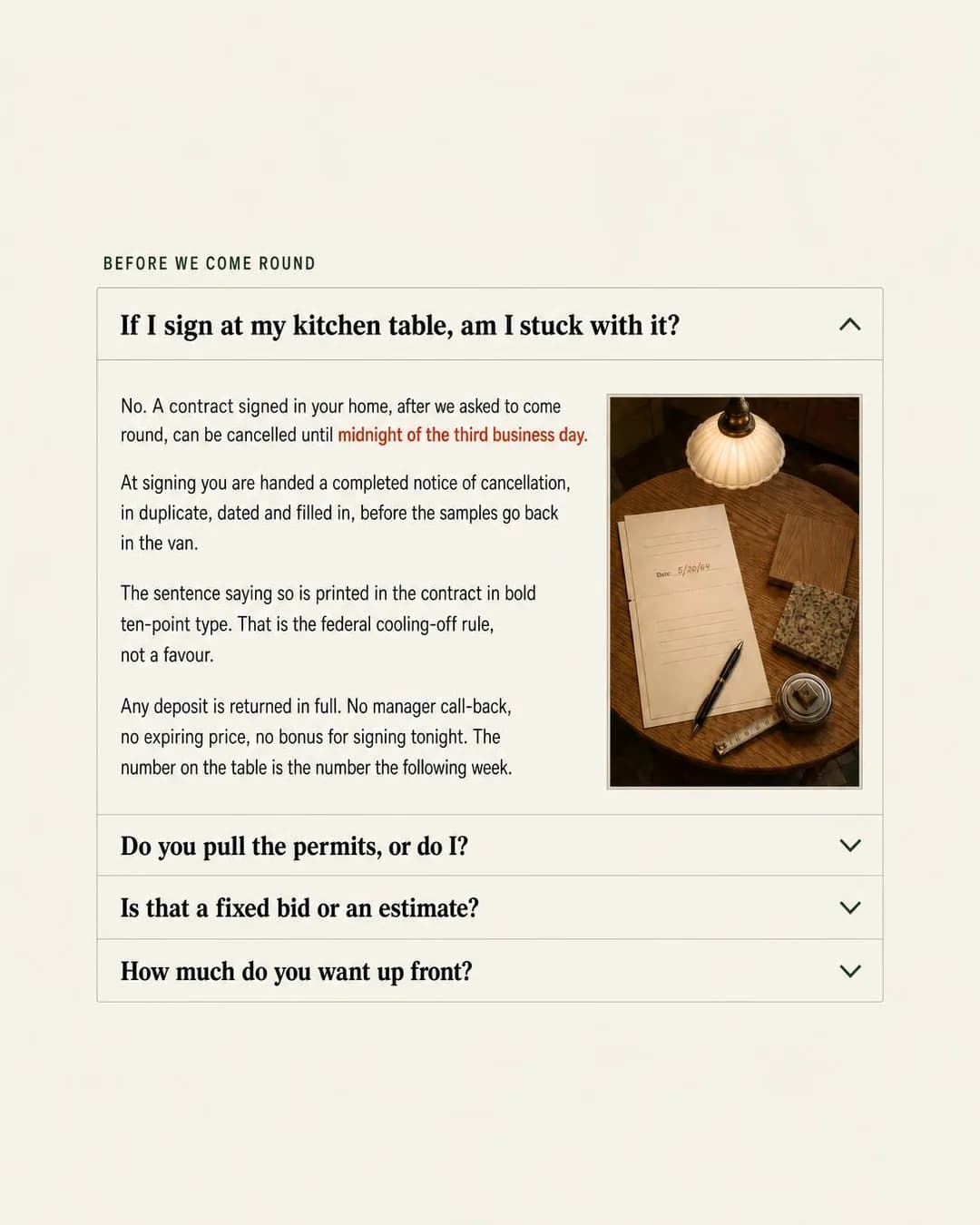
We hand you the paperwork to cancel us.
Fixed bids. Zero pressure.
No Commitment is the family, and the ad's entire content is a federal rule the trade never advertises. A remodeling contract signed at the homeowner's table after the contractor asked to come round is a door-to-door sale under 16 CFR 429, so it can be cancelled until midnight of the third business day, the buyer is handed a completed Notice of Cancellation in duplicate at signing, and the sentence saying so is printed in the contract in bold face type of at least ten points. Every competitor is bound by all of it and none of them mentions it, which makes the strongest trust ad available in remodeling a piece of paperwork the advertiser is already obliged to produce. The render gets the law right, down to "That is the federal cooling-off rule, not a favour."
The count failed, and it failed instructively. The brief asked for exactly three numbered lines; the image prompt turned that into an FAQ accordion with one expanded row and three collapsed ones, and the expanded answer runs to four paragraphs. Set that beside the counts in this batch that came back exact and the rule sharpens: a count survives when it counts things inside the picture, and loses when it counts the picture's own structure, because the visual direction owns the structure. An FAQ card is made of question rows. Asking one for three numbered lines is asking the direction to stop being itself.
Two smaller things worth knowing. The brief banned every figure and date from the frame; the prompt wrote a date line onto the notice anyway and it renders as "Date: 5/20/64", the same stage-one loss as the marker on the hallway floor. And the wide cream margins are not the export-padding defect this cluster keeps finding — the prompt asked for a centred accordion with wide empty margins by name, so re-rendering it would be fixing something that was composed on purpose. The three collapsed questions the model chose, who pulls the permits, fixed bid or estimate, and how much up front, are the trade's real first three questions, and nobody briefed them.
Other headlines from the same run
- 3 days to cancel. No questions asked.
- The pre-filled way out of any contract.
- No pressure. Cancel through midnight.
- Fixed bids. 3-day cooling-off window.
Call to action
Leads was pinned and the button should still be Learn more, because the promise is a document and the reader wants to read it before giving anyone a phone number. Put your actual cancellation notice on the page. Then check your own state as well as the federal rule — many have home-improvement contract statutes that run longer or add notices on top of the three days, and an ad that promises three where your state gives five is understating your own offer.
The Four-Figure Page
LeadsThe full price is on this page. So is $8.00 a day.
- Audience
- Homeowners who have called the kitchen an extravagance — Can afford the work and cannot get past the size of the total, and have never once measured it against how long the kitchen they are replacing actually lasted.
- Angle
- Cost Per Day / Use (Offer & Economics) — Breaks a large price into a smaller daily, monthly, or per-use amount.
Most people look at a $64,240 kitchen quote and call it an extravagance. Divide that by the 8,030 days our 2001 build served before replacement, and the math settles at $8.00 a day. That is a full gut to the studs, shop-built solid cabinetry, and one dedicated crew start to finish. If you are staying put, build for the long run.
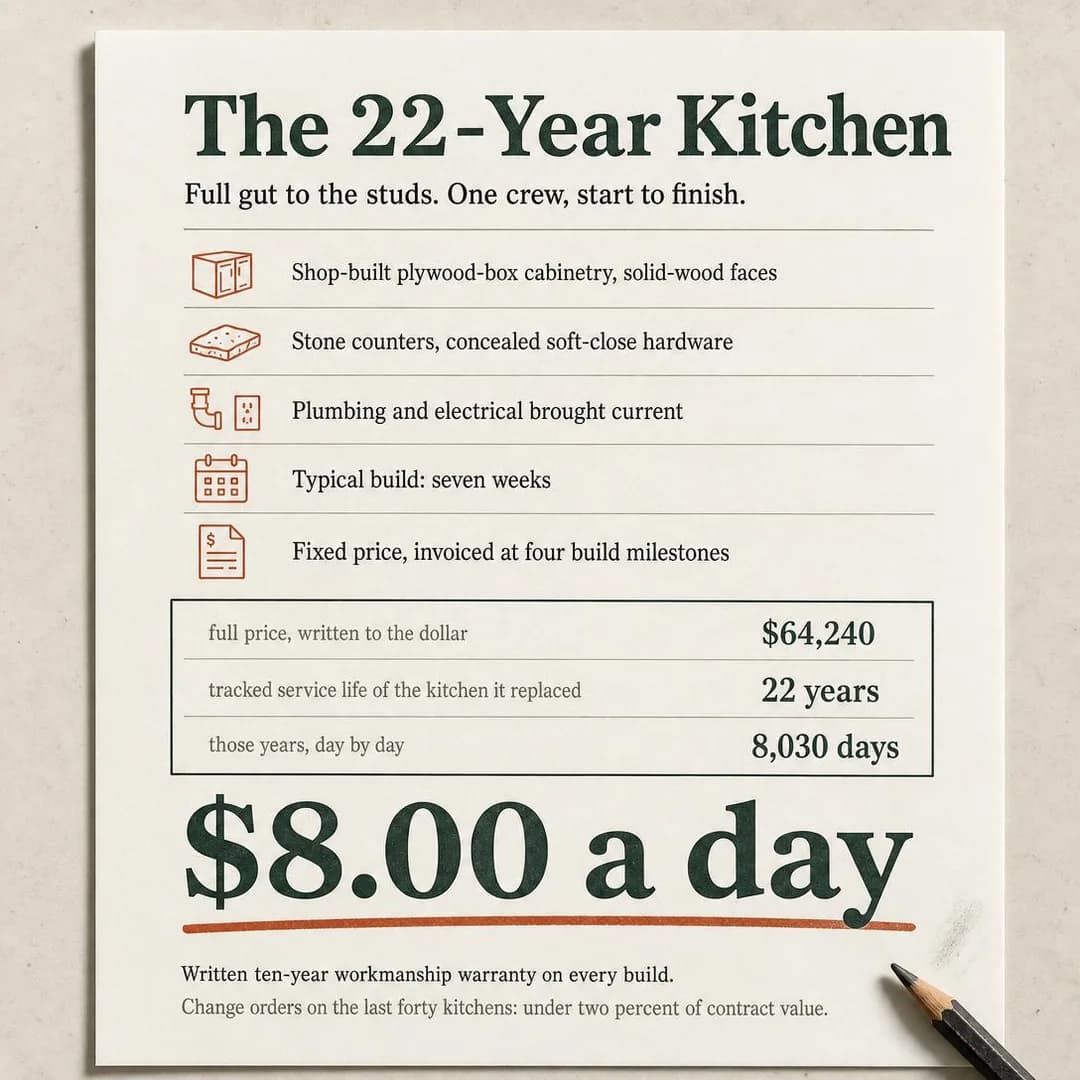
The 22-Year Kitchen: $8.00 a Day
Fixed price. No asterisks.
Cost Per Day is the reframe this category needs and rarely earns, because the objection to a kitchen is not affordability — it is that a five-figure number is being weighed against a savings account with no denominator underneath it. The brief supplied the denominator and the ad renders it as a ledger: $64,240, 22 years, 8,030 days, $8.00 a day, in that order, with the daily figure set at the width of the frame.
This is the control the Facebook batch's most expensive error asked for, and it came back clean. That page's financing ad had to compute an amortisation and rendered $609 a month against a true $626.17, four inches tall, in an ad that also named the term and the APR. Here every figure was supplied and none had to be worked out, and all four render exactly — in the image, in all five headlines and in all five primary texts, three separately generated artefacts agreeing to the cent. The arithmetic closes if you check it: 22 × 365 = 8,030, and 8,030 × $8.00 = $64,240. So the rule this cluster has been circling can be stated flatly. What this pipeline copies is reliable; what it computes is not. Do the division on paper and put the answer in the brief.
The prohibition held here, and the reason matters. The brief banned any monthly payment, rate, APR or term, and there is none — which keeps the ad clear of Regulation Z altogether, since 12 CFR 1026.24(d)(1) attaches to the amount of a payment rather than to a price divided by days. Nothing in the direction pulled against that ban, which is exactly the condition under which the roofing batch found a prohibition survives. What the direction did fill was its own slot: five feature rows, a seven-week typical build, four invoice milestones, a written ten-year workmanship warranty and "change orders on the last forty kitchens: under two percent of contract value" — none of it briefed, all of it repeated by the copy. Every one is a contract term or a statistic about a company that does not exist.
Other headlines from the same run
- $64,240. Exactly $8.00 a Day.
- One Fixed Price. Built for 22 Years.
- A Kitchen Priced at $8.00 a Day
- Fixed to the Dollar: $64,240
Call to action
Leads was pinned but send this to a page rather than a form: the reader's next question is what the $64,240 buys, and the ad has already promised an itemised answer. Keep the daily figure out of anything that also names a monthly payment — the moment a payment amount appears, Regulation Z's triggering terms attach and the ad owes the repayment terms and the annual percentage rate in the same breath.
Four Cards, One Wall
TrafficOur entire supply this year: four kitchens.
- Audience
- Homeowners who assume a good contractor is a phone call away — Have started making calls the month they want the work done, and have not yet met the company that is booked to next spring because it will not run two jobs at once.
- Angle
- Limited Stock (Scarcity, FOMO & Timing) — Uses finite inventory or supply as the urgency mechanism.
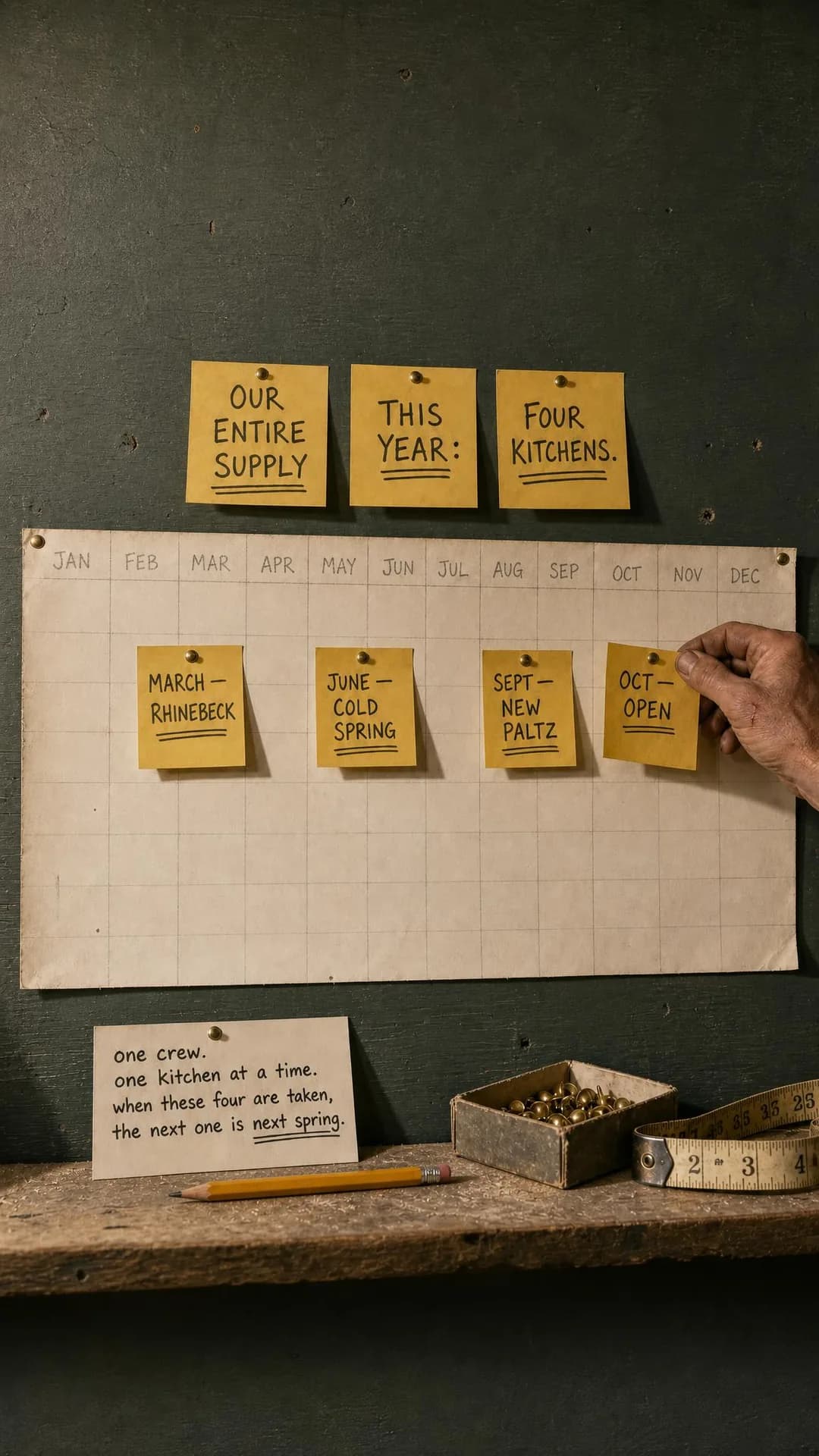
Our entire inventory for the year fits on four index cards. We build four kitchens a year because a five-person crew can only build one kitchen at a time. Rhinebeck, Cold Spring, and New Paltz are claimed. When the fourth card is pinned, our next opening is next spring.
One Crew. Four Kitchens a Year.
Reserve the final build slot.
Waitlist scarcity is usually a lie in this trade and here it is arithmetic: one crew that runs one job at a time builds four kitchens a year, so the scarcity is the shape of the company rather than a deadline invented to hurry somebody. The card at the bottom of the frame, which nobody briefed, says it better than the brief did — "one crew. one kitchen at a time. when these four are taken, the next one is next spring" — and the copy lands the same point: "That is not marketing—it is math."
The count held where it was pinned and not where it was not. The planner carries exactly four notes, as briefed. The frame carries eight, because the image prompt added three more above the calendar spelling out OUR ENTIRE SUPPLY / THIS YEAR: / FOUR KITCHENS, and a card below. Same lesson as the marker on the hallway floor: pin the object and the object comes back right, while the stage that writes the art direction furnishes everything around it. The months drifted too — February, May, August and October in the brief against March, June, September and October in the render.
And then the most instructive failure on this page, which is not a defect in any single artefact. The notes read MARCH — RHINEBECK, JUNE — COLD SPRING, SEPT — NEW PALTZ. Those are real towns and none of them appears in the image prompt: the image model invented them to letter a sticky note. The copy stage then read the render and turned them into claims about the business — "Rhinebeck, Cold Spring, and New Paltz are claimed", "within ninety minutes of our Hudson Valley shop", and a headline that ends "HV." An invention that entered as pixels left as a service area two stages later, because the copy stage reads the hero. Any ad from this pipeline whose image contains a place name, a person's name or a number will tend to have it asserted as fact in the copy, so fix it in the image or expect to fix it twice.
Other headlines from the same run
- One Fall Build Slot Remains.
- Four Kitchens a Year. One Left.
- Built One Kitchen at a Time.
- One Project at a Time. HV.
Call to action
Traffic was pinned and Contact us is the honest button, because the thing being offered is a conversation about a slot rather than a slot you can take online. If you do publish the calendar, this becomes one of the few scarcity ads a reader can verify before believing it — and if you do not, take the town names out first, because an invented service area is the fastest way for a real neighbour to catch you.
Renovated Once, By Design
LeadsThe most expensive bathroom is the one built twice.
- Audience
- Homeowners rebuilding a bathroom they intend to keep — Are gutting the bathroom once and do not want to pay for the same room twice, and have noticed that every ad for this work seems to be about somebody's mother.
- Angle
- Security / Protection (Identity & Emotion) — Emphasizes protecting family, money, property, data, health, time, or peace of mind.
The most expensive bathroom is the one built twice. Protection is simplest while the subfloor is exposed. Every curbless pan receives a bonded membrane and a mandatory 48-hour flood test before setting the first tile. 400-plus installations across the Twin Cities. Zero inches at the threshold, backed by a 10-year structural waterproofing warranty.
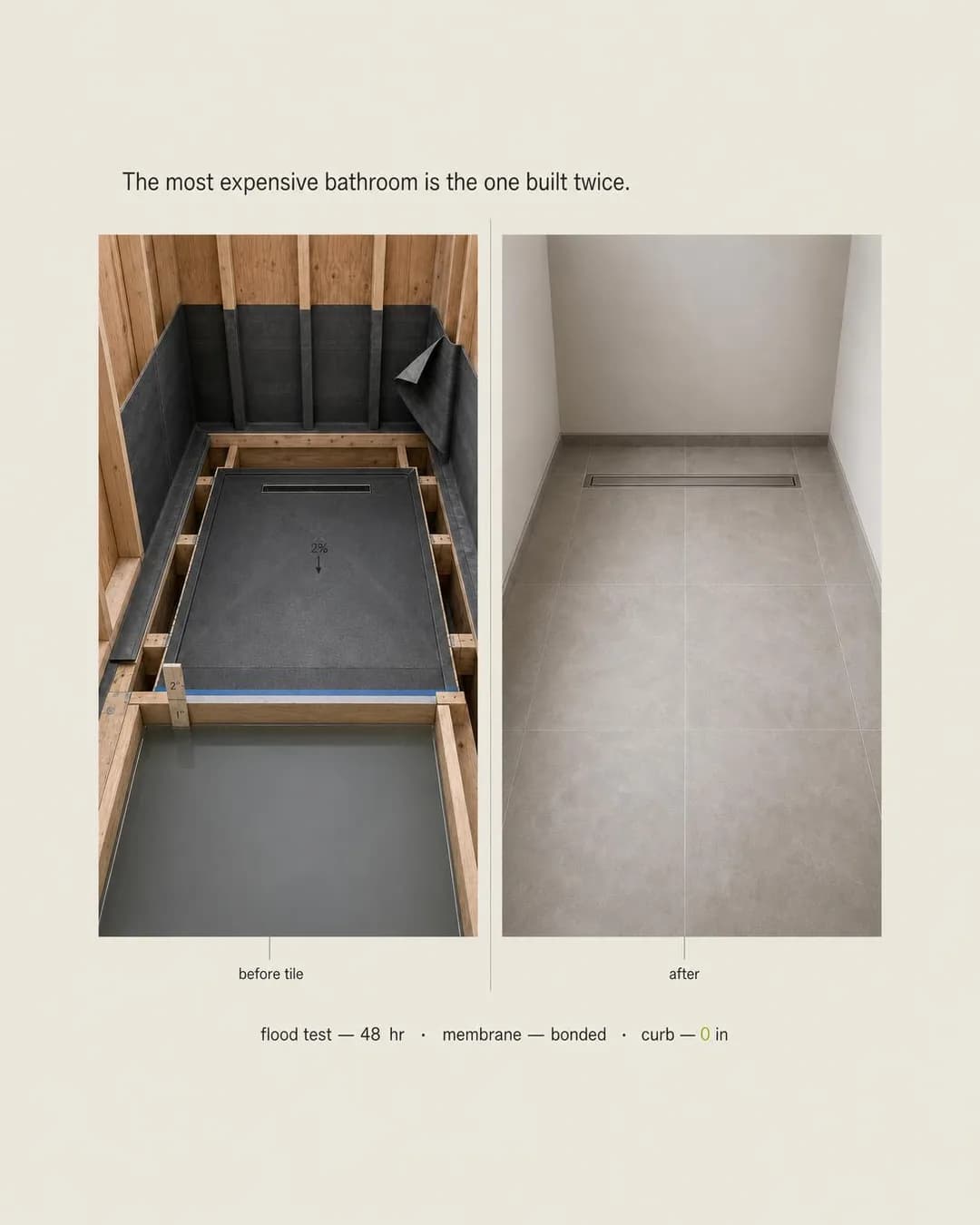
48-Hour Flood Test. Zero Curb.
10-year warranty in writing.
This is the ad the Facebook batch got wrong, run again with the fix. That page's aging-in-place bathroom was the best-made thing in its batch and could not be published: the caption across the foot of the frame read "blocking set before the tile — so she's safe for years", which implies the advertiser knows a specific family member's mobility, and Meta's personal attributes standard prohibits exactly that — it names disability and physical or mental health, and extends to implying awareness of "the personal attributes of their family". The violation was burned into the image where no headline rewrite could reach it. So this brief pinned the prescription instead of the person: two empty rooms, no body, no hand, no reflection, and copy that describes construction and nothing else.
It passes outright. There is no person in the frame and no person in the copy — not an age, not a family member, not a condition, not a pronoun. What the copy talks about instead is joists, a bonded membrane, a 2% fall to a linear drain and a 48-hour flood test, all of which are real practice and correctly stated. The buyer still recognises themselves; the ad never recognises them. That is the whole of the fix, and it is worth copying verbatim by anyone selling this work.
The image, though, is not the ad that was briefed, and this is the clearest instance of the batch's main finding. The brief asked for two bathrooms side by side, one with a four-inch tiled curb and one with none, annotated 4 in and 0 in — a comparison. The image prompt kept the split frame and replaced the comparison with a sequence: the same curbless build before tile and after, labelled "before tile" and "after", with a footer reading flood test — 48 hr · membrane — bonded · curb — 0 in. The four-inch half is simply gone. The prompt stage does not only add furniture and drop prohibitions; it can swap the argument the two halves of a picture are making. Two smaller flags before running: the copy invents proprietary names for an unbranded sample, a "PlaneSet system" and a "Slotline drain", and it claims 400-plus installations across the Twin Cities — the second real place name this batch invented, and this one never went near the image.
Other headlines from the same run
- Built Once. Verified in Writing.
- Curbless Conversions From $14,800
- 0" Threshold. 10-Year Warranty.
- Engineered 2% Fall to Drain.
Call to action
Leads was pinned and this is the rare bathroom ad that can carry a form honestly, because nothing in it implies anything about the reader. Send it to a page about curbless construction — the pan, the fall, the flood test — and let the person who needs it arrive at that conclusion themselves. Keep the copy in the third person about the room if you rewrite it; the moment a sentence addresses the reader's family, the ad is in the policy the Facebook twin broke.
The Labelled Rack
AwarenessSomewhere on this rack: Maple St — bank of six.
- Audience
- Homeowners who have been told every kitchen is the same three cabinet brands — Have walked three showrooms, seen the same catalogue in all of them, and assume the only variable left is which contractor orders it.
- Angle
- Making Of (Story & Founder POV) — Shows product development, manufacturing, design, sourcing, or craftsmanship as a story.

A catalogue never writes your street on anything. In our converted grain warehouse, your drawer boxes get labelled by hand weeks before install. Every box is cut from 3/4" maple plywood with dovetailed solid-wood drawers. The same crew that measures your kitchen builds it at the bench and sets it in your house. No middlemen. No sorting parts out in a driveway.
Built by Hand. Never Ordered.
Book a measured drawing & quote.
Making Of is the family that suits this app better than any other in the library, and the brief's job was to keep one thing out of the frame: a name. The roofing batch had found that this pipeline invents a proper name unless the brief forbids one — a brief naming a role got Marcus and Dana — so this one named the role and banned the name, the nameplate, the signature and the embroidered shirt. It held. The caption reads THE SHOP'S CABINETMAKER — AT THE BENCH SINCE 2016, and there is no person's name anywhere in the image or in five headlines and five primary texts. A prohibition that nothing in the direction pulls against survives, which is the other half of the rule this batch keeps confirming.
What the run added is better than what it was asked for. The drawer box on the bench is labelled MAPLE ST — BANK OF SIX, and the line under the portrait — "Your street goes on the box weeks before it goes in the house." — is the whole argument for a shop-built kitchen in thirteen words. Both came from the image prompt rather than the brief, which is the same stage that furnished the marker on the hallway floor three ads up. It invents in both directions; the only reliable thing about it is that it invents.
Two things to fix before running it. The credentials in the caption — at the bench since 2016, about 40 kitchens a year — were written by the prompt and then repeated by the copy, so an invented number now appears in three artefacts and reads like a fact about the company. And notice what happens when you scroll this page: the waitlist ad four positions up belongs to a company that builds four kitchens a year, and this one builds about forty. They are different invented businesses, but they are on one page, and a reader does not know that. Publishing ten generated ads side by side means the invented figures have to be read as a set.
Other headlines from the same run
- No Showrooms. No Dealer Markup.
- Built at the Bench Two Towns Over.
- 40 Kitchens a Year. Built In-House.
- Real Wood Cabinets, Built Locally.
Call to action
Awareness was pinned and it is the right call: this ad asks for nothing and buys a reputation with people who are eighteen months out, which on this app is most of the audience. Send it to a page about the shop, not to a form — and this is the single best creative in the batch to build a save audience against, because it is the one a reader files rather than answers.
Questions
- Do Instagram ads work for home remodeling companies?
- Yes, and for a different reason than on Facebook. Pew's November 2025 survey puts Instagram at 62% of 30- to 49-year-olds and 40% of 50- to 64-year-olds, against Facebook's 80% and 74%. Read that as two buyers rather than one: the younger band is where the single-room jobs live — the hall bathroom, the kitchen refresh, the one wall — and those are the projects a single crew can actually schedule. The older band, which holds the equity that pays for a whole-house remodel, is on this app at roughly half the rate. So Instagram is not a smaller version of the Facebook audience. It is the half of your own order book that photographs well.
- How do I advertise to someone who will not hire me for a year?
- With the audience tools rather than the reporting, and this is the part of the account almost nobody in the trade builds. Engagement custom audiences from an Instagram business profile retain for up to 730 days, and one of the addressable engagements is the save — Meta's own description of ig_ad_save is "People who saved either organic content or an ad from your Instagram business profile". Audiences built from Lead Generation Ads, by contrast, max out at 90 days. Your form-fill ages out of the account before the drawings are finished; the person who merely saved the picture is still addressable two years later. Build the save audience first, and treat it as the top of the funnel it actually is.
- Should I run remodeling ads on Instagram or Facebook?
- Both, for different jobs, and the split is not about budget. Facebook is where the household is — a kitchen is decided by two owners and that app has the higher odds of reaching the second one — and it is where the paperwork arguments land: allowances, lien waivers, completion credits, fixed bids. Instagram is where the project is collected. A saved post is private, the poster is never told, and collections can be shared, so the ad you want here is the one that survives being filed in a folder called Kitchen for eleven months. Same account, same offer, two different jobs for the creative.
- Does the three-day right to cancel apply if the lead came from Instagram?
- Yes — the rule attaches to where the contract is signed, not to which app produced the lead. 16 CFR 429.0(a) defines a door-to-door sale as one the seller personally solicited, agreed away from the seller's place of business, at $25 or more when it happens at the buyer's residence, and an ad that produced the appointment is solicitation. So 429.1 applies: the contract carries the cancellation sentence in bold face type of at least ten points and the buyer is handed a completed Notice of Cancellation in duplicate. One ad on this page makes that its entire argument, which is the version of this fact worth advertising — every competitor is bound by it and none of them mentions it.
- Can I advertise a bathroom that is easier to get into?
- You can advertise the room. You cannot advertise the person. Meta's personal attributes standard prohibits content that asserts or implies personal attributes, names disability and physical or mental health among them, and extends to implying knowledge of "the personal attributes of their family" — which is what "safe for Mom" does. The Facebook batch produced exactly that violation and burned it into the image where no headline rewrite could reach it. The fix, tested on this page, is to describe construction and nothing else: a curbless entry, a linear drain, blocking set behind the tile. The buyer recognises themselves. The ad never recognises them.
- What size should a home remodeling Instagram ad be?
- Render 4:5 at 1440 × 1800 for Instagram Feed, which is the same export Facebook Feed wants, with primary text around 125 characters and a headline around 40 — Instagram's headline allowance is more generous than Facebook's 27, which surprises most people. Two differences matter. The aspect-ratio tolerance is 1% here against Facebook's 3%, so a crop a few pixels out of true passes there and fails here. And Instagram has four image placements to Facebook's nine, so you are composing for far fewer crops: a 9:16 for Stories and Reels covers most of the rest, and three of the ads on this page are built that way.
Seen enough? Make your own.
Paste your site. It reads your projects, your process page, your service area and your terms, then writes the concepts, renders the images and drafts the copy — for the one trade in this set where the sentence in the ad is a term of the contract you sign four months later.
No credit card · 50 free credits (about 5 ads or Instagram posts)
Every angle used above is documented in the best-in-slot ad angle library. More industries and placements are at all ad examples.