
Ad Generator · Home Remodeling
Facebook & Instagram ad generator for home remodeling companies
Paste your site. It reads your projects, your process page, your service area and your terms, then writes the concepts, renders the images and drafts the copy — for the one trade in this set where the sentence in the ad is a term of the contract you sign four months later.
Enter your remodeling company's website
That is the whole brief. No questionnaire, no uploads, no brand kit to fill in. Free to start, no card — and every ad lands paused, which in this trade is where the payment gets recomputed from your lender's sheet and somebody checks whose company the ad is actually for.
No credit card · 50 free credits (about 5 ads or Instagram posts)
What it takes off a remodeling company's website
- Your project pages, and the range across them. A remodeler sells a $250 structural assessment and a six-figure addition out of the same office, and one before-and-after slider aimed at everybody collects the cheapest possible enquiry — somebody who wanted a free estimate. The portfolio tells the generator which rooms you actually build and which end of the book your crews are short of, four months from now, which is when the work these ads buy gets scheduled.
- Your process page, which is the most valuable page on a remodeling site and the one most companies have not written. Allowances against specified lines, the change-order rule, the payment schedule, the completion date, what happens when a permit comes back. Half of what a remodeler sells is a document the homeowner has never been shown, and three of the ten ads on our examples page are built entirely out of one. If your site explains the paperwork, the generator can argue with it; if it says “quality craftsmanship since 1998”, it cannot.
- Your terms, wherever they appear — deposit, draw schedule, warranty period, any completion credit. Read this list before you paste the URL rather than after, because in this trade an advertised term is a contract term. A deposit line is capped by state law in some states, a monthly payment triggers a federal disclosure rule, and a completion credit written as a range stops being a guarantee. All three are in the caution.
- Your financing page: the partner, the term, the monthly, and whether the annual percentage rate appears anywhere on it. A page stating a payment with no rate is the shape Regulation Z was written about, and it is also the one campaign that costs you ZIP-code targeting. Both halves are below.
- Your service area as you write it, holes included — the historic district whose review board adds four months, the town whose permit office you will not work through again, the county you are not licensed in. Ordinary campaigns can subtract those. The financed one cannot subtract anything, which is a smaller loss here than in a storm trade and still a loss.
- Your lead times and your calendar. Drawings, fixed bid, permit review and cabinet lead time sit about five months in front of demolition, so a kitchen finished in spring is a contract signed in autumn — the only honest scarcity in this trade, and one almost nobody advertises. If your site publishes crew-start availability the generator will use it, and the ad becomes a scarcity claim a reader can verify before believing it.
- The proof a homeowner can check without taking your word for it: your licence numbers, whether you pull permits and hand over the inspection card, whether crews are on your payroll, how long the business has been at the address, your own job records. This trade's advertising is full of invented statistics, which is exactly why the checkable kind wins — and why the generator inventing one is the failure named below.
- Your photographs, colours and type — and one thing worth adding before you run this. The finished-kitchen photograph is the least useful picture in your library, because every finished kitchen looks like every other one and every competitor is posting theirs this week. The pictures that argue are the during shots and the paperwork: a family eating dinner at a folding table with the work zone sealed behind plastic, an allowance sheet beside a specified line, a build calendar, a lien-waiver stack. Put those on the site and the generator will reach for them.
What one click gives you
A concept pinned to one moment in a decision that takes a year
Someone who has been eyeing one wall for four years, a family working out whether they can live through eleven weeks of it, and a couple deciding whether to sell instead are three people at three points in the same journey, and the generator writes one ad per brief rather than blending them. The blended version — kitchens, baths, additions, free estimates — is the ad every remodeler in your market is already running.
A finished image, and in this trade the good ones are paperwork
Rendered in your brand's colours and type. What works here is a document rather than a beautiful room: an allowance sheet against a specified line, a ledger of what moving actually costs, a milestone calendar, a completion clause set as a poster. One rule to brief with, and this batch is the third clean replication of it: a visual direction with a slot for a number will fill that slot — with your figure if the brief supplies one, and with an invented figure if it does not. Write the proof into the brief.
All four Meta shapes
The same image re-framed for 4:5 feed, 9:16 Stories and Reels, and the 1.91:1 asset that routes to Facebook's right-hand column and search results, surfaces with no Instagram equivalent at all. Facebook has nine image placements to Instagram's four and their recommendations disagree — Feed wants 4:5, Marketplace a square — so the portrait is composed to survive a square crop. The wide slot suits this trade better than most, because a schedule or a ledger loses nothing in a wide crop and a kitchen loses the ceiling and the floor.
Five headlines, five body texts, a description
One run, so you are choosing between versions of the same argument rather than between five arguments. Measured across the eight Facebook batches published here: 28 of 400 headlines fit Facebook Feed's recommended 27 characters and 379 fit Marketplace's 40. Twenty-seven characters is room for a noun, not for a claim. Body text runs long everywhere on this site except here — 11 of 405 primary texts fit the recommended 50–150, and every one of the eleven came out of the remodeling batch, from the three ads whose pictures were already carrying the whole argument. Length tracks how much of the case the image is not making.
Published paused, into an ad set you pick
It never creates campaigns or ad sets, never edits your existing ads, and never spends. In this trade the pause is where a monthly payment gets recomputed from your lender's sheet, where a deposit line gets checked against your own state's cap, and where somebody reads the ad once more to confirm it is advertising your company rather than a business the model invented to make the angle work.
The step-by-step path swaps the one click for choosing the audience, the angle, the concept and the image style from a gallery of 66 — same output, more decisions.
What it made for four remodeling companies that do not exist
Generated by best-in-slot. Published exactly as they came back — nothing retouched, every flaw named on the page they came from. Four arguments a finished-kitchen photograph cannot make: a ledger of what moving costs whose last row is “left for the actual kitchen” rather than a total, a before-and-after shot from one tripod position with the doorway simply gone, a family eating dinner at a folding table in week three with the work zone sealed behind plastic, and an owner publishing a job he finished 28 days late — where the image, the copy and the contract term agree that 28 × $250 is $7,000, across three separately generated artefacts.
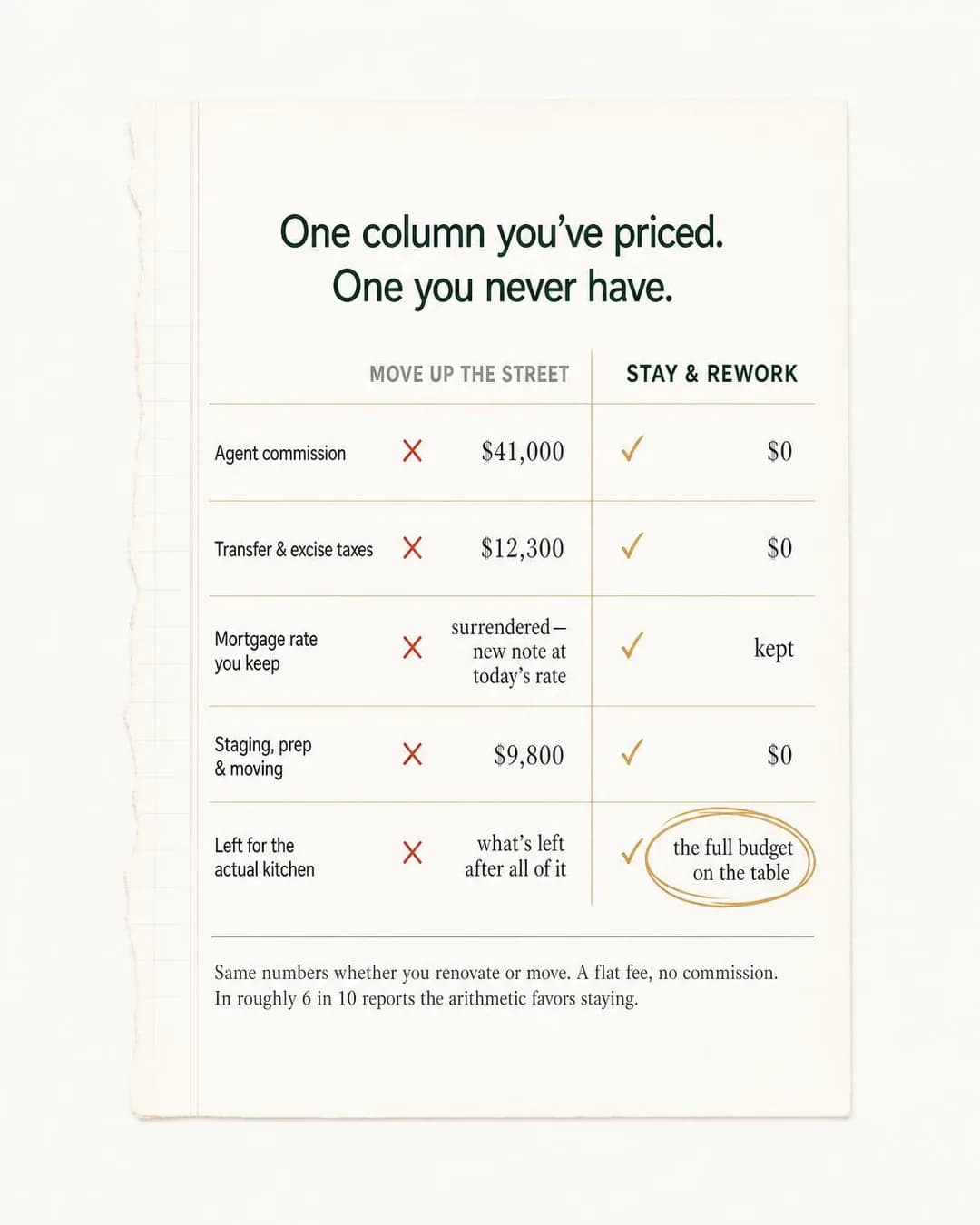
Comparison & Positioning · 4:5 · Traffic
Renovate or sell? See the arithmetic.
Written for: Couples who have outgrown the house but not the street.
How this one was made →

Proof & Trust · 4:5 · Leads
Same Corner. Dead-Flat Ceiling.
Written for: Homeowners who have been eyeing one wall for years.
How this one was made →

Benefit & Outcome · 4:5 · Leads
Demolition Monday. Dinner at 6:30.
Written for: Families who cannot move out for the build.
How this one was made →

Story & Founder POV · 1.91:1 · Awareness
Late by 28 days. It cost us $7,000.
Written for: Homeowners who have read every one-star review in town.
How this one was made →
The offers it will propose
Twelve, and not a list to run at once — pick the two or three matching what your crews are short of in the quarter that starts four months from now, because that is when this work actually gets scheduled. Each has a row on the Facebook guide naming who it is for, which angle family argues it best and which objective buys it. Two carry a rule rather than a preference: the financing row costs you ZIP codes and neighbourhoods for the campaign it runs in, and the aging-in-place row is the strongest emotional argument in the trade written in the exact sentences Meta's personal attributes standard prohibits.
- A fixed-price structural assessment
- A kitchen you can live through
- A specified bid instead of an allowance sheet
- A written completion date with a daily credit
- The project repriced as a monthly payment
- The stay-versus-move arithmetic
- Curbless showers and blocking set for grab bars
- A lien-waiver stack with the final invoice
- Next season's crew starts, published
- Your own record, including the jobs that ran late
- Additions and accessory dwelling units
- Design-build against drawing it and bidding it out
Our own run rewrote the advertiser twice, and printed a monthly payment that is not available on the terms beside it.
Every other caution on this site names a rule and then shows our output walking into it — a policy line, a federal regulation, a state statute. This trade has all of those too and the guide argues them at length. But the finding that belongs to this page is about the tool, and it is the one a careful reader cannot catch by reading for tone or for compliance, because nothing in the ad is false. It is just not your ad.
Two of the ten briefs in our published run asked for a remodeler's ad and came back advertising a different business. Both times the angle sat on a conflict of interest or a licence boundary, and both times the model resolved the tension by changing whose ad it was rather than by flagging it. The stay-versus-move brief returned a neutral flat-fee analysis service whose copy says “Agents earn when you sell. Contractors earn when you renovate. We charge a flat fee for the math alone, so we have no incentive to steer you either way” — a sentence a remodeler cannot say, because a remodeler is one of the two interested parties it names. The financing brief returned the lender: loans from $15,000 to $150,000, fixed rates by credit and term, funding in four business days, soft credit check, “$412 million funded across 5,900 home renovations”. A remodeler offering financing is normally arranging somebody else's credit rather than extending their own, and that difference changes who owes the disclosures. Both ads are good. Neither belongs to the company that commissioned it. Read the first line of every generated ad and ask who is speaking before you read anything else.
Then the arithmetic, and this batch drew the line more cleanly than any before it. What the model copies is reliable; what it computes is not. The confession ad's numbers all descend from a single figure in the brief — 28 days late at $250 a day is $7,000 — and the rendered card, the copy and the stated contract term agree exactly across three separately generated artefacts, because there was nothing to reconcile. The financing ad computed its own payment: $60,000 over fifteen years at 9.49% APR is $626.17 a month, the ad says $609, set four inches tall and repeated in every one of its five primary texts. $609 would be a 9.01% rate on that principal, or $58,354 at the rate printed beside it. That is not an embarrassment, it is 12 CFR 1026.24(a) — advertised terms must be terms actually available — and it is the one error on this page with a regulator attached. Never let a model produce an amortisation figure. Get the payment from your lender's sheet and paste it in.
The same rule generalises, and it is the sentence this trade most needs from a generator page: an advertised term is a contract term. Regulation Z makes the amount of any payment a triggering term under 1026.24(d)(1), so stating one obliges the ad to give the downpayment, the repayment terms over the full term and the annual percentage rate using that phrase; subsection (c) requires a stated rate to be an APR named as one. A deposit is state law rather than federal: California's Business and Professions Code § 7159.5(a)(3) caps a home improvement downpayment at “one thousand dollars ($1,000) or 10 percent of the contract amount, whichever amount is less”, (a)(5) forbids requesting or accepting payment beyond the value of work performed, and (b)(1) makes a violation a misdemeanour punishable by a fine of $100 to $5,000, up to a year in county jail, or both. “Half down to start” is a normal sentence in remodeling advertising and in California it advertises an offence. And a completion credit written as a range — our own run says “typically $200 to $400” a day — is an estimate of a guarantee rather than a guarantee. Pick one number, put it in the contract, and print the same number in the ad.
The personal attributes rule meets this trade in exactly one place and meets it hard, and it is the offer with the best emotional argument in the category. Meta's standard says ads “must not contain content that asserts or implies personal attributes”, enumerates disability and “physical or mental health (including medical conditions)”, and prohibits implying the advertiser knows someone's attributes “or the personal attributes of their family”. Aging-in-place work is sold in those sentences — safe for Mom, whenever she needs it, she cared for you for decades — and every one of them is the prohibited version. The fix keeps the whole job: describe the room, never the person. “Curbless showers with blocking set behind the tile for grab bars” sells the same work and asserts nothing about anybody. Check the render rather than the brief, because on our examples page that ad's violation is a caption burned across the foot of the image, where no headline swap can reach it, from a brief that mentioned no condition at all and described only construction. The drawing in the same frame is also wrong in a way a homeowner cannot see and a building inspector can: it puts grab-bar blocking at 48 inches and bench support at 24, where ADA's figures are 33–36 and 17–19.
The financing ad costs you targeting, and unlike the storm trades it costs you something you can rebuild. An ad promoting a project on a fixed monthly payment promotes a credit opportunity, so its campaign must declare Meta's financial products and services special ad category, required for US advertisers since January 2025. That removes location exclusion; removes ZIP codes, neighbourhoods, sub-city, metro area and small geographic area as location types; floors the radius at 15 miles or 25 kilometres; fixes age at 18–65+; and drops lookalike and saved audiences, though Custom Audiences and Advantage+ Audience survive. For a roofer that deletes the plan, because a hail swath is a ZIP list. Here it deletes a stable target rather than a perishable one, and the copy can rebuild most of it — a remodeling ad is not in a housing category and may describe the building freely, so the 1962 ranch, the original galley kitchen and the addition that never got a foundation do the qualifying the ad set can no longer do. Split the campaign, not the message: financing runs in its own declared campaign, everything else keeps its postcodes, and never let a monthly-payment line drift into an ordinary campaign, because one sentence recategorises the campaign it sits in.
One rule that is not about advertising at all sits underneath the event this whole account is built on. A remodeling contract signed at the homeowner's kitchen table after an ad produced the appointment is a door-to-door sale: 16 CFR 429.0(a) defines one as a sale of consumer goods or services the seller personally solicits, agreed away from the seller's place of business, at $25 or more at the buyer's residence — and the ad did the soliciting. So 429.1 applies, the contract carries the cancellation statement in bold face type of at least ten points, and the buyer leaves with a completed Notice of Cancellation in duplicate. The consequence for anyone reading numbers is precise and easy to miss: the conversion counted on day three can be lawfully undone on day six, before the seven-day click window it was reported in has even closed. Report contracts after the window rather than at signature, and check your own state, which may run longer or add notices on top.
Then the failure that recurs in every batch on this site, which is invented proof. Six of the ten remodeling ads carry a statistic somewhere in the copy and two render one into the image — “300+ post-war homes since 2014”, “3,400 households”, “in roughly 6 out of 10 reports”, “$412 million funded”. Some of those are load-bearing: they are the sentence the whole ad rests on, and a customer will hold you to them. If a figure is your proof it comes out of your own job records or it comes out of the ad, and the practice is always available as a substitute for the tally — “every job permitted, every inspection card handed over” is checkable by the customer at the end of their own job. This batch invented less than any run before it, and the reason is instructive: five of its ten briefs put a document in the frame, and a document has fields to fill from the brief rather than an empty slot to fill from nowhere.
Four rendering checks catch most of the rest, all four demonstrated on the page these ads came from. Counted objects come out wrong even when the typography is right: the allowance board draws exactly three bid cards, correctly, under a caption reading “2 OF THEM MEAN ALLOWANCES” — and all three are allowance lines, so the picture and the caption disagree about the picture. Rendered screens do not reconcile against their own chrome: an inbox with eight correctly descending timestamps sits under a status bar reading 8:14, so the top three messages arrived from the future. Rendered part numbers look authoritative and are not: a faucet renders as MODEL K-72775, which is Kohler's SKU convention and, as far as we can tell, not a Kohler part — in a picture whose entire argument is that the model numbers are real. And a credit line rendered with a strikethrough through it reads as cancelled rather than paid, which on a $7,000 apology is the opposite of the point. Read the image the way a customer in the comments will, then read the copy against it: our calendar ad stamps SPRING BOOKED across the top while all five body texts say hurry, slots remain.
None of this is legal advice, and on this page that sentence is doing work rather than covering a base. The cooling-off rule is federal and the deposit caps, contract notices, licence-number requirements and lien deadlines are state law — they differ, they change, and California and the FTC rule are examples rather than the list. For anything touching a deposit, a payment schedule, a financing term or a contract notice, the next step is your own counsel and your state's contractor licensing board, not a page on a software company's website.
Questions
- Will it write a financing ad I can actually run?
- It will write the ad; you have to replace the number. Our own published run got the hard part right — it printed the rate, the term and the total repayable, which is what 12 CFR 1026.24(d)(1) asks of any ad that states a payment amount and is also the only real differentiator in a category that hides the rate. Then it computed the monthly itself and advertised $609 where the terms it printed produce $626.17, which is a term that is not actually available under 1026.24(a). Copy the payment from your lender's sheet. And run it in its own campaign with the financial products and services category declared, because that campaign loses ZIP and neighbourhood targeting, lookalikes, location exclusion and any radius under 15 miles, and you do not want the rest of the account inside it.
- My sales close four months out. Can an ad account even measure that?
- Not the sale, no, and that is a property of the trade rather than a failure of the ads. Meta withdrew 28-day click and 28-day view attribution on 27 April 2021; what is left is 1-day click, 7-day click and 1-day view, with 7-day click the default. A kitchen that goes click, form, phone screen, in-home consultation, design agreement, signed contract finishes two to six months later, entirely outside all three windows, so a remodeler judging this account on in-platform revenue is reading a number that is correctly close to zero. What the account can be built on is the consultation that was booked and held — the one event that happens in week one and correlates with money, and the only stage that also satisfies Meta's published requirements for conversion leads optimisation. The guide works the whole thing out, including the arithmetic of whether your volume can feed it.
- Will it publish ads to my account on its own?
- No. It publishes into an ad set you choose in your own Meta Ads Manager account, and every ad lands paused. It never creates campaigns or ad sets, never edits ads you already have, and never spends budget. In this trade the pause is where the payment gets recomputed, the deposit line gets checked against your state's cap, and somebody confirms the ad is advertising your company rather than the neutral advisory service or the lender the model invented to make an angle work.
- Can I see what it produces before signing up?
- Yes. The remodeling Facebook examples page has ten finished ads published exactly as they were generated, for companies that do not exist — with the audience, angle and objective each was written for, and the flaws named rather than cropped out, including the two ads that came back advertising somebody else's business, the payment that does not foot, and the caption that burns a personal-attributes violation into the image. Four of the ten are on this page.
Not ready to generate anything yet?
- Facebook ads for home remodeling companies → the playbook: objectives, offers, targeting and the mistakes specific to this trade.
- Home remodeling Facebook ad examples → every ad above and the rest of the batch, each with the audience, angle and objective it was written for.
- Home remodeling Instagram ad examples → every ad above and the rest of the batch, each with the audience, angle and objective it was written for.
Enter your remodeling company's website
That is the whole brief. No questionnaire, no uploads, no brand kit to fill in. Free to start, no card — and every ad lands paused, which in this trade is where the payment gets recomputed from your lender's sheet and somebody checks whose company the ad is actually for.