
Ad Guides · Home Remodeling × Facebook
Facebook ads for home remodeling companies
The offers, the angles, the one event the whole account has to be built on, and why a remodeling ad account cannot show you the revenue it produced — for a remodeling company, on Facebook, checked against Meta's own documentation and the regulations themselves.
Every other guide on this site is ultimately about a rule that applies before the ad runs. This one is about a clock. Meta's attribution stops seven days after a click. A kitchen goes click, form, phone screen, in-home design consultation, paid design agreement, signed build contract — and the far end of that is two to six months out. The transaction the business exists to make is not late for the attribution window; it is outside it by an order of magnitude, and no setting reaches it. A remodeler who judges this account on the revenue Ads Manager reports is reading a number that is correctly close to zero, and every structural decision below follows from that one fact.
So the account has to be built around a substitute — one event that happens in week one and correlates with money. There is exactly one candidate, the consultation that was booked and held, and this page reaches it twice by different routes: once from the attribution window, and once from the requirements Meta publishes for the only optimisation it sells for long funnels. What follows is what a remodeling company should actually buy on Facebook: which of the six objectives, which offers are worth advertising and which argument wins each, which targeting levers survive and which single offer takes them away, whether a click should become a form or a page, and the budget arithmetic of a business that will not know whether last quarter worked until next spring.
The mechanical constraint is the same one the HVAC and roofing guides found and it lands differently here. A remodel sold on a fixed monthly payment is a credit advertisement, so that campaign must declare Meta's financial products and services special ad category — which removes location exclusion, removes ZIP, neighbourhood, sub-city and metro-area targeting, removes lookalike and saved audiences, fixes age at 18–65+ and imposes a fifteen-mile minimum radius. For a roofer that deletes the hail swath and with it the plan. For a remodeler it deletes a stable target rather than a perishable one, and the copy can rebuild most of it, because a remodeling ad is allowed to describe the house in a way a housing ad is not allowed to describe the reader.
The ads shown below are real output rather than mockups drawn for the argument. Seven of them are pulled from the ten on the remodeling Facebook examples page, published exactly as generated, for companies that do not exist. Every price is invented — a $250 structural assessment, a $60,000 kitchen at $609 a month, a $7,000 late credit, a $68,000 fixed bid — and marks where a real number goes. Two of the ten are on this page because they went wrong in instructive ways: one advertises a monthly payment that is not available on the terms it names, which is a Regulation Z problem rather than an embarrassment, and one burns a personal-attributes violation into the image where no headline swap can reach it.
Two things this page is not. It is not legal advice: the cooling-off rule, the deposit caps and the contract notices below are federal and state law, they vary, they change, and the correct next step for any of them is your own counsel. And it is not a benchmark report. There are no cost-per-lead figures here, because the only useful version of that number is your own cost per held consultation, and the budget section shows you what to do with it.
Generate Facebook ads for your remodeling company
Paste your site and best-in-slot reads it the way the invented contractors above were read — services, service area, positioning — then writes the concepts, renders the images and drafts the copy. Free to start, no card.
What you are actually buying by choosing Facebook
Start with who is in the room, and in this trade there are two of them. Pew's November 2025 survey puts Facebook at 80% of 30- to 49-year-olds and 74% of 50- to 64-year-olds, against Instagram's 62% and 40% — the bands that own the houses and hold the equity that pays for the work. But the number that decides the platform is not the reach of a person, it is the reach of a household. A kitchen is not bought by whoever saw the ad; it is bought after a conversation between two people who both have to agree, and Meta sells you one of them at a time. Facebook's advantage in those two bands is really an advantage in the odds that the second decision-maker is reachable at all — by you later, or by their partner tonight, with a screenshot.
That has a design consequence and it is the most underrated thing on this page: the ad has to survive being forwarded. Whatever the ad set knew about the reader — that they were in the 1950s ranch neighbourhood, that they had already visited the site, that they were shown the addition creative rather than the bathroom one — none of it travels with the screenshot. The version of the ad that arrives at the other owner has no targeting, no landing page and no context. Write for that arrival: name the business, name the offer, and put the number in the image where a crop cannot lose it. Every ad in this trade is really two ads, and the second one is the one that closes.
Third, the surfaces. Facebook has nine image placements against Instagram's four — Feed, in-stream video, video feeds, Marketplace, Stories, ads on Reels, search results, Business Explore and the right-hand column — and two of them matter here for reasons that are specific to remodeling. Marketplace is where a household already goes to buy a house's worth of objects, which makes it the one surface where a remodeling ad is not an interruption. And the right-hand column and search results have no Instagram equivalent at all: that is where the 1.91:1 export routes, and a wide export is the right shape for the documents this trade argues with. A schedule, a ledger or an allowance sheet loses nothing in a wide crop. A kitchen loses the ceiling and the floor.
Fourth, shape and the copy budget, measured on this batch the way every Facebook page here measures its own. Meta's ads guide recommends 4:5 at 1440 × 1800 for Facebook Feed, primary text of 50–150 characters and a 27-character headline, with no description line shown; Marketplace wants a square at 1080 × 1080 with 125 characters, a 40-character headline and a 30-character description. Leave Advantage+ placements on and one export fills all nine. This run wrote fifty headlines and the result is the best in the cluster: five fit 27 and all fifty fit 40 — the first batch here where every headline clears Instagram's limit. None of the ten lead headlines fits Facebook's own 27, which is the same result HVAC got. Eight of the ten description lines fit Marketplace's 30, in a field the feed will not show.
Fifth, the finding that changed on this batch, because seven pages on this site currently state the old version of it. Across the seven Facebook batches measured before this one, not one of 350 primary texts fitted the 50–150 recommendation and the shortest string ever written was 200 characters — stated as a floor rather than a tendency. Eleven of this batch's fifty-five fit, and the shortest is 64. But eight of these ten ads still produced nothing under 150, and all eleven short texts come from three ads, each of which wrote a standalone hook as its own variation rather than as the opening line of a body. The live-in kitchen ad did it five times out of five, at 74 to 99 characters, on the first pass. So length is not a property of the pipeline: it tracks how much of the argument the image is already making. Give the picture the whole case and the copy comes back short enough to fit.
Sixth, what Facebook is not for in this trade, because it explains why the Instagram case is a different business rather than the same ads reformatted. Remodeling's native visual is the finished room, and the honest problem with it is that every finished kitchen looks like every other finished kitchen — a slider between the dark oak and the island proves nothing a competitor's slider would not also prove. The version with information in it is a document: an allowance sheet, a completion date, a build calendar, a lien-waiver stack. Five of the ten briefs in this batch put paperwork in the frame for exactly that reason, and paperwork reads as evidence on this platform and as a bad photograph on the other one. This page is about the argument. The photogenic half of the trade is the twin.
Which objective to buy
Ads Manager offers six objectives — Awareness, Traffic, Engagement, Leads, App promotion and Sales — and a remodeling company has a real use for three. The batch on the examples page split six Leads, three Traffic and one Awareness, with no Sales ad in it at all, and that is the fourth trade in this cluster with no Sales line. The reason is ordinary: nobody buys an addition in a checkout.
Leads is the default and takes most of the budget, but the objective is the easy half of the decision and the performance goal underneath it is the hard one. Optimising for the lead is the standard mistake here and it is worse in this trade than in any other on this site: a large discretionary purchase attracts an enormous amount of browsing, and lead optimisation will faithfully find the people most willing to fill in a form about a kitchen they have no intention of buying. The destination section covers the mechanism and the budget section covers whether you can afford to use it.
Traffic is a strong second and unusually strong for a local service, because half of what a remodeler sells is a document the homeowner has never been shown — an allowance schedule, a payment schedule, a change-order rule, a lien waiver. Three of the ten ads on the examples page are Traffic buys and all three teach a piece of paperwork before asking for anything. The click is cheaper than the lead and, in a trade where the lead is worth qualifying, a page read is a better filter than a form.
Awareness is the third, and the argument for it here is neither the roofer's nor the heating contractor's. A roofer buys Awareness because a competitor will physically be at the door within seventy-two hours. An HVAC company buys it because demand is event-triggered and being remembered in January is the product. A remodeler buys it because the decision takes a year and is made in a conversation you are not in. What you are buying is being the name that is already in the room when two people finally sit down with a number — which is why the confession ad in the set below is bought as Awareness and judged on whether the phrase turns up later in sales conversations.
- LeadsDefault
Where most of the budget goes — consultations, assessments, fixed-bid appointments, financing enquiries. Pick the performance goal deliberately: optimise for the held consultation rather than the form fill wherever the volume lets you, and qualify inside the form where it does not.
- TrafficSometimes
For everything a homeowner has never been shown. Allowances, payment schedules, the stay-versus-move arithmetic, lien waivers — three of the ten ads on the examples page are Traffic buys and each teaches a document. Put the form at the foot of that page and retarget the readers, who are a better audience than any interest segment you could buy.
- AwarenessSometimes
A real recommendation here, and the reason is the interval rather than an adversary or a season. The decision takes a year and happens in a conversation between two people; you are buying being named in it. Spend it on the things a homeowner checks a year later — the record, the crew, the address — and judge it on whether the phrase comes back in sales calls, not on this week's leads.
- EngagementRarely
It optimises for the cheapest available reaction, and in a local feed the cheapest reaction to a kitchen is "how much for mine?" — a question you cannot answer in public and cannot afford to ignore. Its one honest use is building a video-viewer pool to retarget, and Traffic usually builds a better one.
- SalesNo
There is a tempting exception and it is worth naming so you can reject it: this trade can genuinely take money online, for a paid assessment or a design retainer. Buy that under Sales and you have taught delivery to find people who buy a $250 thing, which is a different population from people who sign a $60,000 contract. An online deposit is a lead with a card attached. Optimise it as a lead.
- App promotionNo
A kitchen is remodelled roughly once a generation. There is no app, and paying a stranger's install cost to deliver a booking screen for a once-in-twenty-years purchase is the most expensive lead in this guide.
What to advertise, and the argument that wins it
This is where a remodeling account is won or lost, and the losing version is easy to describe because almost everybody runs it: one before-and-after slider, pointed at everybody, with "free estimate" underneath. That ad competes with every other remodeler's identical ad, says nothing that transfers, and collects the cheapest possible lead — somebody who wanted a free thing. The offers below span a $250 assessment and a six-figure addition, and the person who has been eyeing one wall for four years is not weighing the same question as the couple deciding whether to sell instead.
Each row pins four decisions: who the offer is actually for, which angle family argues it best — every one is a page in the angle library — which objective buys it, and, where the examples page has one, a finished ad showing the whole thing assembled. Twelve rows is not a campaign plan. Pick the two or three that match what your crews are short of in the quarter that starts four months from now, because that is when the work these ads buy will actually be scheduled.
Two notes before you use the table. First, the cheap first transaction is the most underused offer in this trade and the one the account architecture wants. A remodeling ad's usual opening ask is a five-figure commitment dressed up as a free estimate; a fixed-price assessment at a named price is a real transaction, filters out the browsing, and — the part that matters — is an appointment that happens inside the attribution window, which is the only kind of event this account can optimise on. The structural-assessment row and the fixed-bid row are both versions of it.
Second, one row on this table carries a policy risk that the others do not, and it is the row with the best emotional argument in the trade. Aging-in-place work sells because somebody's parent is moving in, and Meta's personal attributes standard prohibits content that asserts or implies personal attributes, enumerates disability and physical or mental health, and extends to implying you know "the personal attributes of their family". Every natural sentence for that offer — safe for Mom, whenever she needs it — is the prohibited one. The compliant version sells the same job by describing the room instead, and the creative section has the fix.
A fixed-price structural assessment
Leads- Who it is for.
- Homeowners who have been looking at one wall for years and have never asked, because they assume the answer is a number they do not want to hear.
- Angle.
- Proof & Trust — The cheapest first transaction available in a category whose usual opening ask is five figures, and the one offer here that can honestly carry a Book now button. The ad on the examples page sells a $250 assessment and offers to tell the reader the wall is not load-bearing and walk away — which is what makes the paid appointment credible. It is also the exact event this account should be optimising on, because it happens inside the seven-day window and the contract it eventually produces does not.
 Example adSame Corner. Dead-Flat Ceiling.See the brief →
A kitchen you can live through
Leads- Who it is for.
- Families who cannot move out for the build — two working parents, school-age children, no second kitchen and no budget for three months of restaurants.
- Angle.
- Benefit & Outcome — The objection that kills a kitchen is almost never the price, it is the three months, and "minimal disruption" is what every competitor says about it. Answer with the mechanism instead: a temporary kitchen built on day one, dust walls with zippered doors, the floor vacuumed before the crew leaves. This is also the ad that broke the copy-length floor — the picture carried the whole argument, so all five primary texts came back between 74 and 99 characters.
 Example adDemolition Monday. Dinner at 6:30.See the brief →
A specified bid instead of an allowance sheet
Traffic- Who it is for.
- Homeowners holding three bids within a few thousand dollars of each other, being told they are three prices for the same job.
- Angle.
- Product & Mechanism — They are not the same job, and the reason is a document rather than a method: an allowance is a round number standing in for a decision nobody has made yet. Show the reader their own paperwork first — tile allowance, lighting allowance, cabinet allowance — then show what a specified line looks like. It is arithmetic a person can do in front of you, which is the most rebuttal-proof form an argument in this trade can take.
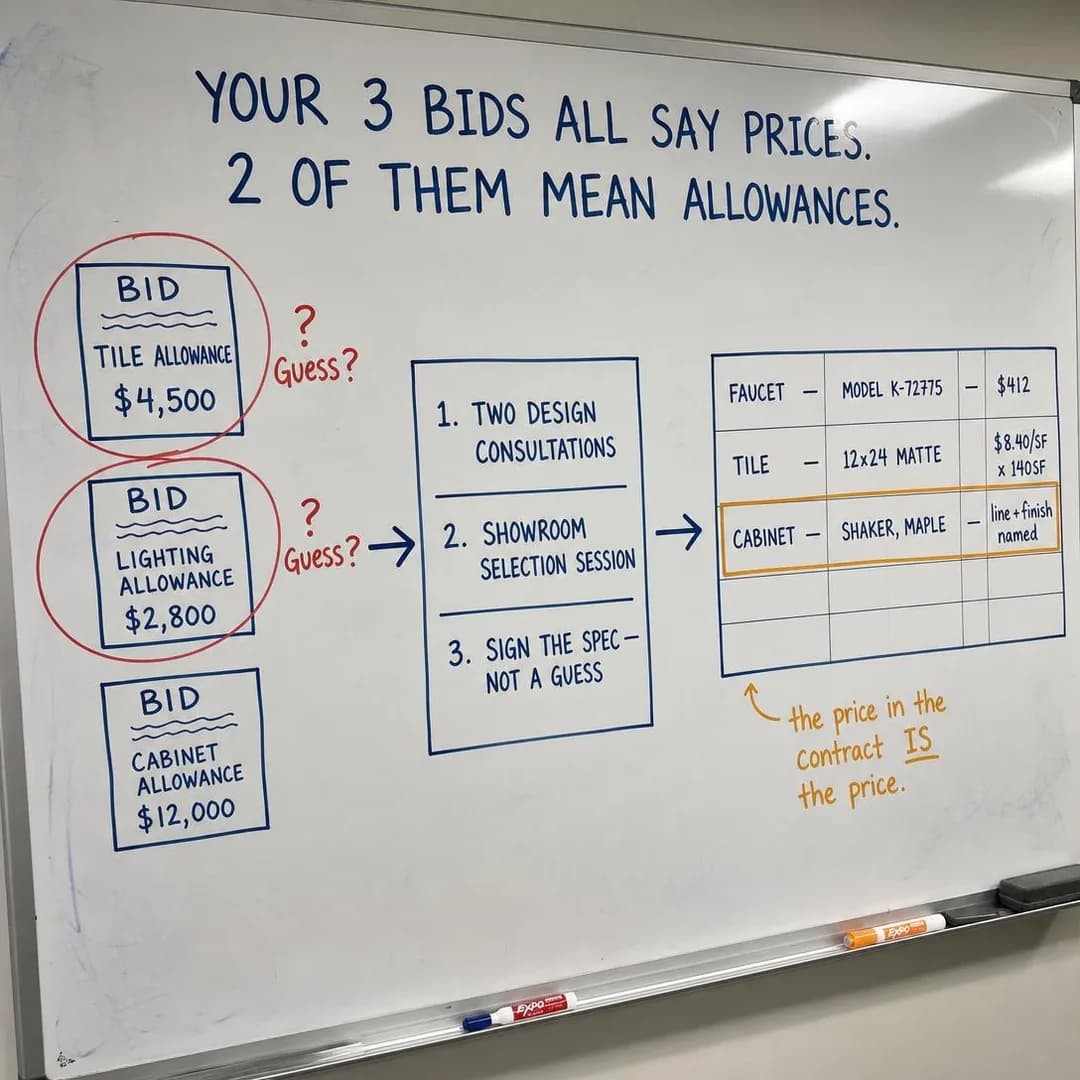 Example adThe Only Bid With Real Model NumbersSee the brief →
A written completion date with a daily credit
Leads- Who it is for.
- People who have heard the six-weeks-became-five-months story from a neighbour and now believe it is what remodeling is.
- Angle.
- Objection & Risk Reversal — The trade's loudest objection, and the answer has to be structural rather than reassuring: a substantial-completion date on page three with a written credit behind it, and a change-order rule that nothing is built or billed before the price is signed. Pick one credit figure and put the same number in the contract and the ad — the ad on the examples page says "typically $200 to $400 a day", and a range with "typically" in front of it is an estimate of a guarantee.
 Example adLate remodels pay you daily.See the brief →
The project repriced as a monthly payment
Leads- Who it is for.
- Households with the equity but not the cash, weighing a five-figure total against a savings account balance and shelving the project by default.
- Angle.
- Offer & Economics — The offer that costs you the targeting, and the reason the targeting section exists. It is also the one where the compliant ad and the strong ad are the same ad: the category quotes a payment with nothing attached, so printing the rate, the term and the total repayable is simultaneously what Regulation Z asks for and the only real differentiator available. Run it in its own declared campaign, and compute the payment from your lender's sheet rather than letting anything else produce an amortisation figure.
 Example ad$60,000 Remodel. $609 a Month.See the brief →
The stay-versus-move analysis
Traffic- Who it is for.
- Couples who have outgrown the house but not the street, and have priced the move without ever pricing the fees.
- Angle.
- Comparison & Positioning — The competitor for a remodeling budget is not another remodeler, it is a listing — and the column nobody has ever built for these people is the commission, the transfer taxes, the movers and the mortgage rate they would be handing back. Build the argument out of rows and never state a total: the comparison tables that fail in this corpus are the ones that add up, and this one works because its last line is "left for the actual kitchen" rather than a sum.
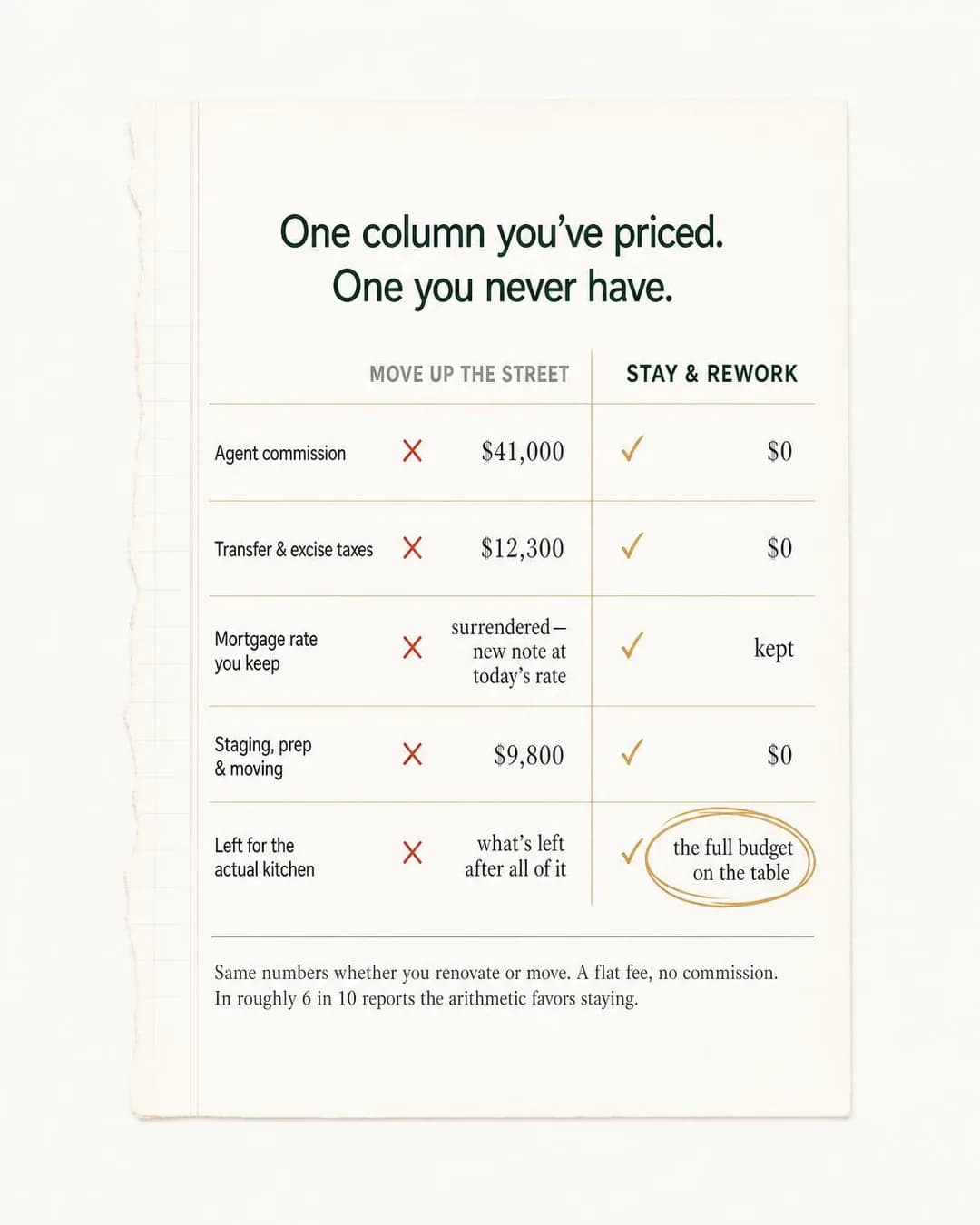 Example adRenovate or sell? See the arithmetic.See the brief →
Curbless showers and blocking set for grab bars
Leads- Who it is for.
- Adults remodelling a bathroom before a parent moves in, or ahead of their own next decade in a house they intend to stay in.
- Angle.
- Identity & Emotion — The strongest emotional argument in the trade and the one ad here that must not run as written. Sell the construction, not the person: the expensive invisible work is done now so the visible clinical work never has to be. Every natural sentence for this offer implies you know a family member's mobility, which is what Meta's personal attributes standard prohibits, and on the examples page the violation is burned into the image where no headline swap can reach it.
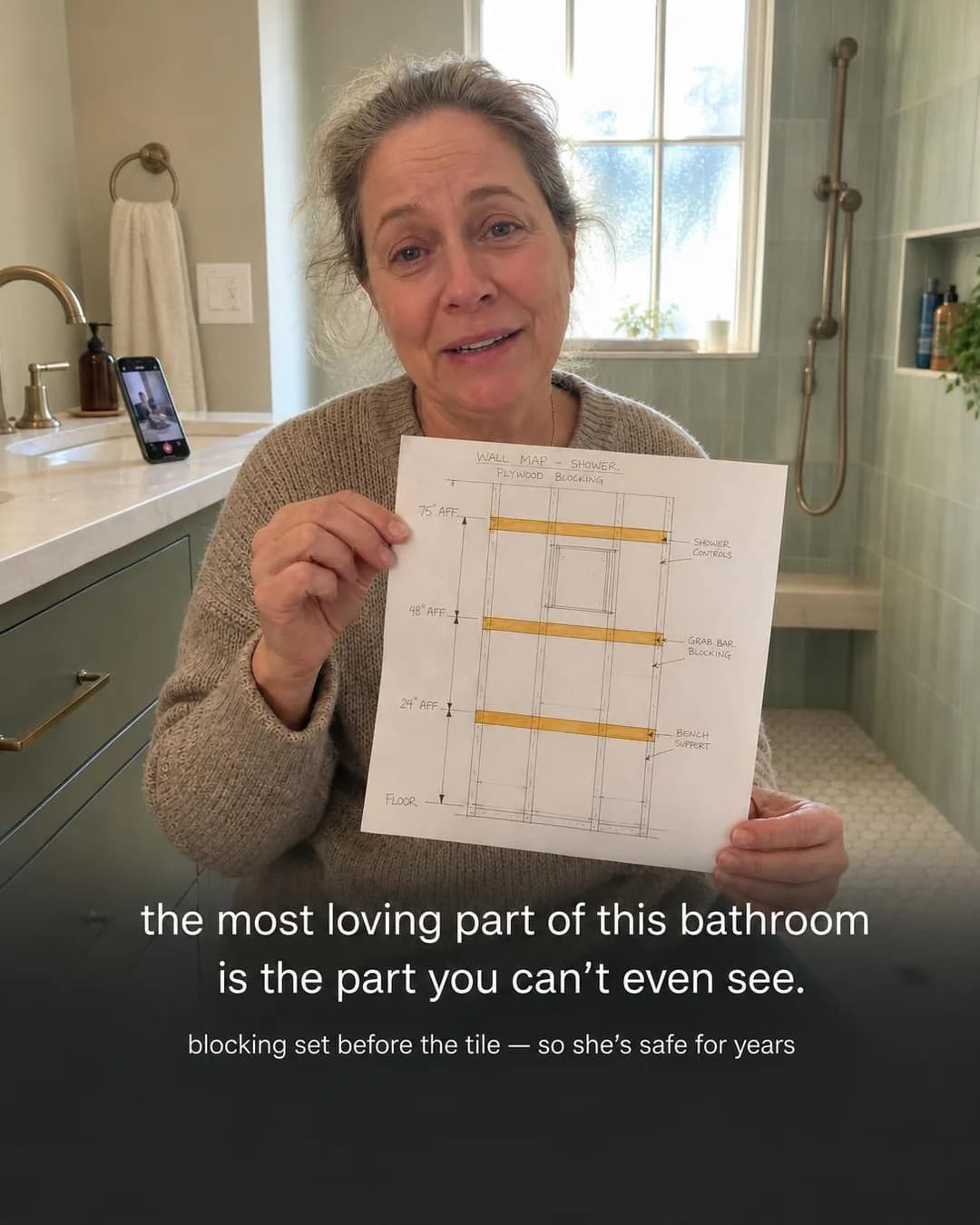 Example adLove built right into the walls.See the brief →
A lien-waiver stack with the final invoice
Traffic- Who it is for.
- Homeowners about to write the last cheque, who have never heard of a preliminary notice and do not know that paying in full is when the exposure is largest.
- Angle.
- Problem & Pain — A hidden problem that is also counterintuitive, which is the rare combination this family is actually for: paying the general contractor is the moment a homeowner feels finished, and an unpaid subcontractor's remedy runs against the house rather than against the contractor who owes them. The mechanism answer is unglamorous and completely checkable. Lien law is state law, so the landing page names your state's deadlines rather than gesturing nationally.
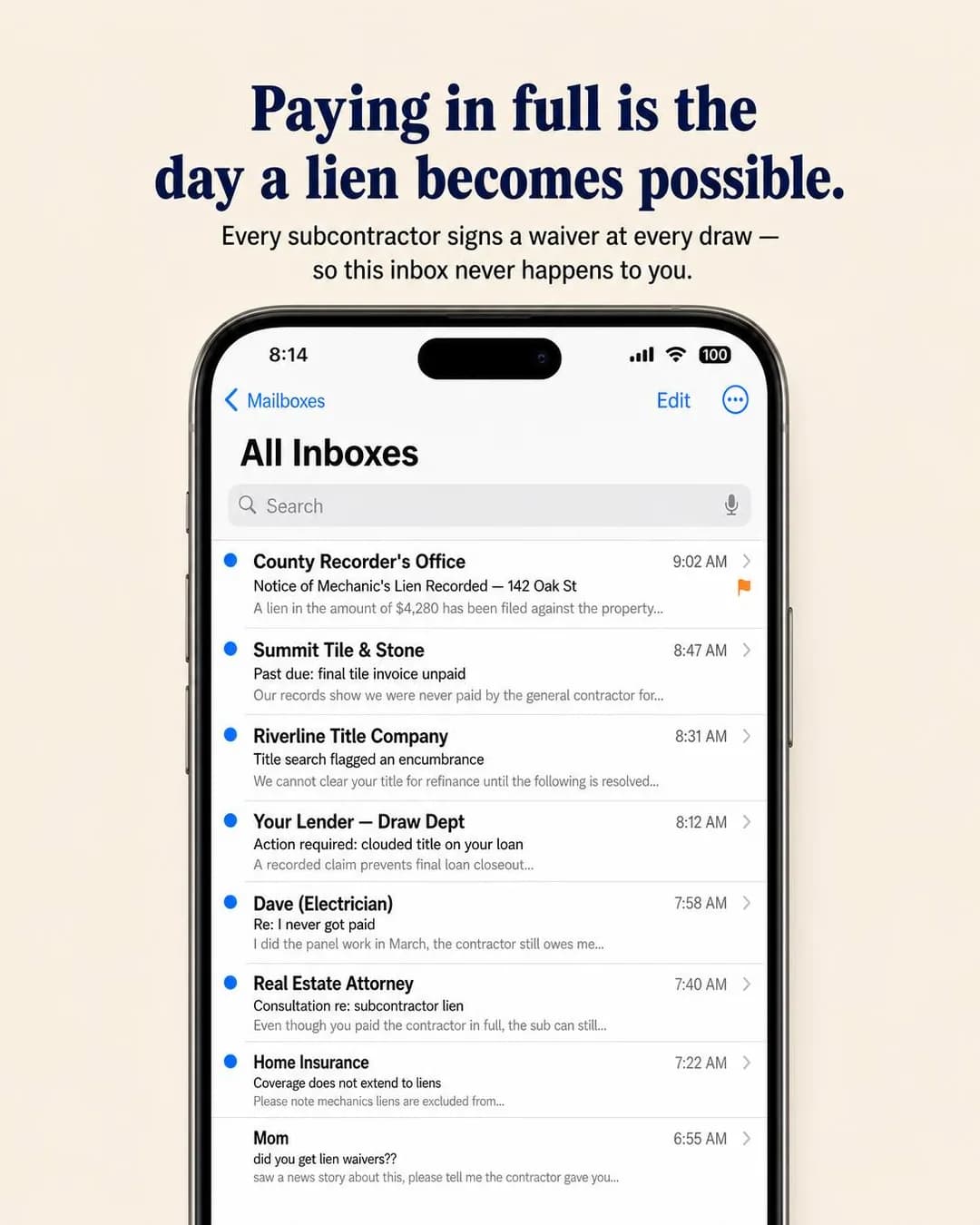 Example adPaid in Full Doesn't Mean Lien-FreeSee the brief →
Next season's crew starts, published
Leads- Who it is for.
- Homeowners planning a kitchen for the spring who have not worked out that spring is decided in the autumn.
- Angle.
- Scarcity, FOMO & Timing — The only honest scarcity in this trade, because it is a calendar rather than a discount deadline: drawings, fixed bid, permit review and cabinet lead time are five months in front of demolition. That converts a sales objection into education the reader has genuinely never been given. If you run it, publish the calendar — an ad whose entire proof is a public schedule and whose landing page is a contact form has broken its promise on the next screen.
 Example adSpring starts are booking nowSee the brief →
Your own record, including the jobs that ran late
Awareness- Who it is for.
- Homeowners who have read every one-star review in town and concluded that all six contractors are the same.
- Angle.
- Story & Founder POV — The least-used sub-angle in the library and the right one for an audience that has stopped believing testimonials: publish the review nobody made you write. It only works as a claim about your own history — a confession from a founder who does not exist is the one ad on the examples page that cannot be made true by changing a number. If you have not run late and paid for it, publish the rule you adopted instead of inventing the failure that produced it.
 Example adLate by 28 days. It cost us $7,000.See the brief →
Additions and accessory dwelling units
Traffic- Who it is for.
- Households that need a bedroom, an office or a rental unit, and are weighing an addition against moving or against a modular quote.
- Angle.
- Benefit & Outcome — The product here is permitted square footage, and the honest ad sells the permit timeline rather than the rendering — jurisdiction, review period, the drawings the review needs, what happens if it comes back. Nobody in this category advertises the schedule, which is precisely why it is the differentiator, and it recruits the reader into a process rather than a picture. No ad in the current batch runs it.
No example ad for this offer on the examples page yet.
Design-build against drawing it and bidding it out
Traffic- Who it is for.
- People who have been told to hire an architect first and have no idea what the second route costs in time, money or coordination.
- Angle.
- Comparison & Positioning — The comparison the trade never publishes because it sounds self-serving, which is a reason to publish it carefully rather than not at all: name what the bid-it-out route is genuinely better at — an unusual structure, a client who wants competitive pricing on a fixed drawing set — and then name the cost, which is that nobody owns the estimate until it is too late to change it. An argument that concedes is the only kind of comparison ad a reader finishes.
No example ad for this offer on the examples page yet.
Targeting: the housing stock is the audience
Start from the declaration, because it is compulsory and getting it wrong is the most expensive mistake available in this account. Since 31 March 2020 every campaign created through Meta's Marketing API must specify a special ad category, including campaigns from businesses that offer none of housing, employment or credit, whose answer is simply NONE. Remodeling is not one of Meta's categories. So for a consultation, an assessment, a fixed-bid appointment or a build-calendar ad, a remodeling contractor keeps every lever: age, a radius below fifteen miles, ZIP codes, lookalikes, saved audiences, exclusions, all of it. The ordinary radius floor is 0.63 miles, or 1 kilometre.
Now the lever this trade lives on. A remodeler's audience is not a radius around the shop, it is a housing stock: the post-war capes with the galley kitchens, the 1970s split-levels with the sunken living room, the 1990s subdivisions whose builder kitchens are now thirty years old. That geography is ZIP- and neighbourhood-shaped, and unlike a roofer's hail swath it does not move — which is the good news and the reason the financed campaign hurts less here than there. The bad news is that most accounts never build it at all, and run a fifteen-mile circle that includes apartment blocks, new construction and three towns of houses nobody is remodelling.
Then the sentence this section turns on, and it is the same one every trade page in this cluster arrives at from its own direction: the category attaches to what an ad offers, not to what a company sells. Meta's scope is ads that "offer housing, employment, or credit opportunities". So a remodeling company is not in a category and a remodeling advertisement can be. Advertise a project on a fixed monthly payment and that campaign is a financial products and services campaign — the API value is FINANCIAL_PRODUCTS_SERVICES, required for US advertisers since January 2025, and any runbook still naming CREDIT has not been touched in over a year.
What the category costs, in full: location exclusion is unsupported; ZIP codes, neighbourhoods, sub-city, sub-neighbourhood, metro area, small geographic area and electoral district are all unsupported as location types; the radius floor becomes 15 miles or 25 kilometres in the US and Canada; age fixes to 18–65+ and gender goes to all; lookalike and saved audiences are removed; and detailed targeting loses behaviour and demographic targeting, interest exclusion and detailed-targeting exclusion, with surviving interests limited to a previously approved list. Custom Audiences survive in full, as do Advantage+ Audience and Detailed Targeting Expansion, and a list can be checked with the is_eligible_for_sac_campaigns flag before launch rather than at it.
Which produces this trade's version of a move every other page in this cluster has had to make, and it is the most permissive version of it. Real estate cannot describe the reader, because the housing category makes the copy the regulated surface. Apparel qualifies on the garment rather than the body. Remodeling is not in a category at all, so when the financed campaign takes the postcodes away, the copy may do the qualifying instead — and the thing it qualifies on is a building. "If your kitchen is original to a 1962 ranch" is a sentence about a house, and it will be read by exactly the households the ZIP list would have found. That freedom has one boundary, and the aging-in-place ad is standing on it: describe the room all you like, never the person in it.
One more thing before the table, because it fails as a hard error rather than as poor delivery. A business admin has to accept Meta's non-discrimination policy in Business Settings before a housing, employment or financial campaign will deliver at all — the API returns error 2859024, "Certification Required". Its neighbour 2909035 comes back for a custom age range, a saved audience, a lookalike or a radius under the floor. If the financing campaign will not launch, read those two codes before touching the creative.
- Special ad categoryDepends on the ad
- Not the business — the ad. Remodeling is not one of Meta's four categories and most campaigns declare NONE. Any creative promoting a monthly payment, a finance offer or a credit approval is a financial products and services ad and must declare it. The field is required on every campaign either way.
- ZIP / neighbourhood targetingUse it — it is the audience
- The housing stock is the target: the streets whose kitchens are the right age and whose owners have the equity. Build the list once, from the neighbourhoods your own signed jobs came from, and keep it — unlike a storm swath it does not expire. The financial category removes it outright, which is the price of the financing ad and the reason it runs alone.
- RadiusUse it — tighter than you think
- A remodeling crew returns to the same address every day for months, so drive time compounds in a way it does not for a trade doing three calls a day. The ordinary floor is 0.63 miles or 1 kilometre, far tighter than anyone sets. Under the financial category the floor is 15 miles or 25 kilometres, which for most companies is a circle over work they would decline.
- Location exclusionUse it — unsupported when financed
- A remodeling service area has holes in it: the historic district whose review board adds four months, the town whose permit office you will not work through again, the county you are not licensed in. Subtract them on every ordinary campaign, and accept that a financed campaign cannot subtract anything.
- AgeUse it, then lose it
- Band it to the offer — an aging-in-place bathroom and a first-kitchen remodel are not the same decade. Under the financial category age fixes to 18–65+ with no say in it. And note that age is on the personal attributes list: targeting a band is fine, telling the reader their age or their parent's in the copy is not.
- Custom Audiences — held consultations that did not signUse it — the best list you have
- Every household you have sat in and not sold is a home you have measured, with a written scope and a decision already in progress. In this trade that decision often finishes a year later. Upload the list, run the completion-date and allowance arguments at it, and exclude it from the entry offers. Custom Audiences survive the financial category, so it is the only precision left inside the financed campaign.
- Custom Audiences — past clientsUse it — unlike a roofer's
- A roof is bought twice in a lifetime and past customers are mostly an exclusion. A remodeling client who finished a kitchen has a bathroom, a basement and a deck left, and the second project is the cheapest sale in the business. Keep them in a separate campaign with a phase-two offer rather than in the cold ads, where the entry offer reads as a company that does not remember them.
- Lookalikes and saved audiencesCareful
- Available and useful on ordinary campaigns, removed entirely under the financial category. Build the lookalike off signed contracts rather than off form fills — the whole problem in this account is that form fills and contracts are different populations, and a lookalike off the wrong one manufactures more of the wrong one at scale.
- Detailed targeting (interests and behaviours)Rarely
- Home-improvement interest segments select for people who enjoy the subject, which in this category is a large and mostly unbuying population. The geography and the copy are doing the qualifying already, and a third layer leaves the audience too thin to leave the learning phase. Check what is actually in the picker today rather than trusting a guide; Meta has retired options in this area more than once.
- ExclusionsUse it
- Exclude active jobs from everything — a homeowner three weeks into your demolition should not be seeing your entry offer — and exclude the held-consultation list from the ads whose entire job is to produce a first consultation. Both are ordinary hygiene and both are unavailable inside the financed campaign, which is one more reason to keep it small.
- Advantage+ placementsUse it
- Nine Facebook image surfaces from one export, including Marketplace and the right-hand column, which have no Instagram equivalent. The cost is that you cannot see which frame a reader will get, which is why the length rules in the creative section are binding rather than advisory. Compose the 4:5 so it survives a square crop.
Lead form, or landing page?
The usual answer for a considered purchase is a landing page, and this is the one trade in the cluster where that answer is wrong for a mechanical reason rather than a conversion one.
Meta sells exactly one optimisation built for a funnel that finishes later, and it is called conversion leads: you send lead stages back from your CRM and delivery optimises for the stage rather than for the form fill. Its documented prerequisites are worth reading in full before you plan anything around it. The integration requires Facebook or Instagram Lead Ads — Instant Forms — with the 15–17 digit Meta Lead ID stored in your CRM; it asks that you generate at least 200 leads a month and upload at least once a day; the stage you optimise for must occur within 28 days of the lead; and its conversion rate must sit between 1% and 40%. Meta's own instruction on choosing the stage is to "select the earliest lead stage you would like to optimize for", because the system optimises for the down-funnel stages as well.
Read those requirements against a remodeling company and two things fall out. The signed build contract is excluded by the 28-day rule even for companies large enough to qualify, so the thing you actually sell can never be the optimisation target — which is the same conclusion the attribution window forced, reached again from the platform's own documentation. And what does fit inside 28 days, at a conversion rate in the low tens of percent, is the consultation that was booked and held. That is the event, and it is now the answer to two independent constraints rather than a preference.
The volume gate is the honest catch: 200 leads a month is beyond most single-crew companies, and a company that cannot feed the integration cannot buy the optimisation. The fallback is not a landing page, it is a harder form. Use an Instant Form on the "Higher intent" type, which adds a review step before submission — the "More volume" type is built to be filled from pre-filled profile data in one thumb movement, and a lead who never looked at what they submitted does not remember you when you ring back. Add three or four qualifying questions: what room, roughly what budget band, own or rent, and when they want it started. Accept the volume drop; in this trade the form is where the qualifying happens if the algorithm cannot do it.
Two things still get a landing page, and both for reasons other than conversion. The financing ad gets one as an obligation: the ad's whole promise is that the rate, the term and the total survive the click, and a page that reverts to "as low as" language undoes the ad and the disclosure it was carrying. And any ad whose proof is a document — the allowance sheet, the build calendar, the completion-date clause, the lien-waiver stack — gets a page that shows the document. An ad whose premise is paperwork should be able to produce the paperwork on the next screen. Never the homepage: somebody who tapped an ad about allowances and landed on a rotating hero of finished kitchens has been asked to start over.
The recommendation: Instant Forms, not a landing page, for the consultation ads — because conversion leads optimisation only works on Lead Ads, and it is the only mechanism Meta sells for a sale that closes later. Run "Higher intent" with three or four qualifying questions, store the Meta Lead ID, and upload the held-consultation stage daily. Landing pages for the financing ad, where the disclosure has to survive the click, and for any ad whose proof is a document. Never the homepage.
Creative direction
Lead with the thing that is not about advertising at all, because it sits underneath the only event this account optimises on. A remodeling contract signed at the homeowner's kitchen table after an ad produced the appointment is a door-to-door sale. 16 CFR 429.0(a) defines one as a sale of consumer goods or services where the seller personally solicits the sale and the agreement is made away from the seller's place of business, at $25 or more when it happens at the buyer's residence — and the ad did the soliciting. Neither exclusion that looks relevant reaches it: the emergency exclusion needs a handwritten, signed, dated waiver describing a bona fide immediate personal emergency, and the home-repairs exclusion covers a visit the buyer requested for "repairing or performing maintenance upon the buyer's personal property", which a kitchen is not. So 429.1 applies: the contract carries the cancellation statement in bold face type of at least ten points and the buyer leaves with a completed Notice of Cancellation in duplicate. The consequence for this page is precise — the conversion you count on day three can be lawfully undone on day six, before the seven-day click window it was reported in has closed.
Second, money, and this trade has two separate rules to keep straight. Regulation Z, 12 CFR 1026.24(d)(1), makes the amount of any payment a triggering term: state one and the advertisement owes the reader the downpayment, the repayment terms over the full term, and the annual percentage rate using that phrase. Subsection (c) requires a stated rate to be given as an APR using that term, and subsection (a) limits an ad to terms actually available. The financing ad on the examples page does the disclosure correctly and then fails (a) on arithmetic: $60,000 over fifteen years at 9.49% APR is $626.17 a month and the ad says $609, four inches tall, in every one of its five primary texts. Never let a model produce an amortisation figure. Compute it from your lender's sheet, and paste it in.
Third, the deposit, which is the other money rule and it is state law rather than federal. California caps the downpayment on a home improvement contract: Bus. & Prof. Code § 7159.5(a)(3) says "the downpayment shall not exceed one thousand dollars ($1,000) or 10 percent of the contract amount, whichever amount is less", (a)(5) says the contractor "shall neither request nor accept payment that exceeds the value of the work performed or material delivered", and (b)(1) makes a violation a misdemeanour punishable by a fine of $100 to $5,000, up to a year in county jail, or both. "Half down to start" is a normal sentence in remodeling advertising and in California it advertises a misdemeanour. Other states cap it differently or not at all — check yours before a deposit term goes anywhere near an ad, and remember that a payment schedule is a term the ad can be held to.
Fourth, the personal attributes rule, which this trade meets in one specific place and meets hard. Meta's standard says ads "must not contain content that asserts or implies personal attributes", enumerates disability and "physical or mental health (including medical conditions)", and prohibits content implying the advertiser knows someone's attributes "or the personal attributes of their family". Aging-in-place work is sold in exactly those sentences — safe for Mom, whenever she needs it, she cared for you for decades — and every one of them is the prohibited version. Meta's own contrast is "Do you have diabetes?" against "New diabetes treatment available", and the fix here is identical: "curbless showers with blocking set for grab bars" sells the same job and asserts nothing about anybody. On the examples page that ad's violation is a caption burned across the foot of the image, where no headline swap can reach it, from a brief that mentioned no condition at all. Steering the brief is not the same as controlling the output; check the render.
Fifth, the two-decision-maker rule, which is a composition instruction rather than a policy. The ad that closes is usually the second time it is seen — forwarded, screenshotted, held up on a phone across a kitchen table — and none of the targeting travels with it. So put the identifying facts in the frame: the company name, the offer, the number the argument rests on. This is also the reason the wide 1.91:1 export is worth having for a document: it routes to Facebook's right-hand column and search results, and a schedule or a ledger crops to a wide slot without losing anything, where a room loses its ceiling and its floor.
Sixth, the pipeline's own failure modes, which this batch documented better than any before it. A visual direction that offers a slot for a statistic will have that slot filled — with a real number if the brief supplies one and an invented one if it does not, and this batch invented less than any previous run because five of its ten briefs put a document in the frame. Typography renders accurately; counted objects do not, and the failure has a new species here: the allowance board draws three bid cards under a caption reading "2 of them mean allowances", so the picture and the caption disagree about the picture. Rendered screens do not reconcile against their own chrome — an inbox with eight correctly descending timestamps sits under a status bar reading 8:14, so the top three arrived from the future. And the model will rewrite the advertiser to resolve a conflict rather than flag it: briefed for a remodeler, the stay-versus-move ad came back as a neutral analysis service and the financing ad came back as the lender.
Seventh, shape and length, measured on this batch. Facebook Feed wants 4:5 at 1440 × 1800, 50–150 characters of primary text and a 27-character headline, and shows no description line; Marketplace wants a square at 1080 × 1080, 125 characters, a 40-character headline and a 30-character description. With Advantage+ placements on, one export and one headline fill all nine surfaces. This run wrote fifty headlines: five fit 27 and all fifty fit 40 — the first batch on this site where every headline clears 40, and none of the ten lead headlines fits 27. Across the eight Facebook batches now measured, 28 of 400 headlines fit 27 and 379 fit 40.
And the finding that changed, which is the most useful thing this batch produced. Seven batches said the primary-text floor was absolute: 0 of 350 fitted the 50–150 recommendation and the shortest string ever written was 200 characters. This batch wrote eleven that fit, the shortest at 64 — and eight of its ten ads still produced nothing under 150. All eleven come from three ads, and in each the model wrote a standalone hook as its own variation rather than as the opening line of a body. The live-in kitchen ad did it five times out of five, at 74 to 99 characters, on the first pass. So length tracks how much of the argument the image is already making. If you want short copy, do not ask for short copy — brief a picture that makes the whole case and leave the copy nothing to explain.
- Write for the forward. The ad that closes is the screenshot arriving at the other decision-maker with no targeting, no landing page and no context — so the company name, the offer and the number all belong inside the frame.
- Never state a monthly payment without the repayment terms over the full term and the annual percentage rate, using that phrase. Stating the payment is what triggers the obligation, and "7.9% financing" is not the disclosure "7.9% APR" is.
- Never let a model compute an amortisation figure. The financing ad in this batch advertises $609 where the terms it prints produce $626.17, which under 12 CFR 1026.24(a) is a term that is not actually available.
- Check the deposit before it goes in an ad. California caps a home improvement downpayment at $1,000 or 10% of the contract, whichever is less, and makes a violation a misdemeanour. "Half down to start" is a normal sentence in this trade and an unlawful one in some of the places it runs.
- Describe the room, never the person. "Safe for Mom", "whenever she needs it" and "she cared for you for decades" all imply a family member's mobility, which Meta's personal attributes standard prohibits. "Curbless shower, blocking set for grab bars" sells the same job.
- Read the rendered image for the violation, not just the brief. The aging-in-place ad here was briefed with construction details and no condition, and the model captioned the frame "so she's safe for years" anyway — in the image, where no headline swap reaches it.
- Do not put a dimension in a drawing you have not checked. That ad's wall map puts grab-bar blocking at 48 inches and a bench at 24; ADA's figures are 33–36 and 17–19. A homeowner cannot tell. A building inspector can.
- If a count is the argument, put it in type and check it against the picture. The allowance board captions "2 of them mean allowances" over three allowance cards. Typography in this pipeline is reliable; drawn quantities and the claims about them are not.
- Build a comparison out of rows and never state the total. The tables that fail in this corpus are the ones that add up; the stay-versus-move ledger works because its last row is "left for the actual kitchen" rather than a sum.
- Hold the camera still in a before-and-after. Same position, same lens, same hour — the pair in this batch works because the floor, the dishwasher and the backsplash are identical and the doorway is simply gone. If the light changes too, you have proved a photographer rather than a wall.
- Render at 4:5, 1440 × 1800 for the feed, and compose so it survives a square crop for Marketplace. The floor for that ratio is 600 × 750 and the aspect-ratio tolerance is 3%.
- Buy the 1.91:1 slot for a document, not for a room. It routes to Facebook's right-hand column and search results, which have no Instagram position, and a schedule loses nothing in a wide crop.
- Write a description line even though Facebook Feed will not show it. Marketplace does, at 30 characters, and it is free — eight of the ten in this batch fit and two are wasted.
- Aim the headline at 27 and check it against 40, because both are live on the same ad. Every headline in this batch that tried to carry an argument overran; the ones that fit name one object or one number.
- Check whose ad came back. This pipeline resolves a conflict of interest by changing the advertiser rather than flagging it — the stay-versus-move brief returned a neutral analysis service and the financing brief returned the lender. Both are unrunnable as written by the company that commissioned them.
- Do not render a proof statistic you have not counted. The slot takes whatever the brief supplies and fabricates when the brief supplies nothing; this batch invented less than any previous one because five of its briefs put a real document in the frame.
- Photograph your own crew, your own site and your own dust wall. A styled kitchen with a fruit bowl in it is the category default and is indistinguishable from a stock photograph, which is the definition of a wasted impression.
Funnel structure
Four stages, and the third one is unusual enough to be the reason this section exists: a remodeling funnel has a stage for a person who never saw the ad. The other three are ordinary, and keeping the whole structure this thin is deliberate — every extra ad set divides the same small pile of evidence, and in this trade the pile is smaller than in any other on this site.
The second stage is the one the account is judged on, and its performance goal is the held consultation rather than the lead wherever the volume allows. The fourth is a separate declared campaign rather than a stage, which is what the special ad category forces and what most accounts get wrong by trying to keep everything in one place.
The interesting one is the third. In every other trade here, retargeting means showing the ad again to the person who clicked it. In remodeling the decisive reader is often somebody else in the same house, who saw a screenshot rather than the ad, is not in any audience you own, and is the person actually holding the objection — the disruption, the money, the fear that it will not finish. So the warm stage carries the reassurance arguments rather than the offer, and it carries them in creative that reads correctly with no prior context. Site visitors and video viewers are the audience you can buy; the second decision-maker is the reader you write for.
Evergreen cold
≈30% of budgetAudience. The neighbourhoods whose housing stock matches the work, built from where your own signed jobs came from. Active jobs and the held-consultation list excluded.
Running. The teaching ads — allowances, the stay-versus-move arithmetic, lien waivers, the permit timeline. Traffic, mostly, and judged on whether the readers come back.
Consultation drive
≈35% of budgetAudience. The same geography, banded to the offer, plus readers of the teaching pages from the last 30–60 days.
Running. The entry offers — the fixed-price assessment, the live-in remodel, the completion-date guarantee. Instant Forms on "Higher intent", optimised on the held consultation where volume allows and qualified inside the form where it does not.
Warm, and the second decision-maker
≈25% of budgetAudience. Site visitors, video viewers and page engagers from the last 90–180 days, plus the held-consultation list — and written so it lands on somebody who has seen none of it.
Running. The reassurance arguments: the completion date, the change-order rule, the temporary kitchen, the record including the late job. Patient, and Leads rather than Traffic, because this is where a year-old decision finishes.
Financing (declared)
Budget it as its own line of budgetAudience. Its own campaign, declared as financial products and services: 15 mile / 25 km floor, no ZIP or neighbourhood targeting, no exclusions, no lookalikes, age 18–65+. Custom Audiences survive and the copy does the qualifying.
Running. The monthly-payment ad and nothing else, with the rate, the term and the total on both the ad and the page. Never a line about payments in any other campaign.
Budget, and a business that finds out two quarters late
Do the arithmetic before copying anybody's number. Meta's delivery system needs roughly 50 optimisation events per ad set per week to leave the learning phase; below that the ad set sits in "learning limited", which is not a penalty but is an admission that the system cannot optimise with what it is being given. Take your own cost per held consultation and multiply by 50. That is the weekly spend at which one ad set delivers with full information — and for a company doing twenty-five jobs a year it is usually a multiple of the entire marketing budget, because twenty-five jobs a year cannot produce fifty held appointments a week under any spend. The answer is fewer ad sets, not more, and the funnel above has four lines for that reason.
The conversion-leads gate is the second piece of arithmetic and it is a cliff rather than a slope. The integration wants at least 200 leads a month and a stage that lands within 28 days. Below that threshold the optimisation is not available at any price, so the money that would have bought lead quality has to buy it somewhere else: in the qualifying questions on the form, in the price on the entry offer, and in the geography. A paid assessment is a budget instrument as much as a creative one — it is the cheapest filter in this account and it is the only one that also produces revenue.
Then the thing that makes this trade different from every other one in this cluster, and it is a reporting problem that behaves like a budgeting problem. Spend today produces a consultation this week, a design agreement next month and a contract in the spring. So the account looks worst exactly when it is working hardest — the first ninety days show cost and appointments and no revenue, by construction, and the temptation to switch it off arrives before the first contract does. Decide the trial length in advance, in writing, and make it longer than your own sales cycle. An account judged on a thirty-day window in a hundred-and-twenty-day business will be turned off while the pipeline it built is still closing.
Two reporting habits make that survivable. Keep the offline upload — the Conversions API takes offline and store events with action_source set to physical_store within 62 days of the conversion, which reaches a design agreement for most companies and a build contract for very few — and treat it as your own bookkeeping rather than as something delivery learns from. And keep a spreadsheet the platform will never see, with the click date and the contract date on the same row, because the interval between them is the number that tells you how long to be patient, and it is the one number nobody else can give you.
Seasonality on top of all of it, offset by the lag. Kitchens finished in spring are contracts signed in autumn, so the autumn budget buys the spring calendar; January and February are the planning months and produce consultations rather than signatures; permit-heavy work — additions, structural, ADUs — wants a longer lead than anything else and should be advertised furthest ahead. The mistake is advertising the season you are in. Advertise the season you want to be building in.
- Test the offer, not the headline. Swapping five words is a significant edit that restarts learning for a change too small to detect.
- One change at a time, and give it a fortnight rather than a week. The learning phase is measured over about a week at fifty events, and this trade rarely has fifty events, so the honest reading interval is longer than the documentation's.
- Judge the entry ads on held consultations, never on leads. The gap between a form fill and a kept appointment is wider in this trade than in any other on this site, and it is the whole reason the account is structured the way it is.
- Judge the campaign on contracts only against a lagged cohort — this quarter's spend against the contracts it produced two quarters later. Comparing this month's spend to this month's revenue measures the sales cycle, not the advertising.
- Before you blame the creative, check whether the ad set ever left learning. Half the "Facebook does not work for remodelers" verdicts are an ad set that never got the evidence to try.
- Do not compare the financed campaign to the local ones. It is buying a fifteen-mile audience it did not choose, with no exclusions and no lookalikes, and comparing its cost per lead to a targeted neighbourhood will make you switch off the wrong thing.
- Test the qualifying questions like creative. Adding a budget band to the form changes the population as much as changing the offer does, and it is the cheapest lever in the account for a company too small for conversion-leads optimisation.
- Track how long a held consultation takes to convert before deciding the retargeting does not work. In this trade the answer is frequently months, and an account judged on a thirty-day window will turn off the campaign that was working.
Seven of these ads, in full
Every ad below was generated by best-in-slot for a remodeling company that does not exist, with its audience, angle and objective pinned before the run — and published exactly as it came back. They are seven of the Facebook examples for a remodeling company; the rest, with the full brief and the alternate headlines behind each one, are on that page.
Proof & Trust · 4:5 · Leads
Same Corner. Dead-Flat Ceiling.
Written for: Homeowners who have been eyeing one wall for years.
The full brief and why it works →
Benefit & Outcome · 4:5 · Leads
Demolition Monday. Dinner at 6:30.
Written for: Families who cannot move out for the build.
The full brief and why it works →
Product & Mechanism · 1:1 · Traffic
The Only Bid With Real Model Numbers
Written for: Homeowners holding three bids that are not the same job.
The full brief and why it works →
Objection & Risk Reversal · 4:5 · Leads
Late remodels pay you daily.
Written for: People who have heard the six-weeks-became-five-months story.
The full brief and why it works →
Offer & Economics · 1.91:1 · Leads
$60,000 Remodel. $609 a Month.
Written for: Homeowners with the equity but not the cash.
The full brief and why it works →
Identity & Emotion · 4:5 · Leads
Love built right into the walls.
Written for: Adults remodeling a bathroom before a parent moves in.
The full brief and why it works →
Story & Founder POV · 1.91:1 · Awareness
Late by 28 days. It cost us $7,000.
Written for: Homeowners who have read every one-star review in town.
The full brief and why it works →
Mistakes specific to this trade
The first four are all the same mistake wearing different clothes — treating a four-month sale as though it finished inside the reporting window. The rest are ordinary, expensive and common.
Judging the account on the revenue Ads Manager reports
It will be close to zero and it is supposed to be. Meta withdrew 28-day click and 28-day view attribution on 27 April 2021; what remains is 1-day click, 7-day click and 1-day view, with 7-day click the default. A kitchen that goes from click to signed contract in two to six months is invisible to all three. This is a property of the trade rather than a failure of the ads, and the fix is to decide in advance which early event you are willing to be judged on — then keep your own spreadsheet of click date against contract date, because no setting in the platform will produce it for you.
Optimising for the lead instead of the held consultation
The standard mistake, and worse here than anywhere else on this site. A large discretionary purchase attracts an enormous amount of browsing, and lead optimisation will reliably find the people most willing to fill in a form about a kitchen they will never buy. The consultation that was booked and held is the only event that both happens inside the attribution window and correlates with money — which is also, separately, the only stage that satisfies Meta's own conversion-leads requirements.
Planning around conversion leads without checking the gate
The integration requires Lead Ads with the Meta Lead ID stored in your CRM, at least 200 leads a month, an upload at least once a day, a stage occurring within 28 days of the lead, and a conversion rate between 1% and 40%. Most single-crew remodelers fail the volume test outright, and every company in the trade fails the 28-day test for the signed contract. Check the numbers before building an account around the feature — and if you do not clear them, spend the effort on the qualifying questions instead.
Counting the signature before the cooling-off period has run
A contract signed at the homeowner's table after an ad produced the appointment is a door-to-door sale under 16 CFR 429, so the buyer may cancel until midnight of the third business day and must be handed a completed Notice of Cancellation in duplicate. The conversion you counted on day three can be lawfully undone on day six, before the seven-day click window has closed. Report contracts after the window, not at signature, and check your own state, which may run longer or add notices on top.
Letting a finance line drift into an ordinary campaign
One sentence about monthly payments recategorises the campaign it sits in, and a financial products and services campaign cannot target by ZIP or neighbourhood, cannot exclude a location, cannot use a lookalike or a saved audience, and cannot go below a fifteen-mile radius. So a single line of copy deletes the neighbourhood list the campaign was built on. Financing gets its own declared campaign; nothing else mentions payments.
Declaring the category on every campaign to be safe
The mirror-image error and it is worse in slow motion, because nothing breaks — you simply hand back neighbourhood targeting, location exclusion, lookalikes, saved audiences and any radius under fifteen miles in exchange for nothing. The category attaches to the ad. Declare the truth about each campaign and split them.
Advertising a monthly payment with nothing attached
"New kitchen from $299/month" states the amount of a payment, which is a triggering term under 12 CFR 1026.24(d)(1), and stating it obliges the ad to give the downpayment, the repayment terms over the full term and the annual percentage rate using that phrase. Your finance partner has approved language for exactly this. Use theirs, and treat the requirement as an advantage — printing the rate is a real differentiator in a category that hides it.
Advertising a deposit you may not lawfully request
California caps a home improvement downpayment at $1,000 or 10% of the contract amount, whichever is less, forbids requesting or accepting payment beyond the value of work performed, and makes a violation a misdemeanour carrying a fine of $100 to $5,000 and up to a year in county jail. "Half down and we start Monday" is an ordinary sentence in remodeling advertising. Check your state before a payment term appears in an ad, and remember the ad is a term the customer will hold you to either way.
Selling the aging-in-place job by describing the person
Meta's personal attributes standard prohibits implying you know someone's disability or health, and extends to the personal attributes of their family — which is precisely what "making a bathroom safe for Mom" does. It is the single most natural sentence for the best-selling emotional offer in the trade, and it is the prohibited one. Sell the construction: curbless entry, blocking set behind the tile, a bench framed in now. And check the rendered image, because on the examples page the violation is a caption burned across the frame from a brief that never mentioned a condition.
Running the before-and-after slider and nothing else
Every remodeler in the market is demonstrating this week that a new kitchen is nicer than an old one, which the reader already knew. A pair that holds the camera position, the lens and the hour constant is evidence; a pair that changes the light, adds plants and lights a fire has proved a stylist. And the argument that actually differentiates in this trade is not the room at all — it is the schedule, the allowance sheet and the payment terms, none of which photograph.
Writing an ad that dies when it is forwarded
The second decision-maker sees a screenshot: no targeting, no landing page, no preceding ad. If the company name is only in the page you clicked from, if the offer only makes sense after the video, if the number is in the primary text that got truncated, the forward arrives as a picture of a kitchen from nobody. Put the identifying facts in the frame. This is the cheapest fix in the guide and almost nobody in the category does it.
Advertising the season you are in
Five months of drawings, fixed bid, permit review and cabinet lead time sit in front of demolition, so a spring kitchen is an autumn contract. Advertising availability for the season you are currently building in sells work you cannot schedule and misses the season you should be filling. Advertise the calendar you want to fill, and if you claim a published schedule, publish it — an ad whose proof is a public calendar and whose landing page is a contact form has broken its promise on the next screen.
Running one free-estimate ad at everybody, all year
It competes with every identical ad in the market, says nothing that transfers, and collects the cheapest lead available — somebody who wanted a free thing. A named price on a real first transaction does the opposite: it filters, it produces an appointment inside the attribution window, and it is the only entry offer here that pays for itself while it qualifies.
Letting the picture invent the proof
A visual direction with a slot for a statistic will fill it, with your number if the brief supplies one and an invented one if it does not. Worse, a rendered claim can contradict its own picture — the allowance board in this batch says two of them are allowances above three allowance cards. Supply the figure, then count what was drawn before it runs.
Questions
- What should a remodeling company optimise its Facebook ads for?
- The consultation that was booked and held. It is the only event that both happens inside Meta's attribution window and correlates with money, and it is also the only stage that satisfies Meta's own requirements for conversion leads optimisation, which asks that the stage you optimise for occur within 28 days of the lead. Optimising for the lead itself is the standard mistake and it is worse in this trade than in any other: a large discretionary purchase attracts a great deal of browsing, and lead optimisation will find the people most willing to fill in a form about a kitchen they will never buy.
- Can I use Meta's conversion leads optimisation for a four-month sale?
- Only partly, and the requirements decide it rather than the theory. The integration needs Facebook or Instagram Lead Ads with the 15–17 digit Meta Lead ID stored in your CRM, at least 200 leads a month, uploads at least once a day, a stage that occurs within 28 days of the lead, and a conversion rate for that stage between 1% and 40%. The signed build contract fails the 28-day test for everyone in this trade, and the 200-a-month volume gate excludes most single-crew companies outright. What fits is the held consultation. If you cannot clear the volume gate, do the qualifying in the form instead — "Higher intent", three or four questions — and keep the offline upload for your own reporting.
- Lead form or landing page for remodeling ads?
- Instant Forms for the consultation ads, which is the opposite of the usual advice for a considered purchase and is a mechanical decision rather than a conversion one: conversion leads optimisation only works on Lead Ads, so a website form forecloses the only lead-quality mechanism Meta sells. Use the "Higher intent" form type, which adds a review step, and add three or four qualifying questions — room, budget band, own or rent, timing. Landing pages for two things: the financing ad, where the rate and term have to survive the click, and any ad whose proof is a document. Never the homepage.
- How much should a remodeling company spend on Facebook ads?
- Do the arithmetic rather than copying a figure. Delivery wants roughly 50 optimisation events per ad set per week to leave the learning phase, so multiply your own cost per held consultation by 50 and you have the weekly spend at which one ad set delivers with full information. For a company doing twenty-five jobs a year that number is usually a multiple of the whole marketing budget, which is an argument for fewer ad sets rather than a bigger one. Then decide the trial length in advance and make it longer than your sales cycle: the first ninety days will show cost and appointments and no revenue by construction, and that is when most accounts get switched off.
- Does advertising remodeling financing change my targeting?
- Yes, and it is the one offer that does. A project sold on a monthly payment promotes a credit opportunity, so the campaign must declare Meta's financial products and services special ad category: no location exclusion, no ZIP, neighbourhood, sub-city or metro-area targeting, no lookalike or saved audiences, age fixed at 18–65+ and a minimum radius of 15 miles or 25 kilometres. Custom Audiences survive. The compensation this trade has and a roofer does not is that the copy may describe the house — the 1962 ranch, the original galley kitchen — which recovers much of what the postcode list was doing. Run financing in its own campaign and keep every other ad free of payment language.
- Can I advertise a deposit or "half down to start"?
- Check your state first, because in some of them that sentence advertises an offence. California's Business and Professions Code § 7159.5(a)(3) caps a home improvement downpayment at $1,000 or 10 percent of the contract amount, whichever is less; (a)(5) forbids requesting or accepting payment beyond the value of work performed; and (b)(1) makes a violation a misdemeanour punishable by a fine of $100 to $5,000, up to a year in county jail, or both. Separately, remember that a payment schedule stated in an ad is a term the customer will hold you to, and that a contract signed at the kitchen table after an ad produced the appointment carries a federal three-day right to cancel.
- How do I advertise a bathroom for an ageing parent without breaking Meta's rules?
- Describe the room instead of the person. Meta's advertising standards prohibit content that asserts or implies personal attributes, name disability and physical or mental health among them, and extend to implying you know the personal attributes of someone's family — so "making a bathroom safe for Mom" is the prohibited version of the best-selling emotional offer in this trade. "Curbless showers with blocking set behind the tile for grab bars" sells the same job and asserts nothing about anybody. Targeting an age band is fine; telling the reader about their household is not. And check the rendered image rather than the brief: the ad on the examples page picked up the violation as a caption in the picture from a brief that only described construction.
Sources
Every platform claim on this page was read against these on . Meta’s policies move; if one of these disagrees with this page, it is right and we are stale.
- Meta Graph API changelog, 27 April 2021 — 28d_click and 28d_view are no longer supported values for action_attribution_windows; queries default to 7d_click. Read 9 September 2026
- Meta Conversions API — Server Event Parameters: event_time may be up to 7 days before the event is sent, and any older event_time returns an error for the entire request. Read 9 September 2026
- Meta Conversions API — Sending Offline Events: action_source must be physical_store, and transactions should be uploaded within 62 days of the conversion. Read 9 September 2026
- Meta Conversions API for CRM Integration (conversion leads) — requires Facebook/Instagram Lead Ads (Instant Forms) and the 15–17 digit Meta Lead ID stored in the CRM; at least 200 leads per month; upload at least once per day; the lead stage optimised for occurs within 28 days; conversion rate between 1% and 40%. Read 9 September 2026
- Meta Conversions API for CRM — Configure Your Sales Funnel: positive stages against other stages, ordered to reflect the funnel, and "select the earliest lead stage you would like to optimize for" because the system optimises for down-funnel stages too. Read 9 September 2026
- Meta Conversions API for CRM — Payload Specification: lead_id, event_name, event_time and action_source are required; action_source is system_generated for all conversion leads events; event_time may be up to 7 days before the event is sent. Read 9 September 2026
- 16 CFR 429.0 — definition of a door-to-door sale ($25 or more at the buyer's residence, seller-solicited, agreement made away from the seller's place of business), including the (a)(3) emergency-waiver and (a)(5) personal-property repair exclusions. Read 9 September 2026
- 16 CFR 429.1 — the required cancellation statement, midnight of the third business day, bold face type of a minimum size of 10 points, and the completed Notice of Cancellation furnished in duplicate. Read 9 September 2026
- Cal. Bus. & Prof. Code § 7159.5 — (a)(3) the downpayment shall not exceed $1,000 or 10 percent of the contract amount, whichever is less; (a)(5) no payment exceeding the value of the work performed or material delivered; (b)(1) a violation is a misdemeanour punishable by a fine of $100–$5,000, up to a year in county jail, or both. Read 9 September 2026
- 12 CFR 1026.24 (Regulation Z) — advertising: (a) terms actually available, (c) rate stated as an annual percentage rate, (d)(1) triggering terms including the amount of any payment, and (d)(2) the additional terms they require
- Meta Marketing API — Special Ad Categories (FINANCIAL_PRODUCTS_SERVICES replaced CREDIT in January 2025; unsupported location types including zips, neighborhood, subcity and metro_area; 15 mile / 25 km minimum radius; lookalike and saved audiences removed; age fixed 18–65+; is_eligible_for_sac_campaigns; error codes 2859024 and 2909035)
- Meta Advertising Standards — privacy violations and personal attributes: ads must not assert or imply personal attributes, the list includes disability and physical or mental health, and content must not imply the advertiser is aware of someone's attributes "or the personal attributes of their family"
- Meta ads guide — image ad specifications, Facebook Feed (4:5 at 1440 × 1800; primary text 50–150, headline 27, no description line; minimum 600 × 750; 3% aspect-ratio tolerance)
- Meta ads guide — image ad specifications, Facebook Marketplace (1:1 at 1080 × 1080; primary text 125, headline 40, description 30)
- Meta Marketing API — basic targeting (custom_locations radius 0.63–50 miles, or 1–80 km)
- Meta Business Help Centre — about the learning phase
- Meta Business Help Centre — significant edits and the learning phase
- Meta Business Help Centre — about Instant Form types
- 2010 ADA Standards for Accessible Design — § 609.4 grab bars 33–36 inches above the finish floor; § 610.3 shower compartment seat 17–19 inches. Cited for the blocking heights in one ad, not as a residential requirement
- Pew Research Center — Americans' social media use, November 2025
That is the playbook. Now make the ads.
Paste your site. It reads your projects, your process page, your service area and your terms, then writes the concepts, renders the images and drafts the copy — for the one trade in this set where the sentence in the ad is a term of the contract you sign four months later.
No credit card · 50 free credits (about 5 ads or Instagram posts)
Every angle recommended above is documented in the best-in-slot ad angle library, and the ads are from home remodeling facebook ad examples. More industries are at all ad guides.