
Ad Examples · Home Remodeling × Facebook · 10 ads
Home remodeling Facebook ad examples
Ten finished ads for remodeling contractors — kitchens, additions, fixed-price contracts, build calendars and financing — with the brief behind each, because we generated them rather than collected them.
Remodeling advertising online is one image with a slider through the middle of it. Drag left for the dark oak and the fluorescent tube, drag right for the island and the pendant lights, and the whole argument is that the second room is nicer than the first — which the reader already knew and which every competitor is also demonstrating this week. It is a collected picture of somebody else's finished kitchen, and a collected picture cannot tell you the only things that transfer: who the ad was written for, what it argued, and what it was supposed to make happen next.
So these were not collected. Every ad below was generated with the audience, the angle and the objective pinned before the run, which means the brief printed beside each one is the brief that produced it rather than a caption written afterwards about somebody else's work. The companies are invented — ten of them, a design-build shop that will not quote off a photograph, a firm that publishes its own late jobs, one that builds a temporary kitchen in your dining room on day one — so no competitor's creative is borrowed and no crew's faces are used.
What makes this trade unusual on Facebook is not a rule about what the copy may say. It is that the sale finishes long after the platform has stopped watching. Attribution stops seven days after a click and a kitchen closes in two to six months, so the contract that pays for everything is not late for the window — it is outside it by an order of magnitude, and no setting reaches it. Everything else about the account follows from that: what you optimise for, how you read the numbers, and which single event in the funnel has to carry all the weight. The guide alongside this page works the whole thing out; the short version is that the event is the consultation that was booked and held, and that the same appointment is the one carrying a federal three-day right to cancel.
All ten angle families appear once each, and the objective split is six Leads, three Traffic and one Awareness, with no Sales at all — the fourth trade in this cluster with no Sales ad in its batch, for the ordinary reason that nobody buys an addition in a checkout. What is different here is the distance to the thing that is bought. A dentist's Leads ad is asking for an appointment that happens next week and is paid for on the day. A remodeler's Leads ad is asking for the first of five conversations, and four of them happen after Meta has closed the file.
This batch had the worst first pass of any run on this site, and the cause turned out to be worth more than a clean run would have been. Six of the ten died at the copy stage with the same error, and the error was misleading: the model had not written bad JSON, it had been cut off mid-sentence by a token cap that was too small once a reasoning model spends part of its budget thinking. The caller then found no closing brace and reported invalid JSON, with nothing to indicate the response had merely been truncated. Lifting the cap fixed it — the six regenerated whole from identical briefs with no further failures of that kind, and one of those then hit the ordinary malformed-string crash this pipeline throws every few batches and was re-run once more. Nothing on this page was regenerated because we disliked it, which is the distinction that keeps the notes below worth reading.
Every price is invented. A $250 structural assessment, a $60,000 kitchen at $609 a month, a $7,000 late credit, a $68,000 fixed bid, a $4,280 lien, $41,000 of agent commission — all of it belongs to companies that do not exist, and one of those numbers is arithmetically wrong in a way the note explains. The proof figures are invented too: six of the ten carry a statistic somewhere in the copy and two render one into the image. Each note says which, and what to put there instead.
What changes because it is Facebook
Start with who is in the room, because in this trade there are two of them. Pew's November 2025 survey puts Facebook at 80% of 30- to 49-year-olds and 74% of 50- to 64-year-olds, against Instagram's 62% and 40%. Those are the bands that own the houses being remodelled and hold the equity that pays for it. But the number that matters here is not the reach of a person, it is the reach of a household: a kitchen is decided by two people who both have to be persuaded, and Meta sells you one of them at a time. Facebook's advantage in those two bands is really an advantage in the odds that the other owner is on the platform too, to be sent the thing. Which makes the most useful question about a remodeling creative not whether it converts but whether it survives being screenshotted and forwarded to someone who has not read the ad set.
Then the constraint this whole page is built on, and it is not a rule about what you may say. It is the calendar. Meta's attribution stops seven days after a click — 28d_click and 28d_view were withdrawn as supported values on 27 April 2021, leaving 1d_click, 7d_click and 1d_view, with 7d_click the default. Now lay a remodeling sale against that. A click becomes a form, a form becomes a phone screen, the screen becomes an in-home design consultation, the consultation becomes a paid design agreement, and the design agreement becomes a signed build contract somewhere between two and six months later. The transaction the business exists to make is not late for the attribution window; it is outside it by an order of magnitude, and no setting reaches it. Every other trade in this cluster can see its own revenue in Ads Manager. This one structurally cannot — and a remodeler who judges the account on in-platform return is reading a number that is correctly close to zero.
The obvious escape is to send the sale back yourself, and it is worth knowing how far that gets you before building it. The Conversions API accepts an event_time up to seven days in the past and is unforgiving past that: "If any event_time in data is greater than 7 days in the past, we return an error for the entire request and process no events" — one stale row rejects the whole upload. Offline and store events, sent with action_source as physical_store, buy considerably more room; Meta's guidance is to upload those within 62 days of the conversion. Sixty-two days reaches a design agreement for most remodelers and a build contract for very few. So the honest architecture is two tiers: an event inside the window for delivery to optimise on, and an offline upload afterwards that tells you — for your reading, not the algorithm's — which campaigns produced contracts.
Which forces the decision that defines the account. The optimisation event has to be something that happens in week one, and exactly one candidate also correlates with money: the consultation that was booked and held. Optimising on Lead instead is the trap this trade falls into hardest, because the gap between a form-fill and a qualified appointment is wider here than anywhere else in this cluster. A large discretionary purchase attracts an enormous amount of browsing, and a lead-optimised campaign will faithfully find you the people most willing to fill in a form about a kitchen they have no intention of buying. Then do the arithmetic before copying anyone's budget: delivery needs roughly 50 optimisation events per ad set per week to leave the learning phase. A remodeler doing twenty-five jobs a year cannot produce fifty contracts a week, cannot produce fifty design agreements a week, and mostly cannot produce fifty held consultations a week either. Multiply your own cost per held appointment by 50 and you have the weekly spend at which one ad set delivers with full information. For most single-crew companies that figure is a multiple of the entire marketing budget, and the answer is fewer ad sets, not more.
Finally the shape and the copy budget, measured on this batch the way every Facebook page here measures its own. Meta's ads guide recommends 4:5 at 1440 × 1800 for Facebook Feed with primary text of 50–150 characters and a headline of 27, and no description line at all; Marketplace, one of the eight other image surfaces Facebook has, wants a square at 1080 × 1080 with 125 characters, a 40-character headline and a 30-character description. Leave Advantage+ placements on and one export fills all nine. This run wrote fifty headlines — one ad returned ten primary texts instead of five, so the primary count is fifty-five — and the headline result is the best in the cluster: five fit 27, and all fifty fit 40, the first batch here where every headline clears Instagram's limit. None of the ten lead headlines fits Facebook's own 27, which is the same result HVAC got. Eight of the ten descriptions fit Marketplace's 30, in a field the feed will not show.
And the primary-text floor broke. Across the seven Facebook batches measured before this one, not one of 350 primary texts fitted the 50–150 recommendation and the shortest string ever written was 200 characters — stated on those pages as a floor rather than a tendency. Eleven of this batch's fifty-five fit, and the shortest is 64. The floor was not a property of the model, and it is worth being precise about what replaced it, because eight of these ten ads still produced nothing under 150. All eleven short texts come from three ads, and in each the model wrote a standalone hook as its own variation rather than as the first line of a longer body — the live-in kitchen ad did it five times out of five, at 74 to 99 characters, and it did so on the first pass, before anything about the run was changed. So the finding is not that copy got shorter. It is that this pipeline writes to 150 only when the image is carrying the argument and the copy has nothing left to explain.
Now the rule that makes that same appointment the most consequential object in the funnel, and almost nobody in the trade thinks of it as an advertising question. A remodeling contract signed at the homeowner's kitchen table is a door-to-door sale. 16 CFR 429.0(a) defines one as a sale of consumer goods or services in which the seller personally solicits the sale and the agreement is made at a place other than the seller's place of business, with a threshold of $25 at the buyer's residence. The trade's instinct is that this cannot apply because the homeowner made contact first — but the ad did the soliciting, and neither exclusion that looks relevant reaches it. The emergency exclusion at (a)(3) needs a buyer-initiated "bona fide immediate personal emergency" plus a dated, signed waiver in the buyer's own handwriting. The home-repairs exclusion at (a)(5) needs the buyer to have specifically requested a visit "for the purpose of repairing or performing maintenance upon the buyer's personal property" — a kitchen is neither personal property nor a repair, and the rule adds that anything additional sold during such a visit falls outside the exclusion anyway. So 429.1 applies: the contract carries the sentence "You, the buyer, may cancel this transaction at any time prior to midnight of the third business day after the date of this transaction" in bold face type of at least ten points, and the buyer leaves with a completed Notice of Cancellation in duplicate. Read that against the paragraph above and the shape is complete — the event you are optimising delivery on can be lawfully undone on day six, before the seven-day click window it was reported in has closed.
Source: Meta Graph API changelog, 27 April 2021 — 28d_click and 28d_view are no longer supported values for action_attribution_windows and return an empty dataset; queries default to 7d_click · Meta Conversions API — Server Event Parameters: event_time may be up to 7 days before the event is sent, and any older event_time returns an error for the entire request · Meta Conversions API — Sending Offline Events: action_source must be physical_store for offline and store events, and transactions should be uploaded within 62 days of the conversion · 16 CFR 429.0 — definition of a door-to-door sale ($25 or more at the buyer's residence, seller-solicited, agreement made away from the seller's place of business), including the (a)(3) emergency-waiver and (a)(5) personal-property repair exclusions · 16 CFR 429.1 — the required cancellation statement, midnight of the third business day, bold face type of a minimum size of 10 points, and the completed Notice of Cancellation furnished in duplicate · Meta ads guide — image ad specifications, Facebook Feed (4:5 at 1440 × 1800; primary text 50–150, headline 27, no description line; 3% aspect-ratio tolerance) · Meta ads guide — image ad specifications, Facebook Marketplace (1:1 at 1080 × 1080; primary text 125, headline 40, description 30) · Meta Advertising Standards — privacy violations and personal attributes: ads must not assert or imply personal attributes, the list includes disability and physical or mental health (including medical conditions), and content must not imply the advertiser is aware of someone's attributes "or the personal attributes of their family" · Meta Marketing API — Special Ad Categories (FINANCIAL_PRODUCTS_SERVICES; no location exclusion; zips, neighborhood, subcity, metro_area and small_geo_area unsupported; lookalike and saved audiences unavailable; age fixed 18–65+; 15 mile / 25 km minimum radius) · 12 CFR 1026.24 (Regulation Z) — advertising: (a) terms actually available, (c) rate stated as an annual percentage rate, (d)(1) triggering terms including the amount of any payment, and (d)(2) the additional terms they require · 2010 ADA Standards for Accessible Design — § 609.4 grab bars mounted 33–36 inches above the finish floor; § 610.3 shower compartment seat 17–19 inches. Cited for the blocking heights in one ad, not as a residential requirement · Pew Research Center — Americans' social media use, November 2025
Want the campaign, not just the creative? Facebook ads for home remodeling companies → is the playbook these ads came out of: which objective to buy, the offers worth running, the targeting levers this trade keeps, and the policy that decides what the copy may say.
Generate Facebook ads for your own remodeling company
Paste your site and best-in-slot reads it the way these invented contractors were read — services, service area, positioning — then writes the concepts, renders the images and drafts the copy. Free to start, no card.
The Last Check Trap
TrafficThe day you pay in full is the day a lien becomes possible.
- Audience
- Homeowners about to write the last check on a kitchen — The job is finished, the final invoice is on the counter, and they have never heard of a preliminary notice or a lien waiver — or of the fact that paying for the same tile twice is a thing that can legally happen to them.
- Angle
- Hidden Problem (Problem & Pain) — Reveals a problem the customer may not realize they have.
You can write the final check to your contractor, shake hands, and still legally owe thousands for your own tile.

Paid in Full Doesn't Mean Lien-Free
Signed lien waivers every draw.
Hidden Problem is the correct family and this is the strongest use of it in the cluster, because the problem is not merely unknown — it is counterintuitive in a way that reverses the reader's own sense of safety. Paying the general contractor in full is the moment a homeowner believes they are finished. It is also the moment the exposure is largest, because an unpaid subcontractor's remedy is not against the contractor who owes them but against the house. The ad's mechanism answer is unglamorous and completely checkable: a signed waiver from every trade at every draw, handed over as a stack with the final invoice.
The inbox is the best-composed frame in the batch and it fails on its own clock. Eight messages descend correctly newest-first — 9:02, 8:47, 8:31, 8:12, 7:58, 7:40, 7:22, 6:55 — from the County Recorder's Office, a tile supplier, a title company, the lender's draw department, Dave the electrician, a real estate attorney, the home insurer and, last, "Mom — did you get lien waivers??". The status bar above them reads 8:14, so the top three arrived from the future. That is the same defect class as the roofing batch's analog clock disagreeing with its own timestamp, and it is now the corpus's most reliable one: this pipeline composes a screen beautifully and does not reconcile it against the chrome around it.
Two more things. The direction asked for a generic email inbox and the model drew Apple Mail specifically — the iOS status bar, the Dynamic Island, All Inboxes, the blue Mailboxes and Edit controls. That is the platform-native-screenshot behaviour the pipeline is known for, working exactly as the format does, and it is somebody else's interface on your ad; it is a normal ad format and it is still worth deciding on deliberately rather than discovering. And this ad returned ten primary texts rather than five, alternating short hook and long body — the only one in the batch to do it, and harmless, but the reason the counts further down this page say fifty-five rather than fifty. The $4,280 lien, the 142 Oak St address and the "100% lien-free" phrasing are all invented; the last of those is the one to change, because a waiver stack makes a lien unlikely rather than impossible.
Other headlines from the same run
- How Unpaid Subs Put Liens on Homes
- Don't Pay for the Same Tile Twice
- Remodeling with 100% Clean Title
- The Paperwork Protects Your Deed
Call to action
Traffic, correctly — the reader does not yet believe the problem exists, so the click has to teach a mechanic's lien before it can sell protection from one. Send it to a page that shows a real redacted waiver and names the notice deadlines in your own state, because lien law is state law and an ad that gestures at it nationally will be wrong somewhere.
Pasta Night, Week Six
LeadsDemolition starts Monday. Dinner's still at 6:30.
- Audience
- Families who cannot move out for the build — Two kids, one bathroom that is not part of the job, no relative nearby with a spare floor for three months, and a quote from someone whose plan for their kitchen is a cooler on the porch.
- Angle
- Convenience (Benefit & Outcome) — Makes an existing task, routine, or purchase easier to complete.
Demolition started three weeks ago. Dinner was still on the table at 6:30.

Demolition Monday. Dinner at 6:30.
Fixed price. 11-week standard.
Convenience is an unglamorous family and it is the right one, because the objection that kills a kitchen remodel is almost never the price — it is the three months. The brief pinned the answer rather than the promise: not "minimal disruption" but a specific temporary kitchen built on day one, dust walls with zippered doors, and a floor vacuumed before the crew leaves. The photograph delivers exactly that and does it at dinner, which is when the fear actually lands. A folding table, a kettle, a microwave, two children eating, the work zone sealed behind plastic at the back of the frame with the light still on inside it.
This ad broke a corpus record and it is worth stating plainly, because the record had held for five batches. Across the five Facebook runs measured before this one, not a single primary text out of 250 fitted Meta's 50–150 character recommendation, and the shortest string any of them produced was 200 characters. This ad's five primary texts run 74, 82, 88, 99 and 76. All five fit. The difference is not restraint, it is that the concept had nothing to explain — the picture carries the whole argument, so the copy had only to name it. That is a usable rule rather than a curiosity: length in this pipeline tracks how much of the case the image is not making.
Two things before it runs. The export is padded — cream bars on all four sides of a photograph, the same defect the roofing batch produced on its founder's letter, and on a photograph it costs real feed area; re-render rather than ship it. And there is a sheet of paper taped to the fridge with a table printed on it, illegible at any size, which is the pipeline putting a plausible object where the scene wants one. It is harmless here. It is the same mechanism that put patient names on a waiting list in the dentist batch, so it is worth looking for every time.
Other headlines from the same run
- Remodel Without Moving Out
- Your Kitchen Out. Your Life Intact.
- The 11-Week Live-In Kitchen Remodel
- Stay Home While We Rebuild
Call to action
Leads is the pinned objective and the button is still Learn more, because the ad answers an objection rather than making an offer — send it to the page that shows the containment and the daily clean-down, and let the form sit at the bottom of that. If you do optimise this for leads, optimise on the held consultation rather than the form fill; this creative attracts the anxious as well as the ready.
The Only Bid With Model Numbers
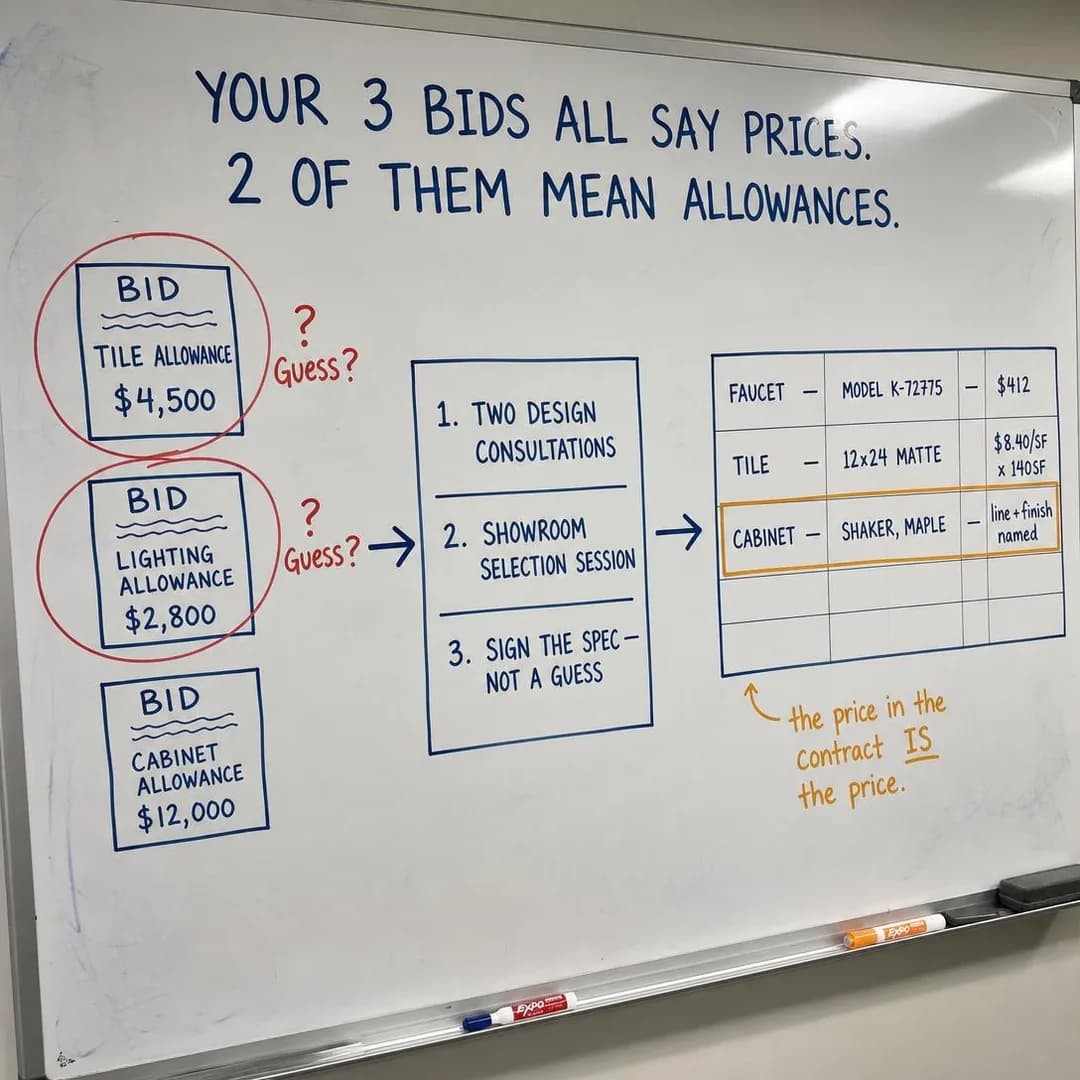
TrafficYour three bids all say prices. Two of them mean allowances.
- Audience
- Homeowners holding three bids that are not the same job — Three proposals within a few thousand dollars of each other, every one of them carrying round-numbered tile, lighting and cabinet allowances, and no way from the outside to tell which document is a price and which is a placeholder.
- Angle
- How It Works (Product & Mechanism) — Explains the process from input to mechanism to result.
Your three remodeling bids all say prices. Two of them actually mean allowances. An allowance is a round-number placeholder that looks like a budget until demo day arrives. Here is how we price differently: two design consultations, one showroom selection session, and every single tile SKU, faucet model number, and cabinet line picked and priced before you sign. The price in your contract is the final invoice.
The Only Bid With Real Model Numbers
Fixed-price kitchens & baths.
How It Works earns its place here because the mechanism is a document, not a method. An allowance is a round number standing in for a decision nobody has made yet, and it is why three bids within a few thousand dollars of each other are not three prices for the same job. The ad does the one thing that makes this argument land: it shows the reader their own paperwork first — TILE ALLOWANCE $4,500, LIGHTING ALLOWANCE $2,800, CABINET ALLOWANCE $12,000 — and only then shows what a specified line looks like instead. Whiteboard was the right direction for it, because the argument is arithmetic a person could do in front of you.
It also produced this batch's sharpest count failure, and it is a new species. The roofing rule was that typography renders accurately and drawn objects do not. Here the typography is right — the headline says three bids and the board draws exactly three bid cards — and the *claim* is wrong: "2 OF THEM MEAN ALLOWANCES" sits above three cards, all three of which are allowance lines. Only two are circled. So the picture and the caption disagree about the picture. Copy that headline into an ad and the first careful reader in the comments will count the boxes for you.
The thing to check before running is smaller and more expensive. The specified faucet renders as MODEL K-72775, and a K- prefix followed by five digits is Kohler's SKU convention. It is not a Kohler part number as far as we can tell, which is worse than either alternative: an ad that appears to name a manufacturer's model you do not stock, in a picture whose entire argument is that the model numbers are real. Put your own actual SKUs on the board, or blur the column. The prices — $412, $8.40 a square foot, 140 square feet — are invented placeholders like every other number on this page.
Other headlines from the same run
- Don't Sign an Allowance Line
- How Fixed-Price Remodeling Works
- Sign a Spec Sheet, Not a Guess
- Actual SKUs Before You Sign
Call to action
Traffic, correctly: the reader has three bids on the table and has just been told they cannot compare them, so the click is the comparison. Send it to a page that shows a redacted real spec sheet beside a redacted real allowance-based bid. An ad whose premise is documentation should be able to produce the document on the next screen.
Same Corner Proof Pair
LeadsYour wall, before and after — same corner, same lens, real permit.
- Audience
- Homeowners who have been eyeing one wall for years — Know exactly which wall it is, have been told by one person that it is load-bearing and by another that it is nothing, and have not asked anyone because they assume the answer is a number they do not want to hear.
- Angle
- Before / After (Proof & Trust) — Contrasts the state before adoption with the state after adoption.
You already know the exact wall. You’ve just heard three different opinions on whether it’s bearing. We don't guess. A structural engineer and crew lead inspect what's inside, check the joist loads, and show you exactly what a flush opening takes. No dropped header, no soffits pretending to be design choices. Just a dead-flat ceiling and a signed permit tag.

Same Corner. Dead-Flat Ceiling.
Book a structural assessment.
Before/After is the format this trade lives on and mostly abuses, and this is the first honest one this cluster has produced. The dental aligner ad two pages over compared a yearbook photograph to a portrait taken decades later; nothing was held constant, so the pair proved nothing. This one holds everything constant. Same tripod position, same oak floor running the same direction, same dishwasher, same tile backsplash, same wall cabinets — and the doorway with its cased opening is simply gone in the right-hand panel, with a flat ceiling where the header would be. Labelled VANTAGE 01 — BEFORE and VANTAGE 01 — AFTER, 34 DAYS, and the copy independently says 34 days. Two separately generated artefacts agreeing on a number is rare enough to note every time it happens.
The angle underneath it is better than the format, though. The brief pinned the audience as people who have been eyeing one wall for years and have never asked, because they assume the answer is a number they do not want to hear — so the ad sells a $250 structural assessment rather than a renovation, and one primary text offers to tell them the wall is not load-bearing and walk away. That is the cheapest first transaction available in a category whose usual opening ask is five figures, and it is the same move the roofing batch made with a flat-fee inspection.
What the panels do not hold constant is the light, and that is the honest caveat on every before/after in this trade. The left frame is flat and grey, the right is full of low sun, styled with plants, a fruit bowl and a fire lit in the hearth. The wall really did come out; the mood came from a photographer and a stylist. If you shoot your own pair, shoot them at the same hour with the same lens and let the structure do the work — it is more persuasive and it is the version that survives someone visiting the house. Also invented, and load-bearing in the copy: "300+ post-war homes since 2014", "300+ Walls Removed Flush", and the $250 price. The claim about pocketing steel or LVL flush into the joists is true of some structures and not others, so it needs to be a claim about your projects rather than about walls in general.
Other headlines from the same run
- No Dropped Beams. Ever.
- 300+ Walls Removed Flush.
- $250 Structural Wall Assessment
- Engineered, Permitted, Flush.
Call to action
The offer is a specific paid appointment at a named price, which is the rare remodeling ad that can carry Book now honestly. Send it straight to the calendar rather than to a contact form — and note that this booking, held, is exactly the event the account should be optimising on, because it happens inside the seven-day window and the contract it eventually produces does not.
The Other Column
TrafficYou've priced every house on your street. Never the one you own.
- Audience
- Couples who have outgrown the house but not the street — Want a third bedroom and a kitchen that two people can stand in, love the neighbourhood and the school run, and have started browsing listings mostly because nobody has ever shown them the other column.
- Angle
- Alternative / Substitute (Comparison & Positioning) — Compares your solution with a completely different way of achieving the same goal.
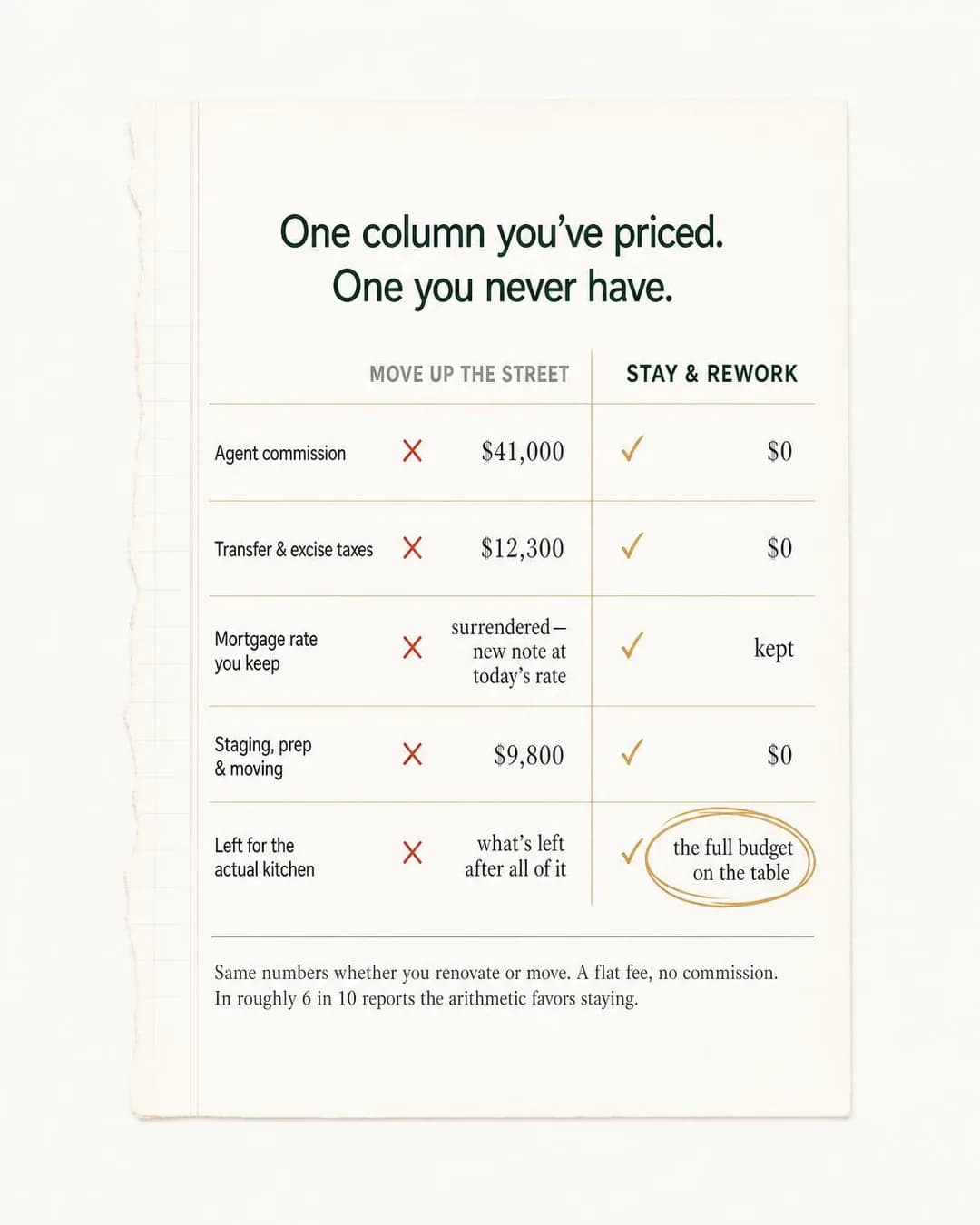
You’ve priced nearly every house on your street. You just haven’t priced the one you already own. Moving means paying agent commissions, transfer taxes, and surrendering your locked-in rate before you even unpack. Staying puts that transaction friction back into the rooms you actually live in. The Fork Report puts both paths side by side on paper—flat fee, no commissions, just arithmetic.
Renovate or sell? See the arithmetic.
A flat fee. Zero commissions.
Alternative Substitute is the family nobody in this trade runs and it is the one with the largest addressable audience, because the competitor for a remodeling budget is not another remodeler — it is a listing. The brief pinned a couple who have outgrown the house but not the street, and the ad answers with the column they have never priced: the commission, the transfer taxes, the movers, and the mortgage rate they would be handing back. The rendered ledger is the batch's best-argued object, right down to the last row being "Left for the actual kitchen" rather than a total.
That last choice is why this table works when three previous ones did not. Real estate's cash-offer comparison did not foot. A gym occupancy board contradicted its own ad. This one never states a sum, so there is no sum to be wrong: $41,000 in commission, $12,300 in transfer and excise taxes, $9,800 in staging and moving, and a right-hand column of zeroes. The copy's "$50,000+ in fees" is consistent with the $63,100 on the page without claiming to be its total. The rule this hands to anyone briefing a comparison chart is short — the failures are the tables that add up, so build the argument out of rows and let the reader do the addition.
And then the most interesting thing in the batch, which is that the ad is off-brief in a way that is more instructive than a clean result would have been. Asked for a remodeler's ad, the model invented a *neutral* business: a flat-fee analysis service whose copy says "Agents earn when you sell. Contractors earn when you renovate. We charge a flat fee for the math alone, so we have no incentive to steer you either way." That sentence is unrunnable by the company the ad was supposed to be for, because a remodeler is one of the two interested parties it names. The model found the conflict of interest inside the angle and resolved it by changing whose ad it was. A real remodeler can still run this — the ledger is honest and the argument is strong — but the line about incentives has to go, and what replaces it is the disclosure: we build the second column, here is the first one anyway. The "6 in 10 reports" figure, rendered into the image and repeated in copy, and the "3,400 households", are invented.
Other headlines from the same run
- One column you have never priced.
- The true cost of staying vs. moving.
- Compare both paths on paper first.
- Keep your rate or buy up? The math.
Call to action
Traffic is right and the destination is the whole ad: a page that actually builds the second column for the reader's own numbers. Do not send this to a contact form. It is also the one creative here worth pairing with a website-visitor retargeting audience later, because the person reading a stay-versus-move comparison has told you exactly where they are in a decision that will take months.
Page Three, Aloud
LeadsRead page three before you sign anything.
- Audience
- People who have heard the six-weeks-became-five-months story — Heard it from a neighbour, a sister-in-law and a podcast, and now treat every schedule a contractor says out loud as a number to be multiplied rather than a commitment.
- Angle
- Guarantee (Objection & Risk Reversal) — Emphasizes a money-back, satisfaction, quality, or performance guarantee.
Most remodeling timelines are fiction. Ours comes with a daily penalty if we miss it. Page three of every contract states a firm substantial-completion date in calendar days. If the crew runs past it, you receive a written credit—typically $200 to $400 deducted directly from your final invoice for every single calendar day late. No arguing. No excuses.

Late remodels pay you daily.
Read page three before signing.
Guarantee is the family that answers this trade's loudest objection, and the brief deliberately made it structural rather than reassuring: not "we finish on time" but a substantial-completion date on page three with a written daily credit behind it, and a change-order rule that nothing is built or billed before the price of the change is signed. The poster does the one thing a typographic direction is for — it commits, in six words, to the only sentence a competitor cannot say back.
It is also the cleanest confirmation of the proof-slot rule this cluster has. The roofing finding was that a visual direction offering a slot for a statistic will have that slot filled, with a real number if the brief supplies one and an invented one if it does not. A solid-colour quote card has no such slot, and true to that, there is not a single figure in this frame. The number lives in the copy instead, where it is set in type and is easy to change — which is exactly where a number that varies by contract should live.
The flaw is in that copy and it undoes the ad if you ship it as written: the credit is quoted as "typically $200 to $400" a day. A range with "typically" in front of it is not a guarantee, it is an estimate of a guarantee, and it invites the reader to assume the low end and you to argue for it later. Pick one number, put it in the contract, and put the same number in the ad. Everything else here is already the strongest version of itself — the headline set is the shortest in the batch, four of the five fit Facebook's 27-character recommendation, and "Late remodels pay you daily." at 28 is the kind of line the 27-character limit was going to produce anyway.
Other headlines from the same run
- Guaranteed completion dates.
- A schedule backed in writing.
- If we run late, you get paid.
- Fixed prices. Written deadlines.
Call to action
Leads was the pinned objective but the button should still be Learn more, because the promise is a contract clause and the reader will want to read it before giving you a phone number. Put the clause on the page verbatim. This is also the ad most likely to be screenshotted and sent to the other owner, which is the quiet job of every remodeling creative — write it so it survives arriving with no context.
Price the Month
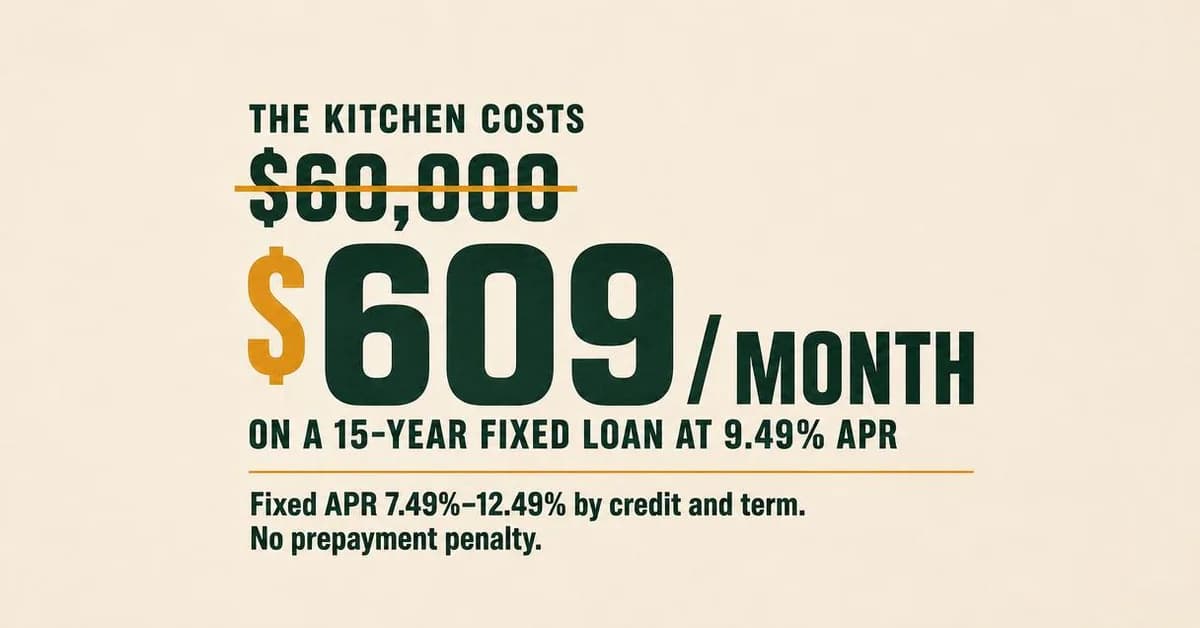
LeadsThe kitchen costs $609 a month. Not $60,000.
- Audience
- Homeowners with the equity but not the cash — Have owned long enough that the house is worth well more than the balance on it, and have shelved the remodel for three years because they were pricing it against a savings account instead of against a payment.
- Angle
- Financing / Installments (Offer & Economics) — Focuses on affordability through payment structure rather than absolute price.
Stop pricing your kitchen against your savings account. A $60,000 remodel is $609 a month on a 15-year fixed loan at 9.49% APR. You keep your existing mortgage rate untouched and your cash reserve intact. Fixed terms from 5 to 20 years, funded in as few as four business days.
$60,000 Remodel. $609 a Month.
Check rates with a soft pull.
Financing Installments is the offer this trade shelves projects without, because the objection is almost never the total — it is that the total is being weighed against a savings account. Repricing a kitchen by the month is the move, and the poster makes it in the cleanest possible way: the project total struck through, the monthly payment at the size of the whole frame, and the term and the rate set underneath it. It also, without being asked, does the thing Regulation Z requires — 12 CFR 1026.24(d)(1) makes the amount of a payment a triggering term, which obliges the ad to state the terms of repayment and the annual percentage rate using that phrase, and all three are in the picture.
And then it gets the arithmetic wrong, which is the most expensive error on this page precisely because everything around it is right. $60,000 on a 15-year fixed loan at 9.49% APR is $626.17 a month. The ad says $609, in type four inches tall, and repeats it in every one of the five primary texts. $609 would be a 9.01% APR on that principal and term, or $58,354 at the rate stated. So the ad advertises a payment that is not available on the terms it names, which under 1026.24(a) — advertised terms must be terms actually available — is the version of this mistake that has a regulator attached to it rather than an embarrassment. Recompute the payment from your own lender's sheet and set that number; never let a model produce an amortisation figure.
The other thing to fix is whose ad this is. The brief asked for a remodeler advertising financing and the copy came back as the *lender*: loans from $15,000 to $150,000, fixed APRs from 7.49% to 12.49% by credit and term, funding in four business days, a soft credit check, and "$412 million funded across 5,900 home renovations". A remodeler who offers financing is normally arranging someone else's credit, not extending their own, and that difference changes who owes the disclosures. It is the second ad in this batch where the model quietly rewrote the advertiser to make the angle work — see the stay-versus-move ledger — and both times it happened where the angle sat on a conflict or a licence boundary. Worth knowing about the tool: it will resolve that tension by changing the business rather than by flagging it.
Other headlines from the same run
- Price the Month, Not the Bid.
- 15-Year Fixed Renovation Loans
- Keep Your Cash. Fund the Remodel.
- Fixed Payments from $15k to $150k
Call to action
Leads was pinned but send this to a page with the rate table and the lender named, not to a form — the reader's next question is who is actually lending. Run it in its own campaign with Meta's financial products and services special ad category declared, which costs you ZIP and neighbourhood targeting, lookalikes, location exclusion and any radius under 15 miles. Keep the rest of the account out of that campaign so the rest of the account keeps its targeting.
The Booked Spring Calendar
LeadsYour spring kitchen is on someone else's calendar right now.
- Audience
- Homeowners planning a kitchen for the spring — Have decided this is the year, assume they will call somebody in February and be cooking on it by May, and have never seen the part of the schedule that happens before the demolition.
- Angle
- Waitlist (Scarcity, FOMO & Timing) — Uses restricted pre-launch access or a queue to build anticipation.

If you want to cook in your new kitchen by May, calling a contractor in February is three months too late. Cabinet build slots take 8 to 12 weeks, and permits take weeks before that. That’s why our five-month pre-construction sequence starts now. Spring crew starts are already being locked on the public calendar.
Spring starts are booking now
Check next available start
Waitlist is the honest form of scarcity for this trade, because the scarcity is real and it is not a discount deadline — it is a calendar. The brief's argument is the one remodelers repeat to every caller and never put in an ad: the five months before demolition are drawings, a fixed bid, permit review and cabinet lead time, so a kitchen finished in spring is a contract signed in autumn. The poster lays that out as a milestone rule — DRAWINGS, FIXED BID, PERMIT, CABINET LEAD, CREW START — which converts a sales objection into a piece of education the reader has genuinely never been given.
It is also the third clean replication of the proof-slot finding, and the rule can now be stated as a rule. A stat-hero direction has a slot the size of the frame and will fill it. HVAC left the slot empty in the brief and got an invented statistic in five of ten images. Roofing put a non-numeric credential in it and got "1 of 3" — the brief's own premise. This brief put a number in it, five months, and the frame renders five months and invents nothing at all. The slot is not a fabrication engine; it is an empty field that takes whatever the brief supplies. Supply something.
The flaw is that the image and the copy are selling opposite things. The stamp at the top reads SPRING BOOKED, which says the season is gone. Every primary text says the opposite — "spring crew starts are already being locked", "that crew start is being claimed on someone else's calendar right now", "claim your date" — which says hurry, there is still one. A reader resolves that contradiction in the direction that costs you the click. Pick one: either the season is full and the ad is selling the *next* season, which is a stronger and rarer ad, or slots remain and the stamp has to go. Also invented: the $68,000 fixed bid and the 8-to-12-week cabinet lead, the latter of which is at least the right shape and should be replaced with your actual shop's quoted lead time, because it is the number the whole argument rests on.
Other headlines from the same run
- See the 5-month project calendar
- Next available crew start date
- A spring kitchen starts in autumn
- Check the live public schedule
Call to action
Leads was pinned and the copy repeatedly promises a public calendar, so the click has to land on one — an ad whose entire proof is a published schedule and whose landing page is a contact form has broken its own promise on the next screen. If you genuinely publish availability, Book now becomes the stronger button and the ad becomes the rare scarcity claim a reader can verify before believing it.
Love in the Walls
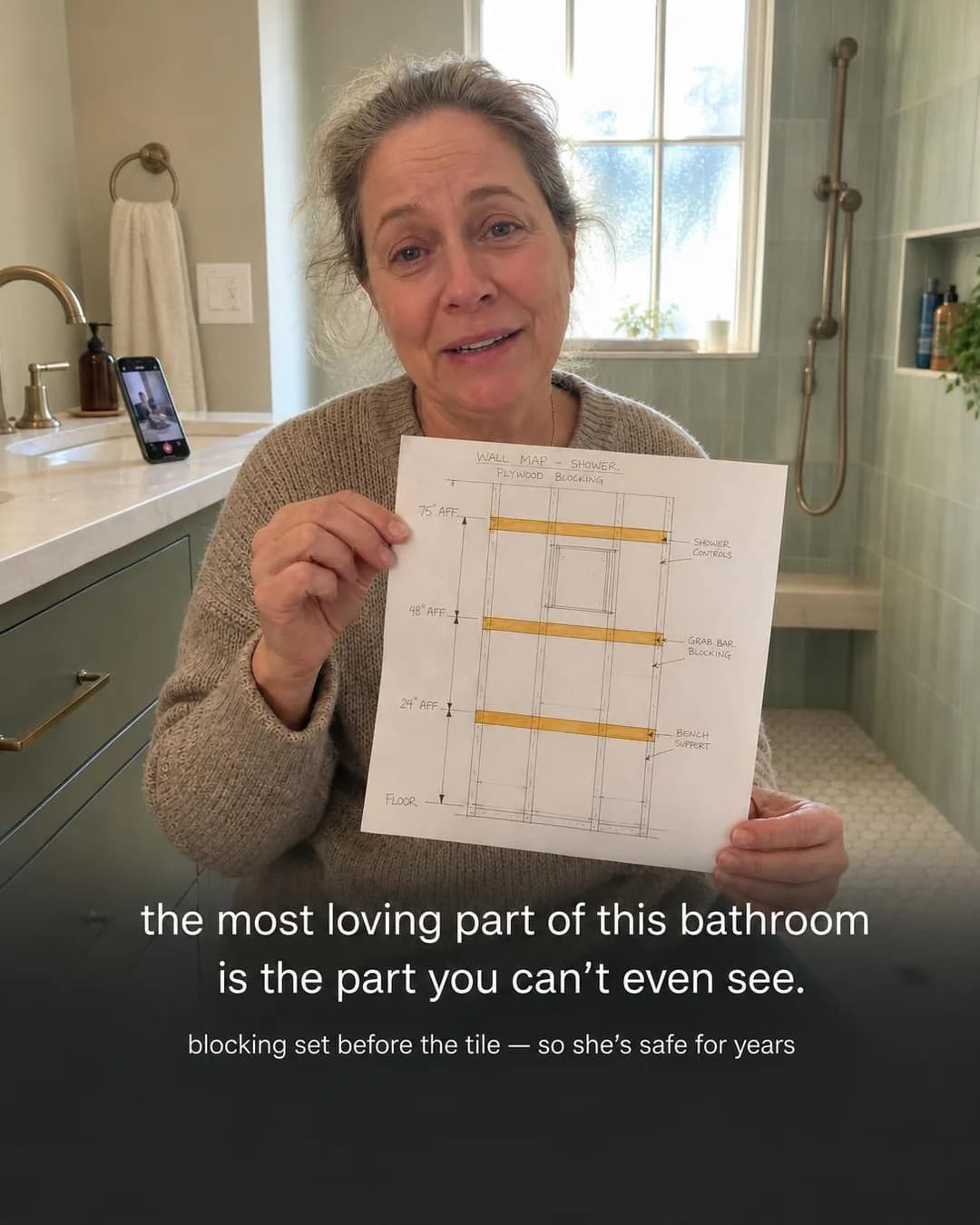
LeadsThe most loving part of this bathroom is inside the wall.
- Audience
- Adults remodeling a bathroom before a parent moves in — Have the room and the will, have already had the conversation, and are working out how to make the house ready without turning the ground-floor bathroom into something institutional.
- Angle
- Care / Love (Identity & Emotion) — Frames the purchase as an act of care for another person, pet, family member, or community.
The most loving detail in this bathroom is completely invisible.
Love built right into the walls.
Design-build bath conversions.
Care/Love is the right family and the ad is the best-made thing in the batch: an owner-operator holding a hand-drawn wall map to camera in a finished bathroom, the drawing labelled WALL MAP — SHOWER, PLYWOOD BLOCKING with dimensioned bands at 75", 48" and 24" above finished floor for the controls, the grab-bar backing and a future bench. The argument is that the expensive, invisible part is done now so the visible, clinical part never has to be — which is precisely how this work is actually sold, and it is a far better ad than the grab-bar-and-stock-photo genre it is competing against.
It is also the one ad on this page that must not run as written, and the reason is the same policy the dentist cluster is built on, reaching one clause further than most advertisers know. Meta's personal attributes standard says ads "must not contain content that asserts or implies personal attributes", enumerates disability and "physical or mental health (including medical conditions)", and — the part that decides this ad — prohibits content implying that the advertiser is aware of someone's personal attributes "or the personal attributes of their family". "Making a bathroom safe for Mom", "She cared for you for decades", "safe for her", "whenever they need it": every one of those implies the advertiser knows a specific family member's mobility. Meta's own contrast is "Do you have diabetes?" against "New diabetes treatment available", and the fix here is identical — describe the room, never the person. "Curbless showers with blocking set for grab bars" sells the same job and asserts nothing about anybody.
Worse, and this is the gym batch's lesson arriving in a new trade: the violation is burned into the image. The caption across the foot of the frame reads "blocking set before the tile — so she's safe for years", where no alternate headline can reach it. Steering the brief is not the same as controlling the output — this brief never mentioned a condition and described only construction details, and the model supplied the person anyway, because that is what the angle is about. Check the render, not just the brief. One more thing to fix before it runs: the blocking heights look authoritative and are not standard. ADA's figures put grab bars at 33–36 inches above the floor and a shower seat at 17–19; this drawing puts grab-bar blocking at 48 and bench support at 24. A homeowner cannot tell. A building inspector can.
Other headlines from the same run
- Safety she feels. Zero clinic look.
- Built for Mom. Detailed for home.
- Ready for her, today and tomorrow.
- The wall map behind the tile.
Call to action
Leads was pinned and it is achievable, but only after the copy is rewritten in the third person — a lead form attached to an ad that implies a family member's disability is the combination most likely to be rejected, and the rejection will name the copy rather than the form. Send the click to a page about curbless construction and blocking, and let the reader recognise themselves in it rather than being recognised by you.
The $7,000 Kitchen Confession
AwarenessWe were four weeks late. It cost us $7,000.
- Audience
- Homeowners who have read every one-star review in town — Have spent evenings reading the worst review of each of six contractors, have concluded that they are all the same, and are looking for the first one to say something that a marketing department would have deleted.
- Angle
- Apology / “We Messed Up” (Story & Founder POV) — Acknowledges a mistake or failure and explains what changed.
In spring 2023, we finished a kitchen four weeks late. It cost us $7,000 off the final bill, and we deserved it. Most contractors make excuses or stop answering the phone. We rewrote our operating playbook. Now, every single contract carries an automatic $250-per-day completion credit if we run late—no claims, no caps, no asterisks.

Late by 28 days. It cost us $7,000.
Automatic completion credits.
Apology — We Messed Up is the least-used sub-angle in the library and this is the first ad in the cluster to run it, which is itself the argument for the brief: the audience pinned here has spent evenings reading the worst review of six contractors and concluded they are all the same, so the only thing that can cut through is a company volunteering the review nobody made it write. The execution splits the frame — the owner in a finished kitchen on the left, a pinned job file on the right reading JOB FILE — SPRING 2023 and "We finished this kitchen 28 days past the date we printed. That's on us."
And it produced the first arithmetic in this whole cluster that actually checks out. Real estate's cash-offer table did not foot. A gym occupancy board contradicted the ad it was in. Roofing labelled a panel FOUR NAILS and drew five. Here the image says 28 days late and a $7,000 credit, the copy says four weeks in one text and 28 days in another, and the contract term is $250 a day: 28 × 250 = 7,000, exactly, across three separately generated artefacts. The reason is worth taking away — every number in this ad descends from one number in the brief, so there was nothing to reconcile. Ads that invent two independent figures are the ones that disagree.
Two flaws, one cosmetic and one disqualifying. The credit line at the foot of the card is rendered with a strikethrough running through it — "28 DAYS LATE — CREDIT −$7,000.00" struck out — which on a credit reads as cancelled rather than paid, the opposite of the ad's point. And the whole ad is a claim about your own history: a confession from a founder who does not exist, illustrated by a portrait of a person who does not exist, about a job that did not happen. Every other ad on this page can be made true by changing a number. This one can only be run by a company that actually ran late, actually paid, and can produce the invoice. If that is not you, the format still works — publish the rule you adopted without inventing the failure that produced it.
Other headlines from the same run
- $250/Day If We Miss Our Date
- No Excuses. Just a $250/Day Credit.
- The $7,000 Remodeling Confession
- A Fixed Date. Backed by $250 a Day.
Call to action
Awareness is the pinned objective and the right one: this ad is not asking for anything, it is buying a reputation with people who will not need a remodeler for another year. Send it to the page that carries the completion-credit clause in full. Judge it on cost per thousand and on whether the phrase turns up later in sales conversations, not on leads — a confession is a slow instrument, and this is the one ad here where the seven-day attribution window is not even the relevant complaint.
Questions
- Do Facebook ads work for home remodeling companies?
- They reach the right household — Pew puts Facebook at 80% of 30- to 49-year-olds and 74% of 50- to 64-year-olds against Instagram's 62% and 40%, and those are the bands that own the houses and hold the equity. The harder question is whether you will be able to tell. Meta's attribution stops seven days after the click and a remodeling sale closes months later, so the account will show you appointments and never show you contracts. That is not a failure of the ads; it is a property of the trade, and the fix is to decide in advance which early event you are willing to be judged on.
- Why does my ad account show no revenue from remodeling jobs?
- Because the job closed outside the window. Meta withdrew 28-day click and 28-day view attribution on 27 April 2021; what remains is 1-day click, 7-day click and 1-day view, and 7-day click is the default. A kitchen that goes from click to signed build contract in two to six months is invisible to all three. You can send the sale back yourself through the Conversions API, but event_time may be at most seven days old and a single older row rejects the entire upload — the longer route is an offline event with action_source set to physical_store, which Meta asks you to upload within 62 days. That reaches a design agreement for most companies and a build contract for very few. Treat the offline upload as your own reporting rather than as something delivery can learn from.
- What should I optimise for if the sale takes four months?
- The consultation that was booked and held — it is the only event that both happens inside the attribution window and correlates with money. Optimising on Lead is the standard mistake here, and it is worse in this trade than in any other on this site: a large discretionary purchase attracts a great deal of browsing, and lead optimisation will reliably find the people most willing to fill in a form about a kitchen they will never buy. Then check the volume before you build the account around it. Delivery wants roughly 50 optimisation events per ad set per week to leave the learning phase, and a company doing twenty-five jobs a year cannot supply fifty held appointments a week. Multiply your own cost per held appointment by 50 to see the weekly spend that would clear it, then run fewer ad sets rather than more.
- Does the three-day right to cancel apply if the lead came from a Facebook ad?
- Almost certainly yes, and the ad is part of why. 16 CFR 429.0(a) defines a door-to-door sale as one where the seller personally solicits the sale and the agreement is made away from the seller's place of business, at $25 or more when it happens at the buyer's residence — and an ad that produced the appointment is solicitation. The exclusion people reach for, (a)(5), covers a buyer who specifically requested a visit for "repairing or performing maintenance upon the buyer's personal property", which a kitchen or an addition is not, and it expressly does not cover additional goods or services sold during the visit. The emergency exclusion at (a)(3) needs a handwritten, signed, dated waiver describing a bona fide immediate personal emergency. So 429.1 applies: the contract carries the cancellation statement in bold face type of at least ten points, and the buyer gets a completed Notice of Cancellation in duplicate. Check your state as well — many have their own home-improvement contract rules that run longer or add notices on top of this one.
- Does advertising remodeling financing change my targeting?
- Yes. A remodel sold on a monthly payment promotes a credit opportunity, so the campaign must declare Meta's financial products and services special ad category, which removes location exclusion, removes ZIP, neighbourhood, sub-city and metro-area targeting, removes lookalike and saved audiences, fixes age at 18–65+ and sets a minimum radius of 15 miles or 25 kilometres. Separately, Regulation Z makes the amount of a monthly payment a triggering term, so an ad that states one must also state the repayment terms and the annual percentage rate using that phrase. Run financing in its own declared campaign and leave the rest of the work in an ordinary one — the guide alongside this page works the whole thing out.
- What size should a home remodeling Facebook ad be?
- Render 4:5 at 1440 × 1800 — Meta's recommendation for Facebook Feed, which is where most of the budget delivers. But Facebook has nine image surfaces to Instagram's four and their guidance disagrees: Marketplace wants a square at 1080 × 1080 with a 40-character headline and a 30-character description, where the feed wants 27 characters and shows no description at all. With Advantage+ placements on, one export fills all nine. Compose the portrait so it survives a square crop, and keep the wide 1.91:1 export for documents and diagrams rather than rooms — a kitchen loses more to that crop than a schedule does.
Seen enough? Make your own.
Paste your site. It reads your projects, your process page, your service area and your terms, then writes the concepts, renders the images and drafts the copy — for the one trade in this set where the sentence in the ad is a term of the contract you sign four months later.
No credit card · 50 free credits (about 5 ads or Instagram posts)
Every angle used above is documented in the best-in-slot ad angle library. More industries and placements are at all ad examples.