
Ad Guides · Dentists × Instagram
Instagram ads for dentists
The offers, the angles, the targeting rules and the policy walls — for the cosmetic and aligner half of a dental practice, on Instagram, checked against Meta's own documentation this month.
Almost every guide to Instagram ads for dentists is a Facebook guide with the platform name swapped, and the swap is where it goes wrong twice. It tells a cosmetic practice to advertise the way a restorative practice does, to the ages where Instagram has the least reach. And it writes the captions in the vernacular the whole category uses — “Embarrassed to smile?”, “Do you hide your smile in photos?” — which is the one kind of line Meta's policies prohibit twice over, as an assertion about the reader's health and as a statement about their appearance.
This page is the other half of the split the Facebook guide in this cluster starts. Dentistry's revenue is not evenly spread across ages: implants, dentures and crown-and-bridge work concentrate in the cohorts where Facebook reaches best, and aligners, bonding, whitening and a first practice of your own concentrate where Instagram does — Pew's November 2025 survey puts it at 80% of US adults aged 18 to 29 and 62% of those 30 to 49. If your growth plan is cosmetic, this is where the budget goes and the Facebook guide is the supporting buy. Most general practices are somewhere between and should run both, with the offer deciding which app each ad set sits on.
What follows is the Instagram half of the playbook: the six objectives and which two this trade buys, the young-adult offers worth advertising here and the argument that wins each, what the copy may and may not say about the person reading, where the click should land when the reader lives in the DMs, and the budget arithmetic that decides whether delivery has enough information to help you. Every platform claim is footnoted at the bottom and dated.
The ads shown below are real output, not mockups drawn for the argument. Six of them are pulled from the ten on the dentist Instagram examples page, published exactly as they were generated, for practices that do not exist. Three of those ten should not run as they stand — a fabricated testimonial, an invented case gallery, and a before/after of a patient who does not exist — and the notes on the examples page say exactly why, which is the reason to believe the rest of this page.
One caveat belongs up front, and one absence is deliberate. The caveat: nothing here is legal or regulatory advice — Meta's rules are the floor, your state dental board's advertising rules sit on top of them, and patient data is a HIPAA question your ad account cannot answer. The absence: no benchmark figures anywhere, because the only arithmetic worth having is yours, and it is in the budget section.
Generate Instagram ads for your practice
Paste your site and best-in-slot reads it the way the invented practices above were read — services, patients, positioning — then writes the concepts, renders the images and drafts the copy. Free to start, no card.
What you are actually buying by choosing Instagram
You are buying the ages this half of the trade is sold to. Pew's November 2025 survey puts Instagram at 80% of US adults aged 18 to 29 and 62% of those 30 to 49, against Facebook's 68% and 80% for the same two groups — and reversed at 50-plus, where Facebook holds 74% and 57% against Instagram's 40% and 19%. The procedure list decides which half of that table you are standing in: aligners, composite bonding, whitening before an event, the first adult practice of your own — young-adult offers, sold where the young adults are. If the growth plan is restorative, read the Facebook guide first and treat this one as the supporting buy.
Second, you are buying interruption, not capture, and the difference shapes every ad. In our own publisher the 1.91:1 ratio routes to Facebook's right-hand column and search results, and Instagram has no equivalent surface — nobody types “dentist near me” into Instagram. So there is no demand-capture buy here at all: emergency and same-day pain ads belong on Facebook, where the six-in-the-morning search actually lands. On Instagram every reader is mid-scroll, which is why the ads that work open on a moment — a row of seltzer cans, a lock screen, a photograph someone kept for ten years — and never on a service name. The first sentence is not a formality here; it is the entire mechanism for stopping a thumb.
Third, the specs differ from Facebook's in the useful direction, and the received wisdom has them backwards. Meta's ads guide recommends a headline of about 40 characters for an Instagram Feed image ad — against Facebook's 27 — so the platform with the wordier reputation actually gives you thirteen more characters. The primary text recommendation is about 125 characters, and the same first-sentence rule applies: measured across the cluster's sixty ads, all but one primary text runs over, so the argument has to survive inside the first line because that is all that shows before the fold. The image itself is the same 4:5 at 1440 × 1800 as Facebook Feed, so one export serves both — but the aspect-ratio tolerance here is 1% against Facebook's 3%, so an export a few pixels out of true passes there and fails here. And 9:16 earns its slot on Stories and Reels, which is where a phone-native ad concept belongs.
Finally, you are buying a warmer room. This is the platform where a practice's audience is already following local businesses, replying to stories and saving posts, and the warm pool of engagers is both bigger and younger than the Facebook Page equivalent. It costs nothing, it does not depend on uploading anything about a patient, and it is the most-skipped asset in local dental advertising — most practices spend their entire budget talking to strangers while their own followers see nothing.
Which objective to buy
Ads Manager offers six objectives — Awareness, Traffic, Engagement, Leads, App promotion and Sales — and the objective is not a label describing what you want; it is the instruction that decides who Meta shows the ad to. Choose the flattering one and the account fills with saves and no appointments.
The distribution on the examples page is the honest shape of this trade on either platform: seven Leads, two Traffic, one Awareness — the identical split to the Facebook batch, because the trade decides the objective and the platform decides the audience. Nothing in dentistry completes in the ad's own session; the most an Instagram ad can cause is a form, a DM or a booking.
The interesting one is Awareness, and on Instagram it is more defensible than on Facebook for a specific kind of practice: a cosmetic studio selling itself to a small, young, local audience. A radius plus an age band buys exactly the few thousand people who might plausibly book, a familiar face on their feed is what that budget is for, and the founder-letter ad on the examples page is what it looks like.
- LeadsDefault
Where most of the budget goes. Choose the destination deliberately — Instant Form, landing page, or a DM — because that choice matters more than anything else in the ad set. See the destination section.
- TrafficSometimes
For the offers the reader has to believe before they can book: the scan that replaces the impression tray, the enamel check that catches wear before it shows. Buy the read, retarget the readers.
- AwarenessSometimes
Buyable for the practice itself on a genuinely small radius — the dentist, the room, the no-lecture philosophy. Do not expect it to fill next week's book, and do not put an offer in it.
- EngagementRarely
It optimises for the cheapest available reaction, and in a three-mile radius the cheapest reaction is a like from your existing follower. Its one honest use is building a saver-pool to retarget, and even then Traffic usually builds a better one.
- SalesNo
Nobody checks out of a dental appointment. The exception is a genuine retail line sold online — whitening kits, brushes — which is an ecommerce business wearing a dental coat; if that is the business, read the fashion guide in this cluster instead.
- App promotionNo
Patients install a practice app after they are patients, if it exists at all; an install cost buys a booking screen nobody has a reason to open, and there is no version of that trade that closes.
What to advertise here, and the argument that wins it
This is the page's real content, because the offers below are the young-adult half of a dental practice and each one has a specific reader. The person who did the mail-order aligner quiz twice is not the person who has kept one photograph for ten years, and neither of them is the person whose friend's wedding is in June. Running one “new patient special” at all three spends the budget twice over.
Each row pins four decisions: who the offer is for, which angle family argues it — every one of those is a page in the angle library — which objective buys it, and, where the examples page has one, a finished ad that shows it assembled. Twelve rows is not a checklist; pick the two or three that match what your chairs are empty for.
The angle is a property of the offer, not of the practice — the same clinic advertising bonding in spring and wedding-season whitening in June should be making two completely different kinds of argument, and an agency running one house style across both is leaving the second one on the table.
Clear aligners, supervised in office
Leads- Who it is for.
- Adults who have done the mail-order quiz twice and stopped at the part where no dentist ever looks in their mouth.
- Angle.
- Comparison & Positioning — Alternative & Substitute is the only family that can split the category in one frame and hand the reader the safer version — one is a clinical process, one is a shipping label — and the rows are honest: a kit cannot take an X-ray, check gum health or course-correct mid-treatment. Lead with the $95 diagnostic exam, not the $2,400 plan.
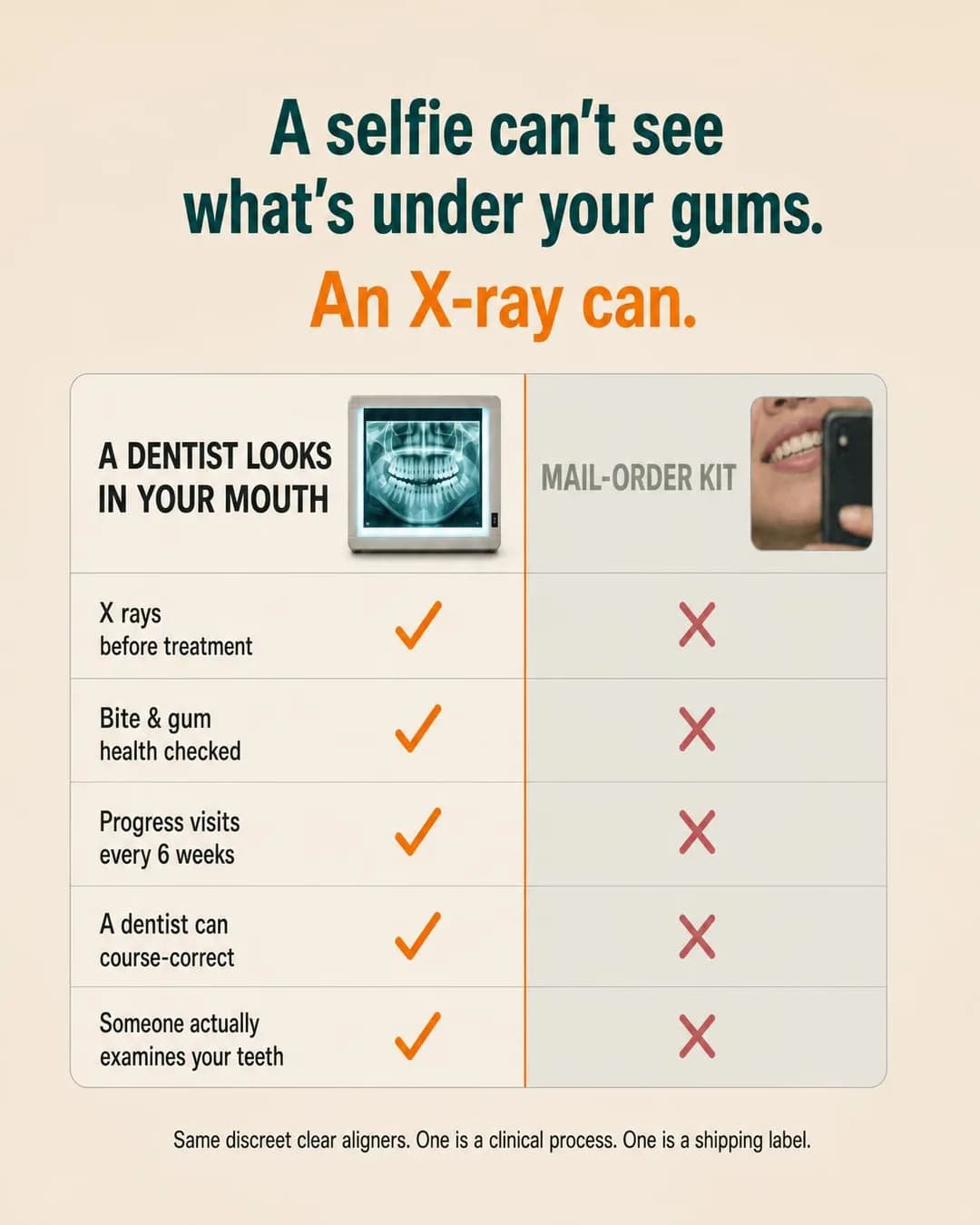 Example adClear aligners. Actual dentist visits.See the brief →
The preview-first aligner consult
Traffic- Who it is for.
- Adults who want straight teeth but dread the impression tray more than the price.
- Angle.
- Product & Mechanism — The mechanism is the differentiator and it is invisible from the patient's side of the chair: a wand and a screen versus putty and a guess. Show the scan, promise the simulation of their own smile, and let the preview — not the price — do the selling. This is the offer that makes aligners buyable for the hesitant.
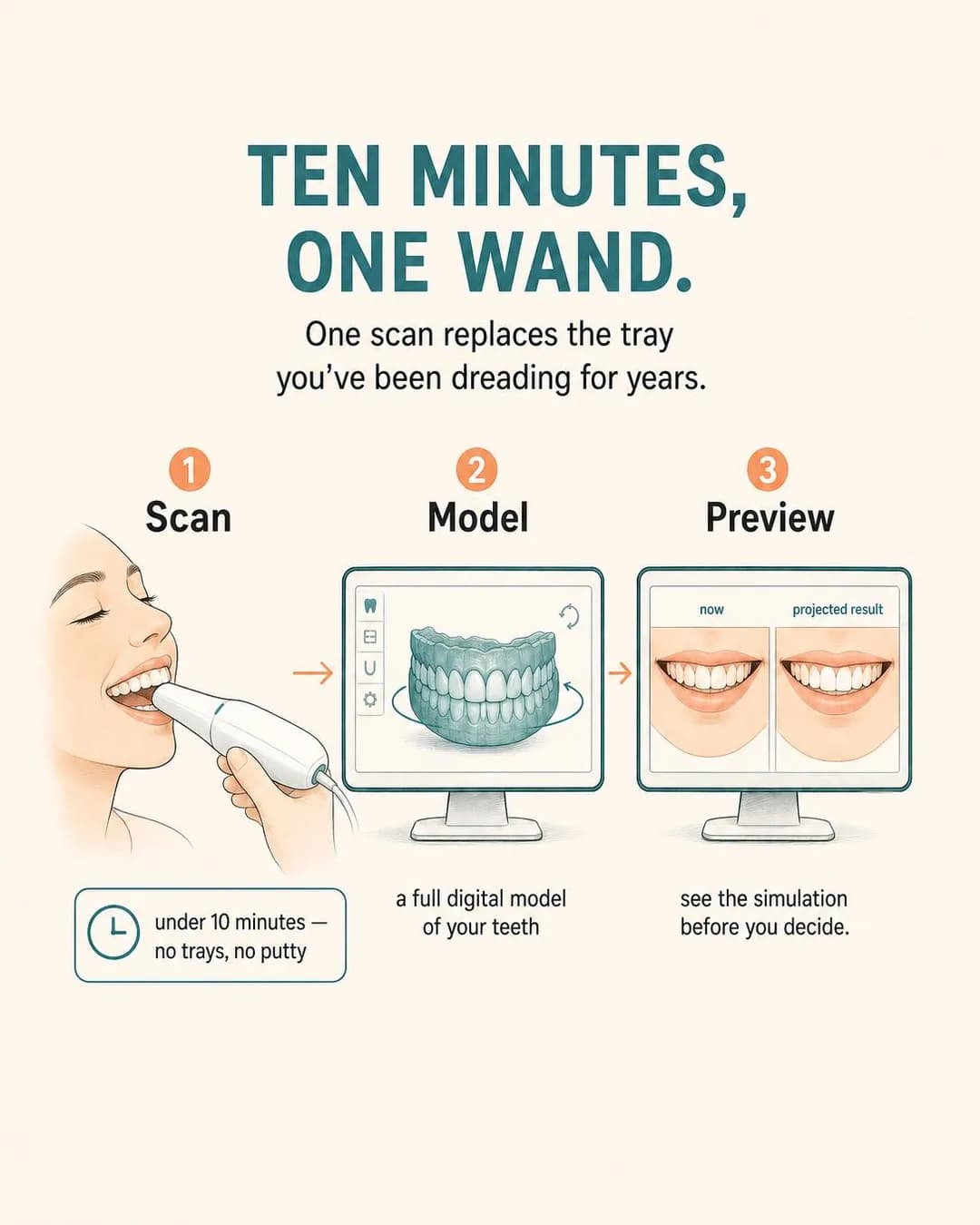 Example adSee your result before you commitSee the brief →
Composite bonding on the old chip
Leads- Who it is for.
- Adults who broke a front tooth in their teens and have arranged their smile around it ever since.
- Angle.
- Proof & Trust — Before/after is the format this offer has always wanted, and Meta permitted it again on 22 July 2026 at 18-plus. It only works with comparable panels and a representative case — the conditions are in the creative section — and the caption stays third-person. The reader's own objection (“I assumed it meant a crown”) is the ad's first line.
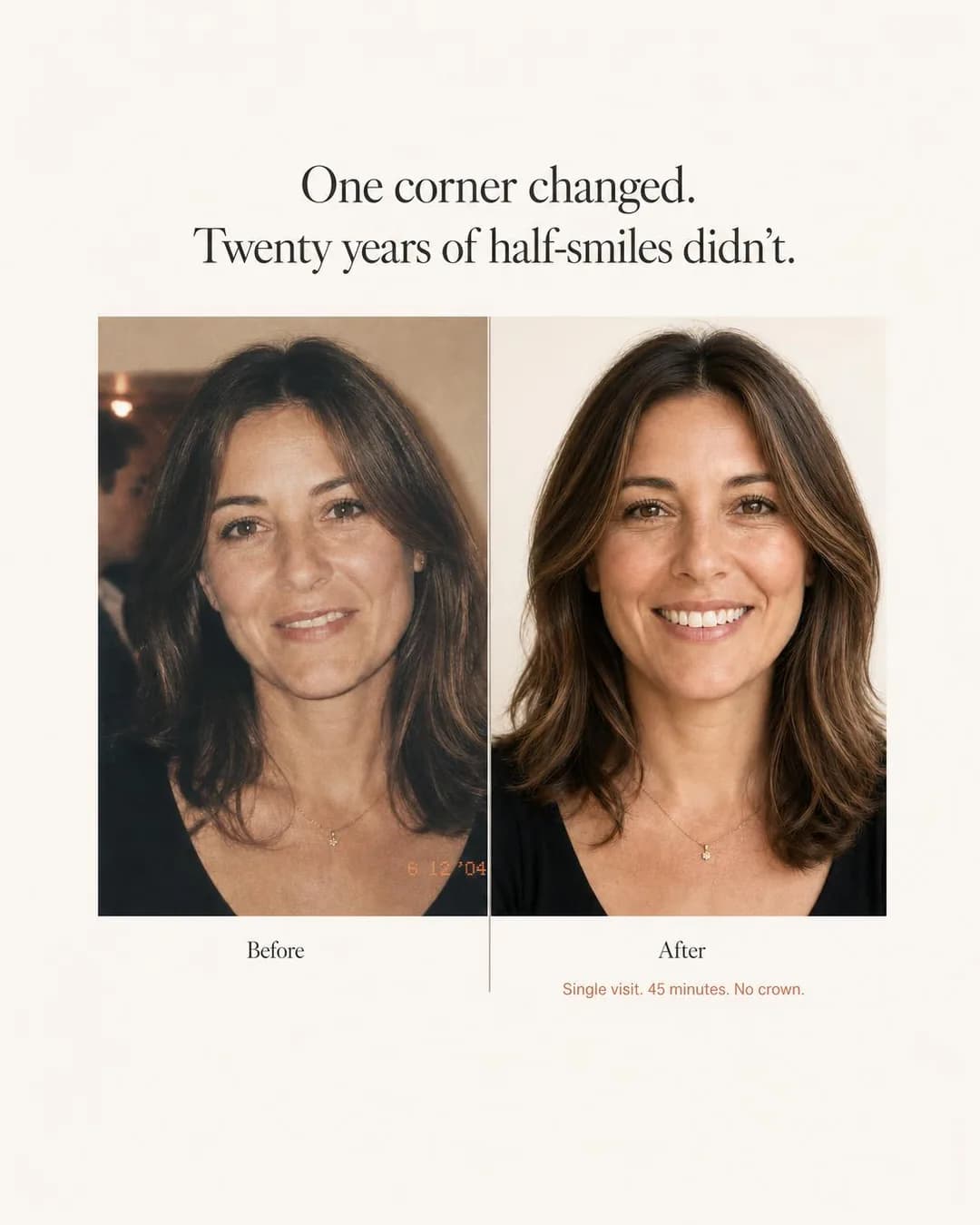 Example adOne corner fixed. Two decades ended.See the brief →
The mock-up-first cosmetic consult
Leads- Who it is for.
- People who want veneers and are afraid of the fake ones.
- Angle.
- Objection & Risk Reversal — Will-It-Work-For-Me is only ever answerable with proof for the reader's specific mouth, and a wax mock-up they hold in their own hands before anything is touched is risk reversal you can photograph. The proof has to be real cases — an invented gallery is the fabricated-evidence hazard the examples page flags on its own specimen.
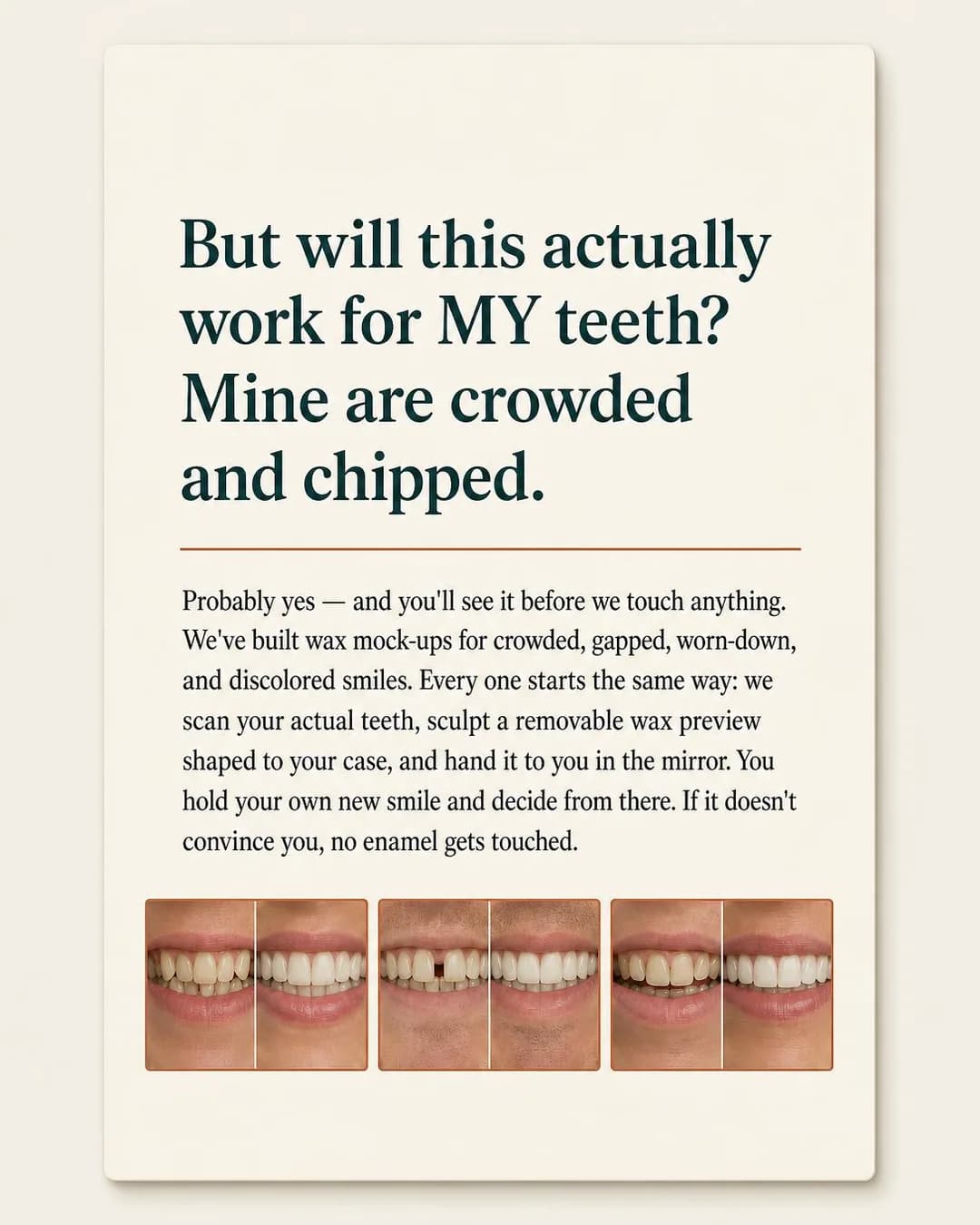 Example adSee your new smile before we touch anythingSee the brief →
Whitening before the event
Leads- Who it is for.
- Someone with a date already on the calendar — an interview, a reunion, a first date — and a half-finished strip box in a drawer.
- Angle.
- Benefit & Outcome — Speed is the product when the deadline is the reader's: 45 minutes in the chair, twelve days before the interview, and the shade comparison shown before they leave. The calendar is the argument, so the ad spends its frame on the countdown, and the copy never has to assert a thing about anyone's teeth.
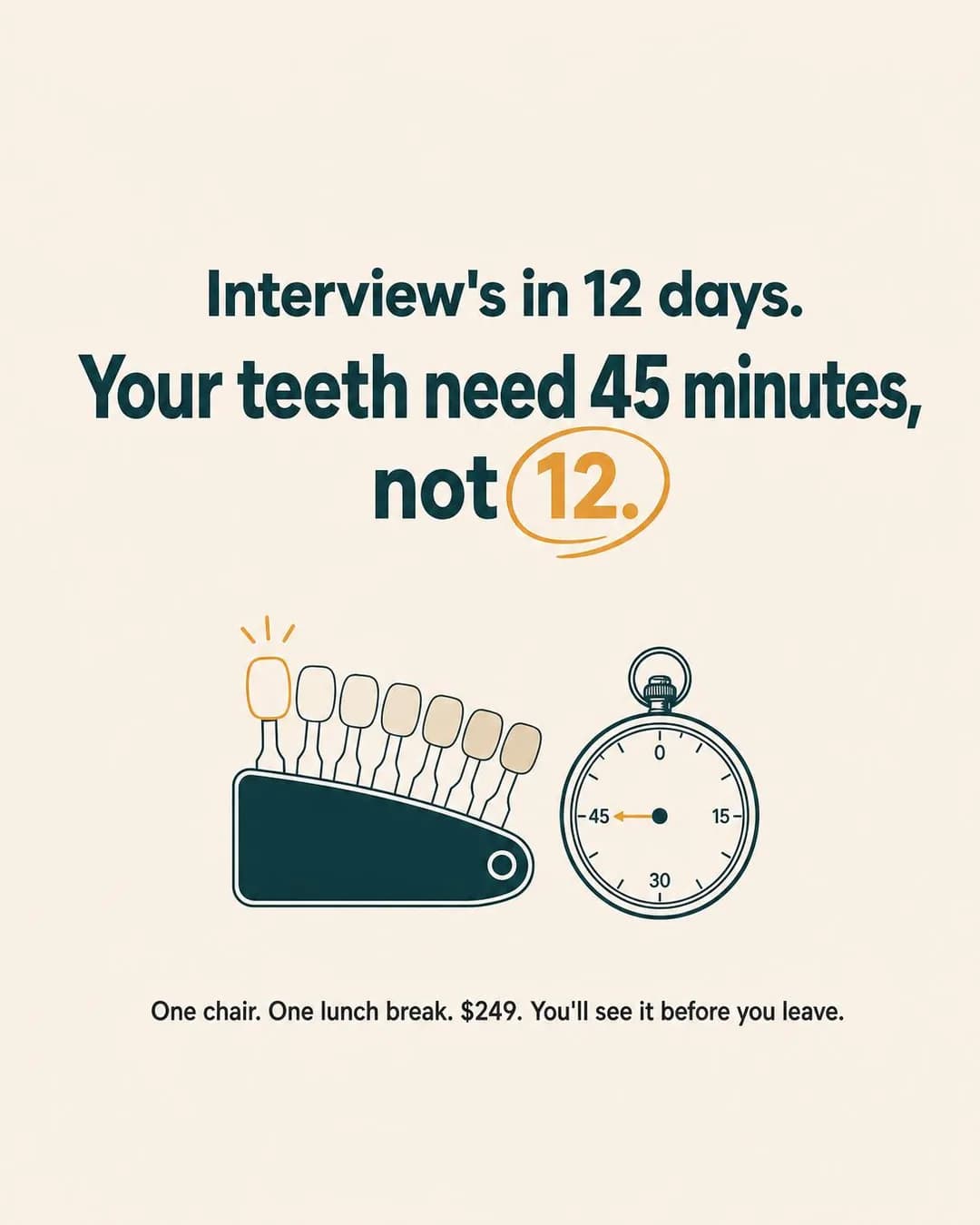 Example ad45 minutes. Visible result. Done.See the brief →
Wedding-season whitening
Leads- Who it is for.
- People in a wedding this year — their own or a best friend's — who know exactly which weekend the photographs are.
- Angle.
- Scarcity, FOMO & Timing — Seasonal Deadline is the one scarcity family whose clock you did not invent: the ceremony date is real and it is the reader's own. Run it from spring against the June-to-September season, sequence appointments backwards from ceremony dates, and buy the month before the peak rather than the peak.
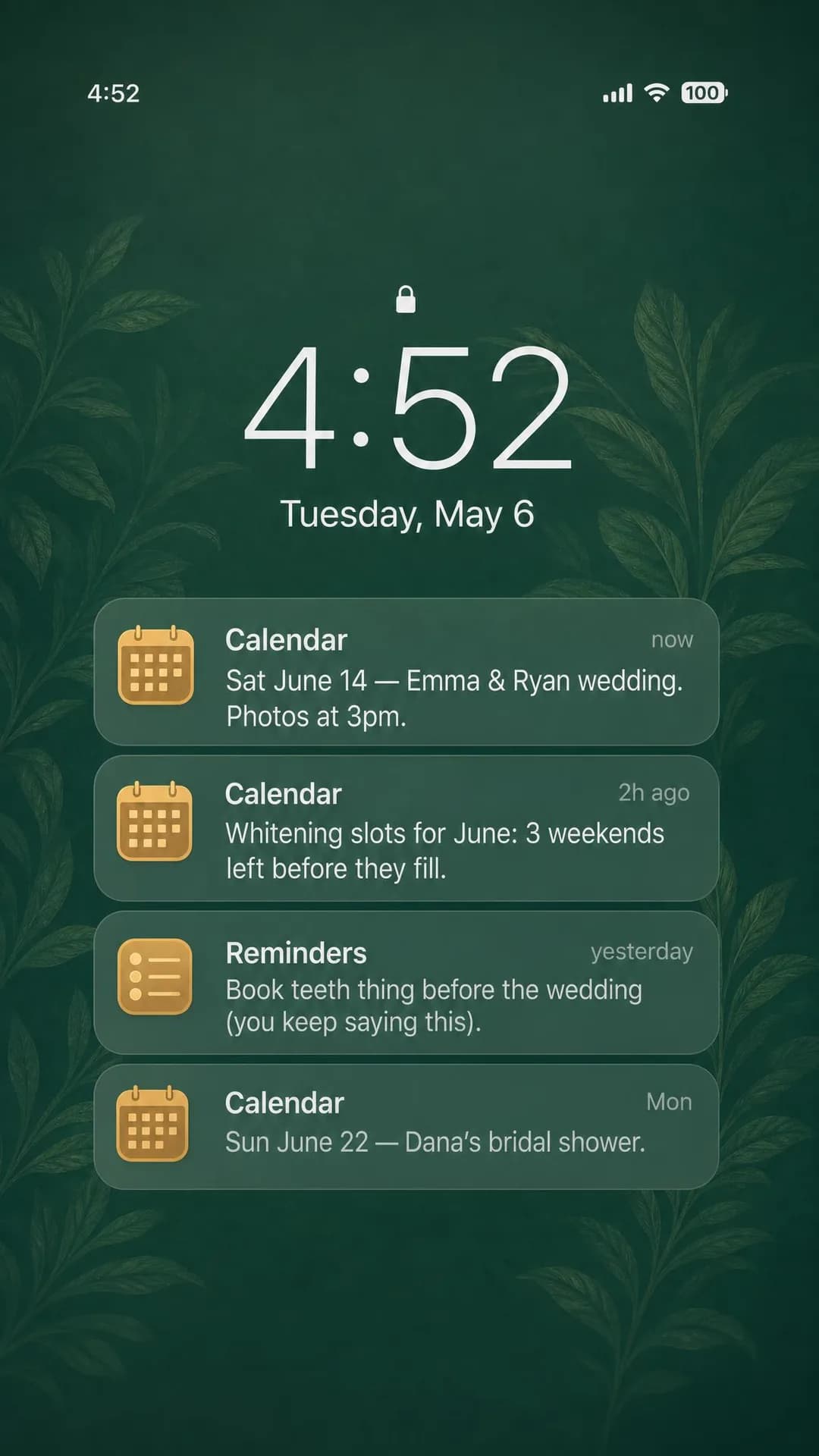 Example adJune wedding slots filling fastSee the brief →
Cosmetic work priced by the month
Leads- Who it is for.
- Under-40s who can afford a monthly number but not a five-figure quote, and have put the work off for three years because of it.
- Angle.
- Offer & Economics — Financing & Installments re-denominates the price rather than discounting it: the total becomes a line on the bill stack the reader already manages. The terms must be the practice's real terms — no-interest claims are regulated — and the copy states the monthly number as the practice's fact, never as a claim about what the reader can afford.
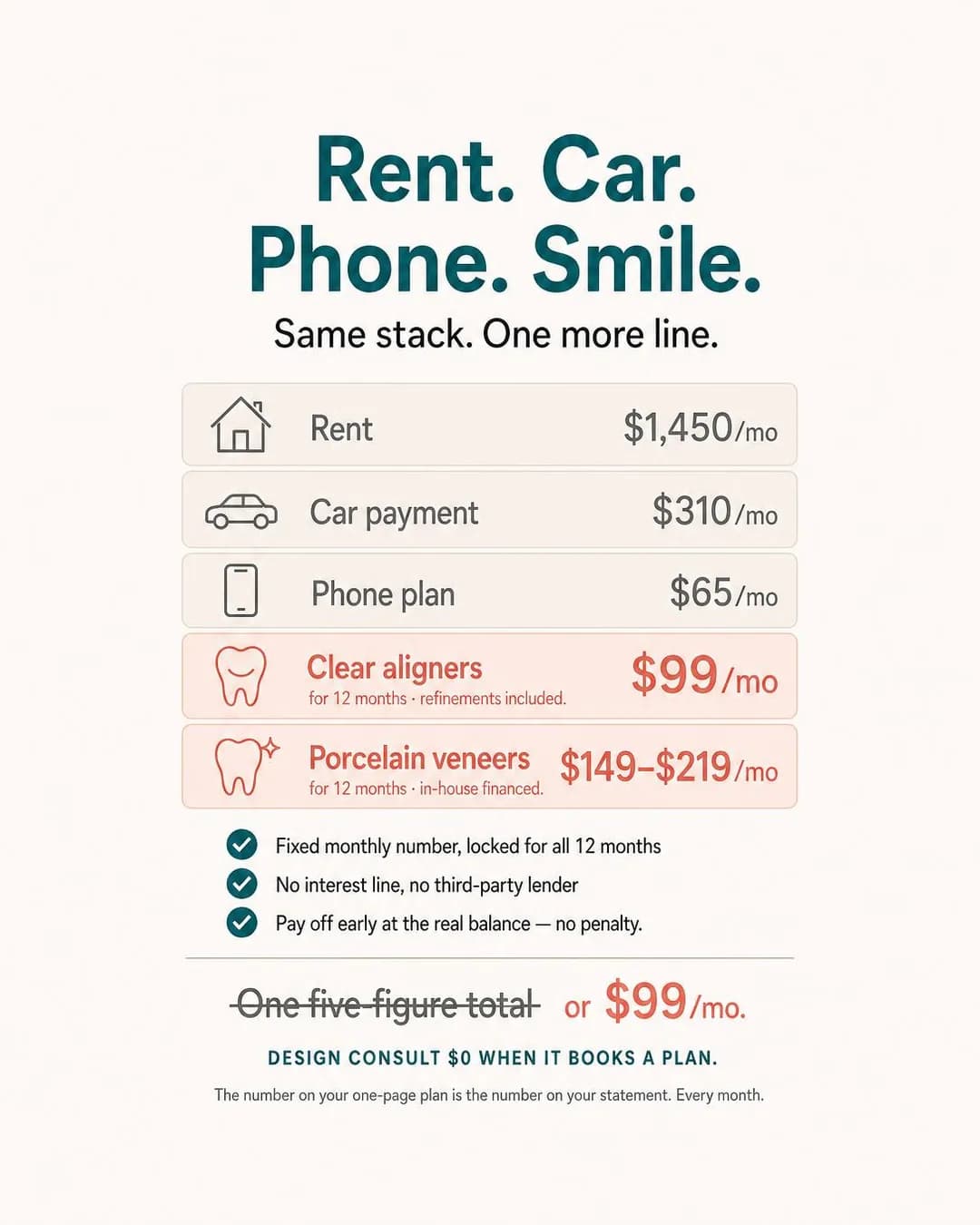 Example adOne more line on the bill stackSee the brief →
The first practice of your own
Leads- Who it is for.
- Someone who aged out of their parents' dentist, moved cities, or changed jobs — refilling a slot that used to be full, not shopping for dentistry.
- Angle.
- Offer & Economics — This reader has already decided to see a dentist; the only open question is which one — so price the first visit specifically enough to be believable, write the copy in the third person (“No insurance?” is a financial-status assertion this audience is especially likely to be on the wrong end of), and get out of the way.
No example ad for this offer on the examples page yet.
The enamel check for the seltzer generation
Traffic- Who it is for.
- Sparkling-water devotees in their twenties and thirties who chose it over soda precisely because it seemed like the healthy option.
- Angle.
- Problem & Pain — Bad Habit is welcome news rather than an accusation — the reader's own healthy choice is the culprit — and the exam is a 15-minute check that shows the wear before it needs fixing. Keep the claim calibrated (acid wear, not “dissolving”), and keep it third-person: the second-person version of this ad is a diagnostic question about the reader's teeth.
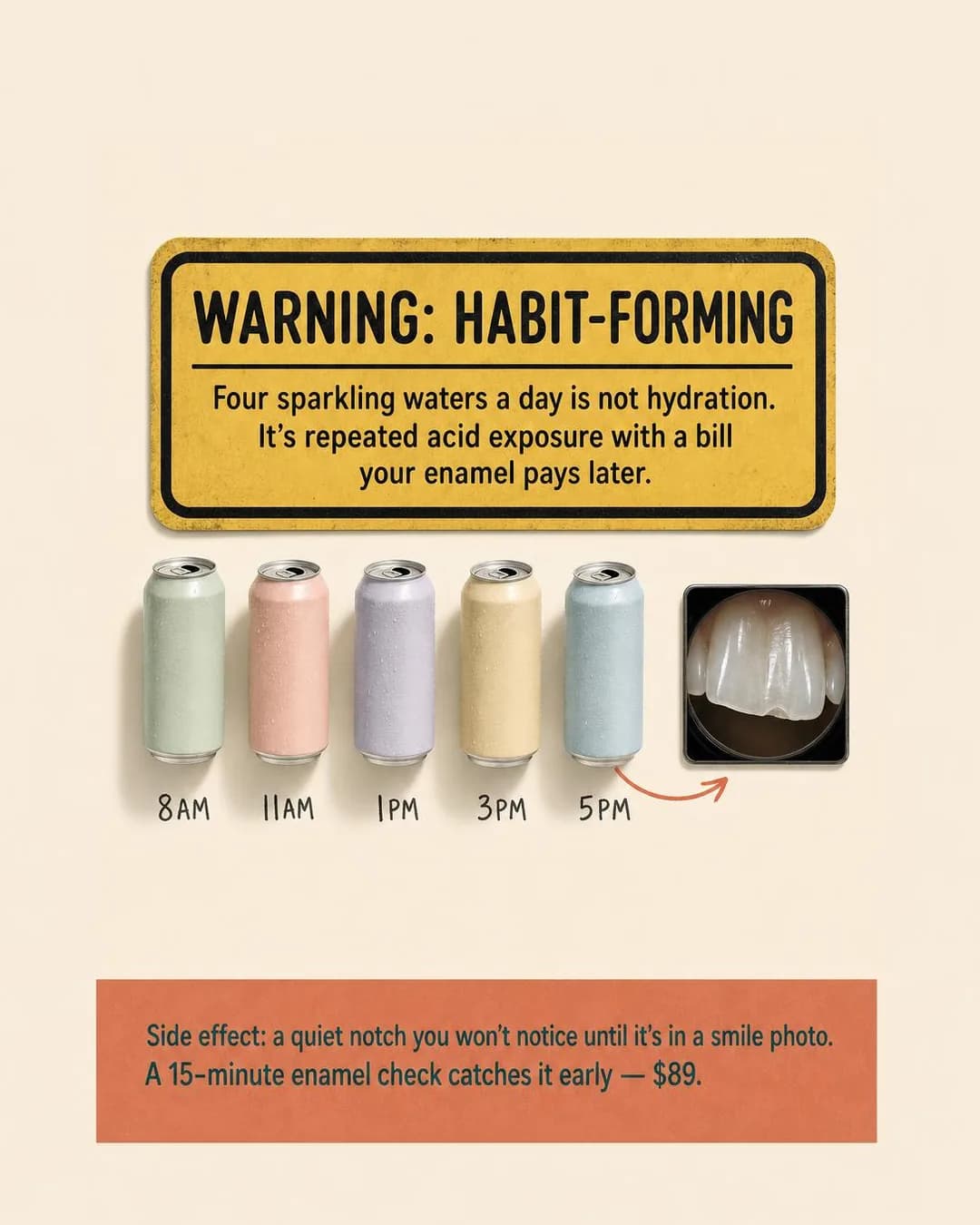 Example adFour cans a day has a priceSee the brief →
The single-visit smile fix
Leads- Who it is for.
- Chronic closed-mouth smilers: people who have kept one photograph for a decade because it is the only one they like.
- Angle.
- Identity & Emotion — Future Self is the family for an offer that is about the photograph, not the procedure — edge reshaping, bonding and whitening in one 2.5-hour visit, posted pricing. It is also the most policy-exposed idea in the category: the entire vernacular of this ad is a second-person assertion about the reader's appearance, so the story goes in a patient's mouth, in the third person, and the price menu has to be real.
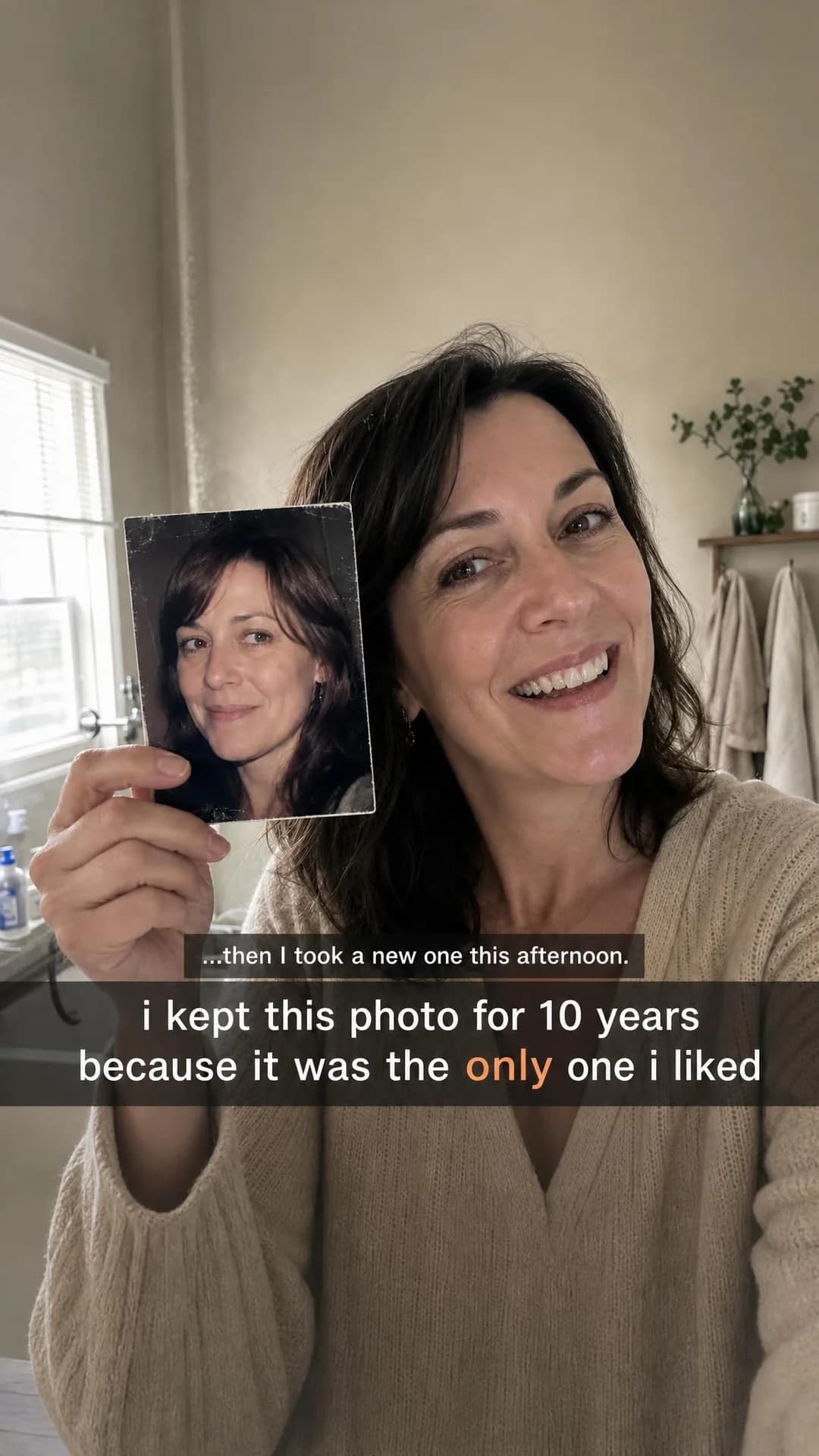 Example adOne visit. New photos this afternoon.See the brief →
The conversation-first visit
Awareness- Who it is for.
- People who switched dentists after the cleaning that turned into a sales pitch.
- Angle.
- Story & Founder POV — Why-We-Built-This is the founder's own story, and every claim in it is about the writer, which is the compliant side of the first person: the meeting, the upsell script, the practice built as the opposite. Awareness is the honest objective — a familiar face in a small radius — and the signature has to be the real dentist's name.
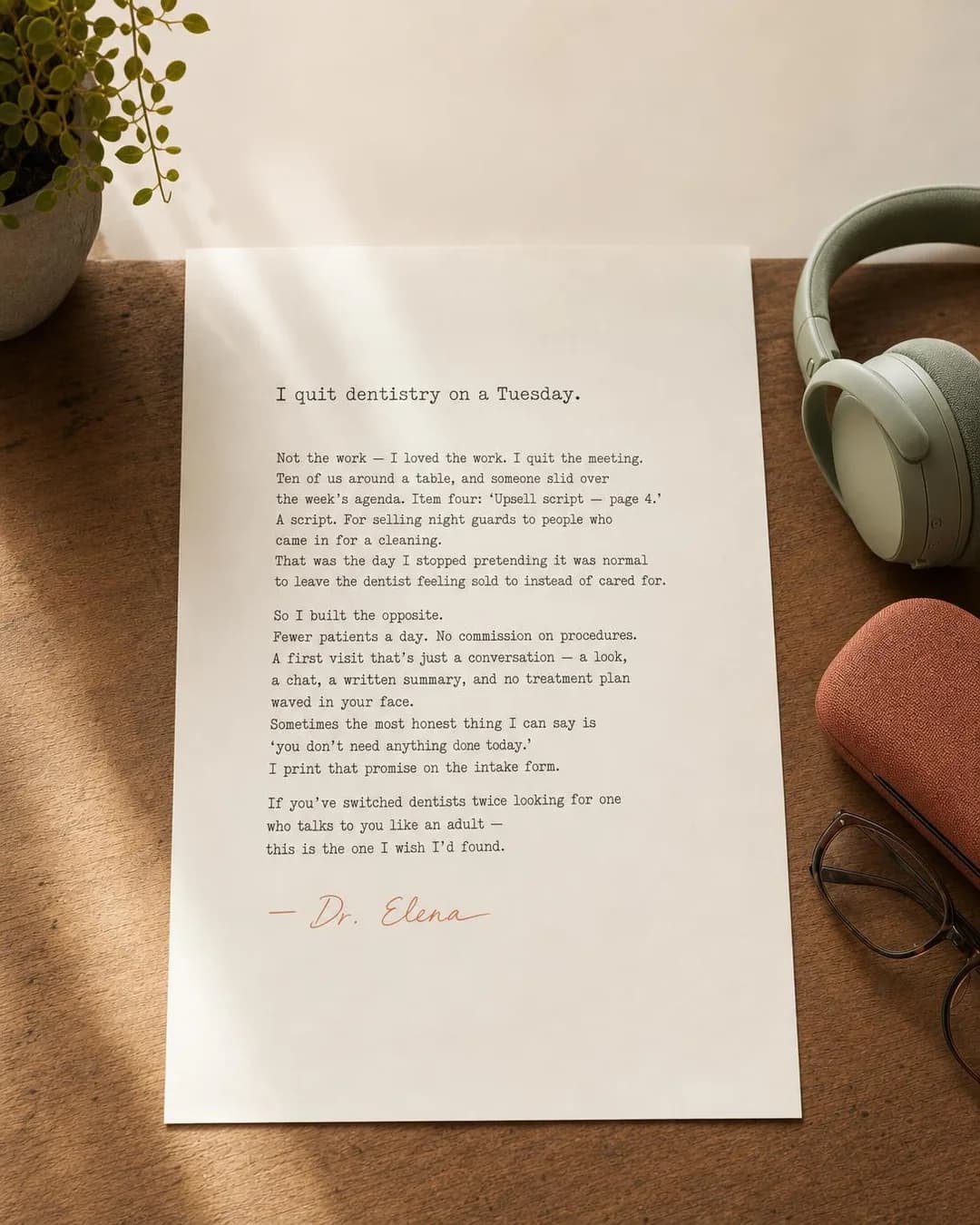 Example adNo upsell script. Just honest care.See the brief →
In-house membership for the self-employed
Leads- Who it is for.
- Freelancers and gig workers priced individual dental cover and found it costs more than the cleanings it pays for.
- Angle.
- Offer & Economics — One of the few products in dentistry with real subscription economics, and this audience meets it without an employer's plan. Price it against individual insurance — the comparison the reader is already running — and check what your state board requires you to disclose beside the price. The Facebook guide's membership row has the full argument; the offer is the same on this app, aimed younger.
No example ad for this offer on the examples page yet.
Targeting: what dentists keep, and the one thing they must not do
Start from the rule that decides everything else, and note that it is the same rule on both apps because it is about the trade, not the platform. Meta's Marketing API accepts exactly four special ad categories — housing, employment, financial products and services, and social issues or politics — and health is not among them. A dental practice keeps every lever a housing advertiser loses, on Instagram exactly as on Facebook. If a guide tells you to leave age open because “Meta restricts health advertisers”, it has confused a dental practice with a real estate agency.
The corollary is the part that catches people, and on this half of the trade it is where the enforcement actually lives. Because the ad set can qualify the audience precisely, the creative does not have to — and Meta's personal attributes policy prohibits an ad that asserts or implies a person's physical or mental health, medical conditions, or vulnerable financial status. The cosmetic vernacular fails this twice: “Embarrassed to smile?” asserts a condition, and the appearance half of it — statements of inferiority about physical appearance, imagery that works by making the viewer feel bad about how they look — is prohibited outright, separate from any health claim. The audience brief and the ad copy are two different documents; “adults who have kept one photograph for a decade” is a targeting and writing instrument, and the sentence that may not appear in the ad is “You've been rationing it for years”.
One age rule attaches to the imagery rather than the category: before-and-after transformation imagery for a cosmetic procedure — permitted again since 22 July 2026 — requires the ad to be targeted to adults 18 and over. That is a condition attached to the creative, which means it has to be true of every ad in the ad set, not just the headline ad.
The one place this can go wrong outside the ad account is patient data, and it is worth stating plainly because the platform will let you do it. Whether you may upload a patient list at all is a HIPAA question for whoever handles your compliance. And Meta's own Business Tools terms prohibit sharing data based on health information — including the names you choose for events, conversions and custom audiences, so “Aligner Enquiry” is fine and “Gap Teeth Enquiry” is not. Name events for what happened, never for who it happened to.
- Special ad categoryNot required
- Health is not one of the four, on either app. Leave the toggle off — ticking it “to be safe” hands back age targeting, lookalikes and your radius in exchange for nothing.
- RadiusUse it
- The smallest radius Meta's Marketing API allows is 0.63 miles / 1 km, so the circle can be as tight as the practice likes. Think drive time, not miles: a river or a one-way commute cuts a market in ways a circle does not. Start as small as the budget can spend and widen only when delivery forces it.
- AgeUse it
- The lever this trade keeps, and on this app the whole point of choosing it. Band to the offer: 18–34 for aligners and the first-practice offer, 25–44 for bonding, veneers and financing. One exception is not optional: transformation imagery in the creative means the ad set is 18-plus, explicitly.
- Detailed targeting (interests)Rarely
- At a small radius the geography and the age band are the targeting; layering interests on top usually leaves an audience too thin to leave the learning phase, which costs more in delivery than the precision was worth.
- LookalikesCareful
- Available to you, unlike housing advertisers — but the seed is the question, not the tool. A patient list is protected health information; website visitors, video viewers and profile engagers are not, and are the safer seed.
- ExclusionsUse it
- The most-skipped setting in local dentistry. Without one, a young radius guarantees you are paying to show a new-patient offer to the patients you already have — who will notice, and ask for it at the desk.
- Event and audience namesCareful
- Meta flags conversions whose names imply a health condition and blocks them from running. “Consult Booked” is fine; the procedure is not. This is invisible until an account stops delivering, which is what makes it worth knowing in advance.
Instant Form, landing page, or the DMs?
Instagram adds a destination Facebook does not, and for a young cosmetic practice it is often the honest one. Meta's lead ads can send people into a conversation on Messenger, Instagram or WhatsApp, and there is an “Instant forms and Messenger” conversion location that runs one campaign and lets delivery pick the form or the chat per person. A cosmetic practice that already lives in its DMs — which is where this audience asks whether the consult is free and whether the mock-up hurts — should buy the conversation, on one condition: someone answers within the hour during the hours the ads run. A click-to-message ad with nobody on the thread is paid-for silence.
When nobody can answer messages that fast, use the Instant Form on the “Higher intent” type. The review step lowers the lead count and raises the proportion that answer the phone, and in a business where the front desk does the converting by hand that is the trade you want. Two or three qualifying questions for the expensive cases — which tooth, what happened, how soon — and accept the volume drop.
Send the click to a landing page whenever the offer carries a mechanism, terms or a price that needs believing: the scan that replaces the tray, the financing plan with its no-interest claim, the mock-up consult with its credited preview fee. Those are pages, and the ad's job is to earn the read. Never the homepage — a reader who tapped an ad about bonding and lands on a rotating hero of a smiling family has been asked to start their search over.
Emergency is not on this list at all, and that is deliberate. Same-day pain is a demand-capture buy: it lives in Facebook's search results and right-hand column, surfaces Instagram has no equivalent of, and the Facebook guide's call-ad section is where it belongs.
The recommendation: The DMs if someone answers inside the hour during opening hours; otherwise Instant Form on “Higher intent”. A landing page whenever the offer carries a mechanism, terms or a published fee — never the homepage. Emergency is a Facebook buy, not an Instagram one.
Creative direction
The first rule is the one that moved most recently: on 22 July 2026 Meta moved its Health and Wellness standards from product-based to claims-based enforcement, and before-and-after transformation imagery for cosmetic procedures is permitted again at 18-plus. This is the format cosmetic dentistry built its whole visual language around, and it is back — with two conditions that matter more than the permission. The panels have to be comparable (same framing, same lighting, same expression; a dim candid against a bright studio portrait is the emotional before/after, and it is worthless as proof), and the caption has to stay clear of anything that works by making the viewer feel bad about how they look. The image is no longer the violation. The caption is, and so is the pair that doesn't hold still.
The second rule is Instagram's own: there is no search surface, so every ad interrupts a scroll, and the ads that stop thumbs open on a moment rather than a service. The ten on the examples page open on a row of seltzer cans, a stopwatch against a circled date, a lock screen, a held photograph, a printed letter — one object each, and the offer arrives after the moment. An ad that opens “Composite bonding from $450” is not wrong, it is invisible.
Third, whose face is in the ad. A stock model with veneers no dentist produced is the default in this category and on this app it is worth less than anywhere: the Instagram feed is full of genuinely well-shot faces, so stock gloss reads as stock at a glance. It is worth less than a badly-lit photo of the actual operatory, the actual team, the actual scanner — the reader is choosing a building they will drive to and a person who will be holding the instrument. And if the face is a named person — a testimonial, a signature — it has to be a real one: this cluster's own runs invented a dentist, a patient with a 2pm appointment and a founding date, and every one of those is a real practice's ad only when every one of them is true.
Fourth, restraint with numbers. One figure per ad, and only one you will honour at the desk — the ADA's Code of Professional Conduct requires that fees not be represented in a false or misleading manner, state boards enforce their own advertising rules on top, and a financing term is a contract claim: the ad's terms have to be the agreement's terms. A comparative claim about somebody else's product or plan is one you would be publishing under your own name.
- Render at 4:5, 1440 × 1800 — identical to Facebook Feed, so one export serves both — but the aspect-ratio tolerance here is 1%, not Facebook's 3%. An export a few pixels off passes there and fails here.
- Write the headline to about 40 characters: Meta's recommendation for Instagram Feed, thirteen more than Facebook's 27, which is the opposite of what everyone assumes. The primary text recommendation is about 125 — and on this cluster's own evidence the primary text always runs long, so the argument has to survive inside the first sentence, because that is all that shows before the fold.
- Give Stories and Reels their own 9:16 creative — a phone-native concept (a lock screen, a held photograph) is a vertical ad waiting to happen. Skip 1.91:1 — not because Instagram rejects it, which it does not (Instagram Feed's technical requirements run from a minimum of 4:5 to a maximum of 1.91:1), but because the surfaces built to want a wide asset are Facebook's right-hand column and search results. Corrected 7 September 2026; this page previously said the app had no placement for the shape.
- Open on a moment, not a service name — a can, a clock, a calendar, a photograph. Nobody searches here, so nothing captures demand for you: the opening line has to earn the stop itself.
- Write every line in the third person. “Do you hide your smile in photos?” asserts the reader's appearance and their health at once; “Edge reshaping, bonding and whitening in one 2.5-hour visit” is the same offer, compliant.
- Put the hesitation in a patient's mouth, in quotation marks — “But will this actually work for MY teeth?” — rather than aiming it at the reader. It is warmer, and it is the version that passes review.
- Before/after is permitted again at 18-plus, with comparable panels — same framing, same lighting, same expression — and the caption kept clear of inferiority claims. Own patients, written consent, a representative case: the permission is Meta's, the picture is the board's, and the claim rules are both.
- One number per ad — a price, a duration or a distance, not all three — and only a number you will honour at the desk. A financing term is a contract claim, not a flourish.
- Look at the rendered image before you judge the copy, and check anything with a number in it: this cluster's runs have drawn a phone whose calendar dates were internally perfect for the wrong year, and a date stamp that matched the copy's story to the year. The discipline is looking, not trusting.
- No invented people, and no real ones without consent: a named dentist's signature, a quoted patient, a founding date — each has to be true before the ad runs. An invented testimonial is the one defect no amount of polish covers.
Funnel structure
Three stages, and on this app a practice is better placed to build the third than on any other — because the warm pool here is bigger. Story replies, saved posts, DM history and profile engagers are all retargetable, and a practice that has run its Instagram account for a year has already paid for the middle of its funnel in effort. Cold does the volume, warm does the conversion, and the patient list is both an exclusion and an audience — excluded from acquisition so you stop discounting for people who already come to you, and targeted directly for the campaigns that only make sense to someone already in the chart.
Keep it three ad sets, not nine. A small budget divided that thin never leaves learning, and variation belongs at the ad level, inside one ad set — the offer is the variable that changes between ads, not between ad sets.
Cold
≈70% of budgetAudience. Small radius around the practice, age-banded to the offer, no interest layering, existing patients excluded.
Running. Two to four offer ads — whichever chairs are empty. Leads, to the DMs or an Instant Form on Higher intent.
Warm
≈20% of budgetAudience. Profile and Page engagers, story replies, video viewers, website visitors from the last 90–180 days.
Running. Mechanism and proof: the scan preview, the mock-up process, the dentist talking. Traffic or Leads.
Patients
≈10% of budgetAudience. The practice's own list — an exclusion on the two stages above, an audience on its own terms.
Running. Wedding and event season, the hygiene recall, unfinished treatment plans. Seasonal rather than always-on.
Budget and testing
The arithmetic is the same on both apps because it is about delivery, not the platform: Meta needs roughly 50 optimisation events per ad set per week to leave the learning phase, so multiply your own cost per lead by 50 to get the weekly spend at which one ad set is working with full information — and for most single-location practices that is more than they can spend, which is an argument for one consolidated cold ad set, not for spending more than the practice can absorb. The Facebook guide carries the full version of that arithmetic, and the leave-it-alone rule that goes with it: significant edits restart learning, and an account adjusted every morning never finishes it.
Then the platform-specific half, which is a calendar. The cosmetic year is other people's calendars: wedding season fills late spring and summer — buy the month before the peak, not the peak, because the June bride books in April — engagement announcements cluster from late autumn into the new year, and graduation and reunion photos each open a window. The wedding-season ad on the examples page is a spring creative, dated September only because that is when the batch ran.
Judge on the number that is actually a patient: cost per attended consult, not cost per lead or per DM started. A conversation that peters out because nobody answered the thread is the click-to-message version of the cheap lead, and the staffing condition in the destination section exists to prevent it.
- Test the offer, not the headline. Swapping five words is a significant edit that restarts learning, for a change too small to detect.
- One change at a time, and give it seven days — the learning phase is measured over a week, so anything shorter is reading noise.
- Read cost per attended-and-kept consult, not cost per lead or cost per DM. The front desk is the second half of this funnel.
- If you bought the DMs, the reply time is part of the creative — measure it like one, and switch to the form the week it slips past an hour.
- Before blaming the creative, check whether the ad set ever left learning. Half of “Instagram doesn't work for dentists” is an ad set that never got the evidence to try.
Six of these ads, in full
Every ad below was generated by best-in-slot for a dental practice that does not exist, with its audience, angle and objective pinned before the run — and published exactly as it came back. They are six of the Instagram examples for a dental practice; the rest, with the full brief and the alternate headlines behind each one, are on that page.
Problem & Pain · 4:5 · Traffic
Four cans a day has a price
Written for: Sparkling-water devotees in their twenties and thirties.
The full brief and why it works →
Proof & Trust · 4:5 · Leads
One corner fixed. Two decades ended.
Written for: Adults who broke a front tooth years ago and smile around it.
The full brief and why it works →
Comparison & Positioning · 4:5 · Leads
Clear aligners. Actual dentist visits.
Written for: People who keep seeing mail-order aligner ads.
The full brief and why it works →
Scarcity, FOMO & Timing · 9:16 · Leads
June wedding slots filling fast
Written for: People in a wedding this year.
The full brief and why it works →
Identity & Emotion · 9:16 · Leads
One visit. New photos this afternoon.
Written for: Chronic closed-mouth smilers.
The full brief and why it works →
Story & Founder POV · 4:5 · Awareness
No upsell script. Just honest care.
Written for: People who switched dentists after the headphones-and-upsell visit.
The full brief and why it works →
Mistakes specific to this half of the trade
Every one of these is common, the first three are why cosmetic accounts collect rejections that restorative accounts never see, and the fourth is what the cluster's own generated runs got wrong on the record.
Writing the caption in the vernacular the whole category uses
“Embarrassed to smile?”, “Do you hide your smile in photos?”, “Tired of cropping yourself out?” — each asserts something about the reader's health and their appearance at once, and the appearance half carries its own prohibition regardless of any health claim. The fix is grammatical: put the hesitation in a patient's mouth in quotation marks, or state the service in the third person. Same offer, delivered.
Boosting the before/after Reel that worked organically
An organic post runs under looser content policies; the moment money is behind it, the advertising standards apply in full — the 18-plus targeting for transformation imagery, the personal-attributes rules, the inferiority rules. The Reel that performed fine on the feed gets rejected the day it is boosted, correctly. Rewrite the caption in the third person, set the age floor, and the same creative runs as an ad.
Before/after panels that flatter instead of compare
A dim candid beside a bright studio portrait is the emotional before/after, not the clinical one — different light, framing and expression is exactly what professional advertising rules mean by non-comparable presentation, and it is worthless as proof even before consent comes up. Same camera, same distance, same lighting, a representative case. The transformation is allowed again; the sales angle was never what the permission covered.
Testimonials, signatures and histories for people who do not exist
A first-person quote from a fabricated patient, a founding date (“since 2014”), a letter signed by an invented dentist — this cluster's own generator produced all three in one batch, fluently. In a health trade a fabricated testimonial is not a style choice: the claim asserts an outcome, and the outcome has to belong to somebody. Real patient, written consent, real history — or the third person.
Running the restorative offers on Instagram because it feels more modern
Implants, dentures and full-arch work concentrate in the cohorts where Instagram reaches 40% and 19% — the exact ages where this app has the least to sell with. The Facebook guide in this cluster gets that half of the trade. Advertising it here buys the most expensive reach in the two-app set, and no amount of creative quality changes the arithmetic.
Expecting Instagram to capture demand
There is no search surface and no right-hand column on this app — the six-in-the-morning toothache search that justifies an emergency ad is a Facebook buy, and Instagram has no equivalent. An emergency ad here interrupts strangers who are not in pain; on Facebook it catches the person already looking. Put same-day pain where the demand is.
Publishing financing terms that are not real terms
“In-house financed. No interest line. No third-party lender.” is a set of credit claims. The ad that says “$99/month for 12 months” has to be backed by a contract that says the same thing — including the early-payoff and penalty terms the fine print carries. A published term is a contract the reader can hold you to, and an invented one is a published price you cannot honour.
One ad set per offer
The intuitive structure and the reason the account never leaves learning. Five ad sets on a small budget is five piles of evidence too thin to optimise on. Consolidate to one cold ad set and let the offers compete as ads inside it.
Sending every click to the homepage
The ad made one specific promise and the homepage answers a different question. If there is no page for the offer, use the DMs or an Instant Form — a conversation that matches the ad beats a beautiful site that does not.
Buying the conversation nobody is having
Click-to-message ads convert exactly as well as the reply time behind them. If nobody answers the thread inside the hour during the hours the ads run, the form is the honest destination — a paid-for silence is the most expensive kind of success this platform sells.
Questions
- Should a dental practice advertise on Instagram or Facebook?
- Follow the procedure. Pew's November 2025 survey puts Instagram at 80% of US adults aged 18 to 29 and 62% of those 30 to 49, against Facebook's 68% and 80% — flipped at 50-plus, which is where the restorative half of the trade lives. The young-adult offers are this page; implants, dentures, emergency and crown work are the Facebook page in this cluster. Most general practices should run both and let the offer decide.
- Can dentists use before-and-after photos in Instagram ads?
- Yes, since 22 July 2026, provided the ad targets adults 18 and over. That is when Meta moved its Health and Wellness standards from product-based to claims-based enforcement, and transformation imagery for cosmetic procedures became permitted rather than auto-rejected. The conditions that matter: comparable panels, a caption clear of anything that works by making the viewer feel bad about how they look, your own patients and their written consent, and a representative rather than best-ever result.
- Why was my ad rejected for “Do you hide your smile in photos?”
- Because the second person asserts something about whoever is reading — their appearance and, in a health context, their condition. Meta's personal-attributes policy prohibits asserting or implying a person's physical or mental health, and statements of inferiority about physical appearance are prohibited separately, so this category's entire vernacular fails twice at once. Put the hesitation in a patient's mouth in quotation marks, or state the service in the third person; the compliant version of the ad is usually already in its own alternates.
- Do dental ads need a special ad category on Instagram?
- No. Meta's Marketing API accepts four special ad categories — housing, employment, financial products and services, and social issues, elections or politics — and health is not one of them, on either app. A dental practice keeps age targeting, lookalikes and any radius it likes. The one age rule in this category is different: creative carrying before-and-after transformation imagery requires the ad set to target 18 and over.
- Should the click go to a form, a landing page, or the DMs?
- The DMs if someone answers messages inside the hour during opening hours — lead ads can click to message on Messenger, Instagram or WhatsApp, with a conversion location that lets delivery pick the form or the chat per person. Otherwise the Instant Form on the “Higher intent” type, which trades volume for leads that answer the phone. A landing page whenever the offer carries a mechanism, terms or a price that needs believing — the scan, the mock-up consult, the financing plan. Never the homepage.
- How much should a dental practice spend on Instagram ads?
- Do the arithmetic rather than copying a number: multiply your own cost per lead by 50 to get the weekly spend at which one ad set leaves the learning phase. Most single-location practices can buy a fraction of that, and the budget section covers what to do with the fraction — consolidate, don't spread.
- Can I upload my patient list to build a lookalike audience?
- Whether you may upload a patient list at all is a HIPAA question for whoever handles your compliance, and the platform will happily let you do something you should not. Separately, Meta's Business Tools terms prohibit sharing data based on health information — including the names given to events, conversions and custom audiences, so an audience called “Aligner Enquiries” is a problem on its own. Website visitors, video viewers and profile engagers are much safer seeds and usually good enough.
Sources
Every platform claim on this page was read against these on . Meta’s policies move; if one of these disagrees with this page, it is right and we are stale.
- Meta Advertising Standards — Health and Wellness (policy updated 22 July 2026)
- Meta Advertising Standards — Privacy Violations and Personal Attributes
- Meta Marketing API — special ad categories (health is not one)
- Meta Marketing API — basic targeting reference (custom location radius: 0.63–50 miles, 1–80 km)
- Meta for Business — lead ads that click to message (Messenger, Instagram, WhatsApp; the Instant forms and Messenger conversion location)
- Meta Business Help Centre — choosing Ads Manager advertising objectives
- Meta Business Help Centre — about the learning phase
- Meta Business Help Centre — significant edits and the learning phase
- Meta Business Help Centre — about Instant Form types
- Meta Business Help Centre — about sensitive health information (event and audience names)
- Meta ads guide — image ad specifications, Instagram Feed
- American Dental Association — advertising, marketing and the Code of Professional Conduct
- Pew Research Center — Americans' social media use, November 2025
That is the playbook. Now make the ads.
Paste your practice website. It reads your services, your patients and your brand, then writes the concepts, renders the images and drafts the copy.
No credit card · 50 free credits (about 5 ads or Instagram posts)
Every angle recommended above is documented in the best-in-slot ad angle library, and the ads are from dentist instagram ad examples. More industries are at all ad guides.