
Ad Guides · Dentists × Facebook
Facebook ads for dentists
The offers, the angles, the targeting rules and the policy walls — for a dental practice, on Facebook, checked against Meta's own documentation this month.
Almost every guide to Facebook ads for dentists is wrong about the same three things, and all three are checkable in an afternoon. It will tell you before-and-after photos are banned; Meta rewrote that rule on 22 July 2026 and they are not. It will hand you headlines — “Missing teeth?”, “Embarrassed to smile?”, “No insurance?” — that Meta's personal attributes policy prohibits outright, which is why the account they came from kept getting rejected. And it will repeat targeting advice borrowed from real estate agents, who advertise under a special ad category that dentists are not in, and so will talk you out of levers you are entitled to use.
This page is the version with the documentation open. What follows is what a single-location practice should actually buy on Facebook: which of the six objectives, which offers are worth advertising and which argument wins each one, what you may and may not say about the person reading, whether to send the click to a form or a page, and the budget arithmetic that decides whether Meta's delivery system is working with enough information to help you. Every platform claim is footnoted at the bottom and dated.
The thing that makes dentistry unusual on this platform is a trade. Housing, employment and credit advertisers are forced into a special ad category that strips their targeting to the studs — no age, no lookalikes, a fifteen-mile minimum radius. Dentists escape all of it and keep every lever. What they pay instead is a content restriction that almost nobody accounts for: the ad set may describe the patient in as much detail as you like, and the ad copy may not describe them at all. Get that trade the right way round and most of this page follows from it.
The ads shown below are real output, not mockups drawn for the argument. Six of them are pulled from the ten on the dentist Facebook examples page, published exactly as they were generated, for practices that do not exist. The prices in them are invented and should be read as placeholders — a fee you publish in an ad is a fee you have to honour at the desk, and the ADA's Code of Professional Conduct plus your own state board both have something to say about that.
Two things this page is not. It is not legal or regulatory advice: Meta's rules are the floor, your state dental board's advertising rules sit on top of them, and where patient data is involved the question is a HIPAA question that your ad account cannot answer. And it is not a benchmark report. There are no cost-per-lead figures here, because a number from somebody else's market is worth less than the arithmetic you can do with your own — which is in the budget section, and is the most useful thing on this page.
Generate Facebook ads for your practice
Paste your site and best-in-slot reads it the way the invented practices above were read — services, patients, positioning — then writes the concepts, renders the images and drafts the copy. Free to start, no card.
What you are actually buying by choosing Facebook
The split between the two apps is not a matter of taste for a dental practice, it is a matter of which procedures pay for the advertising. Cleanings are spread evenly across ages; the revenue is not. Implants, dentures, full-arch and crown-and-bridge work concentrate in the cohort where Pew's November 2025 survey puts Facebook at 74% of 50- to 64-year-olds and 57% of those 65 and over, against 40% and 19% for Instagram. If your growth plan is restorative, this is where the budget goes and the Instagram half is a supporting buy. If it is an orthodontic practice selling clear aligners to people in their twenties, read the Instagram guide first and treat this one as the supporting buy. Most general practices are somewhere in between and should run both, with the offer deciding which app each ad set sits on rather than a flat split.
The second thing Facebook buys you is the phone. Call ads are a mobile-only format, and Meta delivers them across Facebook Feed, Facebook Marketplace, Facebook Reels and Facebook Video feed as well as Instagram Feed and Instagram Stories — so two of the six surfaces that can ring your front desk are Facebook inventory with no Instagram equivalent. For an emergency line that is not a detail. It is also the one place in this whole playbook where the reporting is unusually honest: Ads Manager separates calls placed from 20-second calls and 60-second calls, and a 60-second call is the only number on the platform that behaves anything like a booked appointment. Optimise and judge on that, not on the click.
Third, shape. Facebook stopped being the landscape platform: Meta's own ads guide recommends 4:5 at 1440 × 1800 for Facebook Feed, the same portrait shape as Instagram feed, and that is where the bulk of a practice's creative should be rendered. The exception is 1.91:1, which in our own publisher routes to Facebook's right-hand column and search results and to no Instagram position at all. That is worth exactly one asset for most practices — the emergency ad — because somebody who has just typed a question about a tooth at six in the morning is on the other side of that surface and cannot be reached from the other app.
Finally, the audience you already own. A practice that has been on Facebook for a decade has a Page with engagers, reviewers and event attendees attached to it, and that is the warm pool the middle of the funnel runs on. It costs nothing, it does not depend on uploading anything about a patient, and it is the single most-skipped asset in local dental advertising — most practices spend their entire budget talking to strangers while the people who already followed them see nothing.
Which objective to buy
Ads Manager offers six objectives — Awareness, Traffic, Engagement, Leads, App promotion and Sales — and a dental practice has a real use for two of them, an occasional use for a third, and no use at all for the rest. The objective is not a label describing what you want; it is the instruction that decides who Meta shows the ad to, so choosing the flattering one is how an account ends up with 400 video views and no appointments.
Leads is the default and should be most of the budget. Seven of the ten ads on the examples page were written for it, and the reason is structural rather than stylistic: nothing in dentistry completes in the ad's own session. The most an ad can cause is a form, a call or a booking, which is precisely what Leads optimises toward.
The interesting one is Awareness, and it is only rational here because of the rule dentists escape. A practice's entire addressable market is the few thousand households that would plausibly drive to it — that is a shape you can actually buy when age and a three-mile radius are still available to you, and it is not a shape a housing advertiser can buy at all. An Awareness buy against a genuinely small, genuinely local audience is a different product from the Awareness buy a national brand makes with the same button.
- LeadsDefault
Where most of the budget goes. Choose the destination deliberately — Instant Form, website, or calls — because that choice matters more than anything else in the ad set. See the destination section below.
- TrafficSometimes
For the offers nobody can name. Chairside milling and night guards are invisible from the patient's side of the chair; asking someone to book a procedure they cannot pronounce is asking too early, so buy the read and retarget the readers.
- AwarenessSometimes
Buyable here in a way it is not for most local advertisers, because the radius and age levers survive. Use it for the practice itself — the dentist, the hygienist, the room — not for an offer. Do not expect it to fill next week's book.
- EngagementRarely
It optimises for the cheapest available reaction, and in a three-mile radius the cheapest reaction is your own patients tapping like. Its one honest use is building a video-viewer pool to retarget, and even then Traffic usually builds a better one.
- SalesNo
Nobody buys a crown in a checkout. The exception is a practice with a genuine retail line — whitening kits, electric brushes, aligner refinements sold online — and that is an ecommerce business wearing a dental coat, with its own catalogue and its own guide.
- App promotionNo
If the practice has an app at all, patients install it after they are patients. Paying a stranger's install cost to deliver a booking screen they have no reason to open is the most expensive way to buy an appointment on this platform.
What to advertise, and the argument that wins it
This is the part of a dental campaign that is actually industry-specific, and it is where most accounts go wrong before a single targeting decision is made. A practice sells a dozen distinguishable things to a dozen distinguishable people, and they do not respond to the same argument. The reader who has been quoted $28,000 for full-arch implants and walked away is not weighing the same question as the reader who moved house last month and needs a cleaning; running one “new patient special” at both of them wastes the half of the budget spent on the first.
Each row below pins four decisions: who the offer is actually for, which angle family argues it best — every one of those is a page in the angle library, with the sub-angles spelled out — which objective buys it, and, where the examples page has one, a finished ad that shows the whole thing assembled. Twelve rows is not a checklist to run all at once. Pick two or three that match what your chairs are empty for this quarter.
One structural note before the table: the angle is a property of the offer, not of the practice. The same clinic advertising implants in March and year-end benefits in November should be making two completely different kinds of argument, and an agency that runs one house style across both is leaving the second one on the table.
New-patient exam, X-rays and cleaning
Leads- Who it is for.
- Someone who moved, changed jobs, or lost a dentist to retirement. They are not shopping for dentistry — they are refilling a slot that used to be full.
- Angle.
- Offer & Economics — This reader has already decided to see a dentist; the only open question is which one. Every other family argues a case they have accepted. Price the first visit, make it specific enough to be believable, and get out of the way.
No example ad for this offer on the examples page yet.
In-house membership plan
Leads- Who it is for.
- Self-employed and uninsured patients paying cash at the desk, who have been quietly not coming for two years.
- Angle.
- Offer & Economics — One of the few products in dentistry with real subscription economics, so price it against the right enemy: individual dental insurance, not the practice down the road. That is the comparison the reader is already running, and it is the one you win on arithmetic.
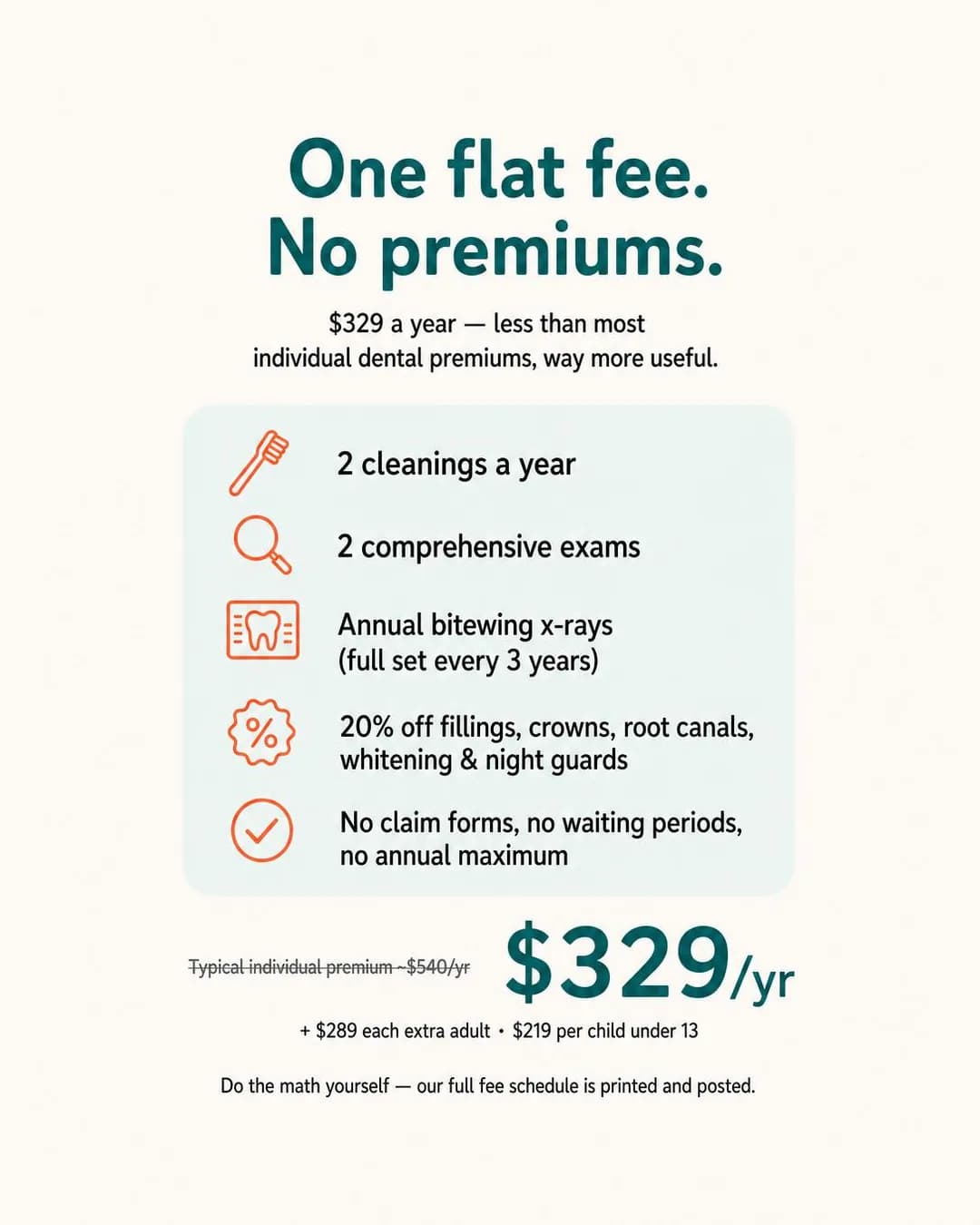 Example ad$329/year. Less than most premiums.See the brief →
Emergency and same-day pain
Leads- Who it is for.
- Someone deciding at six in the morning whether the ER is the answer. There is no consideration cycle here — there is a decision happening now.
- Angle.
- Benefit & Outcome — Speed is not a benefit in emergency dentistry, it is the entire product. Say when you open, how fast you can see them and what it costs, and route the click to a phone call rather than a form.
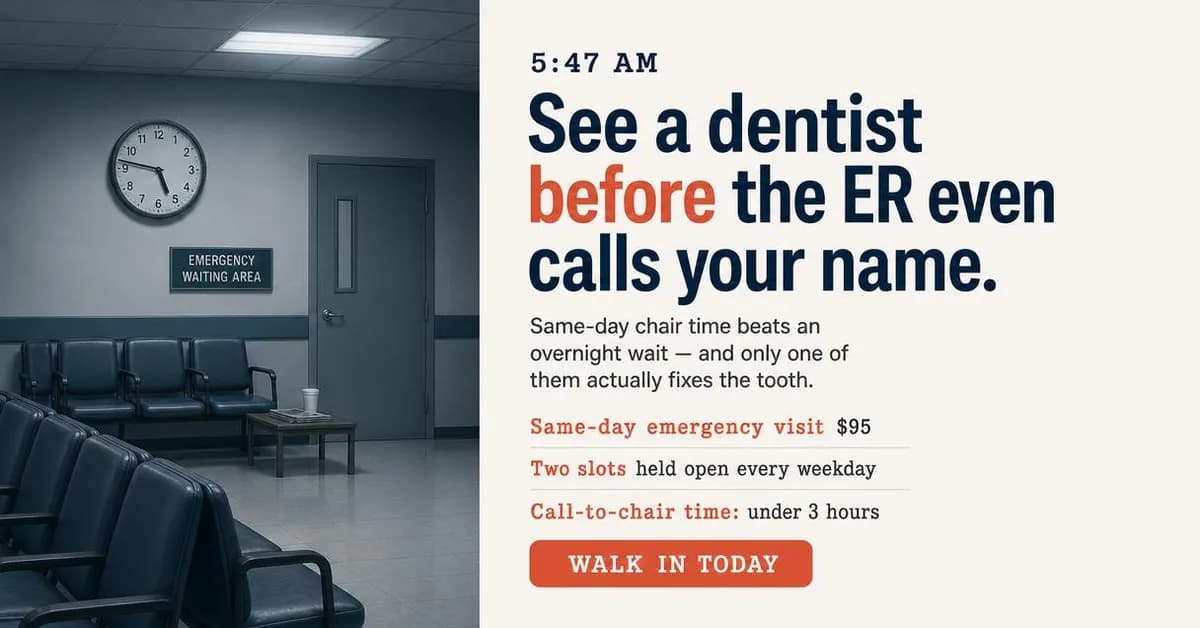 Example adSame-day emergency dental. $95.See the brief →
Implants and implant-retained dentures
Leads- Who it is for.
- Denture wearers, and people who were quoted a full-arch case once and walked out of the consult.
- Angle.
- Comparison & Positioning — The objection was never the implant, it was starting over. Comparison & Positioning is the only family that can split a category in one frame and hand the reader the smaller version of it — keep the prosthesis you already own, change what holds it.
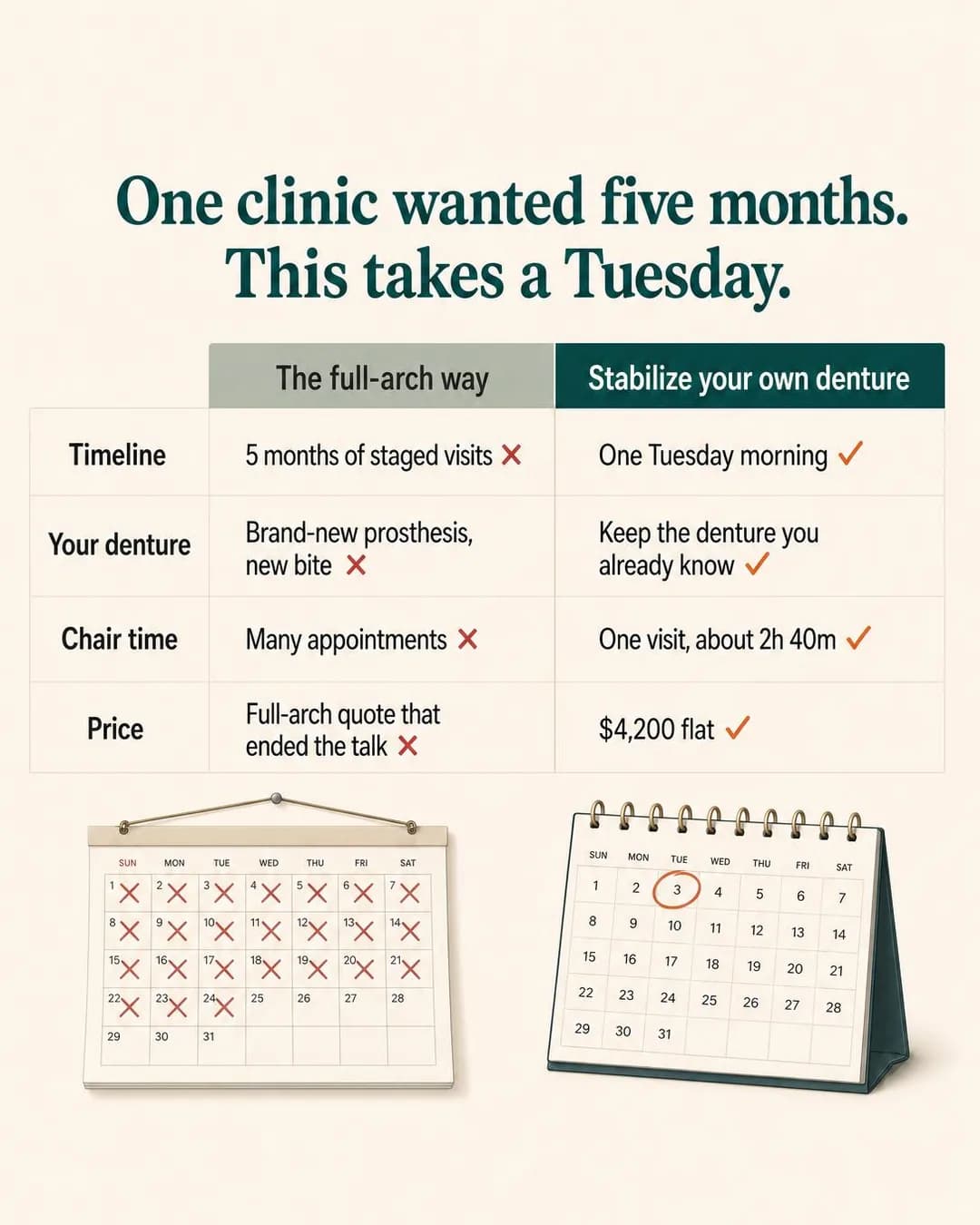 Example adOne visit. Your denture. $4,200.See the brief →
Clear aligners and orthodontic consults
Leads- Who it is for.
- Adults who were told, decades ago, that braces were a thing for children.
- Angle.
- Proof & Trust — This is the offer the July 2026 policy change unlocked. Before-and-after is now permitted for cosmetic procedures at 18+, and it is the format this offer has always wanted; the caption is what gets you rejected now, not the image.
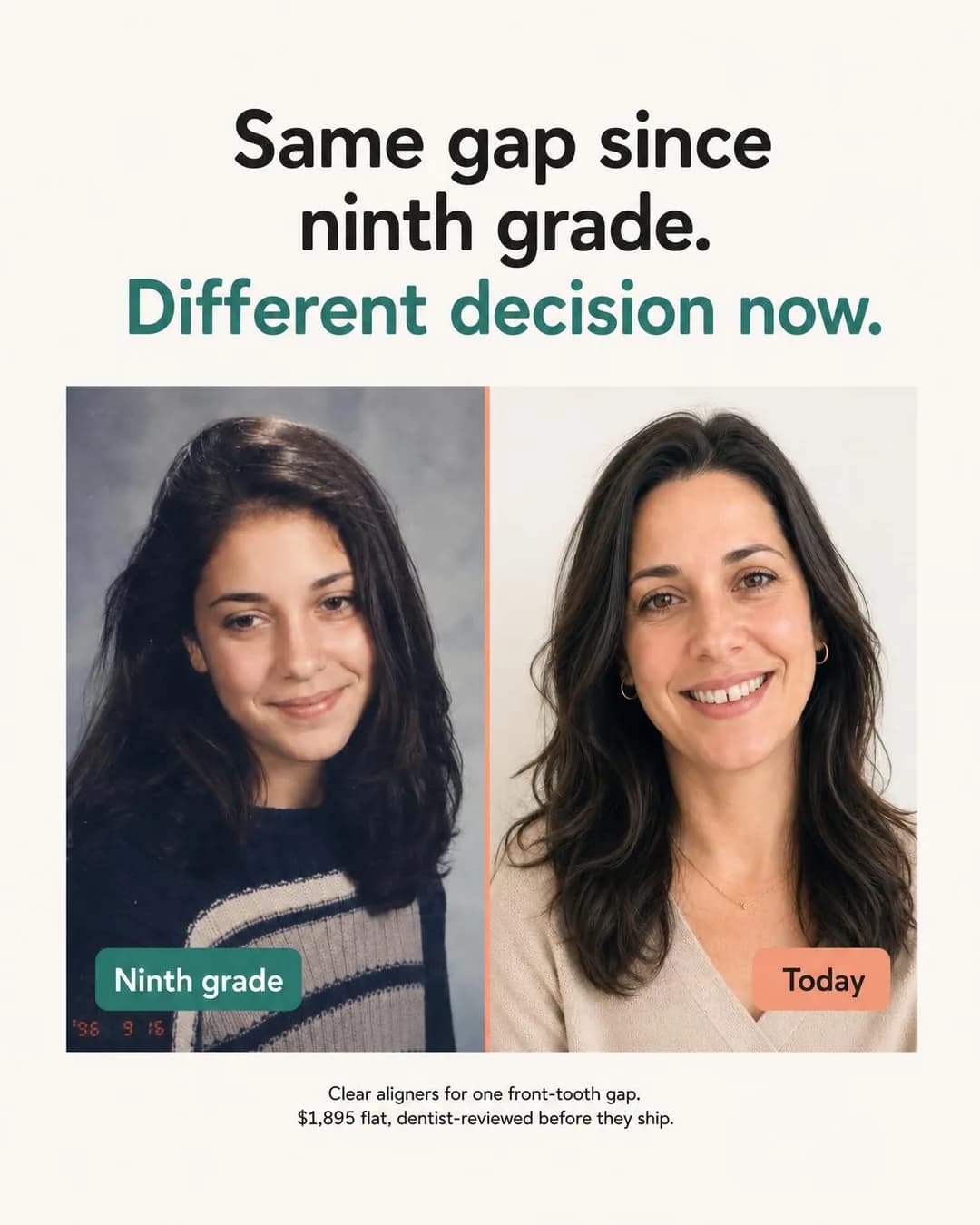 Example adOne gap. One price. Dentist-reviewed.See the brief →
Sedation and anxious-patient care
Leads- Who it is for.
- Adults who have cancelled twice and have not sat in a chair in a decade.
- Angle.
- Objection & Risk Reversal — The objection is not the treatment, it is the reception desk — being asked out loud why they waited. Spend the frame on the first fifteen feet of the visit, and put the hesitation in a patient's mouth rather than aiming it at the reader, which is also the safer construction under the personal attributes policy.
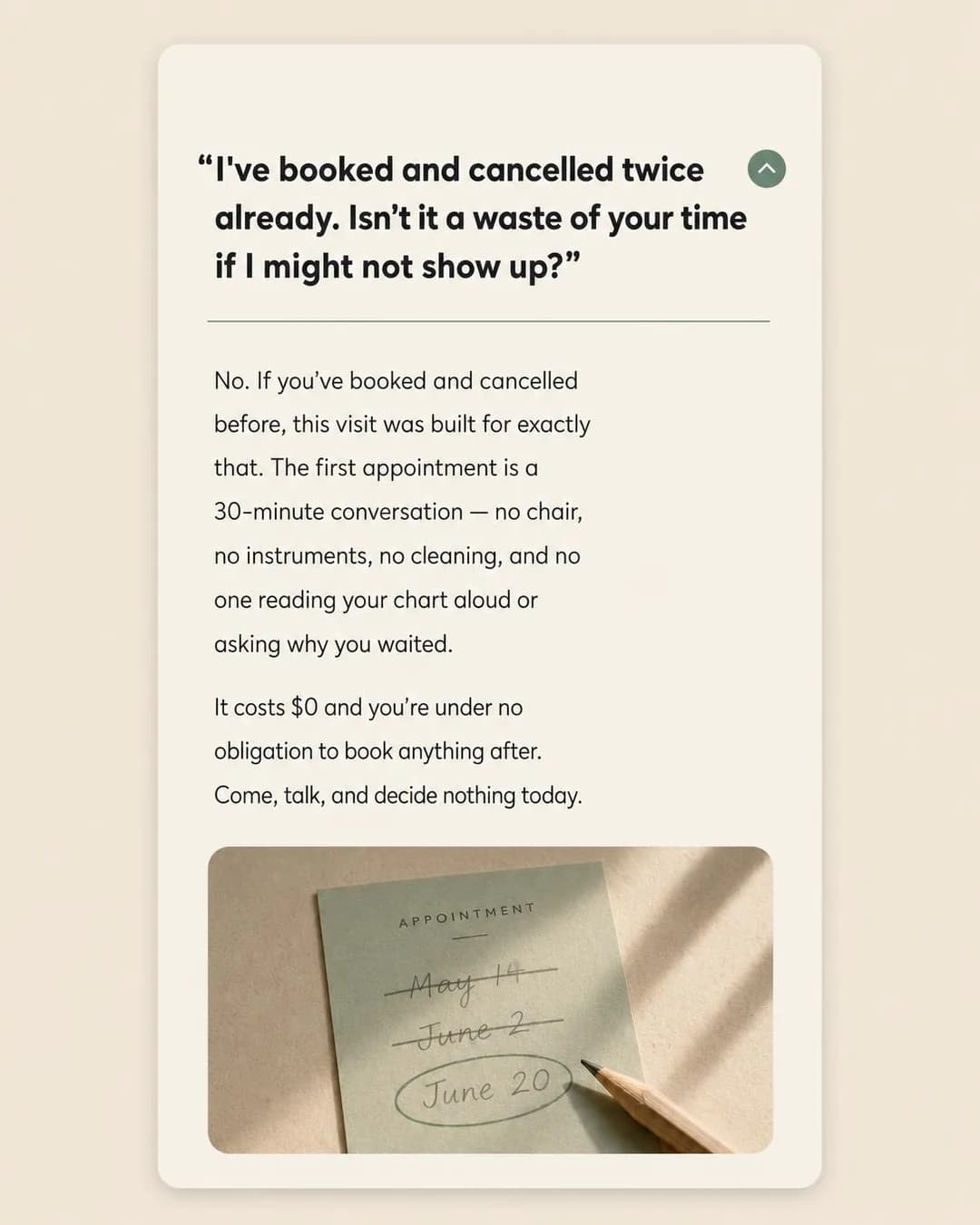 Example adBuilt for the patient who cancels twiceSee the brief →
Same-day crowns (chairside milling)
Traffic- Who it is for.
- Patients organising their life around a second appointment they resent.
- Angle.
- Product & Mechanism — The differentiator is invisible from the patient's side of the chair — your practice looks like every other until someone says there is a mill in the building. Show the mechanism, because “one visit” is not believable without it. What you are selling is the appointment they do not take.
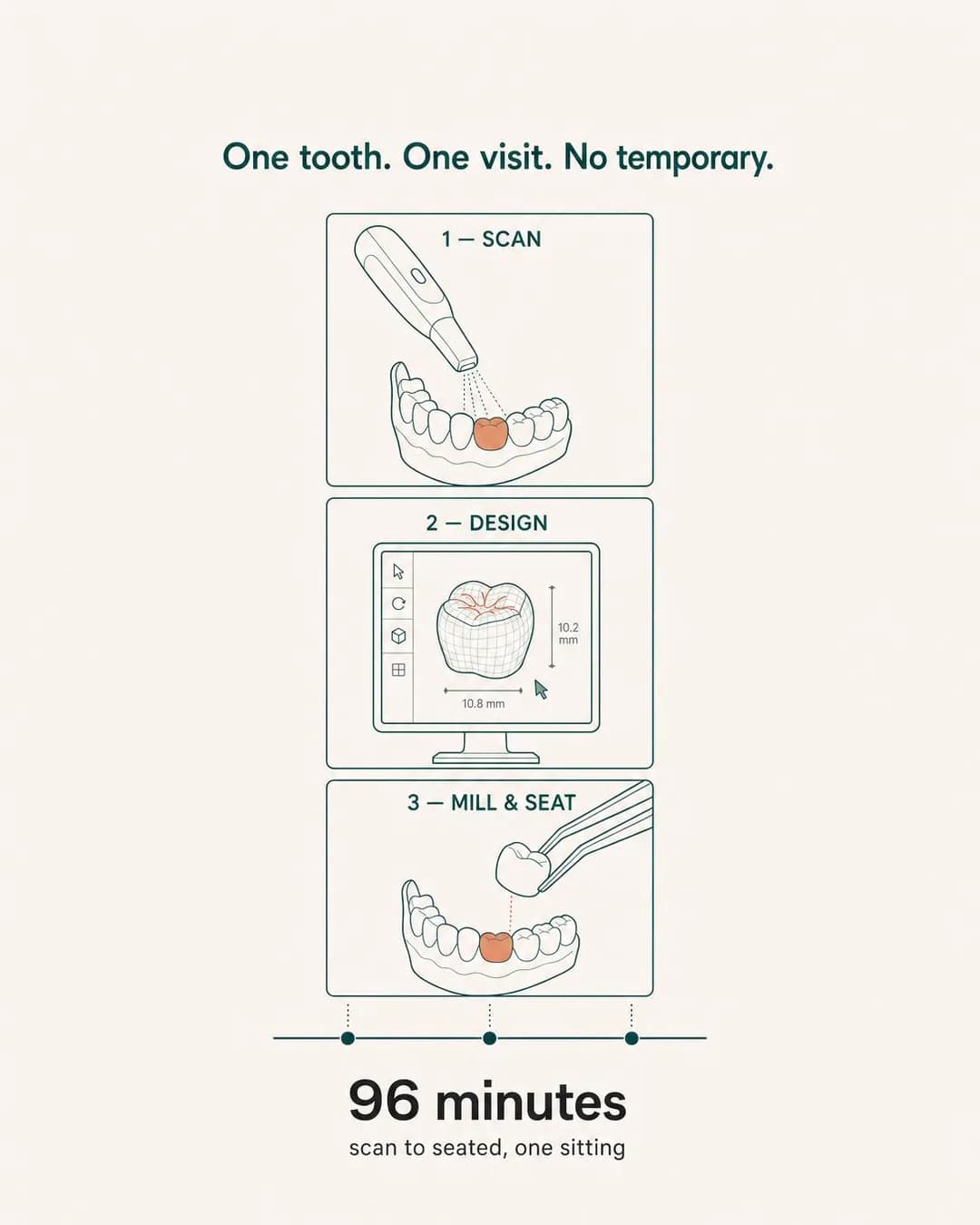 Example adScan to seated in one visitSee the brief →
Night guards and bruxism
Traffic- Who it is for.
- People who wake with a tight jaw and have been blaming the pillow, the mattress, or stress.
- Angle.
- Problem & Pain — The reader has a symptom and the wrong explanation for it. Naming the real cause is the whole ad — but name it in the third person, because the second-person version of this ad (“Do you wake up with jaw pain?”) is the exact shape the policy prohibits.
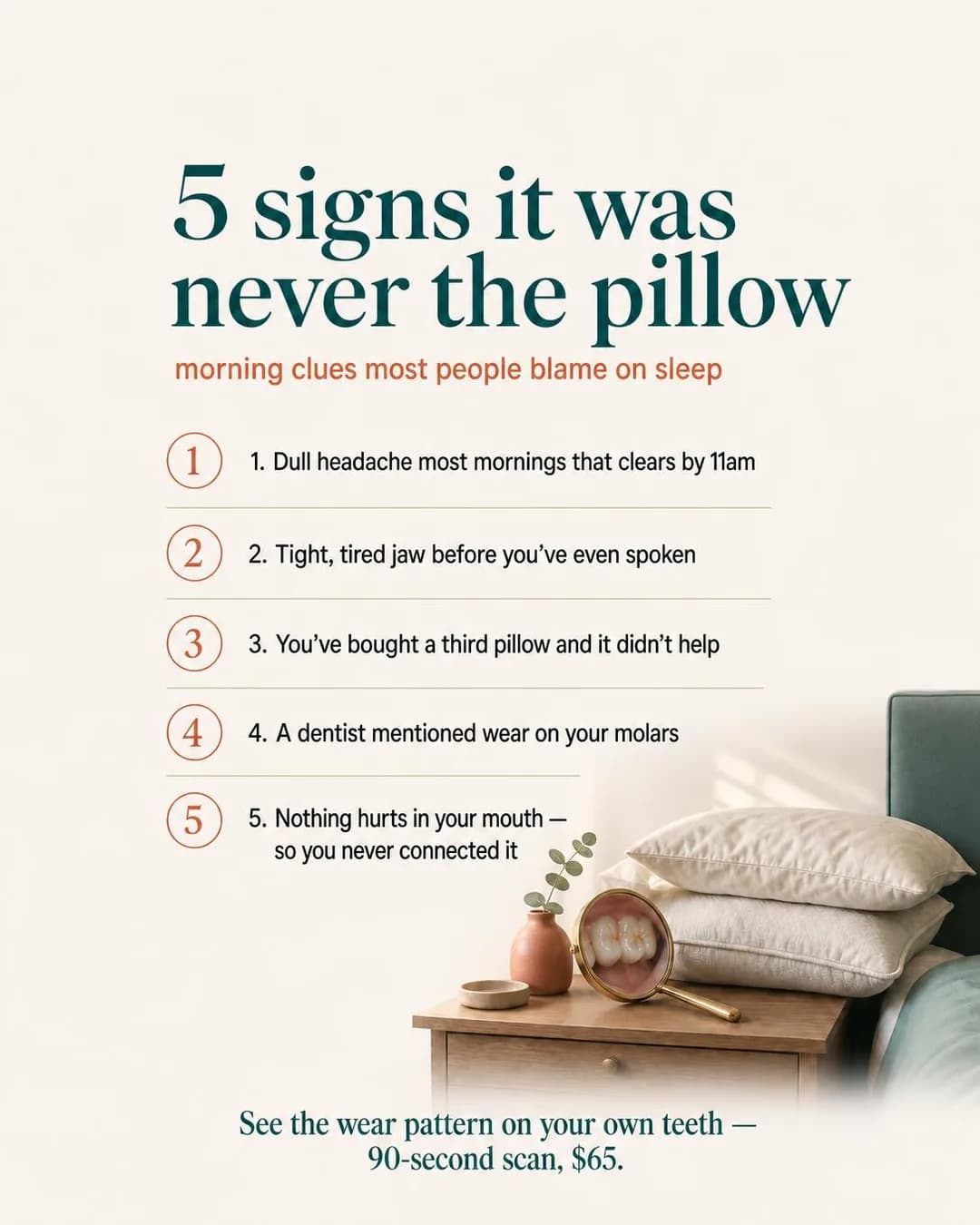 Example adIt was never the pillow.See the brief →
Whitening
Leads- Who it is for.
- Someone with a date already on the calendar — a wedding, a reunion, graduation photos, a new headshot.
- Angle.
- Scarcity, FOMO & Timing — Whitening is never a need, it is a deadline, so the argument is the calendar and not the shade guide. It is also the offer where copy slides into appearance-shaming faster than any other on this list: statements of inferiority about physical appearance are still prohibited even now that the imagery rule has relaxed.
No example ad for this offer on the examples page yet.
Family and children's dentistry
Leads- Who it is for.
- Parents who dread the dentist themselves and are working hard not to show it.
- Angle.
- Identity & Emotion — The person booking is not the person being treated, and their motive is not oral health — it is not passing something on. Identity & Emotion is the only family that can address a parent about their own history without making a claim about the child's mouth.
 Example adThey don't have to inherit your fearSee the brief →
Year-end insurance benefits
Leads- Who it is for.
- Insured patients who have used none of their annual maximum and do not know it expires.
- Angle.
- Scarcity, FOMO & Timing — The rarest thing in advertising: a deadline you did not invent. It resets every 31 December, it is real, and it is the one campaign of the year where urgency is a fact rather than a device. Run it from late October and stop when the book is full.
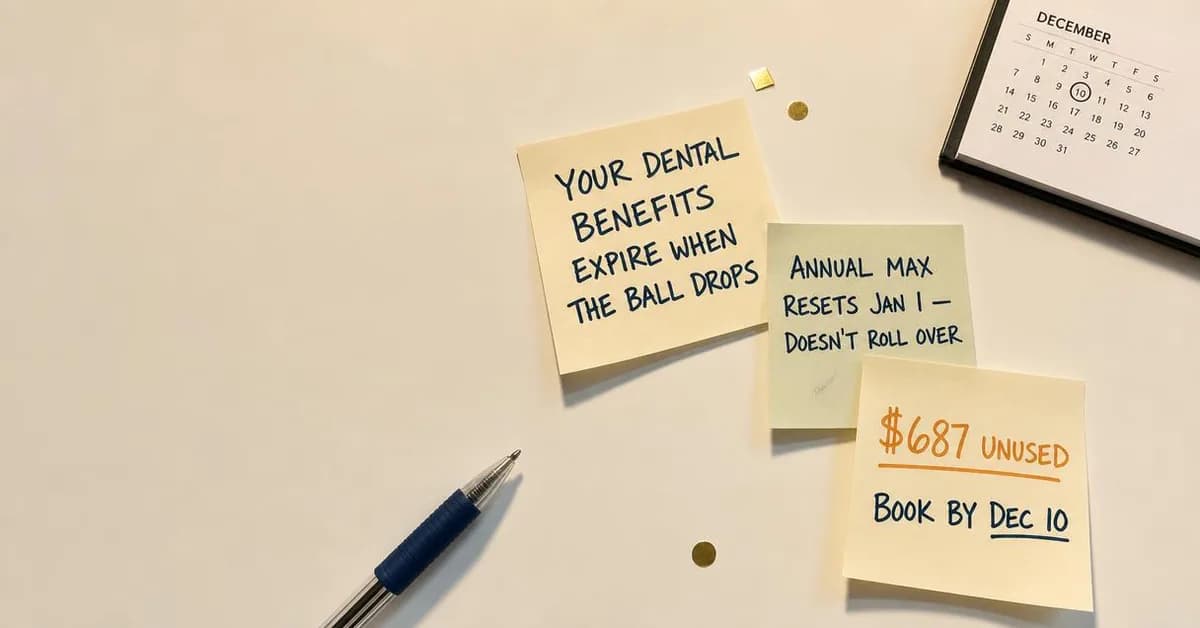 Example adYour benefits expire December 31stSee the brief →
The practice itself
Awareness- Who it is for.
- Patients cycling through a corporate office who have seen four different hygienists in four visits — and your own patient list, between treatment plans.
- Angle.
- Story & Founder POV — The only offer here that is not a procedure, and the one Awareness is actually for. An owner-operator can make a claim a group practice structurally cannot — the same hygienist, a capped list, the dentist who will still be there in five years — and that claim is worth more in a small radius than any discount.
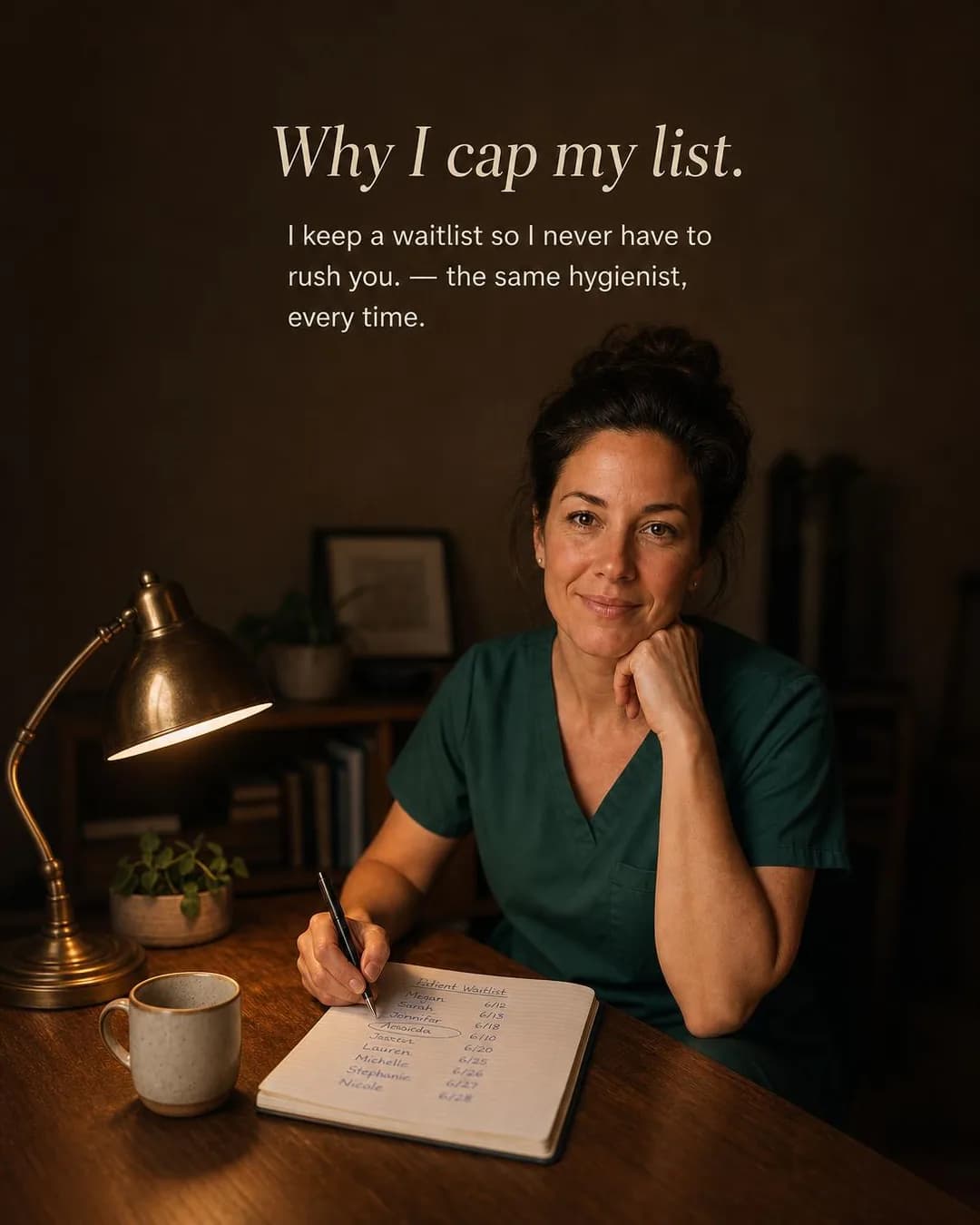 Example adThe same hygienist, every timeSee the brief →
Targeting: what dentists keep, and the one thing they must not do
Start from the rule that decides everything else. Meta's Marketing API accepts exactly four special ad categories — HOUSING, EMPLOYMENT, FINANCIAL_PRODUCTS_SERVICES and ISSUES_ELECTIONS_POLITICS — and health is not among them. A dental practice therefore keeps every lever a housing advertiser loses: age, a radius smaller than fifteen miles, lookalikes, exclusions, the lot. If a guide tells you to leave age open and buy a wide radius because “Meta restricts health advertisers”, it has confused you with a real estate agent.
The corollary is the part that catches people. Because the ad set can qualify the audience precisely, the creative does not have to — and the creative is where the enforcement actually lives. Meta's personal attributes policy prohibits an ad that asserts or implies a person's physical or mental health, medical conditions, or vulnerable financial status, among much else. Meta's own worked example is the pair every dentist needs: “Do you have diabetes?” is non-compliant, “New diabetes treatment available” is compliant. Now run the dental vernacular through it. “Missing teeth?” “Embarrassed to smile?” “Afraid of the dentist?” “No insurance?” — that last one is not even about teeth, it implies vulnerable financial status under a separate clause of the same policy. Every one of them fails on the second person. State the service, describe the patient in the third person, and the identical ad passes.
So the audience brief and the ad copy are two different documents, and the discipline is keeping them apart. “Adults who have not sat in a dental chair in a decade” is a superb targeting and writing instrument. It is not a sentence that may appear in the ad.
The one place this can go wrong outside the ad account is patient data, and it deserves stating plainly because the platform will let you do it. Whether you may upload a patient list at all is a HIPAA question for whoever handles your compliance, not something an ad platform can answer for you. And Meta's own Business Tools terms prohibit sharing data that is based on health information — including the names you choose for events, conversions and custom audiences. A custom conversion called “Sleep Apnea Enquiry” or an audience called “Denture Patients” is the violation, even when the underlying data is clean. Name events for what happened, never for who did it.
- Special ad categoryNot required
- Health is not one of the four. Leave the toggle off — and if you turned it on “to be safe”, you gave away age, lookalikes and your radius for nothing.
- RadiusUse it
- Think drive time, not miles: a river, a bridge toll or a one-way commute cuts a market in half in a way a circle does not. Start at the smallest radius that still gives the ad set enough people to spend the budget, and widen only when delivery forces you to.
- AgeUse it
- The single most valuable lever this trade keeps. Implants and dentures skew decades away from aligners and paediatric. One exception is not optional: if the creative carries before-and-after transformation imagery for a cosmetic procedure, the ad must be targeted to adults 18 and over.
- Detailed targeting (interests)Rarely
- At a three-mile radius the geography is the targeting. Layering interests on top of it usually leaves an audience too small to exit the learning phase, which costs you more in delivery than the precision was worth.
- LookalikesCareful
- Available to you, unlike housing advertisers — but the seed list is the problem, not the tool. A patient list is protected health information; a list of website visitors or video viewers is not, and is the safer seed by a wide margin.
- ExclusionsUse it
- The most-skipped setting in local dentistry. Without an exclusion, a three-mile radius guarantees you are paying to show a new-patient discount to the patients you already have — who will notice, and ask for it.
- Event and audience namesCareful
- Meta flags conversions whose names imply a health condition and blocks them from running campaigns. This is a naming rule with teeth and it is invisible until an account stops delivering. “Form Submit — Consult” is fine; the diagnosis is not.
Instant Form or landing page?
Meta gives you two Instant Form types and the difference is the whole decision. “More volume” is built to be filled and submitted in one thumb movement on a phone; “Higher intent” adds a review step that gives the person a chance to confirm what they entered. The pre-filled profile data is what makes the first one cheap and also what makes it worthless at the desk — a name and a number the reader never actually looked at is a lead that does not remember filling anything in when you ring back.
For most dental offers, use Instant Form on Higher intent. The review step is a filter you are buying deliberately: it will lower your lead count and raise the proportion of them that answer the phone, and in a business where the front desk is doing the conversion by hand, that is the trade you want. Add two or three qualifying questions for the expensive cases — which arch, insured or not, how soon — and accept the volume drop.
Send the click to a landing page when the offer needs substantiation that will not fit in an ad. A membership plan has terms, exclusions and a renewal date; a same-day crown needs the mechanism explained before anyone books it; a published fee needs the conditions attached to it. Those are pages, and the ad's job is to earn the read. Do not send them to the homepage — a reader who tapped an ad about implant-retained dentures and lands on a rotating hero of a smiling family has been asked to start their search over.
Emergency is the exception to all of it, and it is not close. Someone with an abscess at six in the morning does not want a form, and a form does not want them either. Run call ads: mobile-only, delivered on Facebook Feed, Marketplace, Reels and Video feed as well as the Instagram surfaces, and reported in a way nothing else on this platform is — calls placed, 20-second calls and 60-second calls, separately. A 20-second call is usually a wrong number or a hang-up. A 60-second call is somebody talking to your front desk. Judge the campaign on the second number and staff the phone for the hours the ad runs, because an emergency ad that rings out at lunchtime is the most expensive thing in this guide.
The recommendation: Instant Form on “Higher intent” for everything except emergencies, which are a phone call; a landing page whenever the offer carries terms, a mechanism or a published fee — never the homepage.
Creative direction
The rule that changed most recently is the one worth leading on. On 22 July 2026 Meta moved its Health and Wellness standards from product-based enforcement to claims-based enforcement, and before-and-after transformation imagery for cosmetic products, procedures and surgeries became permitted rather than auto-rejected, provided the ad is targeted to adults 18 and over. For years this was the single most-wanted and most-refused format in cosmetic dentistry. It is available again — and what is still prohibited is the thing that used to travel with it: statements of inferiority about physical appearance, imagery that works by making the viewer feel worse about how they look, sensational or exaggerated claims, and any claim to cure or eliminate a disease. In other words the image is no longer the violation. The caption is.
The second thing to get right is whose face is in the ad. A stock photograph of a model with veneers no dentist produced is the default in this category and it is worth less than a badly-lit photo of your actual operatory, because the reader is choosing a building they will drive to and a person who will be holding the instrument. Show the room, show the team, show the machine if the machine is the point.
Third, restraint with numbers. One figure per ad, and only one you will honour at the desk — the ADA's Code of Professional Conduct requires that fees not be represented in a false or misleading manner, and state boards enforce their own advertising rules on top of that. A comparative price claim about somebody else's product (“less than most insurance premiums”) is a claim you would be publishing under your own name and expected to substantiate.
Fourth, and this is the one that makes the length rules below binding rather than advisory: you cannot see the frame your ad will be shown in. Facebook has nine image surfaces — Feed, in-stream video, video feeds, Marketplace, Stories, ads on Reels, search results, Business Explore and the right-hand column — against Instagram's four, and their recommendations disagree with each other. Facebook Feed wants 4:5 at 1440 × 1800, 50–150 characters of primary text and a 27-character headline, and shows no description line at all. Marketplace wants a square at 1080 × 1080, 125 characters, a 40-character headline and a 30-character description. Leave Advantage+ placements on, which almost every practice does, and one ad fills all nine from a single export and a single headline. So write to the strictest surface and compose the portrait so it survives being cropped square — the placement you did not think about is the one holding your reader.
It is worth knowing how hard that is, because it is not a criticism of any one run. Five Facebook batches across this cluster have now been measured the same way — dentists, real estate, gyms, SaaS and apparel — and of the 250 headlines they produced, 19 fit 27 characters and 238 fit 40. Of the 250 primary texts, none fits 150 and the shortest written is 200 characters. Forty characters is about the length a headline comes out at when nobody is counting; twenty-seven is not. Look at what the ones that do fit have in common — “It was never the pillow.” at 24 characters, on the night-guard ad — and the pattern is the same on every page in the cluster. Twenty-seven characters is not enough room for a claim. It is enough room for a noun.
- Render at 4:5, 1440 × 1800. That is what Meta's ads guide recommends for Facebook Feed, and it is where most of the budget will deliver. The floor for that ratio is 600 × 750, and the aspect-ratio tolerance is 3% — an export a few pixels off is still accepted, one that is meaningfully off is not.
- Write the headline to about 27 characters and the primary text to 50–150. Those are Meta's own recommendations for a Facebook Feed image ad, and 27 characters is shorter than almost anyone writes: “Same-day emergency dental. $95.” is 31. Generate five and pick the one that survives the count rather than the one that reads best untruncated. The run on the examples page mostly does not: eight of its ten headlines are over 27 and all ten primary texts are over 150, at 295 to 484 characters. Across all fifty headlines that run wrote, three fit 27 and forty-eight fit 40.
- Check the headline against 40 as well as 27, because both numbers are live on the same ad. Marketplace and Instagram Feed both recommend 40; Facebook Feed recommends 27. A headline between the two is delivered intact on most of the surfaces it reaches and truncated on the one Meta puts most of your budget into.
- Export a square as well as the portrait if Marketplace matters to you — it recommends 1:1 at 1080 × 1080, and it is the placement most likely to be showing a local practice's ad to somebody who was not looking for one. Failing that, keep the top and bottom sixth of the 4:5 free of anything load-bearing, so the centre crop is still the ad.
- Write a description line even though Facebook Feed will not show it. Marketplace does, at 30 characters, and it is free to fill. Six of the ten on the examples page fit; the other four are wasted.
- Buy exactly one 1.91:1 asset, for the emergency ad. It routes to Facebook's right-hand column and search results — surfaces with no Instagram equivalent — and that is where a six-in-the-morning search lands.
- Write every line in the third person. “Missing teeth?” is a rejection; “Implant-retained dentures, placed in one visit” is the same ad, delivered.
- Put the hesitation in a patient's mouth, in quotation marks, rather than aiming it at the reader. It is warmer and it is the version that passes review.
- Before/after is allowed again — set the ad set to 18+ and keep the caption clear of anything that works by making the viewer feel bad about their appearance.
- One number per ad. A price, or a timeframe, or a distance — not all three.
- Do not put the phone number in the image. It is not tappable there, and the call button is.
- Photograph the building. Patients recognise the corner they drive past; they do not recognise a stock model.
Funnel structure
Three stages, and the third one is the stage most practices never build. Cold does the volume, warm does the conversion, and the patient list is both an exclusion and an audience — excluded from the acquisition offers so you stop paying to discount treatment for people who already come to you, and targeted directly for the campaigns that only make sense to someone already in the chart.
Keep the structure this simple on purpose. A practice's budget is small relative to the audience arithmetic Meta's delivery system wants, and every additional ad set divides the same evidence into thinner piles. Variation belongs at the ad level, inside one ad set, not at the ad-set level.
Cold
≈70% of budgetAudience. Radius around the practice, age-banded to the offer, no interest layering, existing patients excluded.
Running. Two to four offer ads — whichever chairs are empty. Leads, Instant Form on Higher intent, or calls for emergency.
Warm
≈20% of budgetAudience. Page and profile engagers, video viewers, website visitors from the last 90–180 days.
Running. Mechanism and proof: how the same-day crown works, the before/after, the dentist talking. Traffic or Leads.
Patients
≈10% of budgetAudience. The practice's own list — used as an exclusion on the two stages above, and as an audience on its own terms.
Running. Year-end benefits, unfinished treatment plans, the hygiene recall. Awareness or Leads, seasonal rather than always-on.
Budget and testing
Here is the arithmetic that decides how well your ads will work, and almost nobody advertising a dental practice has done it. Meta's delivery system needs roughly 50 optimisation events per ad set per week to leave the learning phase; below that the ad set sits in “learning limited”, which is not a penalty but is an admission that the system cannot optimise with what you are giving it. So take your own cost per lead, whatever it actually is, and multiply by 50. That is the weekly spend at which delivery is working with full information on one ad set. Divide what you can genuinely spend by that number and you have an honest measure of how much of Meta's optimisation you are buying.
For most single-location practices the answer is: a fraction of it. That is not a reason to stop; it is the reason the funnel above has three ad sets and not nine. Every dollar you split into another ad set halves the evidence in both. One campaign, one cold ad set, several ads inside it, and let the offer be the variable that changes between ads rather than between ad sets.
Then leave it alone. Pausing an ad set, or changing its optimisation event, its audience or its creative, counts as a significant edit and restarts the learning phase; budget and bid changes can too, depending on the size of the change. An account that gets adjusted every morning is an account that never finishes learning, and the daily fiddling feels like management while being the single largest self-inflicted cost in a small ad account.
Seasonality is real in this trade and it is worth planning the year around three moments: late October through December, when annual insurance maximums are about to expire and the urgency is a fact rather than a device; January, when benefits reset and the deductible conversation starts over; and the back-to-school window for family and paediatric offers. Emergency runs flat all year. Whitening follows other people's calendars — wedding season, graduation, the run-up to the holidays.
- Test the offer, not the headline. Swapping five words is a significant edit that restarts learning for a change too small to detect.
- One change at a time, and give it seven days — the learning phase is measured over a week, so anything shorter is reading noise.
- Read cost per booked-and-kept appointment, not cost per lead. The front desk is the second half of this funnel, and it is where a cheap lead quietly becomes no patient at all.
- For call campaigns, count 60-second calls. Calls placed includes the hang-ups and the wrong numbers.
- Before you blame the creative, check whether the ad set ever left learning. Half the “this doesn't work for dentists” verdicts are an ad set that never got the evidence to try.
Six of these ads, in full
Every ad below was generated by best-in-slot for a dental practice that does not exist, with its audience, angle and objective pinned before the run — and published exactly as it came back. They are six of the Facebook examples for a dental practice; the rest, with the full brief and the alternate headlines behind each one, are on that page.
Comparison & Positioning · 4:5 · Leads
One visit. Your denture. $4,200.
Written for: Lower denture wearers who have stopped eating in public.
The full brief and why it works →
Benefit & Outcome · 1.91:1 · Leads
Same-day emergency dental. $95.
Written for: People deciding at 6am whether to go to the ER.
The full brief and why it works →
Proof & Trust · 4:5 · Leads
One gap. One price. Dentist-reviewed.
Written for: Adults who were told braces were for children.
The full brief and why it works →
Objection & Risk Reversal · 4:5 · Leads
Built for the patient who cancels twice
Written for: Adults who have not sat in a dental chair in a decade.
The full brief and why it works →
Offer & Economics · 4:5 · Leads
$329/year. Less than most premiums.
Written for: Self-employed patients paying cash at the desk.
The full brief and why it works →
Scarcity, FOMO & Timing · 1.91:1 · Leads
Your benefits expire December 31st
Written for: Insured patients who used none of it this year.
The full brief and why it works →
Mistakes specific to this trade
Every one of these is common, most of them are expensive, and the first three are the reason a dental account gets rejections that a plumber's account never sees.
Writing in the voice every dental agency writes in
“Missing teeth?” “Embarrassed to smile?” “Afraid of the dentist?” These are the four best-performing headlines in dentistry and all of them are prohibited, because the second person asserts a condition about the person reading. The fix is a grammatical one, not a strategic one: state the service and describe the patient in the third person. Same ad, same offer, delivered instead of rejected.
Treating “No insurance?” as a dental question
It is not — it implies vulnerable financial status, which is a separate clause of the same personal attributes policy and catches an ad that has nothing to do with teeth. “Membership plan for patients paying out of pocket” makes the identical offer without making a claim about the reader's finances.
Believing before/after is still banned
It was, and it stopped being on 22 July 2026 when Meta moved its Health and Wellness standards to claims-based enforcement. Transformation imagery for cosmetic procedures is permitted at 18+. Guides that still say otherwise are more than a month stale, and the format is the natural one for aligners, veneers and whitening.
Ticking the special ad category box “to be safe”
Health is not one of the four categories. Ticking it anyway hands back age targeting, lookalikes and any radius under fifteen miles — the three levers that make local dental advertising viable — in exchange for nothing at all.
Buying a twenty-five-mile radius for reach
Nobody drives twenty-five miles for a cleaning. A wide radius makes the numbers in Ads Manager look better and the schedule look the same, and it is the most common way a small budget is spent on people who were never going to come.
Running the new-patient special as the only ad
It works, which is the trap. A discount selects for price shoppers, and the practice's margin is in the treatment plan rather than the cleaning. Run it alongside at least one ad for something expensive, aimed at a different age band, or the account will look efficient and the production number will not move.
One ad set per offer
It is the intuitive structure and it is why the account never leaves learning. Five ad sets on a small budget is five piles of evidence too thin to optimise on. Consolidate to one cold ad set and let the offers compete as ads inside it.
Advertising the new-patient offer to your own patients
In a three-mile radius this is guaranteed, not likely. It costs money and it costs goodwill — the patient who has paid full price for two years sees a discount they were never offered, and the next conversation about it happens at your desk.
Sending every click to the homepage
The ad made one specific promise and the homepage answers a different question. If there is no page for the offer, use an Instant Form; a form that matches the ad beats a beautiful site that does not.
Boosting posts instead of running ad sets
Boosting has no objective worth the name, no exclusions, and no form. It is the fastest way to spend a monthly budget on engagement from people who already know you, and it is what most practices are doing when they say Facebook ads did not work.
Judging the ads while the phone rings out
The best-optimised campaign in this guide dies at a voicemail greeting. Leads decay in minutes, not days; if nobody can call back within the hour during the hours the ads run, fix that before increasing the budget, because it is cheaper and it is the actual constraint.
Publishing a fee you will not honour at the desk
A price in an ad is a representation about your fees. The ADA's Code of Professional Conduct requires that they not be represented in a false or misleading manner, state boards enforce their own advertising rules, and “that price was for a different X-ray” is a conversation that ends with a complaint rather than a patient.
Questions
- Are dental ads a special ad category on Meta?
- No. Meta's Marketing API accepts exactly four special ad categories — housing, employment, financial products and services, and social issues/elections/politics — and health is not among them. A dental practice keeps age targeting, lookalike audiences and any radius it likes, all of which a housing advertiser loses. Ticking the box anyway is a common and expensive mistake.
- Can a dentist run before-and-after photos on Facebook?
- Yes, since 22 July 2026. Meta rewrote its Health and Wellness advertising standards from product-based to claims-based enforcement, and before-and-after transformation imagery for cosmetic products, procedures and surgeries is permitted provided the ad is targeted to adults 18 and over. What remains prohibited is the accompanying language: statements of inferiority about physical appearance, imagery that works by making the viewer feel bad about how they look, sensational claims, and claims to cure or eliminate a disease.
- Why was my ad rejected when it only said “Missing teeth?”
- Because of the question mark, effectively. Meta's personal attributes policy prohibits an ad that asserts or implies a person's physical or mental health or medical conditions, and a second-person question does exactly that. Meta's own worked example is “Do you have diabetes?” (non-compliant) against “New diabetes treatment available” (compliant). Rewrite in the third person — describe the service, not the reader — and the same offer runs.
- Facebook or Instagram for a dental practice?
- It depends which procedures pay for the advertising. Pew's November 2025 survey puts Facebook at 74% of 50- to 64-year-olds and 57% of those 65 and over, against Instagram's 40% and 19%. Implants, dentures and crown-and-bridge work concentrate in exactly that cohort, so a restorative practice puts the budget here. An orthodontic practice selling aligners to people in their twenties has a real argument for the other app. Most general practices should run both and let the offer decide which one each ad sits on.
- Instant Form or a landing page?
- Instant Form on the “Higher intent” type for most offers — the review step lowers the lead count and raises the share that answer the phone, which is the right trade when the front desk is doing the converting. Use a landing page whenever the offer carries terms, a mechanism or a published fee. Use call ads for emergencies, and judge them on 60-second calls rather than calls placed.
- How much should a dental practice spend on Facebook ads?
- Do the arithmetic rather than copying a number. Meta needs roughly 50 optimisation events per ad set per week for delivery to leave the learning phase, so multiply your own cost per lead by 50 to get the weekly spend at which one ad set is fully optimised. Most single-location practices can only buy a fraction of that, which is an argument for consolidating into one cold ad set — not for spending more than the practice can absorb in new patients.
- Can I upload my patient list to build a lookalike audience?
- That is a HIPAA question for whoever handles your compliance, not a question your ad account can answer, and the platform will happily let you do something you should not. Separately, Meta's Business Tools terms prohibit sharing data based on health information — including the names you give events, conversions and custom audiences, so a conversion called “Sleep Apnea Enquiry” is a problem on its own. Website visitors and video viewers are much safer seeds and are usually good enough.
Sources
Every platform claim on this page was read against these on . Meta’s policies move; if one of these disagrees with this page, it is right and we are stale.
- Meta Advertising Standards — Health and Wellness (policy updated 22 July 2026)
- Meta Advertising Standards — Privacy Violations and Personal Attributes
- Meta Marketing API — special ad categories (health is not one)
- Meta Business Help Centre — choosing Ads Manager advertising objectives
- Meta Business Help Centre — about the learning phase
- Meta Business Help Centre — significant edits and the learning phase
- Meta Business Help Centre — about Instant Form types
- Meta Business Help Centre — supported objectives and placements for call ads
- Meta Business Help Centre — call ad metrics in Ads Manager
- Meta Business Help Centre — about sensitive health information
- Meta ads guide — image ad specifications, Facebook Feed (4:5 at 1440 × 1800; primary text 50–150, headline 27, no description line; 3% aspect-ratio tolerance)
- Meta ads guide — image ad specifications, Facebook Marketplace (1:1 at 1080 × 1080; primary text 125, headline 40, description 30)
- American Dental Association — advertising, marketing and the Code of Professional Conduct
- Pew Research Center — Americans' social media use, November 2025
That is the playbook. Now make the ads.
Paste your practice website. It reads your services, your patients and your brand, then writes the concepts, renders the images and drafts the copy.
No credit card · 50 free credits (about 5 ads or Instagram posts)
Every angle recommended above is documented in the best-in-slot ad angle library, and the ads are from dentist facebook ad examples. More industries are at all ad guides.