
Ad Examples · Skincare & Beauty Brands × Instagram · 10 ads
Skincare Instagram ad examples
Ten finished single-image Instagram ads for skincare and beauty brands, with the brief behind each. Instagram reaches roughly twice Facebook's share of American teenagers, and in skincare the ad's own claims decide whether it may be shown to them. The notes say which five of these ten could run to a 13-year-old as written, which five could not, and what each one got wrong.
Search for skincare Instagram ads and you get a scroll of other brands' ads in screenshots: a creator holding a bottle to a ring light, a slow pour on a marble counter, a before-and-after of a face nobody can vouch for. A screenshot cannot tell you who the ad was written for, what it argued, or the question this platform asks that Facebook does not: how old is the person you are about to show it to?
So these were not collected. Every ad below was generated with its audience, angle and objective pinned before the run, and the brief printed under each one is the brief that produced it. The ten brands are invented and unnamed, one product each: an over-the-counter acne gel sold with two white pillowcases, a self-tanning mousse, a sunscreen stick for reapplying over makeup, a $12 gel cleanser, a tinted lip balm in six shades, a makeup skin tint in 24, a clay mask, a lactic acid toner, a refill pouch for people who already own the jar, and a cleansing balm coming back into stock. Six were written for Sales, two for Traffic, one for Awareness and one for Leads. All ten are single images, in the feed's 4:5 shape or the 9:16 of Stories and Reels; all ten ran in one pass, and nothing was regenerated.
Instagram's difference here is arithmetic. Pew's 2025 survey of 13- to 17-year-olds puts Instagram at about six in ten against Facebook's 31%, and three-quarters of 15- to 17-year-olds use it. The audience Instagram adds is the youngest one, and skincare is bought at exactly those ages — but reaching it is a decision, not a default. With Advantage+ audience on, the youngest minimum age Meta accepts is 18; to include 13- to 17-year-olds you turn it off and set the range yourself, and what is left in the ad set is age, location, and a purchase or a click.
Then the claims decide whether the ad may go there at all. Meta exempts non-permanent cosmetics and beauty products — creams, makeup, hair products — from the 18+ rule it applies to cosmetic products generally, so a lip balm and a skin tint are covered outright, and reading a cleanser, a mask and a toner into “creams” is our extension of it rather than Meta's wording. A before-and-after is listed at 18+ whatever the product is. Nor can an over-the-counter medicine, which is where acne goes, because in the FDA's reading a treatment for acne is a drug. So the sentence “clears breakouts”, written on a cleanser that was a cosmetic when it was briefed, gives up the audience segment where Instagram's lead over Facebook is widest. The section below has the rules and the sources; the notes under each ad show where this run walked into them.
That is what the batch was built to test. Five briefs described products that could run in a 13+ ad set as written; five could not, and each for a different reason — an acne drug, a sunscreen, a before-and-after, a refill that needs a customer list, and a restock on a lead form. The cosmetic five held: none of them reached for an acne claim or invented an SPF, which is the drift that would have moved a minimum age. The toner still came back selling “renewal” and “barrier-safe resurfacing”, the same direction our skincare Facebook ad examples found, and four of the ten ads tell the reader what is happening to their own skin: “your lipid barrier”, “If your face feels tight after showering at the gym”, “your rough skin”, “balances oily skin without stripping your barrier”. Meta's rejected example, “Do you have diabetes?”, has that shape, and its standard does not say whether cracked, rough or breaking-out skin counts as physical health, so treat those lines as a risk and rewrite them before they run.
Two ads invented their evidence. The self-tanner's before-and-after is not one ankle photographed twice — it is two different ankles, and the left one is already tanned. That ad also lost the one safety fact it was given: the mousse contains no sunscreen, a sentence the FDA requires on the label of a tanning product without one, and the business summary written for it reproduced that warning in full before the copy dropped it. The restock ad draws Instagram's own interface, a reply sticker and a message bar that does nothing, with a question from a handle that does not exist.
Every price and figure here is invented. The briefs supplied some ($12 for 200 ml, three balms for $22, 24 shades, 5% lactic acid at two or three nights a week, 2.5% benzoyl peroxide, $28 down to $21, Tuesday 6 October at 9 a.m.), and the notes trace the ones that came later.
For your own ads, the step that matters most is the first. A model wrote each business a summary from its one-line brief, standing in for the website you would paste, and most of what the notes flag started there: the menthol the cleanser argues against, the freight ledger behind the refill's $7, the “Adults and adolescents” audience the acne brand wrote for a product Meta will not let it advertise to adolescents. With your own site, that summary is yours to read and edit before an ad exists. After it came the concept, whose title and one-line hook head each card; the picture's instructions, which the card does not show; a square image; the copy, written from that square; and a re-frame, which redraws the square at 4:5 or 9:16 rather than cropping it. The card shows the first of the five primary texts each run wrote; where a note quotes one of the other four, it says so.
What changes because it is Instagram: the minimum age, and what the ad set gives up to reach it
Start with who is there. Pew asked 1,458 American teenagers about their platforms between 25 September and 9 October 2025: about six in ten 13- to 17-year-olds use Instagram and 31% use Facebook, three-quarters of the 15- to 17-year-olds are on Instagram against 44% of the 13- to 14-year-olds, and 55% of teens are on Instagram every day against 20% on Facebook. Among adults, Pew's 2025 figures run the other way — Facebook 71% to Instagram's 50%, with Instagram ahead only at 18 to 29 (80% to 68%) and behind from 30 upwards. So Instagram's advantage over its sibling is almost entirely young, and it is at its widest below 18. These are US figures; anywhere else, look at your own orders.
That audience is not in your ad set unless you put it there. Meta's minimum age is 13 (16 in Australia, higher in some jurisdictions), but with Advantage+ audience switched on the Marketing API accepts a minimum age of “between 18 to 25 only”, and Meta's own reference lists minimum age among the “non-negotiable business constraints” its expansion will not cross. An Advantage+ ad set therefore never reaches a teenager. Turning it off and setting 13 is a deliberate act, and in the EU, the EEA and Switzerland it is not available at all: ads with locations there cannot deliver to under-18s.
It costs the ad set almost everything else. Meta's list of audience options “not available to show ads to teens” is gender, ZIP code or locations smaller than cities, detailed targeting (interests, behaviours and demographics), language, website, mobile app, customer list, engagement and offline activity custom audiences, and lookalike audiences. Optimisation narrows too: landing page views, leads, value, post engagement, video views and conversations are out, while impressions, reach, daily unique reach, link clicks, offsite conversions and Instagram profile visits stay.
Read that as five consequences. A Sales ad optimising for purchases still works. A Traffic ad has to optimise for link clicks rather than landing page views, and a lead form is not an option at all. Because custom audiences go both ways, you lose not only retargeting but the ability to exclude: a teen-inclusive prospecting ad set will serve people who already bought from you, and nothing in it can hold them out. Value optimisation is gone on the audience with the smallest orders, which is the audience that would most benefit from it. And the geography narrows twice over — country or city level, with the EU, the EEA and Switzerland excluded entirely — so a brand running one multi-country ad set has to split its map before it can touch the age lever at all. The one thing you can still accumulate is followers: profile visits survive as a goal, which makes the profile the closest thing to an audience you can build here.
It also means you cannot test the decision. Moving the floor from 18 to 13 changes the optimisation goal, the detailed targeting, the custom audiences and the geography at the same time, so the two ad sets differ on four axes and the result is not an age test. Run the teen-inclusive ad set as a separate buy with its own job, and judge it on first orders from new customers rather than against a retargeting ad set it has no way to imitate.
Which ads may go there is decided by what they say and show, and skincare spends the whole range. Meta's Health and Wellness standard requires cosmetic products to be “targeted to people at least 18 years or older” and then exempts “Non-permanent cosmetic and beauty products such as creams, makeup, hair products, and digital editing apps” from its age restrictions, which covers a lip balm and a skin tint outright; calling a gel cleanser, a clay mask or an acid toner a cream is our reading, not Meta's wording. It also lists “General cosmetic products, procedures, surgeries depicting before and after transformation” under 18+ without saying which rule wins when a product is both, so treat 18 as the safe default for any before-and-after. And the Drugs and Pharmaceuticals standard says “Meta doesn't allow targeting for over-the-counter medicine to people under the age of 18”, describing it as “topical or ingestible common medications”.
Acne is where that bites hardest, because the product a fourteen-year-old is most likely to want is a drug. The FDA's over-the-counter monograph for topical acne products calls acne “A disease involving the oil glands and hair follicles of the skin”, permits benzoyl peroxide at 2.5–10% and salicylic acid at 0.5–2%, and sets out what such a label may claim: “For the” (“management” or “treatment”) “of acne”, “Clears up most acne blemishes”, “Helps prevent new acne pimples”. Meta's examples of over-the-counter medicine name anti-inflammatories, allergy medication and antiseptics, not acne gels, so 18 is our reading of the standard rather than a line Meta has written down. The consequence is worth stating plainly: a cosmetic cleanser whose ad promises to clear breakouts has changed what the product legally is and given up the audience Instagram had over Facebook, in the same sentence. Sunscreen sits in the same box, a drug in the United States and unnamed by Meta, safest at 18 and over.
None of that bars you from advertising to teenagers, and Meta's rule about copy is narrower than people assume. Its personal-attributes standard allows a “passing reference to a personal attribute”, including “age groups or age ranges”, and its own allowed examples are “A service for teens” and “Join us this summer at Nature Camp. Open to all teenagers.” What is prohibited is pointing the attribute at the reader: “Are you 18 years old?”, “Ready to upgrade your skin to look younger?”, “Do you have diabetes?”. An ad may be for teenagers; it may not tell a teenager what their skin is doing.
One more thing follows from a stripped ad set, and it changes how many ads you need. Every brief below names an audience — people who wash their face after training, people who lose a lip balm a week, people who have bought the wrong shade online — and in a 13+ ad set not one of those is expressible as targeting. They become creative direction instead: the picture and the first line have to find the person the ad set can no longer ask for, which means more ads in the ad set rather than more audiences beside it. It also means the picture can undo the decision. The clay mask below is the most teen-shaped brief in the batch and its render came back as three adults on a sofa.
Then the shapes. Meta's ads guide recommends 4:5 at 1440 × 1800 for Instagram Feed with a 1% aspect tolerance and a minimum width of 500 pixels; for Stories and Reels it recommends 9:16 at 1440 × 2560, with roughly the top 14%, the bottom 35% and 6% at each side kept clear of anything that matters. best-in-slot exports at 1080 × 1350 and 1080 × 1920, above that minimum. Four of the ten ads here are 9:16; the clay mask (ad 4) leaves its jar and brushes in the bottom band, where the call-to-action button will sit.
And the words. Meta recommends 125 characters of primary text — the caption — and a 40-character headline for the feed, and 44 characters of primary text for an image ad in Reels. Ten of this run's 50 primary texts fit 125, all of them from the two ads whose argument is a single fact (three balms for $22, a restock on Tuesday), while the other eight wrote 252 to 421. All 50 headlines fit 40, and 9 fit Facebook's 27. None of the 50 fits Reels' 44, which is a decision rather than a defect: either write a short second caption for Reels or leave that placement out of the ad set. Measure your own before they run, and read the first 125 characters as if they were the whole ad, because that is where Meta recommends stopping.
Budget for the learning phase as you would anywhere else. Meta says an ad set usually leaves it after about 50 results in a week, so plan on roughly 50 times your own cost per purchase as the weekly spend for each Sales ad set — and remember you are now funding two of them if the teen-inclusive buy is separate.
What Instagram does not change is the other referee. The FDA reads the same words wherever they appear, and our skincare Facebook ad examples take that argument in full; this page covers the FDA's line only, and other countries have their own regulators. The same goes for Meta's creative enhancements. Brightness, contrast and visual touch-ups can alter a delivered image, best-in-slot turns none of them off, and they matter most on an ad about how skin looks: open the before-and-after and the shade line-up in Ads Manager and switch the enhancements off before either one runs. What best-in-slot does do is publish paused unless you tell it otherwise, so nothing here reaches anyone until you have read it in Ads Manager.
Source: Pew Research Center — Teens, Social Media and AI Chatbots 2025 (1,458 US teens aged 13–17, 25 September–9 October 2025): “About six-in-ten or more say they use TikTok and Instagram”; Facebook 31%; Instagram daily 55%, Facebook 20%; “three-quarters of 15- to 17-year-olds say they use Instagram, compared with 44% of 13- to 14-year-olds” · Pew Research Center — Social media fact sheet (survey 5 February–18 June 2025): Facebook 71%, Instagram 50% of US adults; by age 68/80/74/57% and 80/62/40/19% · Meta Business Help Centre — About advertising to teens: audience options “not available to show ads to teens” include gender, ZIP code or locations smaller than cities, detailed targeting, language, website, mobile app, customer list, engagement and offline activity custom audiences and lookalikes; the unavailable optimisation goals are “app events, video views, post engagement, value, ad recall lift, landing page views, leads, conversations and event responses”, while “app installs, impressions, reach, daily unique reach, link clicks, offsite conversions” and Instagram profile visits remain; “Ads with locations in the EU, the EEA or Switzerland can't deliver to audiences under 18 (since November 2023)” · Meta Business Help Centre — About age-based targeting: “The minimum age on Facebook and Instagram is 13, so all ads will be targeted only to people at least 13 years of age”; higher in some jurisdictions, “the minimum age in Australia is 16” · Meta for Developers — Advantage+ audience (Marketing API): “When Advantage+ audience is enabled, advertisers can pass age_min values ranging between 18 to 25 only”; “Non-negotiable business constraints are NOT expanded, these include location constraints, minimum age, language, and custom audience exclusions” · Meta Advertising Standards — Health and Wellness (change log July 2026): “Ads promoting or marketing cosmetic products, procedures or surgeries, must be targeted to people at least 18 years or older”; age restrictions don't apply to “Non-permanent cosmetic and beauty products such as creams, makeup, hair products, and digital editing apps”; “General cosmetic products, procedures, surgeries depicting before and after transformation” listed under 18+; statements of inferiority about physical appearance and “promises of specific outcomes within a set timeframe without disclaimers or qualifiers” prohibited · Meta Advertising Standards — Drugs and Pharmaceuticals: “Meta doesn't allow targeting for over-the-counter medicine to people under the age of 18”; over-the-counter medicine “includes but is not limited to various topical or ingestible common medications, such as anti-inflammatories, allergy medication, antiseptics or certain antibiotic medicines” · Meta Advertising Standards — Privacy violations and personal attributes: “Contain passing reference to a personal attribute. This includes gender, age groups or age ranges”; allowed “A service for teens”, “Join us this summer at Nature Camp. Open to all teenagers.”; not allowed “Are you 18 years old?”, “Ready to upgrade your skin to look younger?”, “Do you have diabetes?” · Meta Business Help Centre — About the learning phase: exit “usually occurs after about 50 results in the week after the ad set's last significant edit” · Meta Business Help Centre — About creative enhancements: “Some enhancements may be turned on by default, but you can turn them off at any time”; brightness and contrast adjusted “if it may improve ad performance”; visual touch-ups “auto-generates new pixels” · Meta ads guide — Instagram Feed image ads: 4:5 at 1440 × 1800, primary text 125 characters, headline 40, minimum width 500, 1% aspect tolerance · Meta ads guide — Instagram Stories image ads: 9:16 at 1440 × 2560; keep about 14% top, 35% bottom and 6% at each side clear · Meta ads guide — Instagram Reels image ads: 9:16 at 1440 × 2560, primary text 44 characters · FDA — OTC Monograph M006, Topical Acne Drug Products (posted 23 November 2021): acne is “A disease involving the oil glands and hair follicles of the skin”; benzoyl peroxide 2.5 to 10 percent, salicylic acid 0.5 to 2 percent; labelling “For the” (“management” or “treatment”) “of acne”, “Clears up most acne blemishes”, “Helps prevent new acne pimples”; benzoyl peroxide warning to “avoid contact with hair and dyed fabrics, which may be bleached by this product”; direction “if going outside, apply sunscreen after using this product” · FDA — Is It a Cosmetic, a Drug, or Both? (Or Is It Soap?): intended use is established by “Claims stated on the product labeling, in advertising, on the Internet, or in other promotional materials”; a drug includes articles “intended to affect the structure or any function of the body”; examples of claims that establish a product as a drug include products said to “regenerate cells” · FDA — Wrinkle Treatments and Other Anti-aging Products: products “intended to make lines and wrinkles less noticeable, simply by moisturizing the skin” are cosmetics; products intended to “remove wrinkles or increase the skin's production of collagen” are drugs or medical devices · FDA — Alpha Hydroxy Acids: recommended label statement “Sunburn Alert: This product contains an alpha hydroxy acid (AHA) that may increase your skin's sensitivity to the sun and particularly the possibility of sunburn. Use a sunscreen, wear protective clothing, and limit sun exposure while using this product and for a week afterwards.”; expert-panel conditions of an AHA concentration of 10% or less and a final pH of 3.5 or greater · FDA — Sunless Tanners & Bronzers: DHA sunless tanners are cosmetics and do not protect against sunburn; tanning products without sunscreen must carry “Warning—This product does not contain a sunscreen and does not protect against sunburn…” (21 CFR 740.19) · FDA — Sunscreen: How to Help Protect Your Skin from the Sun: “In the United States, sunscreens are regulated as drugs” · FDA — Questions and Answers: new requirements for OTC sunscreen products: water resistance stated as 40 or 80 minutes; sunscreens cannot be labelled “waterproof” or “sweatproof”, or called “sunblocks” · 16 CFR 255.1 — FTC Endorsement Guides: when an ad represents that the endorser uses the product, “the endorser must have been a bona fide user of it at the time the endorsement was given” · 16 CFR 255.2 — FTC Endorsement Guides: an ad relating a consumer's experience “will likely be interpreted as representing that the endorser's experience is representative of what consumers will generally achieve”, with a before-and-after example · 16 CFR 239.3 — FTC Guides Against Deceptive Advertising of Guarantees: use “Money Back Guarantee” or similar only if the full purchase price is refunded at the purchaser's request, and disclose any material limitations or conditions · FTC — Enforcement Policy Statement on Deceptively Formatted Advertisements (22 December 2015): an ad's format is deceptive if it misleads consumers about its commercial nature, including by implying “it comes from a party other than the sponsoring advertiser”
Want the campaign, not just the creative? Instagram ads for skincare and beauty brands → is the playbook these ads came out of: which objective to buy, the offers worth running, the targeting levers this trade keeps, and the policy that decides what the copy may say.
Generate Instagram ads for your own skincare or beauty brand
best-in-slot writes yours the way it wrote these: it reads your site (products, ingredients, prices, what you claim), shows you the business summary it took from it, and then makes the picture, five headlines and five primary texts per ad. The brands above had a one-line brief where your site would be, and most of what the notes catch started in that summary — which is the part you get to edit. Ads publish paused unless you say otherwise. Free to start, no card.
The Post-Workout Tingle Fallacy
SalesThat post-workout face tingle isn't detoxification. It's contact irritation.
- Audience
- People who wash their face after training — Wash their face after the gym or practice and again before bed, have tried cleansers that promised to do more than clean, and are tired of the tight, stripped feeling afterwards.
- Angle
- Contrarian (Comparison & Positioning) — Makes a position that runs against conventional wisdom.
That "clean, squeaky tingle" after your workout isn't deep pore cleansing. It’s early-stage barrier damage. Menthol and harsh surfactants trick you into thinking tight equals clean, but all they do is strip your lipid barrier before you wash again at bedtime. This Everyday Gel Cleanser dissolves sweat and surface oil in thirty seconds without disrupting your acid mantle. $12 for 200 ml.
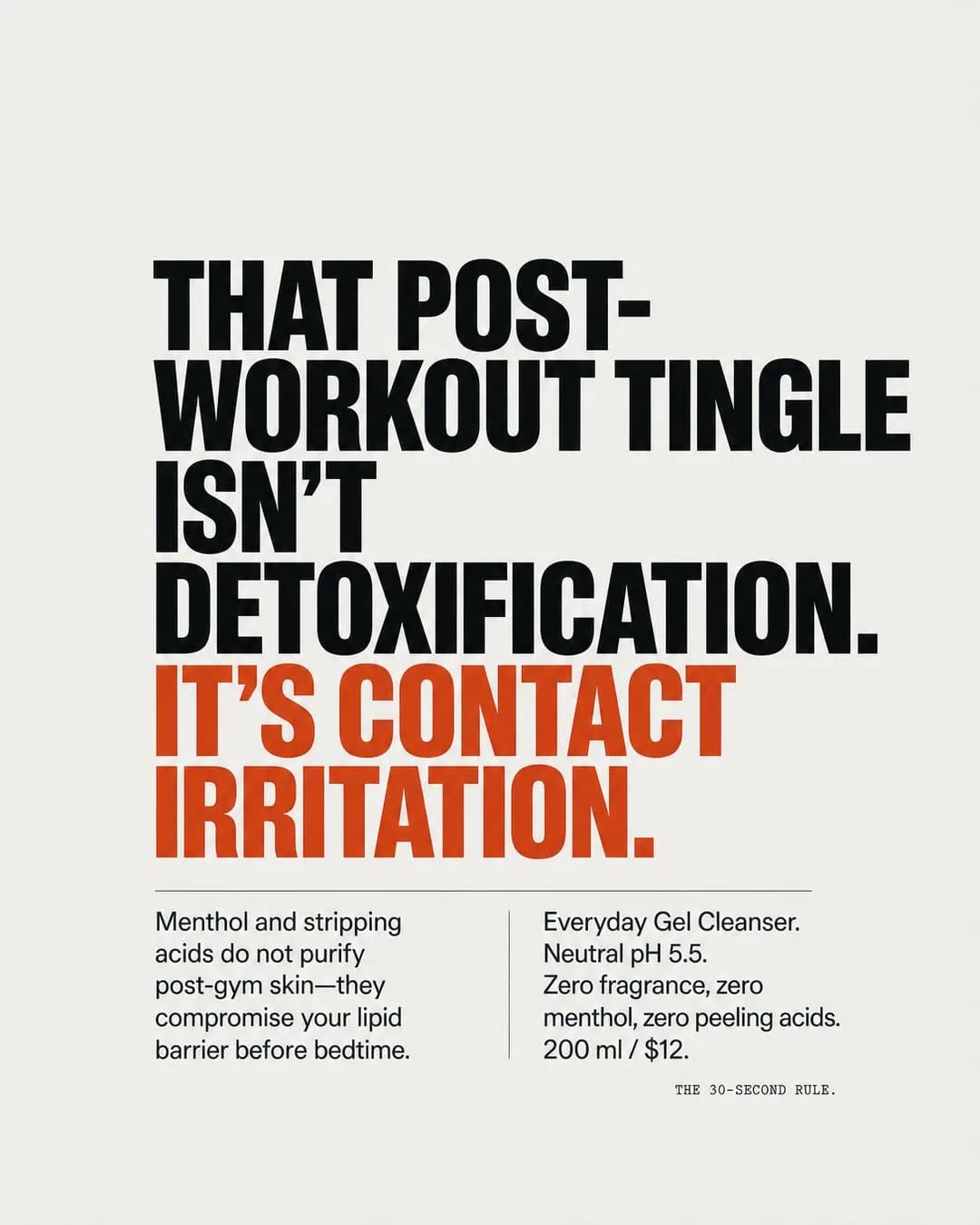
Clean skin doesn't need to tingle.
Neutral pH 5.5. 200 ml / $12.
The category's pitch is that a wash can treat something, and this brand's argument is that thirty seconds on the face is not long enough to try. A typographic poster suits an argument with no picture in it: the claim is the image, in type big enough to read at a scroll's speed, with the product's facts set quietly underneath in two columns.
What it argues against is invented. The brief gave a cleanser with no actives; the business summary added a villain, listing menthol among the sensitisers the formula leaves out, which the copy turned into “menthol-free”. The concept made that villain the ad, “The Post-Workout Tingle Fallacy”, and the poster now states as fact that “menthol and stripping acids do not purify post-gym skin”. The reader's own wash may contain neither. The pH of 5.5 and the product's name came from the summary too.
Then it tells the reader what their skin is doing: “early-stage barrier damage”, “strip your lipid barrier”, “your acid mantle”, and in another primary text “If your face feels tight after showering at the gym, your cleanser is working against you.” Meta's standard covers physical health and its rejected example, “Do you have diabetes?”, has that shape. Say it about the product instead: a cleanser that rinses off without leaving skin tight. Note where the diagnosis lives, though. “It's contact irritation” is the poster's second line, set in the accent colour at the top of the frame, so rewriting it is not an edit to a caption; the image has to be made again.
What did not happen is worth as much. A cleanser for people with oily, sweaty skin is the brief most likely to come back promising clear skin, and none of the five primary texts mentions acne, breakouts or blemishes. Nothing here lifts the ad above Meta's ordinary minimum age of 13.
Other headlines from the same run
- Zero menthol. Zero tightness.
- Stop stripping post-gym skin.
- Everyday Gel Cleanser | $12
- The 30-second rule for cleansing.
Call to action
Sales, to the cleanser's page with a purchase event firing. As a cosmetic with no drug claim in it, this one can run in a 13+ ad set, which is the whole reason to buy it on Instagram — but re-render the poster without the diagnosis first, since that sentence is part of the picture. In a 13+ ad set you have age and location and nothing else, so the ad does the qualifying: this poster names the moment (after training) and lets that find the reader.
The Three Stash Zones
SalesOne for the tote, desk, and coat: 3 for $22.
- Audience
- People who lose a lip balm a week — Keep a lip balm in every bag and coat pocket, lose about one a week, and buy whichever one is by the checkout.
- Angle
- BOGO / Multi-Buy (Offer & Economics) — Rewards buying multiple units or products.
Stop digging through the bottom of your tote. Keep a tube everywhere you actually reach for lip care.

Mix & Match Any 3 for $22
Any 3 shades for $22.
Multi-buy is usually a way to move stock; here it is the honest shape of the product, because a balm people lose once a week is bought three at a time or bought forever. The arithmetic holds and the ad does it in public: three for $22 is “Under $7.50 a tube”, against $9 each. Every price in the copy matches the brief.
It is also one of only two ads in the run written the length Instagram recommends — all five primary texts run 101 to 115 characters against Meta's 125, where eight of the ten ads wrote 252 or more. What the short copy leaves out is the brand's own differentiator: the summary sold “an honest wear time of approximately two hours” against rivals promising “unrealistic 12-hour wear”, and no primary text mentions wear time at all.
The picture is the failure. The style drenches the whole set in one colour, so three tubes, a coat, a tote and a tray are all the same berry — in an ad selling six shades and asking you to mix and match three of them. The shade names never appear, and the one visible bullet is the same red as everything else. Shoot the six, or at least the three the offer buys.
Two things skincare copy usually invents did not appear: there is no SPF in a lip balm that never had one, and nothing about the reader's lips beyond losing the last tube on a Tuesday.
Other headlines from the same run
- A Tube for Every Coat & Tote
- Stop Losing Your Lip Balm
- $22 Trio: Coat, Bag & Desk
- Sheer Tint. No Mirror Needed.
Call to action
Sales, to a page where the trio is built in a click and the shades are swatched on lips. Makeup is exempt from Meta's 18+ rule for cosmetics, so this is the clearest candidate in the batch for a 13+ ad set: turn Advantage+ audience off, set the minimum to 13, and expect age and location only. Meta allows a line addressed to an age group (“A service for teens”), so the ad can say who it is for; it may not say anything about the reader.
Cross-Brand Shade Compatibility Match
TrafficTell us your old foundation shade. We’ll find your exact tint match.
- Audience
- People who have bought the wrong shade online — Have ordered a foundation online twice, found it looked orange or grey in daylight, and now buy base makeup only in a store where they can swatch it.
- Angle
- Fit / Compatibility (Objection & Risk Reversal) — Resolves sizing, integration, device compatibility, workflow fit, or other practical blockers.
Sick of buying foundations online only to end up looking orange in your car mirror? We fixed that. Type in the shade you wear in your old brand, and our 3-step quiz translates it into your ideal skin tint. With 24 flexible shades that adapt to your natural undertone, you get seamless, sheer redness relief that looks like bare skin. If it’s not an exact fit, your first exchange is 100% free.
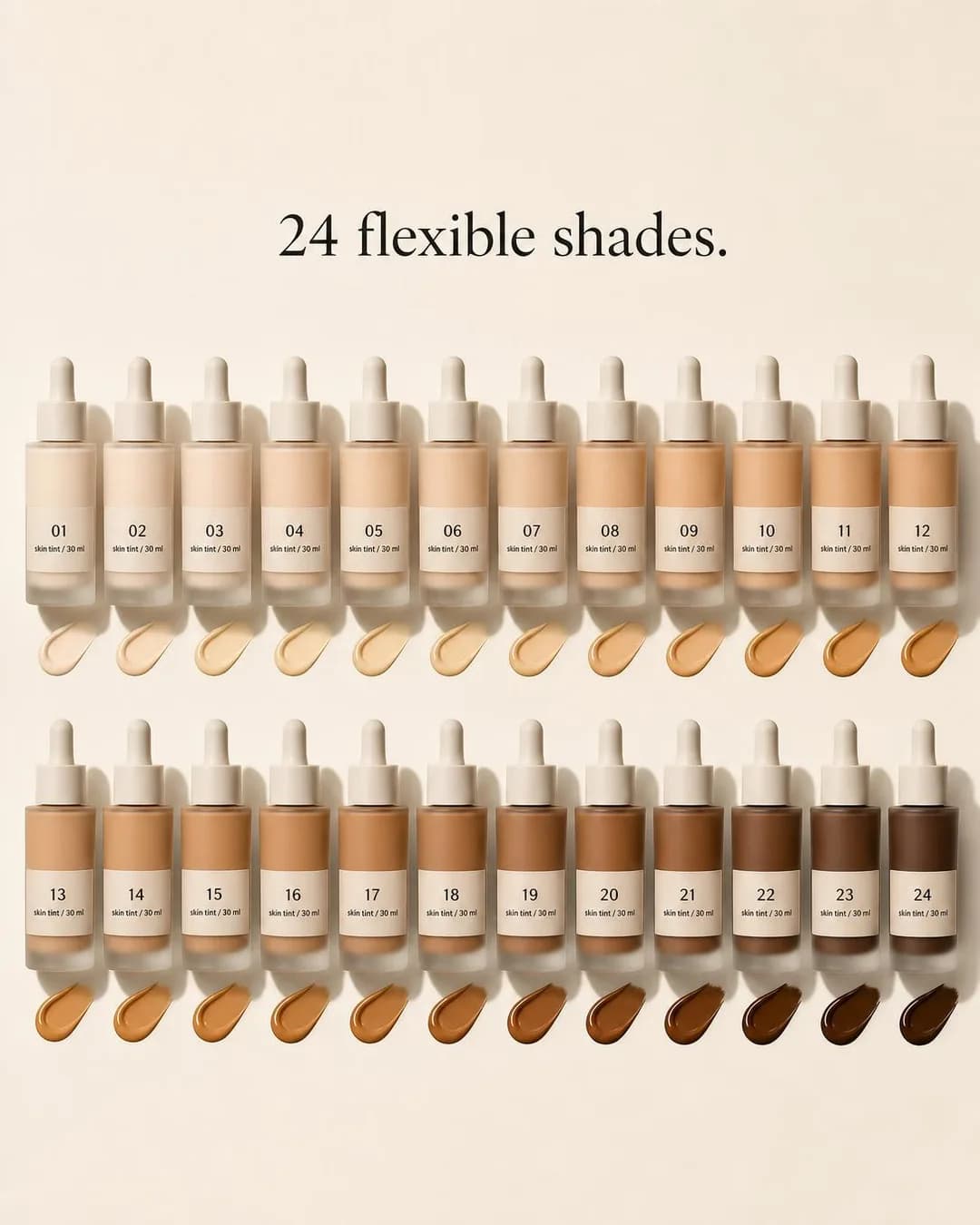
Match Your Old Shade in 3 Steps
Take the 60-second shade quiz.
Fit is the objection that stops a complexion sale online, and a range line-up answers it by showing the range — 24 numbered bottles, each with its own swatch, running from the palest to the deepest. It came back counted: 24 in the square draft, and 24 again after the re-frame redrew the whole picture at 4:5, with the caption “24 flexible shades.” intact. Our batches have watched image models draw eight dumplings where six were asked for and 156 squares where 90 were, so a number this size surviving two renders is worth recording.
The offer hardened on the way out. The brief gave a free first exchange; the summary added a prepaid return label, and the copy sells “Your exact shade match—guaranteed”, “Zero Guesswork”, “completely mistake-proof” and “backed by free returns”. The FTC's guides on guarantees say the word belongs in an ad only with its material limits disclosed, and a first exchange is not a refund. “First exchange free” is a good offer and fits a headline. The shade finder's three questions are the brief's, and the last of them — whether skin burns or tans — is a fair question for a shade quiz and a strange one in an ad that mentions the sun nowhere else.
The other line to watch is in the lead text the card shows: the quiz asks about undertones, and the copy hands that back to the reader — “24 flexible shades that adapt to your natural undertone”. Meta's personal attributes standard covers race and ethnicity, and its allowed and rejected examples turn on exactly this distinction, between describing what you sell and describing who is reading. Describe the range, not the reader: our skincare Facebook ad examples include a sunscreen ad whose copy mostly kept the skin tone in the product rather than on the reader.
Other headlines from the same run
- 24 Flexible Shades. Zero Guesswork.
- Wrong Shade? Free First Exchange.
- Find Your Match From Your Old Shade
- Serum Tint Matched to Your Skin
Call to action
Traffic, to the shade finder rather than the product page, because the quiz is the argument. If the ad set includes under-18s, optimise for link clicks: landing page views are one of the goals Meta withholds from teen audiences. Drop “guaranteed” before it runs, and put the free first exchange in the first 125 characters, where Meta recommends the caption stop.
The Friday Night Group Upgrade
AwarenessThe Friday night upgrade your group chat actually agreed on.
- Audience
- People who do face masks with friends — Do a face mask with friends on a Friday night while watching something, and use whatever sheet mask somebody brought.
- Angle
- Belonging / Community (Identity & Emotion) — Frames the product as a signal of membership in a group or movement.
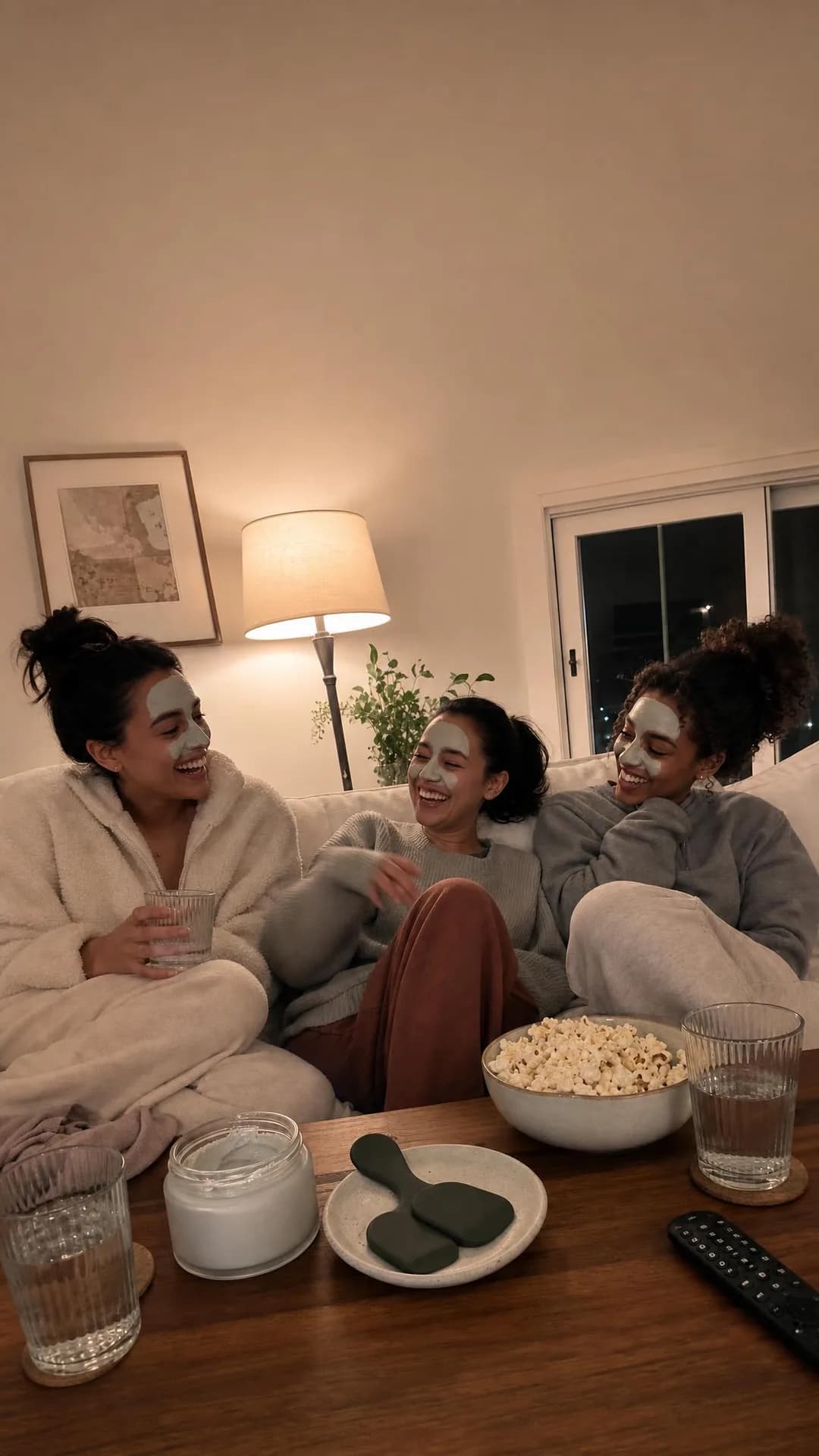
The Friday night upgrade your group chat actually agreed on. Ditch the cold, dripping sheet masks that slide down your face mid-laugh. This whipped kaolin clay mask glides on cleanly with a soft silicone paddle, staying put while you catch up. Ten quiet minutes to reset shine and soften skin.
The Friday night group upgrade.
Silicone paddle included. $18.
A mask is one of the few skincare products people use in company, which makes belonging the natural angle, and this is the most Instagram-native picture in the batch: a phone photo of three friends on a sofa, lamp-lit, popcorn on the table. Only water in the glasses, which is worth noting given how reliably these batches pour wine into a social scene.
It is also the clearest case on the page of the picture overruling the ad set. This is the most teen-shaped brief in the batch — a mask, $18, done with friends on a Friday night — and the render came back as three adults. Nobody briefed their ages; the word “diverse” that produced them came from the picture's instructions. In a 13+ ad set the creative is the only thing left that can speak to the audience you have just opened up, and this creative speaks to somebody else.
It is a 9:16 ad that puts its product in the wrong third. The jar and the brushes sit along the bottom edge, inside the 35% of a Stories frame Meta asks you to keep clear, where the call-to-action button and the profile name will land. The re-frame extended the scene upwards rather than letterboxing it, which is the right behaviour, but it filled the new space with ceiling and left the product where it was.
Two details drift from the instructions rather than from the brief: the picture was asked for two silicone brushes and drew three, and for a mask across the T-zone and nose, which came back as patches on the cheeks. One primary text prices the jar as “Each $100ml jar”, which is a $100 product in an $18 ad — the sort of thing that reads as a typo on a page and as a price on a screen. The claims stay mild and mostly cosmetic (“absorbs oil”, “reset shine”, “rinses clean”), with one jab at the alternative: “Real friends don't let friends sit under slimy sheet masks.”
Other headlines from the same run
- Ditch dripping sheet masks.
- 10-Minute Group Reset | $18
- Better skin, zero mess.
- The 10-minute couch ritual.
Call to action
Awareness, optimised for reach, which is one of the goals that survives a teen-inclusive ad set — and a clay mask is a cosmetic, so it can run to 13 if you set the range yourself. Re-render with the jar higher in the frame before it goes to Stories, and fix the $100 ml line. A mask people do together is an ad that can be sent to a friend, so watch shares as well as clicks.
Dissolving Bonds Without Friction
TrafficStop scratching rough skin; lactic acid unglues it from beneath.
- Audience
- People who scrub their face every morning — Use a gritty face scrub every morning because their skin feels rough, and have never tried an exfoliant that doesn't scrub.
- Angle
- How It Works (Product & Mechanism) — Explains the process from input to mechanism to result.
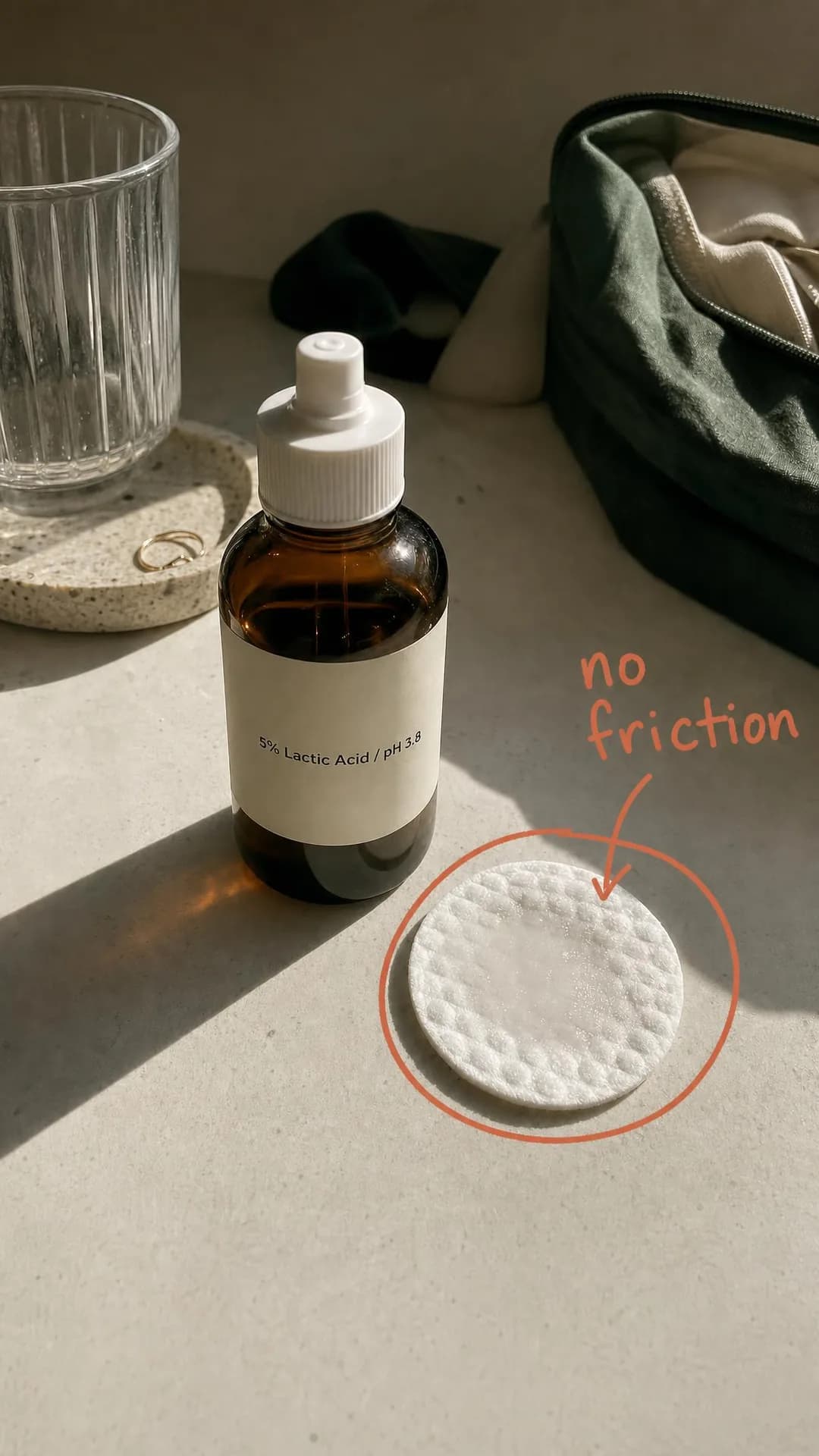
If you're scrubbing rough skin every morning, you're treating the symptom with friction—not solving the bond. Rough texture is just dead skin cells glued together. Instead of scratching at the surface, 5% fermented lactic acid works at pH 3.8 to gently dissolve those cellular bonds from underneath. Just sweep it over skin 2–3 evenings a week with a cotton pad. Dead cells release naturally, leaving your barrier intact.
Dissolves dead cells without friction.
Smooth skin without friction.
When the promise is a schedule — twice a week beats every morning — the mechanism is the argument, and the reason is chemistry rather than effort. The doodle style is the batch's lightest touch: a bottle, a damp cotton pad circled in marker, and “no friction” written beside it. The label the picture printed, “5% Lactic Acid / pH 3.8”, is accurate to the summary and inside the conditions the Cosmetic Ingredient Review panel set for these products, 10% or less at a pH of 3.5 or above.
The words went further than the acid does. “Renewal” is in a headline, “barrier-safe resurfacing” and “works at a molecular level” are in other primary texts, and the lead text explains that the acid works “to gently dissolve those cellular bonds from underneath”. The FDA decides what a product is by what the advertising claims it does, and its own examples of the line are close by: “less noticeable, simply by moisturizing” is a cosmetic, “regenerate cells” is not. An exfoliant that says smoother and more even is selling the same bottle and staying on the right side.
The absolutes came from nowhere. The brief said two or three nights a week to start; the copy promises “No tingling, no friction, and zero redness” for an acid whose own summary buffers it to “minimize surface tingling”. Another primary text has it “soften texture overnight”, which is a timed outcome of the kind Meta's Health and Wellness standard lists as clickbait when it comes without a qualifier. And the $19 bottle becomes “4–5 months” of use, which is the summary's estimate stated as a fact.
What is missing is the sun. The FDA recommends that products with an alpha hydroxy acid carry a Sunburn Alert telling people to use sunscreen and limit sun exposure “while using this product and for a week afterwards”, and this ad — which tells you to sweep acid over your face two or three nights a week — mentions the sun in none of its five primary texts. The brand two rows down sells the sunscreen.
Other headlines from the same run
- Trade the scrub for lactic acid.
- How lactic acid unglues rough skin.
- Gentle texture renewal for $19.
- Stop scrubbing. Start dissolving.
Call to action
Traffic, to a page that gives the schedule and the sun warning above the buy button; optimise for link clicks if the ad set includes under-18s. Meta's rules would let an acid toner run to 13-year-olds as a non-permanent cosmetic, which makes this minimum age a decision you make rather than one you are given: the product has directions, and the ad set is where you decide who gets them.
The Bedtime Towel Wrap
SalesWrapping an old bath towel over your pillow isn’t a skincare routine.
- Audience
- People who have bleached a towel without meaning to — Found pale orange spots on a dark towel or pillowcase, worked out it was their spot gel, and now keep one old towel for bedtime.
- Angle
- Friction / Annoyance (Problem & Pain) — Focuses on an irritating part of an existing workflow, routine, or product experience.
Wrapping an old, scratchy towel over your pillowcase is not a skincare routine. Benzoyl peroxide clears breakouts, but it permanently bleaches dyed fabrics. Instead of waking up on bunched-up terrycloth, get an effective 2.5% gel paired with two crisp white cotton pillowcases. Clear skin without ruined bedding.
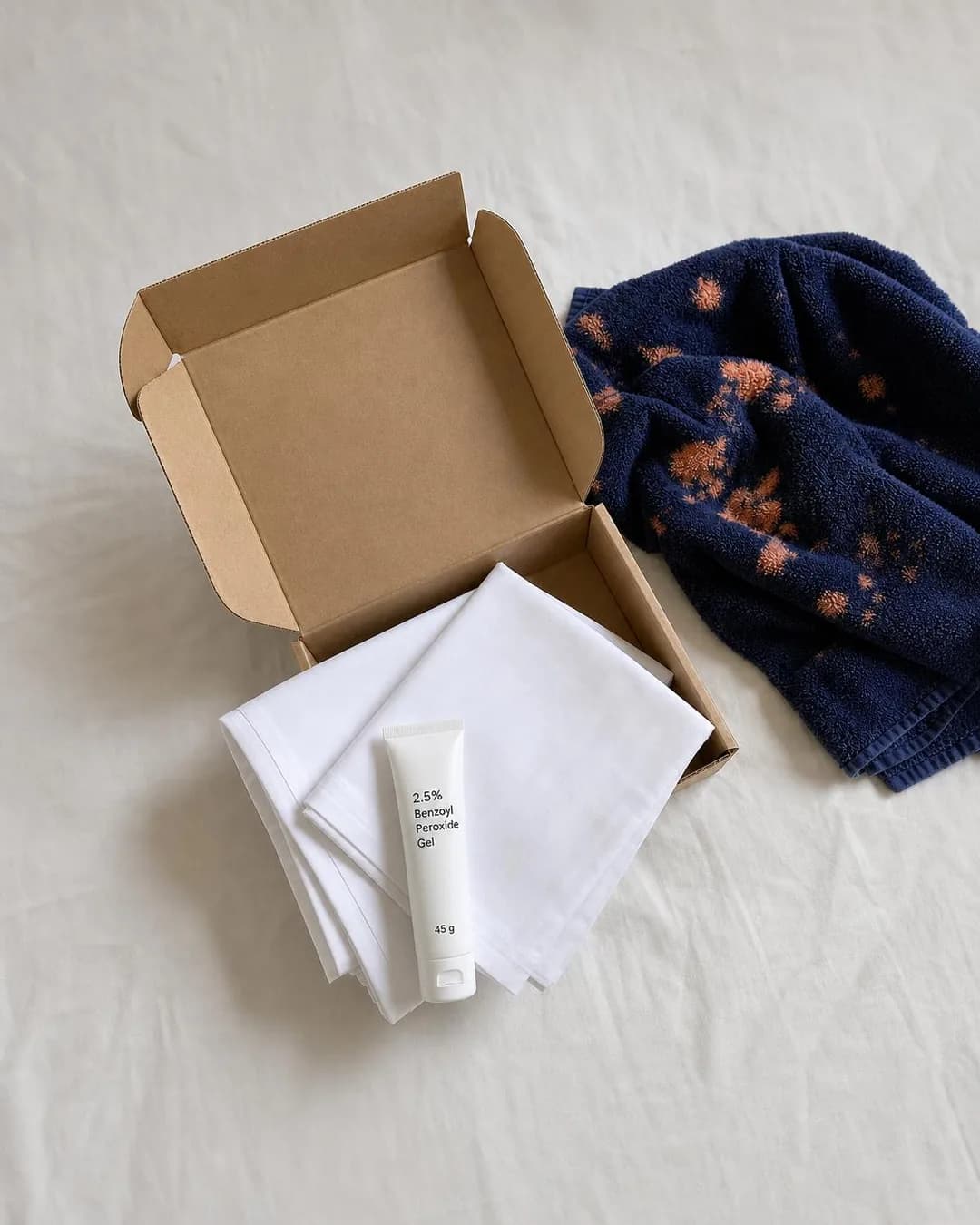
Retire the bedtime towel wrap.
Routine set with cases: $24.
The best detail in this batch came out of a drug label. The FDA's monograph for over-the-counter acne products requires benzoyl peroxide to warn that it may bleach “hair and dyed fabrics”, and the brief turned that warning into the offer: a 2.5% gel sold with two white pillowcases. The picture delivers it exactly — an open box, two folded white cases, a tube marked “2.5% Benzoyl Peroxide Gel / 45 g”, and, pushed to the edge of the frame, a navy towel blotched pale orange.
This is also the ad that cannot have the audience it was built for. Acne is a disease in the FDA's definition and a treatment for it is an over-the-counter drug, which Meta does not allow to be targeted below 18. The business summary did not notice: it wrote the audience as “Adults and adolescents managing persistent breakouts”, for the one product on this page that may not be advertised to adolescents at all. That is the page's argument in a single line, written by the tool itself.
The copy then aims at that buyer's skin. “Stop sacrificing your good sheets to treat nighttime breakouts”, “Raise your hand if you own a dark towel covered in pale orange bleach spots” (another primary text) and “Clear skin without ruined bedding” all address the reader as someone with acne, which is what Meta's personal-attributes standard is about. The product can say what it treats; the ad should not say what the reader has. The monograph is also more careful than the ad in two places the summary had already hardened: it permits “Clears up most acne blemishes” where the copy says benzoyl peroxide “clears breakouts”, and it says dyed fabric “may be bleached” where the summary, and then the ad, says it “permanently bleaches”. The summary invented the comparison too — “minimizing peeling and redness compared to harsher 5% or 10% preparations” — which the copy sells as “standard acne-fighting power with less irritation”.
One omission is worth fixing on the landing page: the monograph's directions tell users of benzoyl peroxide to apply sunscreen if they go outside, and nothing in the ad or its destination says so.
Other headlines from the same run
- Acne care that spares your sheets.
- 2.5% gel + 2 white pillowcases.
- Stop ruining your dark bedding.
- The Night Routine Set is $24.
Call to action
Sales, targeted 18 and over, to a page carrying the Drug Facts panel and the sunscreen direction. Since the ad set is 18+ anyway, it keeps everything a teen-inclusive one loses: exclude recent buyers with a customer list, and retarget people who read the page and did not buy. Rewrite the second-person lines first — the set, the towel and the bleach spots make the argument without ever naming the reader's skin.
Midday Patio Lunch Without Panic
SalesEat lunch in full sun without touching up your foundation after.
- Audience
- People who put sunscreen on once, before 8 a.m. — Put sunscreen on under their makeup every morning, never reapply because they would have to redo their face, and eat lunch outside when they can.
- Angle
- Convenience (Benefit & Outcome) — Makes an existing task, routine, or purchase easier to complete.
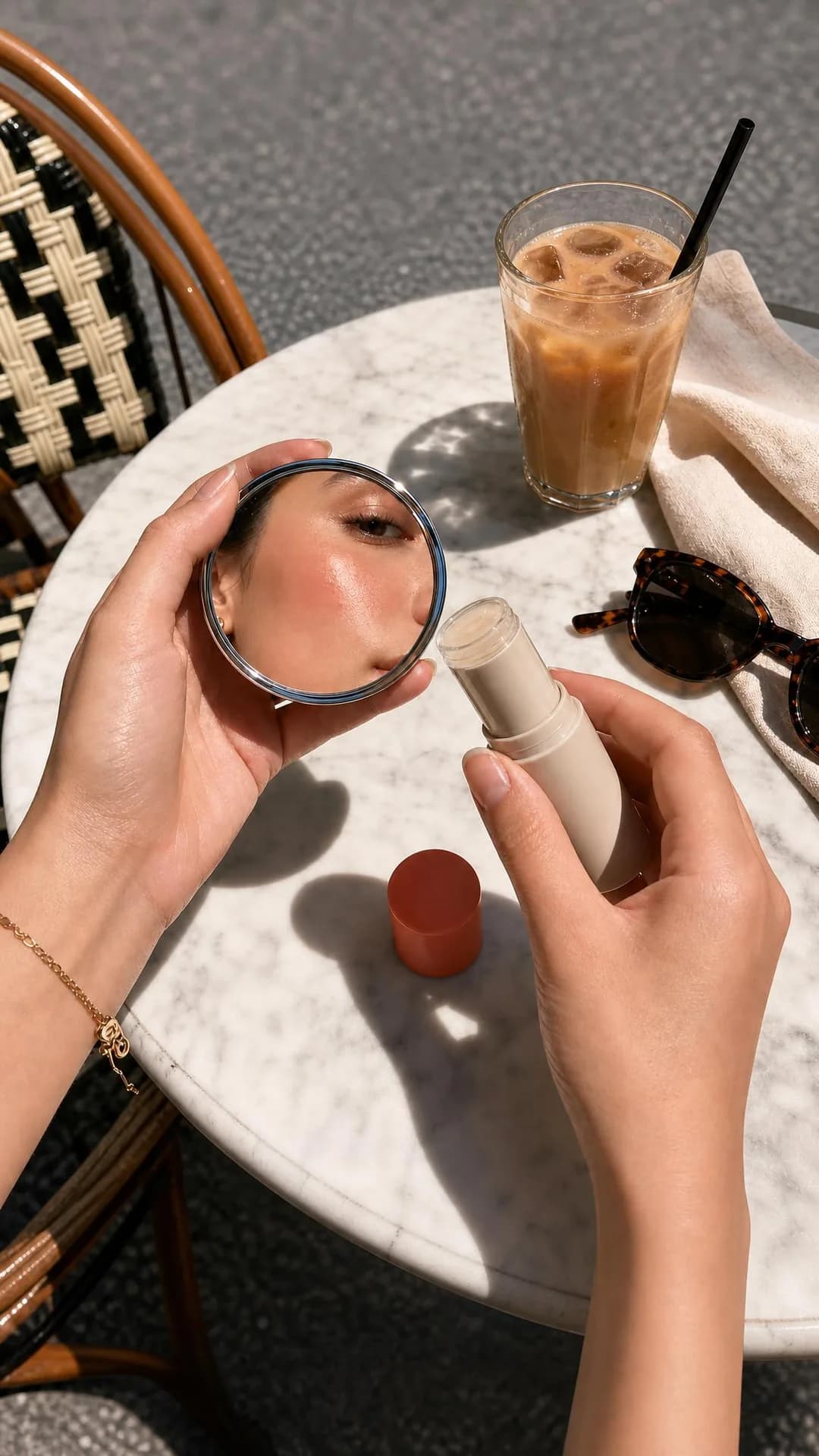
That 8:00 AM layer of sunscreen wore off hours ago. Enjoy your outdoor lunch anyway. Glide broad-spectrum SPF 30 directly over your cream blush, foundation, and powder in thirty seconds flat. No chalkiness, zero makeup melt, and no touch-up kit required. Keep your look completely intact under direct midday sun.
Reapply SPF Over Makeup in 30s
Invisible over-makeup SPF 30.
Reapplication is sunscreen's real problem and nobody solves it with a lotion at 1 p.m., so a stick that goes over makeup argues for itself. First person suits it: two hands, a compact mirror, a café table in full sun, and the stick a twist away from the cheekbone.
The product in the picture is not the product in the copy. The brief and three of the five primary texts sell a clear, transparent, invisible stick (“No mess, no white cast”), and the render drew an opaque cream-coloured bullet — in the square draft as well as the 9:16, so this came from the image rather than the re-frame. It also carries no label at all. In the United States this is a drug, and a real one would show its SPF, a broad-spectrum statement and a water-resistance claim of 40 or 80 minutes or none. An unlabelled stick in a sun ad is the one place a blank prop costs you something.
The claims run past what the brief's SPF 30 can promise. The concept has the patio lunch “sunburn-free”, a headline says “Protect Your Skin. Keep Your Makeup.”, and another primary text offers “total confidence” in midday sun. A sunscreen's own labelling is more careful than that, and the ad never says how much or how often, which is the honest version of its argument, since a stick's dose is the thing people get wrong. The “thirty seconds” that the lead primary text and a headline promise is the concept's invention, not the brief's.
Where it stayed clean: nothing about the reader's skin beyond their 8 a.m. routine, no invented water resistance, and no “sunblock” or “waterproof”, which the FDA does not allow on a sunscreen. The hands the picture drew are light; no brief described them, which is the second time in two batches that an undescribed person came back that way.
Other headlines from the same run
- Say Yes to the Sunny Patio Table
- Clear SPF 30. Zero Makeup Smudge.
- Midday Sun Defense Made Effortless
- Protect Your Skin. Keep Your Makeup.
Call to action
Sales, targeted 18 and over as the safe default, since the FDA regulates sunscreen as a drug and Meta's over-the-counter floor is 18. Re-render the stick clear, and put the SPF and broad-spectrum wording on the pack before anything runs. Reapplication is a reorder argument as much as a sales one: a stick carried for daily reapplication runs out, so upload buyers as a customer list and reach them again once it should have.
The Ankle Line Comparison
SalesRemember your last ankle disaster? Look at this seamless blend instead.
- Audience
- People whose last self-tan streaked — Tried a self-tanner once, got orange palms and streaks at the ankles, and went back to not bothering.
- Angle
- Before / After (Proof & Trust) — Contrasts the state before adoption with the state after adoption.
We’ve all worn long socks in eighty-degree weather to hide ankle stripes. Your last bad tan wasn’t your fault—it was a formula without a guide. Our lightweight mousse uses an olive-bronze guide so you see exactly what you're blending in real time. Enjoy a smooth, 7-day sun-warmed glow without the patchy dry spots.
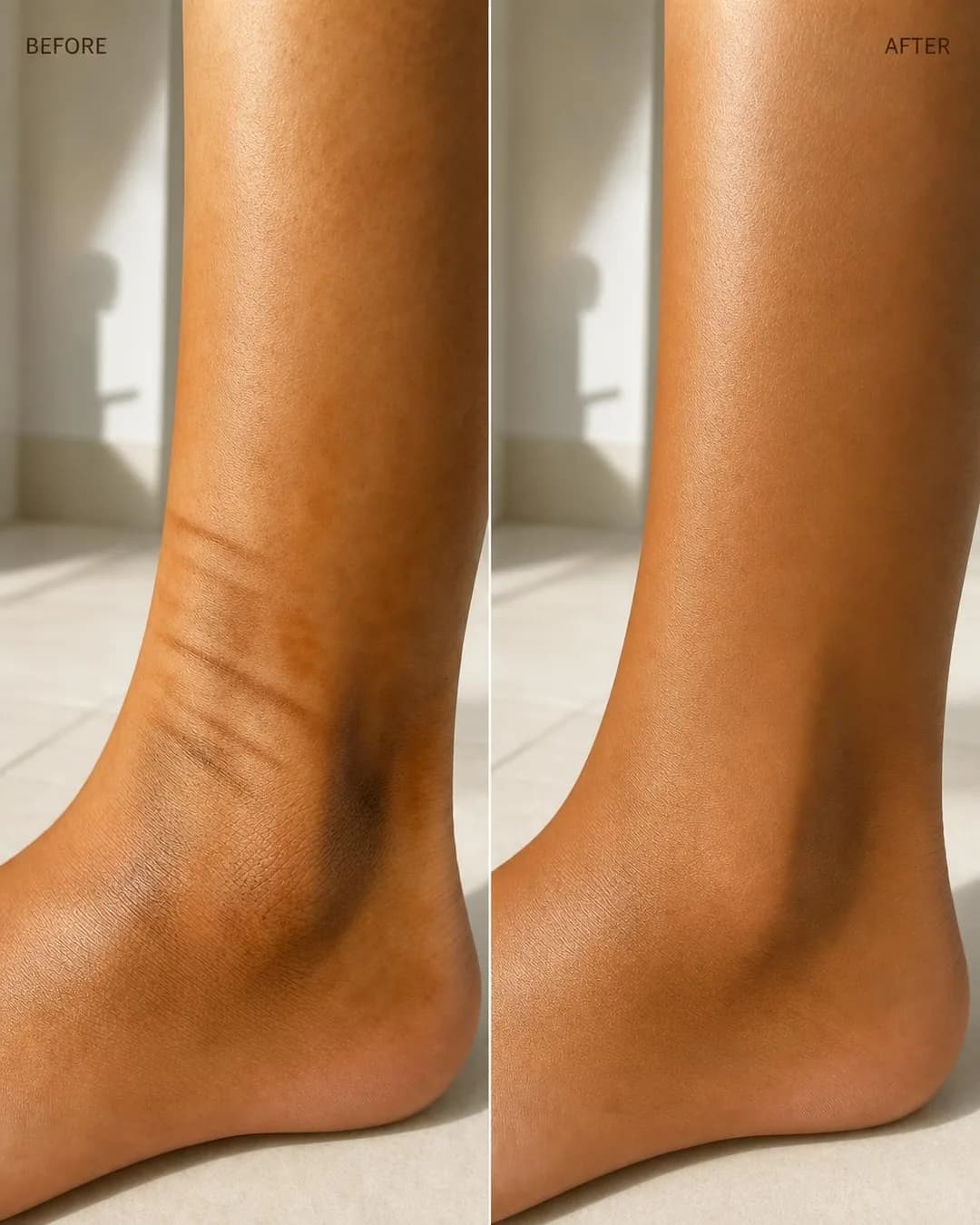
Streak-Free Ankles, Every Time.
7-day even fade. Zero streaks.
Before-and-after is this category's native ad, and the ankle is the right crop, because the ankle is where self-tan goes wrong. The picture is convincing at a glance: “BEFORE” streaked and pooled in the crease, “AFTER” smooth and even, same tile floor, same light.
It is not the same ankle. The heel shape, the foot's angle and the tendon differ between the panels, in the square draft as well as the published 4:5, so what looks like one leg photographed twice is two drawings of two legs — and the “before” is already tanned, which makes the comparison a streaky tan against a good one rather than the bare skin the reader has now. A fourth primary text says what that comparison is for: “Left: what happens when your tan lacks a guide. Right: what happens when it has one.” That turns an invented picture into a claim about rival formulas. The FTC's endorsement guides say an ad relating a consumer's experience is read as what buyers will generally achieve, and that the person shown must be a bona fide user. Nobody used this. Meta lists before-and-after imagery for cosmetic products under 18+ and does not say which rule wins when the product is also an exempt cosmetic, so 18 and over is the safe default here whatever else you change.
The safety line vanished at the last step. The brief said the mousse contains no sunscreen and that the bottle says so; the business summary went further and reproduced the FDA's warning in full, including the sentence about skin ageing. Then no primary text mentioned sunscreen or sun exposure; the closest any of them comes is a “sun-warmed glow”. It is a strange absence in an ad about golden skin, and it is the sentence most worth putting back.
The promises hardened on the way. “Foolproof” and “streak-free” were the summary's words for the brand, and the copy made them promises: “Streak-Free Ankles, Every Time.”, “zero streaks”, “The End of Bad Self-Tans.” The summary's fade of “approximately seven days” became “a uniform fade across seven full days”. One primary text also offers a glow that “rinses clean in 8 hours”, which reads as a wash-off promise beside the ad's own “develops in 6 to 8 hours”; the summary means develop-then-rinse, and the line does not say so. And “We've all worn long socks in eighty-degree weather to hide ankle stripes” is the kind of line Meta's rule on statements about appearance is written for.
Other headlines from the same run
- No Tiger Stripes. Just Warm Glow.
- Olive-Bronze Guide. No Mistakes.
- The End of Bad Self-Tans.
- Foolproof Color in 6–8 Hours.
Call to action
Sales, 18 and over, and only once both panels are photographs of one real customer's leg, taken the same way — a morning's work, and the only version of this ad that is true. Turn creative enhancements off in Ads Manager first: brightness and contrast are exactly what this ad is about. Put the no-sunscreen warning in the copy, not only on the bottle.
Freight Ledger Cost Breakdown
SalesDon't buy another jar. We took $7 off your refill instead.
- Audience
- People who bought the jar this spring — Bought the moisturiser in its glass jar between March and May, are near the bottom of it, and were about to buy a second jar.
- Angle
- Why We’re Cheaper (Story & Founder POV) — Founder explains the structural reason the brand can charge less than alternatives.
If you bought our lipid moisturizer this spring, please don’t reorder the glass jar. You already own the hardware. When we looked at our freight ledger, seven dollars of every order went entirely to moving heavy pressed glass and secondary cartons. By switching to an ultralight 50 ml refill pouch, we strip that dead logistics cost out completely. Same oat ceramide and squalane formula, down from $28 to $21.
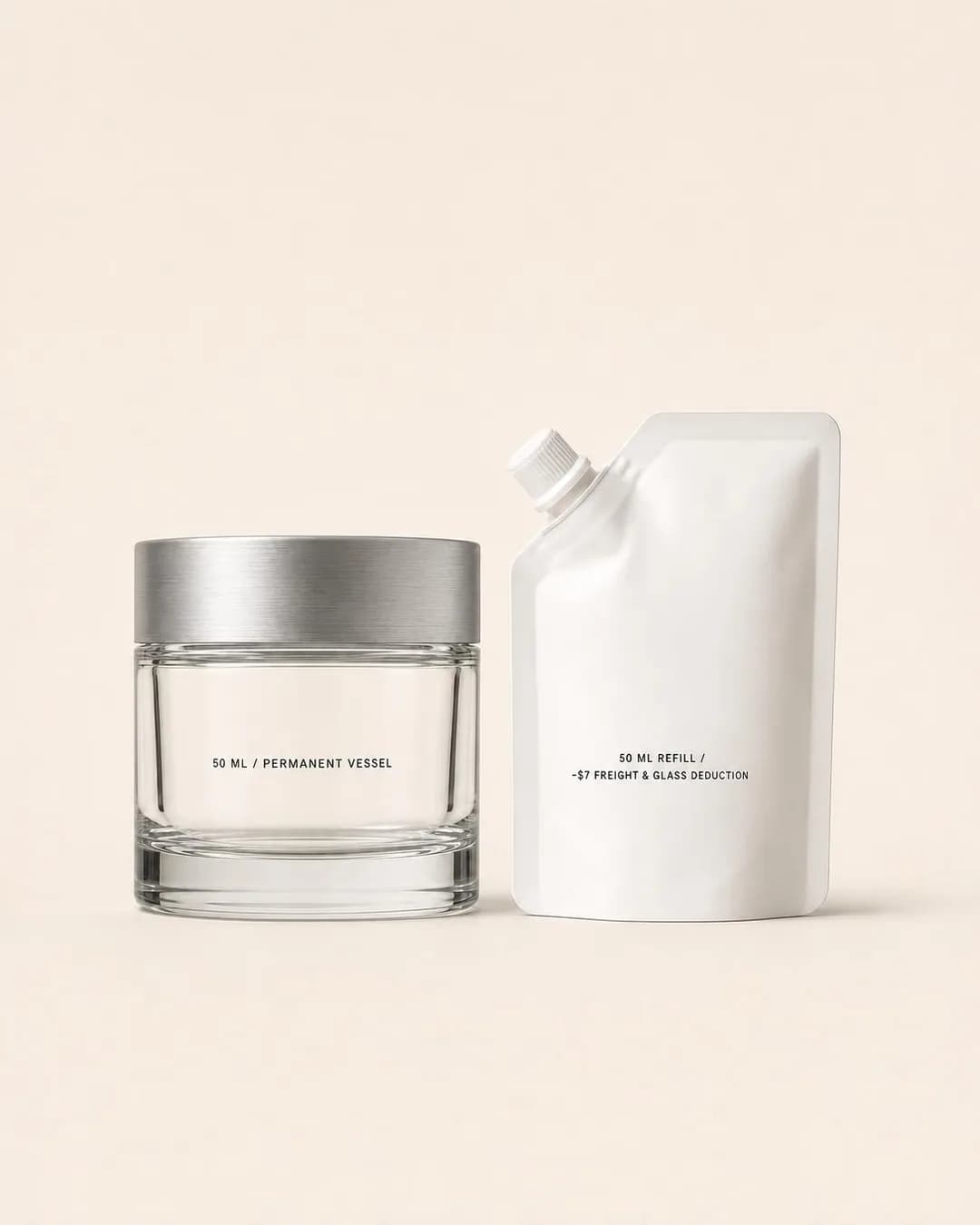
Don't buy a second jar. Pay $21.
Exclusive to jar owners.
A refill is an ad aimed at people who have already bought, and this one knows it: the first line tells them not to reorder the jar. The picture is the cleanest in the batch, the heavy glass vessel beside the flat pouch, and the arithmetic is the brief's: $28 for the jar, $21 for the refill, $7 saved.
What the $7 is made of was invented. The brief said the jar is the most expensive part; the summary turned that into 85% less shipping weight, and the copy turned it into a freight ledger: “seven dollars of every order went entirely to moving heavy pressed glass”, “Our initial jar weighs over 85% more to ship”. The summary also built a mechanism nobody briefed, a batch code engraved in the jar's base and entered at checkout, and the five primary texts cannot agree on it: one tells you to enter the code at checkout, another says the refill “unlocks” automatically from your account history. A brand running this ad has promised a checkout feature it may not have built, in two incompatible versions.
The pouch says it too. The picture printed “50 ML REFILL / −$7 FREIGHT & GLASS DEDUCTION” on the packaging, which is a company's internal accounting written on a product label.
This is the ad whose minimum age has nothing to do with what it says. It only works as a customer-list audience, and every custom audience — website, customer list, engagement, lookalike — is unavailable in any ad set that includes under-18s. The cream is a cosmetic and the copy is clean; the targeting sets the floor. That is the whole shape of the problem for a brand built on replenishment: on the teen half of Instagram there is no refill ad, no reorder window and no lookalike of jar buyers, so that audience can only ever be a first purchase, and the case for buying it has to stand on the first order's margin alone.
Other headlines from the same run
- Cut $7 in dead freight costs.
- Same 50 ml formula. $7 less.
- Your glass vessel is permanent.
- Deduct $7. Refill your cream.
Call to action
Sales, to a customer list of spring jar buyers, built in Ads Manager: best-in-slot publishes into an ad set you have already made, so the audience is yours to build and this ad set is 18+ by definition. Judge it on the second order, not the first — the point of a refill is the third and fourth. And before it runs, cut the batch code unless it exists.
The August Waitlist Restock
LeadsSold out in August. Back in production this Tuesday at 9 AM.
- Audience
- People who found it sold out in August — Went to buy the cleansing balm in August after a friend recommended it, found it sold out, and have not bought a replacement.
- Angle
- Restock (Scarcity, FOMO & Timing) — Announces that a sold-out or unavailable product is back.
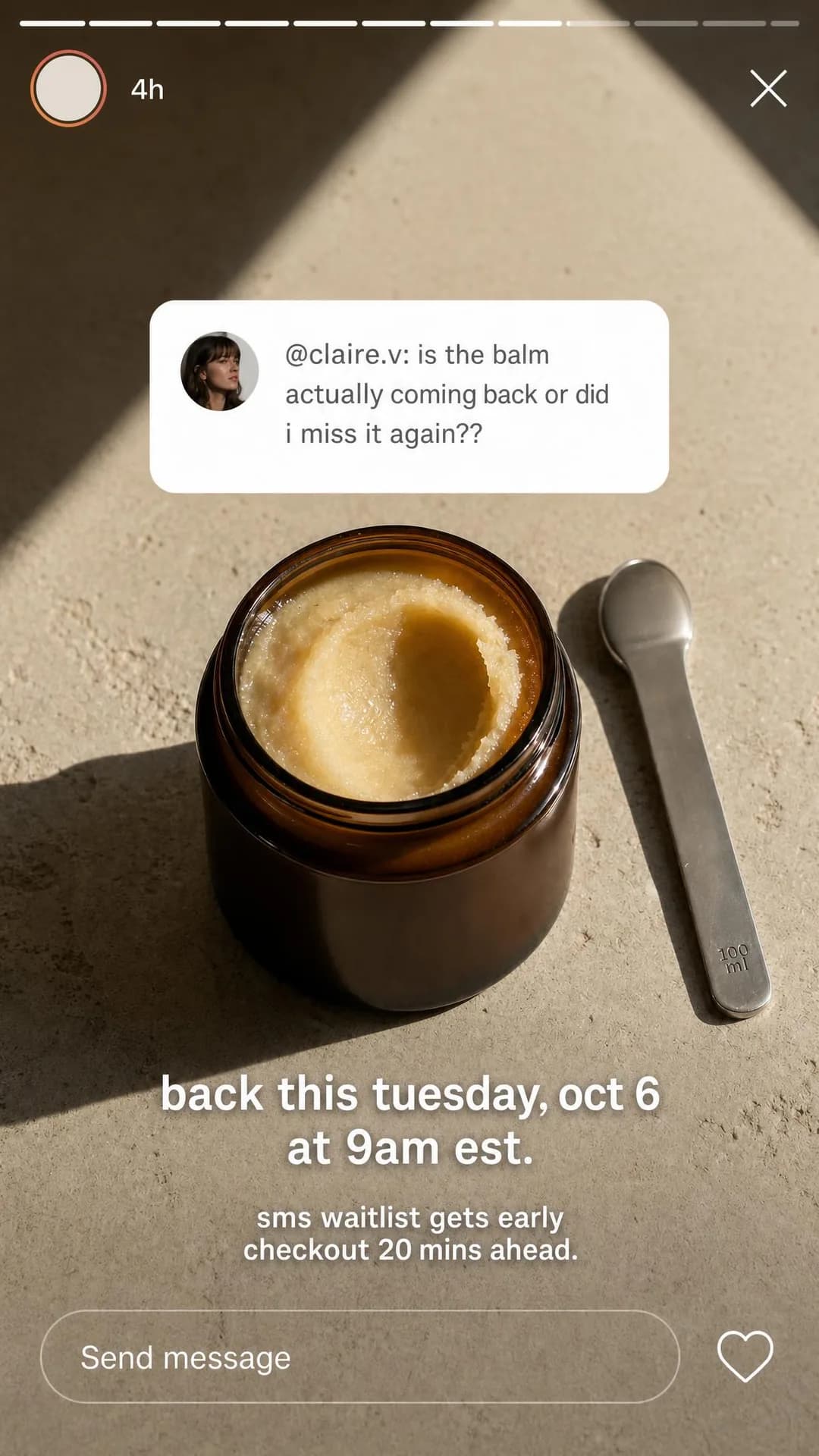
If you checked in August and saw a sold-out page, this is your heads-up.
Restocks Tuesday, Oct 6 at 9 AM
SMS gets 20-min early access
A restock is one of the few skincare offers with an hour attached, and the ad gets the hour right: Tuesday, 6 October 2026 at 9 a.m. Eastern is a Tuesday, and every line that gives the date gives it correctly. The copy is the shortest in the run at 72 to 82 characters, well under Instagram's 125, because a date needs no paragraph.
The picture is a fake Instagram Story. The style was pinned in the brief — an Instagram Story reply — but what the render made of it was not: it draws the app's own chrome — progress bars, a profile ring, a heart, a “Send message” field that does nothing — and, sitting on top, a reply sticker from “@claire.v” with a face and a question: “is the balm actually coming back or did i miss it again??” That handle does not exist and neither does she. The FTC's statement on deceptively formatted advertisements is about exactly this, a format that implies the content comes from someone other than the advertiser, and its endorsement guides require a person shown endorsing a product to be a real user. A real customer's reply, with permission, is a stronger ad and an easier one to defend.
Two smaller inventions, both from the summary: the SMS list became a checkout link “twenty minutes ahead of the public site release”, which the picture burns in and a headline repeats, and the spatula in the photograph is stamped “100 ml”, which is the jar's volume on the spoon.
The restock is also the one offer here that Instagram sells a purpose-built ad for. A reminder ad attaches an event with a start time and notifies the people who tap it before it starts; our restaurant Instagram ad examples set out how one is built and what it notifies, and it applies whole to a drop at 9 a.m. on a Tuesday.
Other headlines from the same run
- Back Tuesday: 20-Min Early Access
- Sold Out in 11 Days. It’s Back.
- The $26 Cleansing Balm Returns
- Join SMS for Early Restock Access
Call to action
Leads, to a signup page for the SMS list — an Instant Form (Meta's in-app form) would have to be built in Ads Manager, and so would the reminder ad this offer really wants. Either way the ad set is 18 and over: leads is one of the optimisation goals Meta withholds from audiences that include teenagers. Re-render without Instagram's interface and without @claire.v, and count the restock from the till, not from the number of people who tapped.
Questions
- Can you advertise skincare on Instagram?
- Yes, and Meta's ad policy for skincare is the same on Instagram as on Facebook, because its Advertising Standards are platform-wide. Three of them reach these ads. Privacy Violations and Personal Attributes stops copy that asserts or implies the reader's age, race or ethnicity or physical health (“Ready to upgrade your skin to look younger?” is its rejected example, “Our new lotion and creams fight wrinkles like never before!” is allowed). Health and Wellness requires cosmetic products to be advertised to people 18 and over, then exempts non-permanent ones such as creams, makeup and hair products, lists before-and-after imagery under 18+, and prohibits statements of inferiority about appearance. Drugs and Pharmaceuticals puts over-the-counter medicine at 18+. In the United States the FDA then decides, from the same words, whether your product is a cosmetic or a drug.
- Can skincare ads target under-18s on Instagram?
- Only some of them, and only in an ad set built for it. Meta's minimum age is 13 (16 in Australia; in the EU, the EEA and Switzerland ads cannot deliver to under-18s at all), and its Health and Wellness standard exempts non-permanent cosmetics and beauty products from the 18+ rule. But with Advantage+ audience on, the youngest minimum age Meta accepts is 18, so you have to switch it off and set the range by hand — and that ad set then keeps only age and location. Gender, sub-city locations, language, detailed targeting, every custom audience including your own customer list, and lookalikes are unavailable, and so are the leads, landing page views, value and post engagement goals. One rule about the copy is narrower than people expect: an ad may be addressed to teenagers (“A service for teens” is Meta's own allowed example), it just may not tell a teenager what their skin is doing.
- Can you advertise acne products on Instagram?
- Yes, to people 18 and over. In the United States an acne treatment is an over-the-counter drug: the FDA's monograph defines acne as “A disease involving the oil glands and hair follicles of the skin” and sets out the claims such a label may make, including “For the treatment of acne” and “Helps prevent new acne pimples”. Meta says it “doesn't allow targeting for over-the-counter medicine to people under the age of 18”, and its examples name anti-inflammatories and antiseptics rather than acne gels, so this is a reading of the standard rather than a line Meta has written. Plan for the consequence either way: a cosmetic cleanser whose copy promises to clear breakouts has made itself a drug ad and given up the audience Instagram had over Facebook.
- Can a skincare ad show a before and after on Instagram?
- Yes, in an ad targeted to 18 and over: Meta lists before-and-after imagery for cosmetic products among what can run to that audience, and it does not say which rule wins when the product is also an exempt cosmetic, so 18 is the safe default. The condition AI cannot meet is the FTC's — an ad relating a customer's experience is read as what buyers will generally achieve, and the person shown must be a bona fide user. The self-tan pair on this page fails on its own terms before it gets there: the two panels are not the same ankle.
- What size should a skincare Instagram ad be?
- Render 4:5 for the feed — Meta recommends 1440 × 1800, and 1080 × 1350 is what best-in-slot exports, above its 500-pixel minimum width. For Stories and Reels use 9:16 (1440 × 2560, or 1080 × 1920) and keep roughly the top 14%, the bottom 35% and 6% at each side clear of anything that matters; one ad on this page leaves its jar in the bottom band, where the button lands.
- How long should the caption be on a skincare Instagram ad?
- Meta recommends 125 characters of primary text — what Instagram users would call the caption — and a 40-character headline for the feed, and 44 characters for an image ad in Reels. Generated copy runs long: ten of this run's fifty primary texts fit 125, all from the two ads whose argument is one fact, while eight of the ten ads wrote 252 characters or more, and none of the fifty was short enough for Reels. Read the first 125 characters of yours as the ad Meta recommends writing, and either write a shorter caption for Reels or leave that placement out.
- Which objective should a skincare brand use on Instagram?
- Sales for most product ads, as long as your store sends Meta a purchase event; six of the ten ads here were written for it. Use Traffic when the ad has to explain something first, Awareness when the point is reach, and Leads for a waitlist. If the ad set includes under-18s the choice narrows: purchases and link clicks survive, landing page views, leads and value optimisation do not, and Instagram profile visits is the one goal that still builds you an audience, since no custom audience is available.
- Is Instagram or Facebook better for a skincare brand?
- It depends on the age of the customer you want. Pew's 2025 figures put Instagram ahead among 18- to 29-year-olds and among teenagers, where it reaches about twice Facebook's share; Facebook leads from 30 upwards. For a brand selling lip products, masks and cleansers to under-25s, Instagram is where they are; for a brand selling a $70 night cream, our skincare Facebook ad examples are the better place to start. Nothing about the claims changes between the two, because Meta's standards and the FDA's reading are the same on both.
Seen enough? Make your own.
Paste your site. The AI reads your products, your ingredient lists and what you claim, then writes the concepts, draws the images and drafts the copy. In our skincare examples its claims about skin drifted one way, from how skin looks towards what the product does to it, so before any ad runs, read it for the words that turn a cream into a drug.
No credit card · 50 free credits (about 5 ads or Instagram posts)
Every angle used above is documented in the best-in-slot ad angle library. More industries and placements are at all ad examples.