
Ad Examples · Restaurants, Cafés & Bakeries × Facebook · 10 ads
Restaurant Facebook ad examples
Ten finished ads for restaurants, cafés and bakeries — waitlists, catering, pickup pricing, a coffee club, pie pre-orders and a supper club — with the brief behind each, because we generated them rather than collected them.
Restaurant advertising online is one photograph of one plate, shot from directly above, with a button underneath it. It is a collected picture of somebody else's food, and it cannot tell you the only things that transfer to your own restaurant: who the ad was written for, what it argued, and what it was supposed to make happen next — which, for a restaurant, is almost never the thing the button says.
So these were not collected. Every ad below was generated with the audience, the angle and the objective pinned before the run, which means the brief printed beside each one is the brief that produced it rather than a caption written afterwards. The ten businesses are invented and unnamed: a bistro that takes no reservations but texts you when your table is ten minutes away, a café that caters office lunches, a deli, a family-run Thai restaurant, a noodle shop that charges less for pickup, a bakery with a gluten-free room, a coffee club, a Thanksgiving pie list, a monthly long-table supper and a $19 burger. No real restaurant's food, room or staff is shown.
What makes this trade unusual on Facebook is not a rule about what the copy may say. It is that the sale is invisible. Home remodeling's money arrives after Meta has stopped looking; a restaurant's arrives while it is still looking — tonight, inside every attribution window there is — at a table, paid by card, with nothing left behind that a pixel could match. Meta has quietly agreed: its store-traffic objective cannot be used for new campaigns any more, and its own developer documentation says store location features "now live" under Awareness. So this is the only trade on this site where Awareness is the recommended buy rather than the trap.
The objective split says the same thing in numbers: three Awareness, two Traffic, three Sales, one Leads and one Engagement — the most Awareness in any batch here, and the first Engagement. The three Sales ads have one thing in common, and it is the useful thing on this page: each sells something that happens on a screen rather than at a table — a pickup order, a subscription, a pre-order. For a restaurant, a purchase Meta can see is a purchase you have to invent.
The batch was briefed to test two things the trade was expected to break. Every brief named its dish or offer precisely, because a picture of food is a statement about the menu — and most of the ten describe food the brief never mentioned, from a Massaman curry to hand-rolled cavatelli. Two contradict it outright: the pastrami brief said whole-grain mustard "and nothing else" and the render adds a layer of loose peppercorns, and the pie brief said pecan and the notice sells bourbon pecan. No brief mentions a drink either, because a glass of wine turns a restaurant ad into an alcohol ad under Meta's own standard. Alcohol arrived anyway, in three ads: bourbon in that pie, and wine in two ads that would now need an audience of 21 and over in the United States.
All ten ran in one pass with no failures, and nothing here was regenerated because we disliked it. Three images were re-rendered for a different reason, and it was a bug in the product rather than a matter of taste. Turning the square draft into a portrait, story or wide format runs through a short re-frame prompt, and five days before this run that prompt had gained an instruction to preserve the ad's logo — whether the ad had one or not. On an unbranded image the model supplied one: Meta's, in the space the new shape opened up, in three of the nine re-frames and in four of four when we re-ran the same two squares to be sure. The prompt now says an ad with no logo gets none; the same squares came back clean six times out of six; and those three ads were re-framed once from their unchanged squares, with the first render taken. Their concepts, squares and copy are the original run's.
Every price and figure is invented. The briefs supplied some of them — a fifty-minute wait, $41.50 against $58.20, $30 a month, $34 pies and a 300-pie oven, $45 a head, a $19 burger — and the model supplied the rest: an 18-hour broth, a $26-an-hour wage, a positive-pressure baking room, guests who "arrive solo" by the half. Each note says which is which, and three of them are arithmetic worth checking before you copy it.
What changes because it is Facebook
Start with who is on it, because for a restaurant the question is not whether you can find the right person — it is whether you can find the whole neighbourhood. Pew's 2025 survey puts Facebook at 71% of American adults against half for Instagram, peaking at 80% of 30- to 49-year-olds. A restaurant's market is a few miles around its door. On the platform that holds more of the adults inside that circle, the circle is closer to being the audience itself rather than a younger slice of it — which is why the arithmetic below is possible here and not a figure of speech.
Then the thing this page is built on. The sale is invisible, and not because it is late. Remodeling's sale closes months after attribution stops; a restaurant's happens the same evening, well inside the seven-day click window — at a table, paid by card, with no email address or phone number left behind that anything could match back to an ad. Meta's own objective list has caught up with that. On 13 February 2023 Meta announced that from Marketing API v17.0, "you will no longer be able to create new campaign using the original store traffic objective, STORE_VISITS", and told advertisers to use OUTCOME_AWARENESS instead, "which is where store location features now live". From v21.0 in October 2024 the surviving legacy campaigns stopped accepting new ad sets and ads. Look at the optimisation goals an ad set can take today and there is no store visit among them. A person walking in and eating is, by Meta's own filing, an Awareness outcome.
Which changes what Awareness means for this trade. Everywhere else on this site it is a way to buy impressions nobody can account for; here it is the only objective that describes what the business actually sells, and it comes with the one control a restaurant needs. Frequency caps are writable only when Reach or ThruPlay is the performance goal, from 1 to 90 impressions per person over 1 to 90 days. A pinned radius can go as small as 0.63 miles or 1 kilometre, and location types are limited to people who live there and people recently there. Put those together and a restaurant can do something no other business on this site can: buy all of its market, at a chosen frequency, every week. The only arithmetic is your own — the adults inside your radius, times the impressions per person per week you want, divided by a thousand, times the CPM your account actually pays. That is the weekly cost of the whole neighbourhood seeing you that often. The question is how often, not who.
What Meta can measure is whatever you sell on a screen. A pickup order from your own website, a coffee subscription, a holiday pre-order: each is a real purchase on a page you control, and each can carry a pixel if your ordering provider lets you place one — check that before you pick Sales. An order through a delivery marketplace sends nothing back to your pixel at all. And even the measurable part has to clear delivery's appetite: an ad set wants roughly 50 optimisation events a week to leave the learning phase, and a café selling fifty coffee subscriptions a week is not a café. Multiply your own cost per online order by 50 before building campaigns around the one number you can see. The value of a new diner is not the first check anyway; it is the check times the visits a regular makes in a year, times your margin — a figure only your own till can produce.
Then the rule a restaurant breaks without deciding to. Meta's alcohol standard lists, among the things that make an ad an alcohol ad, "availability of alcohol sales" and "consumption of alcohol beverages" — not only drinks brands and bar promotions. Alcohol ads must follow local law and, in the United States, target people 21 or older. So the glass of wine on the table in a dinner photograph is not set dressing; it decides the age floor of the whole ad set. None of these ten briefs mentioned a drink. Two ads came back with wine in the picture, and one of those added a spritz and a wine-glass emoji to the copy — the model sets a restaurant table the way restaurant tables are photographed. If your restaurant has a bar and you want to sell it, run that in its own ad set at 21+. If you do not, look at the render before you look at the headline.
Finally the shape and the copy budget, measured on this batch the way every Facebook page here measures its own. Meta's ads guide recommends 4:5 at 1440 × 1800 for Facebook Feed, with primary text of 50–150 characters and a 27-character headline. Seven of this run's fifty headlines fit 27 and all fifty fit 40, but none of the ten lead headlines fits Facebook's own figure. Seventeen of fifty primary texts fit 50–150, the shortest at 54 and the longest at 408. Two ads here are 1.91:1, the wide shape our publisher sends to Facebook's right-hand column and search results — Facebook-only surfaces with no Instagram position.
One correction to this cluster's own record, because the batch disproved it. The home remodeling page concluded that this pipeline writes short copy only when the image is already carrying the argument. Three ads here wrote all five primary texts inside 150 — the catering spread, the sandwich and the reviews. But the two images that carry the most of their argument in words, the pie notice and the pair of receipts, produced the longest copy in the batch, 309 to 408 characters, restating in the text what the picture had already said. So length is not tracking the image. Whatever decides it, it is not something you can brief for yet, and every ad still needs its primary text measured before it runs.
Source: Meta for Developers — "An update to ad objectives: Upcoming API changes" (13 February 2023): from Marketing API v17.0 new campaigns cannot use STORE_VISITS; use OUTCOME_AWARENESS, "where store location features now live" · Meta for Developers — "Marketing API v21 impacts on original objective usage" (13 September 2024): from v21.0 no new ad sets or ads in original-objective campaigns · Meta Marketing API — Ad Set reference: the optimization_goal enum (EVENT_RESPONSES, REACH, no store-visit goal), destination_type ON_EVENT, and frequency_control_specs writable only for REACH and THRUPLAY, interval_days and max_frequency 1–90 · Meta Marketing API — Basic targeting: custom_locations radius from .63 to 50 miles or 1 to 80 kilometers; location_types ['home', 'recent'] the only option · Meta Advertising Standards — Alcohol: ads that promote or reference alcohol include "availability of alcohol sales" and "consumption of alcohol beverages"; United States: 21 years or older · Meta Advertising Standards — privacy violations and personal attributes: no content that asserts or implies physical or mental health (including medical conditions), or implies awareness of "the personal attributes of their family" · Meta Marketing API — Special Ad Categories (HOUSING, EMPLOYMENT, FINANCIAL_PRODUCTS_SERVICES, ISSUES_ELECTIONS_POLITICS; with an incorrect category "there is a risk your ads will be paused") · 16 CFR 465.2 — FTC Rule on the Use of Consumer Reviews and Testimonials: a business may not write, create or disseminate a review or testimonial that misrepresents that the reviewer exists or had the experience · FTC — The Consumer Reviews and Testimonials Rule: Questions and Answers (in effect since 21 October 2024) · FDA — Questions and Answers on the Gluten-Free Food Labeling Final Rule: under 20 ppm gluten, and restaurants' gluten-free claims on menus should be consistent with the federal definition · FDA — The FASTER Act: sesame is the ninth major food allergen (milk, egg, fish, crustacean shellfish, tree nuts, wheat, peanuts, soybeans, sesame), from 1 January 2023 · Uber Help — Customizing your menus for different order types: merchants can set different prices by order type, e.g. "a burger with a $10 delivery price and a $7 pickup price" · Meta ads guide — image ad specifications, Facebook Feed (4:5 at 1440 × 1800; primary text 50–150, headline 27; 3% aspect-ratio tolerance) · Pew Research Center — Americans' social media use, November 2025
Want the campaign, not just the creative? Facebook ads for restaurants, cafés and bakeries → is the playbook these ads came out of: which objective to buy, the offers worth running, the targeting levers this trade keeps, and the policy that decides what the copy may say.
Generate Facebook ads for your own restaurant, café or bakery
Paste your site and best-in-slot reads it the way these invented restaurants were read — menu, hours, location, what you are known for — then writes the concepts, renders the images and drafts the copy. Check every dish it shows against your menu. Free to start, no card.
The 45-Minute Sidewalk Freeze
TrafficStanding on a freezing sidewalk isn’t date night. It’s an endurance test.
- Audience
- Couples who stopped going out on Saturdays — Used to have a regular place, got tired of putting their name down at 7:15 and standing outside until 8:05, and now order in on the one night of the week they meant to go out.
- Angle
- Friction / Annoyance (Problem & Pain) — Focuses on an irritating part of an existing workflow, routine, or product experience.
Standing on a freezing sidewalk for 50 minutes isn’t date night. It’s an endurance test.
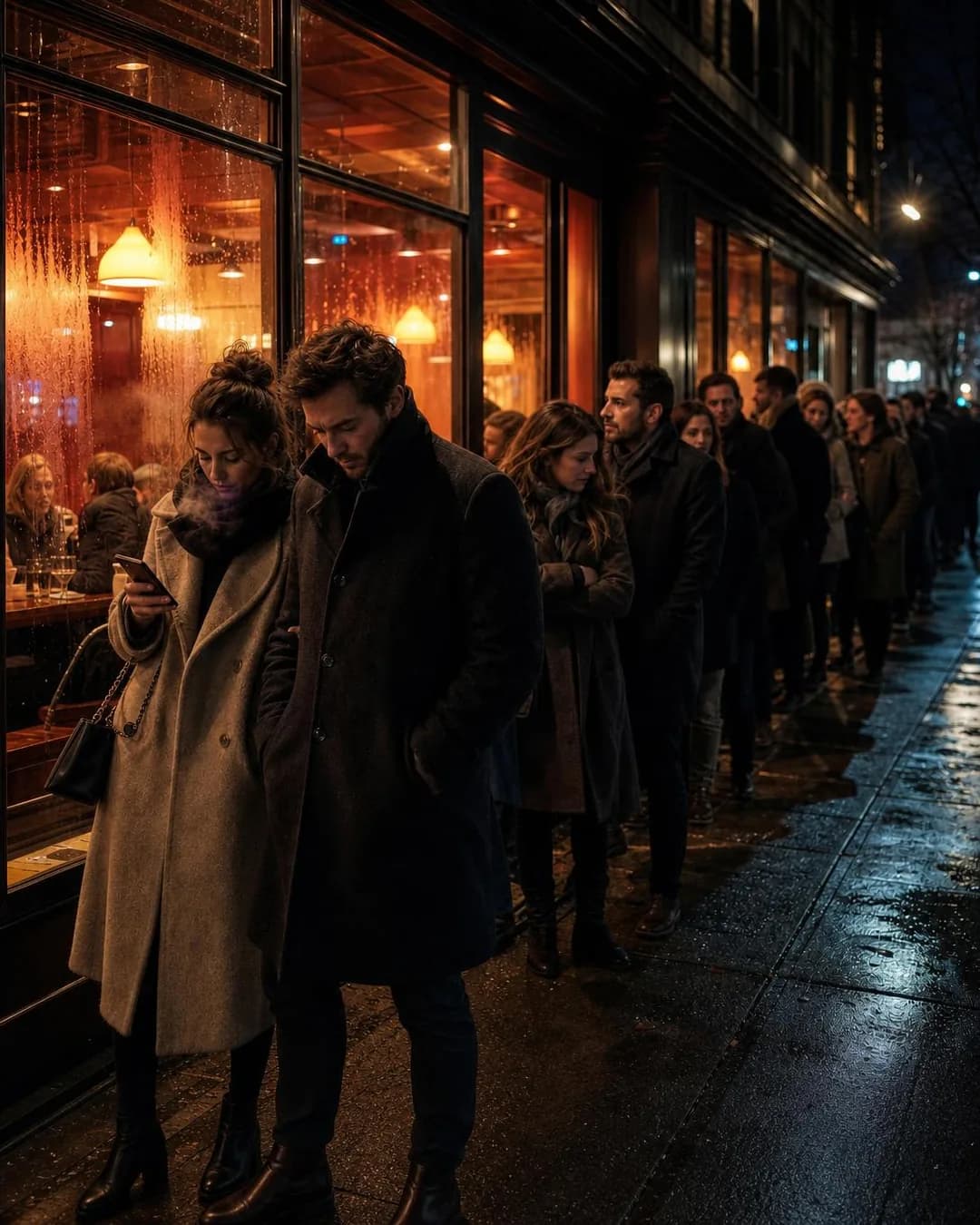
Date night without the freeze.
Wait from home. Dine warmly.
Friction is the right family because the competitor this restaurant is losing to is not the place down the street — it is the sofa. The brief pinned couples who stopped going out on Saturdays rather than people who never went, and the photograph is their memory of why: a couple in heavy coats on a wet sidewalk, a line of a dozen more behind them, and a steamed-up window full of people who got in first. What makes the image interesting is that the same queue usually argues the opposite. A line outside is the oldest proof of popularity a restaurant has, and here it is the problem the ad is selling a way out of. Both readings help you, which is the rare case where an ambiguous picture is an asset — but the copy has to say which one it means in the first line, and this copy does.
Then the two ways it drifts from the brief, one small and one expensive. The small one is the wait: the brief said fifty minutes, the concept stage retitled it "The 45-Minute Sidewalk Freeze", and the copy uses both numbers in different primary texts. Pick yours and use one. The expensive one is the menu. "Stroll in for wood-fired plates and hand-rolled cavatelli" describes a kitchen the brief never mentioned, and a restaurant ad that names a dish is a promise the kitchen has to keep. So is "within 4 miles" and "starting at 4:30 PM", both invented rules for a waitlist the brief described only as texting you ten minutes out.
And this is one of the two ads on the page that turned into an alcohol ad without anybody deciding it should. The brief mentions no drink. The copy has a guest "shivering outside" before "your first spritz arrives", and another primary text tells them to "relax at home with a drink" beside a wine-glass emoji; through the window, a stemmed glass stands on a diner's table. Meta's alcohol standard counts availability of alcohol sales and consumption of alcohol as alcohol advertising, which in the United States means an audience of 21 and over. Strike the spritz and the emoji and the ad is about a waitlist again — the glasses in the window are small enough that you will have to decide about them yourself. This is also one of the three images re-framed a second time: the first came back with Meta's logo in the dark band at the foot of the frame.
Other headlines from the same run
- Skip the sidewalk. Keep dinner.
- Join the waitlist from your couch.
- Handmade pasta, zero curb wait.
- Your table is 10 minutes away.
Call to action
Traffic, to the waitlist page itself, where joining takes one tap and a phone number. Resist Book now: it is the button the eye reaches for, and it is the one promise a no-reservations restaurant cannot keep. Optimise on landing page views rather than clicks, and cap frequency on a small radius — the audience is people within reach of the door on a Saturday, and they need to see this on Friday afternoon more than they need to see it twice on a Tuesday.
The Reclaimed 45-Minute Lunch Break
LeadsReclaim 45 minutes of your workday on team lunch days.
- Audience
- Office managers who order the monthly team lunch — Place the order, meet the driver, find a table, unwrap the trays, answer "is there dairy in this?" twelve times, and then eat standing up at 1:40.
- Angle
- Save Time (Benefit & Outcome) — Quantifies hours, minutes, or steps saved.
Reclaim 45 minutes of your workday on team lunch days.
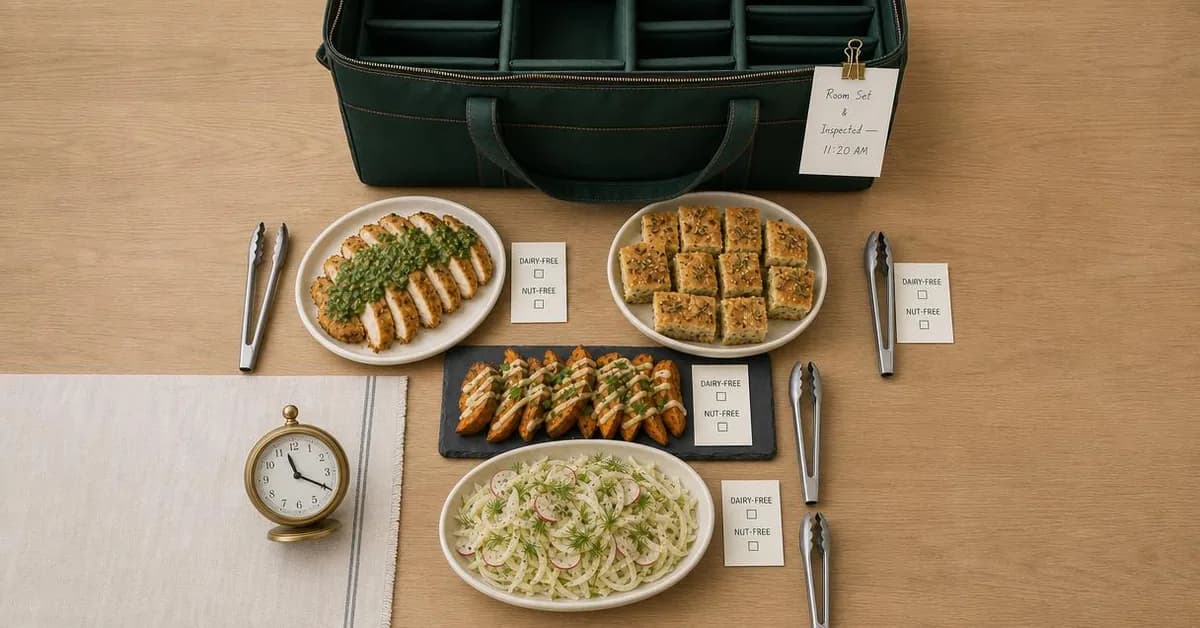
Reclaim 45 Min on Team Lunch Days
Boardroom catering for 10–40.
Save Time is the right family because the buyer here is not the person who eats. The brief pinned the office manager who places the monthly order, meets the driver, finds the table, unwraps the trays and answers "is there dairy in this?" twelve times — and the ad is addressed to her lunch hour, not to anyone's appetite. The overhead spread delivers the offer: sliced chicken under salsa verde, seeded focaccia, sweet potato wedges with a tahini drizzle, a shaved fennel salad, tongs laid out, an insulated tote unzipped at the top of the frame. It also produced a clock that agrees with its own label, which is rarer here than it should be. A brass desk clock reads about 11:18 beside a tag clipped to the bag: "Room Set & Inspected — 11:20 AM". The dentist batch's clock, the roofing batch's and the remodeling batch's inbox all failed that test.
What it gets wrong is the one thing the brief made the point of the ad. Every tray was supposed to be labelled with what is in it and which of the nine major allergens it contains. Each dish has a card instead, and every card is the same: DAIRY-FREE, NUT-FREE, two empty checkboxes, no dish name. Nothing is ticked, so nothing is said. And the omission lands exactly where it matters: the sweet potatoes are dressed in tahini, which is sesame — the ninth major allergen since the FASTER Act, labelled as one from 1 January 2023 — and the focaccia is wheat, and neither card has a line for either. A label that lists the allergens a dish doesn't have and omits the ones it does is worse than no label. For a caterer, that card is the product; photograph your real one.
The copy is the shortest in the batch — all five primary texts between 54 and 95 characters — and its one number deserves the same caution as the cards. "The average office manager loses 45 minutes just setting up and clearing meeting food" is an invented statistic stated as a fact about everyone, and it becomes the headline "Save 45 Minutes of Meeting Prep". The brief's own figure, forty minutes' lead time, survives intact in "Staged 40 Minutes Before You Meet", which is the stronger line because it is a promise you control.
Other headlines from the same run
- We Stage the Table. We Clear It Too.
- No Setup. No Cleanup. Just Lunch.
- Staged 40 Minutes Before You Meet
- Save 45 Minutes of Meeting Prep
Call to action
Leads, on an Instant Form that asks the three things that price a catering order — headcount, date and dietary requirements by allergen, not "any allergies?". This is one of two wide 1.91:1 ads on the page, the shape our publisher sends to Facebook's right-hand column and search results, which are desktop surfaces — and a desktop at ten in the morning is where the person who orders the team lunch actually is.
The Coriander Pepper Crust
AwarenessThat peppery bark you remember wasn’t an accident. It took ten days.
- Audience
- People who once ate a real pastrami sandwich somewhere else — Remember the one they had on a trip years ago, have been disappointed by every sliced-in-advance version near home since, and do not know there is a place ten minutes away that does it properly.
- Angle
- Ingredient / Material (Product & Mechanism) — Spotlights a specific ingredient, component, material, or input.
That peppery bark you fell in love with years ago wasn't an accident. It took ten days.
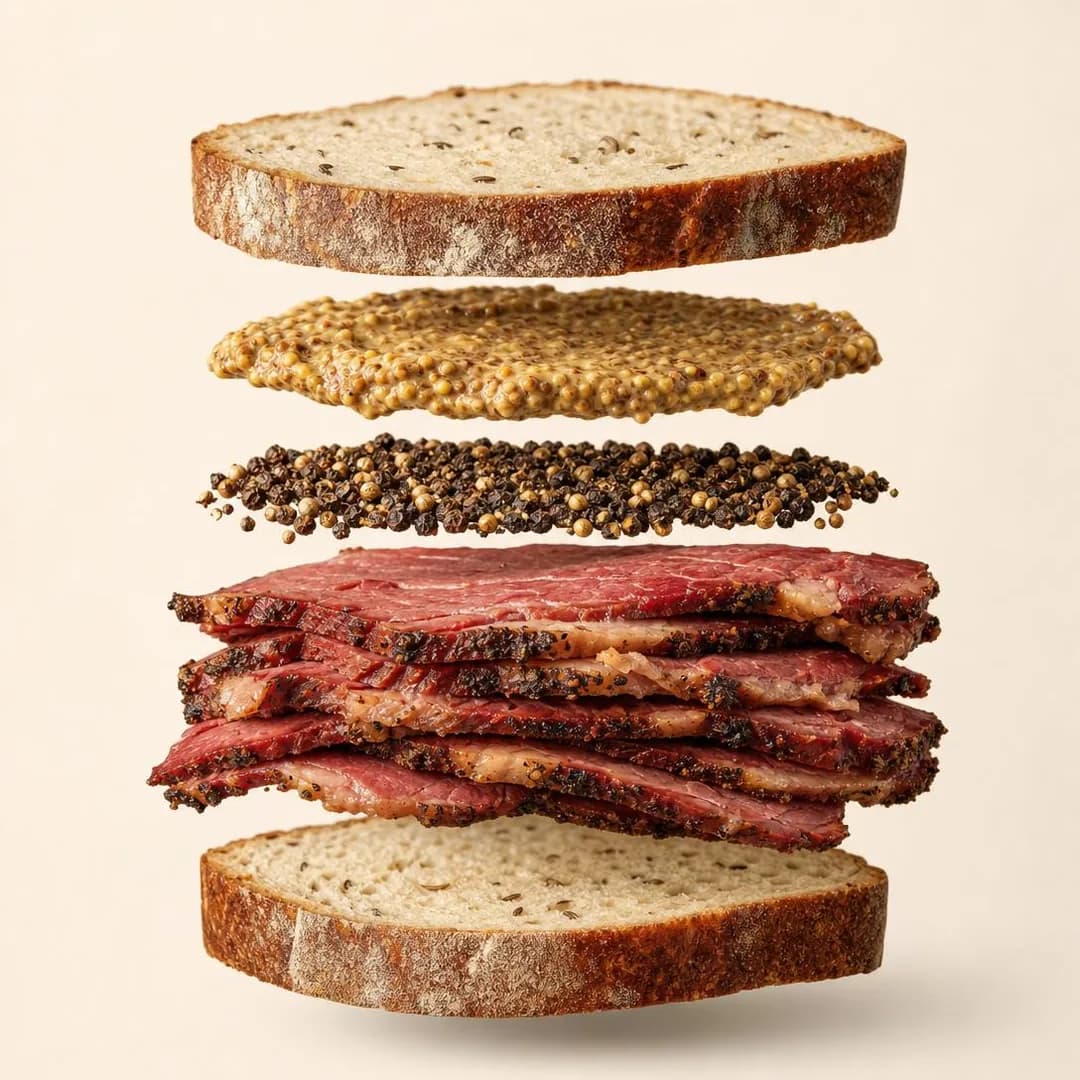
Hand-Crushed Coriander & Pepper Bark
Carved warm at the counter.
Ingredient/Material is the right family because everything that makes this sandwich worth crossing town for is invisible in the finished one: ten days in brine, eight hours of smoke, a knife instead of a slicer. An exploded view is the format for showing what is inside a thing, and the render is the best-looking image on the page — two slices of rye, a spread of whole-grain mustard, a thick stack of ruby pastrami with a black-peppered crust, all floating on cream.
It is also a sandwich nobody makes. Between the mustard and the meat floats a separate layer of loose whole black peppercorns and coriander seeds, a tier of its own, which you would find with a molar. The rub belongs on the crust of the brisket — where the render also shows it — so the spice appears twice, the second time as an ingredient. This one did not come from the image model improvising: the image-prompt stage asked for "a distinct, floating crust layer composed of dense, coarsely cracked black peppercorns and split golden coriander seeds". It took the concept's selling point, the crust, and gave it a layer. That is the restaurant version of the failure this tool is prone to: in this trade the picture of the food is a statement about the menu, and this picture describes a sandwich the deli does not serve.
The brief's numbers survived — ten days, eight hours — and the copy holds all five primary texts between 71 and 106 characters. The additions to strike or make true are small ones: caraway in the rye, "oak and hickory" as the smoke, "carved warm at the counter" and "hand-crushed coriander", none of which the brief said. "Stop Eating Cold Pre-Sliced Beef" is a fair jab at the competition and the right headline for the audience, people who remember one real sandwich from a trip years ago.
Other headlines from the same run
- 10-Day Cure. Hand-Carved Warm.
- Stop Eating Cold Pre-Sliced Beef.
- The Pastrami Sandwich Done Right.
- Smoked 8 Hours. Sliced by Hand.
Call to action
Awareness, correctly: nothing about this sandwich can be bought on a screen, and the sale will happen at the counter where Meta cannot see it. Buy Reach with a frequency cap on a radius a lunch break can cover, schedule it for the late morning, and send the few people who click to a page with the address and the hours. Judge it on reach and frequency inside the circle, and on whether the counter notices.
The Honest Four-Star Complaint
AwarenessThe only real complaint in our reviews: 'The portions are ridiculous.'
- Audience
- People who read the reviews before trying anywhere new — Will not try a new place without checking the star rating first, and then read the three-star reviews to find out what actually goes wrong there.
- Angle
- Reviews / Ratings (Proof & Trust) — Uses star ratings, review excerpts, review counts, or screenshots.
If you filter our reviews by lowest rating, this is the worst thing you'll find.
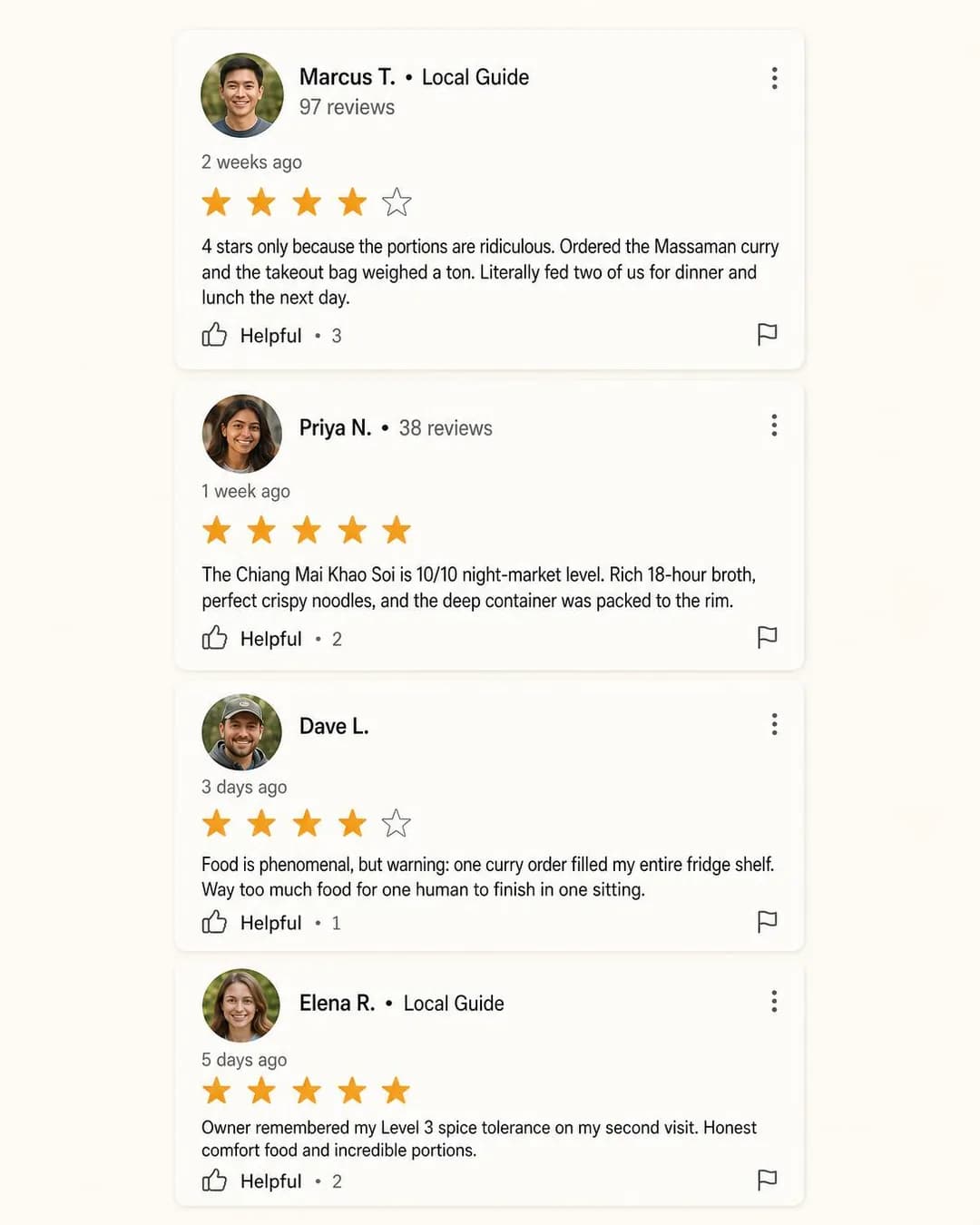
"The portions are ridiculous."
Dinner tonight, lunch tomorrow
Reviews are the proof this trade lives on, and the concept is the cleverest in the batch. The brief pinned people who read the three-star reviews first to find out what actually goes wrong, and the ad meets them there: it leads with a four-star complaint — "4 stars only because the portions are ridiculous" — and builds the whole grid around grievances that are compliments. The copy follows through: "If you filter our reviews by lowest rating, this is the worst thing you'll find."
It is also the ad on this page that must not run as made, and no edit fixes it. Every review is invented: Marcus T., Priya N., Dave L. and Elena R., with faces, review counts and dates, none of whom exists. The FTC's Rule on the Use of Consumer Reviews and Testimonials, in force since 21 October 2024, makes it a violation for a business to "write, create, or sell" a consumer review or testimonial that misrepresents "that the reviewer or testimonialist exists", and to disseminate a testimonial it "knew or should have known" was fake. An ad built from this grid would be both. The format is sound; the content has to be your own reviews, quoted exactly, with every card replaced.
Two further things would survive into a real version if you copied the layout. The cards reproduce Google's review interface down to the "Local Guide" badge, which is someone else's product on your ad. And the reviews praise a Massaman curry, an 18-hour broth and a 32-ounce container, none of which was in the brief — which named the khao soi, the owner remembering how spicy each regular likes it, and portions big enough for lunch the next day. The third survived as "Owner remembered my Level 3 spice tolerance". Also invented: "Over 100+ reviews", which counts nothing twice. The one line that is fine as written is also the most dangerous: "this is the worst thing you'll find" is a claim any reader can check in thirty seconds.
Other headlines from the same run
- Built to feed you twice.
- Read our worst reviews first.
- 32-oz of honest Northern Thai.
- 18-hr broth. Generous bowls.
Call to action
Awareness. Send the click to wherever the reviews actually live rather than to your own page — for an ad whose argument is "read the worst ones", letting the reader do exactly that is the proof. And only run it once every card in the frame is a real review you can point to.
The Habit Tax on Soup
SalesYou pay $16.70 more on the app for lukewarm, soggy noodles.
- Audience
- Regulars who always order through the app out of habit — Order from the same place twice a week, have never looked at the restaurant's own website, and assume the price on the app is the price.
- Angle
- Price vs. Value (Comparison & Positioning) — Explains why sticker price does not equal true value.
You’re paying a $16.70 habit tax on dinner just to eat bloated noodles out of cloudy plastic. Third-party apps secretly inflate every bowl from $16.00 to $19.50, tack on junk fees, and leave your meal sitting on a passenger seat. When you order direct for counter pickup, it’s $41.50 flat. Scalding-hot 18-hour broth, springy wheat noodles, zero platform markups.
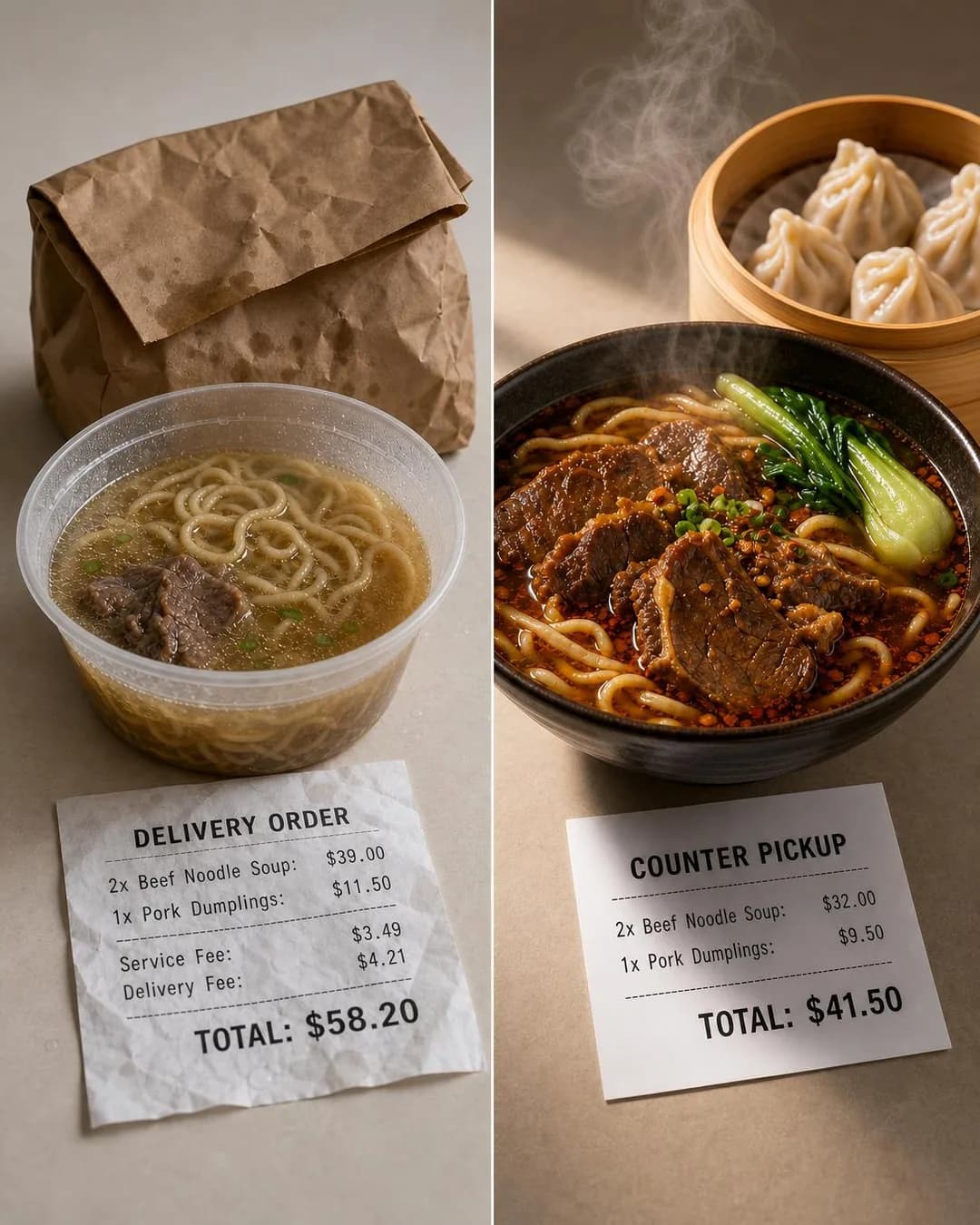
Save $16.70: Skip the Delivery Markup
Zero fees. Piping-hot pickup.
Price vs Value is the ad every restaurant with its own ordering page wants to run, and the receipts make it concrete: the same two bowls of beef noodle soup and an order of pork dumplings, $58.20 through a delivery app and $41.50 direct for pickup. And both receipts foot — $39.00 + $11.50 + $3.49 service + $4.21 delivery is $58.20, and $32.00 + $9.50 is $41.50 — which this cluster has learned not to take for granted: real estate's cash-offer table did not foot, and a gym's occupancy board contradicted its own ad. The copy's derived figures hold too: $16.00 a bowl becomes $19.50, and twice a week the difference is "over $130 a month" ($133.60).
The flaw is in who the ad blames, and the brief put it there. The brief said the app price came out higher "once its menu markup, service fee and delivery fee are added", and the copy took "its" at face value: "Third-party apps secretly inflate every bowl from $16.00 to $19.50." On the major marketplaces the restaurant sets its own menu prices — Uber's merchant help describes setting different prices by order type, with the example of "a burger with a $10 delivery price and a $7 pickup price". So the $3.50 a bowl is the advertiser's own decision, and the ad accuses the app of making it. There is a true version and it is a better ad: we charge more on the app because the app charges us, so order direct and the difference stays with you.
The picture has the same problem at a larger scale: it is not the same order. The delivery half is a pale broth in a plastic tub with a couple of pieces of beef and no dumplings at all; the pickup half is a red chilli broth with bok choy, in a ceramic bowl beside a bamboo steamer — which is not how a pickup order leaves any restaurant. The app carries your own kitchen's food, so a photograph that makes the delivered version look worse is an ad against your own delivered food. Shoot the same order twice, packed the way it actually goes out, and let the receipts do the arguing. The 18-hour broth and the hand-pulled noodles in the copy are invented.
Other headlines from the same run
- Stop Paying the App Tax on Soup
- $41.50 Direct vs. $58.20 Delivery
- Hotter Broth. Fair Menu Prices.
- Order Direct for Real Counter Value
Call to action
Sales — this is one of the three ads here that can be, because the purchase happens on your own ordering page. Confirm your ordering provider lets you place the Meta pixel and fire a Purchase event before choosing the objective; if it does not, run it as Traffic. Target people who already order from you, which a customer list does better than any interest, because the audience here is regulars who have never looked at your website.
The First Real Birthday Cake
TrafficFor the parent who hasn’t trusted a bakery birthday cake in years.
- Audience
- Parents of a child who cannot eat gluten — Have stopped trusting a "GF" label on a muffin that came out of the same oven as everything else, and have not bought a birthday cake from a bakery in years.
- Angle
- “Will It Work for Me?” (Objection & Risk Reversal) — Proves fit across personas, use cases, circumstances, or customer types.
When your child can’t eat gluten, a bakery cake feels like an impossible risk.
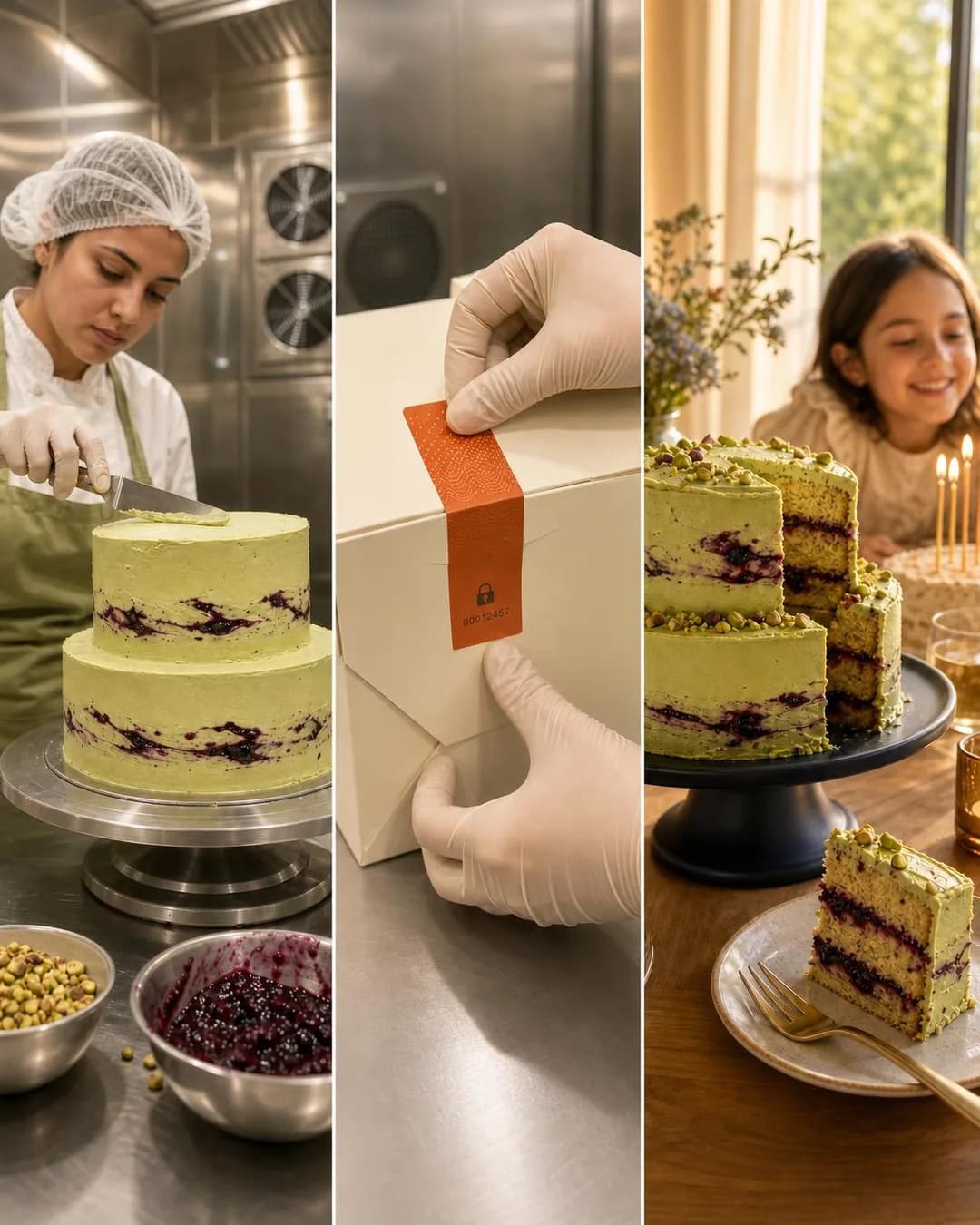
Zero Shared Ovens. 100% Real Cake.
Zero shared-oven risk.
Will It Work For Me is the right family because the objection to a gluten-free bakery is never taste — it is trust. The brief pinned parents who stopped believing a "GF" label on a muffin that came out of the same oven as everything else, and answered with a structure: a separate room with its own door, its own ovens and mixers, no wheat flour ever carried in, everything boxed and sealed before it reaches the counter. The strip has three frames: a baker in a hairnet finishing a pistachio and blackberry cake in a stainless kitchen, gloved hands sealing a box with a numbered orange tamper strip, and a girl smiling at a birthday table.
The first primary text is the one to delete. "When your child can't eat gluten, a bakery cake feels like an impossible risk" implies that the advertiser knows a reader's child has a medical condition, and Meta's personal attributes standard covers exactly that case — physical or mental health, including medical conditions, and the implication that the advertiser is aware of "the personal attributes of their family". The headline "Built for Strict Wheat-Free Kids" does the same thing more quietly. Describe the room, never the reader: "Gluten-free cakes from a room wheat flour never enters" sells the same cake and asserts nothing about anybody.
Then the escalation, which is subtler and more expensive. The brief said a separate room. The business the model invented around the brief made it a positive-pressure chamber, and the copy repeated it as a "positive-pressure chamber" with "full-height observation glass", "certified assay-tested ingredients" and a "serialized tamper-evident sticker", then added "zero shared-air risk" — four claims a real bakery would need to be able to prove, and one no bakery can. The FDA's position is that a restaurant's gluten-free claim should meet the federal definition, under 20 parts per million, so the word carries a number whether or not the ad prints one. And for all its three frames, the strip never shows the thing the ad is about: there is no door, no second set of ovens, no room — just a kitchen.
Other headlines from the same run
- The Birthday Cake You Can Trust
- Clean-Room Baked & Serial Sealed
- Real Bakery Taste, Zero Dust Risk
- Built for Strict Wheat-Free Kids
Call to action
Traffic, to a page that shows the room — the separate door, the ovens, and your testing if you test. A parent who has stopped trusting labels needs to see the structure before a form, and a cake order is a conversation about a date and a name on the top, which is a phone call rather than a checkout.
The Weekday Morning Math Check
SalesStop spending sixty-five dollars a month on your weekday commute coffee.
- Audience
- People who buy a coffee on the way to work most mornings — Stop at the same café four or five days a week, pay $3.25 each time, and have never once added it up.
- Angle
- Subscription Savings (Offer & Economics) — Shows the economic advantage of recurring purchase or subscription.
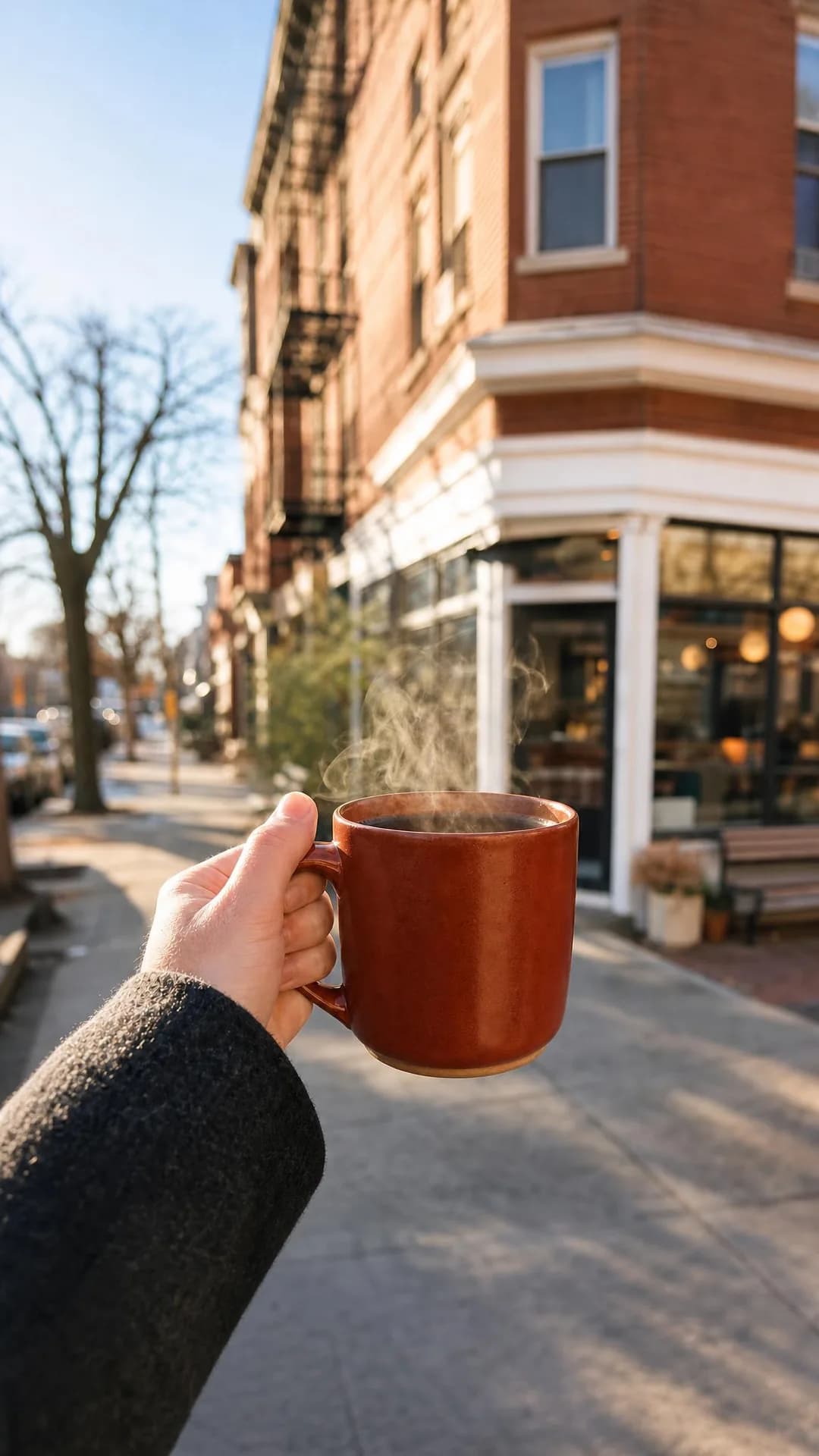
Stop spending $65 a month on your weekday commute coffee. If you grab a morning brew four days a week, the math adds up fast. Our daily club is a flat $30 a month—paying for itself by visit seven. Just say your name at the counter and take your cup.
$30/Month. Coffee Every Morning.
No apps. Cancel anytime.
Subscription is the restaurant trade's cleverest answer to the problem this whole page is about. It turns a $3.25 purchase at a counter no pixel can see into a $30 purchase on a web page that one can — the only way a café gets a Sales ad Meta can actually optimise. The image is simple and right for a story placement: a hand holding a terracotta mug on a sunny sidewalk, the corner café behind it.
The arithmetic is the whole ad, and the batch gets it right and wrong in the same set. The brief pinned $30 a month and $3.25 a cup. $30 ÷ $3.25 is 9.2, so the club pays for itself on the tenth visit — which one primary text says exactly: "At $3.25 a cup, visit #10 is costing you $32.50... Break even in your second week." The headline "Pays For Itself by Visit 7" and two other primary texts say seven. Another claims "$65 a month" for someone buying four days a week, which is $56; the next says five mornings a week runs "over $65", which is right. "Commute Coffee for $1 a Day" holds over a thirty-day month. Two answers to the only question the ad asks, from a single run, is the clearest evidence on this site for the rule: never let a model compute the number the ad is about. Work it out yourself and put the answer in the brief.
Everything else to check is small. "Fresh oat milk included", "15% off morning pastries" and a pause option are all invented perks, and a commuter walking away from a café carries a paper cup rather than the shop's ceramic mug. This is also one of the three re-framed a second time — the first 9:16 came back with Meta's logo floating in the sky above the café.
Other headlines from the same run
- Pays For Itself by Visit 7
- The $30 Flat Daily Coffee Club
- Commute Coffee for $1 a Day
- Smarter Morning Coffee Math
Call to action
Sales, on the signup page, with the purchase firing as a real event — this is the ad on the page that most deserves the objective, because the subscription is the conversion. Then check the volume: fifty subscriptions a week is more than most cafés sell in a year, so this will not leave the learning phase on its own. Run it on a tight radius to people who already come in, and count the names at the counter.
The Wednesday Aisle Flashback
SalesDon’t spend Thanksgiving Eve staring at dented supermarket pie boxes again.
- Audience
- People who ended up with a supermarket pie last year — Meant to order from the bakery, remembered on the Tuesday, found the list closed, and stood in the supermarket aisle on Wednesday night choosing between two dented boxes.
- Angle
- Seasonal Deadline (Scarcity, FOMO & Timing) — Uses a holiday, season, event, or calendar moment as a natural deadline.
Remember standing in the grocery aisle last Thanksgiving Eve, staring at the last two dented pumpkin pies? Don't repeat history. Hearth ovens can physically bake only 300 scratch pies across 48 hours—hand-crimped cultured butter crusts, heirloom fruit, and zero canned shortcuts. Pre-orders close Sunday, November 22 at 11:59 PM (or when all 300 are gone). Pick up fresh Wednesday.
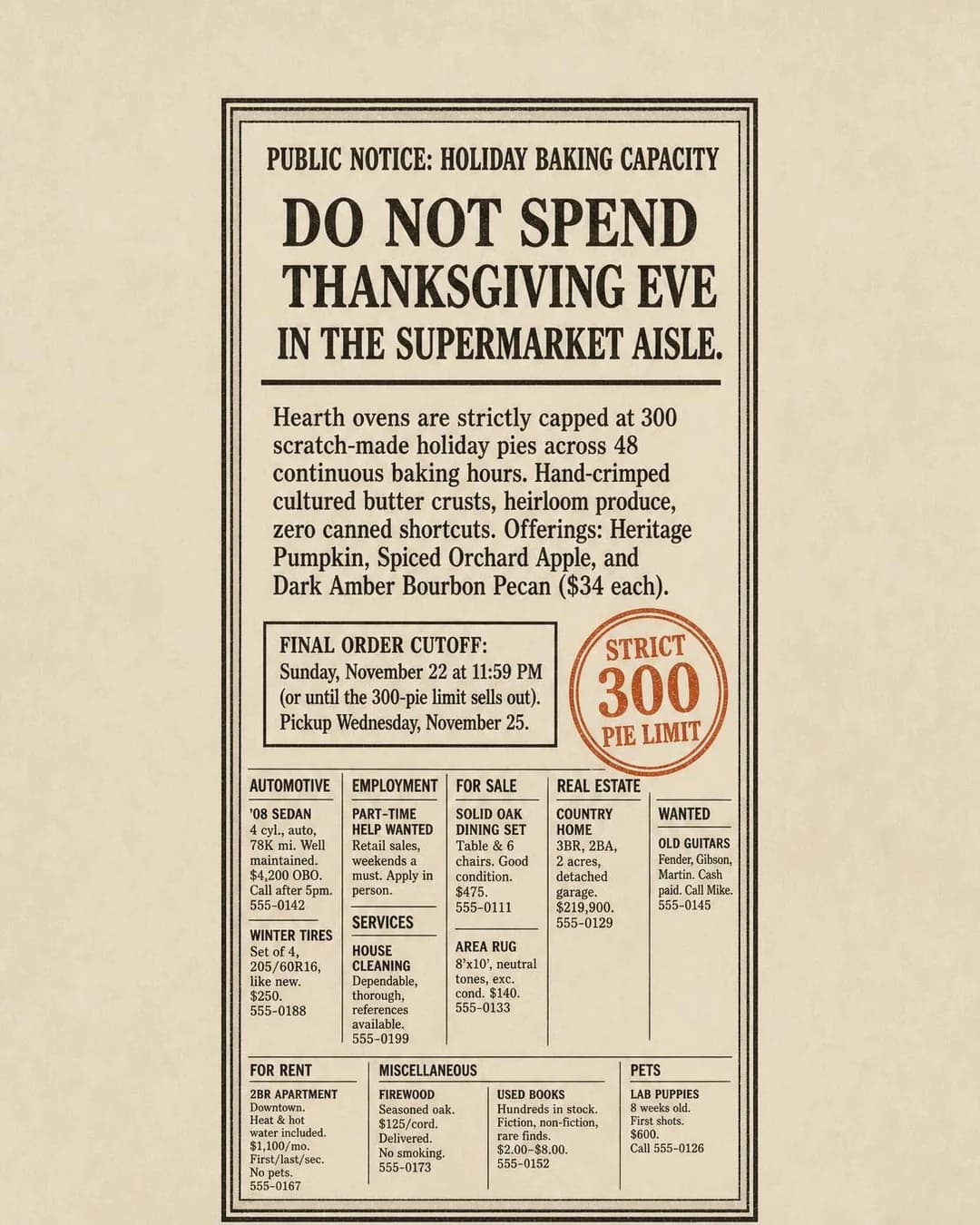
Skip the Dented Grocery Pies
Pickup Fresh Wednesday, Nov 25
Seasonal Deadline is the most honest scarcity a bakery has, because the limit is physical: an oven bakes so many pies in two days and no more. The classified format suits it — a boxed notice headed "DO NOT SPEND THANKSGIVING EVE IN THE SUPERMARKET AISLE", a stamped "STRICT 300 PIE LIMIT", and a cutoff box reading Sunday, November 22 at 11:59 PM, pickup Wednesday, November 25. The dates are right — 22 November 2026 is a Sunday and Thanksgiving falls on the 26th — because the brief pinned them. Every date in this ad descends from the brief, so there was nothing for the model to reconcile.
The menu is where it drifts. The brief said apple, pumpkin and pecan. The notice and every primary text sell "Heritage Pumpkin, Spiced Orchard Apple, and Dark Amber Bourbon Pecan" — bourbon in a pie the brief never mentioned, put on the menu by the business the model invented around the brief and copied by every stage after it. It is probably not an alcohol ad under Meta's standard, which is about drinks, venues and drinking, but it is a menu item, and a customer buying for a table with children or a relative who does not drink will order by what the ad said. So are "cultured butter", "heirloom produce", "10-inch deep-dish in reusable tins" and "zero canned shortcuts" — the last a claim about pumpkin pie specifically, where canned pumpkin is the ordinary starting point. And the brief's pickup window, 7 a.m. to 6 p.m., was dropped from the image and every primary text: the one detail a customer needs on the Wednesday.
Then the filler, which is worth a second look for a reason unique to this format. To make a newspaper page, the model surrounded the notice with invented classifieds — a used sedan, winter tyres, a dining set, and three listings that matter: part-time help wanted, a country home for sale at $219,900, and a two-bedroom apartment to rent. Housing and employment are two of Meta's special ad categories, and its documentation warns that with the wrong category "there is a risk your ads will be paused until the campaign is adjusted". A pie ad does not need either — but one carrying a job listing and two housing listings is giving a reviewer three reasons to ask. Blank the filler. It is also the longest copy in the batch, 377 to 408 characters, for an image that already says all of it.
Other headlines from the same run
- Strictly Capped at 300 Pies
- Thanksgiving Orders Close 11/22
- Scratch Pies: Only 300 Baked
- Reserve Your Holiday Pie ($34)
Call to action
Sales, if the pre-order is taken on a page that can fire a purchase event — and a deadline is the rare restaurant ad that justifies a short, dense flight. Run it from the start of November with a frequency cap on your radius, and add a last-weekend push to people who viewed the order page. Put the pickup hours back on the page before anything else.
From Polite Nods to Neighbors
EngagementStop just politely nodding at the neighbors on your morning commute.
- Audience
- People who moved to the neighbourhood and still know nobody on their street — Have lived there two years, nod at the same faces at the bus stop, and would go to something if they did not have to bring someone they already knew.
- Angle
- Belonging / Community (Identity & Emotion) — Frames the product as a signal of membership in a group or movement.
You’ve lived here two years, yet your deepest conversation is still an awkward nod at the bus stop. Sunday dinner shouldn't be eaten across from a phone screen. On the final Sunday of every month, thirty neighbors gather elbow-to-elbow along one continuous white oak table. Four wood-fired courses passed by hand, no assigned seats, and zero pressure to bring a plus-one.
Stop Nodding. Start Talking.
Reserve your unassigned seat.
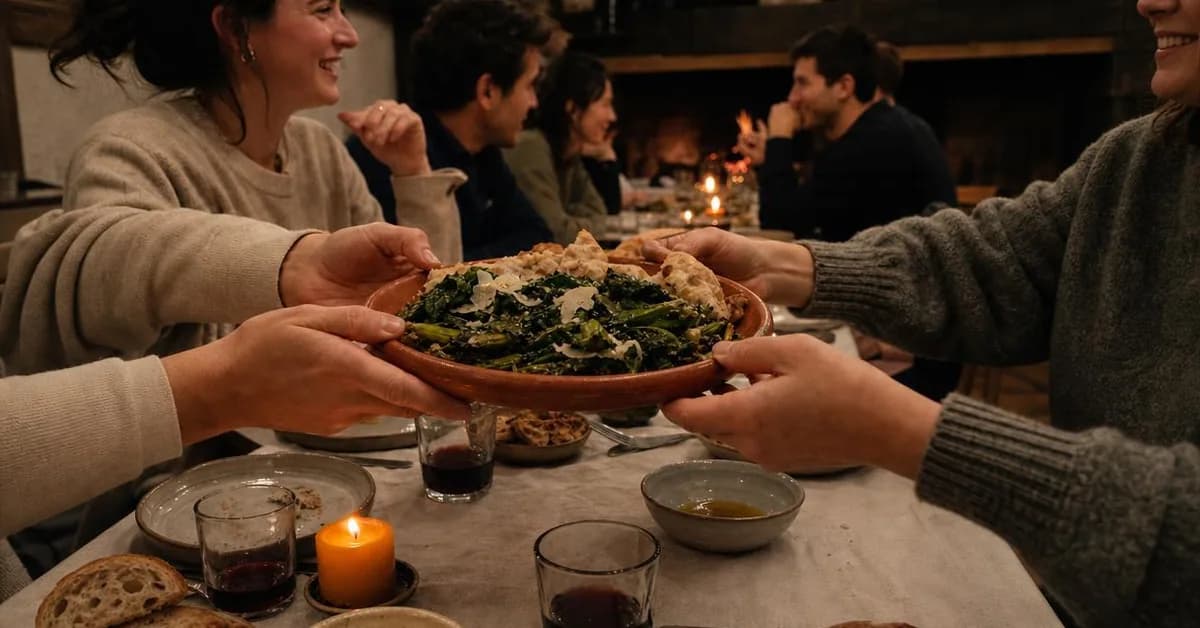
Belonging is the family restaurants use least and have most right to, because a restaurant is one of the few businesses whose product is, literally, other people. The brief pinned newcomers who have lived on a street for two years without knowing anyone, and the photograph is the answer from the inside of the evening: two pairs of hands passing a terracotta platter of charred greens and flatbread across a candlelit table, a fire behind, people laughing at the far end. It looks like a phone picture from a good night, which is the point of a raw-phone direction.
It is also the first Engagement ad in this cluster, and the only objective with a mechanism built for it. A supper that lives as a Facebook event can be promoted with event responses as the optimisation goal and the event itself as the destination — a Facebook object, promoted inside Facebook, which is as platform-specific as an ad gets. This is one of two wide 1.91:1 ads on the page, the shape our publisher routes to Facebook's right-hand column and search.
And it is the second ad on the page that became an alcohol ad on its own. The brief mentions no drink; the image-prompt stage asked for "low glass tumblers filled with house wine", and there they are, three of them, red. The copy adds "house carafes poured generously without ceremony". Under Meta's alcohol standard that is consumption and availability of alcohol, which in the United States means an audience of 21 and over — for an event aimed at new neighbours, excluding every 18-to-20-year-old on the street. Swap the tumblers for water jugs or run it 21+ deliberately. Invented and load-bearing: "over half of our guests arrive completely alone", which is also a headline, a "final Sunday" and a "6:30 PM seating". The brief's thirty seats and $45 survived. The first wide re-frame came back framed as a post with Meta's logo in the corner; this is the second.
Other headlines from the same run
- 30 Seats. 1 Table. No Strangers.
- Sunday Supper for the Block
- Over Half of Us Arrive Solo
- Turn Passersby Into Neighbors
Call to action
Two different ads depending on where the seats live. If the supper is a Facebook event, run Engagement optimised for event responses and keep the event page current. If seats are sold on a ticket page, it is a Traffic ad with Book now, and the thirty-seat limit is the scarcity — say how many are left. Either way, decide about the wine before you decide about the age range.
The Window Stare Itemized Math
AwarenessI saw you pause at our window menu, do the math, and walk.
- Audience
- Locals who read the menu in the window and kept walking — Like the look of the place, compared the price with a drive-through in their head, and decided it could not be worth it without ever finding out what the price pays for.
- Angle
- Why We’re More Expensive (Story & Founder POV) — Founder explains the quality, sourcing, labor, service, or economics behind a premium price.
I saw you pause at our window menu tonight, do the mental math on nineteen dollars, and walk away. I don't blame you when a drive-through charges six. But here, $7 buys daily-ground brisket and milk buns baked two blocks away, and $8 pays our cooks $26/hr with healthcare. No tip prompts at checkout—just an honest plate made by your neighbors.
Where your $19 actually goes
All-inclusive, tip-free menu.
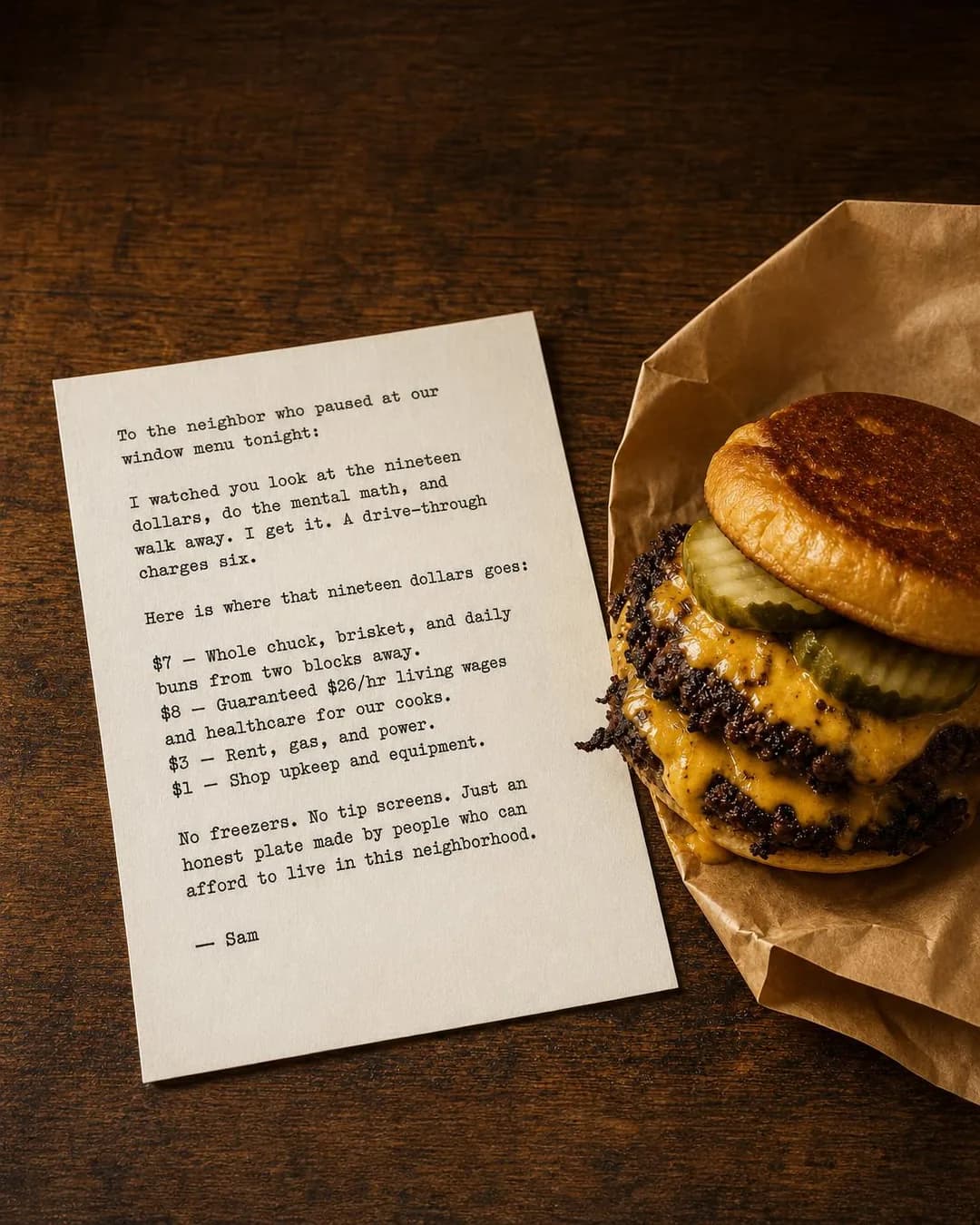
Why We're More Expensive is the objection every independent restaurant is carrying this year, and the founder's-letter format is the right one for it: a typed note on cream stationery beside a double cheeseburger in kraft paper, addressed to "the neighbor who paused at our window menu tonight". It itemises: $7 for whole chuck, brisket and daily buns from two blocks away; $8 for "guaranteed $26/hr living wages and healthcare"; $3 for rent, gas and power; $1 for upkeep and equipment. That is $19 exactly. It foots.
Which is the problem. A breakdown that sums to precisely the menu price leaves nothing for the business — there is no line for profit. Either the ledger is missing a row or the restaurant loses money on every burger it sells, and a reader who does the sum in their head will reach one of those conclusions. Add the margin as its own honest line. It makes the letter more believable, not less, because it is the one line every reader already knows exists.
The rest to check before it runs: "$26/hr" and "healthcare" are an employment claim your own cooks will read, and it was not in the brief, which said only a wage that does not depend on tips. "Sam" is an invented owner signing an invented letter — sign it yourself or not at all. "I watched you look at the nineteen dollars... and walk away" is the brief's audience description turned into a first-person sentence, and it reads as being watched. The copy's claim that cheaper burgers mean "line cooks working for tipped minimum wage" is about other businesses rather than yours. And the brief's fries cut to order appear nowhere, in the picture or the copy.
Other headlines from the same run
- No tips. No freezers. Real wages.
- The honest math behind our burger
- A note to our sidewalk walkers
- Fair wages. Fresh beef. Zero tips.
Call to action
Awareness, on a small radius, to exactly the people the letter addresses — the ones who walk past. Nothing here converts online and nothing should; the job is to change what the price means before the next time someone reads the window. Run it ahead of a price change rather than after one.
Questions
- Do Facebook ads work for restaurants?
- They reach the right people — Pew puts Facebook at 71% of American adults against half for Instagram — and a restaurant's market is a few miles around its door, which on Facebook is close to being an audience you can buy whole. The harder question is whether you will be able to tell. The sale happens at a table, paid by card, and nothing from that meal reaches Meta. So judge dine-in advertising on reach and frequency inside your radius, and on what your own till does in the weeks it runs — not on a conversion count the platform cannot see.
- Which Facebook ad objective should a restaurant use?
- Awareness for anything that sells a meal eaten at your table. Meta retired its store-traffic objective for new campaigns in Marketing API v17.0 and moved store location features into Awareness, and the Reach goal is one of only two (with ThruPlay) that let you cap frequency — 1 to 90 impressions per person over 1 to 90 days — on a radius as small as 0.63 miles. Use Sales only for something that is bought on a screen you control: a pickup order, a subscription, a pre-order. Use Leads for catering and private events, where the order starts as an inquiry. And use Engagement with event responses when the thing you are promoting is a Facebook event.
- How do I measure Facebook ads when customers pay at the table?
- Mostly, you do not — and it is better to design around that than to pretend. An offline event has to carry something Meta can match to a person, like an email or a phone number, and a table that pays by card leaves neither. What works is to sell something on a screen (pre-orders, a coffee club, pickup through your own site), to put an offer in the ad that is redeemed and counted at the till, or to compare what the till does in the weeks an ad runs against the weeks it does not. None of those is precise. All of them are better than a conversion column that is correctly close to zero.
- Can a restaurant's Facebook ad show wine or cocktails?
- Yes, but it is then an alcohol ad. Meta's alcohol standard lists "availability of alcohol sales" and "consumption of alcohol beverages" among the things that make an ad about alcohol, not just drinks brands, and in the United States those ads must target people 21 or older. A happy-hour ad qualifies; so does a dinner photograph with wine on the table. Run your bar in its own ad set at 21+ and keep the rest of the account open to everyone over 18. And look at what an AI tool renders: in this batch, two of ten ads added wine that no brief asked for, and a third put bourbon in a pie.
- Can I use reviews in my restaurant's Facebook ads?
- Real ones, quoted exactly, are the strongest proof this trade has. Invented ones are a federal problem: the FTC's Rule on the Use of Consumer Reviews and Testimonials, in force since 21 October 2024, makes it a violation for a business to write or create a review or testimonial that misrepresents that the reviewer exists or had the experience, or to disseminate one it knew or should have known was fake. An AI-generated review card in an ad is exactly that. Every review on the example above is invented, which is why its note says it must not run as made.
- What size should a restaurant Facebook ad be?
- Render 4:5 at 1440 × 1800 — Meta's recommendation for Facebook Feed, where most of the budget delivers — and keep the primary text to 50–150 characters and the headline to 27. In this batch, 17 of 50 primary texts and 7 of 50 headlines fit those figures, so measure before you run. Keep a wide 1.91:1 version for Facebook's right-hand column and search results, which Instagram has no equivalent of, and a 9:16 for Stories if you have something worth watching for three seconds.
Seen enough? Make your own.
Paste your site. The AI reads your menu, your hours and whatever you sell online, then writes the concepts, draws the images and drafts the copy. In this trade, whatever food it draws, a guest will try to order, so every picture gets held up against your menu before it runs.
No credit card · 50 free credits (about 5 ads or Instagram posts)
Every angle used above is documented in the best-in-slot ad angle library. More industries and placements are at all ad examples.