
Ad Examples · Skincare & Beauty Brands × Facebook · 10 ads
Skincare Facebook ad examples
Ten finished Facebook ads for skincare brands, with the brief behind each. Every skincare ad answers to two referees: Meta reads what it says about the reader, and in the United States the FDA reads what it says about the skin. The notes show where each ad crossed either line, and at which step of the tool it happened.
Search for skincare ad examples and much of what comes back is one of two kinds. One is a before-and-after of a face nobody can vouch for; the other is a creator's UGC clip, bottle held up to a ring light. Both were collected, and a collected ad cannot tell you who it was written for, what it argued, or the question this trade turns on: which of its sentences Meta would reject, and which the FDA would read as a drug claim.
So these were not collected. Every ad below was generated with its audience, angle and objective pinned before the run, and the brief printed under each one is the brief that produced it. The ten brands are invented and unnamed, one product each: a pH 5.5 cream cleanser, a three-product routine set, a retinal night serum, a ceramide moisturiser shown as a before-and-after, a tinted mineral sunscreen in three shades, a vitamin C serum sold with a 60-day refund, a niacinamide serum priced per night, a winter balm made once a year, a hand cream for people who wash their hands thirty times a shift, and a brand apologising for a pump that stopped working. Six were written for Sales, two for Traffic, one for Leads and one for Awareness. All ten ran in one pass, and nothing was regenerated.
Every skincare ad is read by two referees, and they read different words. Meta reads what the ad says about the person looking at it. Its ad policy on personal attributes forbids asserting or implying a reader's age, race or ethnicity, or physical health, among other things, and one of its examples for age is a skincare pair: “Our new lotion and creams fight wrinkles like never before!” is allowed; “Ready to upgrade your skin to look younger?” is not.
In the United States, the FDA reads what the ad says about the skin. It decides whether a product is a cosmetic or a drug by what the product is claimed to do, its “intended use”, and it counts claims “on the product labeling, in advertising, on the Internet”. A product that makes lines and wrinkles “less noticeable, simply by moisturizing the skin” is a cosmetic; one intended to “remove wrinkles or increase the skin's production of collagen” is a drug, and the FDA notes that drugs, unlike cosmetics, need its approval before they go on the market.
Some skincare is a drug by design, sunscreen above all, and is made, labelled and advertised as one. The trap is the cosmetic whose ad drifts, because the same jar can be a cosmetic in one headline and an unapproved drug in the next. Other countries have their own regulators; this page covers the FDA's line only.
The batch was built to see which way the tool leans on each side. On Meta's side, age held. No ad says younger, names an age or mentions wrinkles, and when the retinal serum's business summary wrote an age band, “late 20s to early 50s”, no later step used it. The reader's body did not hold. Wherever an audience description named a skin problem (peeling cheeks, rough winter patches, knuckles that crack), the copy handed it back in the second person: “If your knuckles split by 2 PM”. It did the same where only the business summary had named a symptom: the winter balm's first primary text says “you buy one tin, use it daily on wind-chapped knuckles and raw lips”. So it is not only a matter of how the brief was written. Meta's rejected health example, “Do you have diabetes?”, has that shape. Its standard does not say whether cracked or peeling skin counts as physical health, so treat those lines as a risk and rewrite them before they run.
On the FDA's side, the two products with an SPF, the sunscreen and the routine set, were drugs by design. None of the other eight briefs made a drug claim, and those that described an effect did it the cosmetic way (cleans without the tight feeling, softens the look of fine lines, a moisturiser for winter dryness, absorbs in under a minute), so every repair, rebuild, renewal and cold-protection claim below was added after the brief. Four ads reached for one, and a fifth named its product “Barrier Repair Emulsion”. The retinal serum shows how it happens. Its summary described the effect in cosmetic terms, “softening the appearance of fine lines”, though it already called the serum a “treatment”; the concept wrote “accelerates cellular renewal”; the image prints “activating cellular pathways”; and the copy ends on “Potent retinoid renewal, no burn”. Qualifiers went the same way across the batch: the cleanser brief's “often” became “almost always” and then nothing, “less of the redness and peeling” became “no burn”, and “about one in twelve” became “8.3%”.
Three ads invented their evidence, and one of them is exactly the picture this page opened by dismissing: a before-and-after of a face nobody can vouch for, captioned as unedited daylight. The other two are a science article from a journal that does not exist and a hand-cream tube with an ingredient list nobody wrote. The only deep skin tone in the batch is in the one ad whose brief built skin tone into the product; the two faces whose skin no brief described, the before-and-after and the nurse, came back light. Every price and figure is invented. The briefs supplied some (pH 5.5, $74 against $82, 0.1% retinal, 20% zinc oxide, $38 and 42 cents a night, 3,000 tins on 3 November, one bottle in twelve), and the notes trace the ones that came later.
For your own ads, the step that matters most is the first. A model wrote each business a summary from its one-line brief, standing in for the website you would paste, and most of the claims above either started there or were added at the very next step. With your own site, that summary is yours to read and edit before any ad is made. After it came the concept, whose title and one-line hook head each card; the instructions for the picture, which the card does not show; a square image; the copy, written from that square; and a re-frame that redraws the square into the 4:5, 9:16 or wide shape you see. The card shows the first of the five primary texts each run wrote; where a note quotes one of the other four, it says so.
What changes because it is Facebook
Start with who uses it: if your customers skew older, Facebook is where more of them are. Pew's 2025 survey puts Facebook at 71% of American adults and Instagram at 50%. Instagram leads only among 18- to 29-year-olds, 80% to 68%. From 30 up Facebook leads, and the gap widens with age: 80% to 62% at 30 to 49, 74% to 40% at 50 to 64, and 57% to 19% over 65. That gives Facebook nearly twice Instagram's share of 50- to 64-year-olds and three times its share of over-65s. These are US figures; elsewhere, look at your own orders.
That makes age the attribute a Facebook skincare ad handles most, and it lives in two places. In the ad set it is a lever: you can target an age range, and Meta's personal-attributes standard lets copy make a “passing reference” to “age groups or age ranges”, with “Meet seniors” and “A service for teens” among its allowed examples. In the sentence, the reader's own age is off limits: “Meet other seniors” is rejected, and so is the skincare line quoted above, “Ready to upgrade your skin to look younger?”. In each pair the difference is the word that points at the reader. Put the age band in targeting, which is where the retinal summary's “late 20s to early 50s” belonged, and keep it out of the copy. Meta's allowed skincare line, “fight wrinkles like never before”, clears Meta and still has the FDA to face; the brief's “softens the look of fine lines” clears both.
Then the age floor, which in this trade depends on what the ad shows. Target 18 and over for any before-and-after, including a moisturiser shown as one, and for a sunscreen; an ordinary cream, cleanser or makeup ad can go down to Meta's minimum of 13, higher in some countries. The reasons are spread across two standards. Meta's Health and Wellness standard lists “General cosmetic products, procedures, surgeries depicting before and after transformation” among the ads advertisers can run “When targeting people 18 years or older”. Meta's separate rule for over-the-counter medicine says such ads “may not be targeted to people under 18 years of age”; its examples are anti-inflammatories, allergy medication, antiseptics and certain antibiotics, and it does not mention sunscreen, which the FDA regulates as a drug, so treat 18 as the safe default. The wider floor comes from the Health and Wellness standard, which says its age restrictions “don't apply” to “Non-permanent cosmetic and beauty products such as creams, makeup, hair products”. A moisturiser shown as a before-and-after is both a cream and a before-and-after, and the standard does not say which rule wins, so 18 is the safe default there too.
What targeting cannot do is fix a claim. A cosmetic whose copy drifted into repair or renewal is not made compliant by an 18+ ad set; cut the claim.
The Health and Wellness standard also prohibits some copy outright, and the batch produced examples of both kinds. It bans “statements of inferiority about physical appearance”, which it defines as “terms, descriptions, or questions that are negative and attack an individual's appearance”; the before-and-after's “Tired of shiny-yet-flaky winter skin?” (another primary text) is a negative question about appearance. And “28 days to calm, resilient skin”, from the same primary text, comes close to its clickbait rule for health contexts, “promises of specific outcomes within a set timeframe without disclaimers or qualifiers”. Drop the timeframe unless you can say what it was measured on.
The before-and-after's description line reads “Unretouched daylight results.”, and Meta may retouch it on delivery. With Advantage+ creative on, the brightness and contrast of an image “can be adjusted if it may improve ad performance”, and visual touch-ups “auto-generates new pixels” to expand it for other placements. Meta's help centre says “Some enhancements may be turned on by default, but you can turn them off at any time.” best-in-slot publishes ads paused unless you tell it otherwise, and it does not turn any enhancement off. So open the ad in Ads Manager and turn them off yourself before you switch on a before-and-after, or a sunscreen ad whose whole claim is how a skin tone looks in a photograph.
Then what the Sales objective can see. If your store sends Meta a purchase event, the first order an ad produces is counted, within one or seven days of a click depending on the attribution setting you choose. The reorder is not. It comes when the jar runs out (about two months for the routine set here, ninety nights for the niacinamide serum), long after the window has closed. For a brand whose customers come back, the Sales column undercounts the ads that find returning customers and flatters the ones that find one-time buyers. Tag your ad links so your store records which campaign brought each customer in, and judge each campaign by how often those customers reorder.
Budget for the learning phase too. Meta says an ad set usually leaves it after about 50 results in a week, so plan on roughly 50 times your own cost per purchase as the weekly spend for each Sales ad set.
Last, the shapes and the words. Meta's ads guide recommends 4:5 at 1440 × 1800 for Facebook Feed, primary text of 50 to 150 characters and a 27-character headline. Fifteen of this run's fifty primary texts fit 50 to 150, all from three ads that wrote all five short (the sunscreen, the refund card and the retinal serum, 73 to 116 characters); the other seven wrote 244 to 403. Three of fifty headlines fit 27, one of them a lead; all fifty fit 40. Measure yours before they run. Two ads here are 1.91:1, the shape our publisher sends only to Facebook's right-hand column and search results. One is 9:16 for Stories, where Meta's ads guide asks you to keep roughly the top 14%, the bottom 35% and 6% at each side clear of text.
Source: Pew Research Center — Americans' social media use, November 2025 · Meta Advertising Standards — Privacy violations and personal attributes: no assertions or implications about a person's race, ethnicity, age, physical or mental health (including medical conditions) and more; a “passing reference” to “age groups or age ranges” is allowed; examples include “Meet seniors”, “A service for teens” and “Our new lotion and creams fight wrinkles like never before!” (allowed) and “Meet other seniors”, “Ready to upgrade your skin to look younger?” and “Do you have diabetes?” (not allowed) · Meta Advertising Standards — Health and Wellness (change log 23 July 2026): cosmetic products, procedures or surgeries 18+; before-and-after for general cosmetic products listed under 18+; age restrictions “don't apply” to “Non-permanent cosmetic and beauty products such as creams, makeup, hair products”; statements of inferiority about appearance, permanent skin whitening and timed promises without qualifiers prohibited · Meta Advertising Standards — Drugs and Pharmaceuticals: over-the-counter medicine ads “may not be targeted to people under 18 years of age”; examples given are anti-inflammatories, allergy medication, antiseptics and certain antibiotics · Meta Business Help Centre — About age-based targeting: “The minimum age on Facebook and Instagram is 13”, higher in some jurisdictions · Meta Business Help Centre — About creative enhancements: “Some enhancements may be turned on by default, but you can turn them off at any time”; brightness and contrast adjusted “if it may improve ad performance”; visual touch-ups “auto-generates new pixels” · Meta Business Help Centre — About attribution settings: click-through counts events “within 1-day or 7-day after a link click on your ad” · Meta Business Help Centre — About the learning phase: exit “usually occurs after about 50 results in the week after the ad set's last significant edit” · Meta ads guide — Facebook Feed and Stories image ads: Feed 4:5 at 1440 × 1800, primary text 50–150 characters, headline 27; Stories 9:16 at 1440 × 2560, keep about 14% top, 35% bottom, 6% sides clear · FDA — Is It a Cosmetic, a Drug, or Both? (Or Is It Soap?): a drug includes articles “intended to affect the structure or any function of the body”; intended use is established by “Claims stated on the product labeling, in advertising, on the Internet”; certain claims, such as to “regenerate cells”, “may cause a product to be considered a drug”; moisturizers with sun-protection claims are cosmetic/drug products · FDA — Wrinkle Treatments and Other Anti-aging Products: “It depends”; “less noticeable, simply by moisturizing the skin” is a cosmetic; “remove wrinkles or increase the skin's production of collagen” is a drug or a medical device; drugs “must have FDA approval” before they go on the market · FDA — Sunscreen: How to Help Protect Your Skin from the Sun: “In the United States, sunscreens are regulated as drugs” · FDA — Questions and Answers: new requirements for OTC sunscreen products: water resistance stated as 40 or 80 minutes; sunscreens cannot be labelled “waterproof” or “sweatproof”, or called “sunblocks” · 21 CFR 347.10 — OTC skin protectant active ingredients: allantoin 0.5–2%, dimethicone 1–30%, glycerin 20–45% · 21 CFR 347.50 — OTC skin protectant labeling: indications include “temporarily protects … chapped or cracked skin” and “protect from the drying effects of wind and cold weather” · 16 CFR 255.1 — FTC Endorsement Guides: when an ad represents that the endorser uses the product, “the endorser must have been a bona fide user of it at the time the endorsement was given” · 16 CFR 255.2 — FTC Endorsement Guides: an ad relating consumers' experience “will likely be interpreted as representing that the endorser's experience is representative of what consumers will generally achieve”, with a before-and-after example · 16 CFR 239.3 — FTC Guides Against Deceptive Advertising of Guarantees: use “Money Back Guarantee” or similar only if the full purchase price is refunded at the purchaser's request, and disclose any material limitations or conditions · FTC — Enforcement Policy Statement on Deceptively Formatted Advertisements (22 December 2015): an ad's format is deceptive if it misleads consumers about its commercial nature, including by implying “it comes from a party other than the sponsoring advertiser”
Want the campaign, not just the creative? Facebook ads for skincare and beauty brands → is the playbook these ads came out of: which objective to buy, the offers worth running, the targeting levers this trade keeps, and the policy that decides what the copy may say.
Generate Facebook ads for your own skincare or beauty brand
Paste your site and best-in-slot reads it (products, ingredients, prices, what you claim) and shows you the business summary it wrote before any ad is made. The brands above had a one-line brief where your site would be. Edit out any repair or renewal the summary picked up, and read every claim against your label before it runs. Free to start, no card.
The Rich Cream Trap
TrafficYour skin isn't dry. Your morning wash is stripping it raw.
- Audience
- People who keep buying heavier moisturisers — Have switched to a richer cream twice this year, still feel tight by noon, and wash every morning and night with a foaming cleanser that squeaks, without ever suspecting the wash.
- Angle
- Misdiagnosis / Reframe (Problem & Pain) — Reframes the cause of the problem: “It isn’t X causing this. It’s Y.”
Stop buying heavier moisturizers. Your skin isn't dry—it's being stripped raw every morning. If your face feels uncomfortably tight by 1:00 PM, no thick balm can out-hydrate the foaming wash you used at 7:00 AM. That "squeaky clean" feeling is actually your lipid barrier being washed away. Rebalance your barrier with a non-foaming, pH 5.5 cream wash designed to protect your acid mantle.
Your skin isn’t dry. It’s stripped.
Shop pH 5.5 cream cleanser.
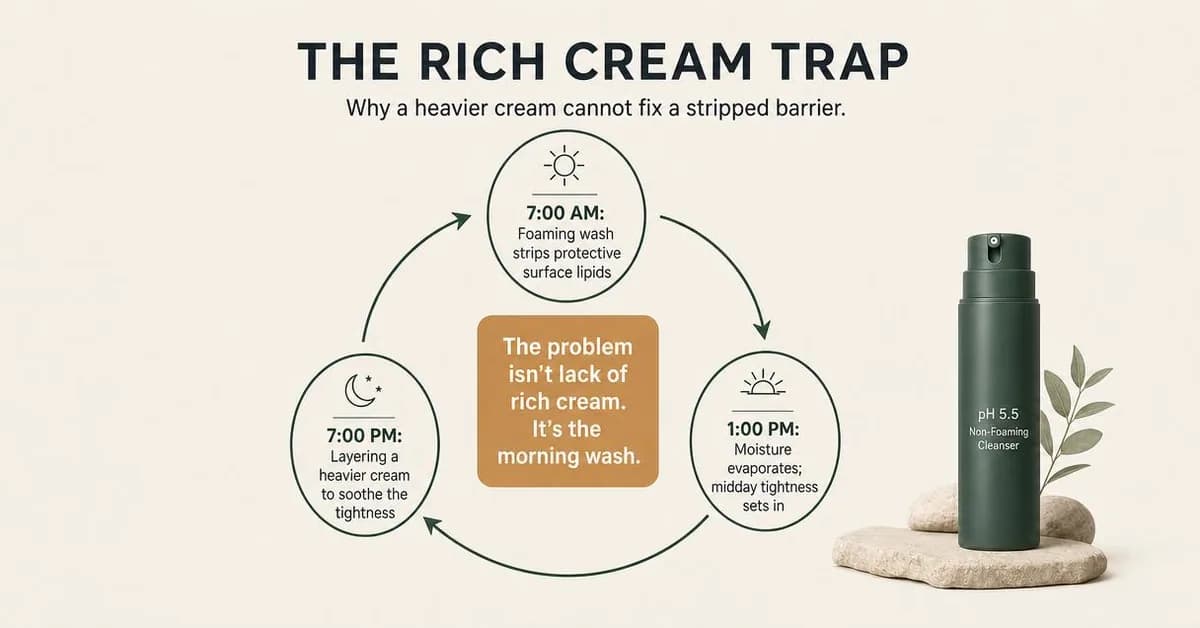
Misdiagnosis is a family skincare earns honestly, because the cause people blame and the fix they buy sit on the same shelf: skin feels tight, so they buy a heavier cream. The brief pinned people who have done that twice this year and still wash with a foaming cleanser that squeaks, and the diagram draws their day as a loop: a foaming wash at 7:00 a.m. “strips protective surface lipids”, tightness at 1:00 p.m., a heavier cream at 7:00 p.m., and round again. In the middle sits the answer: “The problem isn't lack of rich cream. It's the morning wash.” A loop reads well left to right, which suits the wide shape.
What drifted is how sure the ad is. The brief said tightness by midday is “often” the cleanser's doing. The business summary made it “almost always”, the concept's hook dropped the qualifier (“Your skin isn't dry. Your morning wash is stripping it raw.”), and the lead headline repeats it: “Your skin isn't dry. It's stripped.” A misdiagnosis ad delivers a diagnosis, and this one delivers it to every reader, whatever they wash with. The copy also tells readers what state their own skin is in: “being stripped raw every morning” in the first primary text, “compromised skin” and “defenseless” in two of the others. “A cream cleanser that doesn't strip” says the same about the product and nothing about the reader.
The clock drifted too. The brief said noon, the summary 2:00 p.m., the picture's instructions 1:00 p.m., and the copy uses all three; pick one. The oat-derived cleansers and “polyglyceryl esters” in two other primary texts came from the summary. On the FDA's side this is one of the milder ads on the page, since cleaning is a cosmetic's job, but “rebalance your barrier” and “protect your acid mantle” in the first primary text describe what the wash does to skin rather than how skin feels afterwards. “Leaves skin feeling soft, not tight” makes the same point the cosmetic way.
Other headlines from the same run
- Break the rich cream trap.
- Stop the 1:00 PM skin tightness.
- Non-foaming. pH 5.5. Zero squeak.
- Why heavier creams aren’t working.
Call to action
Traffic, optimised for landing page views, to a page that makes the argument before it asks for money. A misdiagnosis ad asks the reader to change a habit first, and a checkout cannot do that. best-in-slot sends the wide shape only to Facebook's right-hand column and search results, so make a 4:5 version as well if you want it in the feed.
The Reclaimed Bathroom Shelf
SalesStop guessing which of your eleven half-empty bottles actually works.
- Audience
- People with a shelf of half-finished bottles — Have eleven products on the bathroom shelf, bought one at a time after reading about each, use four of them, and could not say which ones are doing anything.
- Angle
- Simplification (Benefit & Outcome) — Replaces several tools, products, steps, or workflows with one simpler solution.
If you have 11 half-empty bottles on your shelf right now, you probably don't know which one is actually working. Skincare culture convinced us more steps meant better skin, but an overwhelmed lipid barrier just needs dependable support. This 3-step system replaces the clutter with a squalane cleanser, ceramide moisturiser, and tinted mineral SPF for under $1.25 a day.
Trade 11 bottles for 3 essentials.
The 3-step routine set ($74)
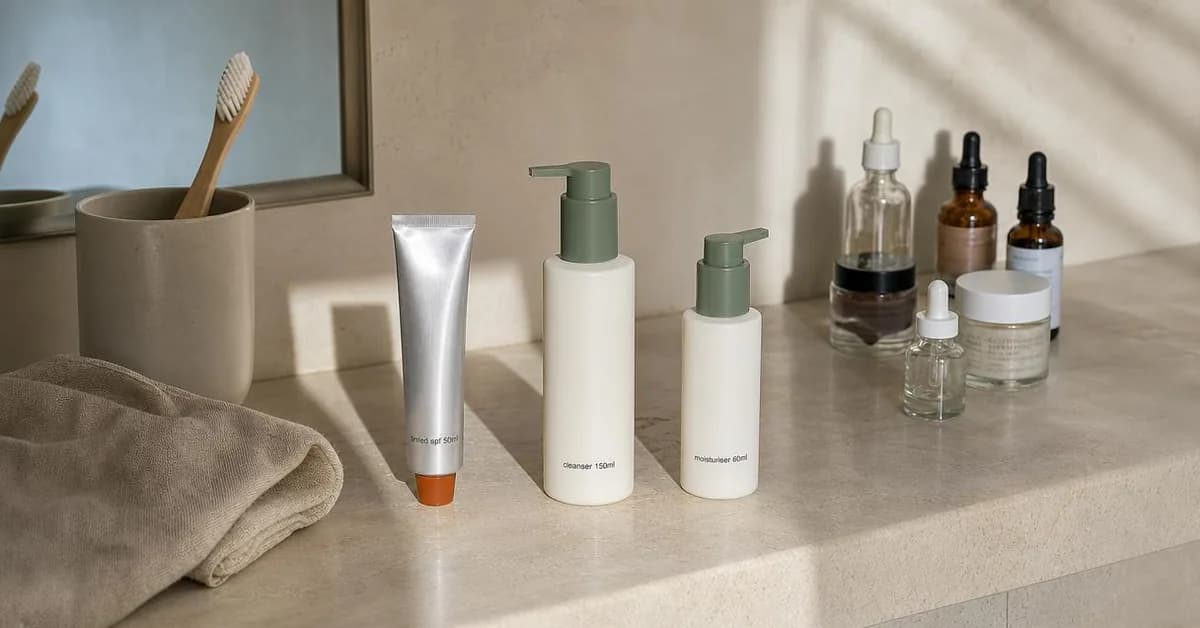
Simplification is a promise that costs a brand sales, since it means selling fewer products, and that makes it believable. The photograph is the best-looking in the batch: three plain containers in morning light, an aluminium tube marked “tinted spf 50ml” and pumps marked “cleanser 150ml” and “moisturiser 60ml”, with droppers and jars pushed to the back of the shelf. Labels that carry only a name and a size give the copy nothing to read back as a claim. One still needs a second look: “spf 50ml” reads as SPF 50 at a glance, on an SPF 30 product.
The arithmetic holds because the brief did it: $22, $28 and $32 make $82, the set is $74, and “under $1.25 a day” is $74 over the summary's sixty days, $1.23. The shelf does not hold. The brief pinned eleven products and the headline promises “Trade 11 bottles for 3 essentials”, but the picture's instructions asked for “five or six” others, “dusty” and “clearly neglected”, and the render drew six, tidy and lit like a still life. That makes nine products and no clutter, so the copy has to make the ad's argument without help from the picture.
The first primary text turns the audience description into knowledge of the reader's bathroom (“If you have 11 half-empty bottles on your shelf right now”), which is presumptuous rather than prohibited. And one of the three products is a sunscreen, which the FDA regulates as a drug, so the age-floor note above applies to this set even though the ad never shows a face.
Other headlines from the same run
- Your entire routine in 3 steps.
- Reclaim your bathroom shelf.
- Calm skin for under $1.25 a day.
- Stop guessing. Start maintaining.
Call to action
Sales, to the set's product page with a purchase event firing, targeted 18 and over as the safe default for a set with a sunscreen in it. Upload set buyers as a customer list: exclude them from this ad, and reach them again near day fifty, before the two months run out.
The Single Conversion Difference
SalesRetinol requires two conversions. Retinal needs only one.
- Audience
- People who gave up on retinol in the first week — Started a drugstore retinol every night, had red, peeling cheeks by day five, and put it back in the drawer.
- Angle
- Mechanism Reveal (Product & Mechanism) — Explains why the product works differently from alternatives.
Standard retinol takes two enzymatic conversions to work. Retinaldehyde needs only one.
Retinol takes 2 steps. Retinal takes 1.
Barrier-first 0.1% retinal · $46
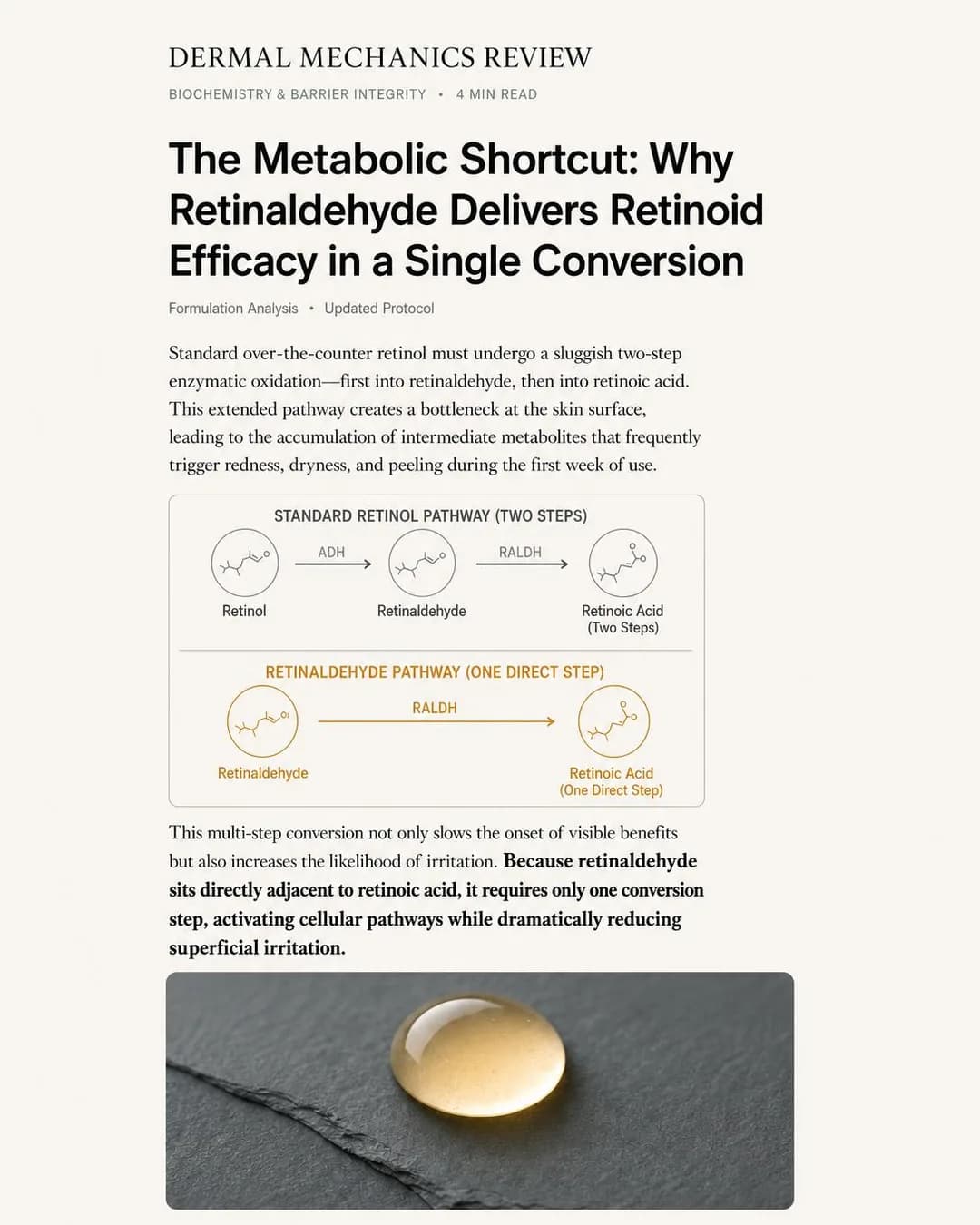
Mechanism Reveal suits a retinoid, a product many people start and abandon, and the brief supplied a mechanism about use: two nights a week for the first month, then every other night. The picture is a journal page, with the masthead “Dermal Mechanics Review” over the headline “The Metabolic Shortcut: Why Retinaldehyde Delivers Retinoid Efficacy in a Single Conversion”, a diagram of retinol taking two conversion steps to reach retinoic acid against retinaldehyde taking one, and a drop of serum on slate. The one-step chemistry came from the business summary, and the concept built the whole ad on it.
What was built on it is where the ad drifts toward the FDA's line, and each step moved it further. The summary described the effect in cosmetic terms, “visibly refining surface texture and softening the appearance of fine lines”, though it already called the serum a “treatment”. The concept wrote “accelerates cellular renewal”, the image prints “activating cellular pathways”, and the copy ends on “Potent retinoid renewal, no burn”. That reads like the FDA's own example of a drug claim, a product said to “regenerate cells”. Meanwhile the schedule, which the brief credited for the reduced peeling, appears in no primary text and no headline; “Skip peeling. Start with retinal.” gives the molecule the credit.
The format is the other problem. The image is an invented publication, with a masthead and a reading time, presenting the brand's claim as somebody else's analysis. The FTC treats an ad's format as deceptive when it misleads people about the ad's commercial nature, including by implying “it comes from a party other than the sponsoring advertiser”. Keep the diagram and run it under your own name.
Age held, in a telling way. The copy never mentions lines, texture or looking younger, because it never says what the serum does for either. One of the other primary texts does address the reader's skin: “If drugstore retinol left your cheeks peeling and raw by day five, your skin wasn't the problem.”
Other headlines from the same run
- Skip peeling. Start with retinal.
- 0.1% Retinal. Zero conversion lag.
- The 1-step metabolic shortcut.
- Potent retinoid renewal, no burn.
Call to action
Sales, but rewrite the copy first, and make the page it lands on say what the ad left out: the two-nights-a-week schedule, and what the serum does for the look of lines and texture, in cosmetic terms. An 18+ ad set will not fix “renewal”. Rewritten as a cosmetic, it falls under Meta's exemption for non-permanent cosmetics and needs no age floor beyond Meta's usual minimum.
Daylight Window Study Diptych
SalesJanuary cheeks do not have to feel like sandpaper until April.
- Audience
- People whose cheeks go rough every January — Get dry, rough patches across the cheeks every winter, have tried face oils that made them shiny without making them smooth, and assume it is just what winter does.
- Angle
- Before / After (Proof & Trust) — Contrasts the state before adoption with the state after adoption.
January cheeks do not have to feel like sandpaper until April. Face oils make dry patches look shiny, but they cannot replace missing skin lipids. Photographed above: unedited morning daylight on Day 1 vs. Day 28 of using a formulation built with three essential ceramides (NP, AP, EOP), 12% plant squalane, and 8% glycerin. Real barrier repair, documented without filters.
Day 1 vs Day 28: Barrier Rebuilt
Unretouched daylight results.
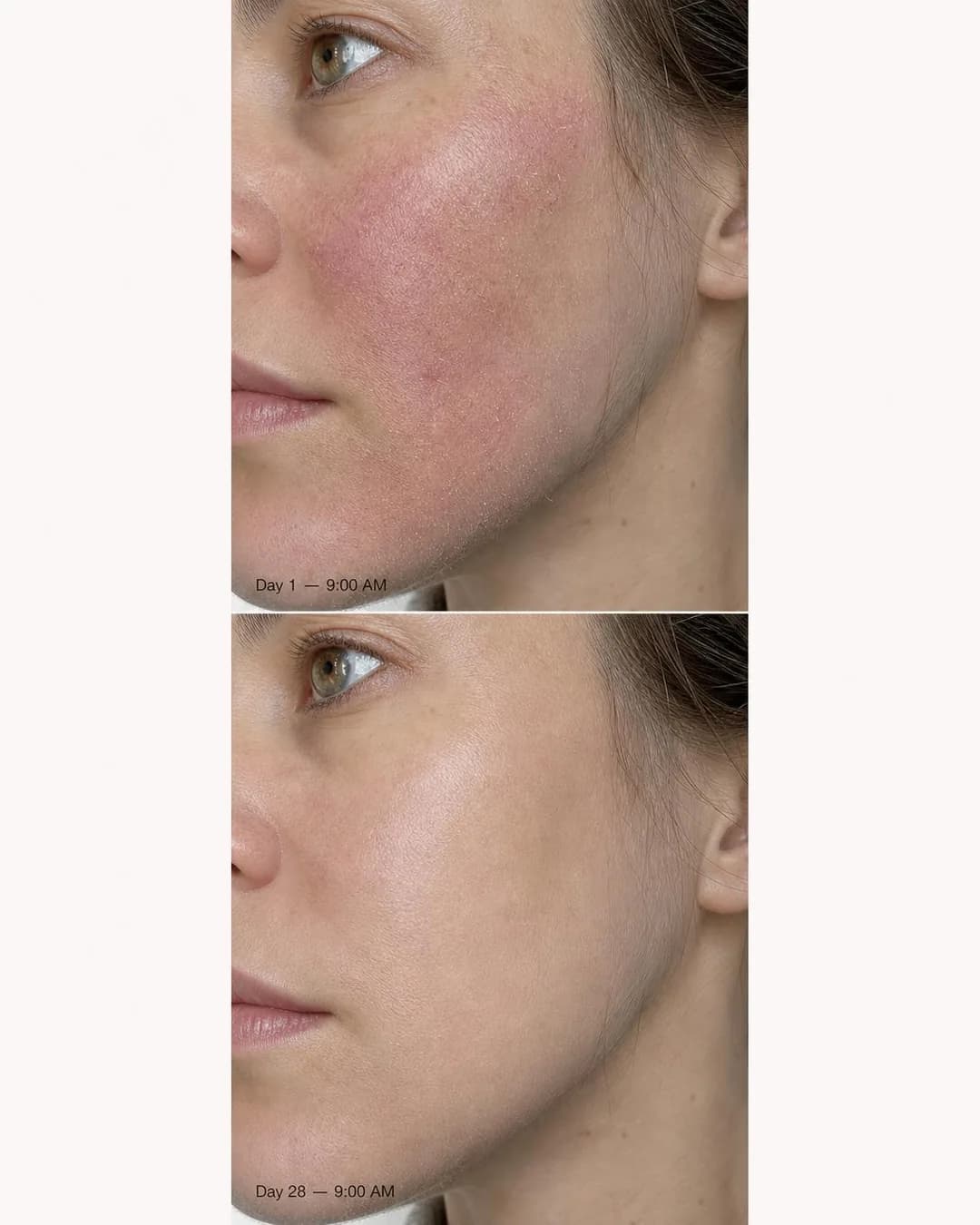
Before/After is this trade's native proof, and the square draft (not shown here) came back as the brief asked: the same cheek at the same angle in the same window light, “Day 1 — 9:00 AM” red, rough and flaking, “Day 28 — 9:00 AM” smooth. It is convincing, which is the problem.
It is a person who does not exist, showing a result nobody produced, and the copy says the opposite. The first primary text reads “Photographed above: unedited morning daylight on Day 1 vs. Day 28”, and the description line says “Unretouched daylight results.” The brief said the brand photographs the same person; the summary made that “real people”; the image step drew one. The FTC's endorsement guides say that when an ad represents that the endorser uses the product, “the endorser must have been a bona fide user of it”, and that an ad relating a consumer's experience “will likely be interpreted” as what buyers will generally achieve. A generated face can be neither.
Nor is the published 4:5 the square: the re-frame redrew both panels, stacked them and pulled the camera back, so the portrait is a second drawing of an invented face. The brief makes a good photography protocol; use it on a real customer, with their consent.
The claims went further than the brief. The brief said winter dryness. The summary added windburn and “raw redness” and had the ceramides “reinforce the extracellular matrix and seal cracked, flaking outer layers”; the concept made redness the difference between the panels and wrote “rebuild”. The copy then promises “Real barrier repair”, “Barrier Rebuilt”, “Real Winter Recovery in 28 Days” and, in another primary text, “This rich daily treatment rebuilds depleted stratum corneum”, and one headline sells a “$28 Daily Barrier Treatment”. The FDA's definition of a drug includes articles “intended to affect the structure or any function of the body”. Rebuilding the skin's outer layer is that kind of claim, where a moisturiser can say softer, smoother and less rough. Two other primary texts speak to the reader's own face: “If your cheeks sting every time you walk indoors from sub-zero air, your lipid matrix is compromised”, a health risk under Meta's standard, and “Tired of shiny-yet-flaky winter skin?”, the negative question about appearance its inferiority rule describes.
Other headlines from the same run
- Not Just Shiny. Actually Smooth.
- Ceramides NP, AP, EOP: Unretouched
- Real Winter Recovery in 28 Days
- $28 Daily Barrier Treatment (50ml)
Call to action
Sales, targeted 18 and over as the safe default, and only once both panels are real photographs of a real customer. Turn off creative enhancements in Ads Manager before switching it on (see the Facebook note). Replace “repair”, “rebuilt”, “recovery” and “treatment” with what a moisturiser can say: softer, smoother, less rough.
The Flash Photography Myth
SalesMineral SPF doesn’t cause flashback—uncalibrated zinc oxide does.
- Audience
- People who stopped wearing mineral sunscreen after seeing photos — Switched to a mineral sunscreen because chemical ones stung their eyes, then saw a grey cast on their face in every flash photo and stopped wearing any.
- Angle
- Myth Busting (Comparison & Positioning) — Challenges and disproves a common belief in the category.
Mineral SPF doesn’t cause camera flashback. Uncalibrated zinc oxide does.
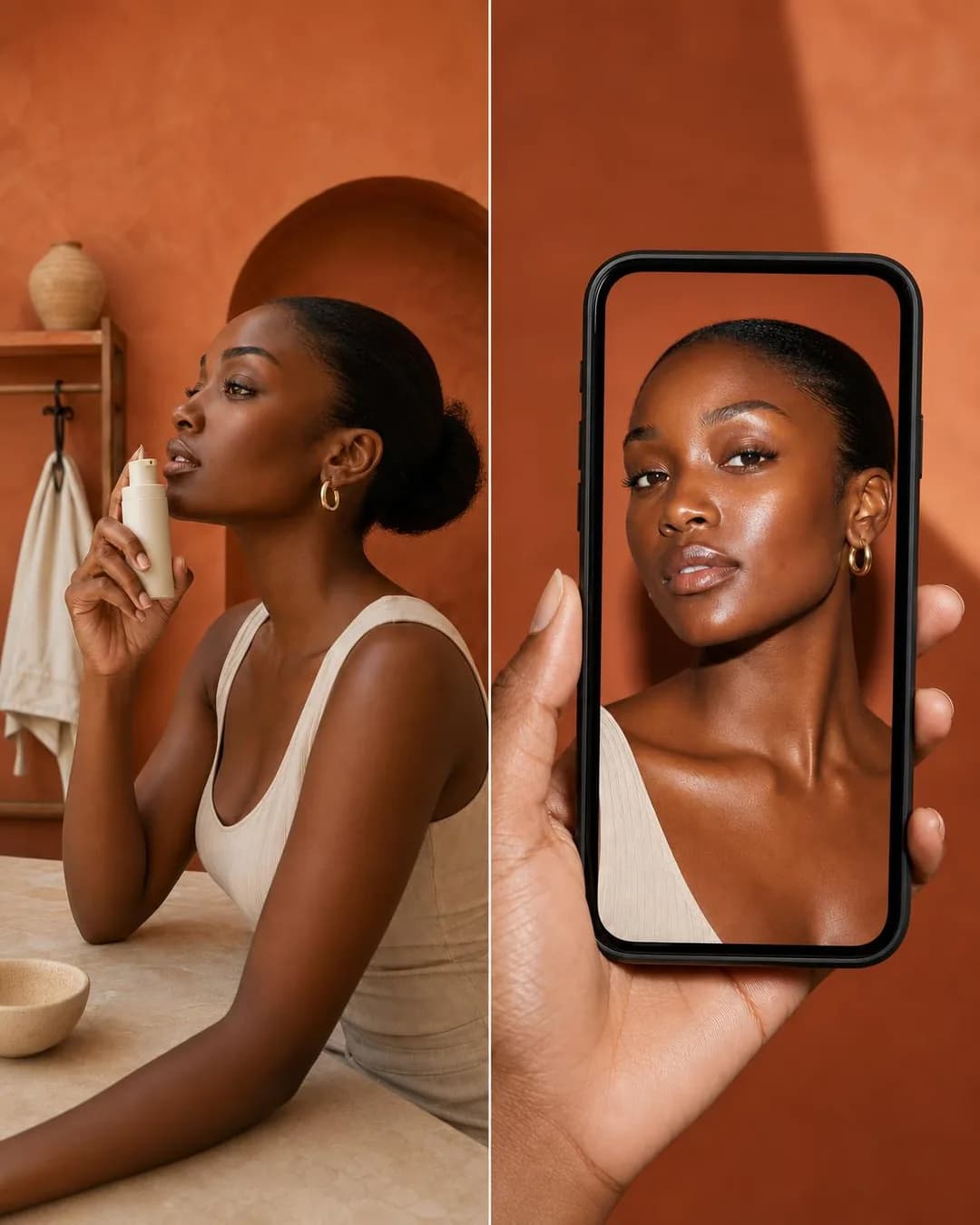
Zero White Cast. Zero Flashback.
Shop Tinted Mineral SPF 30
Myth Busting is the right family because the objection is a belief formed by experience: untinted mineral sunscreen shows up grey on medium and deep skin, and people who have seen it in a flash photo stop wearing any. The render shows a woman with deep skin at a terracotta wall, holding a blank pump to her chin, and beside her a phone showing a portrait of her with no cast at all. The headline states the claim: “Zero White Cast. Zero Flashback.”
The picture cannot prove it. A side-by-side scene is a comparison, and both halves here are the after: the concept asked for one flash portrait, and the picture's instructions split it into two shots of the same result. No panel shows the grey film the ad is about. The portrait on the phone does not look like a flash photograph either; it is lit like a studio shot and glossy, while the summary promises a semi-matte finish. Shoot the real comparison, the same face under the same flash with untinted mineral on one side and your deep shade on the other, and show all three shades somewhere, since the ad sells a range and pictures one.
Where it went right is the part most likely to go wrong. The brief put skin tone in the product, and the copy mostly kept it there: “Calibrated Zinc for Deep Skin Tones”, and “Finally formulated for rich complexions” in another primary text. That matches the allowed side of Meta's race and ethnicity examples (“Find black singles today.” is allowed, “Meet other black singles near you!” is not). The near miss is a third primary text, “The myth: 100% mineral sunscreen will always ruin your photos on rich skin tones”, which puts “your” in the same sentence as a skin tone. This is also the only deep skin tone in the batch; the two faces whose skin no brief described came back light, so look at who appears in your own renders.
The sunscreen facts held: SPF 30 in the description, 20% zinc oxide in another primary text, and no “waterproof”, which the FDA does not allow on a sunscreen. One overreach: “Chemical sunscreens burn your eyes” (another primary text) is a claim about every sunscreen you do not sell.
Other headlines from the same run
- Mineral SPF Doesn't Cause Flashback
- 100% Mineral. True-to-Tone Finish.
- No Chemical Sting. No Grey Cast.
- Calibrated Zinc for Deep Skin Tones
Call to action
Sales. Meta's over-the-counter rule does not name sunscreen, but the FDA regulates it as a drug, so target 18 and over as the safe default. Send it to a page with all three shades swatched on real skin under flash, and turn off creative enhancements, since an adjusted brightness changes exactly what this ad is about. The copy runs 73 to 111 characters, so there is room to put the SPF and the shade names in the first primary text.
The Drawer Graveyard Guarantee
SalesDon’t let another $40 serum rot in your bathroom drawer.
- Audience
- People who own serums they used twice — Have a drawer of serums they stopped using after two or three nights because they stung or pilled under makeup, and assumed the money was gone because the bottle was open.
- Angle
- Easy Returns (Objection & Risk Reversal) — Emphasizes a painless return or exchange experience.
You already have three half-used serums gathering dust in your bathroom drawer. We refuse to be number four.
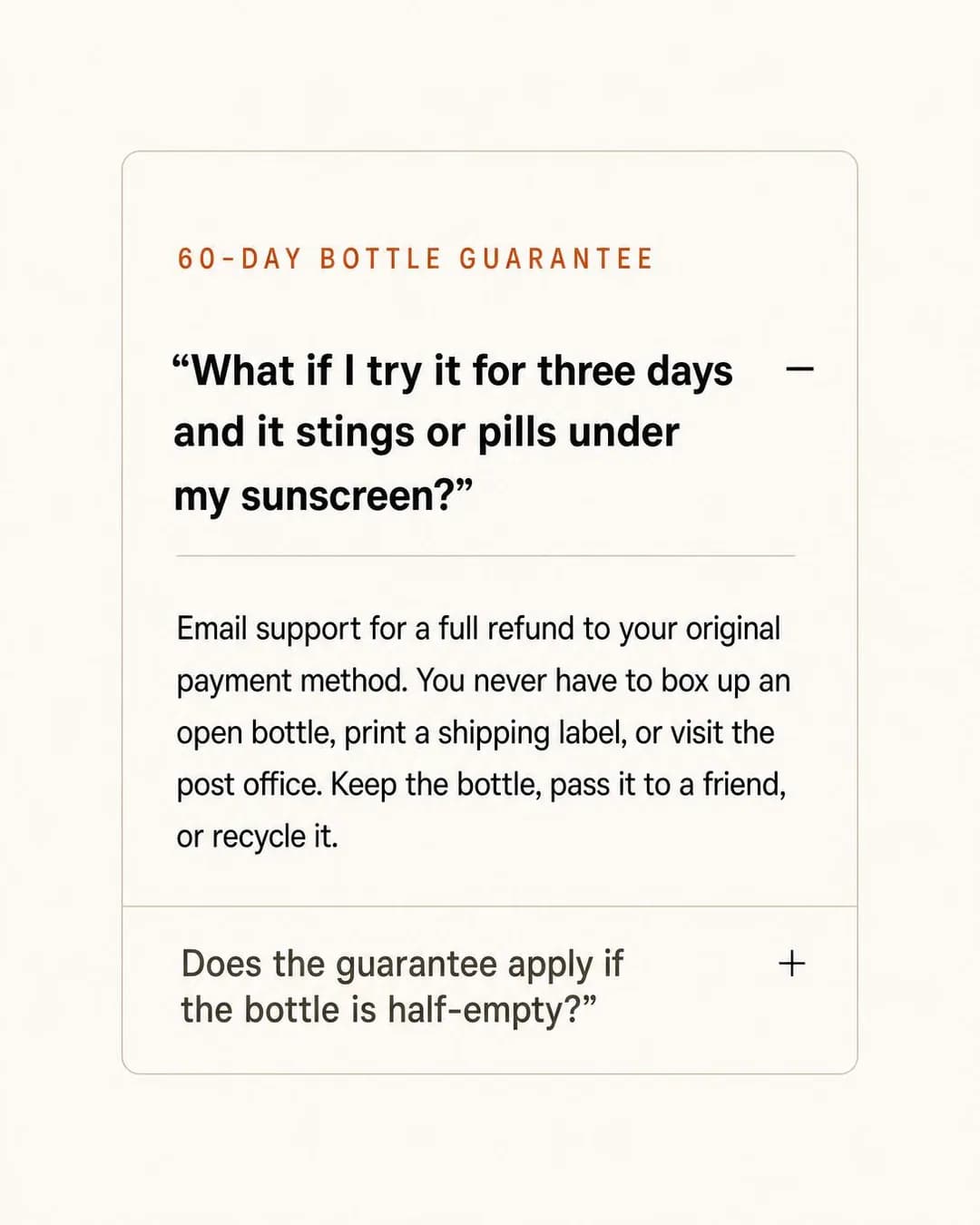
Don’t return it. Just get refunded.
Full refund. Keep the bottle.
Easy Returns answers the objection the brief itself gives: nobody knows how a serum suits their skin until they have used it for a few weeks, and by then the bottle is open. The pictured FAQ card puts the question the way a customer would ask it, “What if I try it for three days and it stings or pills under my sunscreen?”, and answers it plainly: “Email support for a full refund to your original payment method. You never have to box up an open bottle, print a shipping label, or visit the post office.”
What the image leaves out is the product. It never says vitamin C, serum or $42, and none of the five primary texts names vitamin C or the price. The terms need the same attention. The FTC's guides say “Money Back Guarantee” and similar phrases belong in an ad only if the full price is refunded at the purchaser's request, and that an ad mentioning one should disclose any material limitations or conditions. The brief's refund had one, the 60 days, and the image states it. The summary then called the guarantee “unconditional” and listed conditions anyway (“If it breaks out your skin, fails to blend under your sunscreen, or simply does not deliver visible radiance”), and the ad narrowed it the same way: the concept wrote “If it stings or pills, email support”, and a headline says “If it stings or pills, it's on us.” Decide whether the refund is conditional, and if it is, say so in the ad.
Two smaller things. The second question in the image has a closing quotation mark and no opening one, and “True skin turnover takes 4 to 6 weeks” (another primary text) is a figure the summary invented and the copy states as fact; the brief said only “a few weeks”. And judge this ad from your own orders, net of refunds: Meta counts the purchase within days of the click, and a refund on day 59 never reaches that column.
Other headlines from the same run
- 60-day trial: Keep the bottle.
- If it stings or pills, it’s on us.
- The zero-hassle 60-day guarantee.
- Love it, or keep the serum & refund.
Call to action
Sales, to the serum's page with the refund terms beside the price. The strongest audience is people who viewed the product and did not buy, since a guarantee answers the hesitation of someone who has already looked. Put the product's name and price into the first primary text before it runs.
The Ninety Night Calendar Math
SalesStop buying a new serum bottle every five weeks.
- Audience
- People who think a serum runs out in a month — Bought a $60 serum twice, finished each bottle in about five weeks by using three or four pumps a night, and decided serums were not worth it.
- Angle
- Cost Per Day / Use (Offer & Economics) — Breaks a large price into a smaller daily, monthly, or per-use amount.
Most people finish a serum bottle in five weeks because dropper bottles encourage over-application. When you guess your dose, you waste half the product. This 10% Niacinamide Serum uses an engineered airless pump that dispenses exactly 0.33 ml per press. One bottle delivers 90 full nights of targeted pore and texture care for $0.42 a night.
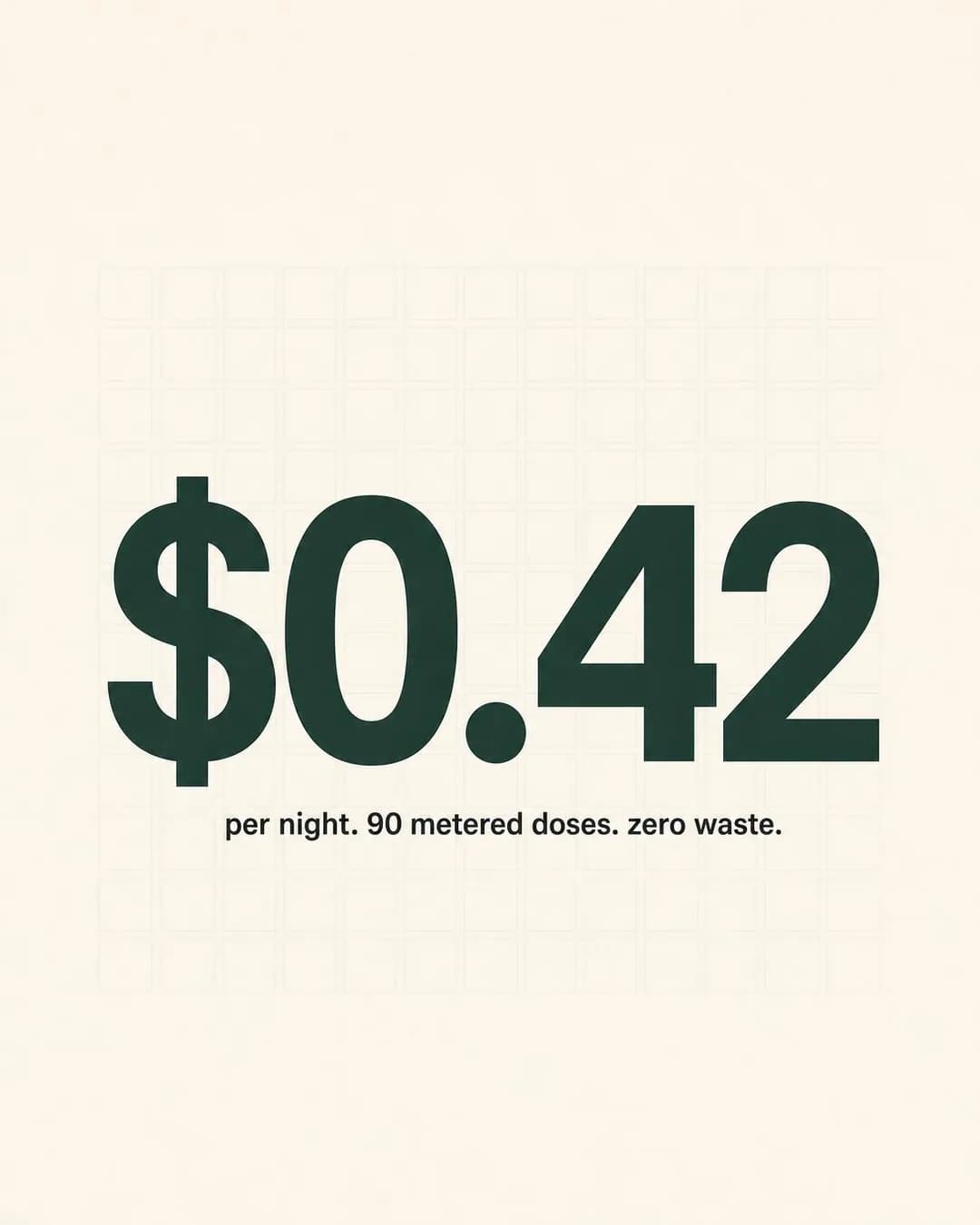
90 Nights. $0.42 Per Dose.
90 metered doses. Zero waste.
Cost Per Day turns a $38 price into a nightly one, and the number is right because the brief did the division: $38 over 90 nights is 42.2 cents. The render prints “$0.42 per night. 90 metered doses. zero waste.”, and the lead headline, “90 Nights. $0.42 Per Dose.”, is 26 characters, the only lead headline in the batch that fits Facebook's 27.
It produced two numbers of its own. Behind the price is a faint grid meant to be one square per night (the picture's instructions asked for “90 tiny uniform squares”), and it has 156: thirteen across, twelve down. It is faint enough that nobody will count it. The second number matters more. The summary divided 30 ml by 90 nights, got 0.33 ml a pump, and the copy turned the packaging into physiology: “Skin saturation happens at precisely 0.33 ml” (another primary text), and “your skin barrier only absorbs one” pump (a third). A division became a fact about skin that nobody measured.
The copy also blames the wrong thing. The brief's audience used three or four pumps a night, the summary blamed droppers, and the first primary text says “dropper bottles encourage over-application” to an audience whose problem was over-pumping. The claims drift mildly: “clarify congested pores” (another primary text) and zinc PCA came from the summary. “Zero waste” means the serum here; “no wasted serum” says so without sounding like a claim about packaging.
Other headlines from the same run
- A Full 90 Nights in One Bottle
- Stop Refilling Every 5 Weeks
- 10% Niacinamide at $0.42/Night
- Engineered for Exactly 90 Nights
Call to action
Sales, and the ad is really a reorder argument: a bottle that lasts ninety nights is a customer you can plan for. Offer a subscription that ships every twelve weeks, and upload buyers as a customer list so a reminder reaches them near day eighty. Watch when they come back, too. A buyer who reorders at about three weeks is still using four pumps a night, and 42 cents was never their price.
The Scraped Tin Reality
LeadsLast February, your tin ran empty. There were none left.
- Audience
- People who ran out of it last February — Bought one tin last November, used it on their hands, lips and heels all winter, and found it sold out when they went back for a second.
- Angle
- Limited Edition (Scarcity, FOMO & Timing) — Positions the product itself as temporary, rare, or exclusive.
Remember scraping the bare aluminum bottom last February? We were already sold out. It happens every winter: you buy one tin, use it daily on wind-chapped knuckles and raw lips, and reach the bottom before the freeze breaks. Because we compound only one finite run of 3,000 tins per harvest, there are no mid-winter restocks. Claim your allocation before the cold sets in.
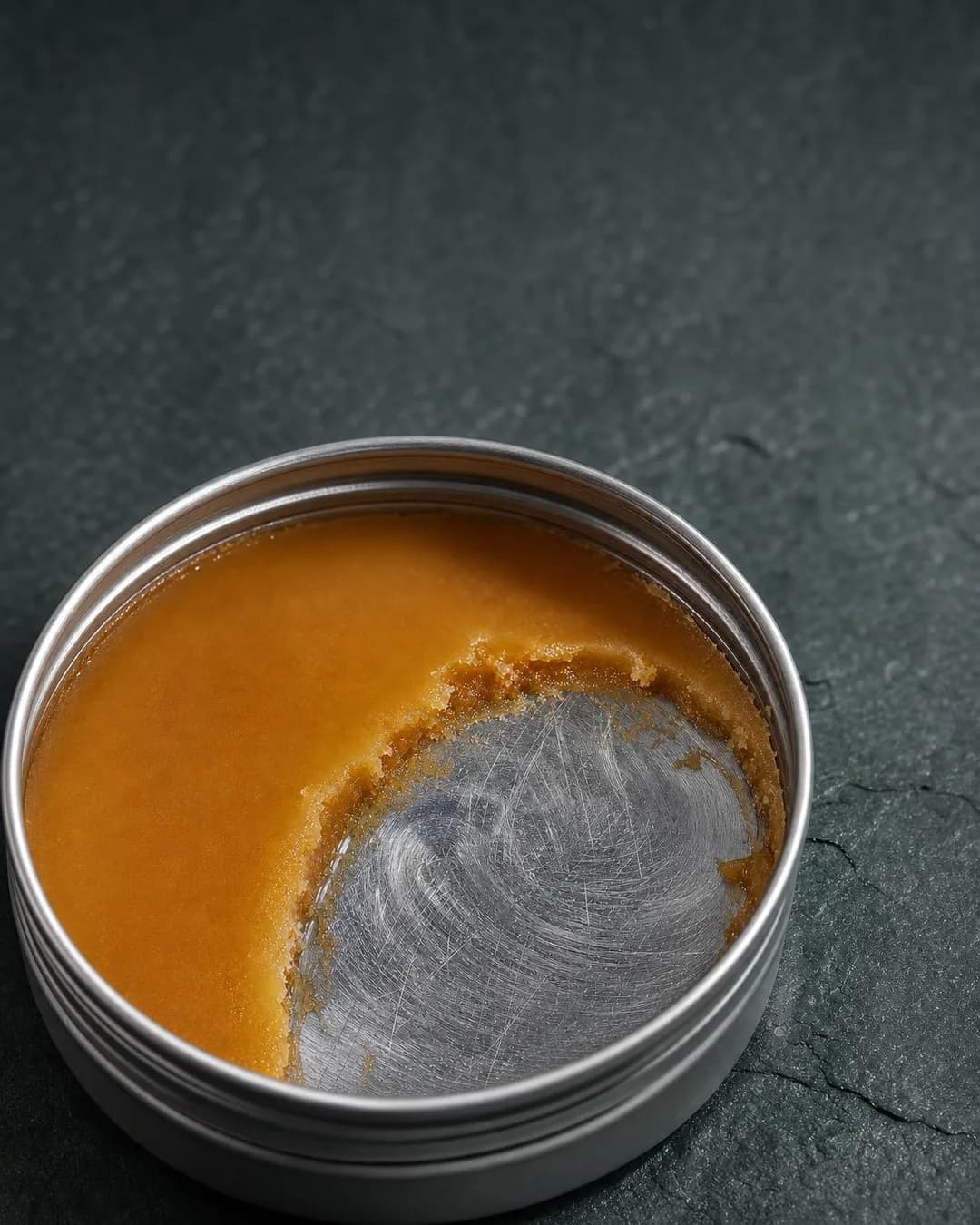
3,000 Tins Poured. Once a Year.
Limit 3 tins per household.
Limited Edition has a physical reason here: one batch, 3,000 tins, once a year, and last year's sold out in nine days. The date survived: both of the other primary texts that give it say Tuesday, 3 November at 10:00 a.m. Eastern, and 3 November 2026 is a Tuesday. A macro in raking light is the right way to show a balm's texture.
But the tin has not run out. The first primary text asks “Remember scraping the bare aluminum bottom last February?”, and the concept, “The Scraped Tin Reality”, called for a tin scraped to bare metal, which the picture's instructions kept, adding a crescent of balm on the rim and a full batch behind it. The render keeps a third to a half of the balm in the tin, so the argument has to come from the copy.
What the summary added became rules: “strictly capped at three tins per household” is now the description line, “Limit 3 tins per household.” The summary also sold the tins through a “private dispatch” list, which two other primary texts repeat, and two more promise “shielding raw hands” and “deep cold protection”, which echo the FDA's rule for over-the-counter skin-protectant drugs; among the claims that rule lets such a drug make are “protect from the drying effects of wind and cold weather” and “temporarily protects … chapped or cracked skin”. “Softens rough winter hands” sells the same tin as a cosmetic. “We refuse to dilute our formula with 80% water” (another primary text) is a jab at every moisturiser on the market, built on the summary's invented “70–85% water”.
Other headlines from the same run
- Don’t Run Out This February.
- Drops Nov 3. Strictly Limited.
- The Annual Winter Balm Returns.
- One Batch Per Year. 3,000 Tins.
Call to action
Leads, before the sale: a signup page for the email that goes out at 10 a.m. on 3 November, or an Instant Form built in Ads Manager. Last year's buyers are the people the brief describes, and you already have their addresses from their orders, so email them directly and exclude them from the ad. What the Leads budget buys is new names competing with them for 3,000 tins, so decide how many you want before you spend.
Twelve-Hour Shift Scrub Pocket Standard
TrafficFor the twelve-hour nurse whose knuckles split from hospital foam.
- Audience
- People who wash their hands thirty times a shift — Nurses, cooks and cleaners who wash their hands dozens of times a shift, have hands that crack at the knuckles by Friday, and skip hand cream at work because it leaves everything they touch greasy.
- Angle
- Identity Callout (Identity & Emotion) — Directly identifies a profession, role, life stage, behavior, or type of person.
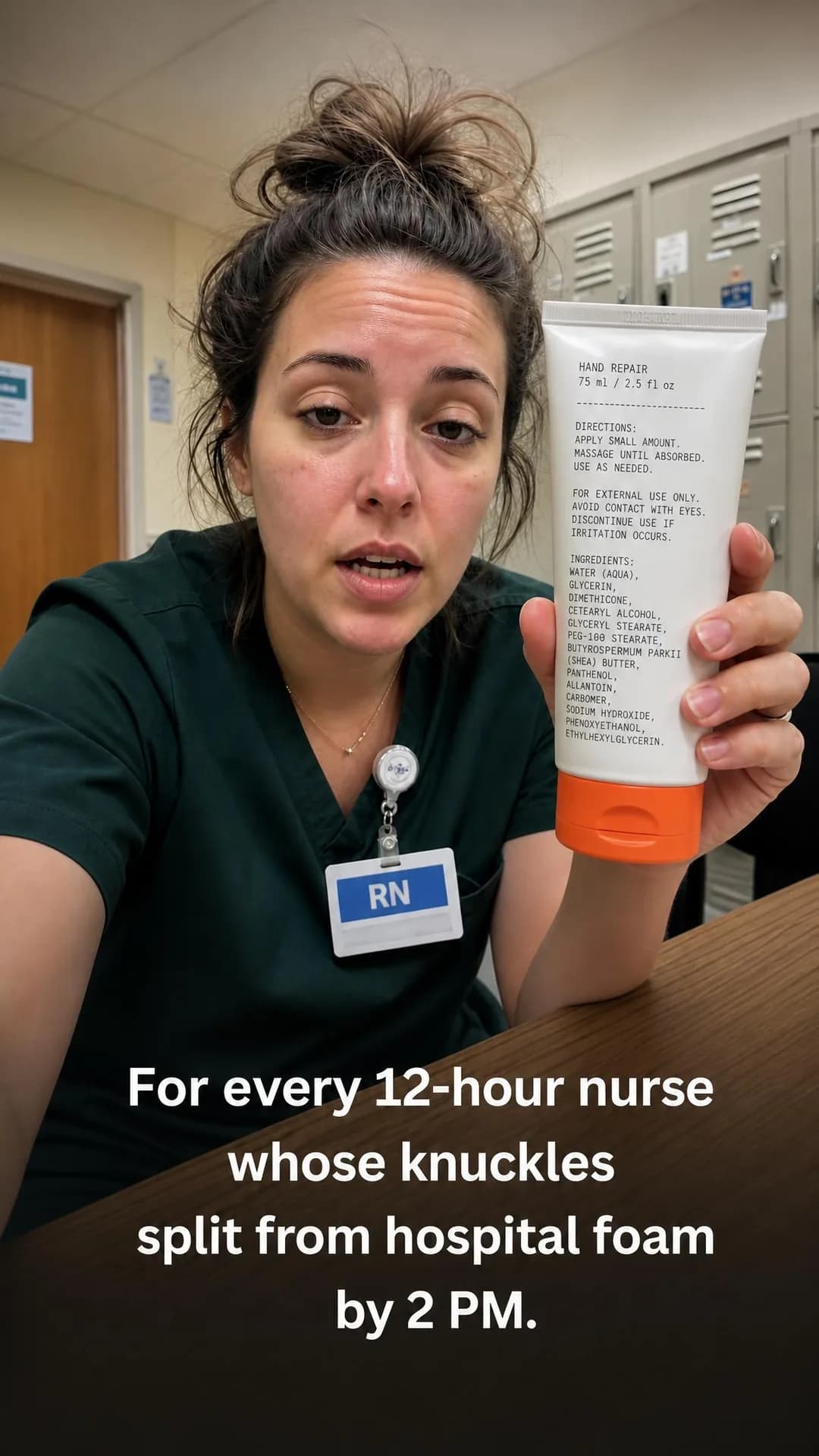
To the nurses hitting the sanitizer pump 40 times a shift: your knuckles don’t have to bleed by day three. Most hand creams leave a slick film that ruins glove application and greases up clipboards. This rapid-recovery barrier cream absorbs in under 60 seconds with zero tacky residue. Formulated with 10% vegetable glycerin and dimethicone to seal skin through brutal shift work.
Built for 12-Hour Hospital Shifts
75 ml flat-fit scrub tube: $16
Identity Callout works when the identity is a situation, and the brief pinned one: nurses, cooks and cleaners who wash their hands dozens of times a shift and skip hand cream at work because it greases whatever they touch next. The concept narrowed that to nurses, and the picture followed: a nurse in a break room, RN badge on her scrubs, holding a tube up to her phone's camera. The cooks, the cleaners and the pan handle are gone. The brief's own point, that the cream absorbs in under a minute and leaves no grease on a clipboard, is why this is a Traffic ad: it has to change a habit before it can sell a tube.
The caption is the hardest problem, because it is part of the image: “For every 12-hour nurse whose knuckles split from hospital foam by 2 PM.” The audience description said hands “crack at the knuckles by Friday”; the concept's hook made them split; and the copy says it to the reader: “your knuckles don't have to bleed by day three” in the first primary text, “If your knuckles split by 2 PM” in another. Meta's standard covers physical health and does not say whether cracked skin counts, but its rejected example, “Do you have diabetes?”, has the same shape, and no alternate headline removes a line from a picture. The caption also sits in the bottom 35% of the 9:16 frame, the band Meta's Stories spec asks you to keep clear.
The tube is a product nobody described. It reads “HAND REPAIR, 75 ml / 2.5 fl oz”, with directions, warnings and a thirteen-name ingredient list. The brief named two ingredients, glycerin and dimethicone; the picture's instructions asked only for “plain, monospaced technical labeling”; and the render invented the other eleven, shea butter and allantoin among them. An ingredient list is what a person with an allergy reads, so on your ad it has to be your product's.
“Hand Repair” also names the claim the copy keeps making: “Clinical Barrier Repair for Nurses”, “rapid-recovery”, “seal skin through brutal shift work”, and “Keep your hands intact” in another primary text. The summary called dimethicone “a breathable skin protectant”, which is the name of an FDA drug category. The FDA's rule for over-the-counter skin protectants lists dimethicone at 1–30% and allantoin at 0.5–2% as active ingredients, and “temporarily protects … chapped or cracked skin” as a claim such a drug may make; glycerin counts only at 20–45%, so the brief's 10% does not. A hand cream sold on protecting cracked knuckles is making a drug's claim. The brief's “absorbs in under a minute” is a cosmetic one, and it is still in the copy. Lead with it.
Other headlines from the same run
- Zero Grease. Dries in 60 Seconds.
- Scrub-Pocket Hand Barrier Cream
- Clinical Barrier Repair for Nurses
- No Slick Residue on Gloves
Call to action
Traffic, optimised for landing page views, to a page that shows the tube in a pocket and says what it does in cosmetic terms. Re-render the image without the caption, or put a product line (“Hand cream that's dry in a minute”) above the bottom band. The ad now speaks only to nurses; give the cooks and the cleaners ads of their own, since a kitchen and a ward are different pictures.
Operator Post-Mortem on Pump Failure
AwarenessIn August, one in twelve of our new pumps locked up.
- Audience
- Customers who ordered in August — Bought a serum in August, found the pump had stopped working a week later, and have been wondering whether to order again.
- Angle
- Apology / “We Messed Up” (Story & Founder POV) — Acknowledges a mistake or failure and explains what changed.
In August, roughly 1 in 12 of our Barrier Repair Emulsion pumps seized after 7 days of use. We engineered a custom airless bottle to shield unpreserved lipids from oxidation, but miscalculated mechanical piston friction. We pulled all inventory immediately and sent every August purchaser a free replacement in our proven legacy bottle—no support tickets or proof required. Our operational log is open.
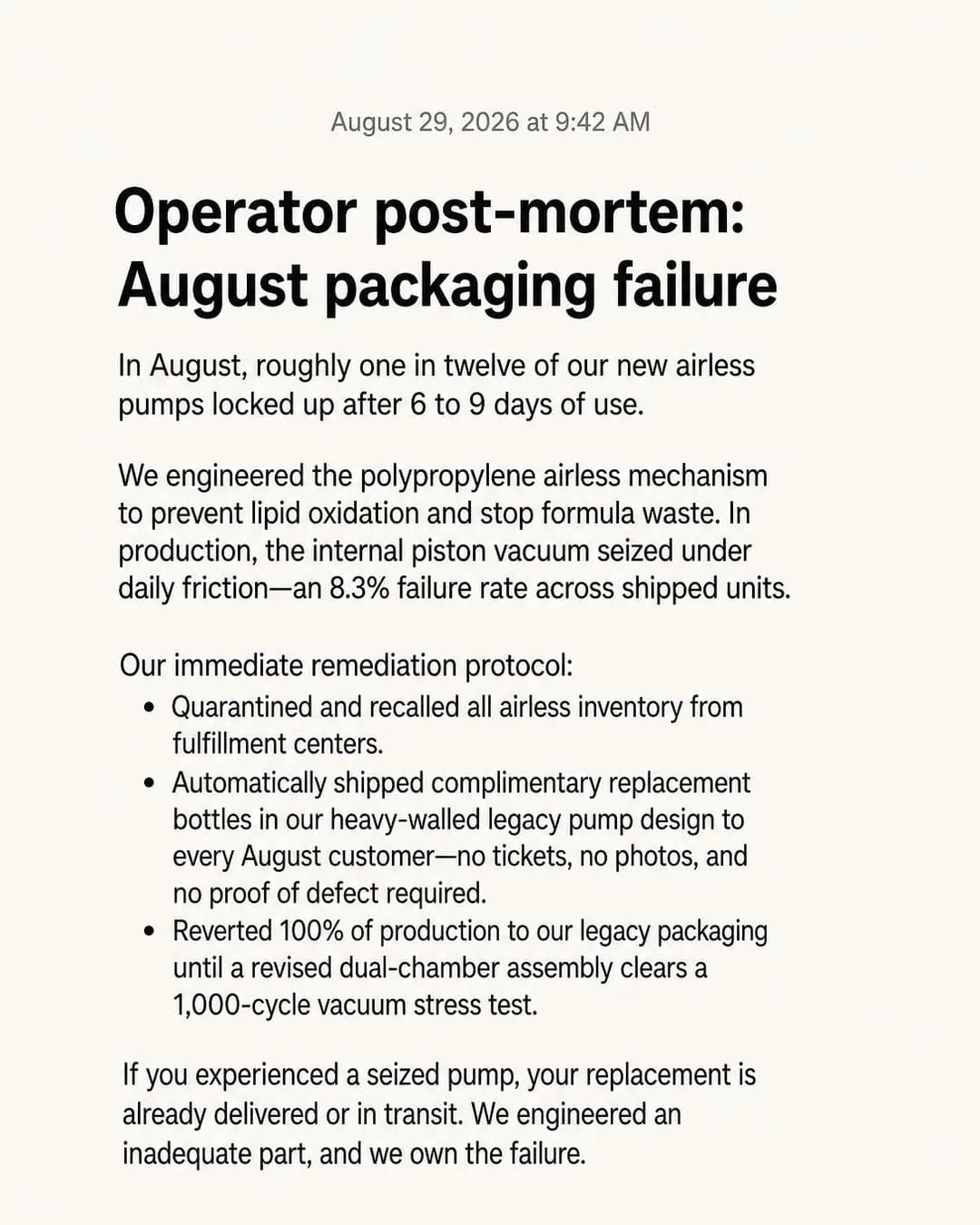
Operator Post-Mortem: August Failure
Legacy bottles fully restored.
Apology is an angle few brands run, and it is aimed at people who have already bought and are deciding whether to buy again. The note is specific. The brief's brand replaced every August bottle “whether or not theirs had failed”, and the note says so plainly: “no tickets, no photos, and no proof of defect required”. It ends “We engineered an inadequate part, and we own the failure.” The square draft draws the iPhone Notes app around the text, status bar and all; the 4:5 re-frame kept only the page.
The numbers came back more precise than the facts. The brief said “about one in twelve” and “about a week”. The summary made those “roughly 8.3%” and “six to nine days”, and the note drops the “roughly”: it gives both “roughly one in twelve” and “an 8.3% failure rate across shipped units”, and two other primary texts state 8.3% on its own. 8.3% is one in twelve with the uncertainty taken out, in an ad whose value is candour. And the note is dated 29 August, reporting on everything shipped in August before August had ended.
Strike one word before it runs: “recalled”. The summary had the brand “quarantined and recalled” its airless stock, and the note and another primary text repeat it. Nothing in the brief was recalled; the brand stopped using a pump. The first primary text already has the plain version, “We pulled all inventory immediately”. The summary also named the product “Barrier Repair Emulsion”, the same drug-shaped word as the hand cream's tube, and the first two primary texts use that name. It called the line “medical-grade” as well, which the copy did not repeat.
Other headlines from the same run
- 8.3% Pump Failure Rate: What We Did
- We Messed Up. Here Is The Fix.
- Legacy Packaging Fully Restored
- Packaging Failure & Remediation Log
Call to action
Awareness, to a customer list of everyone who ordered in August, uploaded from your own orders. It sells nothing and should not be judged as if it did. Every August buyer got a free replacement, so their next order is due a bottle's life later; compare their reorder rate at that point with earlier months' buyers at the same point.
Questions
- What is Facebook's ad policy for skincare ads?
- Meta's ad policy, published as its Advertising Standards, reaches skincare ads through three standards. Privacy Violations and Personal Attributes stops copy that asserts or implies the reader's age, race or ethnicity, or physical health: “Our new lotion and creams fight wrinkles like never before!” is allowed, “Ready to upgrade your skin to look younger?” is not. Health and Wellness requires 18+ targeting for cosmetic products but exempts non-permanent ones such as creams, makeup and hair products, lists before-and-after images for cosmetic products under 18+, and prohibits statements of inferiority about appearance and any promotion of skin whitening or bleaching products that cause permanent skin color change. Drugs and Pharmaceuticals puts over-the-counter medicine at 18+. Meta decides whether the ad runs. In the United States the FDA decides, from the same words, whether the product is a cosmetic or a drug.
- Can skincare brands use before-and-after photos in Facebook ads?
- Yes, in an ad targeted to 18 and over: Meta's Health and Wellness standard lists before-and-after images for cosmetic products among the ads that can run to that audience. A moisturiser is also a cream, which the standard exempts from its age rules, and it does not say which rule wins, so keep 18+ as the safe default. The standard still prohibits “statements of inferiority about physical appearance”. The FTC adds the condition AI cannot meet: when an ad represents that the person shown uses the product, they “must have been a bona fide user of it”, so the photographs have to be of a real customer, which the generated pair on this page is not. On Meta's side, turn off creative enhancements such as brightness and contrast and visual touch-ups, which can change the image Meta delivers.
- Do skincare ads on Facebook have to target people over 18?
- Only some. Meta says its age restrictions for cosmetic products “don't apply” to “Non-permanent cosmetic and beauty products such as creams, makeup, hair products”, so an ordinary cleanser, moisturiser or makeup ad can run to anyone Meta allows ads to reach: 13 and over, higher in some countries. That covers a beauty brand's makeup and hair-care ads as well. Run two kinds at 18 and over: a before-and-after, which Meta lists under 18+, and a sunscreen, because the FDA regulates it as a drug and Meta's floor for over-the-counter medicine is 18 (Meta does not name sunscreen, so treat this as the safe default). Targeting is not the fix for a cream whose copy drifted into a drug claim such as “barrier repair”; cut the claim instead.
- What words get a skincare ad rejected on Facebook?
- Meta's written standards aim at what an ad says about the reader. Its personal-attributes rule stops copy that asserts or implies someone's age or physical health: “Ready to upgrade your skin to look younger?” and “Do you have diabetes?” are its rejected examples, while “New diabetes treatment available” is allowed. Its Health and Wellness standard also prohibits “terms, descriptions, or questions that are negative and attack an individual's appearance”. In this batch, “If your knuckles split by 2 PM” and “Tired of shiny-yet-flaky winter skin?” have those shapes. One rule keeps copy on the right side of both lines: make the product the subject, and describe how skin looks or feels, as the briefs did (“softens the look of fine lines”, “cleans without the tight feeling”, “absorbs in under a minute”).
- Can a skincare ad say “anti-aging”, “repair” or “collagen”?
- On Facebook, yes if the word describes the product: Meta's allowed example is “Our new lotion and creams fight wrinkles like never before!”, and its rejected one aims the idea at the reader (“look younger”). In the United States the FDA is the stricter reader, and its answer for anti-aging products is “It depends”. It decides whether a product is a cosmetic or a drug by what it is claimed to do, including “in advertising, on the Internet”: a product that makes lines “less noticeable, simply by moisturizing the skin” is a cosmetic, and one intended to “remove wrinkles or increase the skin's production of collagen” is a drug. “Regenerate cells” is another of its examples. In this batch, four ads with cosmetic briefs came back with “repair”, “rebuilt”, “renewal”, “recovery”, “treatment” or cold “protection” in the copy, and a fifth used “Barrier Repair” in its product name, so read AI-written copy for exactly those words, and swap them for how skin looks or feels: softer, smoother, less rough.
- Can I advertise sunscreen on Facebook?
- Yes. In the United States sunscreen is an over-the-counter drug, and the FDA's labelling rules come with it: water resistance may be claimed only for 40 or 80 minutes, and a sunscreen may not be labelled “waterproof”, “sweatproof” or a “sunblock”. Keep the ad's claims to what the label says. Meta's standards do not name sunscreen, but its rule for over-the-counter medicine sets 18 as the minimum, so target 18 and over as the safe default. The sunscreen ad on this page kept its SPF and zinc oxide figures right, but its picture shows no before and no grey cast to compare against, which is the part you will have to photograph yourself.
- Which Facebook objective should a skincare brand use?
- Sales, for most product ads, as long as your store sends Meta a purchase event; six of the ten ads here were written for it. Use Traffic when the ad has to change a habit before it can sell, Leads for a waitlist or a limited drop, and Awareness for a message to existing customers, like an apology. Remember what Sales cannot see: Meta counts purchases within one or seven days of a click, and the reorder comes when the jar runs out, weeks or months later. If your customers come back, judge campaigns by how often the customers each one brought in reorder.
- What size should a skincare Facebook ad be?
- Render 4:5 at 1440 × 1800, Meta's recommendation for Facebook Feed, and aim for primary text of 50 to 150 characters and a headline of 27. In this batch, 15 of 50 primary texts fit that range, all from three ads, and only 3 of 50 headlines fit 27, so measure before you run. best-in-slot sends a 1.91:1 version to Facebook's right-hand column and search results, and a 9:16 to Stories, where the top 14%, the bottom 35% and 6% at each side should stay clear of text.
Generate Facebook ads for your own skincare or beauty brand
Paste your site and best-in-slot reads it (products, ingredients, prices, what you claim) and shows you the business summary it wrote before any ad is made. The brands above had a one-line brief where your site would be. Edit out any repair or renewal the summary picked up, and read every claim against your label before it runs. Free to start, no card.
Every angle used above is documented in the best-in-slot ad angle library. More industries and placements are at all ad examples.