
Ad Examples · Roofing × Instagram · 10 ads
Roofing Instagram ad examples
Ten finished ads for roofing contractors — a matched before-and-after, an attic leak, a storm night, a refusal list — with the brief behind each, because we generated them rather than collected them.
Roofing on Instagram is mostly drone footage and a slider. Both are collected images, and a collected image cannot tell you the things that actually transfer — who the ad was written for, what it argued, and what it was supposed to make happen.
So these were not collected. Every ad below was generated with the audience, the angle and the objective pinned before the run, which means the brief printed beside each one is the brief that produced it rather than a caption written afterwards about somebody else's work. The contractors are invented — ten of them, a membrane-first shop in snow-load country, an inspection service, a night-dispatch tarping crew, an owner who will not knock on doors — so no competitor's creative is borrowed and no crew's faces are used.
This page exists to answer one question the Facebook half deliberately left open. Before-and-after is roofing's native creative and the one direction that batch withheld, to keep this trade distinct from home remodeling. Running it here produced the most useful result in the cluster so far, and not the one we expected: pinning the camera position, the hour and the light in the brief worked exactly, and the thing the brief forgot to pin drifted anyway. The note on that ad is the one to read before you brief your own.
The whole batch turned out to argue a single point. Five of these briefs stated a positive requirement and all five came back correct, down to arithmetic that foots to the cent. Three stated a prohibition, and all three lost — every one of them to something else the same brief had asked for. Ask for a scarcity angle and then forbid a countdown and you get a countdown. Name a speaker's role without forbidding a name and you get an invented person. List the markers a quiz may not use and you get the marker you left off the list. Brief what you want, not what you fear.
All ten angle families appear once each, ten distinct visual directions, and the objective split is four Leads, five Traffic and one Awareness with no Sales — the mirror of the Facebook batch's five, four and one. Both roofing batches are Sales-free, and so are both dentist and both real-estate batches, so that is not peculiar to this trade. What is peculiar is how far it reaches: a practice can still sell a whitening kit and an agent a report, and roofing has nothing at all a homeowner buys without somebody physically going up a ladder first.
Nine of the ten came back in a single pass. One was lost at the very last stage to an upstream 500 from the image API — after its hero and its copy had already been generated — and was re-run from the identical brief, unchanged. Nothing here was re-rolled because we disliked the result, which is the distinction that keeps the rest of this page honest.
Every price is invented: $189 for an inspection, $285 for a night tarp, $27,375 for a re-roof, a fifteen-year workmanship warranty. Read them as placeholders marking where a real number goes. The proof figures are invented too, and this batch does something no previous one has — three of its credential numbers each appear in two different ads belonging to two different invented companies. 3,100, 4,100 and 1,900 all show up twice on this page. Each note says which, and what to put there instead.
What changes because it is Instagram
Start with reach, because roofing has the worst platform mismatch of any trade in this set and the honest version is more useful than the flattering one. Pew's November 2025 survey puts Instagram at 40% of 50- to 64-year-olds and 19% of over-65s, against Facebook's 74% and 57%. An asphalt roof reaches the end of its life at around twenty years, so the household most likely to need one is the household that has been in the house twenty years — and on that band Facebook has roughly three times this app's reach. Every other Instagram page in this cluster can say it reaches a different buyer. Roofing has to say it reaches fewer of the same one.
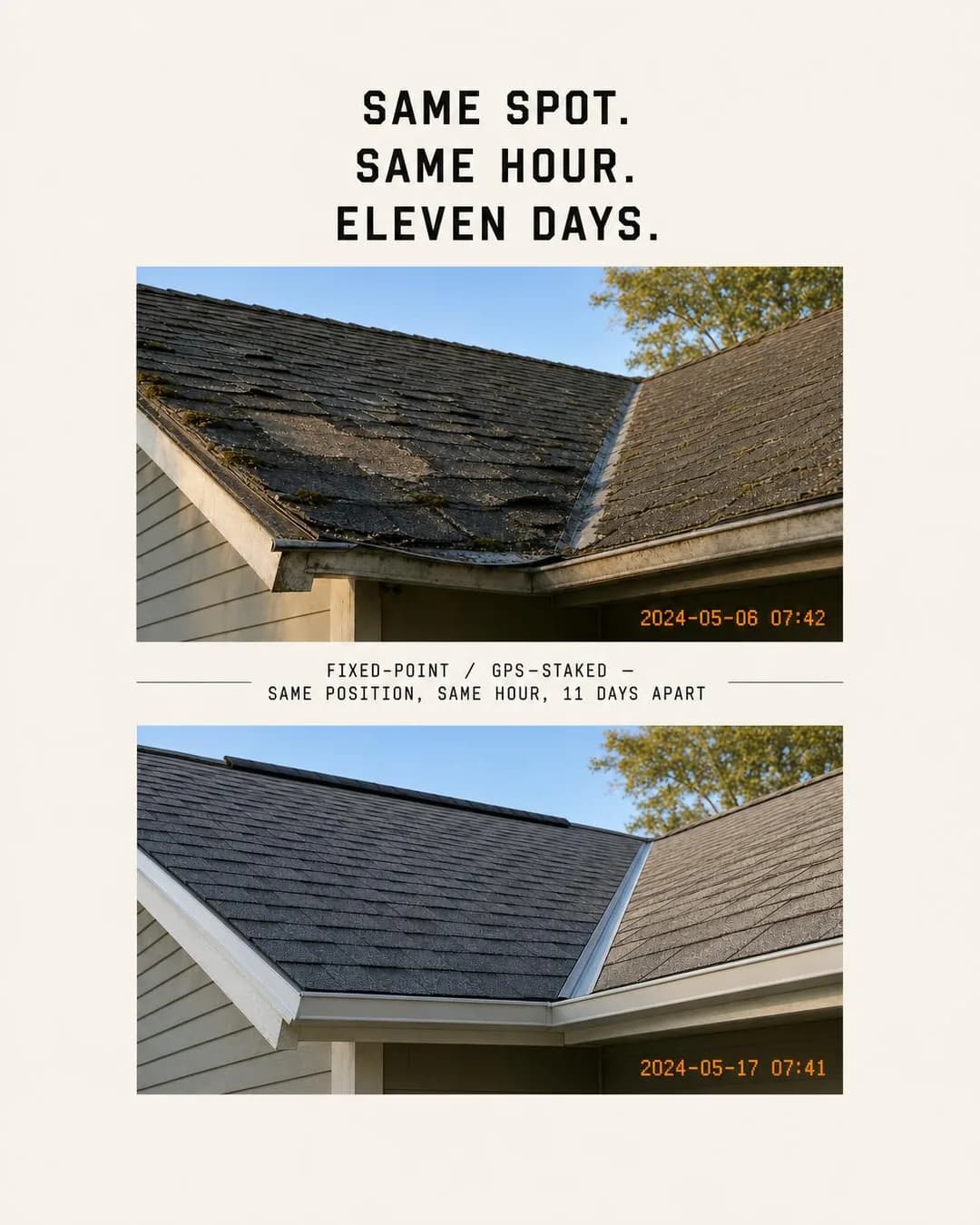
So the reason to be here is the format, and this is the one place where roofing has a real advantage over the other trades on this list. Before-and-after is the native creative of this category, and Instagram is the app built for it. The Facebook batch withheld that direction deliberately, which left a question open, and the ad below that answers it is the most instructive thing on this page. Pinning the camera position, the hour and the light in the brief produced a genuinely matched pair — same corner, timestamps eleven days and one minute apart, sun in the same place. What the brief did not pin drifted: only half the roof is new in the second frame, and the fascia and gutter changed too. A before-and-after proves one thing, that these are the same roof. Pin the scope as tightly as you pin the camera.
Now the part that does not invert, and it is the whole spine of the Facebook page carried across unchanged. Roofing's binding constraints are not Meta's. Advertising a deductible waiver is a Class B misdemeanour for a contractor in Texas under Business and Commerce Code § 27.02(c), and Minnesota Statutes § 325E.66 subd. 1(a)(1) bars the same promise. Texas Insurance Code § 4102.163(a) forbids a contractor to act as a public adjuster or, in the statute's own words, to advertise to adjust claims on property they are working on, and Minnesota § 325E.66 subd. 1(a)(3) bars interpreting policy provisions or advising on coverages without a public adjuster licence. None of those statutes mentions a platform. They attach to what the advertisement says, so nothing about them softens because the render went to a 4:5 Instagram feed image instead of a Facebook one, and Meta will approve the ads that break them here exactly as it does there.
The economics do not invert either, and this is where roofing parts company with its closest neighbour in this matrix. The HVAC pair could argue that Instagram gets the half of the trade you can photograph and that this half happens to be the cheap half — a $349 thermostat that genuinely completes in a checkout. Roofing has no cheap half. There is nothing here a homeowner buys without somebody physically going up a ladder first, so both roofing batches came back with no Sales ad, which is not true of the HVAC pair. What Instagram selects for is not a smaller ticket. It is a photographable one: a membrane rolled out on bare deck, a stain blooming across attic sheathing, two roof corners eleven days apart.
Storm work is the one thing this page can do that the HVAC Instagram page explicitly could not. That page argued there is no demand-capture surface here — nobody opens Instagram to find a contractor while the house is at 88 degrees — and so it ran no emergency ad at all. Roofing's emergency is different in kind: a storm is announced hours ahead and arrives over a whole neighbourhood at once, so an ad in this feed on the evening of a warning is not capturing demand, it is being the name already in the phone when the demand arrives. That is a real Instagram job, and the ad below that does it is also the one to read Meta's crisis standard against hardest. The standard prohibits exploiting a crisis for commercial purposes and names natural disasters as its example. The line runs between advertising a service to people who have been through a storm and advertising the storm — and this ad was briefed to stay on the safe side of it and did not.
Then the specs, where the received wisdom is backwards. Meta's ads guide recommends about 40 characters of headline for an Instagram Feed image ad against Facebook's 27, so the app everyone treats as the wordy one is the more generous of the two. Primary text is about 125. The image is 4:5 at 1440 × 1800, identical to Facebook Feed so one export serves both, but the aspect-ratio tolerance is 1% here against Facebook's 3%, so a crop a few pixels out of true passes there and fails here. And the surface count runs the other way: Facebook has nine image placements to Instagram's four, which is why that page has to compose for a Marketplace square as well as a feed portrait and this one does not.
Measured against this batch: 49 of 50 headlines fit 40 and seven fit Facebook's 27, which is a much higher rate of short headlines than the corpus average — across seven Instagram batches only 21 of 350 headlines fit 27. Of the ten lead headlines, nine fit 40 and two fit 27. None of the 50 primary texts fits 125; they run 208 to 559 characters, and across all fourteen batches published here the count is now 700 of 700 over the recommendation. Six of ten descriptions fit 30, in a field the feed does not show. Three ads are 9:16 for Stories and Reels, and every export on this page was re-framed off a square draft.
Source: Texas Department of Insurance — Roofing and insurance: know the law (illegal to offer to waive, rebate or absorb a deductible; a roofer doing the work may not act as a public adjuster or offer to negotiate settlements or file a claim). Read 8 September 2026 · Tex. Bus. & Com. Code § 27.02 — deductible required; (c) advertising or promising to pay, waive, absorb, rebate or credit a deductible; (d) Class B misdemeanour · Tex. Ins. Code § 4102.163 — a contractor may not act as a public adjuster or advertise to adjust claims for property it is providing or may provide contracting services for · Minn. Stat. § 325E.66 — subd. 1(a)(1) advertising or promising to pay a deductible; subd. 1(a)(3) interpreting policy provisions, advising on coverages or adjusting claims without a ch. 72B licence; subd. 1(c) residential roofers included · Meta Advertising Standards — commercial exploitation of crises and controversial events (ads must not exploit crises for commercial purposes; natural disasters named as an example) · Meta ads guide — image ad specifications, Instagram Feed (4:5 at 1440 × 1800; primary text 125, headline 40; 1% aspect-ratio tolerance; minimum width 500) · Meta ads guide — image ad specifications, Facebook Feed (headline 27, primary text 50–150, 3% tolerance) — the comparison this page measures against · Pew Research Center — Americans' social media use, November 2025
Want the campaign, not just the creative? Instagram ads for roofing companies → is the playbook these ads came out of: which objective to buy, the offers worth running, the targeting levers this trade keeps, and the policy that decides what the copy may say.
Generate Instagram ads for your own roofing company
Paste your site and best-in-slot reads it the way these invented contractors were read — services, service area, positioning — then writes the concepts, renders the images and drafts the copy. Free to start, no card.
Storage Boxes Hide the Roof
LeadsYour holiday boxes can't tell you your roof deck is soft.
- Audience
- Homeowners who finished the attic and then stopped going up there — Boarded the attic out for storage two winters ago, have not been up with a flashlight since, and have never looked at the underside of their own roof deck in daylight.
- Angle
- Hidden Problem (Problem & Pain) — Reveals a problem the customer may not realize they have.
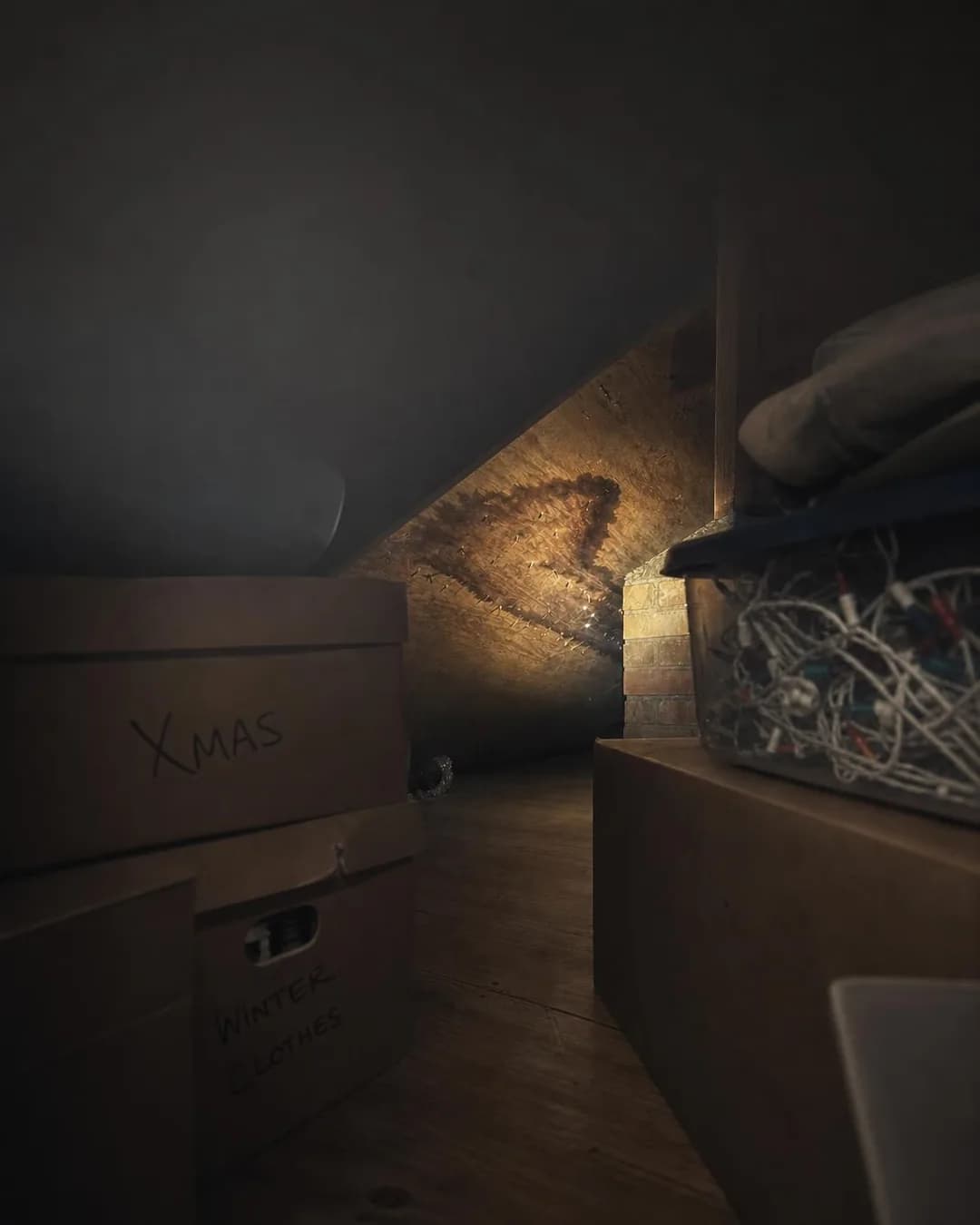
Your holiday boxes can't tell you your roof deck is soft. The last time most homeowners really look at their attic is the day they finish it for storage — and after that, the chimney flashing quietly separates from the brick, water finds the deck, and the wood goes soft behind a labeled box. A $189 Daylight Survey puts a technician in that attic with the lights off, photographing every point where light — or water — is getting through.
Your Attic Hasn't Been Checked
See it in writing. $189.
Hidden Problem is the right family for the one thing this trade cannot get homeowners to check, and the audience brief is what makes it land: people who boarded the attic out for storage and have not been up with a flashlight since. That is a decision rather than a demographic, which is the rule the Facebook batch closed — define the reader by something they did and the ad stops reaching for something they are. The offer is a $189 inspection, which is the cheapest first transaction this category has, in a trade whose usual opening ask is five figures.
The brief asked for pinholes of daylight through the deck around a masonry chimney. What came back is a water stain blooming across the sheathing, lit by an off-frame flashlight, with the nail shanks correctly visible pricking through the boards and a few bright specks among them that could be daylight or could be lit nail heads. That ambiguity matters, because the ad's argument depends on which it is. What is worth noticing is that the copy never claims daylight — it describes the stain, the soft deck and the flashing behind it. The copy stage reads the hero, so where a render diverges from its brief the copy follows the render rather than contradicting it, and the two artefacts stay consistent with each other at the cost of fidelity to what was asked for.
The figure to replace is "3,100" — it is in a headline as "3,100 Attics. Same Stain. Same Cause." and it is invented. Worse, another invented contractor further down this same page also claims 3,100 of something, which is a thing to know about publishing ten generated ads side by side. Note also what the image does not contain: no fabricated statistic at all. A raw phone pic has nowhere to put one. The invention lives entirely in the copy, which is the proof-slot rule holding for the fourth batch running — choose a direction with no slot and the picture stays clean.
Other headlines from the same run
- The Leak Is Behind the Boxes
- Soft Deck. Fine Shingles. Real Problem.
- What's Under Your Holiday Storage?
- 3,100 Attics. Same Stain. Same Cause.
Call to action
A flat-fee inspection with a price on it is bookable, which is unusual in this trade and worth exploiting — send the click to a page that opens on the $189 and a date picker. Learn more is the safer button if the landing page has to explain what chimney flashing is before it can sell a look at it.
One Day, Timestamped
Traffic6:04, dumpster down. 5:40, last magnet pass. That's the whole job.
- Audience
- Homeowners who have already put the job off through one winter — Got quotes last spring, decided to wait, and have spent a year assuming a re-roof means a week of their driveway gone and a week of noise.
- Angle
- Convenience (Benefit & Outcome) — Makes an existing task, routine, or purchase easier to complete.
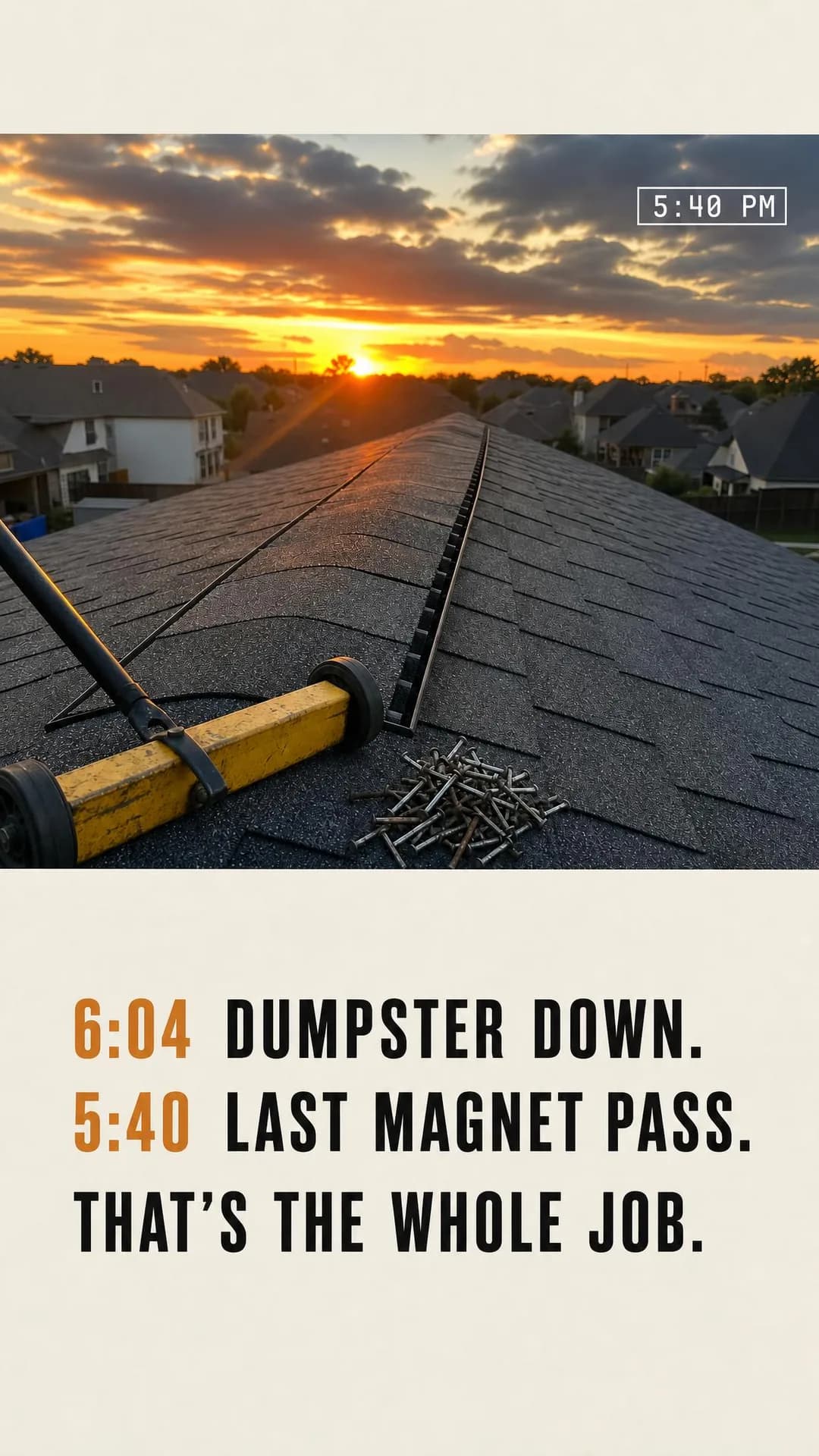
6:04, dumpster's in the driveway. 5:40, I'm doing the last magnet pass on your lawn. That's the whole job — one day, start to finish. The week-long construction site you've been dreading? It doesn't exist here. Fixed quote, fixed schedule, done before dinner.
Done Before Dinner. Seriously.
Get a written quote today.
Convenience is the honest objection here and the ad answers it with a clock rather than an adjective. Everyone in the category says fast. This one says 6:04 the dumpster lands, 5:40 the last magnet pass, and burns 5:40 PM into the corner of the frame. The two times in the caption block match the two times in the copy exactly, which is cross-artifact agreement across three separately generated things, and it is the reason the ad reads as reportage rather than as a promise.
The speaker rule holds because the brief named the speaker. It asked for footage shot by the foreman running the crew, and the copy is written in that person's first person throughout — "I'm doing the last magnet pass", "I filmed that roof at 5:40", "petunias were fine". No invented customer, no fabricated testimonial. Set that beside the storm ad further down, where the brief named a role and not a person and the pipeline invented two people, and the rule sharpens: it is not enough to say who is speaking, you have to say whether a name may be invented.
Two things to fix before it runs, and the first is the kind a roofer spots in a second. The ridge in the photograph carries an uncapped ridge vent — the black corrugated strip is exposed, with no ridge cap shingles over it — in an ad whose entire claim is that the job is finished by dusk. The copy even says "ridge vent cut", which is a mid-job state. Second, the magnet sweeper and its pile of nails are sitting on the roof, while the copy correctly puts the magnet pass on the lawn; a rolling sweeper is a ground tool. Also: this is the batch's clearest instance of the re-frame padding defect, a flat cream band across the top of the 9:16 export where the square draft ran full-bleed to the edge.
Other headlines from the same run
- One Day. Full Tear-Off. Done.
- Torn Off by Noon. Shingled by Dusk.
- The Week-Long Job That Takes a Day
- Fixed Quote. One Day. Ten-Year Warranty.
Call to action
The ad promises a fixed written quote, so the click is a conversation about a specific house. Send it to a page carrying a real one-day schedule with times on it; a landing page that reverts to "fast, professional service" throws away the only differentiator the ad built.
Retire the Hammer
TrafficThe hammer didn't fail you. What's under your shingles did.
- Audience
- Homeowners who have already had one ice dam and paid for the ceiling — Chipped ice off the gutter with a hammer one February, watched a brown ring spread across the bedroom ceiling below it, and paid a painter rather than a roofer.
- Angle
- Ingredient / Material (Product & Mechanism) — Spotlights a specific ingredient, component, material, or input.
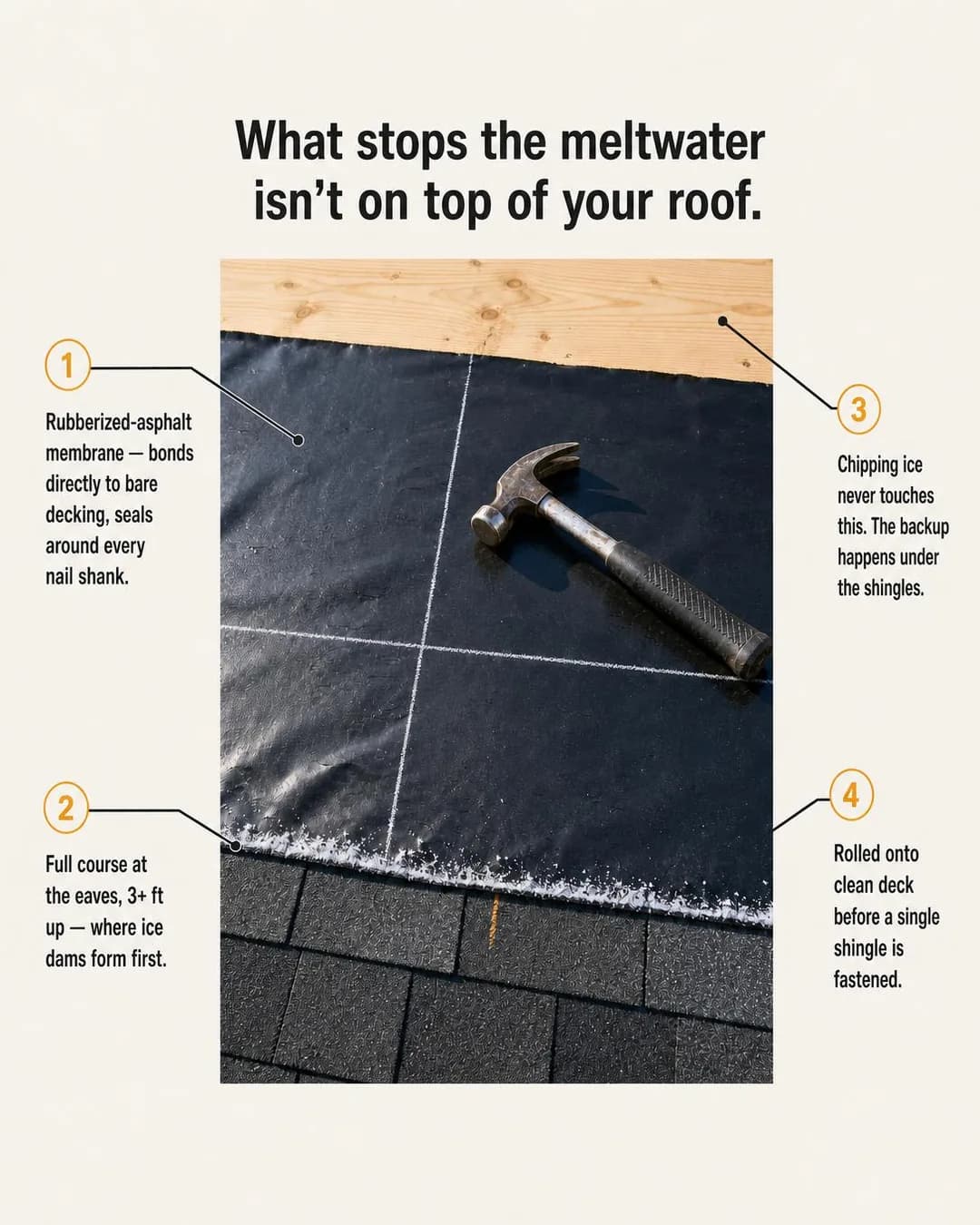
The hammer didn't fail you. What's under your shingles did. Ice dams don't leak through your shingles — they back meltwater up onto the deck, where there's nothing to stop it. Rubberized-asphalt membrane bonds directly to bare wood and seals tight around every nail shank driven through it. That's what keeps February out of your bedroom ceiling.
What's Under Your Shingles Matters
Fixed-price estimates. See how.
This ad is the batch's cleanest experimental result and it took one clause to get. The Facebook batch briefed the same material — a self-adhering ice-and-water membrane — with no seller attached, and the pipeline invented a membrane manufacturer, so the ad ended on "ask your roofer" and sent a roofer's own click to a competitor. This brief added eleven words: the company selling and installing the work, not the company that makes the material. The invented business came back as "a residential roofing contractor for cold-climate neighborhoods", and the copy says "Most roofers never show you what's under the shingles. We photograph it on every job." Name the advertiser's role, not just the thing being advertised.
The count check passes in the way that is now predictable: four numbered callouts were asked for and exactly four render, 1 through 4, because a count set as typography is reliable in this pipeline while a count drawn as a quantity of objects is not. The domain vocabulary is right too — a full course at the eaves at least three feet up, both sides of every valley, sealing around a nail shank — and the frost crystals along the membrane's lower edge are a nice touch nobody asked for. The hammer lying on the membrane is a callback to the audience brief, which described chipping ice off a gutter with one.
One real defect: callout 3 says "Chipping ice never touches this. The backup happens under the shingles", and its leader line lands on the bare lumber at the top of the frame rather than on the membrane or the shingle course. The label is correct and pointed at the wrong thing, which is the same class of error as the one-row table offsets the Facebook batch found — the text is right, the registration is wrong, and it is invisible unless you trace each line to its target. The "1,900+ roofs since 2009" is invented, and it is one of three figures on this page that a second invented contractor also claims.
Other headlines from the same run
- The Membrane Ice Dams Can't Beat
- Standard on Every Job. Not an Upsell.
- Retire the Hammer for Good
- The Deck Gets Protected First
Call to action
Traffic is right for a component most homeowners have never heard of, and the landing page has to explain an ice dam before it can sell a membrane. Because this brand's whole positioning is that every estimate itemises the membrane, the page should show a redacted estimate with that line on it.
Same Spot, Same Hour
LeadsSame yard. Same hour. Eleven days apart. Nothing else.
- Audience
- Homeowners who have been shown a before-and-after and could not tell what it proved — Sat through three sales presentations with a folder of glossy pairs in them, noticed the sun was in a different place in every 'after', and stopped believing any of them.
- Angle
- Before / After (Proof & Trust) — Contrasts the state before adoption with the state after adoption.
You've seen the glossy before-and-afters. Different sun angle in every 'after.' You noticed. So did we. Every roof we replace gets photographed from one GPS-staked position in the yard — before tear-off and again at completion, same morning hour, date printed in the corner. Not retouched. Not staged. 600-plus pairs in the archive, all identical framing. If the proof doesn't hold up to scrutiny, it isn't proof.
Same Spot. Same Hour. See the Difference.
Fixed-point docs on every job.
This is the ad the page exists for, and it is the best answer this cluster has produced to a question it set itself. Before-and-after is roofing's native format and the Facebook batch withheld it deliberately; the open question was whether a generated pair would prove anything. Briefed with the camera position, the hour and the light pinned — same spot in the yard, same morning hour, nothing else changed — it came back genuinely matched. The roof geometry, the gable, the tree and the valley register between frames. The timestamps read 2024-05-06 07:42 and 2024-05-17 07:41: eleven days apart to the day and one minute apart in the hour, agreeing exactly with a headline that says ELEVEN DAYS. That arithmetic is the entire evidentiary content of a before-and-after and the pipeline got it right.
And then the thing the brief did not pin drifted, in both directions at once. Only the front plane was re-roofed — the adjoining slope across the valley is the same weathered brown in the second frame as in the first — while the fascia, the gutter and the rake trim were all replaced without being asked for. So the picture shows a house whose roof is half new and whose trim changed, under copy that says "Nothing else changed except the roof." The rule is the useful part and it generalises past roofing: pinning the vantage is necessary and not sufficient. Pin the scope as tightly as you pin the camera, or the one claim a before-and-after exists to make is the one it cannot support.
Before it runs: "600 Pairs. GPS-Staked. Unretouched." is invented, and it is the load-bearing claim of an ad about documentation, so a contractor with a real photo library should put the true count there and one without should describe the practice instead. The timestamps say 2024 in a run made in September 2026, which is the year-anchor drift this pipeline shows on every rendered document. And the copy is unusually self-aware in a way worth keeping — "You've seen the glossy before-and-afters. Different sun angle in every 'after.' You noticed. So did we." That is the strongest sentence on the page, and it is only earned if your own pairs actually hold.
Other headlines from the same run
- 600 Pairs. GPS-Staked. Unretouched.
- The Timestamps Don't Lie.
- Proof That Holds Up to Scrutiny.
- Before the Shingle. After the Work.
Call to action
A five-figure replacement does not convert from a feed, so this is a lead whatever the button says. Send it to the full documented pair set rather than a quote form — an ad whose promise is fixed-point photography should be able to show a second pair on the next screen.
Five Years Left Lie
Traffic"Five years left" is the oldest line in roofing.
- Audience
- Homeowners who have decided to wait until it leaks — Were told the roof had five years left by someone who wanted the job, and have settled on doing nothing at all until water actually shows up inside the house.
- Angle
- Myth Busting (Comparison & Positioning) — Challenges and disproves a common belief in the category.
"Five years left" is the oldest line in roofing — and it usually came from someone who wanted the job. Here's the thing: you don't need a salesman's guess. You need four questions you can answer from your own driveway. We publish the exact checklist our inspectors use. Score two or more yeses, and it's time for a real set of eyes. Score less, we'll tell you that too — we turn away about one in five callers with the honest news that their roof has years left.
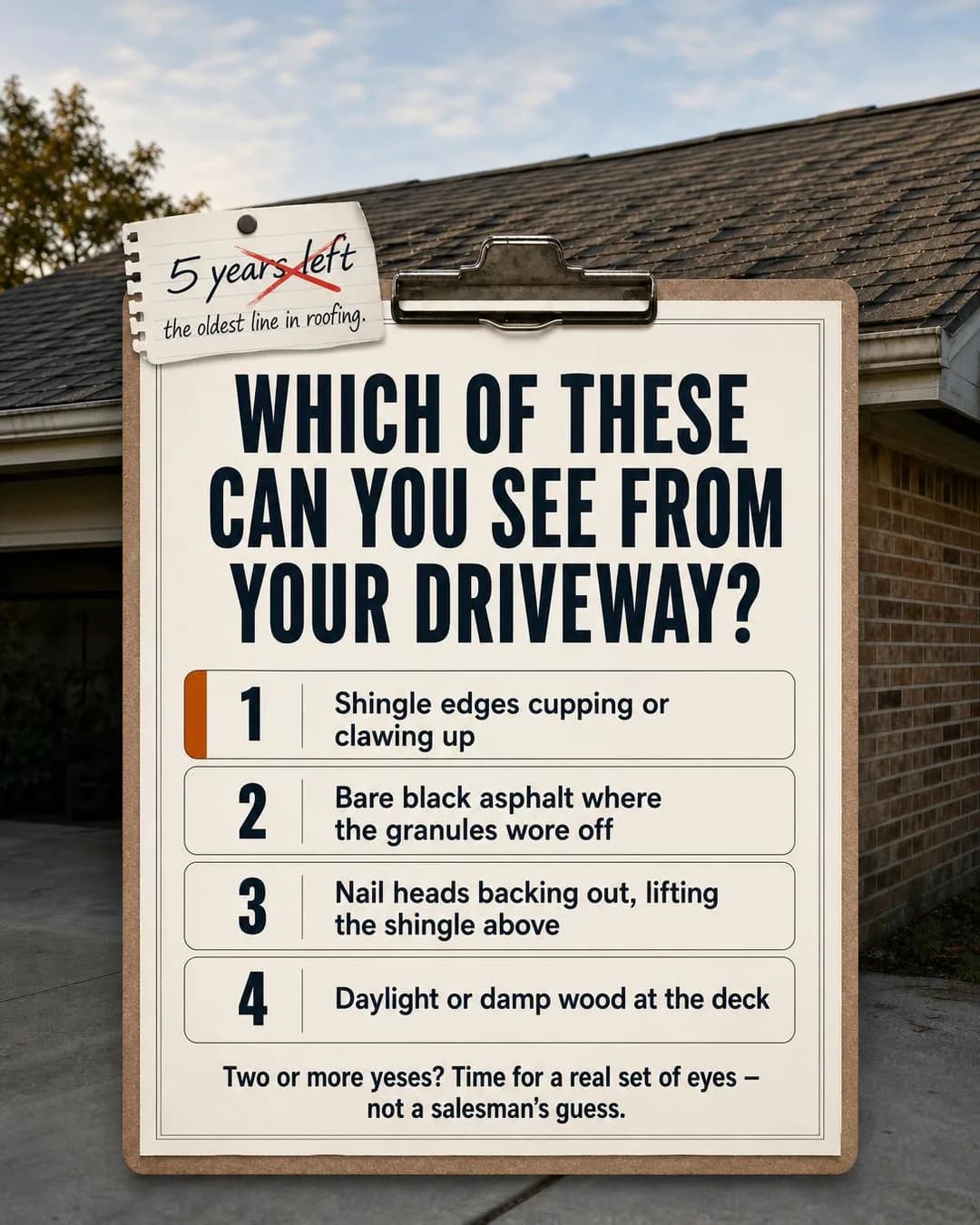
The 4-Question Roof Truth Test
Free visit. Fixed quote. No pressure.
Myth Busting against the most expensive belief in the category — that a roof is fine until it leaks — and the execution is a four-question self-scored check rather than a scare. The four signs are correct and correctly ordered by how early they show: cupped or clawed edges, granule loss exposing black asphalt, nail heads backing out and lifting the course above, and daylight or damp sheathing at the deck. The sticky note reading "5 years left" with a red cross through it answers the audience brief directly, which described being told exactly that by somebody who wanted the job.
The brief explicitly forbade pre-marking an answer — no answer marked, circled, ticked, highlighted or otherwise indicated — because the HVAC Instagram quiz had pre-marked its own. Option 1 came back with an orange accent bar down its left edge that the other three rows do not have. The model used none of the markers on the list and reached for one that was not on it. That is the batch's clearest small lesson and it generalises: prohibiting by enumeration invites the item you did not enumerate. Specify the positive invariant instead — all four rows identical in styling — because a positive requirement is the kind of instruction this pipeline reliably follows.
There is also a logical fault worth catching before this runs, and it is in both artefacts. The headline asks which of these you can see from your driveway, and the fourth option is daylight or damp wood at the deck, which you cannot see from a driveway — it is an attic-interior observation. The copy doubles down: "all visible without a ladder." Either cut the fourth item or change the frame to "from the ground and the attic". The "4,100 Roofs. Zero Scare Tactics." headline is invented, and 4,100 is claimed by a second invented contractor elsewhere on this page.
Other headlines from the same run
- Stop Guessing. Start Counting.
- Your Driveway Knows the Answer
- That Estimate Was a Sales Pitch
- 4,100 Roofs. Zero Scare Tactics.
Call to action
Traffic while the reader is still self-diagnosing. The landing page should be the same four questions with a photograph of each sign, so the click delivers the thing the ad started rather than switching to a form.
The Card of Nevers
LeadsYou've heard 'free roof' twice this week. We will never say it.
- Audience
- Homeowners who have been offered a free roof by someone at the door — Had a stranger knock the week after the storm, were told the deductible would be handled and the roof would cost them nothing, and want to know what a contractor is actually allowed to do on a claim.
- Angle
- Objection Handling (Objection & Risk Reversal) — Starts with a purchase objection and directly resolves it.
You've heard 'free roof' twice this week. In several states, the contractor who said it committed a crime. We put what we will never do in writing — before the inspection starts. The card is yours either way.
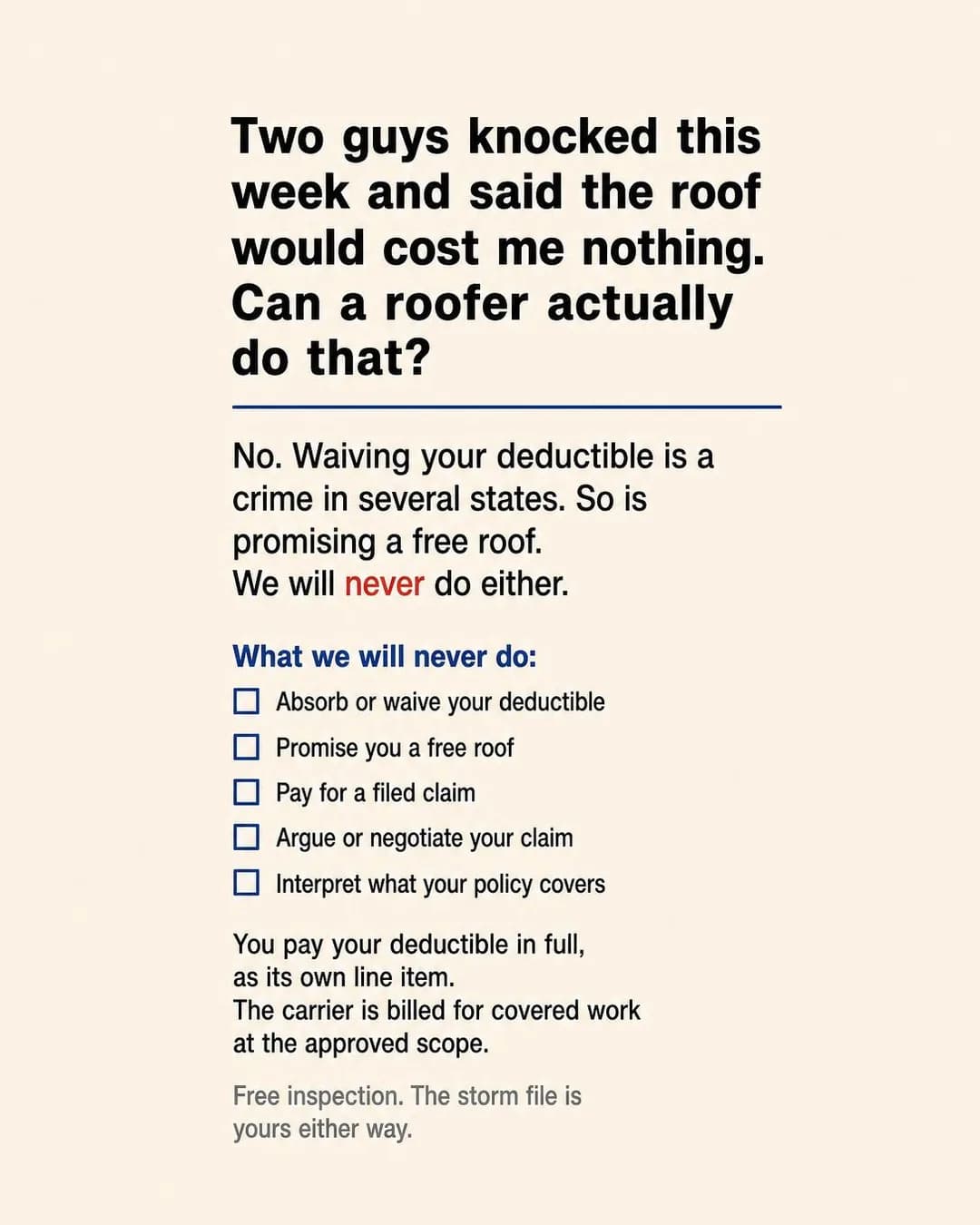
We Will Never Say 'Free Roof'
Free inspection. File is yours.
This is the most valuable ad in the cluster, because it closes a loop the Facebook page opened a day earlier. That page briefed the insurance ad neutrally to see what the model would reach for; it attacked deductible waiving forcefully and by name, and then walked straight into the prohibition almost nobody in the trade has heard of — promising to file supplements, stating what the carrier covers, signing off "Your deductible. We handle the rest." The page diagnosed it and prescribed a four-word fix: document, meet, invoice, never negotiate.
This brief wrote that boundary in, and the fix holds across every artefact. The rendered card lists what the contractor will never do and both statutory violations are on it — "Argue or negotiate your claim" and "Interpret what your policy covers" — alongside absorbing or waiving the deductible. All five primary texts stay inside the line, and the fifth states it outright: "never waive your deductible, never promise a free roof, never negotiate your claim. What we will do: inspect, document, build to scope." Eleven artefacts, no breach. One brief variable flipped the compliance outcome, which is the same shape as the Regulation Z finding on the HVAC pair: the disclosure is a property of the brief, not of the model — and this is the first time this cluster has shown that working in the prescriptive direction rather than the failing one.
Two things before it runs. The checkboxes are empty squares beside a list of things the company will never do, which is ambiguous visual grammar — an unticked box next to "Promise you a free roof" can read as a service list nobody has ticked yet. Make them crosses, or drop the boxes. And "4,100+ storm files opened since 2016" is invented, on the one ad on the page where an invented number does the most damage, because the whole argument is that this contractor is the one telling you the truth about numbers.
Other headlines from the same run
- The Refusal List Is the Proof
- Honest Storm Roofing. In Writing.
- What a Roofer Can Actually Do
- Your Deductible Is a Line Item
Call to action
Pinned to Leads, and the landing page carries a legal burden the ad cannot discharge alone — it is where the deductible explanation has to be exactly right for your state. Avoid any button or page wording that implies you will handle the claim, which is the phrasing the statutes reach.
The Sticker and the Truth
Traffic$27,375 is the sticker. $3.00 a day is the truth.
- Audience
- Homeowners comparing a roof against everything else that number could buy — Have a five-figure written quote on the counter next to a kitchen estimate and a used-car listing, and are judging all three by the sticker rather than by how long each one lasts.
- Angle
- Cost Per Day / Use (Offer & Economics) — Breaks a large price into a smaller daily, monthly, or per-use amount.
$27,375 is the sticker. $3.00 a day is the truth. Most buyers compare the kitchen quote, the car listing, and the roof estimate by the top number. Nobody hands you the denominator. Divide $27,375 across a 25-year system and you get 9,125 days at three dollars. One fixed price. Nothing added after you sign.
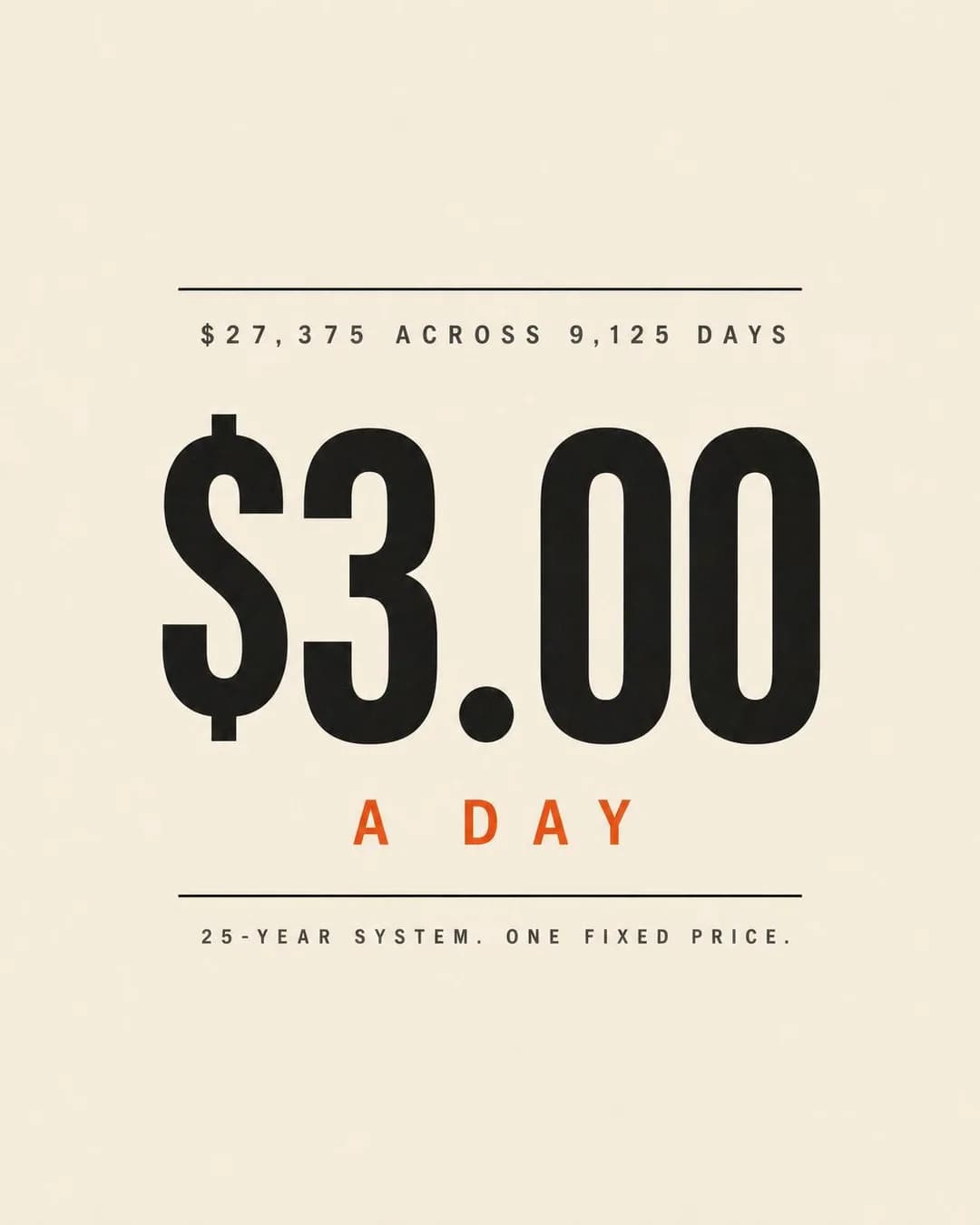
$3.00 a Day. 25-Year Roof.
One page. One number. Done.
Cost Per Day is the right frame for a purchase the reader is comparing against a kitchen and a used car by sticker alone, and the ad's whole job is to supply the denominator nobody hands them. The arithmetic was written into the brief and rendered exactly: $27,375 across a 25-year system is 9,125 days at $3.00, and 9,125 × 3 is 27,375 to the cent. All four figures are set as typography rather than drawn as objects, which is the condition under which this pipeline is reliable with numbers, and the same arithmetic is restated correctly in the copy — "$27,375 ÷ 9,125 days = $3.00".
This ad was also the batch's Regulation Z sweep, and it is the negative result that matters. The HVAC Instagram batch found that a credit line turns up in ads that were never briefed for one, so this batch contains no financing brief at all, and this brief deliberately invited the payment frame while forbidding credit. Nothing came back. No monthly payment, no APR, no installments, no deferred terms anywhere in fifty headlines and fifty primary texts. The ad instead says "Paid in full when the crew finishes. No deposits, no surprises." Because there is no credit offer here, 12 CFR 1026.24's triggering terms have no credit advertisement to attach to — which makes this the cleanest way to run a price ad in a trade where most competitors are quoting a monthly number with no rate on it.
Two headlines fit Facebook's 27-character recommendation, which almost nothing in this corpus does: "$3.00 a Day. 25-Year Roof." at 26 and "Divide Before You Decide" at 24. Worth noting against the fashion page's rule that 27 characters is room for a noun and not a claim — half of this batch's short headlines are claims, so that rule does not hold cleanly here. The "2,300+ tear-offs since 2009" is invented, and if you run this ad the figure to get right is not that one but the 25 years: a cost-per-day argument is only honest if the system genuinely carries that rating, and quoting a warranty term you do not hold turns the strongest ad on the page into the most exposed one.
Other headlines from the same run
- The Math Nobody Prints for You
- One Price. 9,125 Days of Roof.
- Divide Before You Decide
- Fixed Quote. No Surprises. Ever.
Call to action
Traffic, because the reader is mid-comparison and the click has to finish the argument. Send it to a page that shows the same division with your real numbers; a landing page that opens on "financing available" contradicts the ad and drags a Regulation Z problem in behind it.
Crew Slots Fill Fast
LeadsStorm nights, our crews book out. Yours could be next.
- Audience
- Homeowners who have already lost shingles once and saved the number — Watched a gust front take a strip off the back slope last year, waited four days for anyone to come out, and put a roofer's number in their phone that night.
- Angle
- FOMO / Scarcity (Scarcity, FOMO & Timing) — Broadly frames the opportunity as something the buyer may miss.
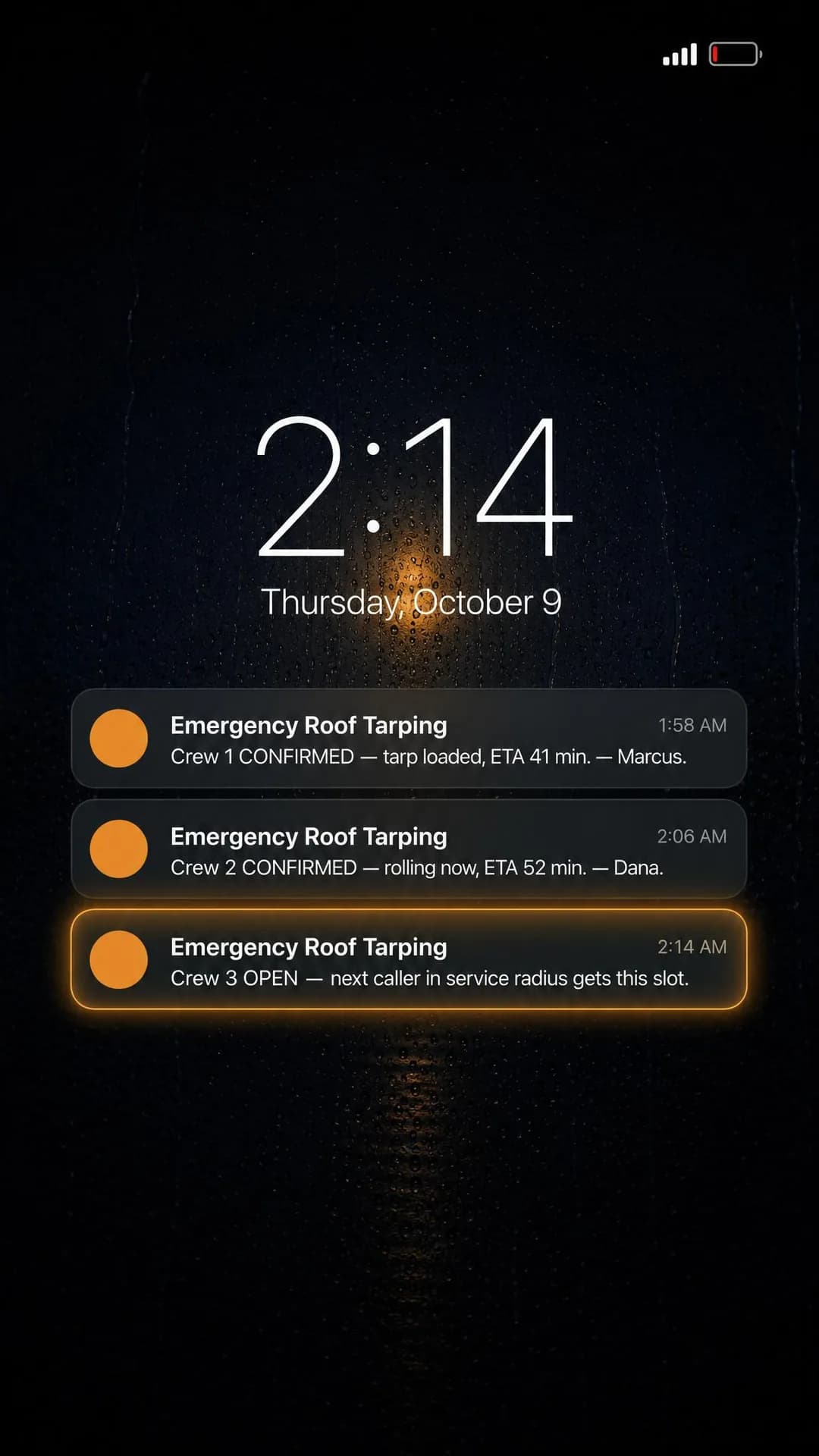
Two crews confirmed tonight. One slot still open. The next caller in the service radius gets it — then the board is full. We run a live dispatch line from 8 p.m. to 6 a.m. every night of storm season. Crews roll in order of call. Median time from confirmation to wheels moving: 41 minutes. Flat $285. Nothing due at the door. Tarp stays up to 45 days.
One Crew Slot Left Tonight
Live dispatch. Flat $285.
This is the ad that failed its brief in the most instructive way, and it is the reason this page argues what it argues. The brief asked for a storm-night lock screen with a generic severe-thunderstorm warning and a dispatch message confirming a crew and a tarp — and said, in terms, no countdown and no scare copy. What came back has no weather alert at all, and instead three dispatch notifications: Crew 1 confirmed, Crew 2 confirmed, and a glowing "Crew 3 OPEN — next caller in service radius gets this slot." That is a last-slot countdown, which is precisely what the brief forbade. Every one of the five headlines is a scarcity headline, and the copy adds "watch the ceiling stain spread."
The cause is not disobedience, it is contradiction. The brief pinned the sub-angle to FOMO / Scarcity and then asked for no countdown, which is two incompatible instructions, and the taxonomy is by far the stronger signal — it is the thing the concept stage is actually built to execute. A prohibition cannot defuse the sub-angle the same brief pinned. If you do not want a countdown, do not buy a scarcity angle; brief this as Speed or as Availability and the ad writes itself without the pressure. That is the batch's most transferable finding and it applies to anyone briefing this tool in any trade.
The other failure is the speaker rule at one remove. The brief named the sender as "the dispatcher on duty" — a role, not a name, and it never said a name may not be invented, so the pipeline invented two, Marcus and Dana, and the copy then sold the practice as a feature: a dispatcher who "tells you the crew name, tarp status, and ETA in writing — signed with their own name." Compare the founder's card at the foot of this page, which was told to sign as the owner rather than by a name and did exactly that. Also check the date: the lock screen reads "Thursday, October 9", which is a valid pair for 2025 and wrong for 2026, when 9 October is a Friday. When a rendered date carries no year, the weekday is what exposes the drift. And read this one against Meta's crisis standard before running it: tarping offered to people with an open roof is the defensible side of that line, and a scarcity construction that makes the storm the urgency engine is not.
Other headlines from the same run
- The Next Caller Gets This Crew
- 41 Minutes. One Slot Open.
- Storm Nights Fill Fast. Call First.
- Your Slot Won't Wait Till Morning
Call to action
Emergency work converts on a phone call, and call ads are mobile-only — judge this on 60-second calls rather than clicks. But do not run this creative as it stands: the scarcity framing is the problem, and the fix is a different sub-angle rather than a different button.
The Family Voted Kitchen
TrafficThe family voted kitchen. You voted ice-and-water membrane.
- Audience
- People who spent the renovation money on the roof — Had one budget and two quotes, chose the one nobody who visits will ever see, and have been explaining that decision to their family ever since.
- Angle
- Security / Protection (Identity & Emotion) — Emphasizes protecting family, money, property, data, health, time, or peace of mind.
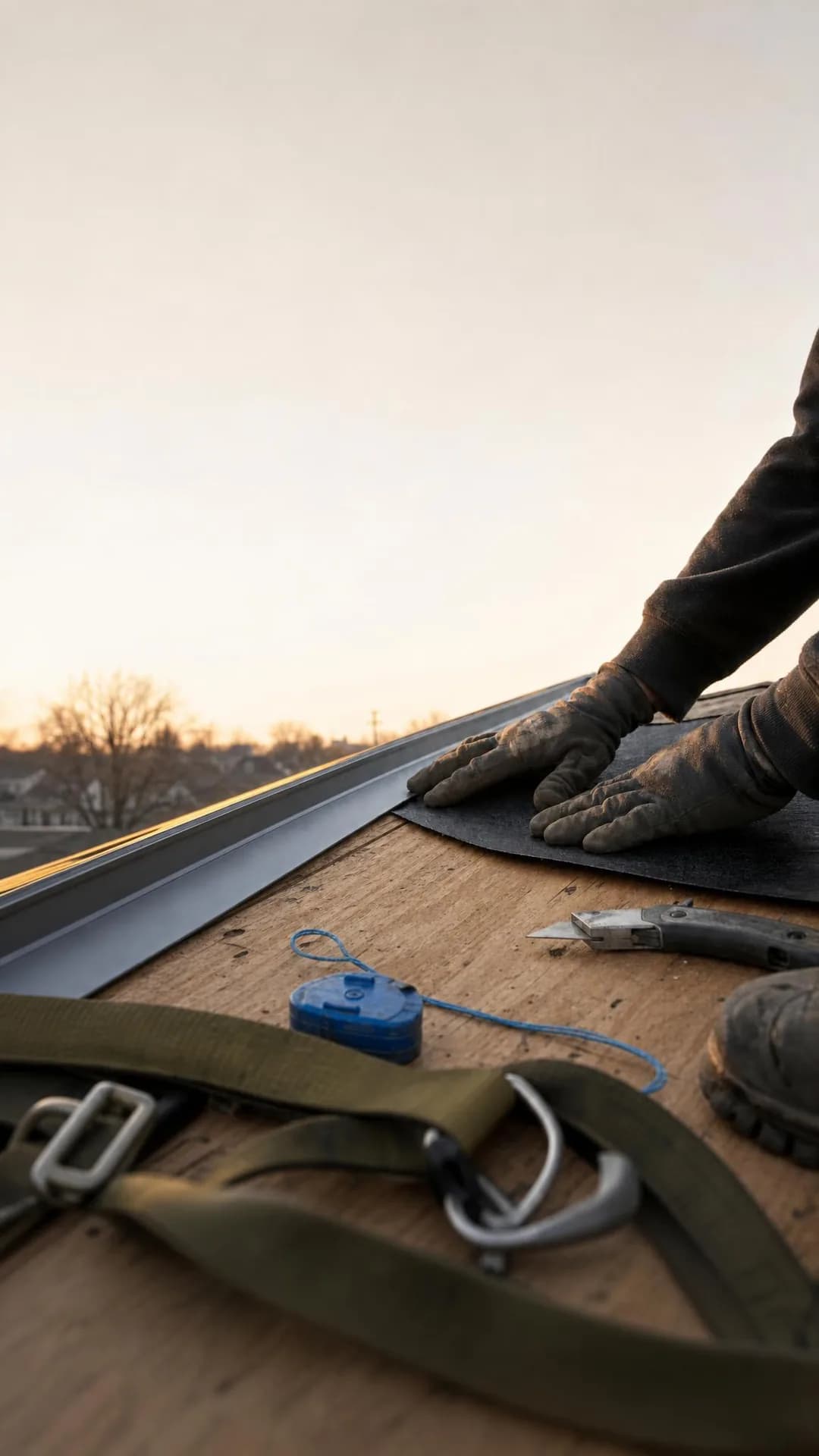
The family voted kitchen. You voted ice-and-water membrane. Six feet of self-adhering membrane at the eave, sealed before the first shingle goes down. That's where ice dams start. That's where we start. Every job, every time, since 2004. Over 3,100 full tear-off reroofs in the Twin Cities. Fixed-price quote from a joint attic-and-roof inspection. 15-year transferable workmanship warranty.
The Roof Nobody Argued About
Fixed price. 15-yr warranty.
The identity rule holds here because the audience was defined by a decision — people who spent the renovation money on the roof — rather than by an attribute, which is the closed rule from the Facebook batch. The copy is second person and frankly emotional ("The family voted kitchen. You voted ice-and-water membrane", "Nobody's going to compliment your eave detail at Thanksgiving") while every sentence names a choice the reader made or a thing they own. No homeowner appears in the frame, as the brief specified, and the ad is genuinely about the pleasure of an invisible decision.
It is also the ad with the most serious real-world problem on the page, and it is a problem of state rather than of object. The brief asked for a crew harnessed and tied off to a ridge anchor. The harness is in the picture — green webbing and a carabiner lying on the deck in the foreground — and nobody is wearing it, while a roofer works on his hands on the sheathing beside it. The equipment rendered; the practice did not. That is the same mechanism as the empty proof slot and the invented name: the brief named a noun and got the noun, and never named the state the noun was supposed to be in. In a trade governed by fall-protection rules, an ad showing an unharnessed roofer is not a detail, and the copy does not flag it either, because the copy describes what is actually in the frame — "the eave detail going in at first light, membrane pressed tight, drip edge set, chalk line ready" — and inherits the omission.
The rest of the domain detail is good: a blue chalk-line reel, a hook-blade utility knife, rake metal along the edge, bare OSB decking. Two things to change before running. The brief asked for a sealed starter course at the eave and what is shown is underlayment near the rake, so the copy's "starter course fastened" is not what the picture supports. And "Over 3,100 full tear-off reroofs" is invented and shares its number with a different invented contractor at the top of this page.
Other headlines from the same run
- Six Feet That Stop Ice Dams Cold
- Built Right Where It Fails First
- The Decision Winter Keeps Proving
- What Protects the House Stays Hidden
Call to action
Traffic is right for an ad whose argument is a detail most readers cannot evaluate yet. Send it to a page that photographs the eave detail on real jobs — and if you use crew photography at all, make the fall protection visibly worn, because that page will be read by people deciding whether you are the careful one.
The Three-Week Confession
AwarenessThe week after a hailstorm, I am three weeks out.
- Audience
- Homeowners who let a door-knocker onto the roof and regretted it — Signed something on a clipboard the week after a storm because the roof was already being walked on, and spent the next four months trying to get the same crew to come back.
- Angle
- Founder Confession (Story & Founder POV) — Opens with an honest admission, uncomfortable truth, or counterintuitive realization.
I have never knocked on a door. Not once, in sixteen storm seasons. The crews that showed up on your street the day after the hail came from out of state. Mine live here. They work through winter. They were busy that week because they were finishing the job before yours. If you signed something on a clipboard before you knew who you were signing with, I understand why. Call before the next storm. Free inspection, written estimate, no deposit until materials are staged. — the owner
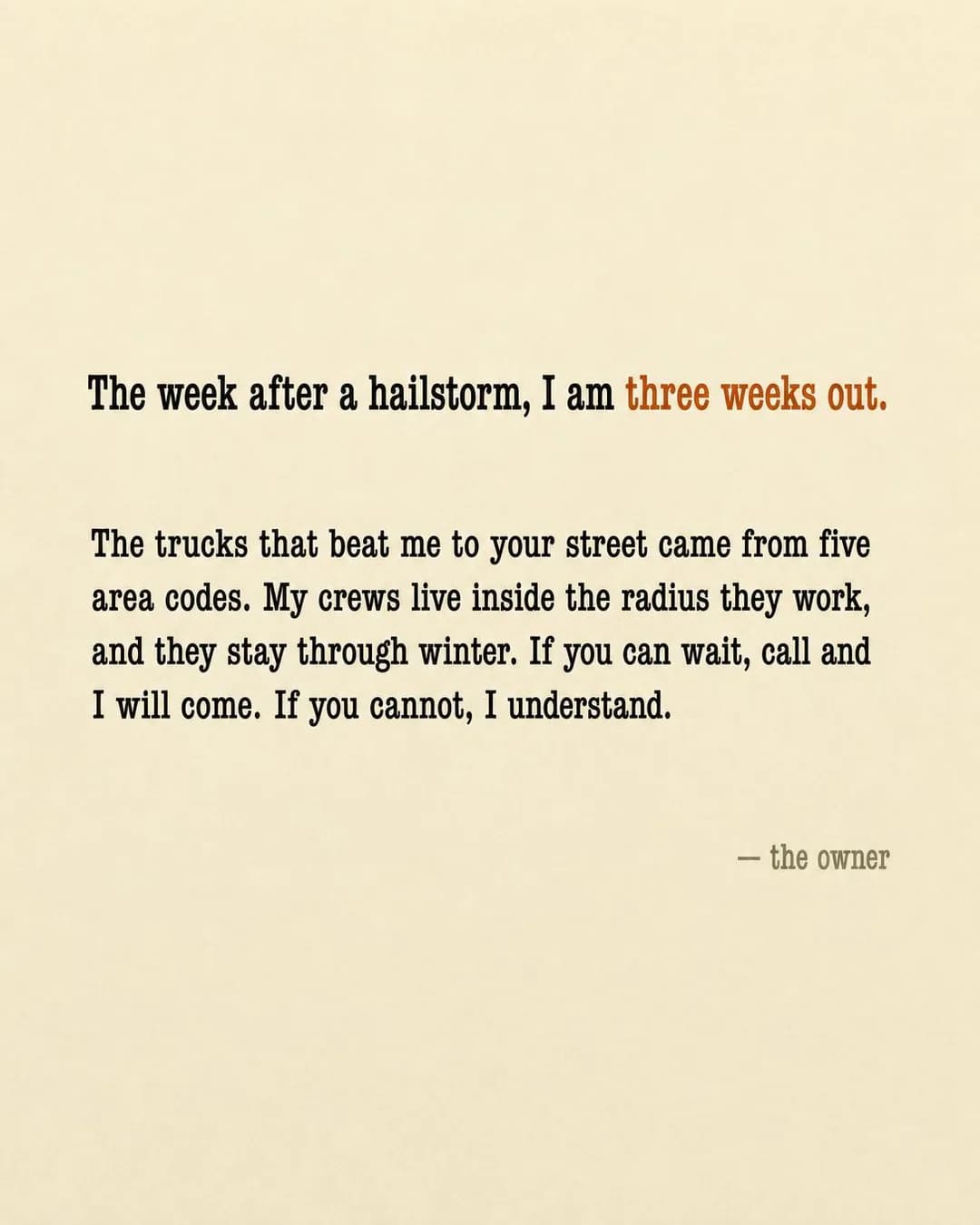
Three Weeks Honest. One Crew. Done.
Call first. No deposit up front.
Founder Confession is the hardest family to run honestly and this is the strongest execution the cluster has produced, because the confession costs the advertiser something real. The card admits the company is three weeks out in the week after a hailstorm, that the trucks which beat it to the street came from five area codes, and that crews who live inside the radius they work are why it is slower. Then it declines to close: "If you can wait, call and I will come. If you cannot, I understand." An Awareness ad that gives the reader permission to hire someone else is a much better advert than one that does not, and it is the only ad here a storm-chasing competitor cannot copy.
The speaker rule passes exactly, and the contrast inside this batch is what makes it a rule rather than an anecdote. The brief said the statement should be signed as the owner rather than by a name, and the card signs "— the owner": no invented person, no face, no biography. The storm-night ad three places up named a role without forbidding a name and got Marcus and Dana. Same batch, same pipeline, two author-implying directions, one variable different. This pipeline will invent a proper name unless the brief forbids one — which is a sharper and more usable instruction than the corpus's previous version, name the speaker.
The image carries no fabricated statistic at all, which is the proof-slot rule replicating for the fourth time in this batch: a solid-colour quote card has nowhere to put a tally, so none appears. "Five area codes" in the body is invented but it is the kind of concrete a real owner could simply count. The one thing to verify before running this is the claim itself — that every job came from someone who called first. It is the entire ad, it is checkable by any customer who asks, and it is worthless the first week you buy a lead list.
Other headlines from the same run
- I Don't Knock. I Don't Rush.
- The Crew That Comes Back
- 16 Seasons. Zero Door-Knocks.
- Worth the Wait. Free Estimate.
Call to action
The one Awareness buy, and the right objective for it: this ad's job is to be the name a household remembers three days after a hailstorm when somebody unfamiliar is at the door. Do not judge it on the week's leads — judge it on whether the calls that arrive in month two mention having seen it.
Questions
- Do Instagram ads work for roofing companies?
- They work, but this is the trade with the worst platform mismatch in this set and it is worth knowing that before you budget. Pew puts Instagram at 40% of 50- to 64-year-olds and 19% of over-65s against Facebook's 74% and 57%, and the household living under a twenty-year-old roof is usually the household that has been there twenty years. So Instagram reaches fewer of the same buyer rather than a different one. What it gives you in exchange is the format: before-and-after is this trade's native creative and this is the app built for it, and a roof is one of the few home systems where the work is genuinely photogenic.
- Does running ads on Instagram change what I'm allowed to say?
- No, and this is the most expensive misunderstanding in the trade. The rules that bind a roofing advertiser are mostly not Meta's — they are state statutes, and they attach to what the advertisement says rather than to the app that rendered it. Texas Business and Commerce Code § 27.02(c) makes advertising a deductible waiver a Class B misdemeanour; Texas Insurance Code § 4102.163(a) forbids a contractor to act as a public adjuster or advertise to adjust claims on property they are working on; Minnesota Statutes § 325E.66 subd. 1 covers both and lets the homeowner and the insurer sue. None of that softens on Instagram, and Meta will approve the ads that break it here exactly as it does on Facebook.
- What actually works as a before-and-after?
- One thing, and it is not the roof: proof that both frames are the same roof. Pin the camera position, the hour and the light, and print the date on each frame — an ad on this page does exactly that, eleven days apart at 07:42 and 07:41 from one staked spot in the yard, and it is convincing because of the registration rather than the roof. Then pin the scope, which is the mistake we made: our own brief specified the vantage and forgot to say the whole roof, so the second frame shows a re-roofed front plane, an untouched slope across the valley, and new gutters nobody asked about, under copy claiming nothing else changed. A slider that changes the weather, the time of day or the camera height proves nothing at all.
- Can I advertise emergency tarping after a storm?
- Yes, and carefully. Meta's advertising standards prohibit content that exploits crises or controversial events for commercial purposes and name natural disasters as an example. Offering tarping to people whose roofs are open is a service and is the defensible side of that line; building the creative around the named event, a news photograph or a countdown moves it. The storm ad on this page is the cautionary one — it was briefed with no countdown and no scare copy and came back with a last-slot countdown anyway, because the brief also pinned a scarcity angle. If you do not want urgency mechanics in a storm ad, do not buy a scarcity angle; brief it as speed or availability instead.
- How do I stop the generator inventing statistics about my company?
- Put the real number in the brief. Where a visual direction offers a slot for a figure the pipeline fills it, and where the brief supplies nothing it invents something plausible — this batch has six ads carrying an invented credential count, and three of those numbers each turn up twice on this page under two different invented companies. Choosing a direction with no proof slot also works: none of the ten images here renders a fabricated statistic, because a quiz, a quote card, a raw phone photograph and a lock screen have nowhere to put one. The invention lives in the copy, which is easier to check before it runs.
- What size should a roofing Instagram ad be?
- Render 4:5 at 1440 × 1800 — Meta's recommendation for Instagram Feed, identical to Facebook Feed, so one export serves both. Two differences matter. The aspect-ratio tolerance is 1% here against Facebook's 3%, so a crop a few pixels out of true passes there and fails here. And the headline recommendation is about 40 characters against Facebook's 27, which is the opposite of what most people assume — the app everyone treats as the wordy one is the more generous. Reserve 9:16 for Stories and Reels; three ads on this page are 9:16, and one of them shows the padding you can get when a photograph is re-framed off a square draft.
- Were any of these ads regenerated or edited?
- One was re-run from an identical brief after the image API returned a 500 at the final re-framing step — a transient upstream error, not a judgement about the result. Nothing was regenerated because we disliked what came back, and nothing was retouched. That is why this page can tell you that our storm ad broke its own brief, that our before-and-after only re-roofed half the house, that the quiz highlighted an answer it was told not to highlight, and that the crew photograph shows a harness lying on the deck instead of worn. A page of examples that quietly fixed those would be a worse page and a dishonest advert for the tool that made them.
Seen enough? Make your own.
Paste your site. It reads your services, your storm and insurance page, your certifications and your service area, then writes the concepts, renders the images and drafts the copy — for the one trade in this set whose binding rules are not Meta's but your state's.
No credit card · 50 free credits (about 5 ads or Instagram posts)
Every angle used above is documented in the best-in-slot ad angle library. More industries and placements are at all ad examples.