
Ad Generator · Roofing
Facebook & Instagram ad generator for roofing companies
Paste your site. It reads your services, your storm and insurance page, your certifications and your service area, then writes the concepts, renders the images and drafts the copy — for the one trade in this set whose binding rules are not Meta's but your state's.
Enter your roofing company's website
That is the whole brief. No questionnaire, no uploads, no brand kit to fill in. Free to start, no card — and every ad lands paused, which in this trade is where the insurance sentence gets read against your own state's statute.
No credit card · 50 free credits (about 5 ads or Instagram posts)
What it takes off a roofing company's website
- Your storm and insurance page, first and most carefully, because it is the most consequential page on a roofing site and the one most likely to contain something you cannot lawfully advertise. If it says you will cover, waive or absorb the deductible, or that you handle, file, negotiate or fight the claim, the generator will write ads from it — and in several states those are the exact sentences the statutes name. See the caution. This is the one page on your site worth re-reading before you paste the URL rather than after.
- Your services list, and which end of it you lead with. A roofer sells a $340 emergency tarp and a five-figure tear-off out of the same office, and one free-inspection ad pointed at everybody collects the cheapest possible lead — somebody who wanted a free thing. The page tells the generator which jobs your crews are actually short of.
- Your service area, as you write it — the towns, the counties, the ZIPs, the “we don't cross the river” line. Roofing is the one trade in this set where the postcode is the whole plan rather than a refinement of it, because hail falls in a swath a few miles wide. One of the offers below quietly takes your ability to name those postcodes; its row says so.
- Your certifications, and whether they are the manufacturer's or your own. A manufacturer-issued system warranty exists because the crew installed that manufacturer's full specified system; a contractor-issued one is worth whatever the contractor is worth in year six. That distinction is the strongest argument in the trade and the generator can only make it if your site actually names the certification — and it is the one claim on this page that collapses entirely if it is aspirational.
- Your financing page: the partner, the term, the monthly, and whether the annual percentage rate appears anywhere on it. A page that states a payment and no rate is the shape Regulation Z was written about, and it is also the campaign that loses you ZIP targeting. Both halves are in the caution.
- Your emergency and after-hours block. Whether you publish an arrival window, whether a call at eight in the evening reaches a human, whether there is a call-out fee. That decides whether it writes a phone ad at all — and note that a roofing emergency call is not an HVAC one: it comes in at dusk from somebody looking at bare deck with rain forecast overnight.
- The proof a homeowner can check without taking your word for it: whether you pull permits and hand over the inspection card, whether crews are on your payroll with workers' compensation or subcontracted by the day, how long the business has been at the address. This trade's advertising is full of invented statistics, which is exactly why the checkable kind wins — and why the generator inventing one is the failure named below.
- Your photographs, colours and type — and one thing worth adding before you run this. The finished-roof drone shot is the least useful picture in your library, because every finished asphalt roof looks like every other one. The bare deck with the rot cut out and the sheathing chalked is the picture that proves something. Put those on the site and the generator will use them.
What one click gives you
A concept pinned to one job at one moment
A tarp going on tonight, a flat-fee inspection on a street that was hailed two summers ago, and a tear-off quote against a layover are three ads to three people who are not thinking about the same thing, and the generator writes one per brief rather than blending them. The blended version — “repairs, replacements, storm damage, gutters, free estimates” — is the ad every roofer in your market is already running.
A finished image, and in this trade the good ones are documents
Rendered in your brand's colours and type. What works in roofing is evidence rather than a beautiful roof: an itemised estimate, a nailing diagram, a comparison chart with a forensic inset of the deck, a burned-in timestamp on a night photograph. One caveat worth knowing before you brief it, because this batch produced the cleanest evidence for it in the corpus: this pipeline renders a count correctly when the count is typography and incorrectly when the count is a number of drawn objects. If a number is the argument, put it in the headline and let the picture carry the mechanism.
All four Meta shapes
The same image re-framed for 4:5 feed, 9:16 Stories and Reels, and the 1.91:1 asset that routes to Facebook's right-hand column and search results — surfaces with no Instagram equivalent at all. Facebook has nine image placements to Instagram's four and their recommendations disagree, so the portrait is composed to survive a square crop. Reserve the wide slot for drawings: every re-frame in this cluster that came back padded has been a photograph, and a diagram has nothing in its margins to lose.
Five headlines, five body texts, a description
One run, so you are choosing between versions of the same argument rather than between five arguments. Worth knowing before you pick: across seven Facebook batches published here, 23 of 350 headlines fit Facebook Feed's recommended 27 characters and 329 fit Marketplace's 40, and not one of the 350 body texts fits the recommended 150 — they run 200 to 708 characters. Twenty-seven characters is room for a noun, not for a claim.
Published paused, into an ad set you pick
It never creates campaigns or ad sets, never edits your existing ads, and never spends. In this trade the pause is where the insurance sentence gets read against your own state's law, every rendered number gets checked against your own job records, and the financing ad gets moved into its own declared campaign.
The step-by-step path swaps the one click for choosing the audience, the angle, the concept and the image style from a gallery of 66 — same output, more decisions.
What it made for four roofing companies that do not exist
Generated by best-in-slot. Published exactly as they came back — nothing retouched, every flaw named on the page they came from. Four pieces of paper rather than four drone shots of a finished roof: a night photograph whose burned-in 20:47 agrees with the 8:47 in its own copy, a comparison chart with the rotten sheathing chalked and numbered, a finance sheet whose two amortisation schedules both foot to the cent, and a handwritten estimate whose eleven line items sum exactly to the total under them.
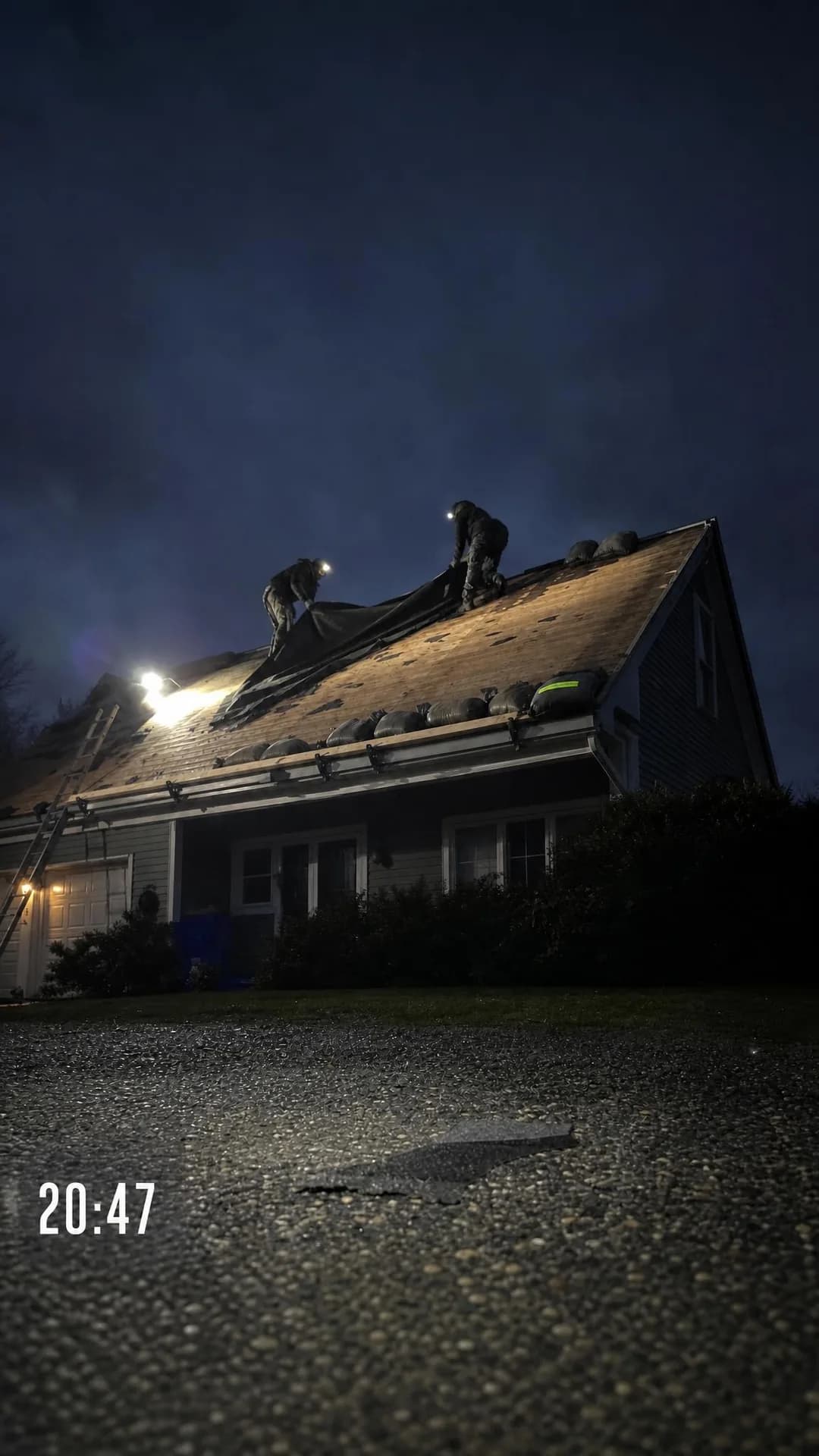
Benefit & Outcome · 9:16 · Leads
Covered in 2 hrs 40 min.
Written for: People with an open roof and rain in the forecast.
How this one was made →
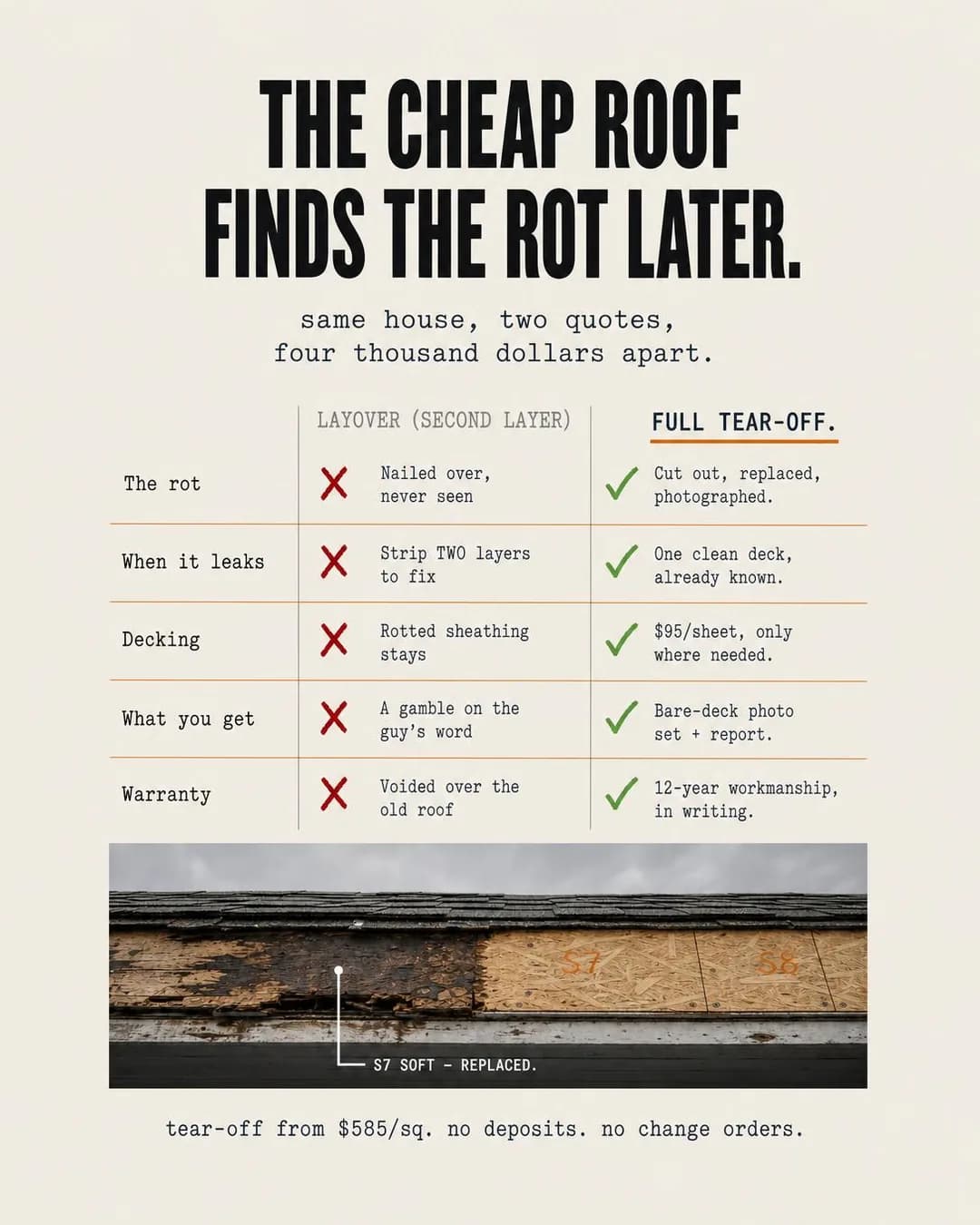
Comparison & Positioning · 4:5 · Traffic
A Layover Nails Over the Rot
Written for: Homeowners weighing a quote four thousand dollars cheaper.
How this one was made →
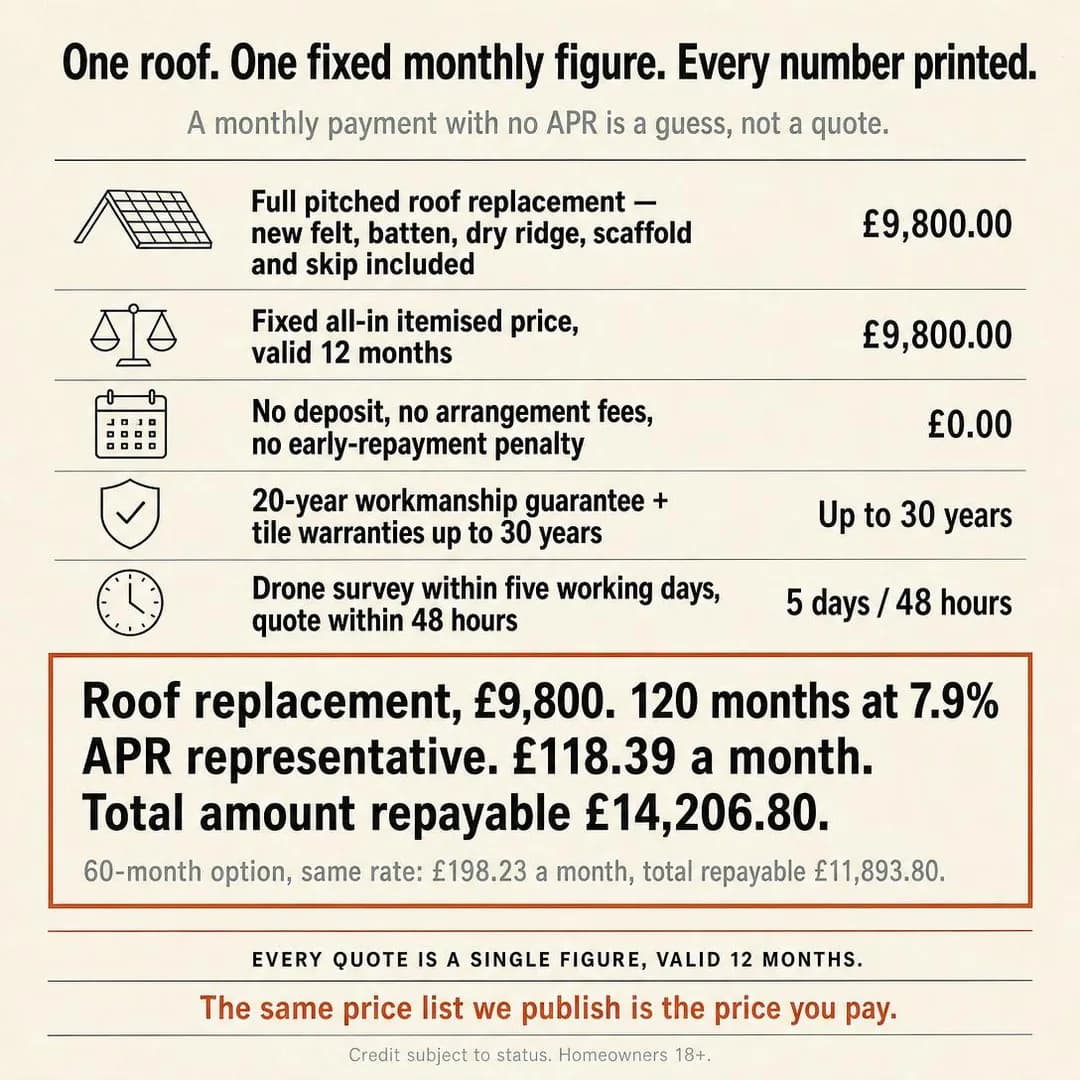
Offer & Economics · 1:1 · Leads
The APR Is Printed. Read It.
Written for: Households replacing a roof they had not budgeted for.
How this one was made →
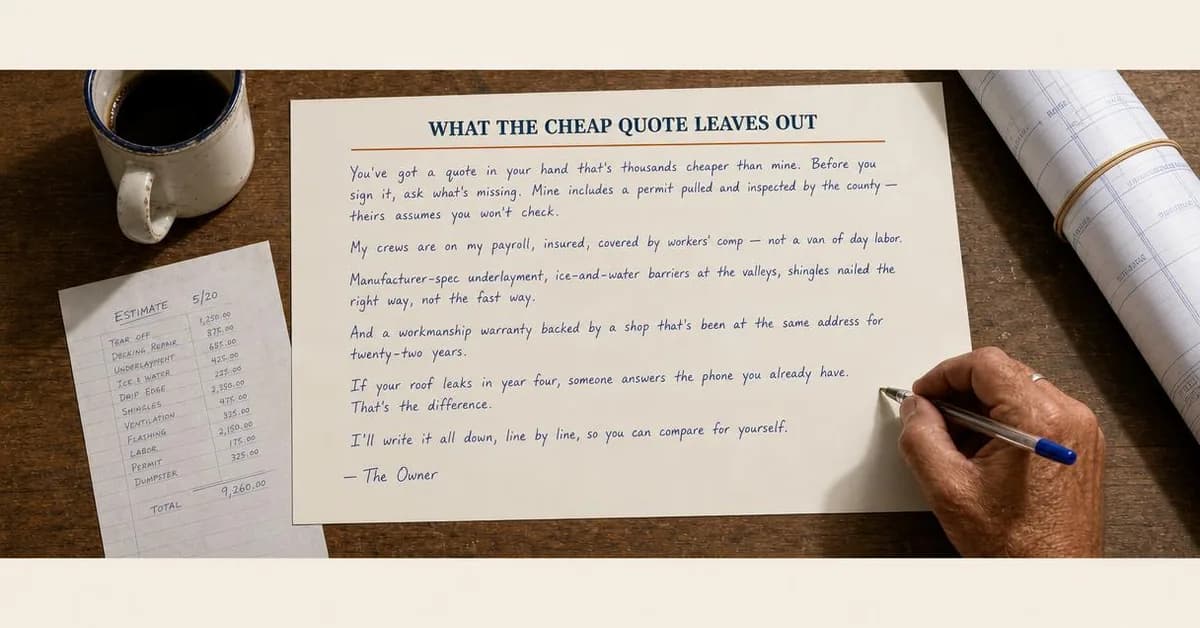
Story & Founder POV · 1.91:1 · Awareness
What's Not in That Cheap Quote
Written for: Homeowners with a door-knocker's quote in their hand.
How this one was made →
The offers it will propose
Twelve, not a list to run at once — pick the two or three your crews are short of this month and let the weather pick the rest. Each has a row on the Facebook guide naming who it is for, which angle family argues it best and which objective buys it. Two of them carry a rule rather than a preference: the claim row is a legal question before it is a creative one, and the financing row costs you the ZIP codes the storm plan depends on.
- Emergency tarping and dry-in
- Post-storm inspection at a flat fee
- Replacement through the homeowner's own claim
- Full tear-off against a layover
- Replacement on a fixed monthly payment
- A system warranty the manufacturer signed
- Six nails in the strip, not four above it
- The last warm week of the sealing season
- Ice-and-water membrane at the eaves and valleys
- Why we are four thousand more than the door-knocker
- Ridge and intake ventilation
- Pre-sale roof certification
The two sentences this trade runs most are prohibited advertising in several states, and Meta will approve both.
Every other caution on this site is a rule about an advertising platform, and the last one was a federal regulation. This one is state law, it is criminal in at least one state, and in both statutes the operative verb is advertise. Texas Business and Commerce Code § 27.02(c) makes it an offence — a Class B misdemeanour — for a seller who expects to be paid from property insurance proceeds to advertise or promise to pay, waive, absorb, rebate or credit the insured's deductible, and § 27.02(b) requires any such contract of $1,000 or more to carry a 12-point boldface notice. Texas Insurance Code § 4102.163(a) says a contractor “may not act as a public adjuster or advertise to adjust claims for any property for which the contractor is providing or may provide contracting services”, regardless of a licence or a power of attorney. Minnesota reaches both from a different direction: § 325E.66 subd. 1(a)(1) bars a residential contractor from advertising or promising to pay any part of a deductible as an inducement, subd. 1(a)(3) bars interpreting policy provisions, advising on coverages or adjusting a claim without a public adjuster licence, subd. 1(c) puts residential roofers inside the definition, and subd. 2 gives both the homeowner and the insurer an action for damages.
Meta will run either without a murmur. Nothing in Ads Manager knows any of this, so ad approval tells you precisely nothing about whether the ad is lawful where it delivered. That is the sentence this whole page exists for, and it is why the review that matters in this trade happens after the ad is approved rather than before.
Now the finding on this page, and it is the reverse of the HVAC one. The insurance ad in our published run was briefed neutrally — document the damage, meet the adjuster on the roof, bill the carrier, the homeowner pays the deductible printed on their own declarations page — with no mention of the trade's illegal house style, to see whether the model would reach for it unprompted. It did the opposite, forcefully: all five body texts attack deductible waiving by name and the rendered card says that anyone offering to make your deductible disappear is committing insurance fraud. That is the correct position, argued better than most contractors argue it. And then the same ad promised to “file supplements if anything gets missed”, told the reader flatly that “your carrier covers everything else at replacement-cost value”, and signed off with a four-word description line: “Your deductible. We handle the rest.” Filing supplements with a carrier on the insured's behalf is adjusting a claim. Stating what a policy pays is interpreting a policy provision. The model knew the famous violation cold and had never heard of the statutory one.
The fix is narrow and it keeps the ad, which is the useful part. Document, meet, invoice — never negotiate, never interpret. “We photograph the damage, we are on the roof when your adjuster is, and we invoice your carrier directly” describes exactly the same work and asserts nothing about what a policy pays or about acting on the homeowner's behalf. Then delete anything shaped like “we handle the rest”, because that is the sentence doing the prohibited work in the smallest number of words, and it is the one that will survive an edit pass aimed at tone.
The same discipline applies to the page the ad points at, and this is the part people miss. The statutes do not stop at the ad unit. A landing page that says you will handle the claim is making the same representation with more words, and so is the boilerplate at the bottom of your quote. If you edit the ad and leave the page, you have edited the smaller half.
This is not legal advice, and on this page that sentence is doing real work rather than covering a base. State contractor and insurance law is the binding constraint on roofing advertising, it differs by state, it changes, and Texas and Minnesota are two examples rather than the list. For anything touching a claim, the next step is your own counsel and your state's department of insurance, not a page on a software company's website.
The financing offer costs you the storm plan, and that part is Meta's. An ad promoting a replacement on a fixed monthly payment promotes a credit opportunity, so its campaign must declare the financial products and services special ad category, required for US advertisers since January 2025. That removes location exclusion; removes ZIP codes, neighbourhoods, sub-city, metro area and small geographic area as location types; floors the radius at 15 miles or 25 kilometres; fixes age at 18–65+; and drops lookalike and saved audiences, though Custom Audiences and Advantage+ Audience survive. For a heating contractor that costs a drive time. For a roofer it deletes the strategy, because hail falls in a swath a few miles wide with an edge you can drive across, and naming the postcodes it crossed is not a refinement of storm advertising — it is storm advertising. Split the campaign, not the message: financing runs in its own declared campaign and accepts that it is buying a county, and the storm work stays in an ordinary campaign where the ZIP list still works. Never let a monthly-payment line drift into the storm campaign; one sentence recategorises the campaign it sits in and the postcodes go with it. Regulation Z applies to that same sentence separately — 12 CFR 1026.24(d) makes the amount of a payment a triggering term, obliging the ad to state the repayment terms and the annual percentage rate using that phrase.
Meta does have one standard aimed straight at this category and it constrains the moment you most want to advertise into. The advertising standard on commercial exploitation of crises and controversial events prohibits ads that exploit crises for commercial purposes and names natural disasters as an example. Roofing's entire demand curve is a natural disaster, and the policy does not draw the line for you, so draw it yourself: a tarp, a phone number and an arrival window is a service offered to people who have been through a storm; a named hurricane, a news photograph and a countdown is advertising the storm. The ad set counts as much as the creative — a campaign whose targeting is built on a named disaster is making the argument the policy is about, whatever the picture shows.
Then the failure that recurs in every batch, which is invented proof. Six of the ten ads on our roofing page carry an invented statistic somewhere in the copy: “median call-to-covered: 2 hours 40 minutes”, “1,900 roofs since 2016”, “40,000+ re-roofs”, “about 14 reliably warm tear-off days”. The first of those is the load-bearing claim of the entire ad it sits in, and it is a number a customer will hold you to on the phone at nine at night. If a figure is your proof it comes out of your own dispatch and job records or it comes out of the ad — and the practice is always available as a substitute for the tally, because “every job permitted, every inspection card handed over” is checkable by the customer at the end of their own job. There is a way to make the tool behave, and this batch demonstrated it: where a visual direction has a slot for a statistic, the slot gets filled with whatever the brief supplies, and it invents only when the brief supplies nothing. Write the proof into the brief.
Three rendering checks that catch most of the rest, and the first is the one a reviewer will miss. Counts drawn as objects come out wrong: our nailing ad is captioned FOUR NAILS and draws five, captioned THE SIX-NAIL STANDARD and draws seven, while everything else in the diagram — the nails above the line, the lift under the wind arrow, the deck and rafters — is correct. Count the objects yourself before shipping any diagram whose whole argument is a quantity. Second, rendered tabular documents misregister their label and value columns: two separately generated images on our page, an insurance declarations sheet and a handwritten estimate, both put labels one row above their figures while their totals stayed perfectly correct. Read across the table rather than glancing at it. Third, rendered dates anchor to the model's sense of now rather than to today — that same declarations page is dated 05/01/2024 to 05/01/2025.
Last, two claims that belong to somebody else and one that belongs to the calendar. “Voided over the old roof” is a statement about a manufacturer's warranty, so it has to be true of the specific shingle you sell rather than asserted in general; a manufacturer system warranty and certified-installer status are checkable, which cuts both ways, so only advertise the certification you actually hold. And every specific is a promise somebody has to keep: an arrival window is kept by the dispatch board, a count of remaining warm days by the forecast on the morning the ad runs, a rebate amount by somebody else's programme. Advertising a window you miss is the one ad in this trade guaranteed to generate its own rebuttal, in public, with a star rating attached.
Questions
- Will it write an insurance ad I can legally run?
- Not on its own, and this is the one industry page on this site where that answer is load-bearing rather than cautious. It writes creative; it does not know which state you are in, and the statutes attach to what the ad says rather than to what the tool intended. Our own published run got the famous rule right — it attacks deductible waiving by name — and then wrote a four-word description line that describes claim adjusting, which is prohibited conduct for the contractor doing the work in Texas and Minnesota. The caution above has the fix, and it is narrow: document, meet, invoice, never negotiate, never interpret. Apply it to the landing page too.
- Our whole year is one hailstorm. Can it keep up with a storm week?
- It can have the creative waiting, which is the part that actually helps — a run takes minutes, so generate the tarp, inspection and tear-off ads in the shoulder season and hold them paused. What changes during the storm is the ZIP list, not the ads, and that is a targeting edit rather than a creative one. Two things not to do in that week: do not hand-edit an ad set's budget mid-storm, because a significant edit restarts the learning phase on the one morning of the quarter when demand is real; and do not let a financing line into the storm campaign, because declaring the financial category removes ZIP targeting and the swath is the plan.
- Will it publish ads to my account on its own?
- No. It publishes into an ad set you choose in your own Meta Ads Manager account, and every ad lands paused. It never creates campaigns or ad sets, never edits ads you already have, and never spends budget. In this trade the pause is where the insurance sentence gets read, every rendered number gets checked against your own job records, and the financed ad gets moved into its own declared campaign.
- Can I see what it produces before signing up?
- Yes. The roofing Facebook examples page has ten finished ads published exactly as they were generated, for contractors that do not exist — with the audience, angle and objective each was written for, and the flaws named rather than cropped out, including the ad that wrote a sentence its own contractor should not run and the diagram that draws five nails under a caption saying four. Four of the ten are on this page.
Not ready to generate anything yet?
- Facebook ads for roofing companies → the playbook: objectives, offers, targeting and the mistakes specific to this trade.
- Instagram ads for roofing companies → the playbook: objectives, offers, targeting and the mistakes specific to this trade.
- Roofing Facebook ad examples → every ad above and the rest of the batch, each with the audience, angle and objective it was written for.
- Roofing Instagram ad examples → every ad above and the rest of the batch, each with the audience, angle and objective it was written for.
Enter your roofing company's website
That is the whole brief. No questionnaire, no uploads, no brand kit to fill in. Free to start, no card — and every ad lands paused, which in this trade is where the insurance sentence gets read against your own state's statute.