
Ad Examples · Hair Salons & Barbershops × Facebook · 10 ads
Hair salon Facebook ad examples
Ten finished Facebook ads for hair salons and barbershops, with the brief behind each one. A salon owns less of its own advertising than almost any other business, and the notes show what the tool put in the gaps.
Search for salon Facebook ad examples and you get a wall of other people's transformations: a split-screen face, a colour reveal shot from behind, a caption saying “swipe”. They were collected, which means not one of them can tell you who it was written for, what it was arguing, or the question a salon owner actually has at 9 p.m. — whether the thing they are about to post is allowed, and whether it is theirs to post.
So these were not collected. Every ad below was generated with its audience, angle and objective pinned before the run, and the brief printed under each one is the brief that produced it. The ten businesses are invented and unnamed, one service each, and they run from a colour correction charged by the hour to a barbershop cut set against a walk-in, a balayage sold on growing out slowly, a child's first haircut and a salon whose stylist has just left. Five were written for Traffic, two for Leads and three for Awareness. All ten ran in one pass, and nothing was regenerated.
This page is about hair — nails, beauty and med spas sit under different Meta rules and are not covered.
A salon owns less of its own advertising than almost any other business. A restaurant photographs its own dish; a skincare brand photographs its own jar. A salon's work exists only on somebody's head, so the picture belongs to a client, the quote under it belongs to a client, the page the click lands on is often whatever takes the booking, and the name the appointment is under belongs to a stylist who can walk across town and take their clients with them. That is the trade's real problem, and it makes it the sharpest test of a tool that cannot use your photographs and has to draw something.
What it drew in those gaps was people. One invented client quote came back as four testimonials attributed to apparently different clients, plus a line claiming the salon hears it often. A consultation card printed a field nobody wrote, categorising its subject. A goodbye letter from a nameless salon arrived signed by somebody. The FTC's endorsement guides say that when an ad represents that someone uses a service, that person “must have been a bona fide user of it at the time the endorsement was given”. A generated client cannot be, and four of them are worse than one. The notes below have the detail.
It also went after the neighbours, and the reason turned out to be upstream of the ads entirely. Eight of the ten ads make a claim about how other salons operate — nine if you count the curly cut's “leaving a salon meant holding back tears” — while only one brief asked the business to compare itself with anyone. The source is the business summary: nine of the ten summaries define the business against other salons before any ad exists, in the paragraph where a model explains what the brand stands for. That is the single most useful thing on this page, because it tells you where to look. For a skincare brand a swipe at the category is a swipe at a market; for a salon the category is three doors down.
Sorting the rest by the step that produced it gives a rule worth keeping. Almost everything the salon would have to honour was already in the business summary — four service inclusions stacked onto a $45 haircut, a 15% discount, a 6:00 p.m. cutoff, an 8 a.m. opening, a child's age on a keepsake card — which is the one step you can edit before any ad is made. The copy step is where the protections died and the sharpest accusations arrived: a mandatory 48-hour allergy alert test and a “once per client” limit both survived the summary and vanished from the finished ads, while “Most salon switches fail” and “no surprise fees ever” appeared out of nothing.
Obligations are born where you can still fix them; accusations are born where you can only delete them.
The numbers behave better than you would expect and worse than they look. Where a brief did the arithmetic, the arithmetic held: $70 down to $45 printed as “Save $25”, and four chairs running three-hour blocks reasoned correctly into twelve appointments a day.
What moves is the premise underneath it. Dates held too — one ad's Friday came back right in all five primary texts, the description and the picture — but a clock time nobody briefed came with it, and where a brief asked for a date without supplying one, something else entirely got written on the card. Prices are the checkable version of the same rule: every price that reached an ad came from a brief, and almost every price invented by a summary never made it.
For your own ads the step that matters most is the first. A model wrote each business a summary from its one-line brief, standing in for the website you would paste, and most of what is described above started there. With your own site that summary is yours to read and edit before anything is made.
After it came the concept, whose title and one-line hook head each card; the instructions for the picture, which the card does not show; a square image; the copy, written from that square; and a re-frame that redraws the square into the shape you see. Each run wrote five versions of the body text Facebook calls the primary text, and the card shows the first; where a note quotes one of the other four, it says so.
What changes because it is Facebook
The useful Facebook fact for a salon is mechanical rather than demographic: Facebook will take the booking itself, and Instagram will not. Meta documents a Book Now action button on a Facebook Page wired to its own scheduling tool — choose Book Now, then “Click Scheduling tool”, then set your hours — and says of the feature that “It's free: All businesses have access to Appointments on Facebook at no charge”, with automated confirmations and reminders and a Google Calendar sync. A third-party scheduler is offered as an option: “You can use a third-party provider to book and manage your appointments from Facebook.”
Instagram's Book now is the reverse. Its action buttons come only from a partner list — Booksy, Fresha, GlossGenius, StyleSeat, Vagaro, Appointments by Square and others — and Meta's note is blunt: “you must already have an existing account with them to be able to add them as an action button partner.”
If you do not already use a scheduler, Facebook is the half of Meta where you can still be booked.
One caution before building on it. As of the read date, both the setup page and the provider list carry the banner “Certain features of Meta's Appointments tool will be going away starting mid July 2024”, Meta does not say which features, and the banner's own “Learn more” link goes to a page that does not mention it.
Keep your client list somewhere you own.
Then who is there. Pew's 2025 survey puts Facebook at 71% of American adults against Instagram's 50%, with Instagram ahead only among 18- to 29-year-olds, 80% to 68%; from 30 up Facebook leads, 74% to 40% at 50 to 64. For a salon that maps onto the money rather than the follower count — the client who sits for three hours of colour and the parent booking an eight o'clock first haircut are both on this page.
Geography matters more than either. A salon's market is the few minutes somebody will drive, and two decisions on this page quietly widen it: declaring a Special Ad Category expands “Audiences based on city or pin drop locations” to a wider radius, and letting an ad set reach under-18s removes “ZIP code or locations smaller than cities (custom location radius or ‘pin drop’)” altogether. Both trade away the one targeting lever a chair business genuinely needs.
Now the part most salon marketing gets wrong. The instinct is that a salon ad is risky because it talks about how people look — and physical appearance is not on Meta's personal-attributes list at all. That standard forbids ads that assert or imply “a person's race, ethnicity, religion, beliefs, age, sexual orientation or practices, gender identity, disability, physical or mental health (including medical conditions), vulnerable financial status, voting status, membership in a trade union, criminal record, or name”. Appearance is governed instead by the Health and Wellness standard, which prohibits “statements of inferiority about physical appearance (i.e., terms, descriptions, or questions that are negative and attack an individual's appearance, specific body parts, or hygiene)”. So “Tired of your flat, lifeless hair?” is a Health and Wellness problem rather than a personal-attributes one, and it is still a problem.
The personal-attributes standard does catch salons, through a door most owners never look at: race and ethnicity, reached by way of hair texture. The curly cut below does it in four of its five primary texts, and the note there has the detail. Mental health is on the same list, and the same ad walks into that one too. Meta's own division is the thing to hold on to — it allows ad creative that describes the product or service, and disallows using “you/your” to reference a personal attribute.
Sell the cut, not the head it is going on.
The age question has no published answer for this trade, which is worth knowing before somebody tells you otherwise. Health and Wellness says “Ads promoting or marketing cosmetic products, procedures or surgeries, must be targeted to people at least 18 years or older”, and the list under that rule names exactly one hair item: “hair restoration surgery”. The exemption from the same rule names one other — the restrictions “don't apply” to “Non-permanent cosmetic and beauty products such as creams, makeup, hair products, and digital editing apps”. A haircut is in neither list, and the exemption is written about products while you sell a service. Read together, an ordinary cut or colour sits outside the restriction, where Meta's usual minimum of 13 applies; anything on the restricted list, and any before-and-after, belongs at 18 and over.
Two traps sit outside the creative. Lead forms first, since two of the ads here are Leads ads: Meta's Lead Ads standard says “Ads must not request health information, including physical health, mental health, medical treatments, medical conditions or disabilities without our prior permission.” Ask what the client wants, not what is wrong with them.
Second, hiring — an ad for a job is an Employment ad under Meta's Special Ad Category rules, whose examples include “Part-time job”, “Internship” and “Apprenticeships”, and declaring it costs you most of your targeting. Whether renting a chair to a self-employed stylist counts is not something Meta addresses; a job ad plainly does. The FAQ below has what it costs.
Then the thing a salon has to solve for itself: knowing whether any of it worked. This page recommends Traffic five times and Sales never, because a booking usually completes on a scheduler rather than a checkout you own — which is also why Meta cannot count it. The click is measurable, the appointment is not, and the gap between them is where a salon's money actually is. Tag your ad links so whatever takes the booking records which campaign sent each client, and failing that, ask at the chair and write it down. That number is also what makes the budget arithmetic usable: Meta puts the learning phase exit at “about 50 results in the week after the ad set's last significant edit”, and fifty times your own cost per booking is the weekly spend at which a single ad set has full information. Most single-site salons should read that as an argument for one ad set rather than several.
If you would rather the ad opened a conversation than a booking page, that is a conversion location and not an ad type — pick Traffic, Engagement, Leads or Sales, then choose Message destinations. Two limits to plan around: a Messenger destination can deliver on Facebook, Instagram and WhatsApp while Instagram Direct delivers on Instagram only, and “conversations” is named among the optimisation goals Meta withholds when an ad set can reach under-18s. best-in-slot publishes link ads with a destination URL and offers Book now among its buttons, so every ad on this page can be published from the product end to end; the conversation formats and call ads are Ads Manager builds.
Last, the shapes and the words. Meta's ads guide recommends 4:5 at 1440 × 1800 for Facebook Feed, primary text of 50 to 150 characters and a 27-character headline.
Eighteen of this run's fifty primary texts fit that range: fifteen come from three ads that wrote all five short, at 54 to 137 characters, and those three are the ads whose picture contains the whole argument — a spec card, a comparison chart and a single illustrated moment. The other seven ads produced three more short ones and thirty-two that ran 232 to 464 characters. Eight of fifty headlines fit 27 and all fifty fit 40. One ad here is 9:16 for Stories, where the guide asks you to keep roughly the top 14%, the bottom 35% and 6% at each side clear of text.
Source: Meta Business Help Centre — About Appointments on Facebook: the tool is free to all businesses, with reminders and a calendar sync · Meta Business Help Centre — Set up Appointments for your Facebook Page: the Book Now wiring, and the mid-July-2024 removal banner · Meta Business Help Centre — List of Providers for Appointments on Facebook: a third-party scheduler is optional on Facebook · Meta Business Help Centre — About Action Button Partners (Instagram): Book now is partner-only, and you must already hold the account · Meta Advertising Standards — Privacy violations and personal attributes: the protected list, what “you/your” may not point at, and the absence of physical appearance from it · Meta Advertising Standards — Health and Wellness (last updated July 2026): statements of inferiority about appearance, the 18+ cosmetic list naming hair restoration surgery, the products-not-services exemption, and the permissive before/after line · Meta Advertising Standards — Lead Ads: “Ads must not request health information, including physical health, mental health, medical treatments, medical conditions or disabilities without our prior permission.” · Meta Business Help Centre — How to Choose a Special Ad Category: the targeting a declared category costs you, including an expanded pin-drop radius · Meta Marketing API documentation — Special Ad Category (updated 21 May 2026): “Current available categories are: housing, employment, financial products and services, or issues, elections, and politics.” · Meta Business Help Centre — About ads for housing, employment or financial products and services: employment examples include “Part-time job”, “Internship” and “Apprenticeships” · Meta Business Help Centre — About ads that click to message: which placements each message destination reaches, and how budget is shared · Meta Business Help Centre — How to set up click to Messenger ads in Ads Manager: works with the traffic, engagement, leads and sales objectives; “Select Message destinations as your conversion location” · Meta Business Help Centre — About Advertising to Teens: the optimisation goals withheld below 18 (including conversations), the loss of sub-city locations, and the minimum age of 13 · Meta Business Help Centre — Call Ads and Call Add-Ons: call ads are mobile-only across six placements and optimise for 60-second calls · Meta Business Help Centre — About the learning phase: exit “usually occurs after about 50 results in the week after the ad set's last significant edit” · Meta ads guide — Facebook Feed image ads: 4:5 at 1440 × 1800, primary text 50–150 characters, headline 27. Facebook Stories: 9:16 at 1440 × 2560, keep about 14% top, 35% bottom, 6% sides clear · Pew Research Center — Americans' social media use, November 2025: Facebook 71% of US adults against Instagram's 50%, and the age split behind it · 16 CFR 255.1 — FTC Endorsement Guides: an endorser must have been a bona fide user · 16 CFR 255.2 — FTC Endorsement Guides: a customer's experience reads as what buyers will generally achieve
Generate Facebook ads for your own salon or barbershop
Paste your site and best-in-slot reads it — services, prices, who cuts what — and shows you the business summary it wrote before any ad is made. Read the paragraph that says what your business stands for first: on this page that is where nine of ten ads got their claims about other salons, and where the promises they could not keep were already written. Then check every picture for a face you do not have permission to use. Free to start, no card.
The Cumulative Overlap Trap
TrafficPulling box dye through your ends twice created chemical gridlock.
- Audience
- People who coloured their own hair at the kitchen sink — Bought a box at the supermarket to stretch the time between appointments, did it again eight weeks later over the top, and have been putting off calling a salon because they expect to be told off when they get there.
- Angle
- Mistake (Problem & Pain) — Shows something the audience is doing incorrectly.
Pulling box dye all the way through your ends "just to refresh" is the single costliest kitchen-sink mistake.

The Box Dye Overlap Trap
Book your free strand test.
Mistake is the honest family for colour correction, because the customer already knows they made one and is avoiding the phone for that reason. The brief pinned exactly that — people who expect to be told off — and the copy answers it well: “No one here is going to scold you for what you did over the bathroom sink” (another primary text), with “Zero Judgment. Just Chemistry.” and “No Lectures. Just a Reset.” among the headlines. If you run one ad from this page, run the one that removes the shame.
What it does not do is sell the service. The whole business rests on an hourly price — $95 an hour, two to seven hours, because nobody can quote a correction from a photograph — and that model survived into the business summary and then out of the ad entirely. No primary text, no headline and no part of the picture mentions a price, an hour or a duration. The only money in the finished ad is a competitor's: “You bought a $12 supermarket box to buy time”, a figure invented at the copy step. An ad whose differentiator is how it charges published without the charge in it.
The picture is the quiet lesson of the batch. The image-prompt step wrote “a woman is viewed from a three-quarter back angle over a clean kitchen sink”, and the render obeyed — banded ends held up to the light, an unbranded applicator bottle, no face and no text. Nothing about illustration guarantees that; a step wrote the camera angle, and it is the cheapest fix available to a trade whose every picture is somebody's head.
The claims about other salons came from further upstream: the summary already had “Most salons quote a flat fee… leading to rushed processing times, compromised hair integrity, or sudden upcharges”, the concept sharpened it to “standard salon bleaching cannot safely lift in one rush”, and the copy hardened that into “standard salon bleaching will snap your hair” (another primary text). Three of the five primary texts also describe the reader's own hair back to them, from an audience line that described only what they did.
Other headlines from the same run
- Zero Judgment. Just Chemistry.
- Why Your Ends Lift Unevenly
- Free 15-Min Strand Diagnostic
- No Lectures. Just a Reset.
Call to action
Traffic, to the consultation booking rather than the appointment, since the service cannot be quoted without seeing the hair. Put the hourly rate back in the copy before it runs, and cut “will snap your hair” — it describes work you have not seen, done by people you have not met. best-in-slot sends this wide shape only to Facebook's right-hand column and search results, so render a 4:5 as well if you want it in the feed.
The Annual Salon Ledger
TrafficCut your yearly hair color budget entirely in half.
- Audience
- People who book a root touch-up they resent — Sit in the chair every six weeks for a service they did not choose so much as inherit, plan their money around it, and have started stretching it to eight weeks and then booking in a hurry before something they have to turn up to.
- Angle
- Save Money (Benefit & Outcome) — Focuses on direct financial savings.
Most salon schedules are engineered to charge you every six weeks. The math doesn't have to look like that. By painting dimension that grows out invisibly for 12 to 14 weeks, your yearly upkeep drops to three intentional sessions. Keep your weekends—and cut your annual hair budget in half.
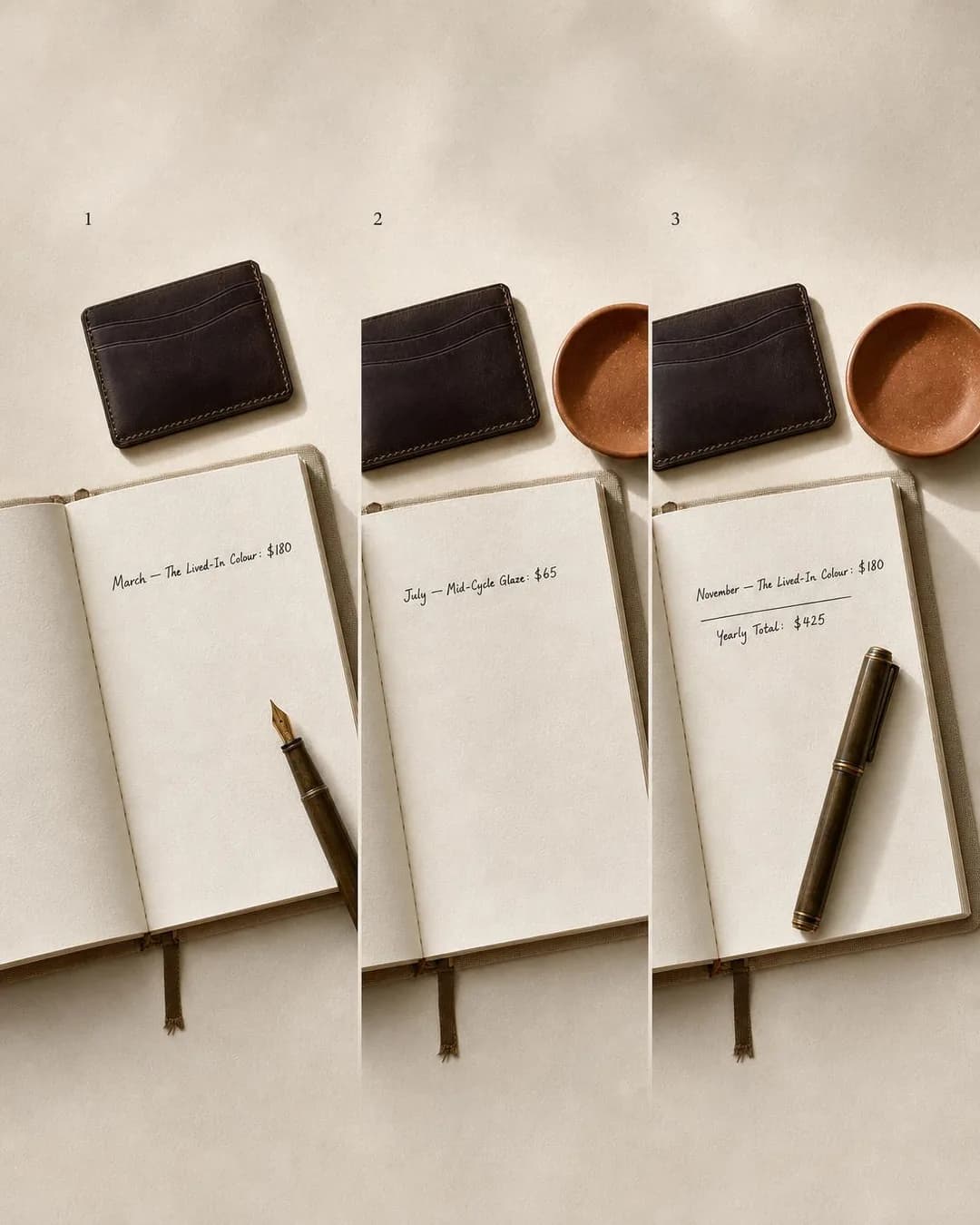
Cut your yearly color budget in half.
Wearable color for 12–14 weeks.
Save Money is believable only when it costs the seller something, and this one does: the salon advertises a balayage that halves its own bookings. The picture makes the case as three ledger entries — “March — The Lived-In Colour: $180”, “July — Mid-Cycle Glaze: $65”, “November — The Lived-In Colour: $180”, then “Yearly Total: $425”. The sum is correct. It is the most convincing ad in the batch and the one worth checking hardest.
The year it describes is not the year the brief described. Twelve to fourteen weeks between visits is 3.7 to 4.3 appointments a year; the business summary rounded first, promising “twice- or thrice-yearly appointments” while still repeating “twelve to fourteen weeks” two paragraphs earlier, and the image prompt then spaced the entries “four months later”, which makes three fit a calendar. The copy is internally consistent and consistently wrong: “$425 for an entire year of colour” sits beside “Three visits a year”, a year the brief's own interval does not produce. On four Lived-In Colours the real figure is nearer $720. The total also counts a glaze the summary marks “(Optional)” and designs for “week seven or eight”, which the picture places in July, four months out. The arithmetic you would check is right; the premise you would not check is invented.
The lead primary text also promises to “cut your annual hair budget in half” against a comparison nobody has made, and three of the five make the six-week cycle sound deliberate — “Most salon schedules are engineered to charge you every six weeks”, and “Traditional foil lines create artificial urgency so you keep returning to the chair” (another primary text). The business summary got there first: “Traditional color services depend on creating a sharp line of demarcation that forces clients back into the chair.” This is the batch's most complete example of an accusation entering before the ad existed, which is why the summary is the place to edit it.
Other headlines from the same run
- $425 for an entire year of colour.
- Break the 6-week root touch-up cycle.
- Three visits a year. Zero root panic.
- Invest in technique, not touch-ups.
Call to action
Traffic, to a page that lays out the real annual cost of both schedules with your prices and your interval in it — this is a spreadsheet argument and it needs somewhere to finish the sum. The strongest audience is the clients already booking with you every six weeks, since the offer is to sell them less often and they are the only people who can check the claim.
The Portable Cut Blueprint
AwarenessYou don't need your stylist. You need their exact measurements.
- Audience
- People who only book on the days one person is working — Have had the same appointment done three times by three people in the same shop and got three different results, and now arrange their week around one person's rota.
- Angle
- Hidden Feature / Aha (Product & Mechanism) — Reveals an unexpected feature or capability.
Stop arranging your entire month around your barber’s Thursday shift.
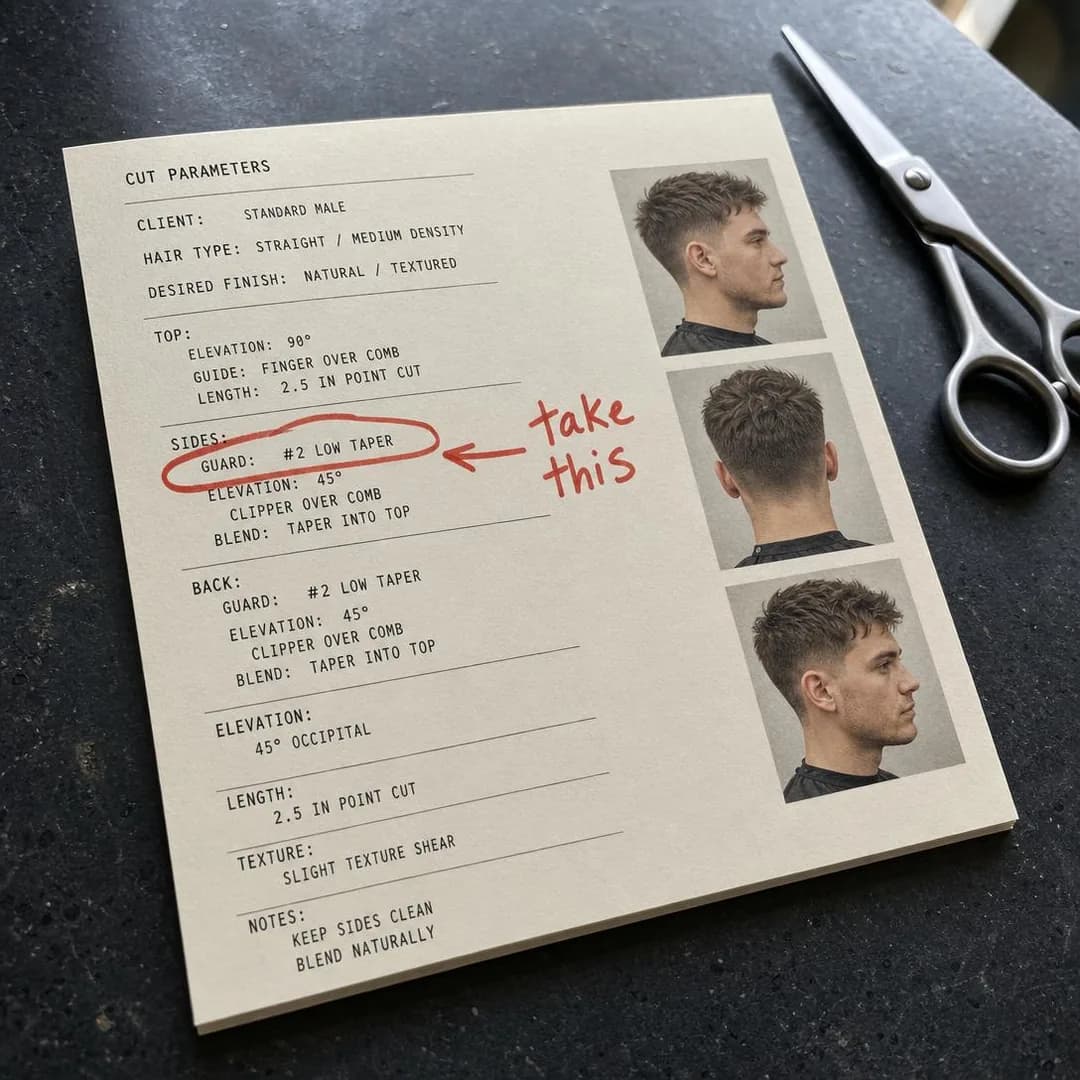
Never rely on one rota again.
Full cut blueprint included.
Hidden Feature is the right family for a piece of admin, and the concept found the sharp version: “The Portable Cut Blueprint”, hooked on “You don't need your stylist. You need their exact measurements.” For a trade where loyalty attaches to a person rather than a business, a record that outlives the person is a good product, and the hand-drawn red circle around the guard number with “take this” beside it is exactly how a client would use it.
Then read the card. Its client field says “CLIENT: STANDARD MALE”, and a second reads “HAIR TYPE: STRAIGHT / MEDIUM DENSITY” — neither appears in the concept or the image prompt, which makes them the only fields in this batch the render invented by itself, and it filled them with categories for a person. Beside them sit three ID-style photographs of an identifiable man who does not exist. That one is a narrowing rather than an invention: the summary asked for “Front portrait, 90-degree profile, and crown/nape photos”, the concept for “three miniature 4000K neutral reference portraits”, and the image prompt reduced it to “three small 4000K neutral reference photos of a finished haircut” — at which point the render put the people back. Two of the three are the same right profile.
The card also cannot do what the ad claims for it. “Exact measurements. Zero guesswork.” sits over a form that prints “LENGTH: 2.5 IN POINT CUT” twice, repeats “ELEVATION: 45°” three times, and gives the SIDES and BACK blocks identical lines. The lead headline promises a cut “charted to the millimeter” over a card measured in inches and guard numbers. And the brief asked for “guard lengths, the exact colour formula, how long it was left on” — the concept dropped colour at the first step and it never returned, leaving a colour salon with a barber's cut spec.
One line to strike: “Salons keep notes on your hair. They just refuse to give them to you” (another primary text) asserts a deliberate withholding, about everybody, with nothing behind it.
Other headlines from the same run
- Your cut, charted to the millimeter.
- The cut blueprint belongs to you.
- Stop gambling on open chairs.
- Exact measurements. Zero guesswork.
Call to action
Awareness, because this sells the shop rather than a slot, and it is the ad most likely to be forwarded by somebody fed up with their own salon. Re-render the card with your own fields before it runs — no client category, no invented photographs, and your colour formula on it if colour is half your business. The summary had the answer the copy lost, too: the record is emailed as a PDF at checkout. Say that.
The Rearview Mirror Relief
Traffic"I didn’t check the rearview mirror once on the drive home."
- Audience
- People who have been cut wet and found out at home — Walked out happy, washed it once, and found the shape gone; now they travel across town to the one person they trust and book the next appointment before they leave.
- Angle
- Testimonial (Proof & Trust) — Uses one customer’s first-person experience as the core persuasion argument.
"I didn’t check the rearview mirror once on the drive home." For years, leaving a salon meant holding back tears until you could reset your hair in your own sink. Here, your curls are sculpted completely dry, curl by curl, before water ever touches the scalp. What you see in the chair is the exact shape that survives tomorrow morning's shower.

"I didn't check the rearview once."
Single-chair studio. Book now.
This is the page's centrepiece and its clearest warning. The brief said the ad was sold on what one client said after their third visit, and the business summary duly invented one quote. The copy turned it into four, spread across four of the five primary texts as though they came from different people — “I didn't check the rearview mirror once on the drive home.”, “I haven't owned a flat iron in six months,” shared one client settling in for her third session', “For the first time ever, I didn't immediately wash my hair in the sink when I got home.” and “I used to brace for panic after every appointment. Now, I book my next visit before I even leave the chair.” A shortened fifth version heads the lead headline, and another primary text adds “We hear this often from clients”, a claim about frequency stacked on a claim about people.
Two of those four are worse than multiplication. The last one is not in the summary at all: it is the brief's own audience description — people who “book the next appointment before they leave” — rewritten as a customer speaking. And the summary's quote ends “I didn't check the rearview mirror once on the way over”; the concept changed it to “on the drive home”, so the headline now has the client not checking the mirror on the very drive the same quote says she spent crying. The FTC's guides require that an endorser “must have been a bona fide user” of the service. There is no user here, the gender assigned to one of them is the copy's own, and four fabrications read as a pattern where one reads as a slip.
The photograph does nothing wrong and is the best thing in the batch: shot straight-on from behind at eye level, the whole frame is the cut. If you are shooting your own, this is the composition to copy.
The pronouns are what need rewriting. Selling a dry cut for coils and curls is a service description and explicitly allowed; four of five primary texts instead turn it on the reader — “your curls are sculpted completely dry”, “dedicated strictly to your pattern”, “your true shrinkage rate and bounce are respected” — and the concept had already fixed the render on “dense 3B curls” while the summary narrowed the customer to “type 2B to 4C curl patterns”. Hair texture is the shortest route from a salon ad into Meta's race and ethnicity clause. The same five texts walk into another item on that list: “clients who spent years navigating salon anxiety”, “holding back tears”, and the headline “No more post-salon panic.” assert something about the reader's mental health.
Other headlines from the same run
- The 90-Minute Dry Curly Cut ($110)
- No more post-salon panic.
- Built to survive your home shower.
- Sculpted dry, curl by curl.
Call to action
Traffic, to the booking page for the ninety-minute cut, and not until every quotation belongs to a real client who agreed to be quoted. The $110 and the ninety minutes should stay; the four testimonials should become one, from somebody who exists. Keep the photograph, and take the anxiety and the panic out of the copy.
The Ninety Second Surrender
TrafficYou said “just a trim” because walk-in shops never gave you time.
- Audience
- People who have stopped saying what they want — Asked for the same thing four times in four places, got four different cuts, and now say "just a trim" because it is easier than explaining and being disappointed anyway.
- Angle
- Category Enemy (Comparison & Positioning) — Defines a common enemy, outdated industry practice, or conventional behavior the brand opposes.
You didn't start saying 'just a trim' because you wanted one. You said it because 20-minute walk-in shops never gave you time to explain.
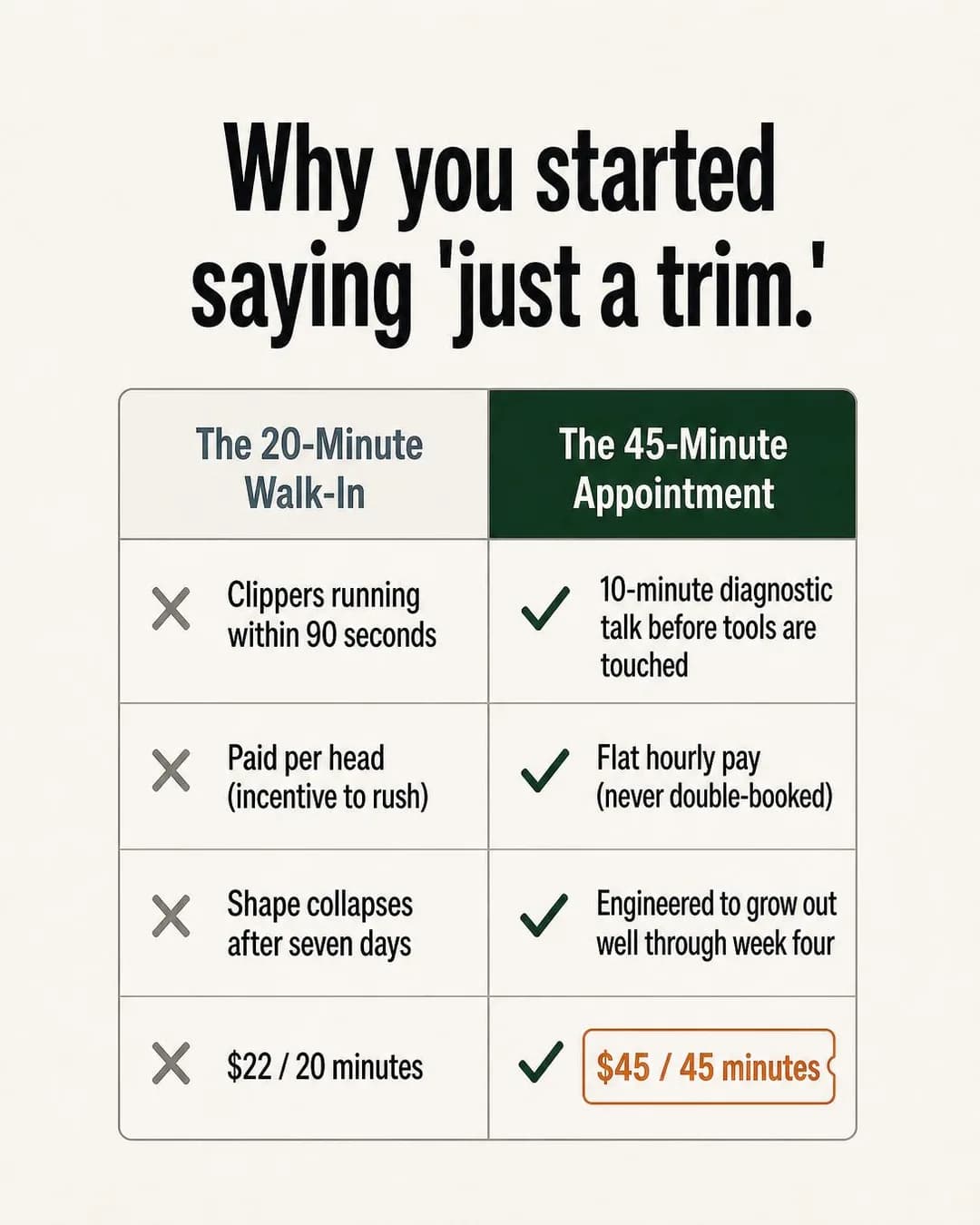
Stop settling for 'just a trim.'
Reserve your 45-minute block.
Category Enemy is the one family here briefed to attack something, and the comparison it was given was narrow and fair: a forty-five-minute appointment at $45 against a twenty-minute walk-in at $22. Both prices came back correct in the chart, and both live only there — the copy states neither, so every price in this ad is inside the picture. That matters if you run it anywhere the image is small.
The rest of the left-hand column is a set of factual assertions about how a competing business operates, and they were written before the ad was. “Clippers running within 90 seconds”, “Shape collapses after seven days” and “Paid per head (incentive to rush)” are all in the business summary — “the barber starts buzzing hair ninety seconds after the client sits down”, “shapes that collapse after seven days”, and barbers “paid flat hourly wages rather than per-head commissions, eliminating the financial incentive to rush”. The image prompt only turned them into chart rows. Do not run the chart as made: three of its four left-hand rows are claims about another business's operations and payroll that you cannot substantiate, and a national chain will ignore it while the shop on the corner will not.
Two more things sit inside the picture, where copy edits cannot reach them. The chart's headline is “Why you started saying 'just a trim.'” — an assertion about the reader's own past behaviour, baked into the image. And the ✓/✕ format forced an argument nobody intended: the row marking “$22 / 20 minutes” with a ✕ tells the reader that the competitor's lower price is a defect. All five primary texts run 57 to 137 characters, the tightest in the batch, because the chart is carrying the argument and the words only have to point at it.
Other headlines from the same run
- The 45-minute haircut appointment.
- 10 minutes of listening first.
- Built to hold shape in week 4.
- No rushing. Never double-booked.
Call to action
Traffic, to the booking page with the forty-five-minute appointment as the only option, because the ad's promise is the length of the slot. Rebuild the left column out of things you can defend — a twenty-minute booking, no consultation, a walk-in queue — and re-render, since the headline and the price rows cannot be fixed in the copy.
The Ten-Strand Preview
LeadsStop guessing blonde from Pinterest. Test your actual hair for $0.
- Audience
- People who keep postponing going several shades lighter — Have had the conversation with three friends, saved a dozen photographs on their phone, and cancelled twice because they cannot picture it on themselves and do not want to find out in the chair.
- Angle
- Try Before You Buy (Objection & Risk Reversal) — Delays payment or commitment until the buyer has experienced the product.
Stop trying to imagine blonde from someone else's Pinterest board. You shouldn't have to risk your hair to see if it works.
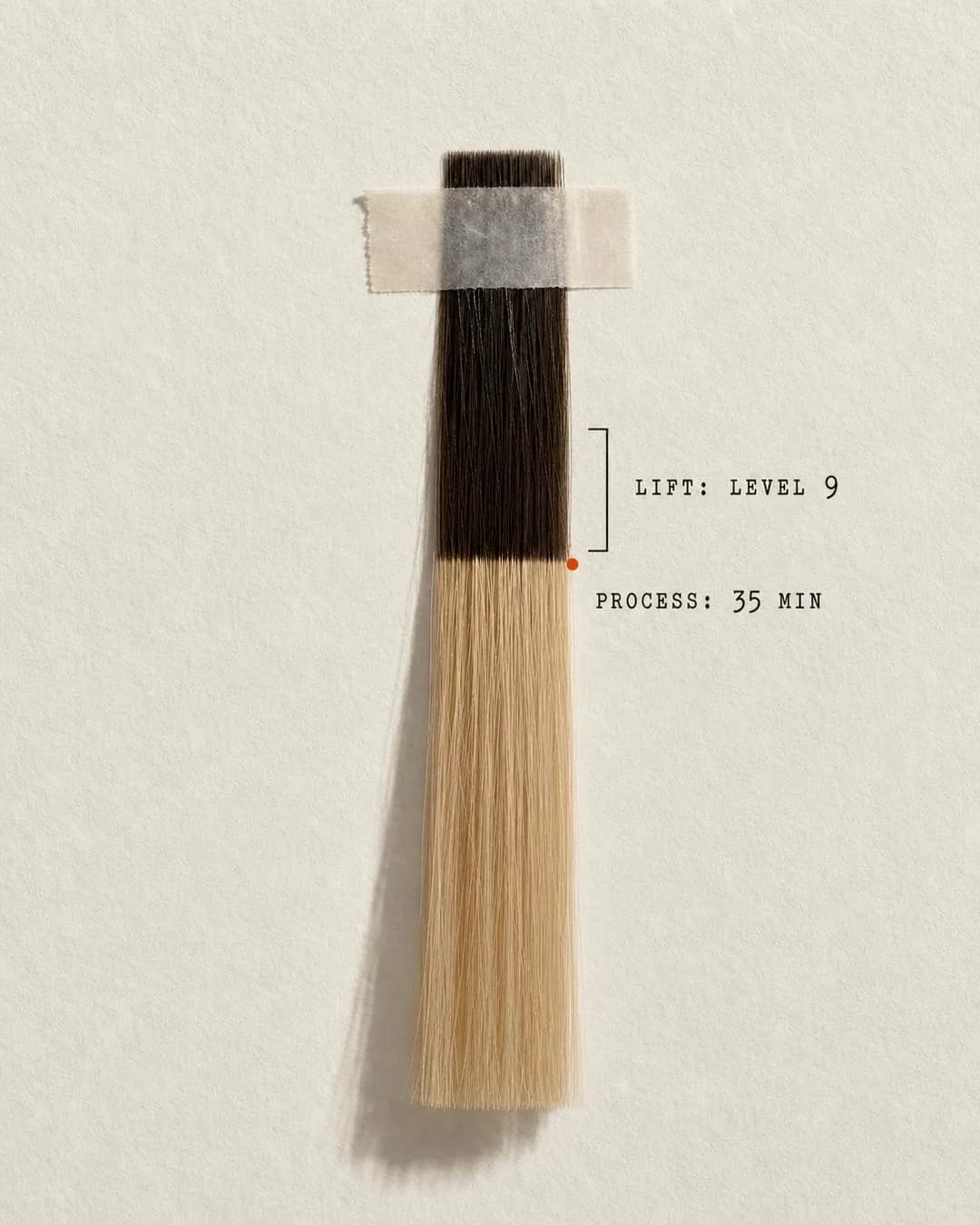
Test Your Hair for $0 First
Complimentary 10-min preview.
Try Before You Buy is unusually literal here, and the macro photograph earns the ad on its own: one taped strand on heavy paper, dark above the demarcation line and blonde below, annotated “LIFT: LEVEL 9” and “PROCESS: 35 MIN”. It is one of the few ads on this page that needs no client in the frame, because the product is a piece of hair. If you sell colour, this is the picture to copy.
It is also the ad that drops the half that matters. The brief paired the free lift preview with a 48-hour allergy alert test, and the business summary kept it twice, calling it “mandatory” and describing “a strict 100% pre-test compliance policy”. It dies at the copy step: four of the five primary texts keep the preview and lose the test, only one mentions a “patch check”, and none of the five says 48 hours. The protection cleared every stage but the last one. Whatever else you cut, that sentence goes back in — and with it the fact that the protocol needs a return visit, which “Walk in or book your 10-minute test” quietly sells away.
The number in the picture became a promise about the reader. The concept chose the shade (“half natural deep brunette and half clean level-nine blonde”), the image prompt printed it as a label, and the copy reported it as an individual's result: “to show you your exact level 9 lift on your phone” (another primary text), for a head nobody has tested. A salon whose entire pitch is that lift cannot be predicted blind has predicted it in the ad. “PROCESS: 35 MIN” is a second invented figure beside it. One more to strike: “Stop trying to imagine blonde from someone else's Pinterest board” names a third-party platform, and it arrived in the concept hook.
Other headlines from the same run
- See Your Lift Before You Book
- The Free 10-Minute Strand Test
- Zero Guesswork. Zero Deposit.
- Preview Your Blonde for Free
Call to action
Leads, for the free test rather than the colour appointment — the offer is a ten-minute visit at no cost, and asking for the booking too early wastes it. If you collect it on a form inside Facebook, keep the questions to what the client wants: Meta's Lead Ads standard forbids asking for health information, and “any scalp conditions?” is health information. Replace the level-nine promise with what the test actually gives, which is what that person's hair does.
The Commute Math Solution
LeadsStop driving two hours back to your old stylist for a haircut.
- Audience
- People who moved and have not found anyone yet — Moved across town or to a new city within the last year, have been back to their old stylist twice at the cost of most of a day, and are still putting off trying somebody local.
- Angle
- Introductory Offer (Offer & Economics) — Gives first-time customers special economics or terms.
Driving two hours back to your old stylist isn't loyalty—it’s an entire wasted Saturday.
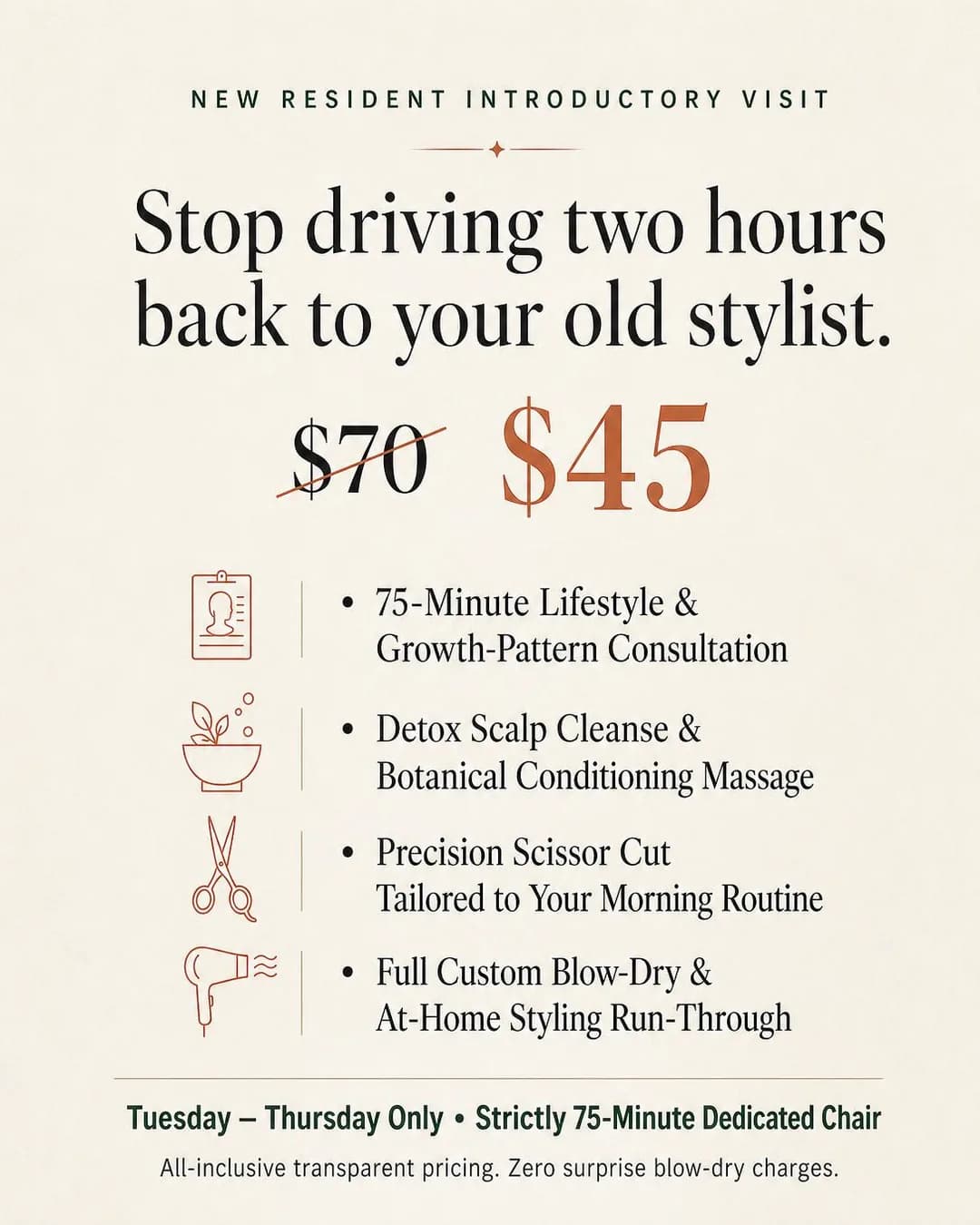
First Visit: $45 (Normally $70)
Book Tues–Thurs • Save $25
The offer arithmetic is the cleanest in the batch, and for the reason the numbers usually hold: the brief did the sums. $70 struck through, $45 in terracotta, “Save $25” in the description, “Tuesday – Thursday Only” along the bottom. Introductory Offer fits the real economics too — a first appointment runs long, and quiet days are when you can afford it.
The graphic then prints four services as a priced promise: a “75-Minute Lifestyle & Growth-Pattern Consultation”, a “Detox Scalp Cleanse & Botanical Conditioning Massage”, a “Precision Scissor Cut Tailored to Your Morning Routine” and a “Full Custom Blow-Dry & At-Home Styling Run-Through”, underwritten by “All-inclusive transparent pricing. Zero surprise blow-dry charges.” None of it is in the brief, and none of it is the graphic's invention either — the business summary listed all four and the guarantee, and the offer-stack layout simply printed what it was given. That is the pattern worth taking away: a style built to stack value will faithfully publish whatever the summary put in the stack, so the summary is where a salon stops promising a scalp detox and a massage for $45.
The brief's one protection went the other way. “Once per client” is in the summary and in none of the five primary texts, none of the headlines and no part of the graphic. Two claims arrived at the copy step instead: “Most salon switches fail because the first cut gets crammed into a rushed 35-minute slot” (another primary text) is an invented failure rate aimed at every other salon, and “no surprise fees ever” widens the summary's promise about blow-dry charges into all charges, forever. The concept also fixed the audience's “cost of most of a day” at “two hours” and built the graphic's headline on it, so the ad now only speaks to people with that commute.
Other headlines from the same run
- 75-Min New Client Cut | $45
- Stop Driving for Haircuts. $45
- Precision Mid-Week Cut | $45
- Test a Local Chair for $45
Call to action
Leads if you intend to follow up, Traffic if the booking page does the work. Put “one per client” back on the graphic, strike every inclusion you do not actually provide, and exclude your existing clients — this price is for people who have never sat in your chair, and a regular who sees it will notice.
The December Fourth Cutoff
TrafficThe December colour book closes permanently Friday, 4 December at 6:00 PM.
- Audience
- People who book their December appointment in December — Have spent two of the last three Decembers taking whatever time was left at a place they would not normally go, and have never once rung in November.
- Angle
- Limited Time (Scarcity, FOMO & Timing) — Uses a deadline to create urgency.
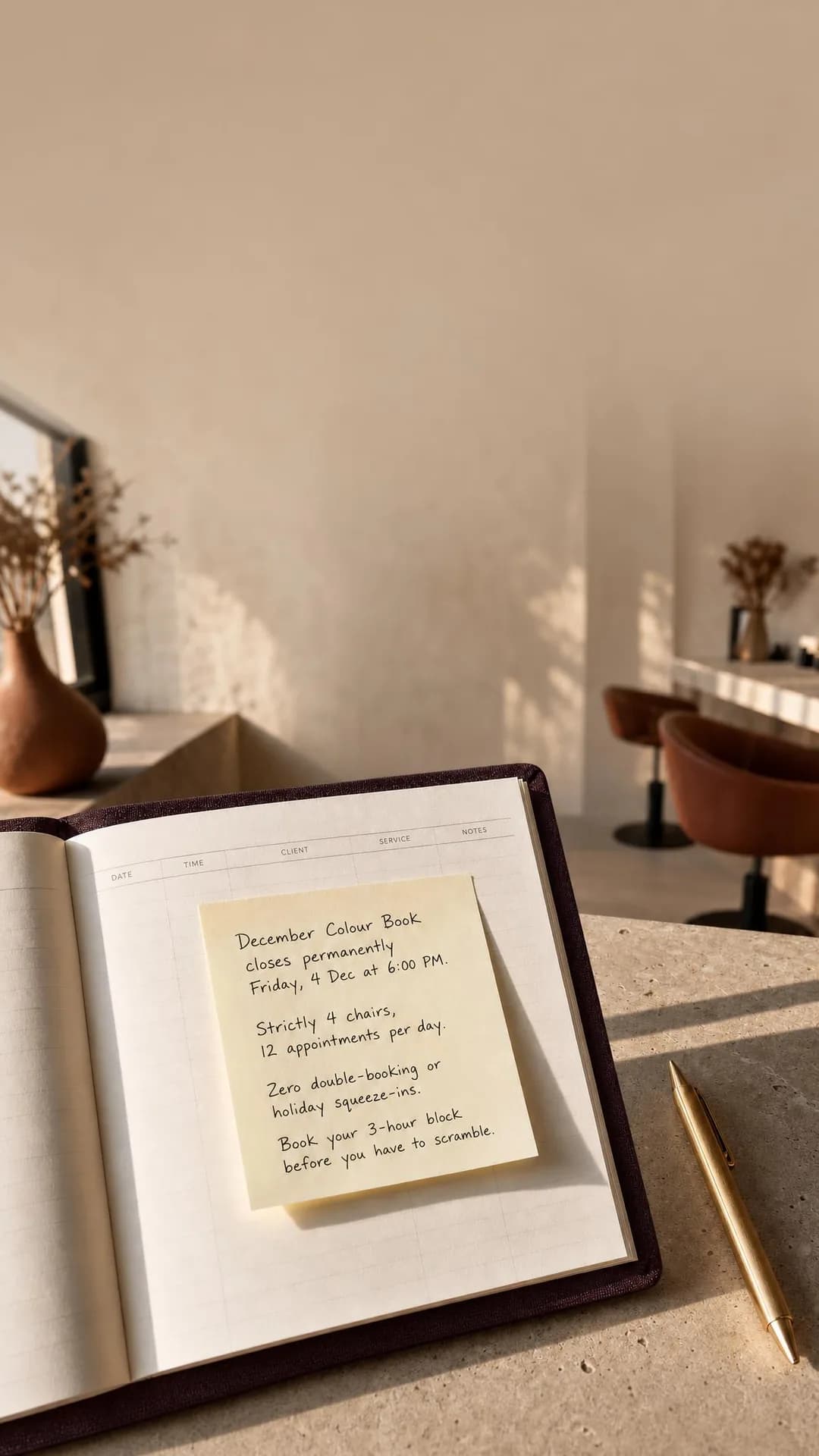
Stop spending December in an unfamiliar salon chair praying they don't over-process your hair. We operate strictly four chairs with zero double-booking, capping our studio at 12 dedicated colour blocks a day. Our holiday colour book closes permanently this Friday, 4 December at 6:00 PM. Once the ledger shuts, there are no squeeze-ins or standby lists. Secure your continuous 3-hour session now.
December Book Closes Friday at 6 PM
Cutoff: Friday, 4 Dec at 6 PM
Limited Time suits a colour book with real physical limits, and this ad reasons about them correctly. Four chairs running three-hour blocks became “Strictly 4 chairs, 12 appointments per day” — arithmetic the business summary had already done and every later step preserved. The date held too: 4 December 2026 is a Friday, and the cutoff reaches all five primary texts, the description and the handwritten note in the picture, though only four carry the full “Friday, 4 December at 6:00 PM” and the lead headline keeps the time while dropping the date.
The time itself was never briefed. “6:00 PM” came from the business summary — “The December colour book closes definitively at 6:00 PM on Friday, 4 December 2026” — and then hardened into a fact in every later step. Check the clock in a dated ad as carefully as the date, because a time that appears from nowhere is a commitment somebody has to keep at the front desk.
Three things to fix before it runs. The brief closed the book for appointments before Christmas and the summary scoped it “through 24 December”; the concept hook closed it “permanently”, and the copy repeated that, with the ledger that “locks until the new year” and “no squeeze-ins or standby lists” — a promise that will cost real bookings in the third week of December. “Stop spending December in an unfamiliar salon chair praying they don't over-process your hair” both attacks unnamed competitors and describes the reader's own hair, and another primary text invents a five-hour appointment for them. And look at the picture: the appointment book the note is stuck to has DATE, TIME, CLIENT, SERVICE and NOTES columns, all of them empty, which is an odd thing for a scarcity ad to show.
Other headlines from the same run
- Don't Settle for Leftover Salon Slots
- 4 Chairs. Zero Double-Booking.
- Only 12 Full-Colour Blocks Per Day
- Your 3-Hour Holiday Hair Sanctuary
Call to action
Traffic, straight to December availability rather than a general booking page, and turn it off the moment the book is full. This is the 9:16 on the page, and its note sits inside the bottom 35% that Meta's Stories spec asks you to keep clear of text, so re-render it higher before using it there.
Trading Shears For Gentle Hands
AwarenessLoving them means trading kitchen shears for soft, patient hands.
- Audience
- Parents who have been doing it themselves over the bathroom sink — Have taken the kitchen scissors to a fringe twice, once badly, and are waiting for a day when the shop will not be loud and full of strangers.
- Angle
- Care / Love (Identity & Emotion) — Frames the purchase as an act of care for another person, pet, family member, or community.
Put the kitchen scissors back in the drawer. You don't have to keep trimming their fringe over the bathroom sink. We open our doors at 8:00 AM, an hour before the public arrives. No salon noise, no blaring music, and no rush—just a warm lap, patient hands, and their very first curl preserved in a handmade envelope.
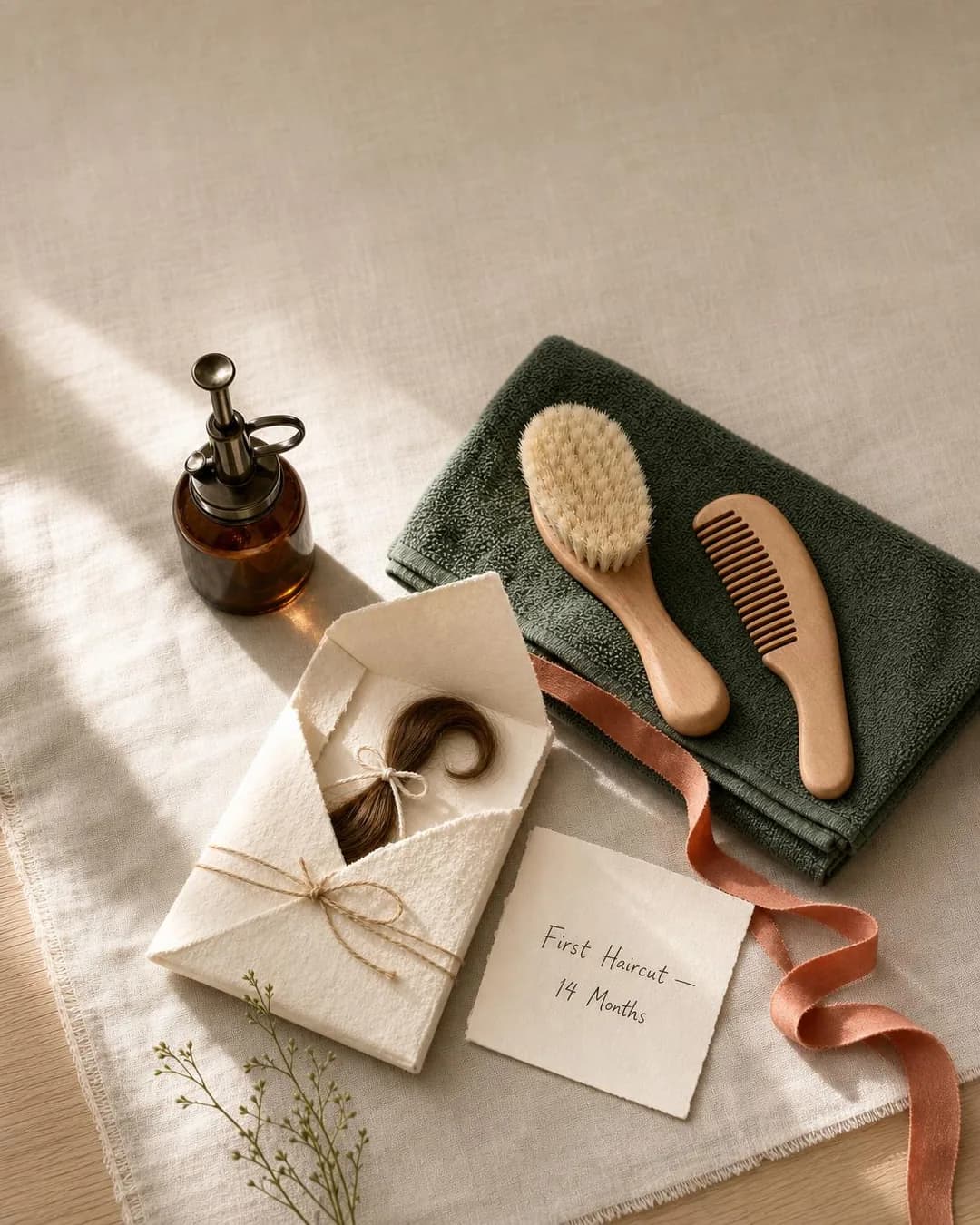
A quiet, private first haircut.
Private 8 AM sessions. $35.
Care & Love is the right family because the appointment is really a memory, and the flat-lay shows the memory rather than the child: a deckle-edge paper envelope tied with twine holding a single curl, a soft brush and comb on a folded towel, a length of ribbon, morning light. No child, no face, nothing that needs anyone's permission — which makes it the safest picture in the batch and the model for the rest of the trade.
It is also the page's thesis at its sharpest, and the easiest to miss. The subject of this ad is a person who is not the buyer, cannot consent, and whose age the ad states: the card reads “First Haircut — 14 Months”. The brief asked for a card with the date on it. The summary added the age alongside the date, the image prompt then wrote “First Haircut — 14 Months” and dropped the date, and the render only obeyed. So the one piece of content the brief actually specified is the one thing that did not survive, replaced by a detail about a child.
The copy is warm and mostly faithful — $35 held — but three things in it are nobody's to promise. “Up to 45 patient minutes” and the 8 a.m. hour both came from the summary rather than the brief, which asked only for “a quiet hour before the shop opens to the public”. “A calm, tear-free milestone” (another primary text) promises how a toddler will behave. And one line asserts the reader's own past and grades it: “You trimmed their bangs yourself last time. It was uneven.” The competitor note creeps in too — “No buzzing clippers. No blaring screens. No frantic crying in a plastic car chair” — from a summary that had already named “franchise kids' shops saturated with blinking screens, plastic distractions, and blaring noise”.
Other headlines from the same run
- No noise. No rush. Just gentle care.
- Trade kitchen shears for calm hands.
- Private 8 AM slots for toddlers.
- Keep their first curl forever.
Call to action
Awareness, aimed at parents — this is an appointment people decide on before they book it. Nothing here is a cosmetic procedure, so it needs no age floor beyond Meta's ordinary minimum. Take the child's age off the card, change “tear-free” to what you actually control — the hour, the quiet and the lap — and cut the line about the fringe they cut themselves.
The Open Ledger Note
AwarenessA personal note about that unexpected text you received this morning.
- Audience
- People whose next appointment is with somebody who no longer works there — Booked twelve weeks ago with one person, found out by text message that they had gone, and are deciding between following them across town and starting again with a stranger.
- Angle
- Letter From Founder (Story & Founder POV) — Uses a direct, personal founder message to customers or prospects.
If you woke up to a text that your stylist is moving on, take a breath. There’s zero awkwardness here. We built this salon on the belief that your hair history belongs to you, not our chairs. If you choose to follow them across town, your complete formula ledger—exact ratios, glosses, and placement notes—is waiting for you with our full blessing. And if staying in your neighborhood routine works better, we’ve prepared an unhurried, seamless bridge right here.
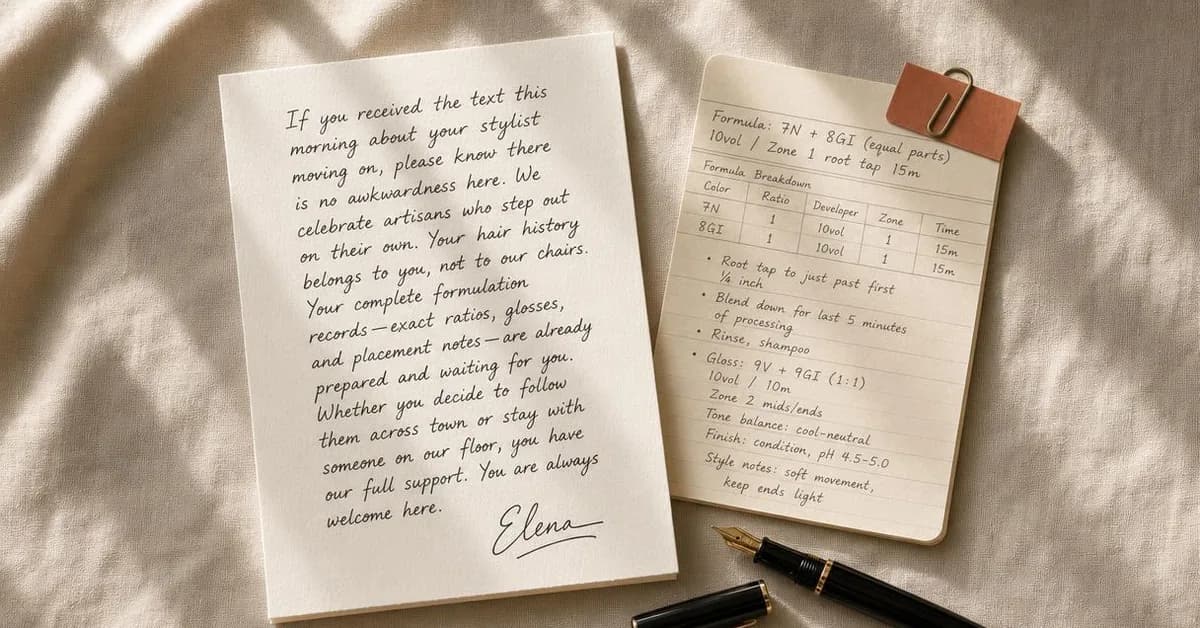
Your hair history belongs to you.
Your color history is ready.
This is the ad no salon wants to need and every salon eventually does, and the letter is close to right: “We built this salon on the belief that your hair history belongs to you, not our chairs”, followed by an offer to hand over the formula record and, if the client would rather follow, the departing stylist's new address. It answers the question the client actually woke up with.
The money is the first thing to settle, though — two primary texts offer “15% off your next two visits” and a “15% continuity courtesy”, which are two faithful renderings of one discount the business summary invented (“Continuity Courtesy: A 15% discount applied to the first two appointments with a new in-house stylist”) and the brief never contained. Decide whether it exists before the ad offers it on your behalf.
It is signed “Elena”, and that is the finding. Every step of this batch was told the business has no name and to render none, and the image prompt repeats the instruction in the same breath as it breaks the spirit of it: “a simple signature signed “Elena””, then “Absolutely no brand name, company name, logo, monogram, or digital overlay appears anywhere in the frame.” The rule covers the company. Nobody wrote one covering a person. A letter is the one format that needs a signatory, so the format supplied one — in the ad about a named individual leaving.
The formula card beside it is partly the prompt's and partly the render's. The prompt wrote one line, “Formula: 7N + 8GI (equal parts) 10vol / Zone 1 root tap 15m”; the render added a breakdown table, “Gloss: 9V + 9GI (1:1)”, “Tone balance: cool-neutral” and “Finish: condition, pH 4.5–5.0”. It looks portable at arm's length and falls apart when read — the table's columns are misaligned, “15m” appears in two adjacent cells, and the developer and time cells on the 7N row are empty. In the one ad whose whole premise is that the record is accurate enough to take across town, the record does not survive being read. Note the pair, too: two ads here were asked for a client card, and one dropped colour entirely while the other invented a formula, because neither had a real one to copy.
Other headlines from the same run
- Follow them or stay: zero drama.
- Your complete formula file is ready.
- A graceful stylist transition.
- No awkwardness. Total support.
Call to action
Awareness, to a list of the departing stylist's clients from your own booking records. It is not selling an appointment and should not be judged on one; what you are buying is the chance to say this before the client hears a version of it elsewhere. Sign it with the owner's real name and photograph a real card with the client's details removed — and if you are also running a “chair available” ad this week, keep it in a separate campaign, because that one loses most of its targeting.
Questions
- Can a salon use client photos in Facebook ads?
- Only with the client's permission, and that is a real constraint rather than a formality, because a salon's proof is always a photograph of somebody else. Meta's published standards do not address client consent; the FTC's endorsement guides do. When an ad represents that the person shown uses your service, they “must have been a bona fide user of it at the time the endorsement was given”, and an ad relating a customer's experience “will likely be interpreted as representing that the endorser's experience is representative of what consumers will generally achieve”. A generated head satisfies neither, which is why the curly-cut ad on this page is a warning rather than a template: one invented client quote came back as four. Get written permission and keep it, and shoot from behind when the client would rather not be identifiable — two of the ads here do exactly that.
- Do salon ads have to be 18+ on Facebook?
- Not for an ordinary cut or colour, on the best reading of what Meta actually publishes. Its Health and Wellness standard restricts “cosmetic products, procedures or surgeries” to 18 and over, and the list under that rule names exactly one hair item: hair restoration surgery. The exemption from the same rule names one other, “Non-permanent cosmetic and beauty products such as creams, makeup, hair products”. A haircut is in neither list, and the exemption is written about products while a salon sells a service, so the honest answer is that Meta has not addressed the trade. Treat a routine cut, colour or blow-dry as outside the restriction, where Meta's usual minimum of 13 applies, and use 18 and over for anything on the restricted list and for any before-and-after.
- Can salons use before-and-after photos in Facebook ads?
- Yes — the common belief that Meta bans them does not match the standard. The only sentence about before-and-afters in Health and Wellness is permissive: “General cosmetic products, procedures, surgeries depicting before and after transformation” appears in the list of things advertisers can run when targeting people 18 years or older. So a colour transformation is allowed and belongs in an 18+ ad set. The one before-and-after prohibition we could find first-party is specific to skin whitening and bleaching. The harder condition is not Meta's: both photographs have to be of a real client who agreed to appear, and the standard still forbids “statements of inferiority about physical appearance”, so the caption cannot run the before down to sell the after.
- What words get a salon ad rejected on Facebook?
- Start with the ones aimed at the reader. Meta's personal-attributes standard forbids asserting or implying someone's race, ethnicity, age or physical and mental health, and disallows using “you/your” to reference a personal attribute while allowing creative that describes the product or service. For a salon, hair texture is the shortest path into that rule: “your curl pattern” points at the reader, “a dry cut for curls and coils” points at the service. Physical appearance itself is handled elsewhere, by Health and Wellness, which prohibits “terms, descriptions, or questions that are negative and attack an individual's appearance, specific body parts, or hygiene” — so “Tired of your flat, lifeless hair?” is the shape to avoid. Mental health is on the first list too, which catches more salon copy than owners expect: “salon anxiety” and “post-salon panic” both appear in one ad on this page.
- Are barbershop Facebook ads different from salon ads?
- The rules are identical — nothing in Meta's standards distinguishes a barbershop from a salon — but two practical things differ. The purchase is smaller and more frequent, so an ad has to win on something other than price, which is why the barbershop ad on this page sells the length of the appointment rather than the cut. And the competitor is usually a named local shop or a walk-in chain rather than a diffuse market, which makes comparison ads riskier: that same ad's chart asserted how a rival pays its staff, a claim its own business summary invented and nobody could substantiate. Compare what you do — the booking, the consultation, the time in the chair — and leave the other shop's operations out of it.
- Can a salon take bookings straight from a Facebook ad?
- Facebook is the half of Meta where you can do it without adding a third-party scheduler. Meta documents a Book Now action button on a Page wired to its own scheduling tool, and says of the feature that “It's free: All businesses have access to Appointments on Facebook at no charge”, with confirmations, reminders and a Google Calendar sync; a third-party provider is offered as an option, not a requirement. Instagram is the reverse — its Book now button comes only from a partner list such as Booksy, Fresha, GlossGenius, StyleSeat or Vagaro, and you must already hold an account with the partner. One caution: as of the read date the Appointments setup page carries a banner reading “Certain features of Meta's Appointments tool will be going away starting mid July 2024” without saying which features, so keep your client records somewhere you control.
- How do I know if a Facebook ad actually got me a booking?
- This is the trade's real measurement problem, and it is worth facing before you spend. A salon booking usually completes on a scheduler rather than a checkout you own, so Meta can count the click and not the appointment — which is why every ad on this page is built for Traffic or Leads and none for Sales. Two things close the gap. Tag your ad links so whatever takes the booking records which campaign sent each client, and ask at the chair, because a salon is one of the few businesses that gets to talk to every customer it acquires. You need that number for anything else to work: Meta puts the learning phase exit at “about 50 results in the week after the ad set's last significant edit”, so fifty times your own cost per booking is the weekly spend at which one ad set has full information.
- Should a salon use click-to-message ads or send people to a booking page?
- A booking page if you have one, messaging if the question comes before the appointment — a colour correction, say, where nothing can be priced without seeing the hair. Click-to-message is a conversion location rather than an ad type: choose Traffic, Engagement, Leads or Sales, then pick Message destinations. One ad can offer several apps with the budget shared between them, though a Messenger destination can appear on Facebook, Instagram and WhatsApp while Instagram Direct delivers on Instagram only. Two practical limits: “conversations” is named among the optimisation goals Meta withholds when an ad set can reach under-18s, and best-in-slot publishes link ads with a destination URL, so a click-to-Messenger ad is an Ads Manager build even though every other ad on this page can be published from the product.
- Is a “stylist wanted” ad different from a normal salon ad?
- Completely, and it is the trap most likely to catch a salon, because the hiring ad runs from the same Page as everything else. An ad promoting a job is an Employment ad under Meta's Special Ad Category rules, whose own examples include “Part-time job”, “Internship” and “Apprenticeships”. Declaring the category costs you age, gender, ZIP code, exclusion targeting, lookalike audiences and saved audiences, and widens any city or pin-drop radius — which for a business whose market is a few minutes' drive is the most expensive of those losses. Whether renting a chair to a self-employed stylist counts as an employment opportunity is not something Meta's published examples address; a job ad plainly is one. Run recruitment as its own campaign, and never fold “we're hiring” into an ad that is also selling appointments.
- Which Facebook objective should a salon use?
- Traffic for most of it, pointed at the booking page — five of the ten ads here were written for it. Use Leads where the first step is genuinely not an appointment, such as a free strand test or a new-client offer you intend to follow up, and Awareness for the ads that sell the shop rather than a slot: a keepsake first haircut, a consultation card, a letter to clients whose stylist has left. Sales mostly does not apply, because the booking completes somewhere Meta cannot see. Whichever you pick, run fewer ad sets than you think: the learning-phase arithmetic above usually means one properly funded ad set beats four starved ones.
- What size should a salon Facebook ad be?
- Render 4:5 at 1440 × 1800, which is Meta's recommendation for Facebook Feed, and aim for 50 to 150 characters of primary text with a 27-character headline. Both are harder to hit than they sound — the Facebook note above has what this batch of ten actually produced against them. If you also want Stories, Meta asks for 9:16 at 1440 × 2560 with roughly the top 14%, the bottom 35% and 6% at each side kept clear of text; the 9:16 on this page breaks that rule, which is the sort of thing worth checking before you publish rather than after.
Generate Facebook ads for your own salon or barbershop
Paste your site and best-in-slot reads it — services, prices, who cuts what — and shows you the business summary it wrote before any ad is made. Read the paragraph that says what your business stands for first: on this page that is where nine of ten ads got their claims about other salons, and where the promises they could not keep were already written. Then check every picture for a face you do not have permission to use. Free to start, no card.
Every angle used above is documented in the best-in-slot ad angle library. More industries and placements are at all ad examples.