
Ad Examples · HVAC × Instagram · 10 ads
HVAC Instagram ad examples
Ten finished Instagram ads for HVAC contractors — mini-splits, dehumidification, duct sealing, thermostats and one financing ad that shows exactly what Regulation Z was written about.
The whole visible output of this trade on Instagram is a technician giving a thumbs-up beside a condenser, a snowflake-and-flame graphic with a phone number, and a carousel of tune-up coupons. Those are collected images, and a collected image cannot tell you the only things that transfer between businesses — who the ad was written for, what it argued, and what it was supposed to make happen.
So these were not collected. Every ad below was generated with the audience, the angle and the objective pinned before the run, which means the brief printed beside each one is the brief that produced it rather than a caption written afterwards about somebody else's work. The contractors are invented — a duct-sealing shop that photographs its own work through a thermal camera, a two-person outfit whose owner is on every install, a flat-price thermostat service — so no competitor's creative is borrowed and no technician's face is used.
This is the Instagram half of a pair, and the pairing is the argument. The Facebook page owns the homeowner with the five-figure replacement, the emergency call at six in the morning, and the permit conversation. This page owns the half of the trade you can photograph: a mini-split head, a linear ceiling diffuser, a thermostat still in its box, a pair of thermal images of the same attic joist two hours apart. Every offer here is under about $8,000 and most are under $2,000. That is not a taste; it is what a format with no search surface and no right-hand column selects for.
The trap in this trade does not get smaller when you change apps, and the most useful thing on this page is the ad that proves it. A replacement sold on a monthly payment is a credit advertisement whichever placement it renders on, because Meta's special ad category is declared on the campaign and Instagram is a placement inside it — and because Regulation Z attaches to what the advertisement says, not to where it ran. The financing ad below was deliberately briefed the way the trade briefs it: a monthly number and nothing else. It came back as the non-compliant shape, on purpose, and the note under it is the most important paragraph on this page.
All ten angle families appear once each, in ten different visual directions, and the objective split is four Leads, four Traffic, one Sales and one Awareness. The single Sales buy is the thermostat install, which is the one offer here that genuinely completes online at a published price — and the fact that this page has a checkout at all where the Facebook page barely does is the clearest read on what changes: the small-ticket end of the trade lives on this app.
Nine of the ten came back in one pass. The tenth failed twice at the concept stage on malformed JSON, with a different parse error each time, and came back on the third attempt from the identical brief. Nothing here was regenerated because somebody preferred a different result.
Every price is invented — $349 for a thermostat install, $1,950 for a return rebuild, $340 for a duct audit, $2,650 for a bedroom mini-split, $69 a month for a financed one. Read them as placeholders marking where a real number goes. Two ads also carry invented proof figures, and one renders an entirely fabricated customer testimonial. Each note says which, and what to put there instead.
What changes because it is Instagram
Start with reach, because for this trade it does not favour this app and saying so is more useful than pretending otherwise. Pew's November 2025 survey puts Instagram at 80% of US adults aged 18 to 29 and 62% of those 30 to 49, against Facebook's 68% and 80% — and then 40% against 74% for the 50 to 64 band, which is where a paid-off house and a fifteen-year-old furnace live. If your offer is a system replacement, the Facebook page in this pair is the one to read. What Instagram has is the newer owner and the smaller job, and one thing Facebook does not: a format that rewards showing the equipment. A furnace in a basement is not an image. A ceiling slot cut into 1920s plaster is.
Now the rule that most contractors get backwards, and it is this page's spine. The Facebook page explains that a replacement sold on a fixed monthly payment is a credit advertisement, so the campaign declares financial products and services and gives up location exclusion, ZIP and neighbourhood targeting, lookalike and saved audiences, and any radius under 15 miles or 25 kilometres. The natural response is to move the financing ad to Instagram. That does nothing. The special ad category is declared on the campaign, and Instagram Feed, Stories, Reels and Explore are placements inside that campaign — since 31 March 2020 every campaign created through the Marketing API has had to declare a value, with NONE as the answer for everybody else. So the same 15-mile floor applies, bought with a smaller slice of the homeowners you wanted. Instagram is the worse place to run a financed offer, not the way around it.
The second wall travels with the ad too, and it is not Meta's. Under Regulation Z, 12 CFR 1026.24(d)(1), four things are triggering terms in a consumer credit advertisement: the amount or percentage of any downpayment, the number of payments or period of repayment, the amount of any payment, and the amount of any finance charge. State any one and (d)(2) requires the ad to state the downpayment, the terms of repayment reflecting the obligations over the full term of the loan including any balloon payment, and the annual percentage rate, using that term. Subsection (c) adds that a stated rate of finance charge must be given as an annual percentage rate using that phrase. The category's house style — a monthly number and nothing else — states the amount of a payment and stops, and there is an ad below that does exactly that because it was briefed to. None of this changes because the render went to a 4:5 feed image instead of a 1.91:1 one.
Third, and this is where the two pages genuinely diverge in what they can do: Instagram has no surface to capture demand from. In our own publisher the 1.91:1 shape routes to Facebook's right-hand column and search results — the place a six-in-the-morning search for a dead air conditioner lands — and Instagram has no equivalent, which is why no ad in this batch is 1.91:1 and, more importantly, why there is no emergency dispatch ad here at all. Nobody opens Instagram to find a contractor while the house is at 88 degrees. Every reader on this page is mid-scroll, so every ad has to interrupt, and all ten open on an object or a moment rather than on a service name. What this app buys is being the shop a household already knows the name of in March.
Fourth, the specs, and the received wisdom is backwards here as well. Meta's ads guide recommends a headline of about 40 characters for an Instagram Feed image ad against Facebook's 27, so the app everyone treats as the wordy one gives you thirteen more characters. Primary text is about 125. The image is 4:5 at 1440 by 1800, identical to Facebook Feed so one export serves both, but the aspect-ratio tolerance is 1% here against Facebook's 3% — a crop a few pixels out of true passes there and fails here. Measured against this batch: all ten lead headlines fit 40 and not one fits Facebook's 27; 46 of the 50 headlines fit 40 and exactly one fits 27. None of the 50 primary texts fits 125, running from 257 to 537 characters. Eight of ten descriptions fit 30, in a field the feed does not show. Two ads are 9:16 for Stories and Reels.
Finally the destination, which is the one thing a page of examples cannot show you and the place a small contractor should think hardest. Lead ads can send people into a conversation on Messenger, Instagram or WhatsApp, and the instant forms and Messenger conversion location runs one campaign and lets delivery pick per person. For a two-van shop that thread is a genuine booking path and a genuine hazard: a direct message is not a dispatch system, and a household that messages your account at eleven at night has not booked anything and may believe it has. Buy the form for anything time-critical, and keep the thread for the jobs that can wait a day.
Source: Meta Marketing API — Special Ad Categories (page dated Updated: May 21, 2026; declared per campaign, required on every campaign since 31 March 2020; FINANCIAL_PRODUCTS_SERVICES audience and location restrictions) · 12 CFR 1026.24 (Regulation Z) — advertising: (a) actually available terms, (c) rate stated as an annual percentage rate, (d)(1) triggering terms and (d)(2) the additional terms they require. Read against the eCFR API, 7 September 2026 · Meta ads guide — image ad specifications, Instagram Feed (4:5 at 1440 × 1800; primary text 125, headline 40; 1% aspect-ratio tolerance; minimum width 500) · Meta ads guide — image ad specifications, Facebook Feed (headline 27, primary text 50–150, 3% tolerance) — the comparison this page measures against · Meta for Business — lead generation (lead ads can click to a conversation on Messenger, Instagram or WhatsApp; the instant forms and Messenger conversion location) · Meta Advertising Standards — privacy violations and personal attributes · Pew Research Center — Americans' social media use, November 2025
Want the campaign, not just the creative? Instagram ads for HVAC companies → is the playbook these ads came out of: which objective to buy, the offers worth running, the targeting levers this trade keeps, and the policy that decides what the copy may say.
Generate Instagram ads for your own contracting business
Paste your site and best-in-slot reads it the way these invented contractors were read — services, service area, positioning — then writes the concepts, renders the images and drafts the copy. Free to start, no card.
The May Ritual, Named
TrafficYou've moved this air conditioner four times now.
- Audience
- First-time owners of a house with no ducts upstairs — Bought a small older house in the last two years, carried the same window air conditioner in from the last three apartments, and put it back in the bedroom sash every June because nobody has told them what the alternative costs.
- Angle
- Friction / Annoyance (Problem & Pain) — Focuses on an irritating part of an existing workflow, routine, or product experience.
You've moved this air conditioner four times now. Up three flights in the last apartment, into the U-Haul, back up the stairs in this house. Every May you wrestle it into the bedroom window. Every October you pull it back out. There's a reason over 4,000 people have replaced that ritual with a single-zone mini-split that gets installed once and runs quieter than the box ever did. One afternoon, $2,650–$3,400, and your window closes again.
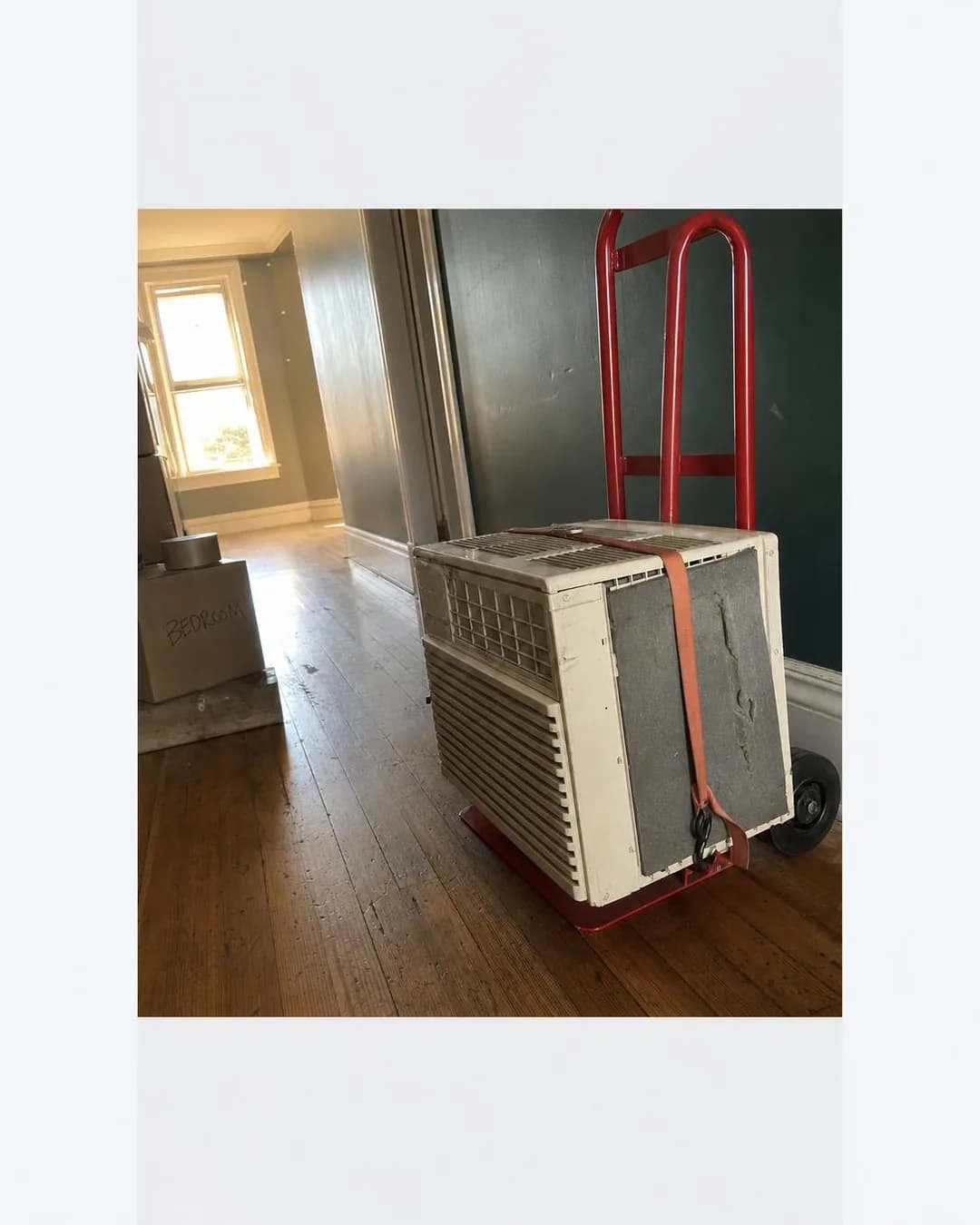
The window unit you've moved four times
Starting at $2,650. Done in a day.
Friction / Annoyance is the right family for an offer whose competitor is not another contractor but a habit, and the ad finds the specific moment rather than the general complaint. It does not argue that a mini-split is quieter or more efficient. It argues that you have carried this box up a flight of stairs every May since before you owned the house — and the picture is exactly that, the window unit strapped to a hand truck on a bare floor beside a packing box marked BEDROOM. In a trade whose ads are all equipment beauty shots, an ad about the annual chore is a sharper wedge than any specification.
This is also the ad that identifies the newer half of the market better than any targeting lever could. The reader is a first-time owner of a house with no ducts upstairs, which is a real and large segment, and the offer sized to them is one room for $2,650 rather than a system for $12,000. That is the whole reason this page exists alongside the Facebook one.
Two things before it runs, and the second one matters more than it looks. The copy carries an invented proof figure in three different phrasings — over 4,000 people, over 4,000 bedrooms, over 4,000 of these — along with an invented product name and a comparative noise claim, Quiet-9 running at library volume. Substitute your own install count or drop the tally. And one primary text ends with the line 0% financing available. That is a stated rate of finance charge in an ad that was never briefed as a financing ad, which under 12 CFR 1026.24(c) has to be expressed as an annual percentage rate using that phrase, and which is enough to make the campaign a financial products and services campaign with the radius floor that carries. The credit problem in this trade does not stay in the ad you think of as the credit ad.
And the export is the batch's one production defect. The 4:5 file is 1080 by 1350 with a near-square photograph inset in the middle of it, bars on all four sides. This is the re-frame padding defect the apparel batch found twice and the HVAC Facebook batch did not hit at all; it is back on the third batch to be checked for it, and for the third time it is a photograph that suffers it — a drawing has nothing in its margins to lose, and a photograph does. Re-crop before publishing, and check every non-square export by eye rather than trusting the pixel dimensions.
Other headlines from the same run
- One install. No more May ritual.
- Mini-splits for the one room that needs it
- Your bedroom. Quieter. Window back.
- Replace the haul-in with one clean fix
Call to action
A Traffic buy, correctly: most readers have never priced a ductless install and think it costs what a replacement costs. Send this to a page that shows one head on one wall with a price beside it. Book now only works if that page can take a survey appointment directly, because the next step here is somebody looking at the wall.
The Box Finally Opens
SalesStill on the hall table? Someone else will finish it.
- Audience
- People who already bought the thermostat and never fitted it — Own a smart thermostat that is still in its box on the hall table, opened the instructions once, found a wire colour that is not in the diagram, and have not gone back to it in four months.
- Angle
- Ease (Benefit & Outcome) — Emphasizes getting the result with less effort, complexity, or skill.
Still on the hall table? You're not alone. Over 40,000 homes had the same problem — bought the thermostat, opened the wiring diagram, stopped. $349 gets a technician to your house who does the install, places the sensors, and shows you the app. 82 minutes average. One visit. Done.

Still in the box? We'll finish it.
Installed in one 90-min visit
This is the only ad on either HVAC page whose transaction completes without anybody visiting first, and Ease is the correct family because the customer's obstacle is not money — it is that the wiring diagram did not match their wall. The offer is unusually well-chosen for this app: a $349 flat price, a two-hour window picked at checkout, and a job small enough that a person will book it from a phone at eleven at night. Almost nothing else in this trade can be sold that way.
The packaging hero earns its keep by being technically literate, which is worth pausing on. The open box contains the thermostat and exactly two wireless sensors, matching the brief. The booklet renders a real terminal legend — R for 24V power, C for common, W for heat, Y for cool, G for fan, O/B for the heat pump reversing valve — and all six are correct, in the right order, against a six-wire diagram with six matching rows. The display reads 72 with Heat 71 and Cool 74 beneath it, which is a valid deadband straddling the setpoint. Three separate consistency checks pass on one image, and the trade vocabulary is right rather than decorative.
The flaw is in the copy and it is the same fabricated-proof pattern the Facebook batch documented, with an extra wrinkle: over 40,000 homes had the same problem in one primary text and over 40,000 installs completed to date in another. The same invented number is doing two incompatible jobs — a market-size claim in one place and an operational record in the other — which is what happens when a figure is generated rather than counted. The 82 minutes average is invented too, though it at least agrees with the 75 to 90 minutes another variant quotes. Replace both with your own scheduling data or cut them; the ad's argument is the flat price and the two-hour window, and it does not need a tally.
Other headlines from the same run
- $349 installed. One visit. Done.
- Someone else handles the wiring.
- The box finally gets opened.
- Buy the visit, not the struggle.
Call to action
The one ad in this pair where the button should complete the purchase. Shop now matches a published price paid at checkout; Book now is the honest label if the money is collected at the visit instead. Do not send this to a quote form — the entire offer is that there is no quote.
The Compressor Cycle Gap
TrafficYour AC only removes moisture when it happens to be cooling.
- Audience
- Households whose house is cool and still feels damp — Keep dropping the thermostat another degree to make the living room feel dry, end up cold in July with the windows fogging at the edges, and have been told by two contractors that the system is working fine.
- Angle
- Mechanism Reveal (Product & Mechanism) — Explains why the product works differently from alternatives.
Your AC only removes moisture when it happens to be cooling. Which means a correctly sized system — the kind you just paid for — actually dries your house less, because it cycles less often. The chart below shows the gap: moisture removal flatlines the moment the compressor stops. A ducted whole-home dehumidifier runs on its own humidity setpoint, independent of the thermostat, so the house stays dry whether or not the AC is running. Installed once into your return duct. Rated capacity up to 110 pints per day.
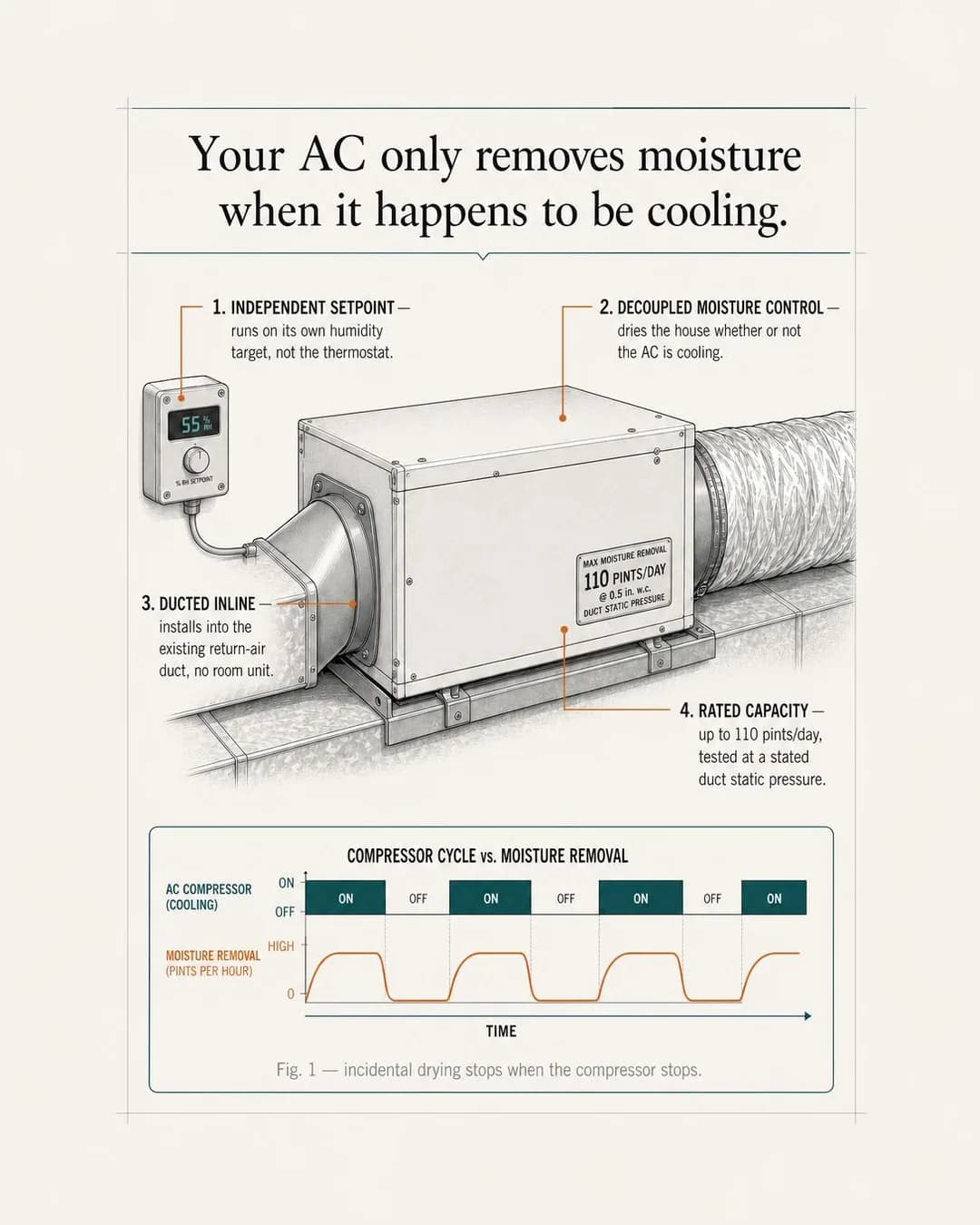
Decoupled moisture control for your HVAC
Installed by your contractor
Mechanism Reveal is the right family here because the fact underneath the offer is genuinely counterintuitive and almost never advertised: an air conditioner removes moisture only while the compressor is running, so a correctly sized system — the efficient one, the one you were told to buy — dries the house less than the oversized one it replaced. That reframes a complaint every contractor hears as a design consequence rather than a fault, and it sells a separate machine instead of a bigger one. The audience brief sharpens it further by naming the households two contractors have already told the system is working fine, which is the exact person for whom this argument lands.
The callout diagram is the most internally consistent technical render in either HVAC batch. Four numbered callouts, four drawn subjects. The nameplate on the unit reads 110 pints per day at 0.5 inches water column duct static pressure, and callout four says up to 110 pints per day tested at a stated duct static pressure — the picture agrees with its own annotation, and the pressure figure is a real way to qualify a moisture-removal rating rather than a decorative number. The controller reads 55% RH setpoint, matching callout one's claim of an independent humidity target. And the chart at the foot is correctly phased: four compressor ON blocks with the moisture-removal curve high, three OFF blocks with it flat at zero, which is the argument the headline makes drawn correctly rather than approximately.
It is also the only ad in this batch whose rendered numbers are equipment specifications rather than proof claims, and that is the difference between a figure a customer can check against a data sheet and one they cannot check at all. Confirm the capacity against the unit you actually install and the ad needs no editing. The one thing to watch is the chart's ON and OFF blocks running roughly equal width, which undercuts the copy's point that an efficient system spends more time off than on.
Other headlines from the same run
- Dries the house whether AC runs or not
- Up to 110 pints/day, ducted inline
- Independent humidity setpoint, no thermostat
- Whole-home dehumidification, installed once
Call to action
Traffic, and it is one of the few cases where the objective is not a compromise. The ad has taught a mechanism and the reader now wants to know whether it applies to their house, which is a page about measuring humidity rather than a form. Put the form at the bottom of that page and count the lead as the second click.
The Two-Hour Ceiling
LeadsSame joist, same spot, two hours apart.
- Audience
- Owners of a house with one floor that never keeps up — Have a ground floor that is comfortable and a top floor that is not, have been quoted for a bigger system twice, and would like to see evidence before they spend anything at all.
- Angle
- Before / After (Proof & Trust) — Contrasts the state before adoption with the state after adoption.
Your upstairs is hot because conditioned air is leaking into your attic before it reaches the room. Most contractors will quote you a bigger system. We seal the ducts you already have. Every job includes two thermal photos of your attic — same tripod mark, same joints, two hours apart. The second photo shows what changed. Core Seal starts at $680. Audit first if you want to see what's leaking before you decide: $340, credited if you book.
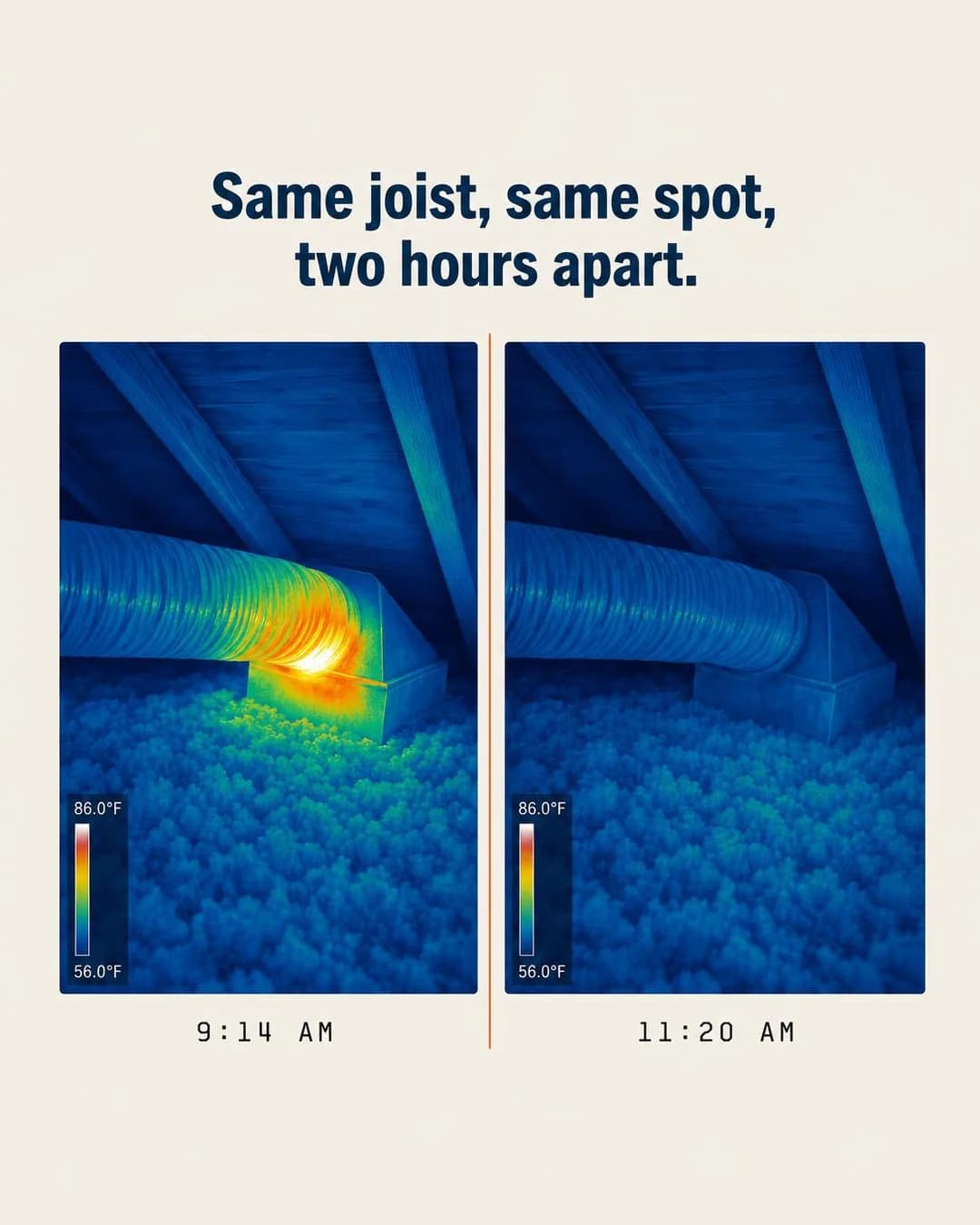
Same attic. Two hours. Proof.
Thermal proof. Fixed price.
Before / After is the most abused family in home services and this is the version that earns it, because the proof is an instrument reading rather than a flattering photograph. The offer is duct sealing, which is the cheap fix the trade routinely skips past on the way to quoting a bigger system, and the audience brief names exactly the household that has been quoted for one twice. The argument — start with a $340 audit, see the leaks, then decide — is the smallest possible first transaction in a category whose usual first ask is enormous.
The image passes the comparable-presentation test that this cluster has watched fail repeatedly, and it passes it on the one thing that actually matters for a thermal pair: both panels carry the identical scale bar, 86.0°F at the top and 56.0°F at the bottom. A before-and-after thermal image with two different scales proves nothing at all, and getting that right is not a detail — it is the whole evidentiary content of the picture. Same joist, same duct, same insulation, same framing; the orange bloom at the boot connection in the left frame is gone in the right, and a boot takeoff is where a leak genuinely is.
It also agrees with its own copy across two artifacts, which is rare. The timestamps render as 9:14 AM and 11:20 AM, two hours and six minutes apart, and one of the primary texts quotes both times exactly and calls it two hours. And the copy declines to make the claim it was most invited to make: no comfort claims, no savings estimates, just two pictures of your own ceiling. That is the same restraint the Facebook batch's comparison chart showed when it wrote projected from utility's published rates instead of inventing run costs.
The one thing to check before running it is not in the pixels. An attic at 9:14 in the morning and the same attic at 11:20 are not at the same ambient temperature, so a fixed display scale does not by itself isolate the sealing from the sun. If you sell on this proof, shoot the pair with the system running the same way in both frames and be ready to say so — the ad's whole premise is that the customer does not have to take your word for it, and that premise collapses the first time somebody asks a good question about it.
Other headlines from the same run
- Your ducts, photographed twice.
- We seal leaks. You see the proof.
- Two photos. One fixed attic.
- Same spot, before and after sealing.
Call to action
The audit is a priced, bookable, standalone job, which makes this the rare Leads ad that should point at a calendar rather than a form. If the $340 is credited against work booked later, say so on the booking screen — that is the sentence that turns an audit from a cost into a deposit.
The Two-Vent Vacuum Myth
TrafficTwo vents, twenty minutes, and a truck that never touched your return.
- Audience
- People who get the $79 duct cleaning call every spring — Have been telephoned about duct cleaning three springs running, once let a crew in and watched them run a vacuum hose into two vents for twenty minutes, and still cannot say whether it did anything.
- Angle
- Myth Busting (Comparison & Positioning) — Challenges and disproves a common belief in the category.
That duct-cleaning crew spent 20 minutes on two vents. They never touched the return box — the part of your system that actually controls what you breathe. Most dust and comfort problems trace back to a leaky, undersized return, not dirty pipes. We seal and resize the return side in a single visit: mastic-sealed plenum, 4-inch filter cabinet, before/after static-pressure reading left in your furnace. $1,950 installed. One fix, not a recurring service.
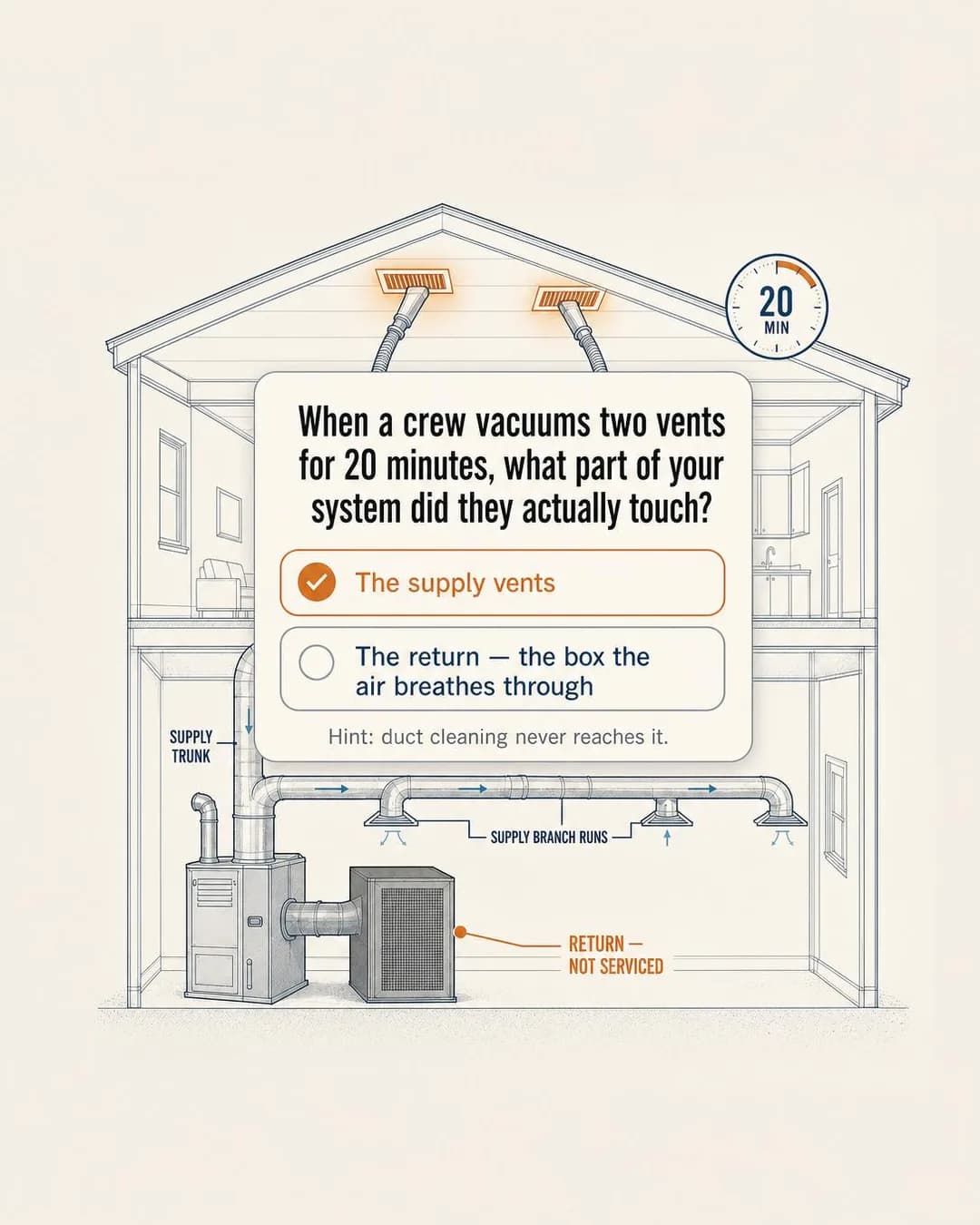
They vacuumed two vents. Not the return.
Sealed return plenum, $1,950
Myth Busting against a practice rather than against a competitor is the defensible way to run this family, and the ad picks the right target: the household in the brief has taken the seasonal duct-cleaning call three springs running and once watched a crew run a hose into two vents for twenty minutes. The counter-offer is specific and mechanical — a mastic-sealed return plenum and a four-inch filter cabinet, $1,950, one visit, with a before-and-after static pressure reading left in the furnace. Selling a measurement alongside the work is what separates this from the thing it is arguing against.
The quiz format is native to this app and the render is internally correct: two vents drawn with vacuum hoses matching the copy's two vents, a 20 MIN timer matching the twenty minutes, supply airflow arrows pointing the right way, and the return called out as the part nobody serviced. The count check passes, which is the check the gym batch's whiteboard failed.
Two things to fix. The poll pre-marks its own answer, which makes it a diagram wearing a quiz's clothes — if you want the format's engagement, leave both options open and put the answer in the caption. And the box the RETURN — NOT SERVICED callout points to is drawn with a louvred face that reads as a condensing unit, sitting indoors beside the furnace where a condenser never goes. It is probably meant as a filter grille on the return plenum, but ambiguity is expensive in a technical drawing: the reader who knows the trade sees a mistake and the reader who does not learns nothing. Redraw it as plain sheet metal with a filter slot, or crop to the furnace and the plenum alone.
Other headlines from the same run
- Duct cleaning never touches this part
- The box they didn't clean is the problem
- Your return wasn't on their checklist
- 20 minutes. Two vents. Zero return work.
Call to action
Traffic is right because the ad has to finish an explanation before it can sell anything, and the landing page has one job: show a return plenum before and after with the static pressure numbers beside it. A generic services page throws away the entire argument.
The Coldest Night, Wired For
LeadsThe night your neighbor warned you about already has a backup element installed.
- Audience
- Owners replacing a furnace who have heard heat pumps do not work in winter — Have a furnace at the end of its life, have read that a heat pump is the sensible replacement, and have also been told by a neighbour and by their last contractor that it will leave them cold in January.
- Angle
- “Will It Work for Me?” (Objection & Risk Reversal) — Proves fit across personas, use cases, circumstances, or customer types.
Your neighbor's right to worry. Most heat pumps quoted at 47°F leave you cold in January. The difference: every system we install ships with a wired electric backup element already in place. Not an upsell. Not a maybe-later. Installed, labeled, commissioned. The coldest night on record already has a plan.
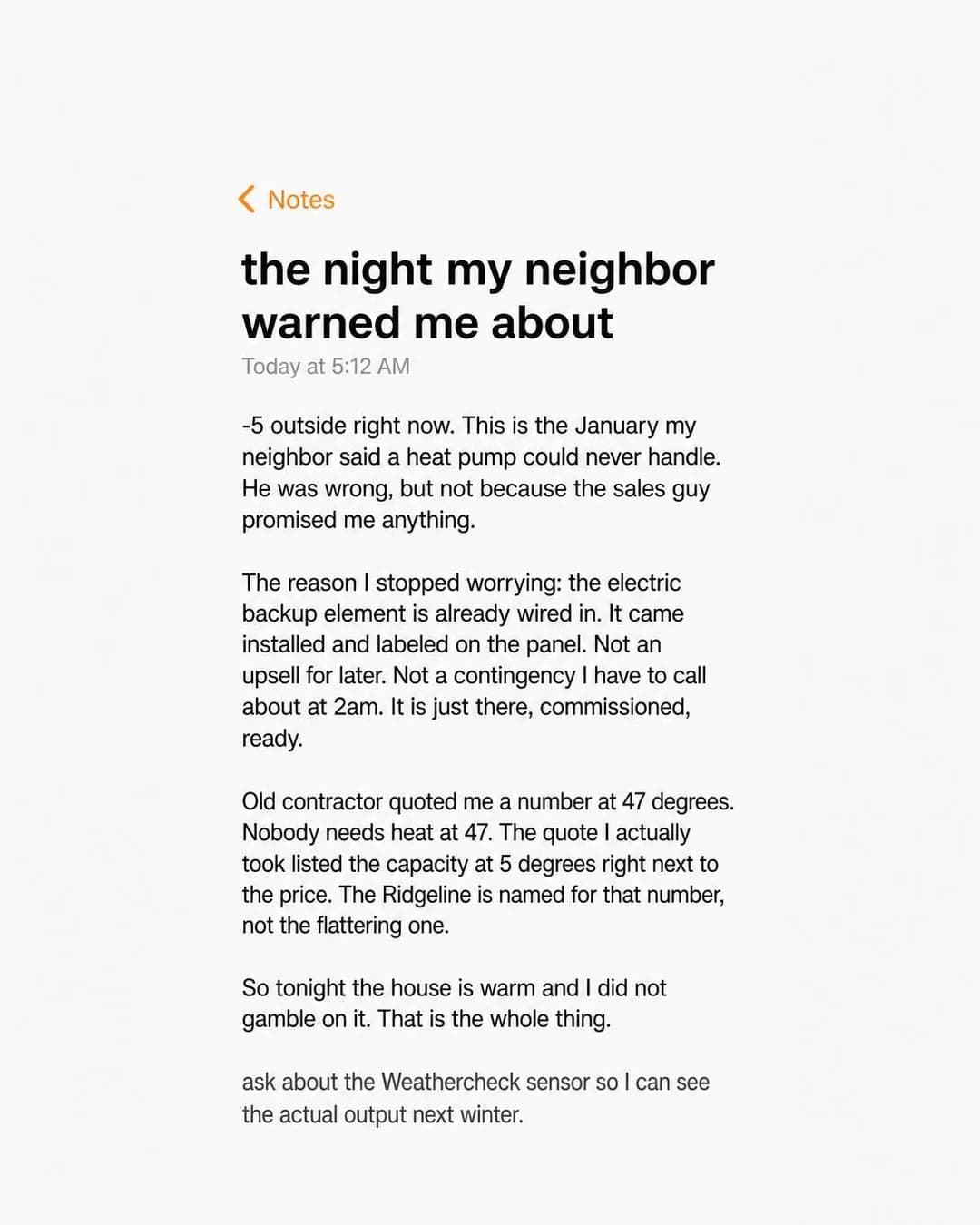
Backup element installed, not sold
Quoted at 5°F. Backup included.
The objection this ad answers is the single most common one in the trade right now and almost nobody answers it with a number. The offer does: the manufacturer's published heating capacity at 5°F written on the quote next to the price, and an electric backup element wired in whether the model needs it or not. The line that carries it — most contractors quote capacity at 47 degrees, and nobody needs heat at 47 — is a real and checkable criticism of how these systems are actually sold, which is what makes Will It Work For Me a stronger family here than any reassurance would be.
And this is the ad that found a new failure class, sibling to the Facebook batch's bicycle ad and worth as much. The brief specified an offer, an audience and an objection. It did not specify who was talking. A Notes screenshot has to have an author, and with none given the pipeline invented one: the whole image is a homeowner's private diary entry, timestamped Today at 5:12 AM, opening with minus 5 outside right now and closing with a note to ask about a sensor next winter. Two of the five primary texts are written in the same invented first person. That is a fabricated customer testimonial in the most persuasive possible wrapper — an unsolicited private note — and it is not runnable without a real customer who actually wrote it.
The rule generalises, and it is the counterpart to the one the Facebook page found. That page's lesson was to name the physical thing rather than the commercial mechanism, after a brief with no trade noun in it produced an ad for a bicycle shop. This one is: name the speaker as well as the thing. A direction that implies an author — a note, a letter, a review, a message — will invent one if the brief does not supply it, and what it invents is a person making claims on your behalf. If you want this direction, brief it in the contractor's own voice, or supply a real customer and their real words.
One thing that did go right and is worth recording, because the pipeline's own documentation flags it as a hazard: the interface chrome is generic. A back arrow and the word Notes in orange, no wordmark, no third-party interface being imitated. The dentist Instagram batch's lock screen needed the same check.
Other headlines from the same run
- Rated at 5°F, not the easy number
- The cold snap already has a plan
- Wired for the night you're afraid of
- Heat pump systems built for January
Call to action
The reader has an objection rather than a purchase, and the honest next step is a conversation with a load calculation in it. Send it to a page showing a real capacity table at 5°F for the equipment you install — the offer is that the number is on the quote, and a landing page that hides it behind a form contradicts the ad.
Cheaper Than Your Subscriptions
LeadsYou already pay more than this for apps you forgot about.
- Audience
- Owners of one unusable room and no savings for it — Have a converted attic, a garage room or a back extension that is unusable for four months of the year, and treat a four-figure quote as out of the question while spending more than that a year on things they pay for monthly.
- Angle
- Financing / Installments (Offer & Economics) — Focuses on affordability through payment structure rather than absolute price.
You're already paying $89/month for subscriptions you barely use. For $69/month, you could fix the one room in your house that's been unusable for years. No down payment, no loan application, install and service included. The room that's always freezing? Sorted.

One room fixed for $69/month
Install + service included
Read this one as evidence rather than as an ad, because it was briefed as an experiment and it returned the result. The Facebook page carries the same family and the same sub-angle, and its brief asked for the interest rate, the term and the total repayable to be printed on the advert; it produced $128 a month, 9.9% APR fixed, a 120-month term and $15,360 total repayable, and $128 times 120 is $15,360 exactly. This brief is the same offer with that clause deleted — a one-room ductless mini-split installed and offered on a fixed monthly payment, and nothing more. One variable changed.
What came back is the category's house style, rendered beautifully. A poster reading CHEAPER THAN YOUR FORGOTTEN SUBSCRIPTIONS, four struck-through lines — streaming bundle $23, gym you skip $45, food delivery plus $12, that app you forgot $9 — and then A whole room fixed, $69/mo. Under 12 CFR 1026.24(d)(1) the amount of a payment is a triggering term, and so is the amount or percentage of any downpayment, which the copy supplies for free with no down payment. Two triggering terms, and nowhere in the image or the copy is there an annual percentage rate, a number of payments, a term, or a total repayable. This is the exact shape the regulation was written about, it is on approximately every HVAC website in the country, and it is what this tool produces when the brief does not ask for the disclosure. It must not run as it stands.
The arithmetic, meanwhile, is fine: the four struck-through subscriptions sum to $89, and the lead primary text says you are already paying $89 a month for subscriptions you barely use. That is the standing finding replicating — this pipeline computes reliably and omits what it was not asked for. Which is the useful half of the result. The fix is not better copywriting; it is that whoever arranges your financing already has approved language, and this rule is why they have a compliance function. Print the rate: in a category that hides it, printing it is the ad.
One more thing to change even after the disclosure is added. The argument works by telling the reader what they spend — you are hemorrhaging money on subscriptions, you are probably spending $80-plus on things you forgot about, cheaper than the gym you skip. Meta's personal-attributes policy covers vulnerable financial status, and a question mark or a joke is not an exemption. Compare the same offer stated about the product: one room, its own system, $69 a month with the rate and term printed. Same selection, no assertion about the reader, and it is the resolution every page in this cluster has arrived at from its own direction.
Other headlines from the same run
- Less than your streaming bill
- Install included. No loan needed.
- $69/mo. That room, sorted.
- Cheaper than the gym you skip
Call to action
A financed install does not convert from an ad, so this is a lead however the button is labelled — and the landing page has to carry the same four numbers the ad should have carried, because a page that reverts to as-low-as language undoes whatever the ad fixed. Run it in its own campaign declared as financial products and services, and accept the 15-mile radius floor as the price of the offer rather than mixing it into a local ad set.
Price Doubles April 30
LeadsSame visit, $60 more, the day you stop thinking about winter.
- Audience
- People who first think about the air conditioning when it is already hot — Have not opened the vents or looked at the outdoor unit since last September, will switch the system on during the first genuinely hot weekend, and will find out then whether it still cools.
- Angle
- Early Bird (Scarcity, FOMO & Timing) — Rewards buyers who act before others.
April 30 is the last day to book your AC start-up visit for $129. May 1, same coil cleaning, same refrigerant check, same written report — $189. No membership, no upsell, just math. The date doesn't move, and neither does the $60 jump. Book before you forget.
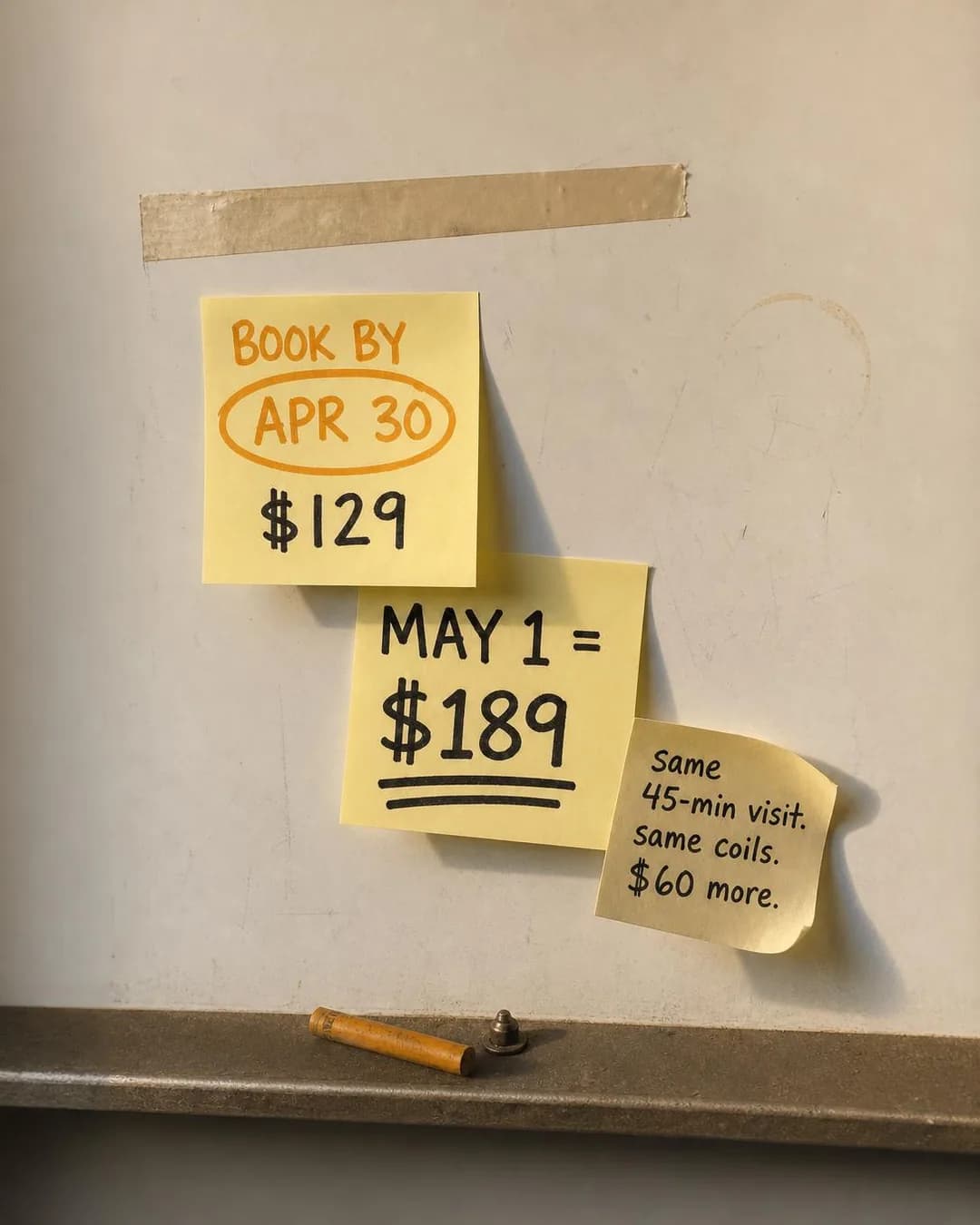
$129 ends April 30. Then it's $189.
Lock pre-season pricing now
Early Bird only works when the deadline is real, and in this trade it is: the same forty-five-minute visit in March and in the first ninety-degree week are different products, because in July it competes with several hundred households discovering their system at the same moment. The ad sells the calendar rather than a discount, which is the honest version of urgency in a category that mostly manufactures it — and it says so out loud, no membership, no upsell, just math.
The post-it photo is the cheapest image in the batch and one of the most effective, which is a useful thing to notice about this app. Three notes on a scuffed panel by a furnace: BOOK BY APR 30, $129; MAY 1 = $189; and Same 45-min visit, same coils, $60 more. Every number checks — $189 minus $129 is $60, and the forty-five minutes matches the copy. There is no fabricated statistic anywhere in it, because a post-it has nowhere to put one. That is the batch's clearest illustration of a pattern worth briefing around: where a visual direction offers a slot for proof, this pipeline fills it whether or not you asked; where the direction has no such slot, the problem does not arise.
The one drift from the brief is worth knowing rather than fixing. The brief asked for start-up visits released in March at the pre-season price, framing the scarcity as slots. The ad kept the family and moved the mechanism to a dated price increase, which renders far better — two numbers and a date beat an unverifiable count of remaining appointments — and is also more honest, since a published price change is checkable and a slot count is not. If you want the slot framing, it needs a real booking system behind it.
Other headlines from the same run
- Same visit. $60 more after April 30.
- Book now: $129. Wait: $189 + 2 weeks.
- Pre-season AC tune-up — $129 til April 30
- April 30 = last day for $129 start-up
Call to action
The only ad here that must land on a calendar with dates on it. The whole argument is a deadline, and a contact form that replies next week contradicts the ad — if live booking is not possible, put the callback window on the landing page in the same type size as the price.
The Wall You Refused to Ruin
TrafficYou stripped that wall by hand. Don't bolt a fridge to it.
- Audience
- People restoring an older house room by room — Have spent two years stripping paint off the original mouldings, are now at the point of putting cooling in, and have been shown exactly one option — a white wall unit at head height in the middle of the best wall.
- Angle
- Self-Expression (Identity & Emotion) — Positions the product as a way to express personality, taste, or individuality.

You stripped that wall by hand. Don't bolt a fridge to it. Most installers will tell you the only way to cool a heritage room is a white wall unit at head height — right where your picture rail deserves to stay intact. We route ducted cooling into the eave void and feed it through narrow ceiling slots you'll never notice. The cornice stays. The plasterwork stays. Your two years of careful restoration stays exactly as you meant it. From $7,900 for a single zone.
Cooling that respects the plaster
Concealed systems from $7,900
This is the batch's second experiment and it answers a question the Facebook page left open. That page found that briefing the offer as a thing is not sufficient protection, because the angle can put the person back: a $249 zoning damper, briefed under Identity & Emotion, rendered Stop tiptoeing down that hallway to check on her — second person, about the reader's own household, about somebody who needs looking after. So this brief keeps Identity & Emotion and moves the subject to the house: a slim ducted air handler in the eaves feeding linear slot diffusers, so a 1920s plaster cornice and picture rail survive the installation.
The result is the same grammar carrying a different kind of fact. The wall you refused to ruin. You stripped it by hand. Do not bolt a fridge to it. That is still second person and still emotional, and it is not a personal attribute — the policy is a list of attributes, race, age, health, financial status and the rest, and a renovation you chose to do is not on it. The distinction the cluster has been circling is now stated cleanly: an identity ad is dangerous when it tells the reader what they are, and workable when it tells them what they did. Same family, same intensity, and the difference is entirely in what the brief points at.
The image is genuinely handsome and the comparison inside it does not hold up. The right panel is a finished room — cornice intact, a thin ceiling slot, a brass wall control. The left panel is labelled THE DEFAULT OPTION and shows the same corner mid-restoration, paint peeling, a scraper on the sill, and an empty dashed rectangle where a wall unit would go. So the pair changes two variables at once, the equipment and the state of the plaster, which is the same comparable-presentation failure the dentist bonding ad had — and the thing the ad is actually arguing against is never drawn at all, only outlined. Put a real wall-mounted head on a finished wall in the left panel and the ad makes its point in one glance.
One drift to catch before it runs: the copy came back British-inflected. Twenty-millimetre ceiling slots, picture rails, heritage rooms, eighteen months on your knees with a scraper. The brief's own vocabulary pulled the locale, and millimetres in an American ad is a small thing that reads as a large one. Worth remembering that period-property language is regional, and the pipeline will follow it wherever it points.
Other headlines from the same run
- No box on the wall you restored
- Ducted comfort, cornice intact
- Your ceiling. Your taste. No compromise.
- The retrofit your house deserves
Call to action
Traffic, because concealed ducted retrofit is a thing most readers do not know exists and cannot price. The landing page should be photographs of finished ceilings in old houses, and the price should appear on it — an offer pitched at people restoring a house has to survive the question of what it costs, and $7,900 answers it faster than a form does.
The Truck Notebook
AwarenessShe wrote your crawlspace notes in March, still has them
- Audience
- People who have had a different technician every time — Have used a large home-services company for three years, met a different name at the door on each visit, had to explain the same crawlspace every time, and would rather deal with somebody who remembers the house.
- Angle
- Day in the Life (Story & Founder POV) — Embeds the product naturally into a founder, creator, employee, or customer’s routine.
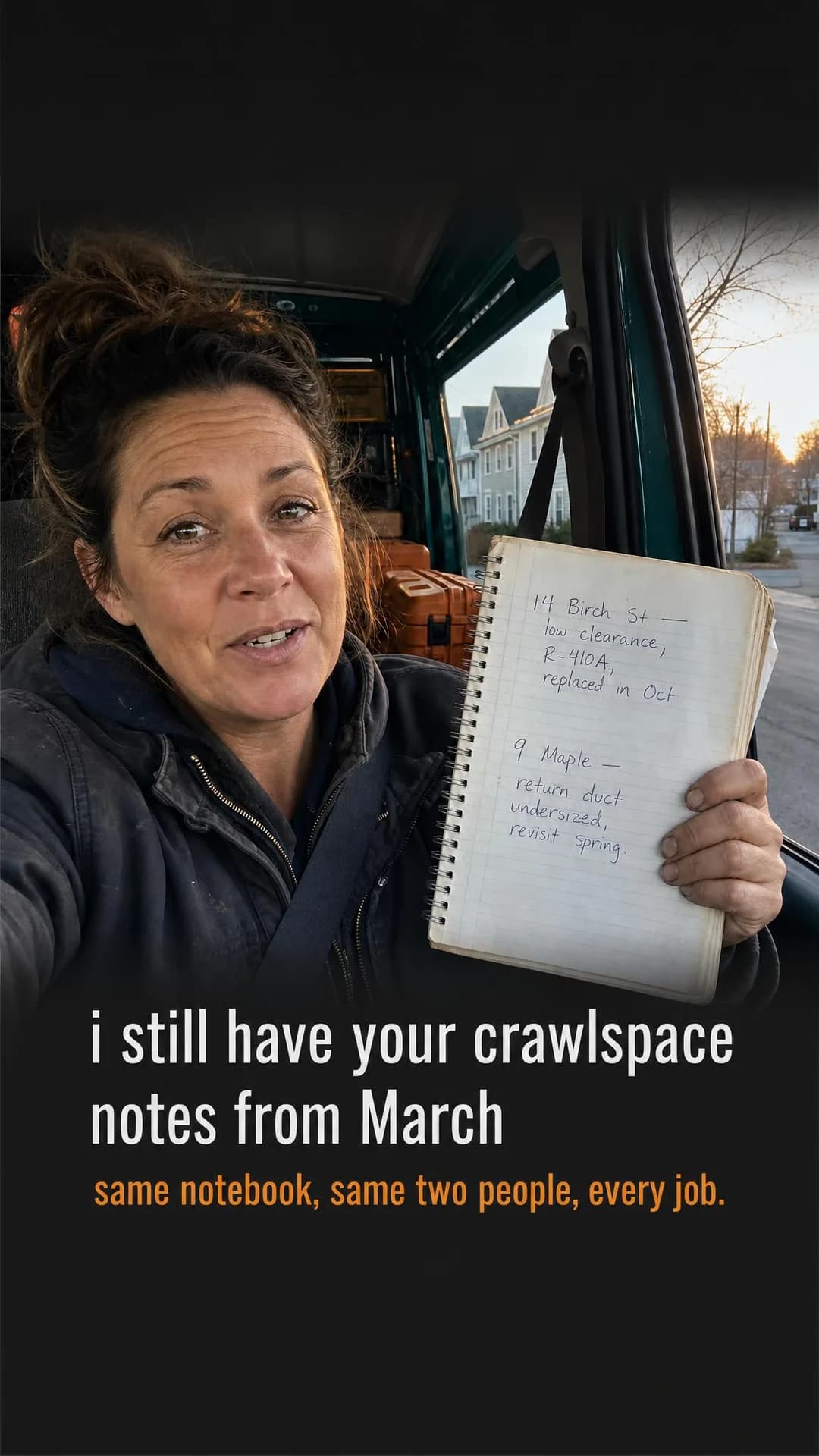
I still have the notes from your crawlspace visit in March. Same notebook, same two people, every job. No dispatch, no explaining your house twice. When you call about a noise or a follow-up, I already know which unit, what refrigerant, and where the tight spot is. Heat pumps, ductless systems, furnace replacements — installed and maintained by two licensed techs who remember what we wrote down. Free quote, $95 diagnostic credited same-day.
Same notebook. Same two techs.
Heat pumps & ductless systems
Day in the Life is the family this app was built for and the one the Facebook pair does not use, and the offer underneath it is a real differentiator rather than a mood: the same two people on every job, with the notes from your last visit still in the van. The trade's actual failure mode is a different technician every time and a customer re-explaining the same crawlspace, and a two-person shop cannot compete on price or availability with a franchise but can compete on that. Awareness is the right buy — this ad is not trying to book anything, it is trying to be the name a household remembers.
The render is the strongest execution in the batch on the thing that usually breaks: legible handwriting that survives inspection. The notebook reads 14 Birch St, low clearance, R-410A, replaced in Oct; and 9 Maple, return duct undersized, revisit spring. Both entries are the sort of thing that is actually written in a service notebook, the refrigerant designation is real and correctly formatted, and the caption below the frame — i still have your crawlspace notes from March, lowercase, in the voice of the person on camera — matches what the notebook shows. The owner is a woman on camera in her own van, which is what the brief specified and what makes the founder claim legible without a word of text asserting it.
The figures to replace are ordinary rather than dangerous: 140 homes in the notebook and 140 installs a year are invented, though they at least describe the same business consistently and are plausible for two people. Put your own number in or drop it — the ad's proof is the notebook, not the count.
Other headlines from the same run
- I wrote it down the first time.
- No crew rotation. Just continuity.
- Your crawlspace notes ride with me.
- Two people. 140 installs a year.
Call to action
The one Awareness buy, and the same defence the Facebook page's makes: a contractor's real market is the households within a drive who will eventually need somebody, and being the shop they think of first is the product. Do not judge it on leads that week. Judge it on whether the calls that arrive in November mention the notebook.
Questions
- Do Instagram ads work for HVAC companies?
- For part of the trade, yes, and it is worth being specific about which part. Pew puts Instagram at 80% of 18- to 29-year-olds and 62% of 30- to 49-year-olds, against Facebook's 68% and 80% — and 40% against 74% in the 50 to 64 band, which is where a paid-off house and an aging furnace usually are. So a system replacement belongs on the Facebook page in this pair. What this app is good for is the smaller, visible job: a one-room mini-split, a thermostat install, duct sealing you can photograph, a dehumidifier with a nameplate on it. Every offer on this page is under about $8,000 and most are under $2,000, which is the format choosing the offer.
- Can I run my financing ad on Instagram to avoid the special ad category?
- No, and this is the most expensive misunderstanding in the trade. The special ad category is declared on the campaign, not on the placement — Instagram Feed, Stories, Reels and Explore all sit inside a campaign that has already declared a value, and since 31 March 2020 every campaign made through the Marketing API has had to declare one. So a financed offer running on Instagram still loses location exclusion, ZIP and neighbourhood targeting, lookalike and saved audiences, and any radius under 15 miles or 25 kilometres, and it buys that with a smaller share of homeowners. Run financing in its own declared campaign on whichever placement performs, and keep everything else local.
- Does Regulation Z apply to an Instagram ad?
- It applies to the advertisement, and it does not know which app rendered it. Under 12 CFR 1026.24(d)(1) the amount or percentage of a downpayment, the number of payments or period of repayment, the amount of any payment, and the amount of any finance charge are triggering terms; state one and the ad must also give the downpayment, the repayment terms across the full term of the loan including any balloon payment, and the annual percentage rate using that phrase. Subsection (c) adds that a stated rate has to be expressed as an annual percentage rate. The financing ad on this page states a monthly payment and a zero downpayment and nothing else, which is why its note says it must not run as it stands. Your finance partner has approved language for exactly this.
- Why is there no emergency repair ad on this page?
- Because Instagram has nowhere to catch that demand. On Facebook the 1.91:1 shape routes to the right-hand column and search results, which is where a search for a dead air conditioner at six in the morning lands, and Instagram has no equivalent surface — which is also why nothing in this batch is 1.91:1. Nobody opens this app to find a contractor while the house is at 88 degrees. Every ad here interrupts rather than captures, which is why all ten open on an object or a moment rather than on a service name, and why what this app really buys is being the shop a household already knows in March.
- What size should an HVAC Instagram ad be?
- Render 4:5 at 1440 by 1800 — identical to Facebook Feed, so one export serves both — but hold the crop tighter, because Instagram's aspect-ratio tolerance is 1% against Facebook's 3% and a frame a few pixels out of true passes there and fails here. Headline about 40 characters, which is thirteen more than Facebook Feed allows, and primary text about 125. Reserve 9:16 for Stories and Reels; two ads here use it. And check every re-framed export by eye: one of the ten on this page came back as a near-square photograph padded inside a 4:5 canvas, which is a defect this cluster has now seen three times and always on a photograph.
- Were any of these ads regenerated or edited?
- None were edited. One was re-run: the duct-sealing ad failed twice at the concept stage on malformed JSON, with a different parse error each time, and came back on the third attempt from the identical brief. Every other ad is a single pass, published exactly as produced — including the financing ad whose note says it must not run, the Notes screenshot that turns out to be a fabricated customer testimonial, and the padded export. Naming those is the point of the page; a library of ads with the failures quietly removed would be telling you something untrue about the tool that made them.
Seen enough? Make your own.
Paste your site. It reads your services, your service area, your plan and your financing page, then writes the concepts, renders the images and drafts the copy — for the one trade in this set whose hardest rule is not Meta's.
No credit card · 50 free credits (about 5 ads or Instagram posts)
Every angle used above is documented in the best-in-slot ad angle library. More industries and placements are at all ad examples.